
Dynamic Slices
pxlq · Project 4 · Curated
Edition size: 512 · First mint: 12 December 2020
Live artwork. Move the pointer or touch to explore interactive works. Open artwork
The work and its context
Dynamic Slices turns a grid of circular fragments into a field of small, coordinated gestures. Each cell contains coloured sectors and open arcs, resembling a diagram that refuses to settle into a finished circle. The repeated arrangement makes differences easy to see: one element opens toward its neighbour while another curls inward, and variations of fill and line weight change the balance between figure and ground. The four inspected previews offer distinct versions of that relationship. 1234
The work is pxlq's December 2020 Curated project, numbered 4 on Art Blocks' second Ethereum contract. The index reports 512 invocations at the research cutoff. The brief project description emphasizes interaction, which is a defining part of the code even though the examples below are read from still previews. The pxlq dossier covers the artist's other projects. 56
Conception and development
In a February 2021 interview, pxlq traced the work to a shape drawn during a meeting and to an interest in rows of variations, naming Manfred Mohr as an example. The first satisfactory version was static. Erick Calderon suggested a dynamic component, prompting pxlq to use the real-time renderer as more than a delivery mechanism for a fixed picture. That sequence is the artist's account of development. 7
The resulting interaction is closely tied to the visual premise. A field of variations can be studied as a collection of separate shapes, but a shared control makes their differences respond together. The viewer gets to compare not only one cell with another but also one state of the entire array with the next. This is an interpretation of the inspected control logic, not a report of live interaction testing in this review. 6
The same interview stresses pxlq's pleasure in making and looking rather than an elaborate hidden meaning. Accordingly, there is no need to assign the slices a symbolic code. Their visual ambiguity is enough: they can suggest dials, bowls or orbiting fragments without depicting any of those things as a documented subject. 712
How the work was constructed
The script uses p5.js 1.0.0. It derives a numeric seed from the token hash, extracts thirty-two byte pairs and reduces each to a smaller range. Those reduced values select the palette, the relation of background to foreground, grid spacing, stroke colour and whether a second coloured slice is drawn. A separate seeded sequence supplies angles and individual colour choices within that overall setup. 56
Palette and geometry are consequently controlled at different levels. One token establishes a common chromatic world, while each cell receives its own angles and colour choice from that world's permitted options. The picture remains recognizably coherent because the cell size, spacing and palette are shared. Its local variation comes from the small arrangements made inside those common boundaries. This explains why the field can look orderly from a distance and restless when examined closely. 6
For each position, the program stores two pie-like shapes and two stroked arcs. It chooses a starting angle and related ending angles, then gives those components different sizes and stroke weights. Some branches draw only one filled slice. The open outlines are not simply the borders of the filled areas; they are separate drawing operations. Their ability to extend past a coloured sector is a major source of the work's visual tension. 6
The dynamic component is unusually economical. In each draw cycle, a value is calculated from horizontal pointer position and inverted vertical pointer position, then clamped between zero and one. That common value expands selected angular spans and adjusts an arc's start. All cells respond to the same normalized control, but their different initial angles and spans mean that they do not become identical. The viewer changes the field's state without replacing the token's underlying choices. 6
This is why “random animation” would be a poor description. The variation within the grid is seeded, and the interaction is a defined transformation of those stored parameters. Nothing in the inspected draw loop suggests that a new hash is requested when the pointer moves. The distinction matters both for understanding authorship and for documenting an output: token identity persists while the visible configuration responds. 6
A still preview is therefore a partial record. Without knowing the pointer state at capture, it cannot establish the full angular range of a token's components. The images below are useful for reading density, palette and the balance of fill against outline, but claims about movement come from code inspection and the artist interview. No local execution or browser interaction trial is implied. The p5 library dependency and the version identified by the index are recorded separately from the artist script. 5678
The mint
The live Art Blocks index, observed on 2026-09-17, records 512 invocations against a current maximum of 512. The first indexed mint is 2020-12-12T13:31:24+00:00; the second is 2020-12-12T15:08:47+00:00. Its activation field reads 2020-12-12T19:33:36+00:00, while the scheduled-start field reads 2020-12-12T15:08:47+00:00. These are different recorded events, not interchangeable definitions of launch. The current maximum is not by itself evidence of the originally announced edition. 5
The indexed completion field is 2020-12-12T20:17:48+00:00. These observations establish the platform's recorded chronology, rather than a reconstruction of every public purchase. They do not identify which mints were artist, reserved or administrative allocations. Accordingly, no precise public sellout duration is asserted here. The recorded price setting at the research cutoff is 0.05 ETH; it is a later configuration observation, not a verified opening price or proof that each recipient paid that amount. Gas, transfers and resale consideration are separate. Historical price changes and allocation classes remain questions for a transaction-level follow-up. 5
pxlq recalled expecting to sell only a small initial group and then distribute the rest gradually. The interview instead describes surprise at the response and pleasure in seeing a collector engage with the interactive work. That supports a qualitative reception history, but it supplies no exact sequence of opening-price changes or independently timed public sellout. The later activation timestamp in the index is another reason to resist reducing the release to one unqualified date-time field. 75
Copyright and licensing
The project reports the exact artwork label “NFT License”, with no linked terms, as observed on 2026-09-17. Its operative permissions and version remain unverified, so the rights category is unknown. The label is preserved rather than silently mapped to a similarly named contract or a blanket permission to reproduce the work. 5
The rendering dependency is p5.js 1.0.0; its upstream licence file contains LGPL 2.1. That dependency licence does not establish the artist script’s licence. No separate, explicit grant for the project code was found in the inspected script and project record. Artwork, artist code and library rights therefore remain separate. 568
Close reading of four outputs
The selected editions are 0, 1, 10 and 20. Their full Ethereum token IDs are 4000000, 4000001, 4000010 and 4000020 on contract 0xa7d8d9ef8d8ce8992df33d8b8cf4aebabd5bd270. They were chosen as an early-edition comparison, not as rare examples. The readings use the indexed still previews, with pointer position unknown. 1234
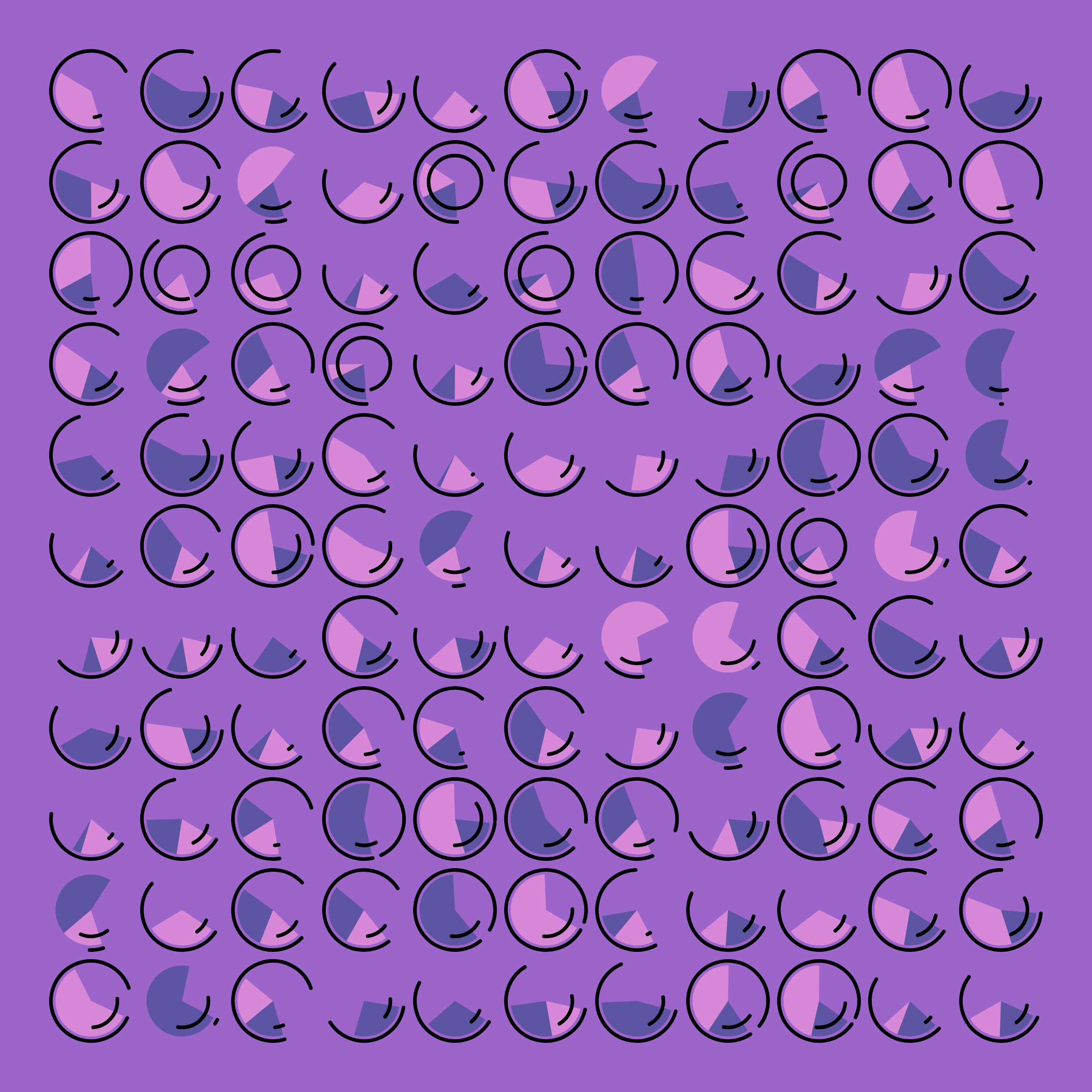
#0 combines a purple ground with pale pink and muted violet sectors, organized by dark arcs. The field looks comparatively soft because the filled colours sit close to the background in value. The outlines do most of the work of separating one gesture from another. Some cells seem to lean or twist, but their centres stay aligned in a strict array. That conflict between expressive local forms and stable global placement is the picture's principal rhythm. 1
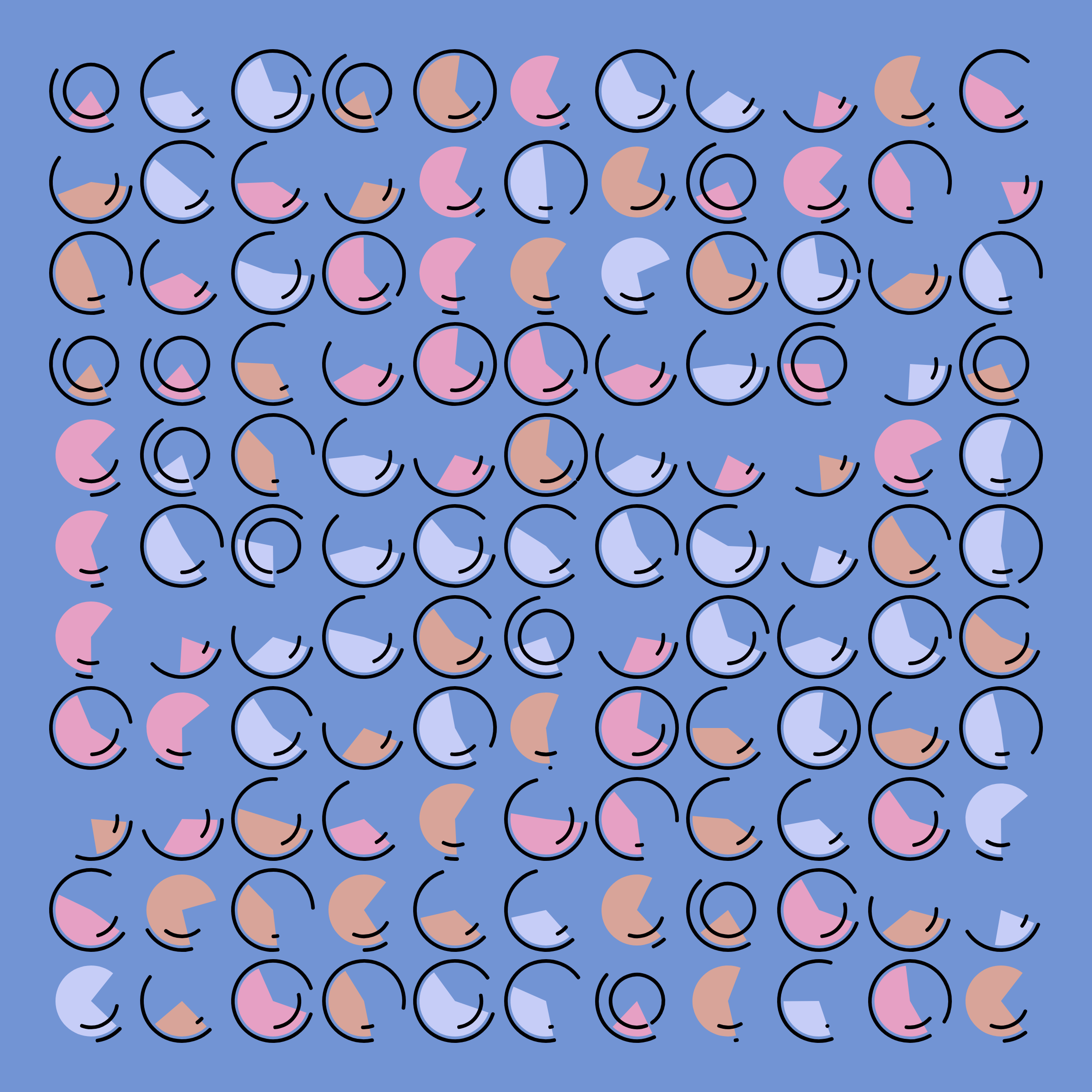
#1 places lighter sectors on a blue ground. Peach, pink and very pale blue give the cells a clearer internal contrast, while dark outlines hold the array together. Compared with #0, the negative spaces within each partial circle are easier to distinguish from its filled areas. The repeated form becomes more diagrammatic. The index calls this a Single-slice output, whereas #0 is Multi; the difference in the previews can be discussed alongside that metadata without treating the trait name as a complete description of the image. 21
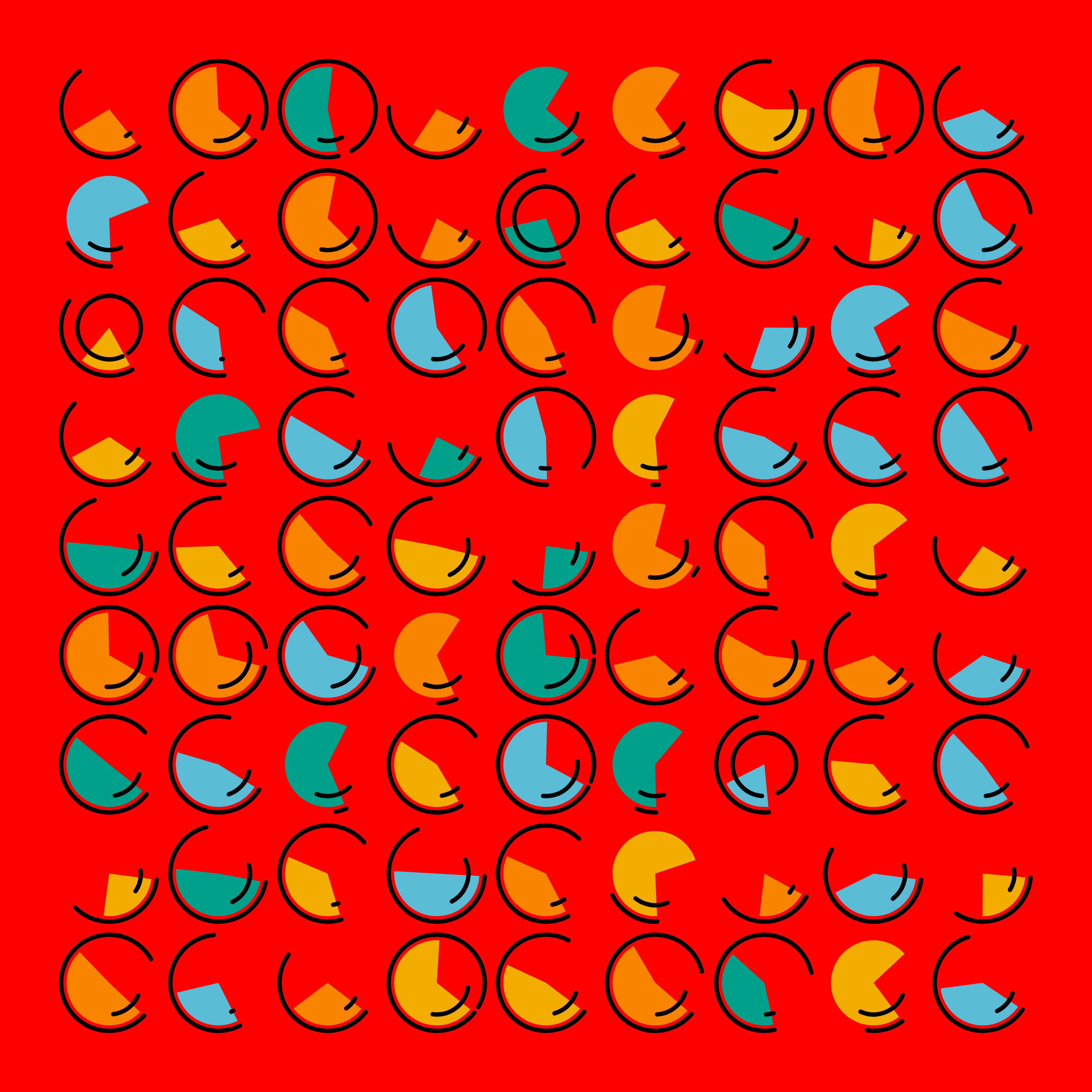
#10 is much more forceful chromatically. Red ground surrounds yellow, cyan and green sectors, making every cell conspicuous. Its comparatively larger elements give the eye fewer small events to negotiate across the same square. Dark rings and arcs prevent the saturated colours from blending into one continuous pattern. Here the grid reads almost as an assembly of individual signs, each sharply asserted against the common red field. That is a different perceptual result from #0's softer, more continuous texture. 3
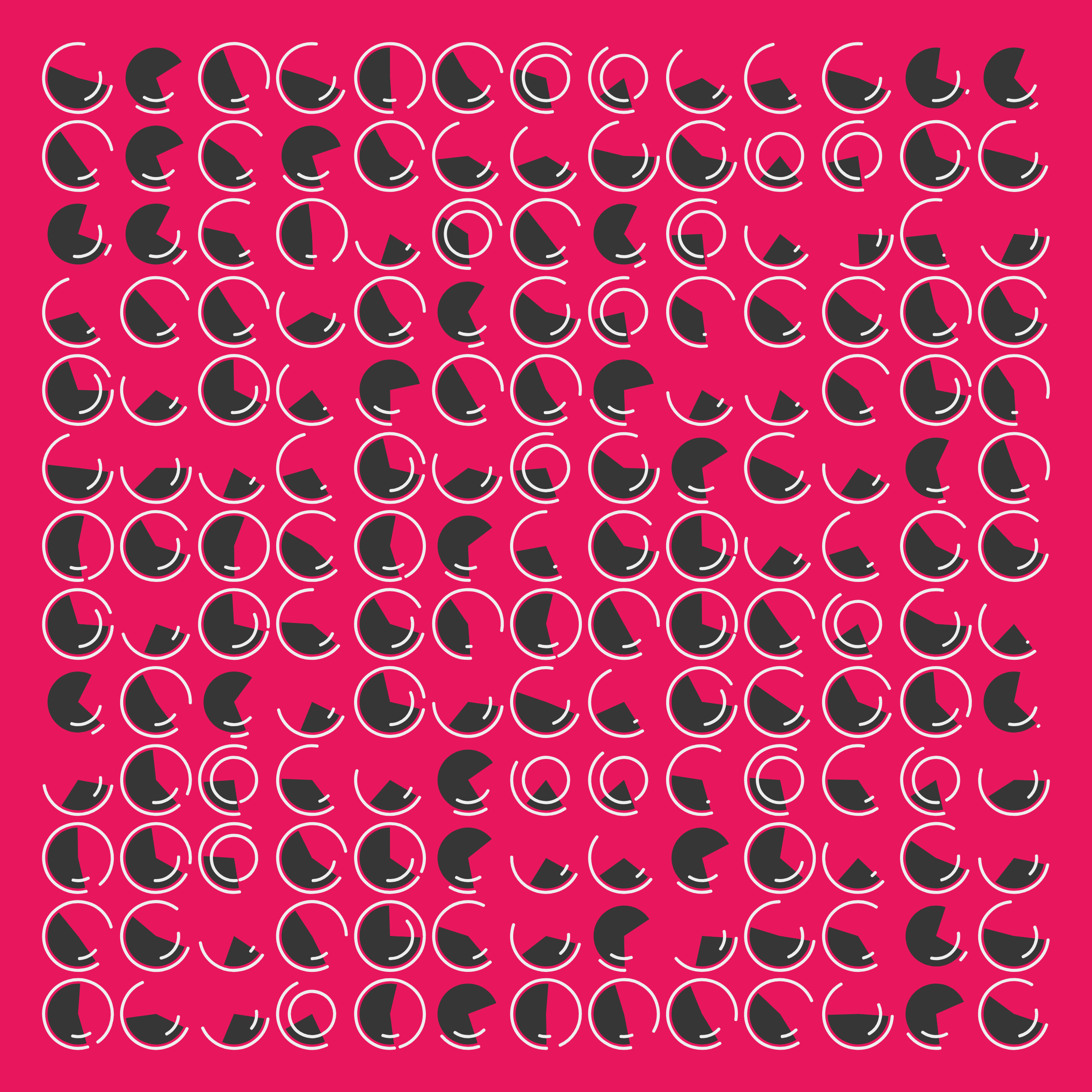
#20 uses a hot pink field, dark fills and pale strokes. The lighter arcs appear to float around the dark components, reversing the emphasis of #10, where dark outlines organize bright fills. Its denser arrangement encourages scanning across rows rather than pausing on one large element. The array becomes a woven-looking surface of recurring crescents and loops. This description concerns the visible pattern, not a claim that the program simulates weaving. 4
Together the four show that background colour is active, not merely framing. It appears inside incomplete circles and between their separate components, becoming part of every cell. Since the pointer-dependent transformation changes angular coverage, it can also change how much of that ground is exposed. The code therefore connects interaction to figure-ground balance, rather than appending movement to an otherwise finished composition. 61234
Significance and limitations
Dynamic Slices makes participation precise. The viewer is neither selecting a new output nor freely redesigning the image; a defined control moves through the possibilities of an already generated field. That modest arrangement gives an ordinary circular doodle an extended life as a system of relationships. The work is most clearly understood by keeping its two scales together: the particular behaviour of each slice and the coordinated response of the grid. 67
Unresolved research questions:
- Reconstruct opening price, original maximum and public allocation history.
- Identify the operative NFT License and separate artist-code terms.
- Capture documented pointer positions during a live-render review.
- Compare indexed code with a pinned chain retrieval.
References
-
pxlq. Dynamic Slices #0. Published 2020-12-12. Accessed 2026-09-17. ↩
-
pxlq. Dynamic Slices #1. Published 2020-12-12. Accessed 2026-09-17. ↩
-
pxlq. Dynamic Slices #10. Published 2020-12-12. Accessed 2026-09-17. ↩
-
pxlq. Dynamic Slices #20. Published 2020-12-12. Accessed 2026-09-17. ↩
-
Art Blocks. Dynamic Slices project record and Art Blocks index. Accessed 2026-09-17. ↩
-
pxlq. Dynamic Slices artist script. Accessed 2026-09-17. ↩
-
Jeff Davis / Art Blocks. In Conversation with pxlq. Published 2021-02-17. Accessed 2026-09-17. ↩
-
p5.js contributors. p5.js 1.0.0 licence. Accessed 2026-09-17. ↩
Written by GPT-6 Astra for AB5D. Original prose: CC0. Artwork and code rights are addressed separately above.
Batch usage: 5,899,866 tokens, including cached input, across the ten-essay research and drafting batch.
Token usage
5,857,292 input tokens (including 5,618,176 cached) and 42,574 output tokens. Per-essay usage was not recorded separately. Website publication and later presentation edits are excluded.
Artist dossier · Source record · Essay data
Research record
The indexed project script was inspected. Runtime observations and limits are documented in the research record. Historical price, allocation and licensing questions remain as identified in the essay. Publication does not resolve those evidence gaps.