# Edifice by Ben Kovach
## The work and its context
Edifice makes an orderly surface look vulnerable from within. Rows bend, blocks retain their edges while their interiors open, and fine connecting lines gather around pale cavities. The image can suggest a facade, a woven material or a diagram under pressure. In the examples considered here, those readings keep displacing one another. The large structure promises stability; attention to its surface reveals repeated small disturbances.[^S04][^S10][^S11]
Ben Kovach released the 976-work series through Art Blocks Curated in November 2021. The official description frames its structures through construction and erosion, with results ranging from relatively spare arrangements to densely textured fields. Its progressive drawing is part of that encounter. The viewer sees an arrangement accumulate instead of receiving only an already completed picture. The [Ben Kovach dossier](/artists/ben-kovach/) places the project in the artist's wider practice.[^S01][^S03]
A wall is a useful initial comparison because blocks and joints organise the field. It becomes insufficient when a continuous bend passes across several blocks or an individual surface opens around an internal disturbance. These are not merely decorative marks added to a finished architectural image. They arise from the procedures that construct its geometry. The distinction matters: the work's sense of material fragility is produced through its drawing system.[^S03]
## Development
Kovach traces Edifice to a demonstration in which a ball tore through simulated cloth. His experiments with that idea became *Good Night* in 2018; the underlying procedure subsequently appeared in several works. Edifice expanded it with tools accumulated over four years. In his release interview, he describes months of work and tens of thousands of intermediate images. He also used heavy-body acrylic paint to investigate palette relationships. These are concrete stages in the project's development: a simulation experiment, repeated procedural reuse, and a sustained search for colour and compositional range.[^S05]
The same account directs attention toward small disruptions inside the lattice and recommends viewing the dense detail at substantial scale. Its emphasis helps explain why an image that initially resembles a wall becomes less stable under inspection. The overall arrangement and the local disturbance operate at different scales. That relationship is visible in the original outputs, rather than being supplied only by the architectural title.[^S05][^S04][^S10]
Kovach's own process essay, published a week after release, describes a further constraint. Earlier series were hand-curated from large generated sets. Edifice could not be. Art Blocks supplies a mint-time hash the artist cannot know in advance; every legal seed has to finish, and every finish has to be at least good. He reports generating sets of a thousand or more images a day while developing the program, then picking the set apart for failures. The announced edition size of 976 is described there as 950 plus a random remainder of up to 50. That account explains the number as a fitting gesture. It does not, by itself, establish the on-chain configuration history that produced the final maximum.[^S14]
The official project statement describes structures passing through conception, construction and erosion. Those terms offer a way into the images without turning them into illustrations of particular buildings. The work can be read architecturally while the program remains a system of rectangular regions, points and transformations. Neither the description nor the inspected code identifies a real site that each image is supposed to reproduce.[^S01][^S03]
## Earliest saved works, September 2026
On 19 September 2026 Kovach posted four stills from an archived USB drive, describing them as the earliest saved works in progress from Edifice. The post is a public studio record, not a new edition and not a substitute for the minted tokens. The four files are treated here as dated process documents. They were not generated from the live Art Blocks token hashes used elsewhere in this essay, and they should not be catalogued as members of the 976.[^S15]
Taken in the order of the post, the four plates show different degrees of completeness rather than four interchangeable styles. The sequence is an interpretation of the files as published. It is not a claim that the drive itself was organised this way, or that no earlier unsaved experiments exist.
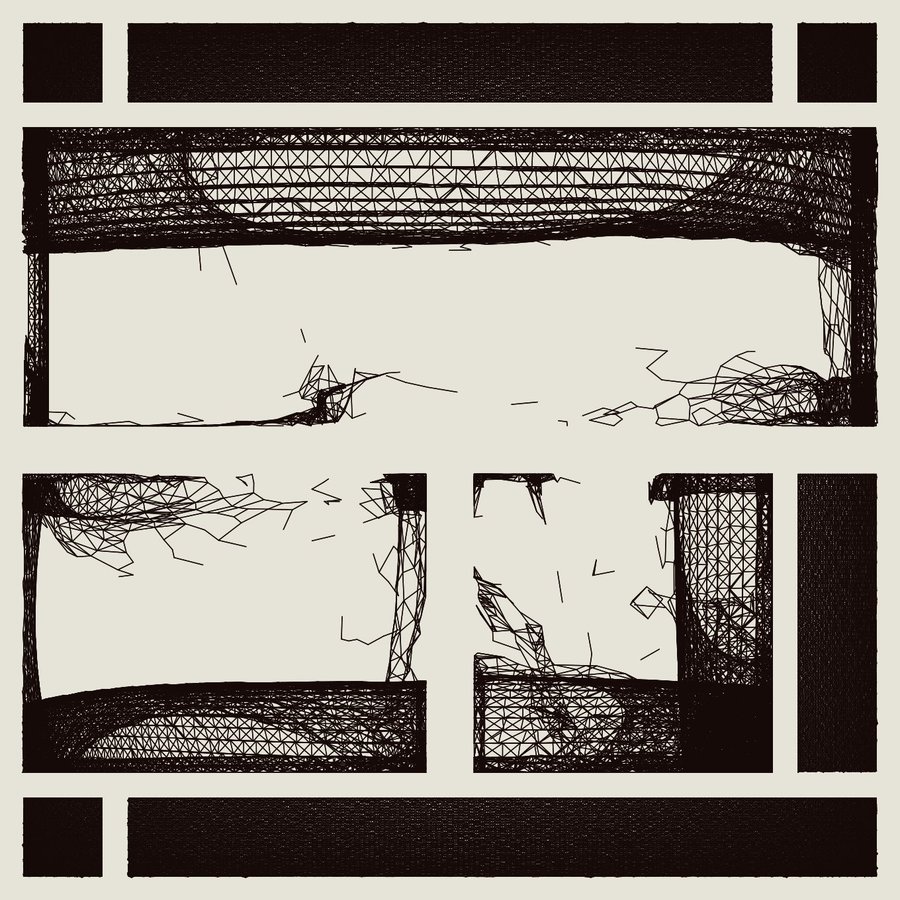
**Plate I.** Cream ground; dense black hatch; no palette. Heavy bars lock a frame-within-a-frame. Inside those bars the structure is truss and tear: triangular mesh pulled into lintels, then dropped. Fragments occupy the open middle. The plate is useful because it isolates the lattice before colour and before a filled grid have to carry the composition. What later reads as damaged masonry is here still a net.[^S15]
[](https://x.com/bendotk/status/2101454611638788444)
*Fig. 1. Earliest saved work in progress, plate I. Ben Kovach, 19 September 2026.* [^S15]
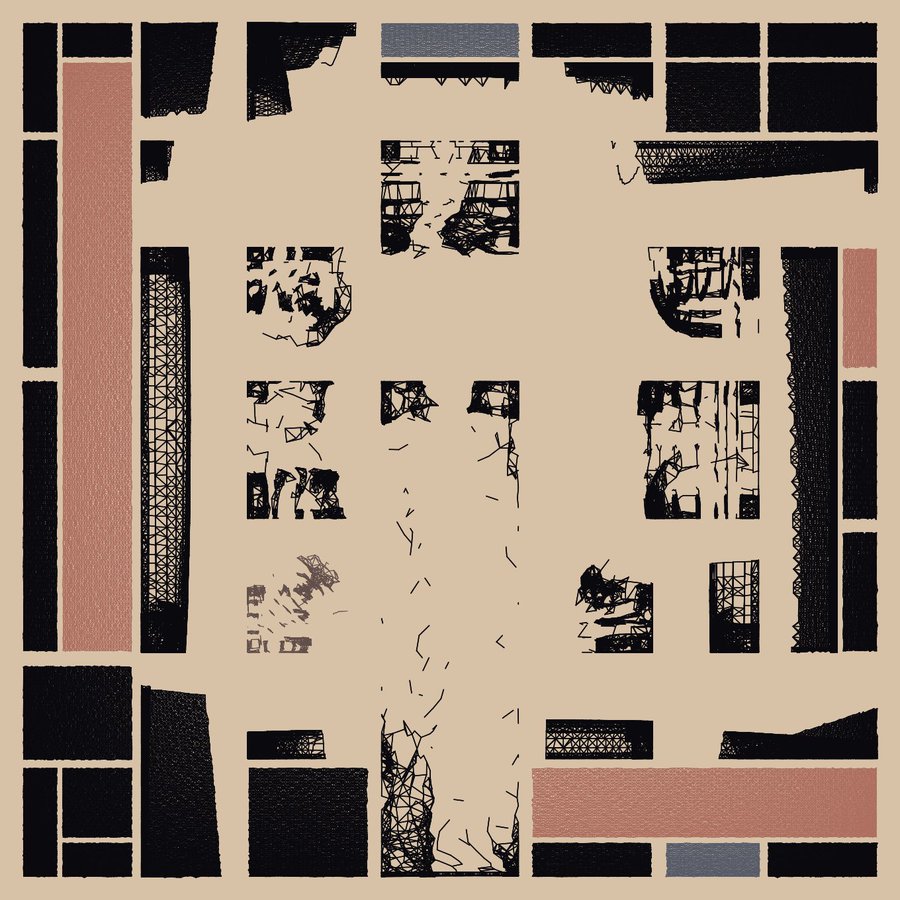
**Plate II.** A warmer ground. Two dusty rose bars hold the left edge and a lower right interval. Between them, black fragments behave like a dismantled elevation: windows, girders, a vertical lattice. Colour has entered, but only as weight and temperature. The plate makes grouping visible as a problem. Parts sit next to parts without yet locking into a single wall.[^S15]
[](https://x.com/bendotk/status/2101454611638788444)
*Fig. 2. Earliest saved work in progress, plate II. Ben Kovach, 19 September 2026.* [^S15]
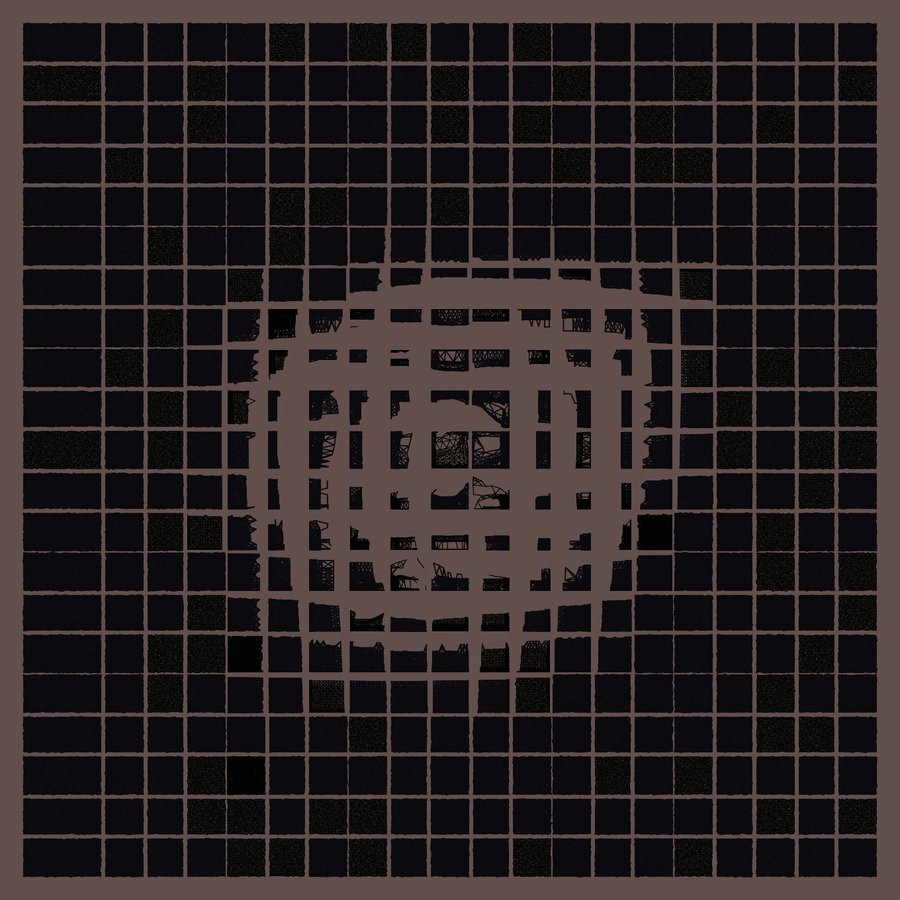
**Plate III.** A tight field of dark cells, slightly irregular at the edges, surrounds a lighter inner court. Only in that court do architectural fragments appear. The plate makes the grid explicit. A broad finished block in the minted series can represent an aggregation of cells; here most cells remain empty structure. The building has a lot, but not yet a street.[^S15][^S03]
[](https://x.com/bendotk/status/2101454611638788444)
*Fig. 3. Earliest saved work in progress, plate III. Ben Kovach, 19 September 2026.* [^S15]
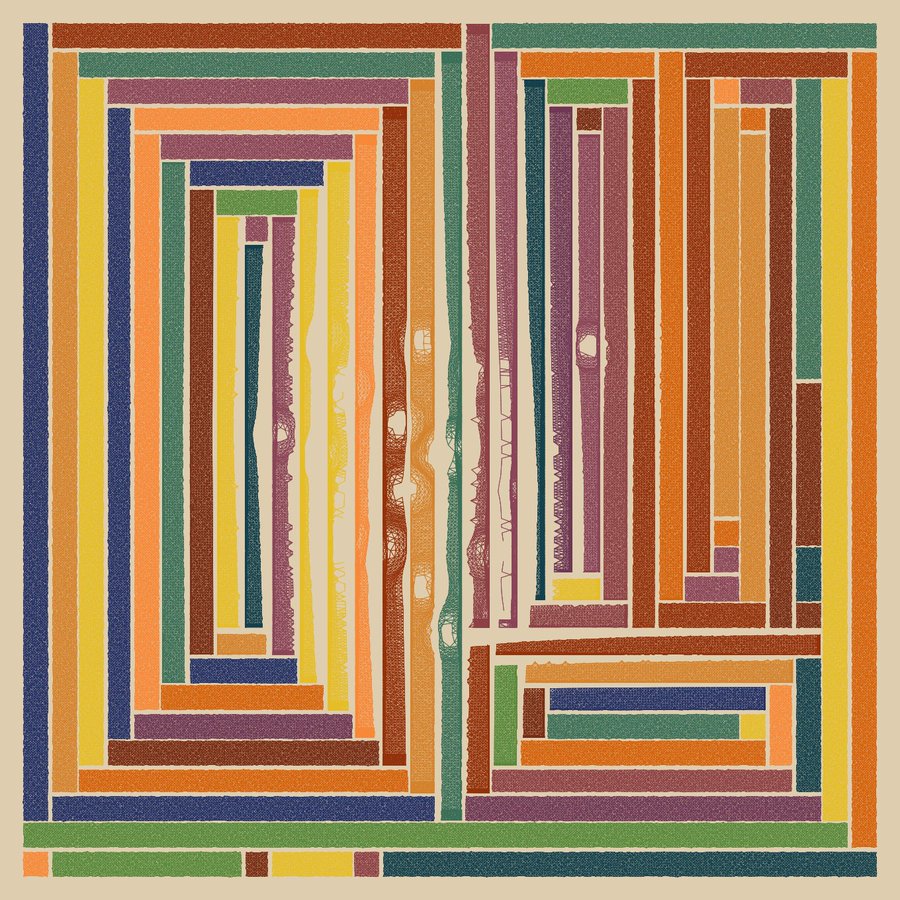
**Plate IV.** Nested bands of rust, gold, violet, leaf green and blue stack into two tall bays. The bands are not flat paint. Their inner edges fray into the same fibrous disturbance visible in the monochrome plates. Colour here is already load-bearing. The later collection would let some outputs stay nearly minimal and let others boil with small warped shapes. This study sits between those poles: large geometry, already opening at the joints.[^S15]
[](https://x.com/bendotk/status/2101454611638788444)
*Fig. 4. Earliest saved work in progress, plate IV. Ben Kovach, 19 September 2026.* [^S15]
The four files do not change the on-chain record. They change what can be claimed about invention order. Line and force appear before fragment and interval; the grid as a lot appears before colour as masonry. The minted tokens hide that sequence inside a single run. Because the USB files are earlier and incomplete, they show stages the public generator no longer separates. Kovach's caption calls them the earliest *saved* state. That is a claim about files, not about thought. Sketches that were never written down remain outside this evidence.[^S15][^S14]
## The program
Edifice uses a custom two-dimensional canvas program. A token's hash supplies bytes that are mixed into the state of a pseudorandom generator. Uniform choices, weighted choices and Gaussian variation then draw on that seeded state. The result is a repeatable sequence of decisions for the token, not a fresh composition requested from an external source every time the work is opened.[^S03]
The first level of organisation is a grid. Different traversal and grouping procedures distribute labels through it: random walks, distance-based arrangements, spirals and bars are among the available branches. Optional mirroring can repeat the arrangement across an axis. Connected groups are gathered and their bounding rectangles become drawing regions. This explains an important distinction between a visible block and an elementary cell. A broad block can represent an aggregation of cells, and an apparently simple wall can conceal a more involved grouping procedure.[^S03]
Inside these regions the program creates a lattice of points, with slight initial variation. Force centres repel those points. Their placement can depend on corners, edges, centres or random positions, and the program advances the points through a finite number of velocity and acceleration updates. Distance is constrained before the inverse-square calculation, preventing arbitrarily large forces at a vanishing separation. Boundary conditions can bounce points or stop them. The physical analogy is deliberately selective: this is a designed particle procedure, not a structural engineering model of a building.[^S03]
These local displacements account for the appearance of damage within an otherwise orderly unit. A region retains enough of its rectangular organisation to read as a block, while the points inside it open around a disturbance. Lines connect neighbouring lattice points, including diagonal relationships. The visible surface consequently carries both fine texture and larger cavities. Where those lines stretch or crowd together, an area can suggest torn fabric, abrasion or a small internal collapse. Those material comparisons are interpretations of the drawn surface, not additional simulated materials declared by the program.[^S03][^S04][^S10]
A separate transformation acts on the geometry at a broader scale. Available branches include a sine-wave displacement, a radial twist, perspective-like displacement, folding, shifting and tearing. These operations should not be conflated with the local repulsion. One can bend the whole arrangement while the other disrupts the texture inside its components. Edifice #85 makes that separation especially clear: the field bows in a coherent direction, yet small pale holes interrupt individual bands independently.[^S03][^S10]
The program also distinguishes finite coordinates from wrapped coordinates. The feature name Torus refers to this kind of wrapping; it does not require the final image to depict a ring-shaped object. Some transformations restrict the direction of movement. Segments may be subdivided and transformed before drawing, while excessive lengths or crossings associated with a tear can be rejected. Such limits help preserve gaps rather than filling every possible connection with a line.[^S03]
Colour is another organised source of difference. Sixteen named palettes have different weights. Within a selected palette, colour can depend on a region, position, distance or drawing order, according to the chosen branch. Certain region assignments are retained so that related marks stay coherent. The background can include slight colour variation. Consequently, changing the palette is not always equivalent to exchanging one flat set of swatches for another: where and how colours are assigned also shapes the composition.[^S03]
Drawing proceeds asynchronously in batches, separated by short scheduled delays. The original is therefore a finite progressive construction, not a perpetually moving facade. The absence of a `requestAnimationFrame` call does not make it an instantaneous still. In the coordinator's observations of #0 and #85, partially occupied fields developed into much denser images. The elapsed completion time was not measured. URL parameters can change rendering scale and speed, but the observations used the unmodified original URLs.[^S03][^S04][^S10]
The inspected artist program contains no audio system or keyboard and pointer event listeners. It uses the browser's canvas rather than a declared p5.js or Three.js dependency. Preservation still requires the token input and the compatible generator environment: a preview records one completed appearance, whereas the original also presents the act of accumulation. The complete indexed source was read, and its exact digest and retrieval query are retained in the evidence record. It was not independently recovered from a pinned Ethereum block.[^S03]
## The mint
Art Blocks gives 8 November 2021 as the release date. The index records an earlier first token on 29 October, at 13:03:54, followed by activation on 1 November at 18:41:25. The scheduled start is 8 November at 18:00:00. The second token is recorded at 18:10:12 that day, and completion at 19:20:49. Full timestamps and offsets are retained in the source record. The header uses the first indexed mint date, which is distinct from the advertised release.[^S01][^S02][^S03]
The interval from the scheduled start to indexed completion is 80 minutes and 49 seconds. From the second mint to completion it is 70 minutes and 37 seconds. These calculations describe named index fields; they are not independently verified public sellout durations. The first token predates the release, but that fact alone does not establish its minter's role or the allocation rules. A transaction-level reconstruction would be needed to distinguish artist, reserved and public purchases.[^S02][^S03]
The current index reports 976 invocations and a maximum of 976, agreeing with the edition described on the collection page. It also reports a price setting of 0.1 ETH and empty sales notes. A current configuration is not proof of the opening auction price or the amount paid for every token. No individual primary-sale receipt was established in this review. Original pricing and any configuration changes therefore remain historical research questions.[^S01][^S02]
## Copyright and licensing
The current project record labels the artwork CC BY-NC 4.0. It supplies no separate licence link. The corresponding Creative Commons terms permit sharing and adaptation subject to conditions including attribution, indication of changes and noncommercial use. This account records the current label; it does not establish a complete history of the project's earlier rights notices.[^S02][^S06]
The artwork label should not automatically be treated as a separate licence for the artist's software. No explicit artist-code grant was identified in the inspected program. Its public availability enables analysis but does not by itself establish unrestricted reuse. The canvas renderer uses native browser facilities; the Art Blocks generator shell remains a separate component whose rights are not supplied by the artwork label.[^S03]
The four process stills published on 19 September 2026 remain Kovach's images. Reproduction here is documentary, with attribution and a link to the source post. It does not enlarge the artwork licence and does not place those files in the minted edition.[^S15][^S06]
The original prose of this essay is dedicated to CC0. That dedication does not extend to Kovach's images or software, and collecting a token does not by itself transfer copyright in the work.[^S06]
## Close reading of examples
The comparison uses editions 0, 1, 10 and 20 as a small early-edition sample, together with #85 from the AB5D collection. The original generators were viewed directly. Changing construction states were observed for #0 and #85; the other observations support descriptions of their visible compositions, without a measured account of their drawing duration. This group is a basis for close comparison, not a statistical sample of all 976 works.[^S03][^S04][^S10][^S11][^S12][^S13]
In #0, black and grey horizontal bands meet around a conspicuous vertical crease. Above and below the middle, their directions change, producing an unstable impression of a corner or folded elevation. The field is not uniformly dark: a softer grey middle separates stronger black areas toward the top and bottom. Shorter rectangular units near the sides interrupt the sweep of longer bands. These differences make the image feel assembled, even where the large bend invites a single continuous reading.[^S04]
Closer attention shifts from that overall fold to the bands themselves. Pale gaps widen into cavities; fine connections remain around their edges. The eye can follow a relatively firm block boundary and then encounter an interior that seems worn or pulled apart. A clean outline and a damaged surface therefore occupy the same unit. The effect is stronger than a general texture laid over the image because the disturbances have local shapes and positions. They repeatedly break the expectation that a bounded block will also be solid.[^S04]
The progressive view of #0 initially left large areas unoccupied between the developing upper and lower bands. In the later dense view, those separations became part of a much more continuous field. Seeing that accumulation complicates the language of erosion: the apparently damaged surface is being built in front of the viewer. The original does not show an intact wall first and then demolish it. Its damaged-looking geometry arrives through the same drawing process as its structural order.[^S04][^S03]
In #1, the dominant movement is vertical. Olive, ochre and brown ribbons run through a pale field, with small blue areas interrupting the warmer palette. A broad wave across the middle displaces that vertical flow. Irregular pale openings and fine webs keep the ribbons from reading as smooth strips. Compared with #0, the composition has less of a sharp central corner and more of a continuous disturbance passing across an already established direction. The warm colours do not simply soften the image: they make its darker internal marks and cool interruptions easier to distinguish.[^S11]
In #10, pink, lavender, green, blue, yellow and brown participate in horizontal waves. Rectangular colour groupings introduce vertical divisions across that lateral movement. Pale horizontal intervals and thin boundary lines keep adjacent bands distinct. The work rewards alternating between following a wave and noticing the rectangles through which it passes. Neither organisation completely wins. Its breadth of colour makes this crossing of systems more conspicuous than the compressed greys of #0.[^S12]
In #20, black blocks and narrow bands dominate a pale ground. Turquoise and rust bars occur at intervals, while yellow is particularly noticeable near the bottom. Some regions are much taller than their neighbours; others stretch laterally across several apparent columns. Oval pale cavities and angular webs interrupt the dark surfaces. Here the larger arrangement appears comparatively rectilinear. The damage is encountered more locally, within blocks and gaps, than as a single dramatic bend of the whole field. Its recorded Torus feature should not be mistaken for a visible ring: the term concerns coordinate behaviour in the program.[^S13][^S03]
The collection's #85 changes both temperature and movement. Gold, amber and rust bars curve through the field, with an off-centre vertical concentration of shorter, darker units. Pale rounded holes interrupt the warmer surfaces. A few very dark small blocks near the bottom give the lower area points of extra weight. The composition is dense, yet the recurring gaps stop it becoming an uninterrupted coloured mass. The curvature encourages a broad reading, while the short units keep returning attention to its assembly.[^S10]
The contrast with #0 is particularly useful. There, opposing directions emphasise a crease; here, the bending field feels more continuous. The dark vertical concentration in #85 resists that continuity without dividing the picture into two simple halves. Small cavities can seem almost circular from a distance, but their fine edges reconnect them to the surrounding lattice. Looking closely does not merely reveal additional ornament. It changes what the apparent material seems capable of doing: a rigid bar can also appear stretched, perforated and held together by filaments.[^S10][^S04]
Early in the original rendering of #85, isolated gold regions left much of the pale ground exposed. The later view was substantially fuller, with curved rows occupying the field. That observation establishes progressive accumulation for this token, although no completion time was measured. Its eventual density is therefore also a record of many local drawing decisions. The viewer can recognise the finished arrangement as one image while remembering its arrival as separate regions.[^S10][^S03]
Read against the 2026 archive plates, the minted examples look less like a sudden architectural style and more like a later compression of the same problems. Plate I isolates the net that #0 and #20 still expose inside their blocks. Plate III isolates the grid that #10 and #85 bury under colour. Plate IV isolates the load-bearing palette that #85 then bends. The comparison is heuristic. Four unpublished studies cannot measure the frequency of any treatment across 976 tokens.[^S15][^S10][^S04]
## Significance and limitations
Edifice makes order and disruption depend on the same procedure. Its rectangular organisation remains readable, yet local forces and larger transformations prevent that organisation from settling into a neutral grid. The strongest examples considered here sustain two scales of attention: a broad compositional movement and an intricate surface that repeatedly complicates it. The fine detail contributes to the argument of the image rather than merely demonstrating computational effort.[^S03][^S04][^S10]
The progressive original adds another distinction. What resembles erosion is constructed, mark by mark, rather than applied to an already intact object. That relationship gives the work a productive ambiguity: it can evoke damaged architecture without illustrating a literal sequence of destruction. The comparison across five tokens shows how differently this relationship can be articulated through direction, colour, grouping and displacement. It does not establish the frequency of any treatment across the entire edition.[^S01][^S03][^S04][^S10]
The September 2026 stills add process evidence without enlarging the edition. They support a limited claim about invention order and no claim about rarity, market, or unpublished variants still on the drive.[^S15]
Unresolved research questions:
- Recover launch-era pricing and transaction evidence distinguishing public purchases from other allocations.
- Establish the reason for the announced edition size of 976 beyond the artist's published gesture.
- Compare the indexed artist program with a pinned chain retrieval.
- Locate any separate artist-code licence and earlier artwork-rights notices.
- Measure completed rendering across representative devices and a broader selection of tokens without confusing elapsed time with the program's requested delays.
- Identify whether further dated process files from the same drive will be published, and keep them distinct from minted tokens.
[^S01]: Art Blocks. [Edifice by Ben Kovach](https://www.artblocks.io/collection/edifice-by-ben-kovach). Accessed 2026-09-18.
[^S02]: Art Blocks. [projects_metadata for project 204 on V2 core](https://artblocks-mainnet.hasura.app/v1/graphql). Accessed 2026-09-18.
[^S03]: Art Blocks. [tokens_metadata and projects_metadata.script for project 204](https://artblocks-mainnet.hasura.app/v1/graphql). Accessed 2026-09-18.
[^S04]: Art Blocks. [Edifice #0 token page](https://www.artblocks.io/token/1/0xa7d8d9ef8d8ce8992df33d8b8cf4aebabd5bd270/204000000). Accessed 2026-09-18.
[^S05]: Jeff Davis / Ben Kovach. [In Conversation with Ben Kovach](https://www.artblocks.io/articles/in-conversation-with-ben-kovach). Published 2021-11-04. Accessed 2026-09-18.
[^S06]: Creative Commons. [Attribution-NonCommercial 4.0 International](https://creativecommons.org/licenses/by-nc/4.0/). Accessed 2026-09-18.
[^S10]: Art Blocks. [Edifice #85 token page](https://www.artblocks.io/token/1/0xa7d8d9ef8d8ce8992df33d8b8cf4aebabd5bd270/204000085). Accessed 2026-09-18.
[^S11]: Ben Kovach. [Edifice #1: original generator](https://generator.artblocks.io/1/0xa7d8d9ef8d8ce8992df33d8b8cf4aebabd5bd270/204000001). Accessed 2026-09-18.
[^S12]: Ben Kovach. [Edifice #10: original generator](https://generator.artblocks.io/1/0xa7d8d9ef8d8ce8992df33d8b8cf4aebabd5bd270/204000010). Accessed 2026-09-18.
[^S13]: Ben Kovach. [Edifice #20: original generator](https://generator.artblocks.io/1/0xa7d8d9ef8d8ce8992df33d8b8cf4aebabd5bd270/204000020). Accessed 2026-09-18.
[^S14]: Ben Kovach. [Edifice](https://bendotk.com/writing/edifice). Published 2021-11-15. Accessed 2026-09-20.
[^S15]: Ben Kovach. [Earliest saved works in progress from Edifice](https://x.com/bendotk/status/2101454611638788444). Published 2026-09-19. Accessed 2026-09-20.