Ignition
ge1doot · Project 9 · Curated
Edition size: 512 · First mint: 6 January 2021
Live artwork. Move the pointer or touch to explore interactive works. Open artwork
The work and its context
Ignition presents a floating structure made from blocks, frames, bright faces and openings. Some outputs resemble compact satellites; others expose enough empty framework to look unfinished or skeletal. Light can turn the same basic vocabulary into a brightly coloured object or a dark structure crossed by luminous beams. The selected preview stills show only one view of each object, while the code and artist account establish rotation and interaction as parts of the work. 1234567
Credited to ge1doot, Gerard Ferrandez, Ignition is Curated project 9 on Art Blocks' second Ethereum contract. The platform displays a release date of 8 January 2021 and reports 512 invocations at the research cutoff. The Gerard Ferrandez dossier covers his wider practice. This account concentrates on the relationship between rule-based construction and an object that can be manipulated in the browser. 1
Conception and development
Ferrandez's pre-release interview describes a practice of iterative programming in which unexpected results redirect the work. For Ignition, he names Context Free Art and Structure Synth as starting points for an interest in recursive grammar systems. He then developed his own JavaScript environment, storing rules as native objects rather than writing a separate parser. Those are the artist's stated technical influences, not influences inferred merely from a blocky appearance. 3
This history clarifies what “grammar” means here. A small set of instructions can call other instructions, transforming and subdividing a structure as it develops. The artist determines the available rules and their relationships; a seeded process selects among alternatives. The final object is a particular traversal through that designed system. Direct inspection of Ignition's rules supports this general account. 2
The interview also places the project at the beginning of Ferrandez's NFT involvement. His questions concerned whether the token represented code, output or both. Ignition's visible and interactive form gives that question practical force: a screenshot can show the object, but it cannot preserve the experience of turning it or changing its lighting state. 32
How the work was constructed
The project is indexed as plain JavaScript, and the retrieved script contains its own geometry, transformation and rendering routines. It obtains a WebGL context from a browser canvas, compiles vertex and fragment shaders, creates buffers and sends triangles to the graphics processor. There is no p5.js or Three.js import in the inspected source. This supports the specific claim of no separately loaded creative-coding library, while still acknowledging dependence on browser and graphics capabilities. 12
A seed derived from the token hash drives a repeatable pseudo-random sequence. Before building the main object, the script selects several broad conditions, including lighting mode, colour behaviour, spacing and a geometric alternative. Those choices set the environment in which the recursive construction develops. The result is not an arbitrary new object on every animation frame; its generated structure and its continuing display behaviour are different stages. 2
The named rules include start, WHOLE, QUAD, COOLER, CUBE and FRAME. WHOLE distributes calls across positions in three dimensions. QUAD selects among weighted alternatives: it can create a frame, a cooler-like element, a cube, another smaller whole, or nothing. That empty alternative is significant. The object gets its character not only from where material is added but also from where the rule system leaves space. 2
Transformations accumulate through translation, scale and rotation. A minimum-size check and a depth limit constrain further development. The rules are therefore recursive but bounded. The code can make an object seem intricate without requiring an endless geometric process. Its later conversion into triangle buffers gives the browser a concrete collection of surfaces to draw. The relation between a compact generative description and a larger visible structure is central to the work's construction. 2
The rendering routines calculate normals and apply lighting in shaders. A time-related grain term adds surface variation. The rotation is updated through camera or view transformations and pointer-derived motion, not through a physically validated gravitational simulation. The project description's language of self-gravitation is best retained as artistic framing rather than translated into a technical claim about celestial mechanics. 12
Pointer handling includes dragging, wheel input and two-pointer distance changes. The artist describes throwing the object into continued rotation, holding a click to toggle the beams and using a wheel or pinch to zoom. The inspected script supports persistent motion and lighting controls, but this draft did not perform a live interaction trial. Exact input timing and the appearance at a given frame therefore remain outside the claims of the still-image readings. 23
The artist's interview includes a tentative claim of historical priority for this type of fully on-chain interactive WebGL NFT. This essay does not adopt it as established fact. Its distinctive construction can be explained directly without settling a broader priority dispute. Similarly, retrieving the script through Art Blocks' index is meaningful code inspection, but is not an independent historical chain verification. 23
The mint
The live Art Blocks index, observed on 2026-09-17, records 512 invocations against a current maximum of 512. The first indexed mint is 2021-01-06T20:54:47+00:00; the second is 2021-01-08T18:08:41+00:00. Its activation field reads 2021-01-07T18:36:07+00:00, while the scheduled-start field reads 2021-01-08T18:08:41+00:00. These are different recorded events, not interchangeable definitions of launch. The current maximum is not by itself evidence of the originally announced edition. 1
The indexed completion field is 2021-01-08T18:17:08+00:00. These observations establish the platform's recorded chronology, rather than a reconstruction of every public purchase. They do not identify which mints were artist, reserved or administrative allocations. Accordingly, no precise public sellout duration is asserted here. The recorded price setting at the research cutoff is 0.15 ETH; it is a later configuration observation, not a verified opening price or proof that each recipient paid that amount. Gas, transfers and resale consideration are separate. Historical price changes and allocation classes remain questions for a transaction-level follow-up. 1
The displayed 8 January release and the first indexed mint on 6 January are compatible with an earlier initial token, but its allocation role must be verified rather than guessed. The interview itself is dated 6 January and presents the project as upcoming. The second indexed mint occurs on 8 January, followed by the completion field later that day. This is a useful release sequence, yet it still does not justify an exact public-sellout claim without classifying the intervening transactions. 13
Copyright and licensing
The project reports the exact artwork label “NIFTY License”, with no linked terms, as observed on 2026-09-17. Its operative permissions and version remain unverified, so the rights category is unknown. The label is preserved rather than silently mapped to a similarly named contract or a blanket permission to reproduce the work. 1
No separate project-code licence was found in the inspected script and metadata. Public visibility of code is not a reuse grant. The browser rendering environment and any incorporated third-party code must be considered separately from the token and its artwork. 12
Close reading of four outputs
Editions 0, 1, 10 and 20 were selected as an early-edition comparison. They are Ethereum token IDs 9000000, 9000001, 9000010 and 9000020 on 0xa7d8d9ef8d8ce8992df33d8b8cf4aebabd5bd270. Each reading concerns the indexed still preview. Camera orientation, animation time and interaction history at capture are not independently known, so differences of viewpoint are not automatically attributed to differences of generated geometry. 4567
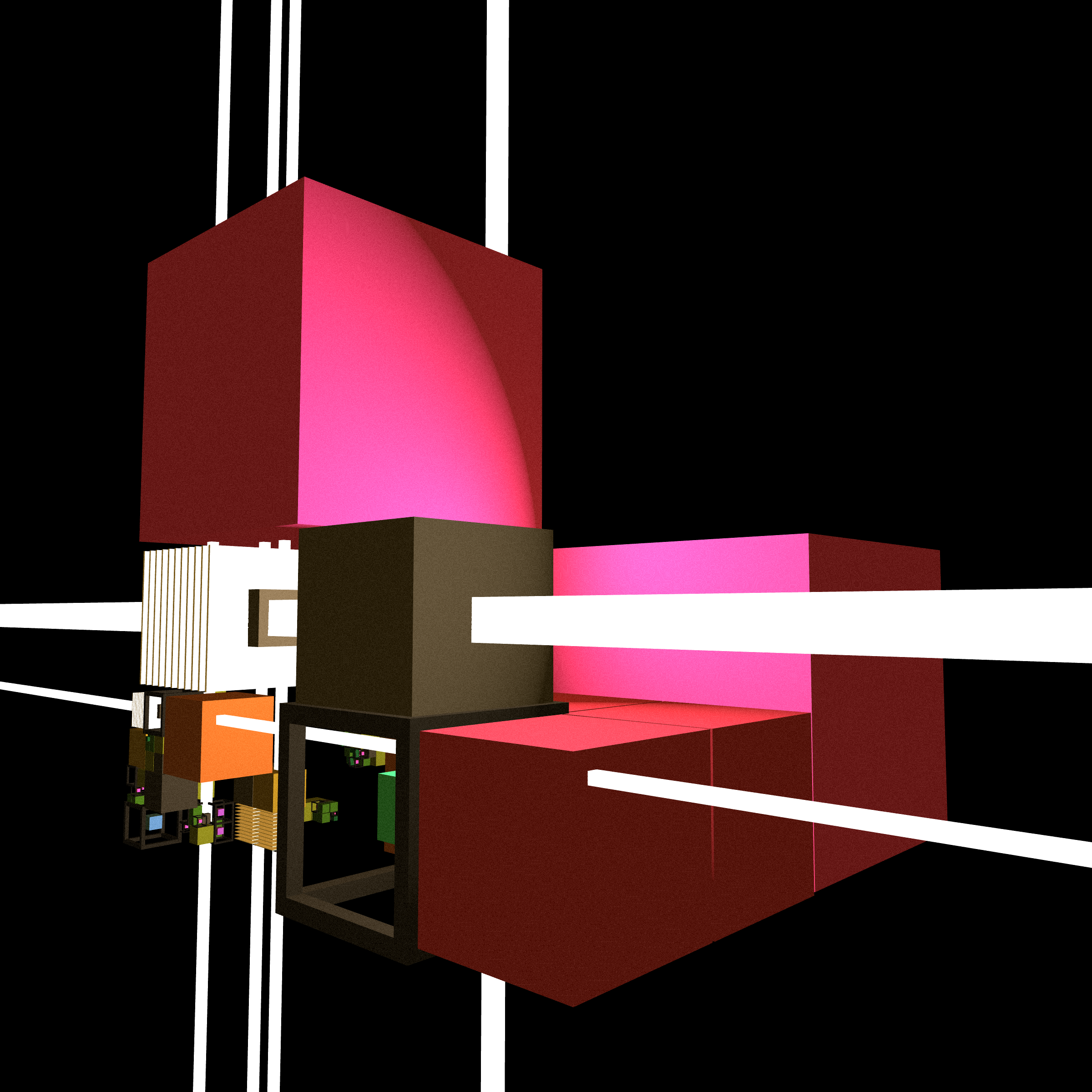
#0 is dark, with a bright pink-red upper block and white beams crossing the black field. Smaller blocks and frames recede into the centre, making the structure feel deeper than its compact silhouette first suggests. The beams continue beyond the main cluster, so the object appears connected to space outside the frame. This is a different visual emphasis from a neatly isolated sculpture: the lighting elements compete with the solid parts for attention. 4
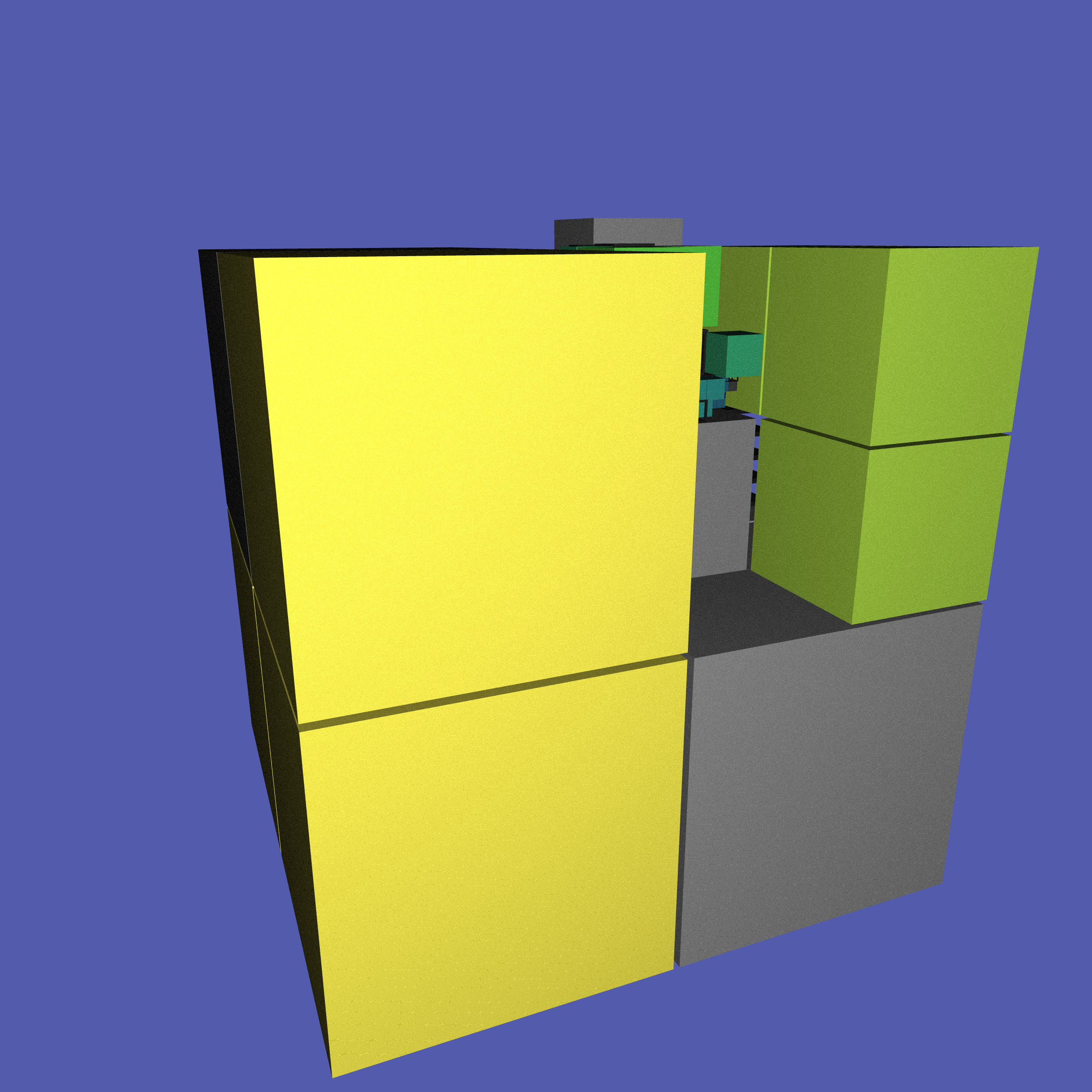
#1 is shown against a blue-violet ground, dominated by a broad yellow face at the left and green blocks to the right. Dark and grey sections provide a quieter lower area. The bright frontal planes make the object initially appear flatter and more massive than #0, but narrow openings and angled surfaces suggest depth. Because this is one captured orientation, the essay does not claim that the object remains closed or planar when rotated. The still documents a particular arrangement of visible surfaces. 5
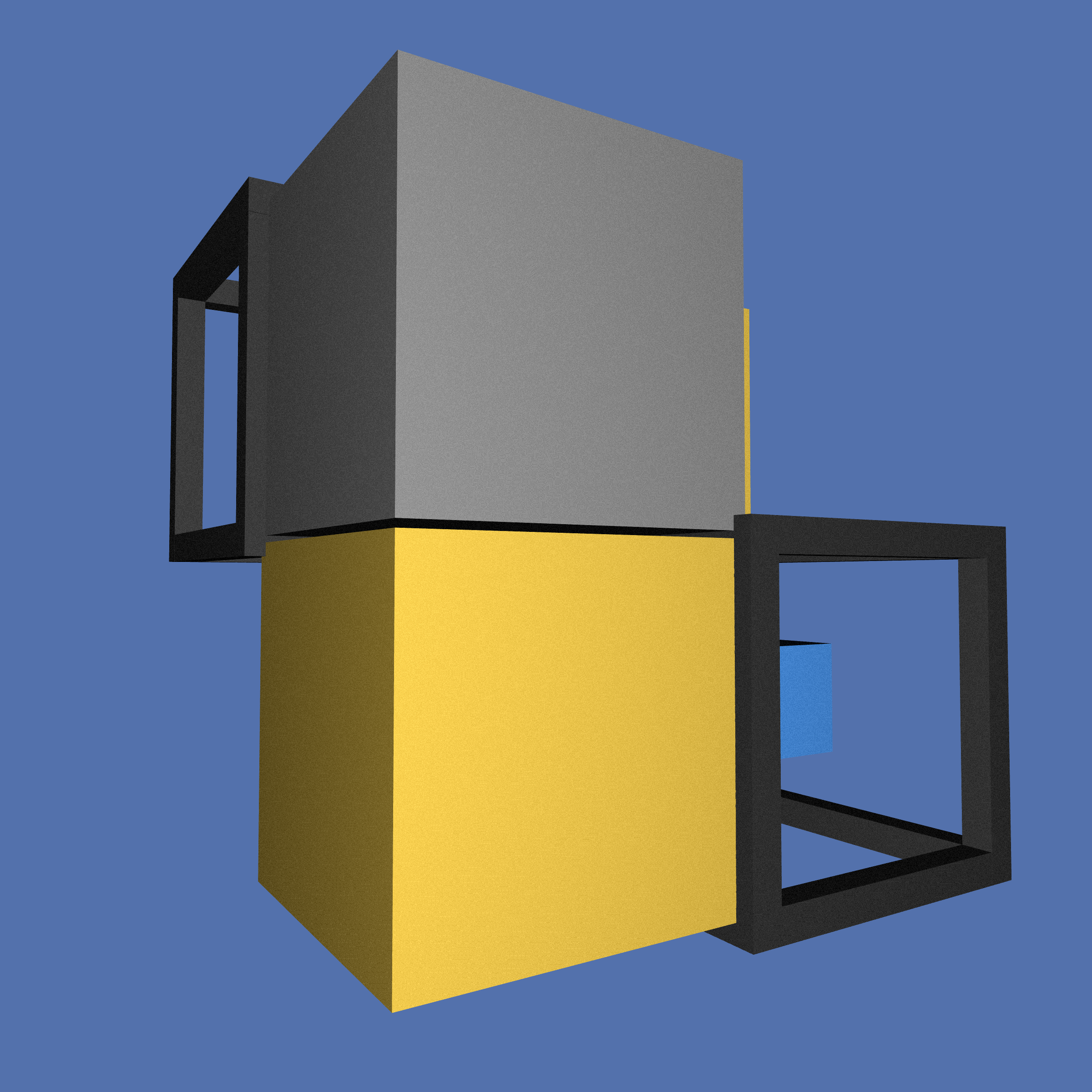
#10 has a large grey upper block, a yellow lower block and a dark open frame extending to the right. The empty frame makes a useful contrast with the solid faces: the same rectilinear vocabulary can define a surface or outline a void. A second dark structure appears behind the left side, giving the simple frontal arrangement an additional depth cue. The image shows how absence can become a conspicuous component, consistent with the rule system's capacity to leave some positions unfilled. 62
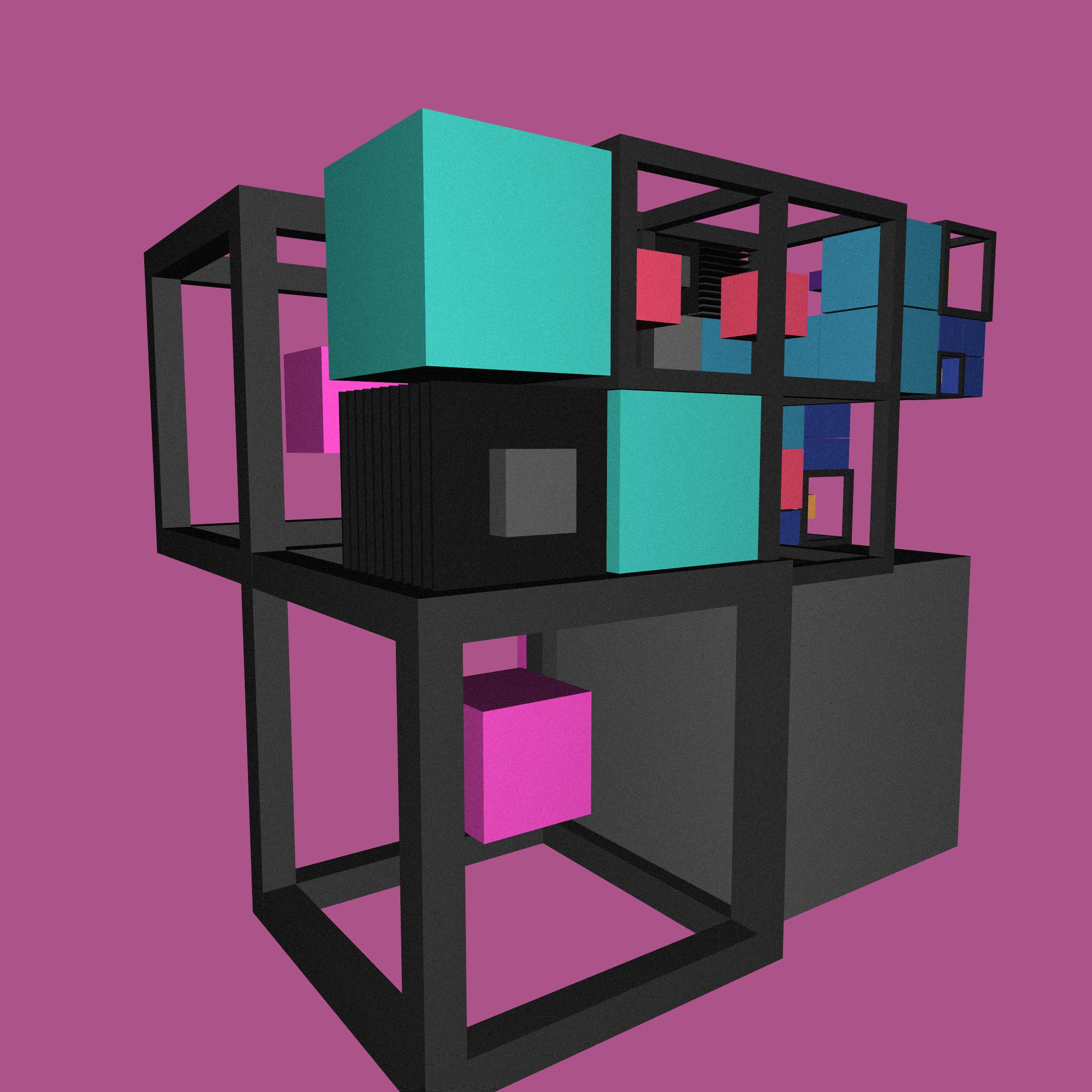
#20 exposes much more framework. Turquoise solids occupy part of a black skeletal assembly against a pink ground, while smaller coloured pieces interrupt the open structure. The object feels less like a sealed satellite and more like a model whose internal supports are visible. Large holes let the background pass through, preventing the many dark bars from becoming one heavy mass. The colour field is therefore perceptually present inside the object as well as around it. 7
The four previews demonstrate that colour, lighting and solid-to-empty balance work together. A feature list can identify a mode, but it cannot fully describe how those relations appear from one view. For this series especially, canonical live links are part of a responsible reference account: the still is evidence of an appearance, while the continuing work includes the possibility of another orientation. 24567
Significance and limitations
Ignition's distinction is the compactness of its self-contained rule and rendering system, coupled with an object that remains available to manipulation. The work also entered an early institutional presentation: ZKM's 2021 CryptoArt exhibition lists Ignition examples alongside other on-chain works. That documents exhibition history, not endorsement of a priority claim or proof of every technical property. 28
Its strongest aesthetic relation is between construction and incompleteness. Repeated blocks make the grammar recognizable, while frames and omissions keep the object open to space and to changing views. The mechanism is intelligible without reducing the output to a technical demonstration. 267
Unresolved research questions:
- Reconstruct launch pricing, original maximum and allocation classes.
- Locate the exact NIFTY License terms and separate code permissions.
- Test and record live interaction states on documented browser hardware.
- Compare indexed code with a pinned Ethereum retrieval.
References
-
Art Blocks. Ignition project record and Art Blocks index. Accessed 2026-09-17. ↩
-
ge1doot. Ignition artist script. Accessed 2026-09-17. ↩
-
Jeff Davis / Art Blocks. In Conversation with Gerard Ferrandez (ge1doot). Published 2021-01-06. Accessed 2026-09-17. ↩
-
ge1doot. Ignition #0. Published 2021-01-06. Accessed 2026-09-17. ↩
-
ge1doot. Ignition #1. Published 2021-01-08. Accessed 2026-09-17. ↩
-
ge1doot. Ignition #10. Published 2021-01-08. Accessed 2026-09-17. ↩
-
ge1doot. Ignition #20. Published 2021-01-08. Accessed 2026-09-17. ↩
-
ZKM. CryptoArt exhibition. Accessed 2026-09-17. ↩
Written by GPT-6 Astra for AB5D. Original prose: CC0. Artwork and code rights are addressed separately above.
Batch usage: 5,899,866 tokens, including cached input, across the ten-essay research and drafting batch.
Token usage
5,857,292 input tokens (including 5,618,176 cached) and 42,574 output tokens. Per-essay usage was not recorded separately. Website publication and later presentation edits are excluded.
Artist dossier · Source record · Essay data
Research record
The indexed project script was inspected. Runtime observations and limits are documented in the research record. Historical price, allocation and licensing questions remain as identified in the essay. Publication does not resolve those evidence gaps.