
Seasky
Ralgo · Project 459 · Presents
Art Blocks Presents, project 459 · 100 outputs · minted 4 October 2023 · CC BY-NC 4.0


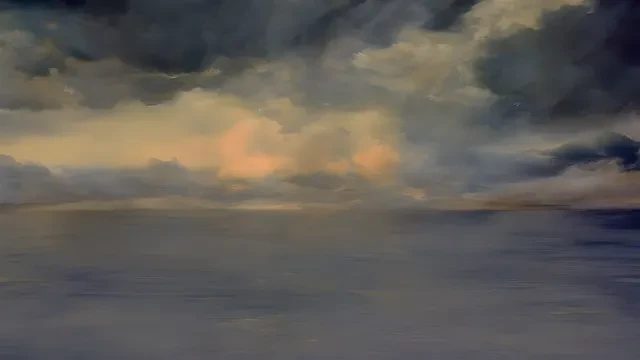
Seasky #54, held by AB5D. Strange Clouds, Quantum cloudburst, BirdDensity 3. Render: Art Blocks media proxy.
The work and its context
Seasky is project 459 on the Art Blocks contract 0x99a9b7c1116f9ceeb1652de04d5969cce509b069. The index records 100 invocations against a maximum of 100, the runtime p5@1.0.0, an aspect ratio of 1.3 (13:10), the vertical "presents" and the licence CC BY-NC 4.0, linked to the Creative Commons legal code 1. Art Blocks lists it as an Art Blocks 500 release in the Presents category, released on 4 October 2023 2. The Art Blocks 500 is the platform's name for the projects released between 2020 and 2025, which it treats "as a finite and complete set" 3.
Each output is a seascape built in public. Over about a minute the viewer watches layer after layer of translucent cloud accumulate over a glowing field, then a sea of small elliptical marks is laid in below the horizon, the sky is softened, and a flock of birds appears 1. The project text calls this a "prominent display of the construction process, showcasing the creation of clouds that seek to dominate the scene" 1. The finished pictures sit somewhere between Romantic sea painting and digital glitch: soft, smoky clouds in yellows, maroons and reds, over seas that are cream, lilac or pink.
Ralgo is the working name of Robert Allen, a UK-based generative artist whose site says he makes "painterly seas, strange worlds, impossible structures, unlikely creatures and stories made of light" 4. The artist wallet recorded by the index, 0x43cc...00a9, resolves to the ENS name ralgo.eth 15. A newsletter preview written ahead of the October 2023 drop described Seasky as the Art Blocks debut of an artist "with a plethora of work on fxhash and a past verse exhibition" 6.
Conception and development
Before Seasky, Ralgo worked mainly on fxhash and with Verse. In February 2023 Verse showed his Order v Chaos at Cromwell Place in London as part of its "Imperfections" programme: 80 works at $150 each, described as a follow-on from his fxhash series Overgrowth that "uses colour for the first time" 7. The Verse biography gives him "a background in software development" and years of "experimenting with creative graphical coding" 7. In the accompanying interview with Leyla Fakhr he named Qubibi, Tyler Hobbs, Dandelion Wist, Melissa Wiederrecht and Mark Ludgate among the artists he admires. He also argued that "celebrating chaotic forces, and imperfections" matters as much as striving for perfection 8.
The Seasky statement develops the same theme. Ralgo writes that the project "was born from my exploration of the realm of chaos" 1. While experimenting he found "an unconventional method of creating clouds by layering objects at specific intervals". Pushed further, the clouds began to resemble the work of "19th century masters such as JMW Turner and Gustave Courbet" 1. The sea was "itself inspired by impressionist techniques" 1.
Colour was the other experiment. Ralgo says he normally relies on "generative randomized color rather than predefined palettes", but here he "imposed limits on greens and overall saturation levels" and then let in "some unnatural reds, oranges, and blues" 1. The creative credit in the project record names "Harvey Rayners article on his approach to fully generative color" as helpful 1. That article, "The Fontana approach to fully generative color" (2022), sets out a system in which, among other steps, saturated greens are removed and purples and ultramarines suppressed 9. Ralgo's link with Rayner is also visible elsewhere: his site lists Quasi Dragon Studies, 40 compositions he made within Rayner's series, and his QQL composition #325 4.
How the work was constructed
The program is a single script of 21,903 bytes, SHA-256 e858654fa5acecb9c3994ae6f1aa71928fe7d22a6f7d854aa31cc9d648b2fe44. It was retrieved from the Art Blocks index and read in full. No code is reproduced here 1.
It seeds two sfc32 generators from the two halves of the token hash, runs each through 500,000 warm-up steps, and then alternates between them for every random number 1. Nothing else is random: p5's own random and noise functions are never called, so each output is fixed entirely by its hash (code reading).
All fifteen traits are decided at the start. To test the logic, the trait code was ported to Python and run on all 100 hashes. It reproduces 13 of the traits exactly for every token, and all 15 for 76 tokens. Each of the other 24 differs in one trait, discussed under quirks 1. The table compares the program's own rates, from 200,000 simulated draws of the ported logic, with the published counts.
| Trait | Program rate (simulation) | Published count of 100 |
|---|---|---|
| MainStyle: Strange Clouds, Maroon, Red Shift, Dark Clouds, Blue Shift, Burnt Orange, Ocean | 30%, 21%, 15%, 14%, 9%, 6%, 5% | 22, 30, 16, 11, 13, 5, 3 |
| BackColorFlow: Wild Yellow, Wild Blue, Wild Red | 50%, 36%, 14% | 51, 33, 16 |
| CloudBurst: Standard, Quantum, Loose | 62%, 32%, 7% | 53, 40, 7 |
| CloudDensity: 300 to 650 in steps of 50 | peaked at 450 and 500 (22% each); 300 and 650 about 3% each | 4 at 300, 4 at 650 |
| Explosion: Yes | 37% | 31 |
| Horizon Noise: Yes, Strong | 18%, 4% | 15, 4 |
| SeaLight: White, Light, Pink, Light Blue | 49%, 44%, 5%, 2% | 29, 66, 5, 0 (see quirk 1) |
| SeaStyle: Wavy, Light, Diamond | 66%, 26%, 9% | 63, 26, 11 |
| BirdDensity: 0, 1, 2, 3 | 31%, 45%, 11%, 12% | 23, 56, 11, 10 |
Rendering runs over 55 animation frames on an offscreen WebGL buffer of 3,900 by 3,000 pixels 1. In each of the first 50 frames the scene is rotated and a new cluster of cloud is built from hundreds of overlapping, heavily stroked ellipses whose colour drifts by a small random walk in red, green and blue. The walk is held within brightness bounds, and when one channel dominates it is nudged down. Green is pushed down most readily, and highly saturated colours are pulled back (code reading) 1. At intervals set by the LightvClouds trait, the program lays a screen-blended "light" layer of tens of thousands of faint ellipses behind the clouds. The MainStyle decides the colour of the cloud strokes: black for Dark Clouds, dark red for Maroon, orange-brown for Burnt Orange, and so on 1.
Frame 51 draws the sea: between 150,000 and 300,000 small ellipses, tilted into perspective, then 1,400 faint vertical lines and 6,000 tiny pale glints. Frames 52 to 55 blur the upper half of the image, draw optional reflections, and add the birds in frame 53. Pressing "s" saves a 3,900 by 3,000 JPEG, as the artist's display note says 1.
Quirks in the algorithm
A full read of the program, the Python port and a colour measurement of all 100 renders turned up the following. Code-only points are marked.
- The SeaLight label is wrong for 22 tokens. The program turns one intermediate sea value into "White" just before the traits are written. The published labels behave as if that step were missing. Twenty-one tokens labelled "Light" come out with the program's fixed cream sea, and one labelled "White", #24, has a sky-tinted "Light" sea 1. The renders confirm the program, not the label. The bottom strip of each of the 21 averages about RGB (178, 168, 156), like the tokens correctly labelled White, while "Light" seas average about (114, 113, 126) (own measurement of the media-proxy renders). Corrected, the split is 49 White, 46 Light and 5 Pink, close to the program's rates. #1 is an example.
- Two Growing Light labels the program does not produce. For #28 and #68 the index says "Growing Light", while the ported logic gives "Challenging Light". Every later trait for both tokens matches, so the random sequence is not out of step (code reading) 1. This was not checked visually.
- An assignment where a comparison was meant. In the sea loop, a condition sets a variable to 2 instead of testing it. The test therefore always passes, so every sea mark is turned by a tiny extra angle, which fans the sea's texture across the picture. Only six tokens escape, because their angle was drawn as zero 1. A separate tilt meant for about a fifth of tokens runs once at most, because the same line overwrites its switch after the first mark (code reading).
- Labels and colours that can never appear. The sea-name list includes "Dark" and "None", but every path that could lead to them is remapped, so the dark navy sea colour and the no-sea option are unreachable. A grey, monochrome cloud mode is keyed to a background value that is always converted to Wild Blue first. "Light Blue" can happen, about 2 per cent of the time, but no minted token has it (code reading) 1.
- The blur's limits never apply. The last two blur passes are meant to soften only parts of the sky. But the switch that allows blurring is set on the very first pixel checked and never reset, so each pass treats the whole upper half. Birds added in frame 53 then go through two more blur passes, which may explain their soft edges (code reading) 1.
- What BirdDensity means. Levels 0, 1, 2 and 3 draw 0, 6, 10 and 14 birds respectively; a count of the birds in #54 is consistent with 14. Level 0 means an empty sky. Quantum Separation raises 0 to 1, so all 51 Quantum Separation tokens have birds. Explosion lowers the level by one, and 18 of the 23 birdless tokens are Explosions (code reading) 1.
- Rules found in the data. All 31 Explosions have no reflection and none has a Quantum cloudburst. All 40 Quantum cloudbursts have a Wavy sea, and all six Diamond Clouds are Quantum. Horizon Noise never appears with Quantum Separation, nor with Red Shift, Blue Shift or Burnt Orange. No Growing Light has a SkyBurst. All five Pink seas have a Wild Blue ground, and no Strange Clouds has Wild Red 1.
- Hidden variables. Several choices that change the picture are not traits. The light layer is either wide or circular (52 and 48 tokens); the sea is tilted at one of two angles (72 and 28); and Strange Clouds uses one of two stroke tints. The MainStyle label shows only the last style to win: four tokens first drew Ocean and were then overwritten as Red Shift or Blue Shift (code reading) 1.
- Small slips. The trait is spelt "Quantum Seperation", and the charity text reads "Institute of HeathMath" for the HeartMath Institute 110. On devices that report themselves as iPhone, iPad or iPod, the buffer drops to 30 per cent scale, 1,170 by 900 pixels (code reading) 1.
The most coveted variants
No collector writing on Seasky's traits was found. At retrieval the lowest listing was 0.48 ETH 1. The notes below rest on the index data and the code.
The rarest styles. Ocean is the smallest MainStyle, with three tokens: #52 and two others 1. It paints its cloud strokes in dark blue-green, and every Ocean without Quantum Separation carries horizon noise (code reading). #52 combines Ocean with an Explosion, a Wild Blue ground and a cream sea.

Seasky #52, one of three Ocean outputs. Render: Art Blocks media proxy.
Diamond Clouds (6) and Pink seas (5). Diamond Clouds occur only in Quantum cloudbursts, drawing the cloud shapes as four-sided polygons rather than ellipses 1. #15 is a Maroon Diamond Clouds with red cloud masses over a teal sky. #40, a Maroon with a Pink sea, has the strongest red and pink contrast among the suggested examples.

Seasky #15, Maroon with Diamond Clouds. Render: Art Blocks media proxy.
Strong Horizon Noise (4). Strong noise draws more of the vertical cream and black flecks along the horizon. #24 has it with 14 birds and a Strange Clouds sky; it is also the one token whose sea is labelled White but painted Light (quirk 1) 1.

Seasky #24, Strong Horizon Noise. Render: Art Blocks media proxy.
The mislabelled seas. A collector who wants a white sea should look at the picture, not the label. #1, for instance, is listed as "Light" but has one of the palest cream seas in the edition, under a Maroon Explosion with no birds 1.

Seasky #1, labelled SeaLight "Light" but painted with the program's white sea. Render: Art Blocks media proxy.
AB5D's #54. #54 is a Strange Clouds output with a Quantum cloudburst, a low horizon, a Direct reflection and the maximum bird level: a pale yellow cloudbank crossed by 14 birds 1. It was minted on 4 October 2023 at 17:44:47 UTC and moved twice before reaching the AB5D wallet 0xdd19...c045 on 2 September 2025 1. Etherscan's page for the token shows a last sale of 0.135 ETH, which could not be matched to a transaction 11.
Notable collectors
At retrieval the 100 tokens were held by 46 addresses 1. The largest holder, 0x9e37...439a, minted 26 tokens on mint day and still holds all of them. It has no ENS name or public label, and no source names its owner 112. The artist's wallet, ralgo.eth, holds 10: #0, #12, which he minted during the auction, and eight received from other wallets between June 2024 and November 2025, six of them in October 2025 15. Fifty tokens have changed hands at least once since mint 1.
Seasky Aria and the paired collection
In October 2023 Ralgo released Seasky Aria, 103 works on Ethereum. Its description calls it "the next stage of evolution of the Seasky collection", made by applying "various AI iterations and artistic curation" to each Seasky, at 4K for 9:16 displays 13. His later Verse series Wild Wave Studies (50 works, January 2024) also grew out of these "experiments into enhancing the style" of Seasky and stays "faithful to the Turneresque theme" 1415.
His website now presents the two together as "Seasky & Aria", 100 pairs with the heading "One horizon, two expressions" 16. Each Seasky is matched with one selected Aria. For #54 the partner is Melancholy Waters 17.
Melancholy Waters, the Aria paired with Seasky #54 on the artist's site. Image: Ralgo, ralgo.art (hotlinked).
The mint
Invocation 0 was minted to the artist's wallet on 16 June 2023, eleven days before the project was activated on 27 June 1. The public sale used Art Blocks' exponential Dutch auction with settlement. The index records a starting price of 2 ETH, a price half-life of 409 seconds, a start at 17:00 UTC on 4 October 2023 and a resting price of 0.1 ETH 1. The first public token, #1, was minted at 17:13:59 UTC, when the curve stood just under 0.5 ETH (own computation from the auction parameters). Fourteen tokens were minted while the price was still falling, and the settled price recorded is 0.1 ETH 1. Under settlement, buyers who paid more than the final price can claim back the difference, so every buyer was entitled to the 0.1 ETH resting price.
Eighty-nine tokens were minted within an hour of the start, and the edition was complete at 18:24:35 UTC 1. The revenue record shows a render provider share of 10 per cent and an additional payee receiving 25 per cent. That matches the pledge to give "25% of all proceeds" to the HeartMath Institute 110. No source inspected names the payee address.
Copyright and licensing
The index records CC BY-NC 4.0 with a link to the Creative Commons legal code 1. On that licence the outputs may be shared and adapted for non-commercial purposes with attribution; commercial use needs the artist's permission. The program has no separate code licence, and p5.js is loaded by the platform 1. The Aria image above belongs to the artist. It is linked from his site, not re-hosted, and the Aria collection's own licence terms were not found 1317.
Significance and limitations
Seasky is a small, painterly edition that shows its own making. It takes a technique found by accident, the stacking of translucent shapes at intervals, and aims it at Turner and Courbet's skies 1. It also marks an fxhash and Verse artist's move to Art Blocks, and leads into his later AI reworkings 61314. For collectors the most important finding is practical: one published trait, SeaLight, is wrong for about a fifth of the edition, and the images, not the labels, show which sea a token has.
Unresolved research questions:
- Where did the SeaLight and two LightvClouds labels come from? Presumably a separate features script differed from the on-chain program, but this needs confirming with Art Blocks or the artist, as does whether the labels could be corrected.
- Who controls the 25 per cent additional payee address, and did the donation reach the HeartMath Institute?
- The project website recorded in the index (ralgo.art/seasky/) returned 404 when checked, and the artist's X posts could not be read. Does an archived project page or thread discuss favourite outputs, the Aria process or prints?
- What has Seasky traded for on the secondary market? Etherscan's 0.135 ETH last sale for #54 and Verse's summary sales figures came from automated extraction and need checking against transactions 1118. The short quotations from the Verse pages, the Aria description and ralgo.art were also extracted automatically and should be confirmed against the pages.
- Do #28 and #68 look like Growing Light outputs? A side-by-side re-render with the ported logic would settle it.
Bibliography
Primary
-
Art Blocks public GraphQL index,
projects_metadata(including the full program),project_minter_configurations,tokens_metadataandtransfers_metadatafor project 459, all 100 tokens. Retrieved 2026-09-20 via https://artblocks-mainnet.hasura.app/v1/graphql. Includes the project description, creative credit, charitable giving and display notes quoted above. Trait port, simulation and render colour measurements are the author's own. ↩
-
Art Blocks, "Seasky by Ralgo", collection page. https://www.artblocks.io/collection/0x99a9b7c1116f9ceeb1652de04d5969cce509b069-459 ↩
-
Art Blocks, "Art Blocks 500: The Complete Collection". https://www.artblocks.io/articles/art-blocks-500-complete-collection ↩
-
Ralgo (Robert Allen), Ralgo.Art home page and About. Read 2026-09-20. https://ralgo.art/ ↩
-
Etherscan, address
0x43cc80b0d94c86c0c1184d1a0eec42fbe51a00a9(ralgo.eth). https://etherscan.io/address/0x43cc80b0d94c86c0c1184d1a0eec42fbe51a00a9 ↩
-
Ralgo, "Seasky & Aria", paired collection. https://ralgo.art/collections/seasky-pairs/ ↩
-
Ralgo, "Seasky #54 & Melancholy Waters". https://ralgo.art/collections/seasky-pairs/54/ ↩
-
"Seasky Aria", collection page, OpenSea. https://opensea.io/collection/seasky-aria ↩
-
Harvey Rayner, "The Fontana approach to fully generative color", Medium, 2022. https://medium.com/@harvey.rayner/the-fontana-approach-to-fully-generative-color-e5f7f5a0443a ↩
-
HeartMath Institute, official site and donations page. https://www.heartmath.org/ and https://www.heartmath.org/donations/ ↩
Video and audio
- No video, podcast or recorded talk about Seasky was found in the searches made for this draft.
Criticism, collecting and market
-
Mint or Skip, "What just happened?", newsletter, 2023 (exact date not recorded). https://mintorskip.beehiiv.com/p/just-happened ↩
-
Verse, "Wild Wave Studies by Ralgo", series page. https://verse.works/series/wild-wave-studies-by-ralgo ↩
-
Mint or Skip, "My fave drop of 2024 so far", 5 January 2024. https://mintorskip.beehiiv.com/p/fave-drop-2024-far ↩
-
Etherscan, NFT page for Seasky #54. https://etherscan.io/nft/0x99a9b7c1116f9ceeb1652de04d5969cce509b069/459000054 ↩
-
Etherscan, address
0x9e37bdc1efd5828465dfc3fce33ae1cc47e0439a. https://etherscan.io/address/0x9e37bdc1efd5828465dfc3fce33ae1cc47e0439a ↩
-
Verse, "Seasky by Ralgo", series page with market summary. https://verse.works/series/seasky-by-ralgo ↩
Further reading
-
Verse, "Order v Chaos, Imperfections", exhibition page, Cromwell Place, London, 22–27 February 2023. https://verse.works/exhibitions/ordervchaos-imperfections ↩
-
Leyla Fakhr, "Ralgo on Celebrating Chaotic Forces", Verse Journal, 27 February 2023. https://verse.works/journal/ralgo-on-celebrating-chaotic-forces - Art Blocks, "Art Blocks 500" discovery page. https://www.artblocks.io/discover/ab-500 - OpenSea, "Seasky by Ralgo". https://opensea.io/collection/seasky-by-ralgo ↩
- Art Blocks, "Art Blocks 500" discovery page. https://www.artblocks.io/discover/ab-500
- OpenSea, "Seasky by Ralgo". https://opensea.io/collection/seasky-by-ralgo
Supplied revision published by AB5D. Author not specified. Original prose: CC0. Artwork and code rights are addressed separately above.
Token usage unavailable for the complete essay.
Token usage
Usage for this supplied revision was not provided. The linked generation record describes the original research batch.
Research record
The indexed project script was inspected. Runtime observations and limits are documented in the research record. Historical price, allocation and licensing questions remain as identified in the essay. Publication does not resolve those evidence gaps.