
Spot and Perp
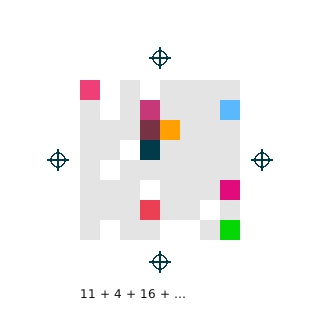
Give an AB[500] work to AB5D. Take a Debit and a Spot, settled at once. Or leave the Debit for the next giver and hold a Perp, an open position: Perps queue, and when a Debit comes back to the desk the oldest one settles into it.
AB[500] → Debit
The desk is closed.
The giver's debt
The desk began as a gift returned. AB5D gave 50 Debits away, and Wubbushi sent 50 back. Wubbushi read it as Rauschenberg erasing a de Kooning: a gift cancelled by a larger one.
The desk gave those 50 away again, one for each AB[500] work given to the archive, in thirty-eight minutes. Then people kept giving and took a Perp instead: a place in a queue for a Debit that might come back.
AB5D bought Debits back on the open market and sent them to the desk. Each went to the holder of the oldest open Perp, and that Perp settled: m + r + 16 = 31. 109 Perps settled this way.
14 stay open, and will not be settled. In Nietzsche's Zarathustra the one who gives from overflow is the one who gains, and also the one left wanting: he never learns the happiness of those who receive. The ledger here says the same. The archive gave Debits and received 173 works. The givers were paid. The giver is still in debt, and the open Perps are that debt, kept on purpose.
The desk is closed. It is never going to give you up.
The fifth plate
Jack Butcher's Credits print the four process plates, cyan, magenta, yellow and black, worth 1, 2, 4 and 8. A Credit's payment second chose its mask, m. Wubbushi's Debits print what the Credit kept, r = 15 − m, so a Credit and its Debit use up every plate there is.
AB5D adds the plate the arithmetic has no room for: a spot ink, plate 16, mixed from the AB[500] work that was given for it. No Pantone number. Every ink is named instead in Werner's 1814 Nomenclature of Colours, the book Darwin carried on the Beagle, and in Munsell's notation, then read by thirty-seven colourists, painters and theorists.

m = 9
Jack Butcher
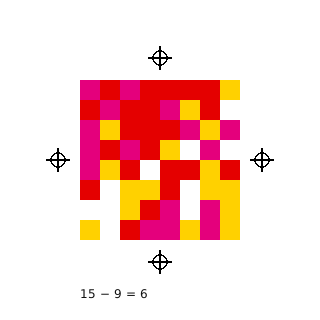
15 − 9 = 6
Wubbushi
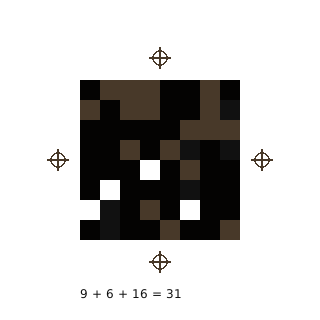
9 + 6 + 16 = 31
Miragem ink
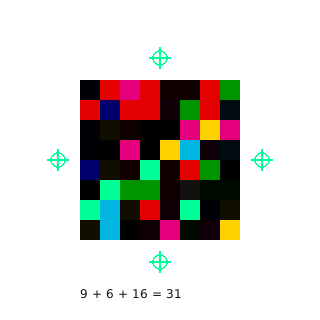
9 + 6 + 16 = 31
Friendship Bracelets ink
Two ways to give
Exchange for a Debit
- You send
- one AB[500] work
- You receive
- the next Debit and a Spot
- Line
- m + r + 16 = 31
- Supply
- one per Debit in the pool
- Record
- an exchange
Leave the Debit
- You send
- one AB[500] work, marked PERP
- You receive
- a Perp; the Debit stays for the next giver
- Line
- m + r + 16 + …
- Supply
- open, for as long as the desk is
- Record
- a gift, credited on the Donor Register
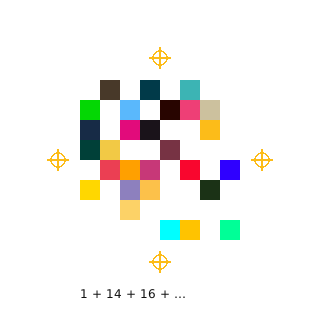
A Perp is drawn like a Credit, except the payment is the gift. Its plates are made but not inked: proof grey. Every later gift to the desk, Spot or Perp, inks one of its cells in that gift's own ink, so the earliest Perps fill with the colours of everything given after them, a Richter colour chart set by chance. Its receipt is the 21 characters derived from the gift, after Klein's receipts for immaterial zones.
Wubbushi's own writing starts from a ledger in which comparison has a cost, and a debit and a credit cost the same. The canon's last reading charges each ink that cost against its paper.
How long you held it
A Spot's tier is the gift's oTDH: the share of the work's life the giver held it, uninterrupted, up to the gift. A work bought in order to give it scores zero.
Albers: interaction
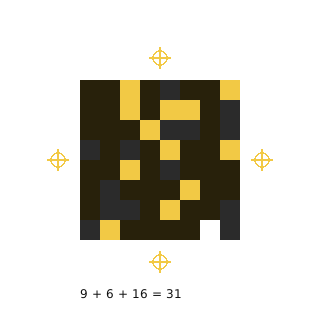
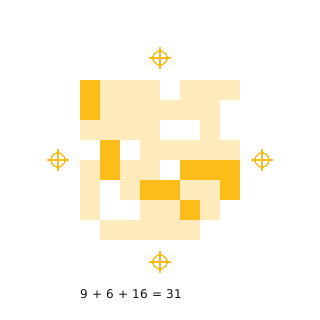
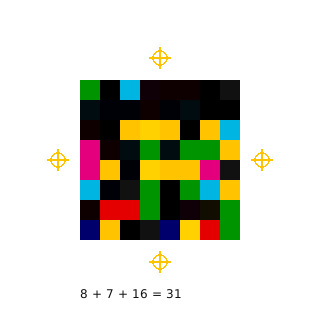
The Debit's plates in one ink, its depth in screens of that ink. One colour made to read as many.
Goethe: demanded colour
The Debit's plates in one ink, the Credit's in a second, overprinted where they meet: a colour and the colour it demands.
Turrell: aperture
All four process plates, and the spot ink, fluorescent, only where no process ink reached: light through an opening.
Proofs
Real AB[500] works and their real holding histories, as the desk would proof them today. Asterism's is a gift already made to AB5D; the others are what a Spot or Perp would be if their holders gave them now. Select one to read its canon.
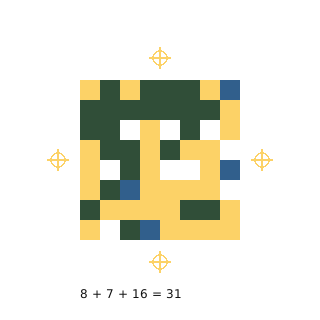
The colour canon
Each reading is computed from the ink, in the figure's own terms: CIE 1931 colorimetry, D65 sRGB, the Munsell renotation. The full canon for each token is published, and its hash is written on-chain when the gift is proofed.
| Figure | Work | Reads |
|---|---|---|
| Aristotle | De Sensu, c. 350 BC | parts light to dark |
| Leon Battista Alberti | De pictura, 1435 | which elemental colour |
| Leonardo da Vinci | Trattato, notes c. 1490 to 1510 | nearest of six simple colours |
| Isaac Newton | Opticks, 1704 | spectral band and wavelength |
| CIE | 1931 standard observer | chromaticity and luminance |
| Moses Harris | The Natural System of Colours, c. 1766 | made from which primitives |
| Patrick Syme after A. G. Werner | Nomenclature of Colours, 1814 | the name Darwin would have used |
| J. W. von Goethe | Zur Farbenlehre, 1810 | the demanded colour |
| Philipp Otto Runge | Farben-Kugel, 1810 | place on the colour sphere |
| Thomas Young and Hermann von Helmholtz | trichromacy, 1802 and 1852 | share of each cone |
| Michel Eugène Chevreul | simultaneous contrast, 1839 | the colour it casts on white |
| James Clerk Maxwell | colour triangle, 1855 | red, green and blue coordinates |
| Ewald Hering | opponent process, 1878 | reddish or greenish, yellowish or bluish |
| Albert Munsell | A Color Notation, 1905 | hue value/chroma |
| Wilhelm Ostwald | Die Farbenfibel, 1916 | full colour, white, black |
| Ogden Rood, Georges Seurat, Paul Signac | optical mixture, 1879 to 1890 | what the field mixes to at a distance |
| Ellsworth Kelly | Colors for a Large Wall, 1951 | 64 panels, 8 by 8 |
| Josef Albers | Interaction of Color, 1963 | one ink read as many |
| Johannes Itten | The Art of Color, 1961 | extension, season, the pair's contrast |
| Wassily Kandinsky | Concerning the Spiritual in Art, 1911; Bauhaus, 1923 | advance or recede; its form |
| J. M. W. Turner | the Deluge pair, 1843 | morning or evening |
| Piet Mondrian | Neo-Plasticism, 1920 | admitted or refused |
| Kazimir Malevich | Black Square, 1915; White on White, 1918 | the ground |
| Alexander Rodchenko | the last paintings, 1921 | nearest pure colour |
| Henri Matisse and the Fauves | Salon d'Automne, 1905 | wild enough |
| Yves Klein | IKB, 1960; Zones, 1959 to 1962 | distance from IKB; the Perp receipt |
| Ad Reinhardt | Black Paintings, 1953 to 1967 | dark enough to hide |
| Agnes Martin | the grids | pale enough |
| Gerhard Richter | 4096 Farben, 1974; Farbtafeln | chip number; the Perp chart |
| Ludwig Wittgenstein | Remarks on Colour, 1950 to 1951 | the -ish it can and cannot be |
| Brent Berlin and Paul Kay | Basic Color Terms, 1969 | basic term and stage |
| James Turrell | Skyspaces, 1974 onward | the ink as light |
| Olafur Eliasson | Room for one colour, 1997 | under sodium light |
| Stuart Semple, after Anish Kapoor | Pinkest Pink; Black 3.0, 2016 to 2019 | no one owns this ink |
| Robert and Sonia Delaunay | Simultanéisme, 1912 to 1913 | how far a pair vibrates |
| Wubbushi | the reciprocal cost of comparison, 2026 | the ledger's cost of the ink |
| Sol LeWitt | Paragraphs on Conceptual Art, 1967 | the instruction |
Rules of the desk
- Buy, then send.The transfer must come from the holder. A marketplace delivering a purchase straight to the desk is refused, so a seller can never be credited.
- AB[500] only.The 500 projects are fixed on-chain at deployment and cannot be changed.
- One Spot per project.Each AB[500] project can be exchanged for a Debit once. Perps are never capped.
- One transaction.The work goes to the AB5D treasury and the Debit, Spot or Perp comes back in the same transaction, or nothing happens.
- On press.Ink, tier and canon are proofed by AB5D after the gift, once, and locked.
- On the record.Spots are recorded as exchanges and Perps as gifts on the Donor Register.