
- Artist
- Aluan Wang
- Based
- Taichung, Taiwan (born 1982)
- Raster
- raster.art/artist/aluan-wang
- In the set
- Good Vibrations · 1,024 editions
- Links
- Full bibliography
- oTDH
- 17,043 · rank 81 of 308
- Holding signal
- 609 collector identities · 612 holder addresses · 1,603,850 raw collector-days · 14 Sep 2026
- Collector TDH
- aluanwangTDH · dashboard
Aluan Wang entered the Art Blocks ecosystem in August 2021 as the first Taiwanese artist with a dedicated collection. Good Vibrations comprises exactly 1,024 unique outputs, each generated from a distinct transaction hash that simultaneously determines visual structure and sonic behavior.1 The project sits within a broader practice rooted in audiovisual performance, large-scale interactive installation, and creative coding that spans more than a decade of exhibitions and awards in Taiwan and beyond.
Background and artistic formation
Born in Taichung in 1982, Aluan Wang trained initially in interactive design and quickly became known in Taiwan's audiovisual scene for merging geometric visuals with electronic breakbeat rhythms. His early installations treated code as a responsive material, capable of generating both image and sound in real time. Awards at the Taipei Arts Festival in 2012 and 2015 recognized this hybrid approach, which already privileged algorithmic systems over predetermined outcomes.2 By 2021 he had founded akaSwap, Asia's first Tezos-native NFT platform, and had begun exhibiting algorithmic works that explored migration, memory, and natural form through code.
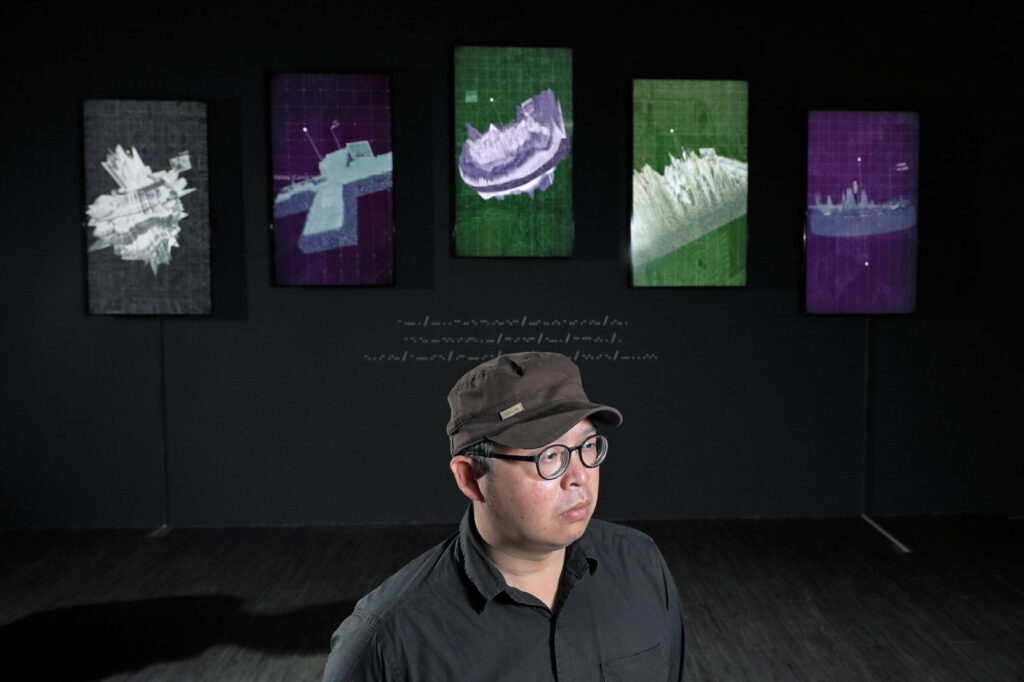
Artist portrait, photograph by AABT | Lin Chia-Hsien
Good Vibrations therefore arrived as both a technical culmination and a philosophical statement. It translated the artist's long-standing interest in rhythm and geometry into a fully on-chain, collector-minted format where every edition remains unique yet belongs to a coherent family of outputs. The collection's scale, 1,024 editions, reflects a deliberate engagement with the combinatorial possibilities of generative systems rather than an arbitrary cap.
Concept: vibration as universal law
The title and conceptual core of Good Vibrations derive from the principle that everything in life is vibration. Aluan Wang invokes this idea, often attributed to Einstein, to frame the work as a record of temporal experience in which audible and inaudible frequencies coexist without moral hierarchy.3 There is no dominant element between sound and image; both are generated from the same logical substrate. The artist describes the outputs as music sheets of Good Vibrations, in which past, present, and future occur simultaneously and the viewer-listener is invited to attend to the vibration itself.
Inspiration is drawn explicitly from musical minimalism. References to György Sándor Ligeti and Steve Reich appear in the artist's own account of the project, signaling an affinity for processes that unfold through repetition, phase, and gradual transformation rather than narrative development. The generative system inherits this aesthetic: small parametric differences, seeded by the transaction hash, produce outputs whose coherence emerges from underlying mathematical relationships rather than authorial imposition.
In a public reply to the AB5D thread, Wang made this time-based lineage more precise. Casey Reas's CENTURY was a major influence, while minimalist music shaped his approach to temporal progression. He also pointed back to A/V 5 and A/V 12, two small audiovisual studies from 2013 that he described together as tributes to Ligeti's Poème symphonique for 100 metronomes and Reich's Music for 18 Musicians. These works make Good Vibrations look less like a sudden blockchain-era experiment than a continuation of a decade-long study of pulse, duration, repetition, and gradual change.10
The past, present, and future all happen at the same time, requiring listening to the vibration, writing down the sheet in time.
Technical implementation: hash, geometry, and synthesis
Each edition begins with a unique transaction hash that serves as the sole source of entropy. This hash determines the distribution of geometric elements across the canvas, the selection and weighting of visual parameters, and the configuration of the audio engine. Position-calculation functions ensure consistent appearance across screen sizes while preserving the distinct character of every output.4
Rhythm and tempo are governed by a metronome whose size directly modulates trigger rate. The system employs modular arithmetic on the circle's circumference (2π) to derive precise beat lengths, creating temporal structures that feel both mechanical and organic. Waveform generation relies on elementary trigonometric and piecewise functions to produce sine, square, triangle, and sawtooth oscillations, which are then combined and filtered according to parameters also derived from the hash.
Visual traits include surface palettes (Sunset, Ocean, Forest, Cosmological, Monochromatical), line counts, melody numbers, color-dot densities, shape weights, background-object configurations, special-line modes, and ring structures. These elements interact continuously with the audio engine so that a dense linear composition may trigger rapid rhythmic events while a sparse cosmological surface may emphasize sustained tones. The result is a synchronized audiovisual object in which neither medium illustrates the other; both manifest the same underlying procedural logic.

2021, AB5D collection · live generator, animation begins automatically · click the work to enable sound
AB5D holding · open live view
Experience and reception
Collectors and viewers encounter Good Vibrations as both static image and live audiovisual performance. Because sound parameters are computed from on-chain logic and rendered client-side, each edition can be experienced with synchronized audio that reflects its unique hash. The surfaces range from warm gradients to cool monochromatic fields; line densities vary from sparse constellations to dense rhythmic lattices; oscillator combinations produce everything from pure sine tones to complex, beating textures. The live AB5D holding above demonstrates the project's balance of precision and expressive variation; clicking the work enables its hash-derived sound.
Wang's reply also corrects a category error in how the later works can be displayed. InkField and Polypaths are live renders by default: the brush or growth process performs itself in the browser rather than presenting a recording. Rendering is part of the work, not a delay before it. His preference for a bespoke site or a dedicated browser tab over a marketplace grid has consequences for collectors: faithful display requires giving the work time and computational space to breathe.10
Subsequent projects such as Polypaths (2025) show the artist extending similar algorithmic thinking toward organic branching structures and interactive manipulation. In Polypaths, users drag lines and drop dots to generate plant-like forms whose growth rules remain legible yet surprising. The continuity with Good Vibrations lies in Wang's refusal to treat code as a neutral tool. It is a collaborator whose unforeseen solutions can exceed the artist's expectations.5
Chaos, sampling, and the hidden path
The three-part Chaos sequence makes inheritance between systems literal. Writing in Chinese from the position of a collector, 豆泥 traces how Chaos Research samples and transforms works from Wang's Tezos collection, how Chaos Memory resamples its predecessor alongside fragments associated with J. M. W. Turner's paintings, and how Chaos Culture grows again from remnants of both earlier works. The analysis draws on correspondence with Wang and inspection of files stored with the projects. It reveals an artist treating his collection, education, and previous code as active source material rather than as background biography.8
A later Chinese-language profile by c2x3 connects this method to Auto Messages. Its account describes Wang's apparent disorder as the product of disciplined repetition, closer to an improvising musician who internalizes a structure before departing from it. In Auto Messages, quadtree subdivision creates areas of negative space while accumulated points blur the paths from which forms emerge. The hidden path becomes a bridge between the sampled histories of Chaos, the growth rules of Polypaths, and the archived brush movements of InkField.9
Growth as a field of dispositions
Two Polypaths outputs can feel as if they came from different emotional climates. Number 412 erupts in yellow, its crowded lines and scattered marks pushing outward with almost comic agitation. Number 312 is spare and grey-green, a reticent structure that appears to conserve its energy. The contrast matters because both belong to the same system. The algorithm does not enforce a signature look so much as establish a field of possible dispositions: riot and reserve, density and hesitation, all latent in one set of growth rules.6
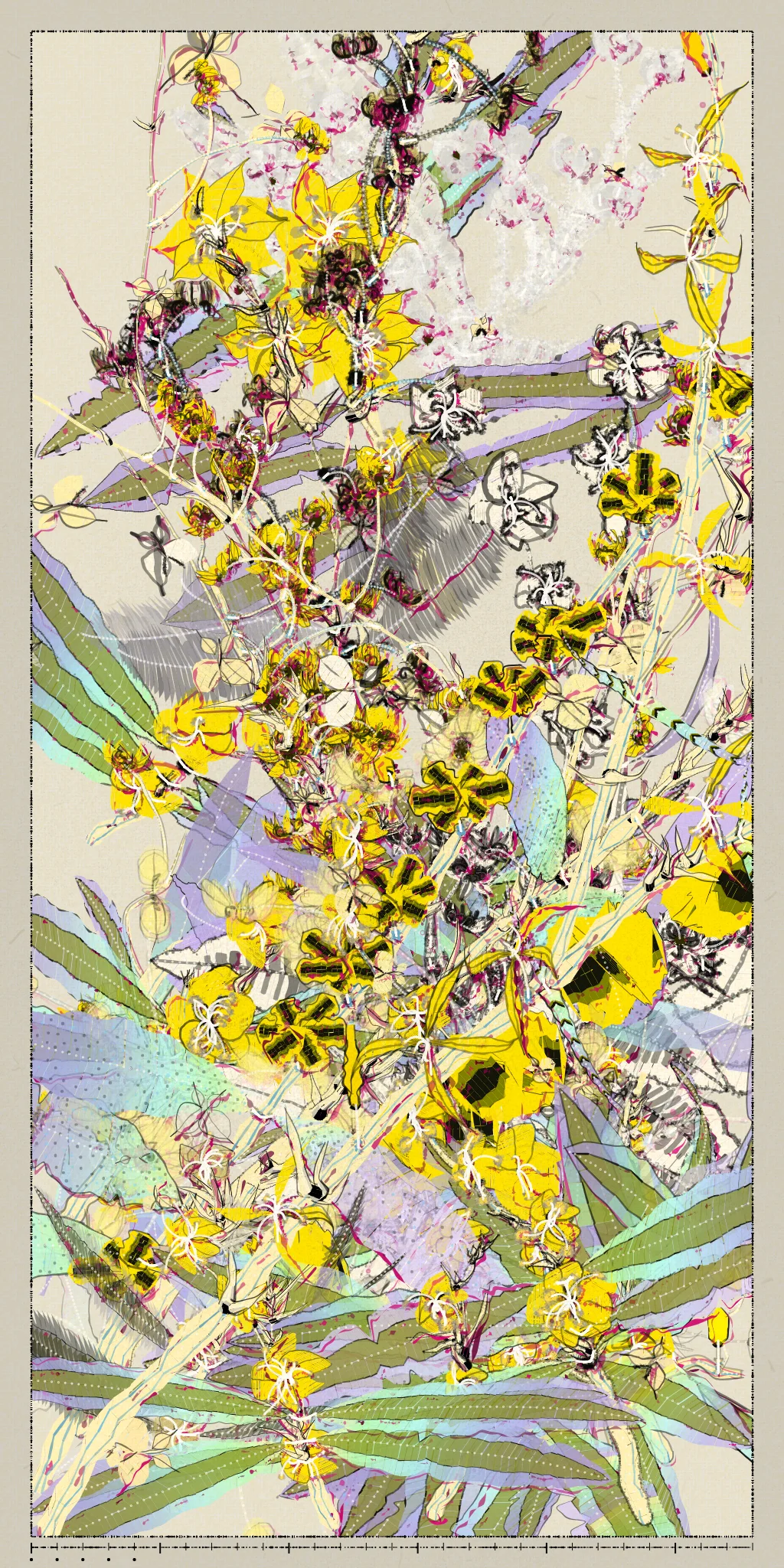
2025, Verse
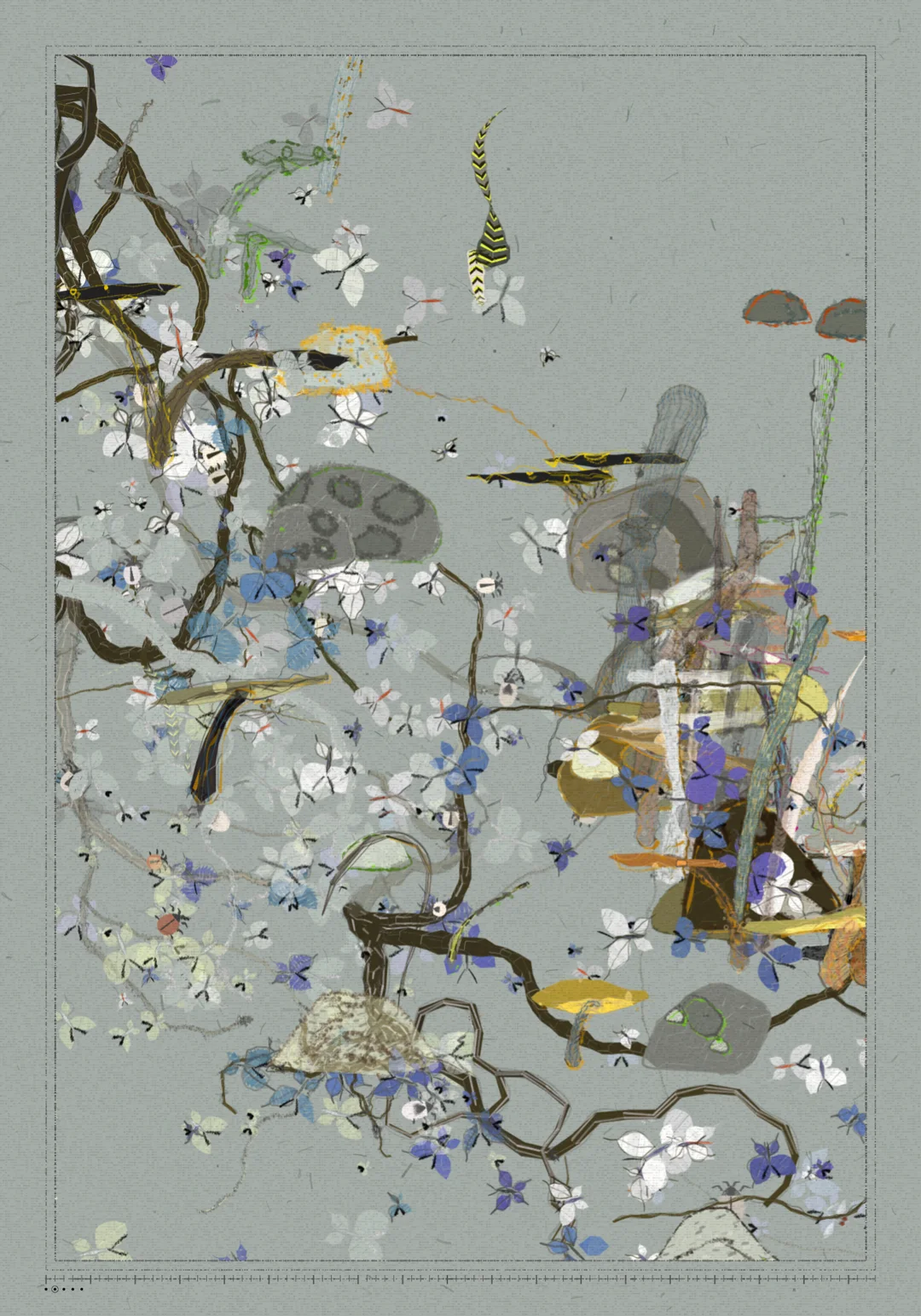
2025, Verse
The gesture is archived; the ink is mortal
InkField (2026) changes the source material from transaction hash or simulated growth to the artist's own body. Wang recorded fifty painting sessions as data, preserving each brush's path, pressure, velocity, turns, and millisecond pauses. A browser then performs the gesture again, stroke by stroke. Each recorded session anchors an individual work rather than supplying a common script for fifty cosmetic variants.7
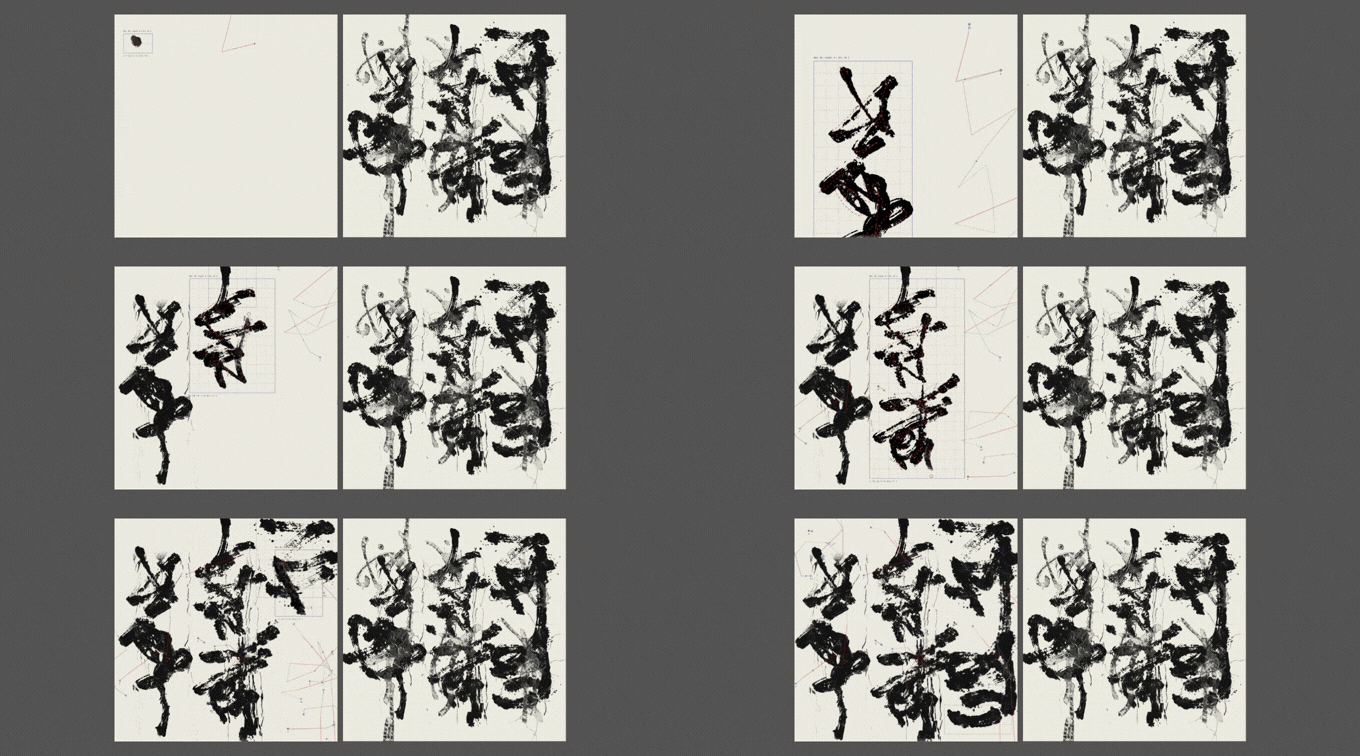
Recorded gesture and simulated ink, 2026
The distinction is between what persists and what remains vulnerable. The hand, path, and timing are deterministic; ink bleed, dry-brush texture, and edge behavior can shift when the work is performed. The archived gesture becomes a score and the simulated ink its performer. This division clarifies a concern running across Wang's career: Good Vibrations binds image and sound to the same hash, Polypaths lets one growth grammar produce contrary moods, and InkField asks how a fixed human action can remain alive through computational variation.67
Recorded gesture replayed in the browser, 1:35
Path, timing, and variable ink, 1:09
Place in the AB[500]
Within the AB[500] archive, Good Vibrations occupies a distinctive position. It expands the sensory register of on-chain generative art by integrating real-time audio synthesis as a first-class compositional element. It also broadens geographic representation, bringing Taiwanese algorithmic traditions into sustained dialogue with the primarily North American and European lineages that dominated early Art Blocks releases. The project's philosophical framing, rooted in vibration as a non-dualistic principle, offers curators and collectors a conceptual bridge between minimal music, Eastern thought, and contemporary code practice.
Aluan Wang's contribution demonstrates that generative systems can sustain both technical rigor and cultural specificity without sacrificing one for the other. The 1,024 editions remain individually distinct while collectively articulating a coherent worldview in which every output, like every lived moment, participates in the same vibrational continuum.
Bibliography
For the complete bibliography see the Aluan Wang links page.