- Artist
- Kim Asendorf · site
- Based
- 1981, Bremen, Germany
- Raster
- raster.art/artist/kim-asendorf
- In the set
- Cargo · 1,000 editions
- Links
- Full bibliography
- oTDH
- 9,419 · rank 238 of 308
- Holding signal
- 410 collector identities · 420 holder addresses · 947,832 raw collector-days · 14 Sep 2026
- Collector TDH
- kaTDH · dashboard
Kim Asendorf has pursued a coherent investigation of digital materiality for more than fifteen years, treating the pixel simultaneously as technical unit, aesthetic substance, and conceptual problem.1 Working across net art, generative systems, and blockchain platforms, he has produced work that is at once rigorously procedural and visually arresting. His open-source pixel sorting algorithm, released in the early 2010s, became a foundational tool for a generation of digital artists and designers. The Cargo project, released on Art Blocks in 2023, extends these concerns into real-time, screen-adaptive animation while preserving the precise, layered abstraction that has defined his career.2
The Pixel as Material and Method
Asendorf's earliest widely recognized contribution was the development of an open-source pixel sorting script. The algorithm isolates intervals along horizontal or vertical axes and reorders pixels according to brightness, hue, or other parameters, generating images that retain vestiges of their photographic or graphic sources while asserting new formal orders. Since its dissemination around 2012 the script has been used by thousands of practitioners, effectively seeding a recognizable strand of glitch and generative practice.3 Early series such as Mountain Tour demonstrated how systematic disruption of source imagery could produce compositions of intense optical presence without abandoning all referential trace.
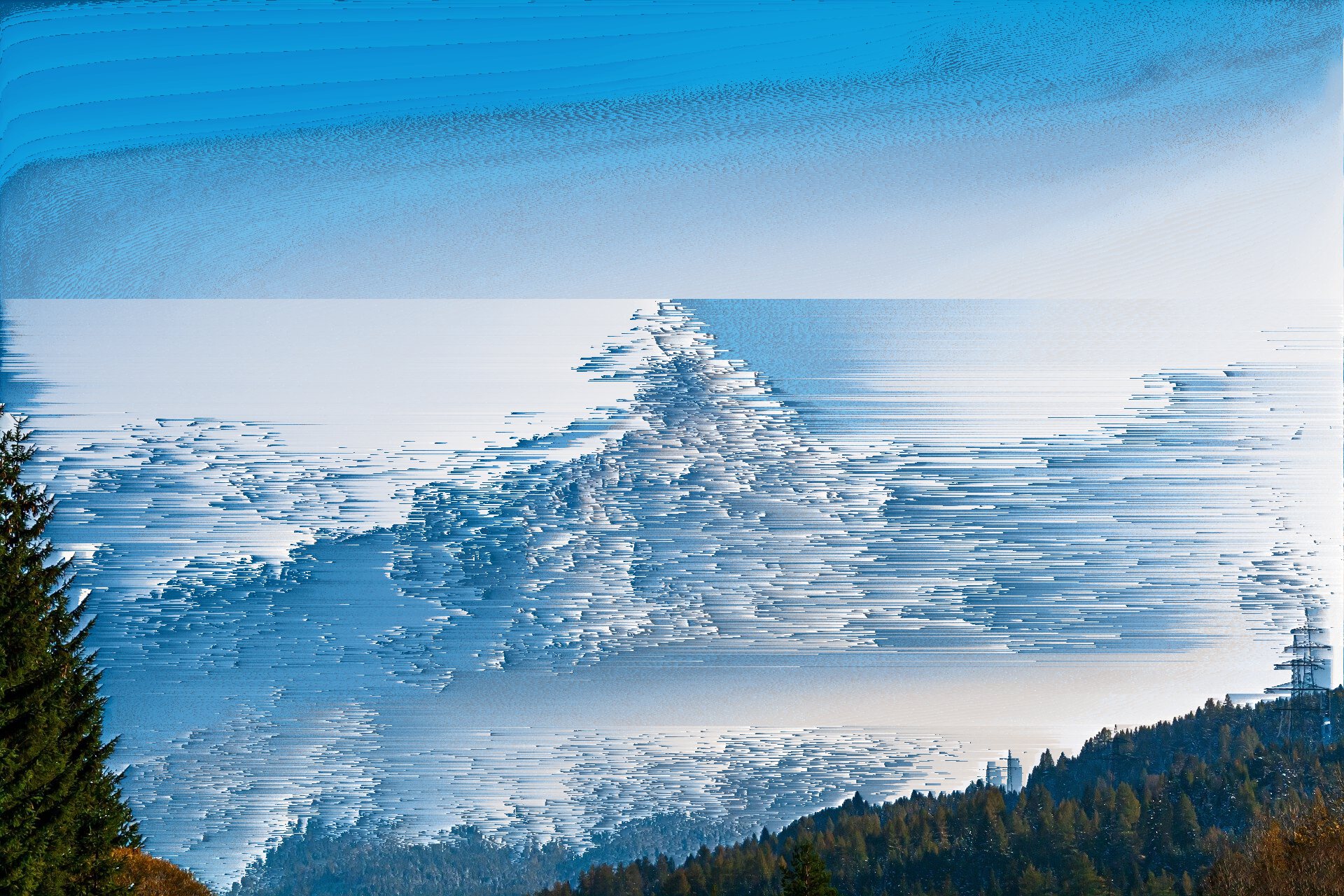
Kim Asendorf, 2010. The open-source script that seeded a generation of glitch and generative practice. (Self-hosted: artists/kim-asendorf/img/pixelsort-2010.jpg)
The technique operates at the level of the single pixel, treating the digital image not as a fixed representation but as raw material subject to rule-based transformation. This emphasis on process over product, and on the pixel as both carrier and subject of meaning, has remained constant even as Asendorf's technical means have evolved from desktop scripts to browser-based real-time systems.
Net Art Roots and Institutional Contexts
With formative roots in net art, Asendorf has consistently favored accessibility and direct encounter. Many of his works exist primarily as browser experiences or shareable code rather than as unique physical objects. This orientation has allowed his projects to circulate widely while also securing sustained institutional attention. His work has appeared in programs at Transmediale, ZKM Karlsruhe, the Whitney Museum's Dreamlands exhibition, The Photographers' Gallery in London, and numerous other festivals and museums.4 These contexts have situated his pixel-level operations within longer histories of media art, experimental film, and digital culture.
From Monogrid to Cargo: Blockchain and Real-Time Systems
The migration of Asendorf's practice onto blockchain platforms began with Monogrid in 2021, a project that translated his characteristic grid structures into mintable, interactive tokens. Cargo, released in March 2023 as a curated Art Blocks collection of 1,000 editions, represents a further step in this trajectory.5 Each output is a self-contained real-time WebGL animation written in JavaScript and GLSL. The work continuously redraws and resizes itself to the dimensions of the browser window, turning the collector's screen into an active compositional field rather than a passive frame.6
Visually, Cargo outputs present layered geometric forms, shifting color fields, and intricate interference patterns. The compositions suggest contained yet mobile digital matter, volumes that accumulate, disperse, and re-form without ever settling into a final state. The title evokes logistics and transport while the actual imagery remains resolutely abstract, continuing Asendorf's long-standing refusal of literal narrative in favor of systemic behavior.

2023, Art Blocks token 426000000

2023, Art Blocks token 426000200

2023, Art Blocks token 426000400

2023, Art Blocks token 426000599

2023, Art Blocks token 426000799

2023, Art Blocks token 426000999
Series outputs · live on Art Blocks
Pixel Matter: A Canonical Off-Platform Work
Alongside his on-chain projects, Asendorf has continued to produce significant work outside blockchain contexts. Pixel Matter, a 2022 collaboration with net art pioneer Olia Lialina presented at Roehrs and Boetsch in Curuna Ardez, stands as a major canonical achievement.7 The exhibition treated the pixel as both the irreducible building block of all digital imagery and a subject worthy of sustained artistic scrutiny. Works moved between screen-based animation, print, and installation, tracing how pixel structures construct visual meaning across different material supports.
The project exemplifies Asendorf's ability to move fluidly between solo algorithmic production and collaborative, historically reflective frameworks while maintaining a consistent focus on the pixel as the primary site of digital aesthetics.
COLORS OF NOISE, Sabotage, and Continuing Systems
Subsequent projects have extended the same systemic logic into new registers. COLORS OF NOISE (2023), presented on Feral File, maps spectral characteristics of audio noise into visual fields, creating immersive, continuously shifting patterns.8 Sabotage (2022) introduces deliberate interference into grid structures, allowing a disruptive agent to rearrange pixels and thereby dramatize the tension between order and entropy that runs through much of Asendorf's oeuvre.9 These works, together with more recent explorations such as PXL DEX, demonstrate a practice that remains in active development rather than resting on earlier technical or aesthetic solutions.
Legacy and Influence
Asendorf's influence extends beyond individual projects. His decision to release the pixel sorting algorithm as open source has shaped the visual vocabulary of countless digital works. Participation as one of the first fifteen artists in the MoMA Postcard project further signals recognition within the wider contemporary art conversation about digital media.10 The 2026 retrospective exhibition Complex at the Goethe-Institut Bangkok surveyed work from 2021 to early 2025, confirming his position as a central figure bridging pre-blockchain net art and the current generative ecosystem.11
In Cargo, the AB[500] presents an artist whose career demonstrates that the most compelling blockchain-based work often emerges from long, materially specific histories rather than from platform-native novelty alone. Asendorf's real-time, adaptive animations continue the essential project of generative art: to make visible the behaviors of systems that would otherwise remain abstract or invisible.
MOTZKO's digital art collection provides a collector-side view of that longer history through holdings spanning monogrid, SABOTAGE, Cargo, pixel works, and later on-chain animations.12
Bibliography
For the complete bibliography see the Kim Asendorf links page.