
- Artists
- Matt Hall and John Watkinson · Art Blocks profile
- Founded
- 2005
- Practice
- Generative systems, on-chain art, digital ownership, self-reference, software interfaces, and computational constraint
- Raster
- raster.art/artist/larva-labs
- In the set
- Quine · 497
- AB[500]
- 1 project · 497 editions
- Links
- Full bibliography
- oTDH
- 2,792 · rank 307 of 308
- Holding signal
- 316 collector identities · 318 holder addresses · 141,743 raw collector-days · 14 Sep 2026
- Collector TDH
- lalTDH · dashboard
Larva Labs is the two-person studio of Matt Hall and John Watkinson. They met while studying computer science in the 1990s, continued working together after graduation, and formed the studio in 2005. Their biography is less a sequence of media than a sequence of technical questions. What can a phone do before the smartphone? Can a digital portrait be owned? Can an artwork live entirely inside a blockchain? Can an image contain the source code that produces it?1
That investigative continuity matters. Larva Labs did not arrive at art by applying a brand to software. Hall and Watkinson made software the place where an artwork's appearance, rules, ownership, circulation, and preservation could be designed together. CryptoPunks tested digital collection and exchange. Autoglyphs moved the generator and its output on-chain. Quine turns the generator inward, making a program that displays and reproduces its own instructions.
The image contains its cause. To look at a Quine is to look at colour, structure, text, and executable procedure at once.
From portrait to protocol
CryptoPunks began in 2017 with 10,000 algorithmically assembled, 24-pixel portraits. The figures draw on punk and cyberpunk cultures, but the project's decisive invention is systemic. Larva Labs paired a finite generative set with verifiable ownership and a marketplace written into the contract. Collectors could claim, offer, bid, buy, and sell without a conventional dealer or platform standing between the work and its exchange.2
The portraits became identities as well as collectables. A holder could use one as a public face, and a visual grammar of types and attributes made ten thousand tiny images socially legible. Yet the work was always larger than the composite sheet. Its form included the generator that produced difference, the contract that recorded ownership, the market that circulated the portraits, and the community that animated those mechanisms.
NODE's 2026 exhibition 10,000 made this expanded form explicit. Instead of presenting the Punks as inert pictures, it exposed code, palette, attributes, and live market events. Bids, offers, transfers, and Ethereum blocks became movements in a continuing software system.3 That curatorial model clarifies Larva Labs' central proposition: in computational art, an interface and a rule can be as materially significant as an image.
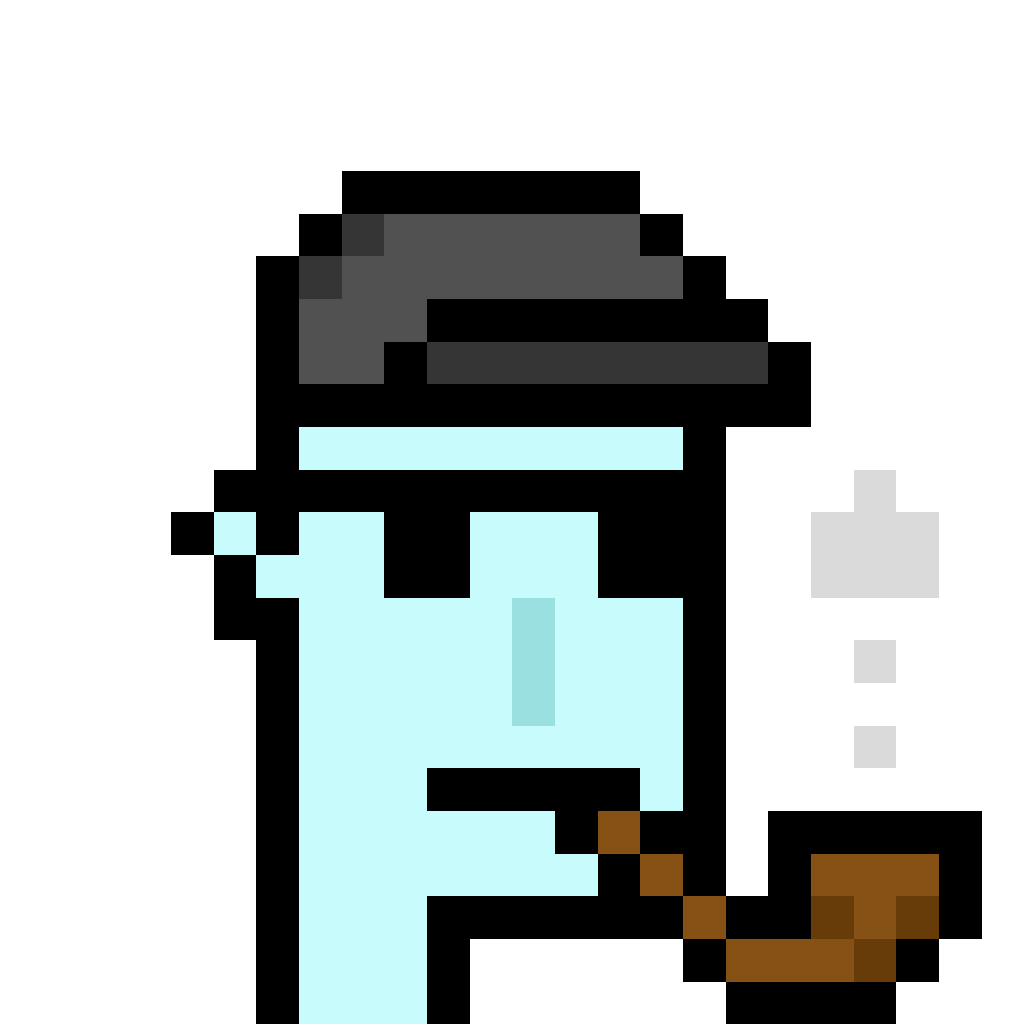
Larva Labs, 2017 · 24×24 pixels · one of nine Aliens
The algorithm as the artwork
Autoglyphs, released in 2019, pursued a stricter problem. CryptoPunk ownership was registered on Ethereum, but the original images were referenced from outside the contract. Hall and Watkinson asked whether the artwork itself could be created and preserved on-chain. The answer was a 512-work generator embedded in the smart contract. A collector paid a 0.2 ETH donation to the climate organisation 350.org, triggered the algorithm, and received a unique arrangement of simple typographic marks.4
The output could be read as text, drawn on a screen, plotted with a pen, or realised through other instructions. Larva Labs connected this openness to Sol LeWitt's wall drawings, where an instruction set guides each material execution. Centre Pompidou places the work beside the constraints and visual languages of computer-art pioneers Ken Knowlton and A. Michael Noll.5
Autoglyphs established two ideas that Quine would intensify. First, the program can be the primary artwork, while any single rendering is one encounter with it. Second, severe computational limits can produce conceptual clarity. On-chain storage is expensive and narrow. Rather than hide those limits, Larva Labs made them the condition from which the visual system had to grow.
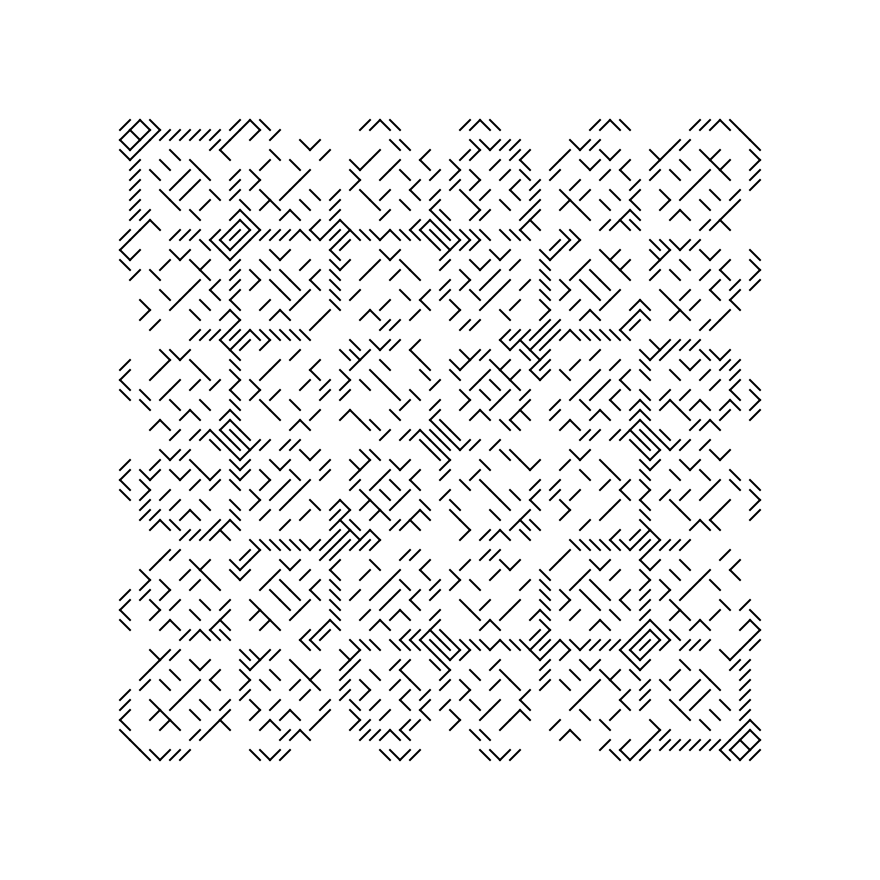
Larva Labs, 2019 · generated and stored on-chain · held by Centre Pompidou
A final project about beginnings
Art Blocks invited Larva Labs to make the last project in its Curated AB[500] collection. The invitation carried an awkward freedom. Hall and Watkinson usually begin with a product or technical constraint, but Art Blocks offered a general platform capable of hosting almost any browser-based generator. They responded by choosing a constraint that could address the platform itself: make code visible, active, and central to the composition.6
A quine is a computer program that produces its own source code as output. Larva Labs extended that logical object into a visual one. The main Art Blocks script does not directly draw a finished composition. It assembles a smaller, token-specific generator from selected fragments for rendering, colour, symmetry, and text layout. That child program then creates an image in which its own source is embedded. Copy the code from the image, run it, and it can regenerate the work.7

Larva Labs, 2025 · 497 editions · AB5D treasury
The work turns a familiar hierarchy inside out. In most generative art, code remains backstage while the rendered image receives attention. Here the source becomes composition, and the composition becomes a transport layer for the source. Nothing is merely illustrative. The coloured cells determine where the program can be read; the program determines the coloured cells.
A program listing as a picture plane
Each Quine is organised as a 78 by 148 field inside a larger 90 by 160 grid. The proportions recall the tall windows and monospaced columns of a code editor. Every cell may be coloured or blank, creating a structure in which typographic marks can remain readable while also participating in pattern, density, rhythm, and figure-ground reversal.8
Most outputs are subliminal: their code occupies coloured cells. A smaller group is liminal, placing code in uncoloured cells. The terms make a visual operation out of a conceptual threshold. Source can sit inside colour or emerge through its absence. In either case, the text crosses between instruction and image.
Five engines control the primary spatial organisation. Shape overlays geometric forms. Force applies Newtonian calculations to horizontal and vertical lines. Ribbon bends intersecting bands through force fields. Lattice evokes encoded transmission patterns. Glyph adapts ideas from the Autoglyphs generator. Other variables govern symmetry, Euclidean or non-Euclidean space, chrome, colour, and text placement.9


Four evenly spaced outputs show the flagship algorithm's range.
The range is broad without disguising kinship. Some works read as diagrams, woven textiles, circuit maps, television test patterns, or compressed architectural plans. Others become nearly heraldic. Their shared grid and typographic pressure keep the edition coherent. Variation does not come from changing the work's premise; it comes from repeatedly testing how much that premise can contain.
Quinity and the moving original
Self-reproduction is not limited to exact repetition. A Perfect-Quine returns its own source in one step. An N-Quine produces another related program, which produces another, until the sequence eventually loops back to the first. A rare Pseudo-Quine continues generating related programs without closing the loop. Larva Labs calls the length and kind of this cycle the work's quinity.10
This makes a token potentially plural. A five-generation Quine contains five distinct but related visual states. None is a preparatory sketch, and none simply replaces an earlier version. Together they form one cyclic program whose identity lies in recurrence.
Art Blocks' PostParams system gives the owner a specific role within that structure. A collector can select which generation serves as the token's poster image across the platform and compatible marketplaces, then change that selection later. The underlying Quine remains the same, but its public face is chosen by its custodian.11
The intervention is constrained rather than expressive in the usual sense. The collector cannot redraw the work or alter its source. They navigate an authored set of states. Ownership becomes editorial attention: which moment in the loop should stand for the loop now?
Colour under pressure
Quine was the first Larva Labs project that required Hall and Watkinson to think about colour primarily as abstraction. In CryptoPunks and Meebits, colour usually described a thing: skin, hair, clothing, an accessory, a voxel surface. Quine has no character to colour. Hue must articulate force, interval, figure, and code density.12
That shift makes the works look unexpectedly historical. Their gridded bands can recall geometric weaving, early computer graphics, hard-edge painting, or broadcast calibration, but those affinities are not stylistic quotations pasted over software. They emerge from how the program must fit itself into a finite rectangular field.
The code also signs the image from within. A comment near the end identifies the token, generation, and Larva Labs authorship. In certain outputs the signature remains intact on one line, a trait the studio calls a Perfect Sig. The gesture is both modest and profound. The signature is not metadata applied after completion. It belongs to the executable material and is regenerated whenever the work runs.13
Standing behind a distribution
Long-form generative art asks an artist to release a system before knowing each result. Hall and Watkinson describe the difficult late stage of moving beyond attractive test outputs and judging the average, and even the weakest, possibilities. The artist cannot rescue the edition by selecting only successes after minting. They must stand behind the generator's entire distribution.14
Quine adds a second standard. Every output must work visually, but its displayed source must also remain functional. Composition and computation cannot drift apart. An adjustment to line, colour, or density may affect legibility; a change in code length may alter the image that must contain it. Code golf, the craft of reducing a program to fewer characters, becomes pictorial editing.
This reciprocal pressure distinguishes Quine from art that prints source as decoration. The text is not a symbolic claim to technical depth. It must run. The visual field is therefore accountable to the program, and the program is accountable to the visual field.
The edition as an instrument
Quine's 497 works should not be understood as 497 illustrations of one idea. The edition is the instrument through which the idea becomes knowable. One output can demonstrate self-reference, but it cannot reveal the balance among engines, spatial modes, colour systems, symmetries, code placement, and quinity. The set turns a hidden parameter space into a public field of comparison.
This is the long-form wager that Larva Labs inherited from Art Blocks and helped establish through Autoglyphs. An artist publishes a generator rather than a final image. Collectors execute that generator under controlled conditions, and the resulting edition becomes a finite record of an otherwise much larger possibility space. Hall and Watkinson describe this fixed set as a particularly effective way to explore an infinite algorithm because it gives variation a boundary and each output a durable place inside the whole.15
The model changes where artistic judgement operates. In a conventional series, an artist may produce many candidates, reject some, revise others, and release a selected group. In Quine, judgement is concentrated before release. The artists choose engines, distributions, exceptions, thresholds, and relationships, then accept the unpreviewed combinations those decisions produce. The edition records not only what the generator can do, but what Hall and Watkinson were willing to author without seeing in advance.
That does not make every output interchangeable. A Quine's specific code, pattern, loop length, and display state give it an individual identity. Yet individuality is relational. A rare Pseudo-Quine becomes legible because Perfect-Quines and finite N-Quines establish the norm it departs from. A quiet field gains meaning beside dense lattices and force-driven ribbons. The collection is therefore both archive and measuring device.
Preserving a behaviour
Larva Labs' trajectory can also be read as a series of answers to digital art's preservation problem. CryptoPunks placed ownership and exchange on Ethereum, then later added fully on-chain access to images and attributes. Autoglyphs embedded the generator and drawing instructions in the original contract. Quine goes further by placing reconstructive information inside each visible result. Preservation becomes part of what the artwork depicts.
This does not mean that software escapes history. A Quine still needs an interpreter, a display, and someone prepared to execute it. Its colours will appear on particular screens; its code will be copied through particular interfaces; its PostParams state will be presented by particular services. Self-containment is not isolation from every dependency. It is a decision to preserve the work's operative logic as openly and compactly as possible.
Autoglyphs made a similar distinction. The contract returns instructions rather than prescribing one privileged physical form, so a glyph can be drawn by a browser, a plotter, or a person. Artnome's launch interview records Hall and Watkinson asking whether art, provenance, rules, and operation could all become self-contained and open.16 Quine answers with a feedback loop: the program preserves an image, and the image preserves a program.
The result is not merely durable data. It is durable behaviour. A static render can document how a Quine looked at one moment. The embedded source preserves the possibility of making it act again, including movement through generations and the production of its signature. That distinction is central to Larva Labs' historical importance. They design works to survive not only as files that can be viewed, but as procedures that can still produce consequences.
From on-chain object to public institution
By the time Quine appeared, Larva Labs' earlier works had entered museums that approach blockchain art through different histories. The Whitney holds Autoglyph #115 as generative digital art. Centre Pompidou holds both an Autoglyph and a CryptoPunk, placing the former in relation to instruction art and early computer graphics. ZKM exhibited CryptoPunks and Autoglyphs alongside A. Michael Noll and Kenneth Knowlton, treating compact on-chain code as part of a longer history of computational constraint.17
Quine was also presented materially. At Art Basel Miami Beach in December 2025, Art Blocks displayed the full 497-work edition in a custom vitrine and offered ten signed, framed artist proofs. The translation did not convert code into a conventional picture so much as test how a self-contained digital system could occupy the visual and commercial architecture of an art fair.18
These institutional settings expose a productive tension. Larva Labs builds work that can persist and execute without depending on a museum, yet museums and exhibitions can make the work's historical relations visible. Autonomy does not eliminate interpretation. It gives interpretation a durable object to meet.
Why they belong in the AB[500]
Larva Labs belongs in the AB[500] through a single project with unusual finality. Quine is the last Art Blocks Curated release and a concentrated reflection on the conditions that made the collection possible. Art Blocks established a public method for publishing an algorithm, minting unknown outputs, and collecting a finite sample from an open-ended system. Quine turns that method into its subject.
The project also completes a line across the studio's major work. CryptoPunks joined generative images to digital ownership and exchange. Autoglyphs put the generator and artwork on-chain. Quine binds source and appearance so tightly that each can recover the other. The progression is not toward greater visual complexity. It is toward fewer separations between artwork, instruction, execution, and record.
There are 497 Quines in the AB[500]. Each is a token, an image, a program listing, a generator, and, for N-Quines, a loop of related states. The edition closes Art Blocks Curated by returning attention to the small, strange fact beneath every project in the set: before the image, there was code. Larva Labs makes that fact visible, then makes it run.
Bibliography
The references cited here are listed below. For the complete 48-source ledger, see the Larva Labs bibliography.