- Artist
- Zach Lieberman · site
- Based
- 1977, New York City
- Raster
- raster.art/artist/zach-lieberman
- In the set
- Box Light Studies · 100 editions
- Links
- Full bibliography
- oTDH
- 3,804 · rank 305 of 308
- Holding signal
- 63 collector identities · 63 holder addresses · 57,515 raw collector-days · 14 Sep 2026
- Collector TDH
- zlTDH · dashboard
Zachary Lieberman is an artist, researcher, and educator whose simple stated goal is to surprise.1 Born in 1977, he holds a BA in Fine Arts from Hunter College and an MFA in Design and Technology from Parsons School of Design, where he later taught for more than a decade.2 His trajectory from printmaking and sculpture to computational art was catalyzed by an accidental encounter with Flash and ActionScript, which connected what he has described as the math and logic part of his brain to an already developed visual sensibility.3 What began as a practical necessity, learning to code for web design work, evolved into a lifelong practice of writing software as a form of poetry.
Lieberman is perhaps best known as the co-creator of openFrameworks, an open-source C++ toolkit for creative coding first released in 2005 that has become foundational infrastructure for a generation of artists working with code.4 The project, developed with Theo Watson, was conceived as a simple, intuitive library that would lower barriers to entry for artists seeking to work with computation, embodying the same spirit of generosity Lieberman had encountered in early Flash communities and the printmaking studios of his student years.5 For this work, openFrameworks received an Honorary Mention at Ars Electronica in 2008, and it continues to thrive through the contributions of a global community of practitioners.6
From Gesture to Light
Lieberman's artistic practice has consistently explored the amplification of human gesture through technology. In 2003, while artists in residence at the Ars Electronica Futurelab in Linz, Austria, Lieberman and Golan Levin created Messa di Voce, an interactive audiovisual installation in which the speech, shouts, and songs of two vocalists are radically augmented in real time by custom software, transforming every vocal nuance into complex, expressive graphics.7 The work has been presented in more than twenty venues across twelve countries and stands as a landmark in the history of interactive media art.
Other major works include Drawn, an installation that redeems the hand trace of drawing by creating animated works freed from the sensation of automatism, and Mas Que la Cara, a public art installation in Downtown Houston that augments participants' faces with dynamically generated masks responding to their movements.8 His work has been exhibited at major institutions including the Museum of Modern Art (MoMA) in New York, the Exploratorium in San Francisco, and the Museum of Digital Art (MuDA) in Zurich.9
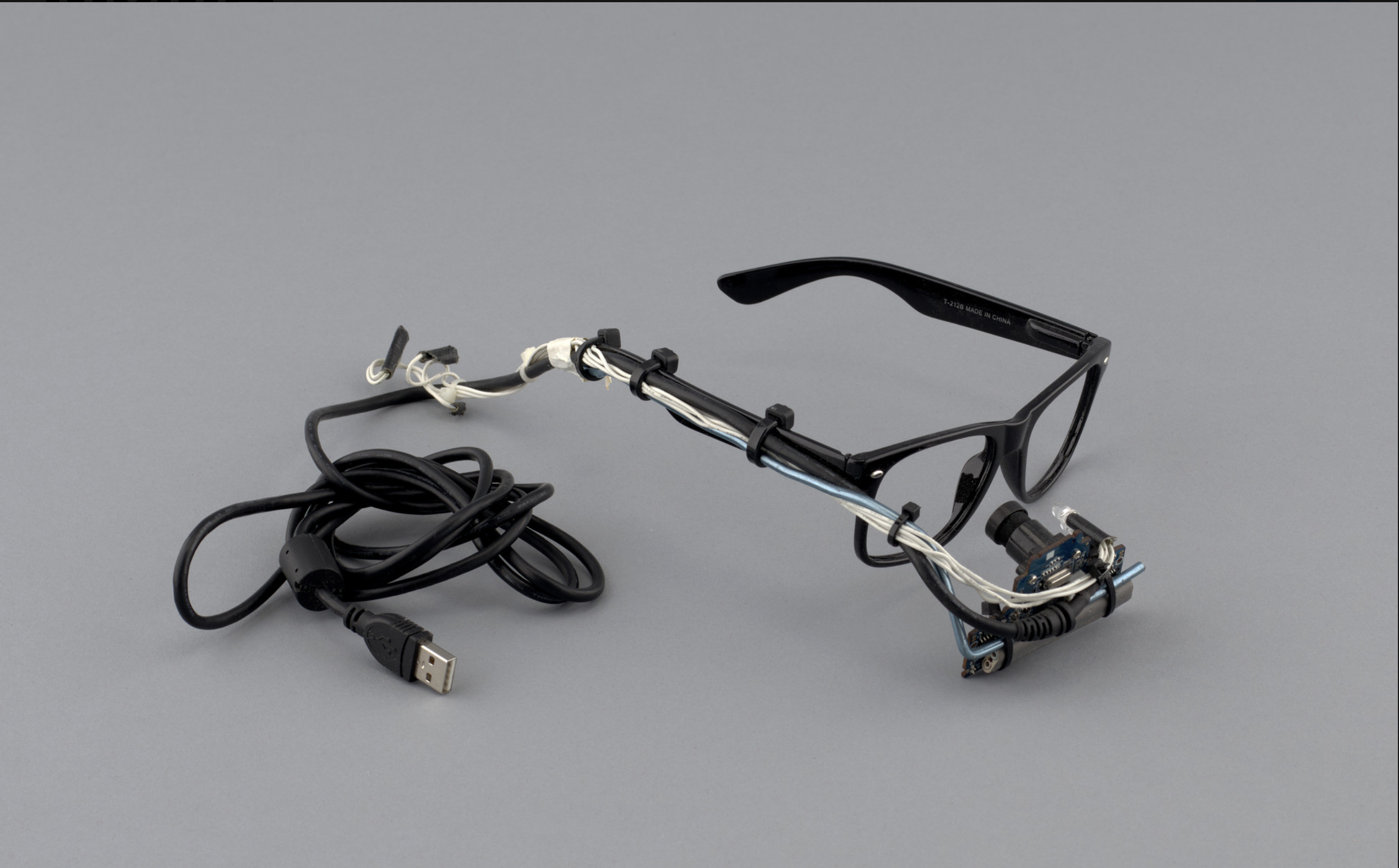
Zach Lieberman, James Powderly, Evan Roth, Chris Sugrue, Tony TEMPT1 Quan, Theo Watson, 2009
openFrameworks and custom software, eyeglasses, PlayStation Eye camera, IR pass filter, IR LEDs, battery clip, resistor, zip ties, and flexible metal wire
Collection: MoMA, New York. Exhibited in Talk to Me (2011) and This Is for Everyone (2015-2016).
The EyeWriter and Social Practice
Of all his projects, Lieberman has said that the EyeWriter holds the most personal value.10 Developed in 2009 with James Powderly, Evan Roth, Chris Sugrue, Theo Watson, and Tony TEMPT1 Quan, the EyeWriter is a low-cost, open-source eye-tracking system that enables people with paralysis to draw using only their gaze.11 The project was originally created to help the legendary graffiti artist TEMPT1, who was suffering from ALS, to paint again. Using a modified PlayStation Eye camera, infrared LEDs, and openFrameworks-based software, the team built a device that cost approximately fifty dollars, a fraction of the price of proprietary medical systems.12 TEMPT1's drawings were projected in real time onto buildings throughout Los Angeles, and the project won the Golden Nica in Interactive Art at Prix Ars Electronica in 2010, as well as being listed among Time Magazine's Best Inventions of the Year.13 The EyeWriter entered the permanent collection of MoMA and has been exhibited there multiple times, including in the landmark Talk to Me exhibition in 2011 and This Is for Everyone: Design Experiments for the Common Good in 2015-2016.14
Pedagogy and Institutional Life
In 2013, after a decade of teaching at Parsons, Lieberman co-founded the School for Poetic Computation (SFPC) in New York, an artist-run school offering low-cost, intensive ten-week sessions that function as a hybrid of artist residency and seminar.15 At SFPC, students and faculty explore the intersections of code, design, hardware, and theory, with a particular emphasis on artistic intervention and the lyrical possibilities of computation. He currently serves as an adjunct associate professor at MIT's Media Lab, where he leads the Future Sketches research group, continuing to investigate the essence of code as a creative medium.16
His influence extends through the countless artists, students, and practitioners who have learned to think about code as a creative language through his teaching and his generosity in sharing ideas. Lieberman has been named one of Fast Company's 100 Most Creative People in Business and has received numerous awards including the Interactive Design of the Year from Design Museum London.17
Box Light Studies in the AB[500]
Lieberman's contribution to the AB[500], Box Light Studies, consists of 100 editions of algorithmically generated light compositions.18 The series extends his long-standing fascination with how computational logic can generate organic, almost living visual phenomena, and how simple rules can evolve into complex, contemplative systems. Each output explores the behavior of light within bounded spaces, creating luminous geometries that feel simultaneously mathematical and poetic.

2024, token 0

2024, token 20

2024, token 40

2024, token 59

2024, token 79

2024, token 99
Series outputs · live on Art Blocks
The variety grid above demonstrates the range of outputs across the collection, from tightly geometric arrangements to more diffuse, atmospheric compositions. The work reflects Lieberman's commitment to what he calls daily sketching, a practice of making small artworks with code that he has maintained since 2016, posting them to social media as a way of saying hello to the world.19 This way of working openly, as he describes it, has radically reshaped his thinking about making and has become a model for a generation of computational artists.
Off-Platform Canonical Works
Beyond the Art Blocks ecosystem, Lieberman's canon includes major works that have shaped the field of interactive and generative art. Circles, Blobs, Ripples, exhibited at Unit London in 2024, focuses on the three motifs that have come to define his singular style, testament to his mastery over mathematical systems and his ability to create moments of quiet reflection and contemplation.20 The Daily Sketches project, begun in 2016, represents a deliberate turn away from the exhibition object as primary output, treating Instagram as an intimate studio journal rather than a marketing platform.
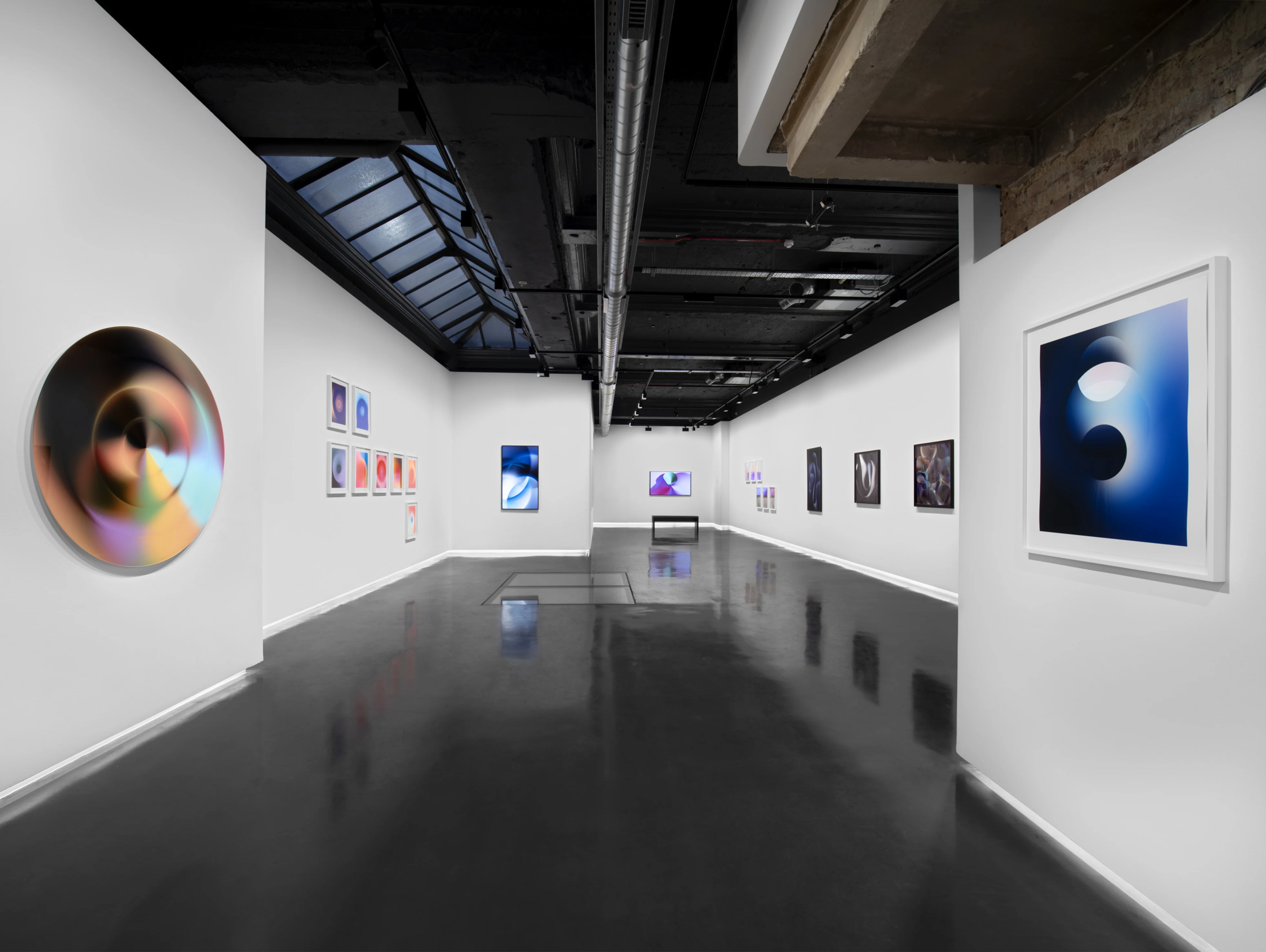
Zach Lieberman, 2024
Installation view, Unit London, March 2024
Source: Unit London / Courtesy the artist.
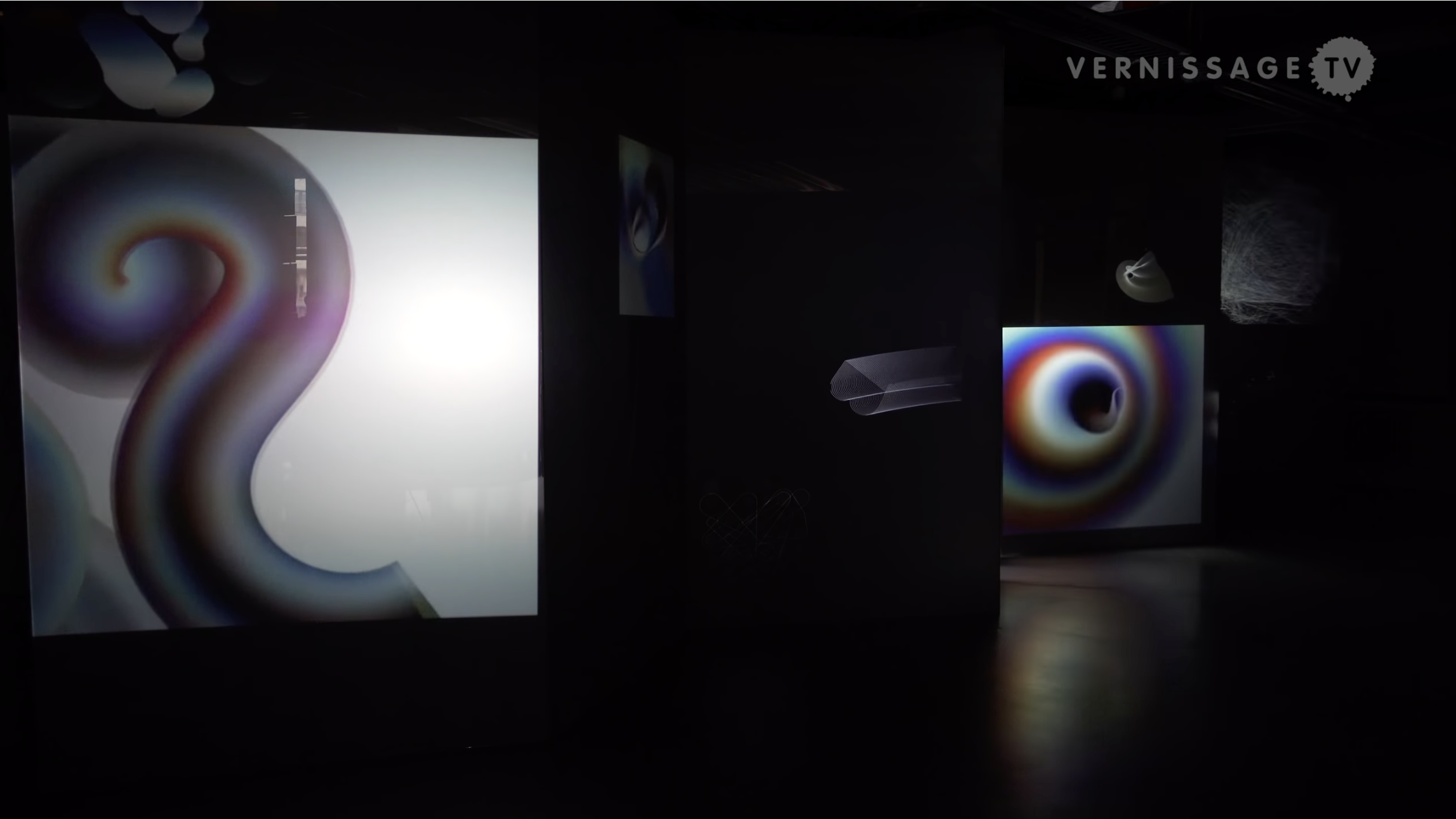
Zach Lieberman, 2016-ongoing
Exhibition view, MuDA Museum of Digital Art, Zurich, 2019
Source: MuDA / Courtesy the artist.
Legacy and Influence
Lieberman's influence on contemporary art and technology is difficult to overstate. Through openFrameworks, he helped build the infrastructure that enables thousands of artists to work with code; through the School for Poetic Computation, he has shaped the pedagogical model for alternative art education in the digital age; and through his daily practice of sharing sketches openly, he has modeled a way of being an artist online that prioritizes process over product and community over spectacle.
His work has been recognized with a Golden Nica from Ars Electronica, Interactive Design of the Year from Design Museum London, inclusion in Time Magazine's Best Inventions, and a place on Fast Company's list of the 100 Most Creative People in Business.21 Yet his significance arguably lies less in individual accolades than in the ecosystem he has helped cultivate: a global community of practitioners who have learned to think about code as a creative language through his tools, his teaching, and his example.
Bibliography
For the complete bibliography see the Zach Lieberman links page.