
BUSY
James Merrill · Project 504 · Curated
Art Blocks Curated, project 504 · 50 outputs · ranked auction 8–9 April 2025 · CC BY-NC 4.0


BUSY #35 (City, CMYK, Circular turbulence), held by AB5D. Render: Art Blocks media proxy.
The work and its context
BUSY is project 504 on the Art Blocks contract 0xab0000000000aa06f89b268d604a9c1c41524ac6. The index records 50 invocations against a maximum of 50, the runtime p5@1.9.0, an aspect ratio of 0.733 (22:30), the vertical "curated" and the licence CC BY-NC 4.0 with a link to the Creative Commons deed 1. The project text calls it "a generative reflection of urban complexity and interconnected systems", made by an artist working "at the intersection of code and mechanical plotting" in a Vermont studio 1.
Each output is a portrait sheet packed with bundles of parallel coloured lines that turn and knot like pipes or streets. Between them sit hand-drawn buildings, cars, parks, billboards and small machines. The description names the source of that density: "highly detailed Wimmelbilder scenes", the German hidden-object picture books 1. Merrill's own account adds Where's Waldo? and Richard Scarry, and the aim of making viewers "sit with the art for extended periods" 2.
BUSY is also a physical edition. Merrill's project page lists 50 standard ink drawings at 30 × 22 inches and five "ultra large" drawings at 60 × 24 inches, all made on drawing machines in his studio in 2025 3. The five large sheets are the separate Art Blocks project BUSIEST (project 503), which shares BUSY's code 12.
Conception and development
Merrill came to generative art through pen plotters. In his long essay "Creating BUSY", published on the day the auction closed, he describes finding #PlotterTwitter in 2019 and buying an AxiDraw A3, and then early success with A Series of Tubes (2020) 2. Earlier interviews describe a self-taught route through Flash and ActionScript, and a view of mathematics as "my greatest enemy, and it's also my most used tool" 4. The Art Blocks interview with Jordan Kantor covers his earlier project ORI and a taste for work that takes "hundreds of hours to simulate and render" 5.
The project text credits the man-made city: "I often observe cities as layered systems that we've normalized through familiarity" 1. A later profile ties the idea to a post-pandemic visit to New York, where Merrill found that "there was order in the chaos" 6.
"Creating BUSY" sets out the design. Merrill says he "began to consider BUSY more of a framework than a single artwork" 2. He built a pipeline that turned his own SVG drawings into geometry the algorithm could place. He made the program work to "a fixed density level per square inch", so one composition could be drawn at different paper sizes. After much trial he solved overlapping shapes with "a math-based solution instead of a buffer-based one" 2. The essay also covers the production side:
- fountain pens with archival ink
- a 3D-printed pen holder to keep the "5-12 separate ink layers" in register
- LED progress clocks wired to the plotters
- a commitment to "500-700 hours of drawing time" 2
Two site-specific versions came first and after. BUSY In Marfa swapped in about 50 local landmarks, drawn from Google Street View, and was plotted live at the Art Blocks weekend in Marfa, Texas, in 2024. One visitor had the Marfa water tower drawing tattooed "on someone's forearm" 23. BUSY In Istanbul added Istanbul landmarks and was plotted live at the Istanbul Digital Art Festival in 2025 7. He has also discussed the project on video 8.
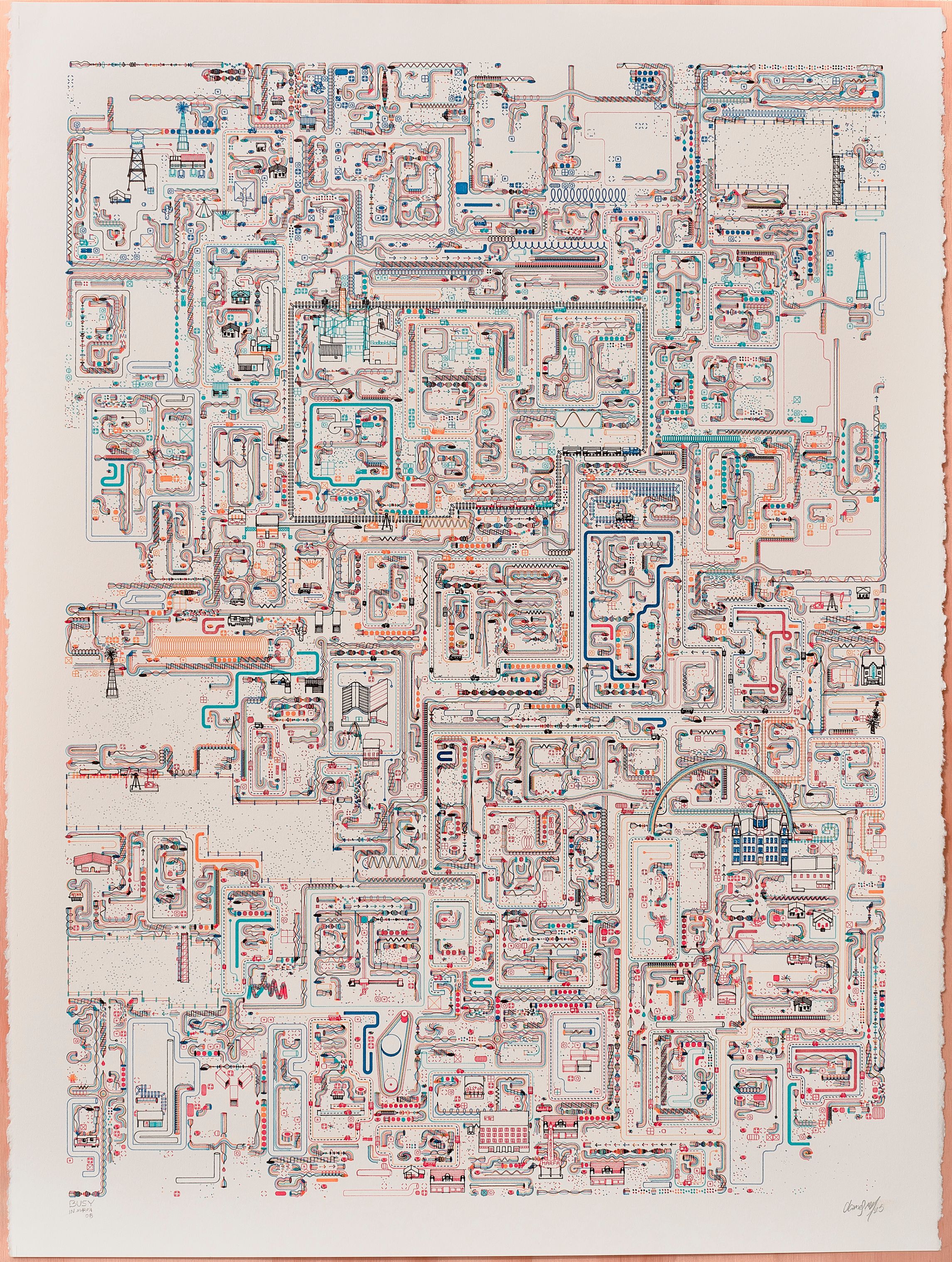
BUSY In Marfa (2024), ink on paper, signed lower right. Photo: James Merrill / lostpixels.io.
How the work was constructed
The program is nine script parts that concatenate to 251,648 bytes, SHA-256 2f43df1d6e02a1260e535256082d399bc58f6090002e046455f7330d24e5cf5a. It was read in full, apart from two embedded blocks that were characterised rather than read line by line 1:
- A vector sprite library of about 116 KB. It uses a compact text format of colours, shapes and reusable paths and decodes to 155 named entries, most of them a drawing paired with its mask. The sprites include 26 small buildings ("a0"), 20 larger blocks ("a2"), four "a1" pieces, eight trees, cars seen from three angles, trains, a boombox, two cameras, a Ferris wheel, a pool, two parking lots and a pen plotter 1.
- Bundled libraries. These are the MIT-licensed splay-tree and polygon-clipping code and a set of robust geometry predicates, used to merge rectangles into loop outlines 1.
The rest is Merrill's own minified code.
Seeding. The token hash is split into two 128-bit seeds for two small generators. They are used in turn, after 500,000 warm-up calls each. They draw the five traits and then a seed for p5's own random and noise functions, which drive everything else 1. Replaying the trait draws for all 50 hashes in Node reproduced every published trait value exactly (own computation) 1.
The grid. The drawing is laid out on a grid over a 22 × 30 inch sheet with a 1.5 inch border. The density trait sets the cell size, the number of inks in each pipe bundle and how many landmarks are placed (code reading) 1.
| Density (program weight) | Grid (cells) | Inks per bundle | Landmark target | Count of 50 |
|---|---|---|---|---|
| City (20/51) | 126 × 180 | 6 | 1 | 16 |
| City XL (16/51) | 135 × 192 | 5 | 1,000 | 15 |
| Detail (5/51) | 135 × 192 | 3 | 1 | 8 |
| PIPES!!! (5/51) | 118 × 168 | 7 | 5 | 6 |
| Thin Air (5/51) | 111 × 158 | 4 | 40 | 5 |
Counts from the index; other columns computed from the code 1.
Building the scene. The program works in stages over many frames:
- Landmarks. It places landmarks by weighted draw. They include sprite buildings (weight 90), the pen plotter (100), parking lots, parks, lakes, billboards, rainbow arches, dot fields and wheel-and-belt machines.
- Walkers. It sends out walkers that claim grid cells:
- one large self-closing loop, in City, Detail and PIPES!!!
- smaller loops traced round merged rectangles
- junction pieces (the "furball" knot, a four-way splitter, a three-way split and a crossing), each sending out four or three pipes
- "solo" walkers that wander until 70 to 95 per cent of the grid is taken, depending on density
- Micro-units. It fills the remaining cells with small ornaments: rounded boxes, fans, tanks and crossed squares 1.
Drawing the pipes. Every pipe is cut into starts, straights, corners and ends. Each straight gets one of 18 decorative treatments: braids, beads, drips, springs, woven swaps and dotted runs. Many of them shuffle the order of the inks, so colours cross over along a pipe 12.
Plotter-ready output. Nothing is filled. Solid areas are hatched with parallel strokes, and every mark is a line a pen can draw. Shapes are clipped against the masks of objects lower on the page, which gives the scene its stacked, slightly aerial look. This is the geometric occlusion Merrill describes 12.
A saveCanvas URL parameter switches to an SVG canvas and downloads BUSY-<hash>.svg for plotting. A batch parameter saves a PNG and reloads the page (code reading) 1.
The other four traits work as follows (code reading unless stated) 1:
- Palette is drawn from eight weighted entries. Seven have weight 2 and Mega has weight 1. Published counts are CMYK 11, Robot 10, Fogged 9, Mega 6, Ls 5, Lovely Monday 4, Dark Days 4 and SKIBLADE 1. Each palette lists its inks, a set of accent colours for sprite outlines and a "diffusion" factor.
- Turbulence sets how likely a walker is to turn at each cell, from 1 to 15 per cent. The chance rises across the sheet in the named direction, peaks at the centre for Circular, or is random or low (Minimal).
- Direction sets each cell's preferred heading. It only sets the first step of solo walkers.
- Ink Distribution picks landmark and fill colours by position on the sheet: top to bottom, along a diagonal, or at random. It does not affect the pipes, whose inks are drawn at random.
While it computes, the page previews the walkers' paths under joke loading messages such as "Reticulating Splines". Then the pipes and small fills are drawn outwards from the centre 1.
Quirks in the algorithm
- BUSIEST is hidden inside BUSY. The script contains a mode switch for a 60 × 24 inch sheet, a "busiest" density and the CMYK palette. It also contains a list of five fixed hashes that replace the token's own hash according to its token number. In BUSY the switch is never set. The BUSIEST script (project 503) sets it at the top. Each of its five tokens therefore renders a hand-picked seed, not its on-chain hash, which is why the index records no features for them (own comparison of the two scripts) 1.
- Highways and trains never appear. A flag that removes the "highway" and "railroad" pipe types is on in every density except the hidden "busiest" one. The highway cars, the railway sleepers and the three train sprites can therefore never be drawn in a BUSY token (code reading) 1. Cars still appear, but only in parking lots.
- Dead branches. Several pieces of code can never run in a BUSY token (code reading) 1:
- The "busiest" density has weight 0, and a sixth density preset is defined but never listed.
- A constant always picks the second parking-lot design, so the first lot and its car layout are never used.
- An electric-pole routine refers to a class that does not exist.
- A "wheel twister" junction is missing from its weighted list.
- A one-cell ornament has weight 0.
- One helper only consumes a random number.
- A precedence slip. In the fountain and in the spiral lake fill, a random angle is multiplied by a random number and compared with 0.5 before the sign is applied. The twist is therefore always plus or minus one radian, never the wider range the code seems to intend (code reading) 1.
- A missing
break. When a walker picks a new direction, the "down" option falls through to "left". So a downward turn is tested against the cell to the left (code reading) 1. - Caps that do not cap. Landmark limits written as pairs, such as lakes [0, 3] and arches [0, 1], choose one of the two values rather than a range. A limit of 0 still allows one, because the count is checked only after the object is built. Sprite limits choose the same way, so each output allows either no Ferris wheel or up to four (code reading) 1.
- Palettes can lose inks. When "diffusion" is above 1, the ink pool is filled by drawing with replacement, so some inks may never be picked. Replaying p5's seeded generator shows 10 of the 50 tokens missing at least one listed ink. Pixel counts on the renders confirm three of them: #28 has no Dark Days dark blue, #34 no fire orange, and #47 neither fire orange nor black 19.
- SKIBLADE's rarity is luck. SKIBLADE has the same weight as six other palettes, 2 in 15. One or fewer in 50 draws has a probability of about 0.7 per cent (own computation) 1.
- Browser-dependent blending. When drawing starts, the page detects the browser. Safari, Firefox, Edge and Opera switch to multiply blending, where overlapping inks darken as they would on paper. Chrome keeps normal blending (code reading) 1.
- Leaks from renaming. The minifier seems to have replaced substrings throughout the file. The browser's
subtreeoption reads "sube2", the tree sprites are named "e2-1" to "e2-8", and a console message reads "Placed … c6 in … iterations" 1. - Messages for the curious. The pen plotter sprite prints "Hey you! Look around coords" with its grid position to the console. When the drawing finishes, a message dates the work to "April 2024 - March 2025", thanks "Bantam Tools for making EPIC drawing machines" and reports how many times the random function was called 1. There is no mouse or keyboard input (code reading) 1.
The most coveted variants
No published collector guide or sales analysis of BUSY was found. What follows rests on the index, the code and the renders, and makes no claim about market preference.
SKIBLADE (1 of 50). #22 is the only SKIBLADE, a cool palette of blues, blurple and petrol, here on a Detail density with Diagonal left ink distribution 1.

BUSY #22, the only SKIBLADE. Render: Art Blocks media proxy.
City XL (15 of 50). These are the outputs closest to a Wimmelbild. With up to 1,000 landmarks placed before the pipes, buildings, parks, billboards and machines crowd the sheet. #16 is a Robot City XL with Diagonal right ink distribution 1.

BUSY #16, City XL. Render: Art Blocks media proxy.
PIPES!!! (6) and Thin Air (5). PIPES!!! carries the widest bundles, seven inks, and only five landmarks. Thin Air has the largest cells and the fewest inks per bundle, which leaves more white space. #6 is a PIPES!!! in Mega. #47 is a Thin Air in Dark Days, and its ink pool lost two colours (quirk 7) 1.

BUSY #6, PIPES!!!. Render: Art Blocks media proxy.

BUSY #47, Thin Air in Dark Days. Render: Art Blocks media proxy.
Circular turbulence (4). In #5, #35, #37 and #44, walkers turn most often near the centre and run straighter towards the edges 1. AB5D's #35 is one of them, a City in CMYK, the most common palette.
Invocation 0. #0 was minted on 21 March 2025, before the auction. It is still in the artist's address 1.
At retrieval the 50 tokens were held by 43 addresses, none with more than three. The lowest listing was 15 ETH 1. VERSE reports a highest sale of $9,643 and volume of $85,242, figures read by automated extraction and not checked 10.
BUSY on paper
The pen plots are part of the edition's design. The index's sales note says plot claims are "limited to one claim per digital artwork, regardless of ownership changes". It asks buyers to check a claims page before buying on the secondary market 1. That Notion page could not be read without JavaScript, so the number of drawings claimed is not known.
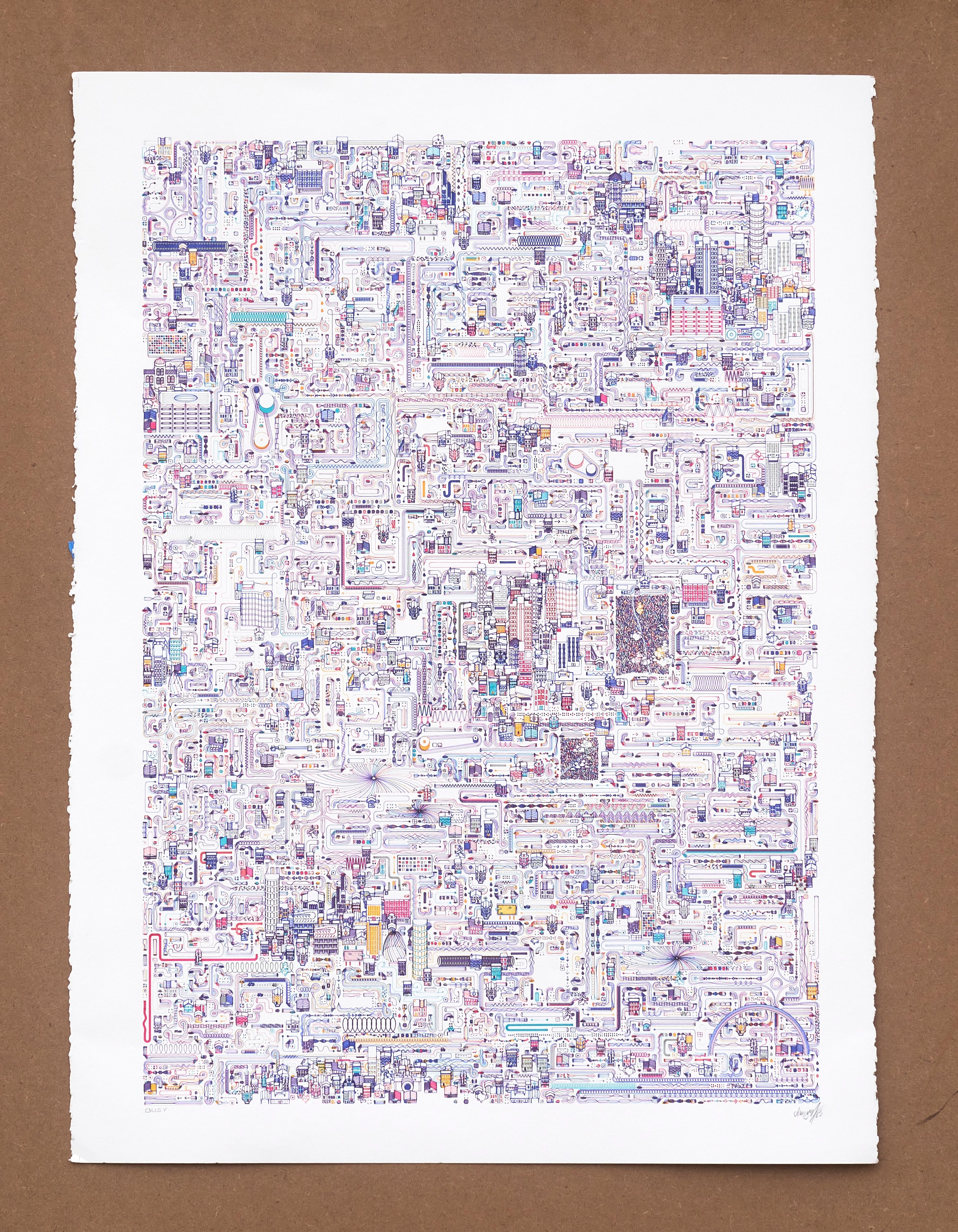
BUSY (2025), ink on paper. Photo: James Merrill / lostpixels.io.
For BUSIEST, Merrill borrowed a prototype large-format machine, the Artframe 72×24, from Bantam Tools. He worked on "60"×24" sheets" with four inks, and each drawing took "around 16 hours" 2. One of them was carried part-finished to bitforms gallery in New York and completed live at an opening there 2. The BUSIEST project record promised each collector "a complimentary signed plot of their mint" 1. A 2026 profile cites "7 miles of ink" 6.
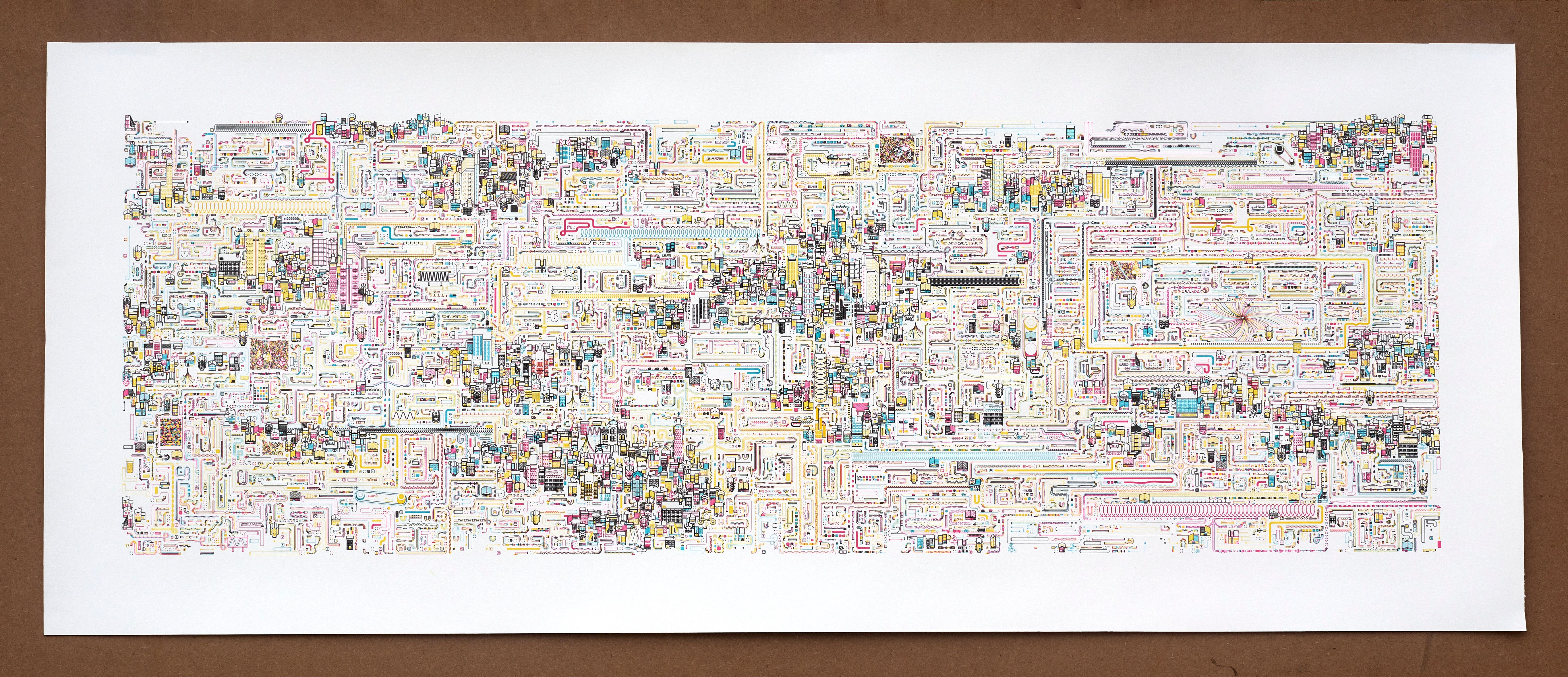
BUSIEST (2025), ink on paper, 60 × 24 in. Photo: James Merrill / lostpixels.io.
The mint
Invocation 0 was minted on 21 March 2025 at 19:19:23 UTC, and the project was activated on 26 March 1. The other 49 were sold through Art Blocks' ranked auction minter, which the purchase page describes as "49 of 50 artworks releasing through a ranked auction with settlement" 111. The index's minter record gives these details 1:
- a base price of 0.05 ETH
- a start of 8 April 2025 at 16:00 UTC
- a configured end 24 hours later, extended to 17:00 UTC under an "extra time" setting
- all 49 tokens minted in a single second, 9 April at 17:03:11 UTC
The clearing price is not stored in the index, and the index's own price field reads 0 1. BUSIEST sold the day before at a fixed 2 ETH, and all five of its tokens were minted within seven minutes of its 16:00 UTC start on 7 April 1.
Copyright and licensing
The index records CC BY-NC 4.0 with a link to the Creative Commons deed 112. On that licence the images may be shared and adapted for non-commercial use with credit. Commercial use needs permission. The program carries no separate code licence, and it bundles third-party MIT-licensed geometry code. p5.js is loaded by the platform 1. The physical drawings and the photographs above belong to James Merrill. They are linked, not re-hosted.
Significance and limitations
BUSY is a long-form project built from the start for the plotter. Its program is a scene engine with a library of hand-drawn sprites, and every mark it makes is a line a pen can draw. Its edition joins a digital token to a pen plot, and the larger BUSIEST run sits in the same code 123. The code also shows what was cut: highways, trains and a denser city are written but switched off.
Unresolved research questions:
- What was the ranked auction's clearing price, and how many bids were there? The settlement and withdrawal transactions in the minter record would settle it 1.
- How many BUSY pen plots have been claimed? The claims page needs a browser with JavaScript.
- When exactly were BUSY In Marfa and BUSY In Istanbul? Merrill's project page gives October 2024 and June 2025, while the Istanbul page says July 2025. What was the date and title of the bitforms show?
- The profile's "7 miles of ink" and the VERSE market figures came from automated extraction and are unconfirmed. Merrill's posts on X (@toThePixel) are leads that could not be fetched.
- Did Merrill turn off highways and railroads on purpose to keep the plots within their time budget, and was the Ferris wheel's either-none-or-four cap intended?
Bibliography
Primary
-
Art Blocks public GraphQL index:
projects_metadatafor project 504 (full program, minter configuration) and project 503 (BUSIEST, program and tokens), andtokens_metadatafor all 50 BUSY tokens. Retrieved 2026-09-20. https://artblocks-mainnet.hasura.app/v1/graphql. Collection page: https://www.artblocks.io/collection/busy-by-james-merrill ↩
-
James Merrill, "Creating BUSY", lostpixels.io, 9 April 2025. Key quotations were checked against the page in a second, targeted fetch. https://lostpixels.io/writings/creating-busy ↩
-
James Merrill, "BUSY", project page, lostpixels.io. https://www.lostpixels.io/art/busy ↩
-
James Merrill, "BUSY In Istanbul", lostpixels.io. https://lostpixels.io/art/busy-in-istanbul ↩
-
Art Blocks, "Purchase BUSY by James Merrill". https://www.artblocks.io/collection/busy-by-james-merrill/purchase ↩
-
p5.js v1.9.0 source,
src/math/random.js(seeded generator used for the ink-pool replay). https://github.com/processing/p5.js/blob/v1.9.0/src/math/random.js ↩
Video and audio
-
Video, titles and channels as returned by YouTube's oEmbed service on 2026-09-20; not watched for this draft:
-
"Inside BUSY and Plotting Generative Art: James Merrill and r4v3n | Beyond the Blocks Ep. 1.5", Art Blocks Official. https://www.youtube.com/watch?v=DPxeGKq2Yws
-
"BUSY by James Merrill", Art Blocks Official. https://www.youtube.com/watch?v=5QOw_vXvP1I
-
"From Origami to Algorithms: The Generative Art Journey of James Merrill", Honargardi. https://www.youtube.com/watch?v=j9hNHI6GTFQ
-
Criticism, collecting and market
-
Eva, "The Art of Plotter Drawings: When Code Meets Chaos", The Overview, 11 February 2026. https://www.theoverview.art/james-merrill-plotter-drawings/ ↩
-
Unit London, "A Closer Look at the Work and Practice of James Merrill", 28 April 2023. https://unitlondon.com/2023-04-28/a-closer-look-at-the-work-and-practice-of-james-merrill/ ↩
-
Jordan Kantor, "In Conversation with James Merrill", Art Blocks. https://www.artblocks.io/articles/in-conversation-with-james-merrill ↩
-
VERSE, "BUSY by James Merrill", series page (market figures read 2026-09-20). https://verse.works/series/busy-by-james-merrill ↩
-
Creative Commons, Attribution-NonCommercial 4.0 International. https://creativecommons.org/licenses/by-nc/4.0/ ↩
Further reading
- VERSE, "BUSIEST by James Merrill". https://verse.works/series/busiest-by-james-merrill
- Art Blocks, BUSY exhibition page. https://www.artblocks.io/exhibitions/busy-by-james-merrill
- NFT Calendar, "Busy by James Merrill" (drop listing with artist statement). https://nftcalendar.io/event/busy-merrill-nft/
- OpenSea, BUSY collection page. https://opensea.io/collection/busy-by-james-merrill
- James Merrill, lostpixels.io "About". https://lostpixels.io/about
- Earlier AB5D essay on BUSY. https://ab5d.xyz/series/busy-by-james-merrill/
AB5D editorial synthesis of the supplied revision and earlier essay. Original prose: CC0. Artwork and code rights are addressed separately above.
Token usage unavailable for the complete essay.
Token usage
Usage for this supplied revision was not provided. The linked generation record describes the original research batch.
Research record
The indexed project script was inspected. Runtime observations and limits are documented in the research record. Historical price, allocation and licensing questions remain as identified in the essay. Publication does not resolve those evidence gaps.