
Singularity
Hideki Tsukamoto · Project 8 · Curated
Edition size: 1,024 · First mint: 1 January 2021
Live artwork. Move the pointer or touch to explore interactive works. Open artwork
The work and its context
Singularity arranges luminous, irregular rings around a dark opening. At a distance, each image can resemble a single glowing body; close inspection reveals many overlapping contours. The centre is conspicuously empty, while the surrounding lines vary from a relatively smooth halo to a turbulent cloud. The tension between a stable aperture and an unsettled perimeter gives the work its force. These are visual observations of the selected outputs, not claims that the images reproduce actual astronomical measurements. 1234
Hideki Tsukamoto released the Curated project at the beginning of January 2021. It is project 8 on Art Blocks' second Ethereum contract, with 1,024 indexed invocations at the research cutoff. The project names Symmetry, Chaos, Mass, Force and Turbulence among its hash-driven properties. The Hideki Tsukamoto dossier provides broader context; this account connects those evocative names to the inspected drawing operations. 56
Conception and development
In a pre-release interview dated 31 December 2020, Tsukamoto described Art Blocks itself as an inspiration: the purchase could become the event that supplied the input for a work. He also named space, creation, matter and void as concerns, and discussed a four-chapter series conceived as moving backwards toward Genesis. These are documented intentions, rather than a cosmic interpretation imposed solely because the images look like luminous apertures. 7
The same account connects his practice to technical drawing, programming and earlier seeded work. Singularity therefore gives a pre-existing procedural method a new context rather than creating randomness from nothing. The important conceptual change, in his description, is the significance of the seed supplied through the collecting process. The script still defines the range of possible forms and the way those inputs become visible. 76
The property names are expressive but need care. Mass is not a measured quantity of physical matter, and Force is not a calibrated astronomical force. They label parameters in an artistic system. Explaining their implemented effects makes the work more precise without requiring the viewer to believe that it is a scientific visualization. 6
How the work was constructed
The indexed project uses a plain JavaScript rendering environment. The script parses hash bytes into normalized values, then assigns them to mass, aperture, force, symmetry, turbulence, chaos, saturation and detail. A second stage maps those normalized inputs into working ranges. For example, mass determines the range of the outer drawing loop, while aperture sets the starting radius around the empty centre. 56
The renderer draws many closed radial paths on a two-dimensional canvas. Each path is sampled around a full turn in 512 angular steps. Noise modifies the radius at each angular position. As the outer loop progresses, a squared normalized index changes the strength of displacement, turbulence contribution and transparency. The luminous object is thus accumulated from lines; it is not an imported photograph, a prebuilt three-dimensional mesh or a simulation of a black hole. 6
The broad relationship is readable in the images. A controlled inner opening remains legible while successive displaced paths build a thicker, less settled outer envelope. A line can remain close to its neighbours in one output and diverge into more pronounced lobes in another. Changing several parameters together alters the balance between the central aperture, the visible band and the faint outer field. No single adjective such as “chaotic” adequately describes all those changes. 613
The symmetry parameter offsets the coordinates used to sample noise. The noise field itself is initialized with a fixed seed, while token-dependent parameters determine how it is sampled and applied. This is a useful corrective to the idea that every generative work simply seeds a random-number generator with the entire hash and lets it run. Here some variation comes through mapped parameters acting on a consistently initialized noise system. 6
Colour is also conditional. The script evaluates how close selected parameter values are to designated ranges, accumulates form and rarity points, selects a gradient family and adjusts the mixture between a pale base colour and the gradient. The resulting palette is therefore connected to the parameter evaluation, rather than being an entirely independent decorative choice. That does not make more saturated outputs better, nor does it establish their observed scarcity in the actual edition. 6
A metadata routine multiplies assigned probability values and reports a “Chance” figure. This is an internal classification calculation, not an empirical count of matching works in the minted set. Treating it as a verified market rarity would overstate the evidence. The four example records preserve their indexed features, while the prose concentrates on the visible forms and the code that helps explain them. 61234
The script includes a noise implementation attributed to Rune Madsen and links its source repository. The repository README describes the plugin, but the retrieved material did not establish a licence for the particular bundled adaptation. Thus “no separately loaded library” is not equivalent to “no third-party code.” The work uses the browser's two-dimensional canvas and includes supporting code within the script itself. This review inspected that source without executing it. 68
The mint
The live Art Blocks index, observed on 2026-09-17, records 1,024 invocations against a current maximum of 1,024. The first indexed mint is 2021-01-01T15:19:09+00:00; the second is 2021-01-01T17:59:53+00:00. Its activation field reads 2021-01-01T15:45:38+00:00, while the scheduled-start field reads 2021-01-01T17:59:53+00:00. These are different recorded events, not interchangeable definitions of launch. The current maximum is not by itself evidence of the originally announced edition. 5
The indexed completion field is 2021-01-01T18:40:56+00:00. These observations establish the platform's recorded chronology, rather than a reconstruction of every public purchase. They do not identify which mints were artist, reserved or administrative allocations. Accordingly, no precise public sellout duration is asserted here. The recorded price setting at the research cutoff is 0.1024 ETH; it is a later configuration observation, not a verified opening price or proof that each recipient paid that amount. Gas, transfers and resale consideration are separate. Historical price changes and allocation classes remain questions for a transaction-level follow-up. 5
The artist interview appeared on 31 December, giving a dated pre-release account of the intended work. The index records the first token earlier on 1 January than the second token and scheduled-start field. Those observations support a sequence with an initial mint before the later recorded start, but they do not identify the initial recipient's role. Nor does the compact interval between the later timestamps establish a public sellout duration until reserved and administrative mints are separated. 75
Copyright and licensing
The project reports the exact artwork label “NFT License”, with no linked terms, as observed on 2026-09-17. Its operative permissions and version remain unverified, so the rights category is unknown. The label is preserved rather than silently mapped to a similarly named contract or a blanket permission to reproduce the work. 5
No separate project-code licence was found in the inspected script and metadata. Public visibility of code is not a reuse grant. The browser rendering environment and any incorporated third-party code must be considered separately from the token and its artwork. 56
The inline Rune Madsen attribution is retained in the research record. Its presence establishes acknowledged third-party material, while the inspected README supplies no sufficient permission basis for redistributing this particular adaptation. The draft therefore links evidence and retains a code digest without republishing the project script. 68
Close reading of four outputs
The comparison uses editions 0, 1, 10 and 20, with Ethereum token IDs 8000000, 8000001, 8000010 and 8000020 on 0xa7d8d9ef8d8ce8992df33d8b8cf4aebabd5bd270. The preselected early group is not a statistical sample. All four observations concern the indexed static previews, and the parameter labels below remain platform-reported descriptors. 1234
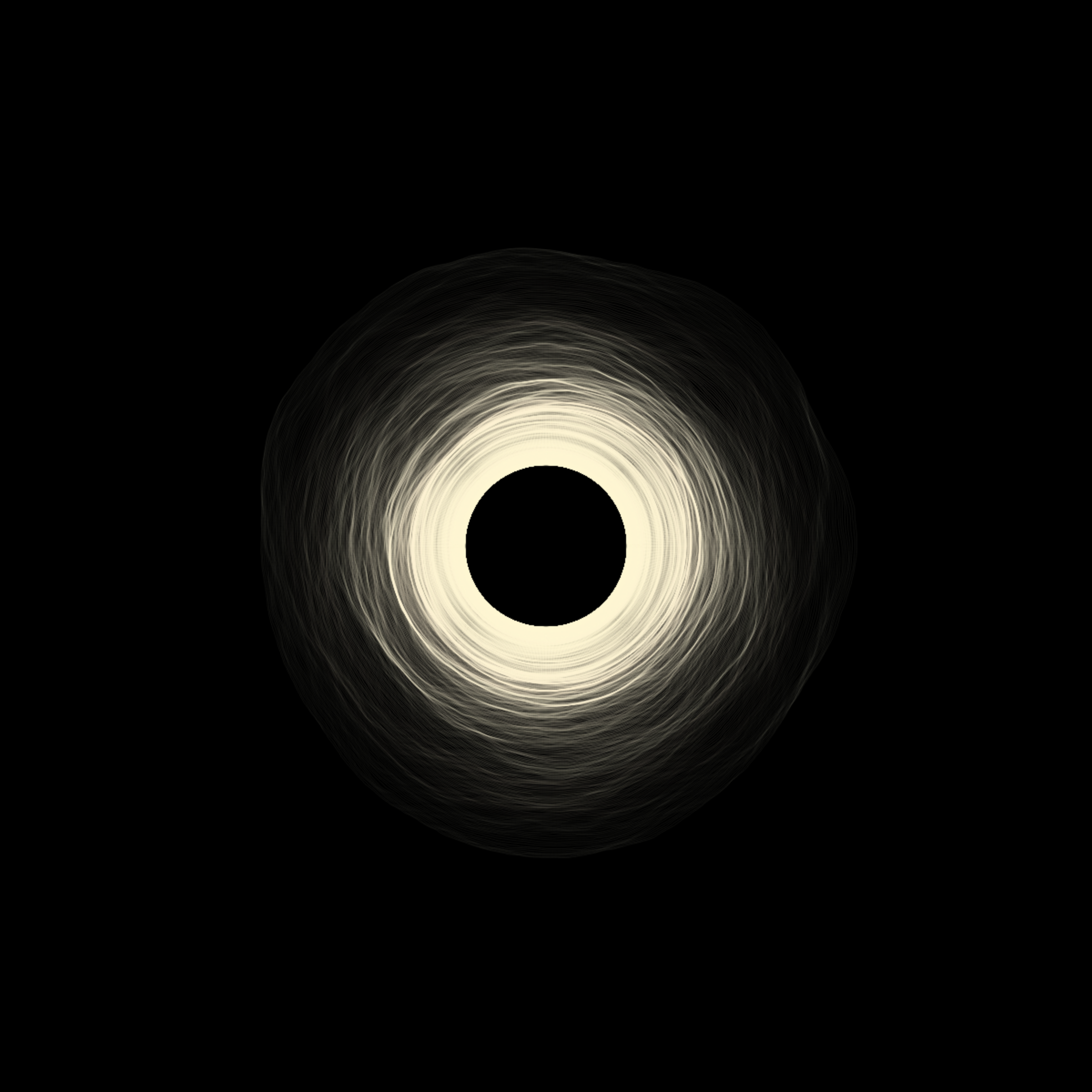
#0 shows a compact cream-coloured halo around a small black centre. The brightest band lies close to the opening, while faint outer paths dissolve into the surrounding black. Its edges are irregular enough to resist becoming a perfect diagram of concentric circles, yet the overall impression is restrained. The eye is drawn inward by brightness and then stopped by the empty centre. The aperture is not merely a missing part of the picture; it organizes the way the surrounding light is perceived. 1
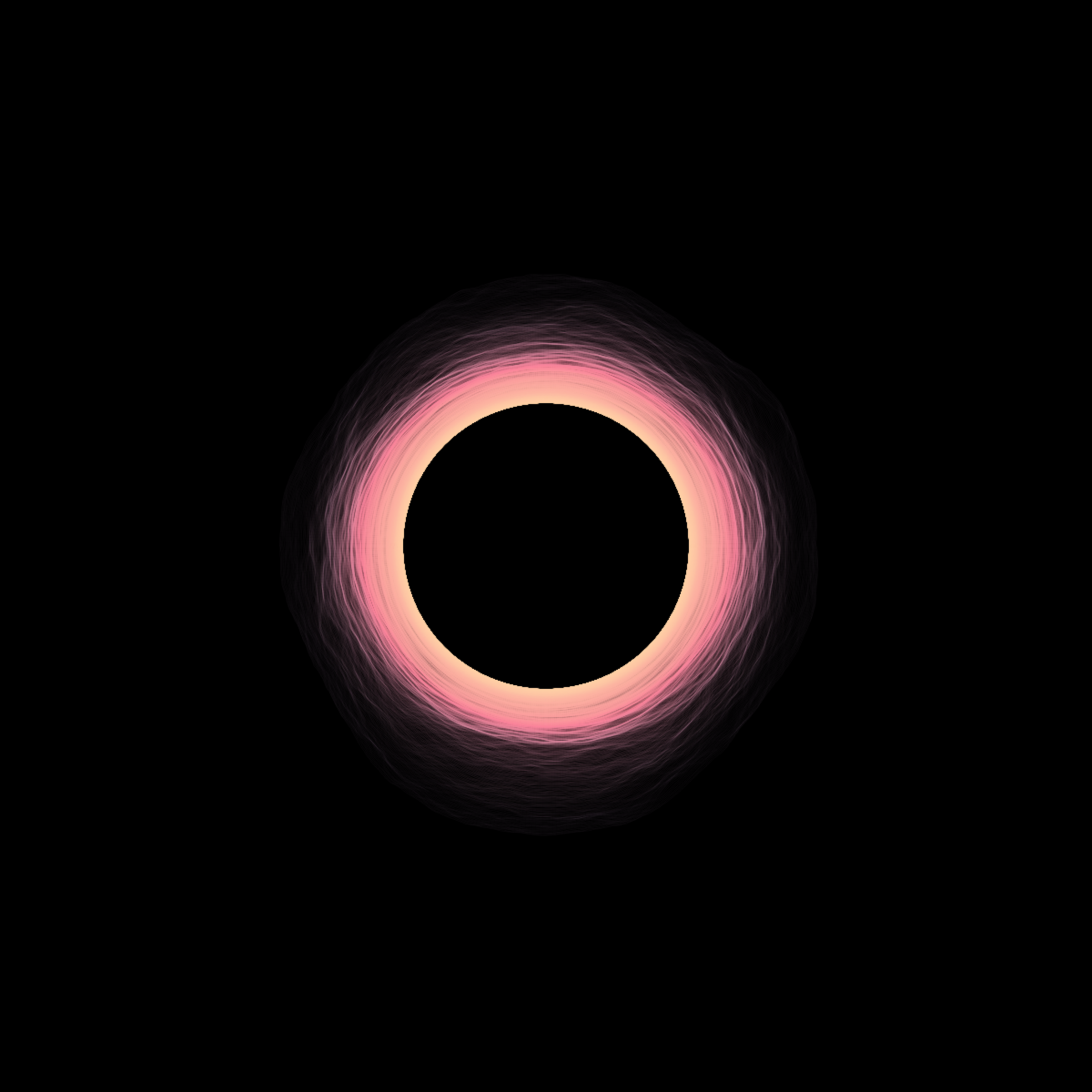
#1 has a larger-looking opening in relation to its luminous band, with pink colour concentrated around the ring. Its outline remains comparatively smooth. Beside #0, it makes the distinction between aperture and outer envelope easier to see: increasing the apparent prominence of the void changes the entire image's balance, even though both works share a similar centred structure. The indexed high Symmetry descriptor is consistent with that impression, but the visual argument does not depend on treating the label as a measurement of aesthetic order. 2
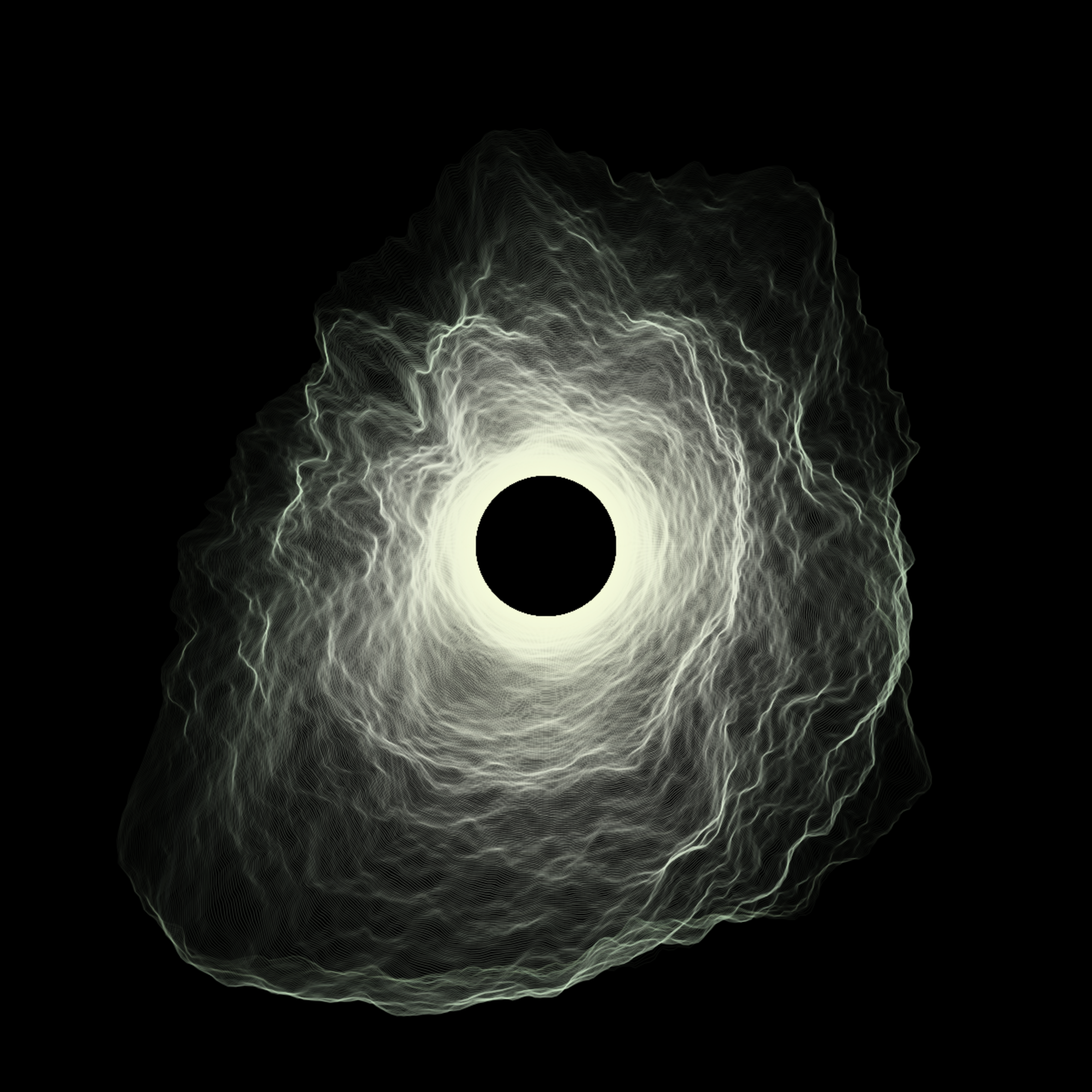
#10 spreads into a wider, greenish-white cloud. The centre remains sharply legible, while the outer paths form pronounced lobes and tendrils. The contrast between the smooth opening and the unsettled perimeter is much stronger than in #1. The index describes its Turbulence as extreme, and the code provides a mechanism through which that parameter affects noise sampling. The image is best understood as the combined result of several parameters, not a one-variable demonstration extracted from a controlled experiment. 36
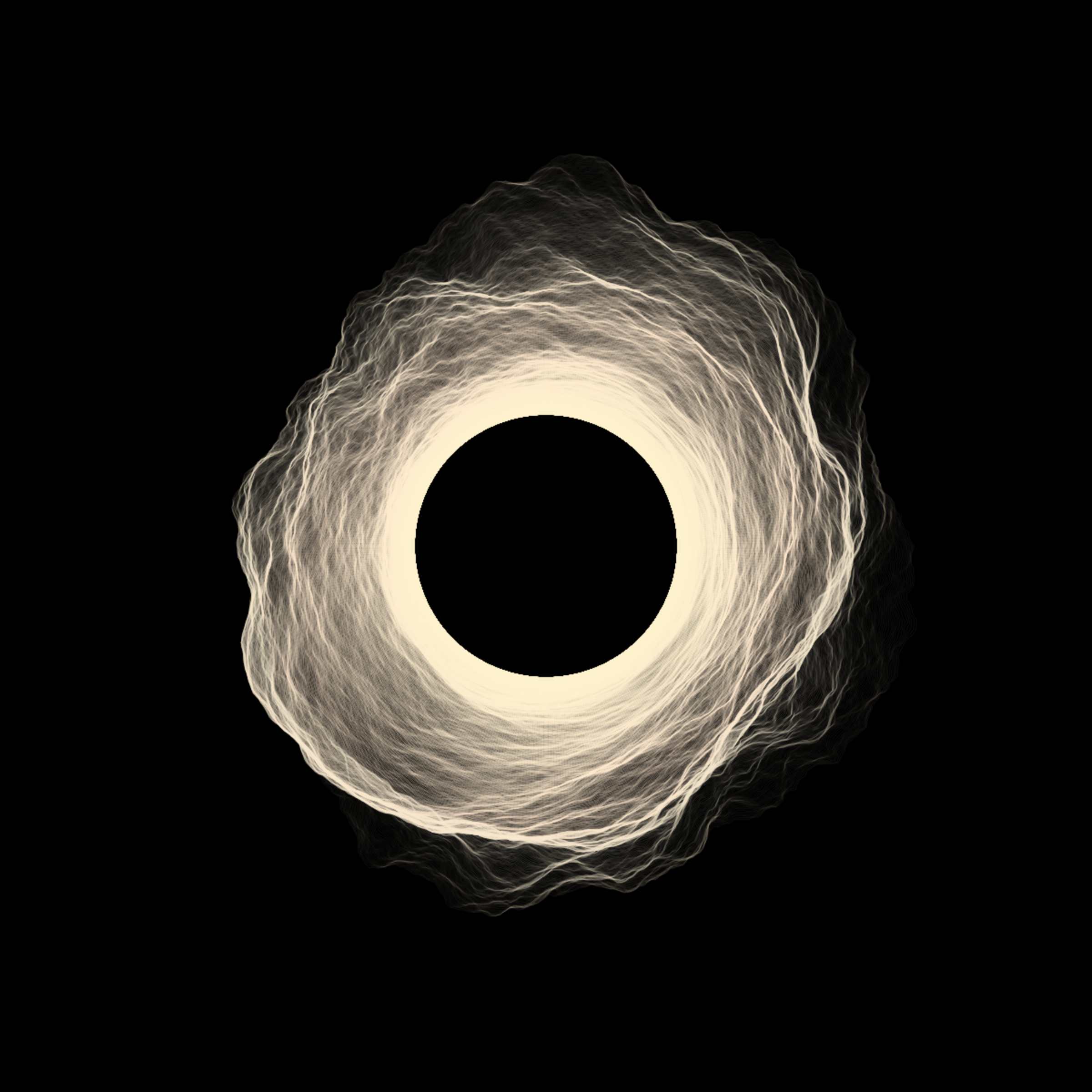
#20 has a broad warm-white band surrounding a larger black opening. Its outer edge is visibly wavy, but the luminous material feels more substantial and continuous than the diffuse field of #10. The bright inner region and softer perimeter create a sense of density changing outward. This is an optical interpretation of line accumulation and transparency; there is no simulated substance whose physical density has been measured. 46
Across all four, centring does not eliminate difference. It provides a stable comparison point, allowing changes in aperture, contour, colour and outer extent to become conspicuous. The series' formal economy depends on holding that common structure while allowing the surrounding envelope to vary widely. 1234
Significance and limitations
Singularity's achievement is to make an accumulation of two-dimensional paths feel like a luminous volume surrounding absence. Its scientific vocabulary is evocative, but the work becomes more interesting when those words are tied to specific drawing choices. Fixed noise initialization, token-dependent sampling and conditional colour together produce a range of forms whose differences cannot be reduced to one rarity score. The distinction between bundled code and externally loaded libraries is equally important to a durable account of the work. 6
Unresolved research questions:
- Establish original mint terms and classify public versus reserved allocations.
- Locate the operative NFT License and separate artist-code terms.
- Resolve the licence of the bundled noise adaptation.
- Verify indexed source against chain data and compare documented renders.
References
-
Hideki Tsukamoto. Singularity #0. Published 2021-01-01. Accessed 2026-09-17. ↩
-
Hideki Tsukamoto. Singularity #1. Published 2021-01-01. Accessed 2026-09-17. ↩
-
Hideki Tsukamoto. Singularity #10. Published 2021-01-01. Accessed 2026-09-17. ↩
-
Hideki Tsukamoto. Singularity #20. Published 2021-01-01. Accessed 2026-09-17. ↩
-
Art Blocks. Singularity project record and Art Blocks index. Accessed 2026-09-17. ↩
-
Hideki Tsukamoto. Singularity artist script. Accessed 2026-09-17. ↩
-
Jeff Davis / Art Blocks. In Conversation with Hideki Tsukamoto. Published 2020-12-31. Accessed 2026-09-17. ↩
-
Rune Madsen. Rune.Noise.js README. Accessed 2026-09-17. ↩
Written by GPT-6 Astra for AB5D. Original prose: CC0. Artwork and code rights are addressed separately above.
Batch usage: 5,899,866 tokens, including cached input, across the ten-essay research and drafting batch.
Token usage
5,857,292 input tokens (including 5,618,176 cached) and 42,574 output tokens. Per-essay usage was not recorded separately. Website publication and later presentation edits are excluded.
Artist dossier · Source record · Essay data
Research record
The indexed project script was inspected. Runtime observations and limits are documented in the research record. Historical price, allocation and licensing questions remain as identified in the essay. Publication does not resolve those evidence gaps.