
Variant Plan
Jeff Davis · Project 5 · Factory
Edition size: 199 minted / 200 maximum · First mint: 20 December 2020

The work and its context
Variant Plan uses blue and pale grey rectangles to produce an image somewhere between a diagram, an architectural plan and a stack of overlapping frames. Its limited palette and right-angled vocabulary give the series a clear common identity, but the internal hierarchy changes from one output to another. A broad empty rectangle can dominate one image, while another divides the same square into a busy collection of narrow compartments. The four inspected examples show how little visual material is needed to make those distinctions. 1234
Jeff Davis made Variant Plan as a commission for Variant Fund. Art Blocks identifies it as Factory project 5, with the project description preserving the commission code F01Y20. Its release history is more complicated than one date or edition figure suggests. The Jeff Davis dossier covers the artist's broader practice; this essay treats the commission, the drawing system and the conflicting distribution records together. 56
Conception and development
Jesse Walden's 2023 account says he partnered with Davis in December 2020 and distributed the resulting works to early founders and backers of Variant. That is primary evidence for the social purpose of the commission: the tokens were intended as gifts of appreciation within a particular network. It does not turn the images into financial instruments or establish any rights in the fund. 6
Davis's 2020 portfolio also lists Variant Plan, describing a square, adaptive-resolution series of 200 images. This supports a 2020 conception and production context even though the current Art Blocks page gives a January 2021 release date. Those statements concern different records and potentially different stages of the project. They should remain visible rather than being compressed into a falsely uncomplicated chronology. 75
The visual connection between “plan” and the commission is suggestive, but the inspected sources do not specify a particular building, floor plan or brand manual as the basis of the algorithm. The essay therefore treats architectural resemblance as interpretation. The code supplies a more concrete explanation: rectangles constrained to a common grid, with a small set of line and fill behaviours. 8
How the work was constructed
The script uses p5.js 1.0.0 and reads the token hash into an expanded array of values. It first makes overlapping hexadecimal pairs, then constructs additional pairs from characters in separated parts of the hash. Those values select the number of rectangles, their dimensions, offsets and stroke treatment. The procedure builds an image from related measurements rather than selecting one complete plan from a library of finished designs. 58
The working grid has eight divisions. Between eight and sixteen rectangles are drawn, with widths and heights chosen in relation to that grid. The active image area occupies four-fifths of the canvas dimensions, leaving a stable outer margin. Position offsets are also quantized, so the elements repeatedly align even when their sizes differ. This is one reason the results can resemble rationally planned spaces rather than arbitrary overlapping boxes. 8
A binary choice reverses the main colours: pale grey ground with blue lines or blue ground with pale grey lines. The four selected early outputs happen to show the former relationship; they are not evidence that the reverse branch was absent from the edition. The code's palette restriction is especially important here. Variation is concentrated into geometry and layering, while colour reinforces a coherent series identity. 81234
The first few rectangles receive special offsets toward opposite sides of the field. Subsequent bounds checks move rectangles back inside the permitted image area when necessary. These operations give the composition a controlled spread and maintain its relation to the margin. They are constraints, not evidence that the script is solving a usable architectural layout. There is no documented requirement for doors, circulation or buildable rooms. 8
Stroke selection changes more than line width. In one branch, rectangles are filled with the background colour; in the other, they are unfilled. A later filled rectangle can therefore erase earlier lines inside its area, while an unfilled one lets earlier structure remain visible. The apparent organization of compartments is partly an effect of occlusion. A viewer cannot reliably recover the original rectangle count by counting the final visible cells. 8
The last rectangle is forced into the finer, unfilled treatment. This creates a final overlay that can remain readable across earlier filled regions. The effect is visible in the samples as smaller or thinner outlines interrupting broader framed areas. It is a useful example of an artist-written rule that gives a drawing sequence a conclusion without selecting a specific final picture in advance. 814
The code ends with noLoop. These are static compositions, although they are generated responsively from code rather than fixed to the dimensions of one stored preview. The library version, artist script and token hash remain distinct parts of the rendering record. The present review inspected the indexed script and supplied images; it did not run a local reproduction or prove byte-for-byte identity with a historical chain read. 589
The mint
The live Art Blocks index, observed on 2026-09-17, records 199 invocations against a current maximum of 200. The first indexed mint is 2020-12-20T00:39:36+00:00; the second is 2020-12-20T00:40:56+00:00. Its activation field reads 2020-12-29T02:26:17+00:00, while the scheduled-start field reads 2021-01-11T22:38:00+00:00. These are different recorded events, not interchangeable definitions of launch. The current maximum is not by itself evidence of the originally announced edition. 5
The indexed completion field is not recorded. These observations establish the platform's recorded chronology, rather than a reconstruction of every public purchase. They do not identify which mints were artist, reserved or administrative allocations. Accordingly, no precise public sellout duration is asserted here. The recorded price setting at the research cutoff is 0 ETH; it is a later configuration observation, not a verified opening price or proof that each recipient paid that amount. Gas, transfers and resale consideration are separate. Historical price changes and allocation classes remain questions for a transaction-level follow-up. 5
There is a material count conflict. Walden writes that he minted and distributed a collection of 200; Davis's portfolio also describes 200 images. The current Art Blocks page and index report 199 invocations, with a maximum of 200. The sources are recorded with their different dates and roles. Neither an unminted final item, a burn, nor an indexing omission is asserted as the explanation without supporting evidence. 567
The platform page gives 11 January 2021 as release, while indexed mints begin in December 2020. Given the documented commission, a public-sale narrative would be inappropriate without additional evidence. The draft distinguishes the creation and distribution account from the platform's displayed release date and leaves the exact reconciliation for review. 56
Copyright and licensing
The artist-set artwork label in the current project record is CC BY-NC 4.0, classified here as creative-commons. The metadata supplies no terms link. The named Creative Commons deed permits sharing and adaptation with attribution, indication of changes and a noncommercial restriction. This is the label observed on 2026-09-17; a complete history of earlier terms has not been recovered. 510
The rendering dependency is p5.js 1.0.0; its upstream licence file contains LGPL 2.1. That dependency licence does not establish the artist script’s licence. No separate, explicit grant for the project code was found in the inspected script and project record. Artwork, artist code and library rights therefore remain separate. 589
Close reading of four outputs
The examples are editions 0, 1, 10 and 20, corresponding to token IDs 5000000, 5000001, 5000010 and 5000020 on Ethereum contract 0xa7d8d9ef8d8ce8992df33d8b8cf4aebabd5bd270. Their early sequence was chosen before comparison. All four use a pale ground with blue marks, so they are especially useful for comparing structure while holding the broad palette relationship steady. 1234
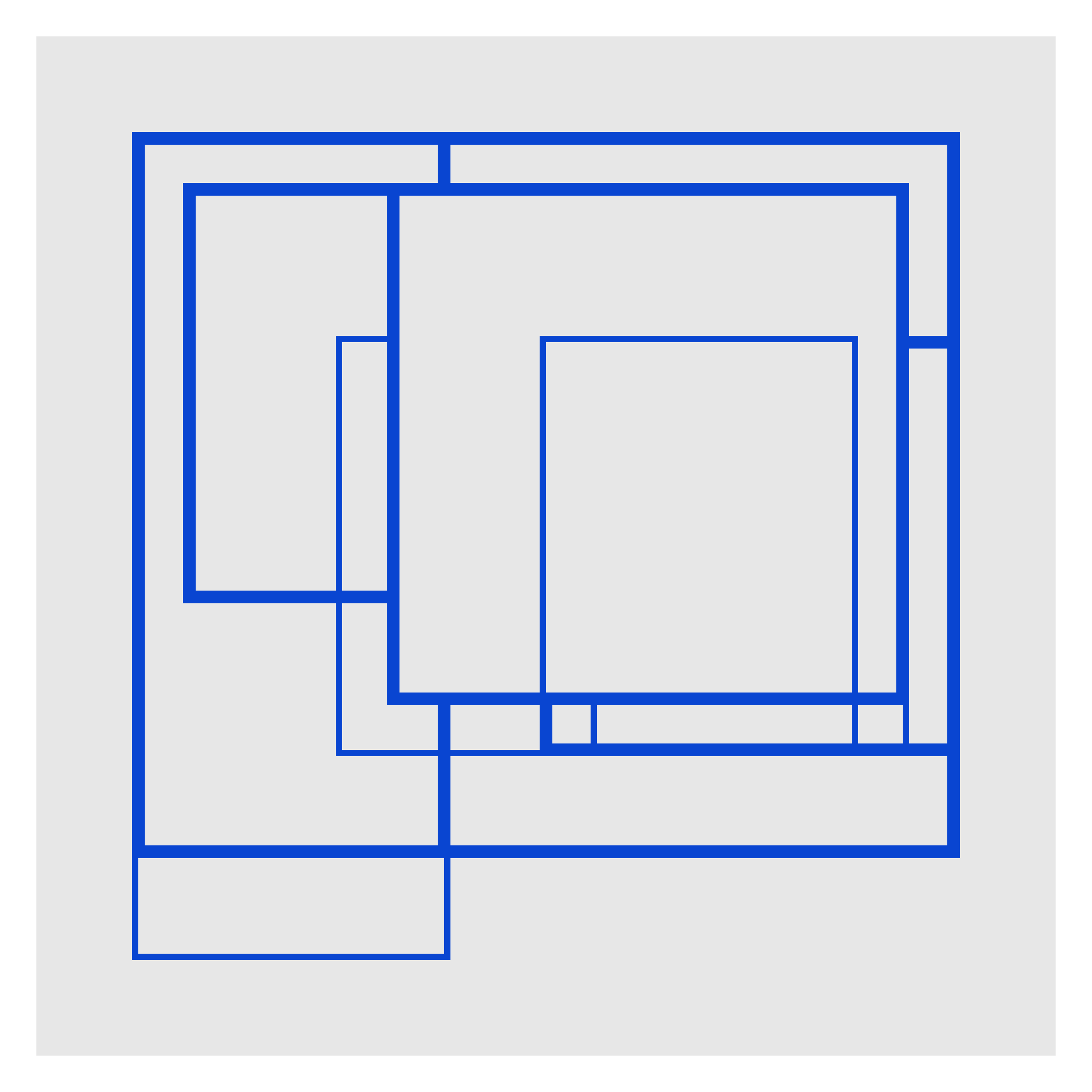
#0 contains several nested and overlapping frames. A thick outer structure seems to promise one complete enclosure, but thinner lines and smaller rectangles repeatedly interrupt that promise. A conspicuous central-right rectangle has a fine outline, allowing it to read as a second system laid over the larger plan. Along the bottom, narrow compartments and crossings produce a more crowded zone. The image alternates between the suggestion of one organized building and the evidence of several drawings occupying the same sheet. 1
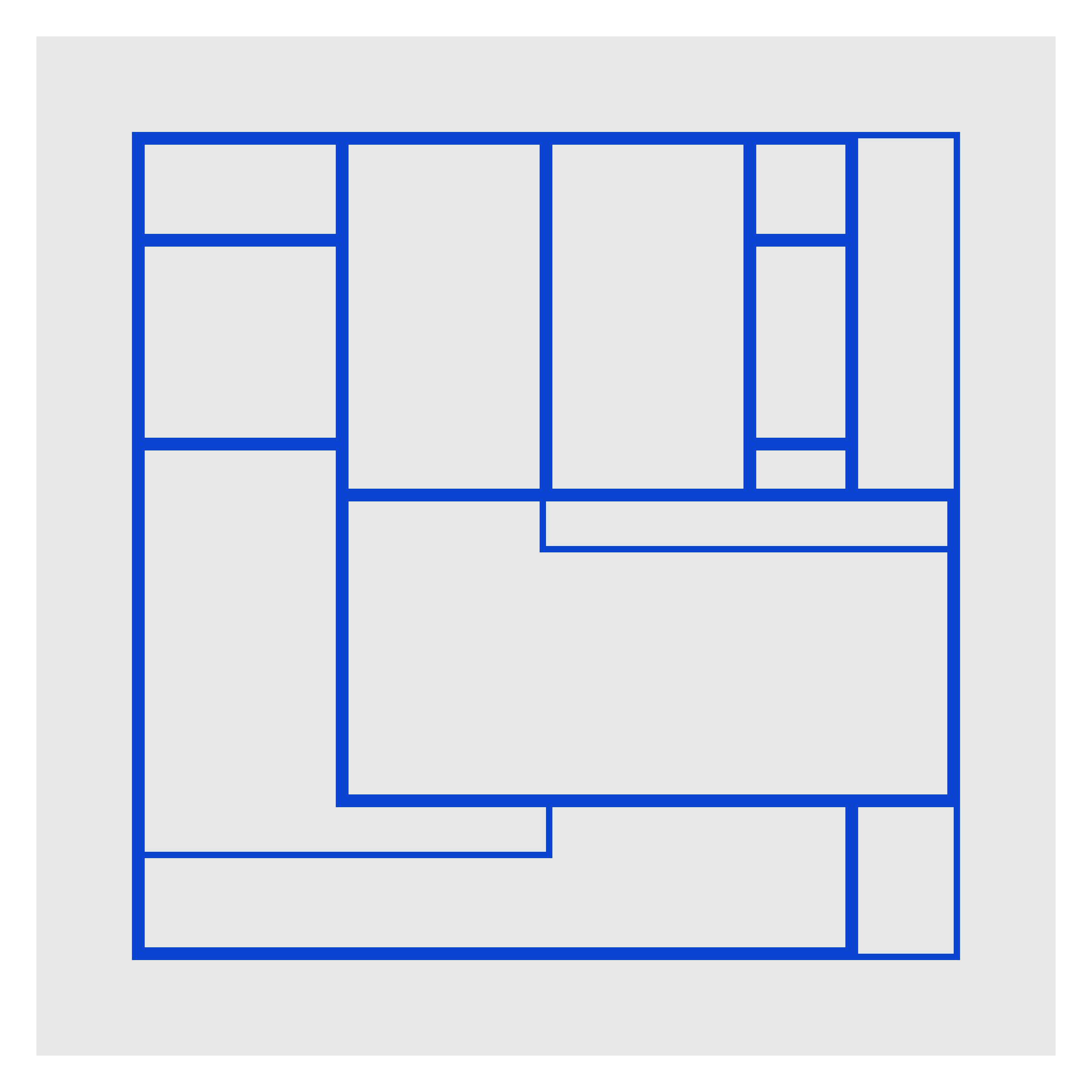
#1 gives the upper portion a clearer sequence of tall compartments, while a broad rectangle occupies much of the middle and right. Narrow subdivisions on the upper right contrast with that larger open area. The eye is encouraged to group these into functional-looking spaces, even though the code assigns no such function. Its apparent plausibility is an aesthetic effect of alignment and proportion. Compared with #0, it seems more ordered, but that order is still produced by overlapping and selectively obscured rectangles. 28
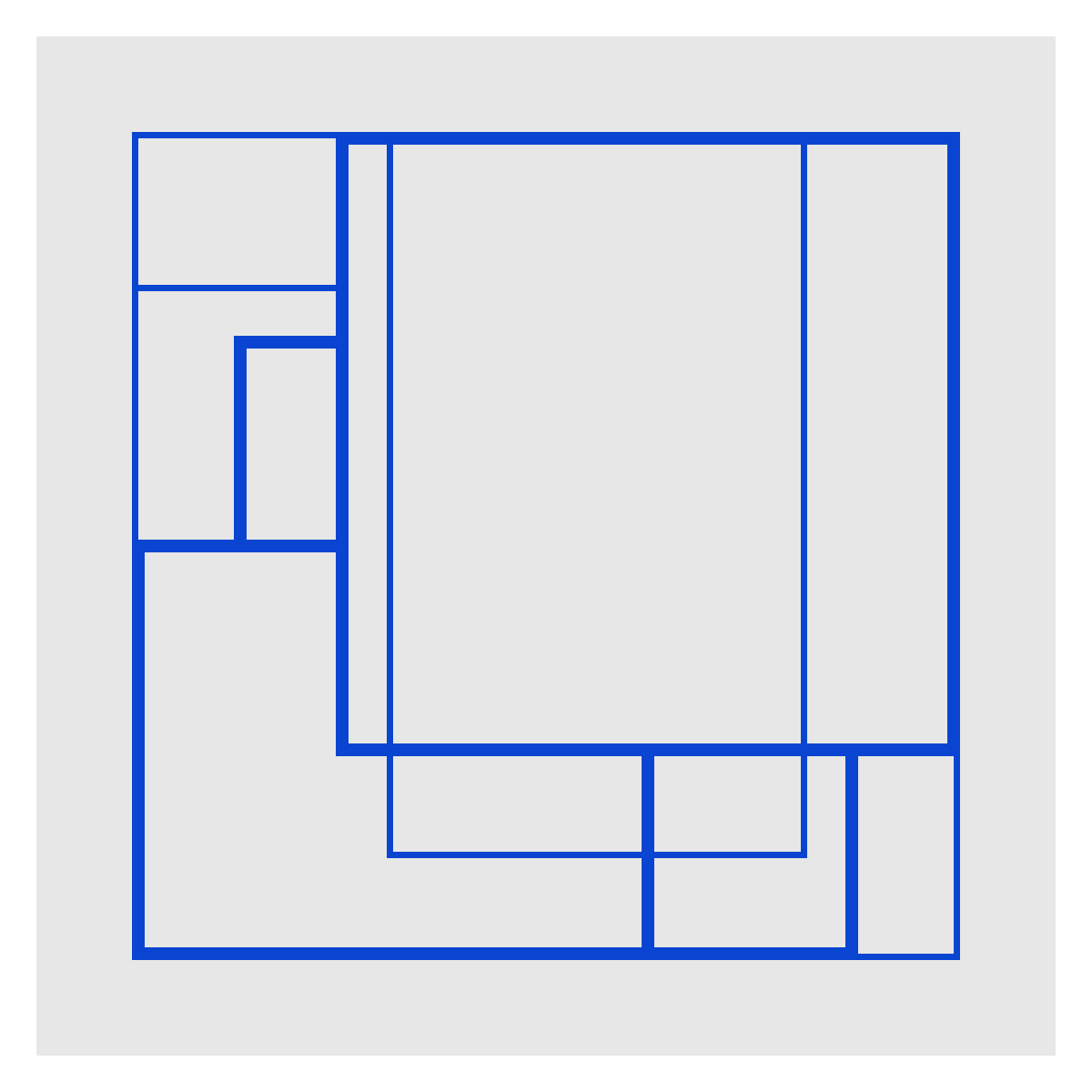
#10 is dominated by a large upper-right rectangle. Smaller cells cluster along the left and bottom edges, making the dominant shape feel like a room surrounded by subsidiary spaces. Thin outlines pass through or behind the heavier structure, complicating that initial reading. The work demonstrates how a simple change in relative area can generate hierarchy without adding a new kind of shape or colour. 3
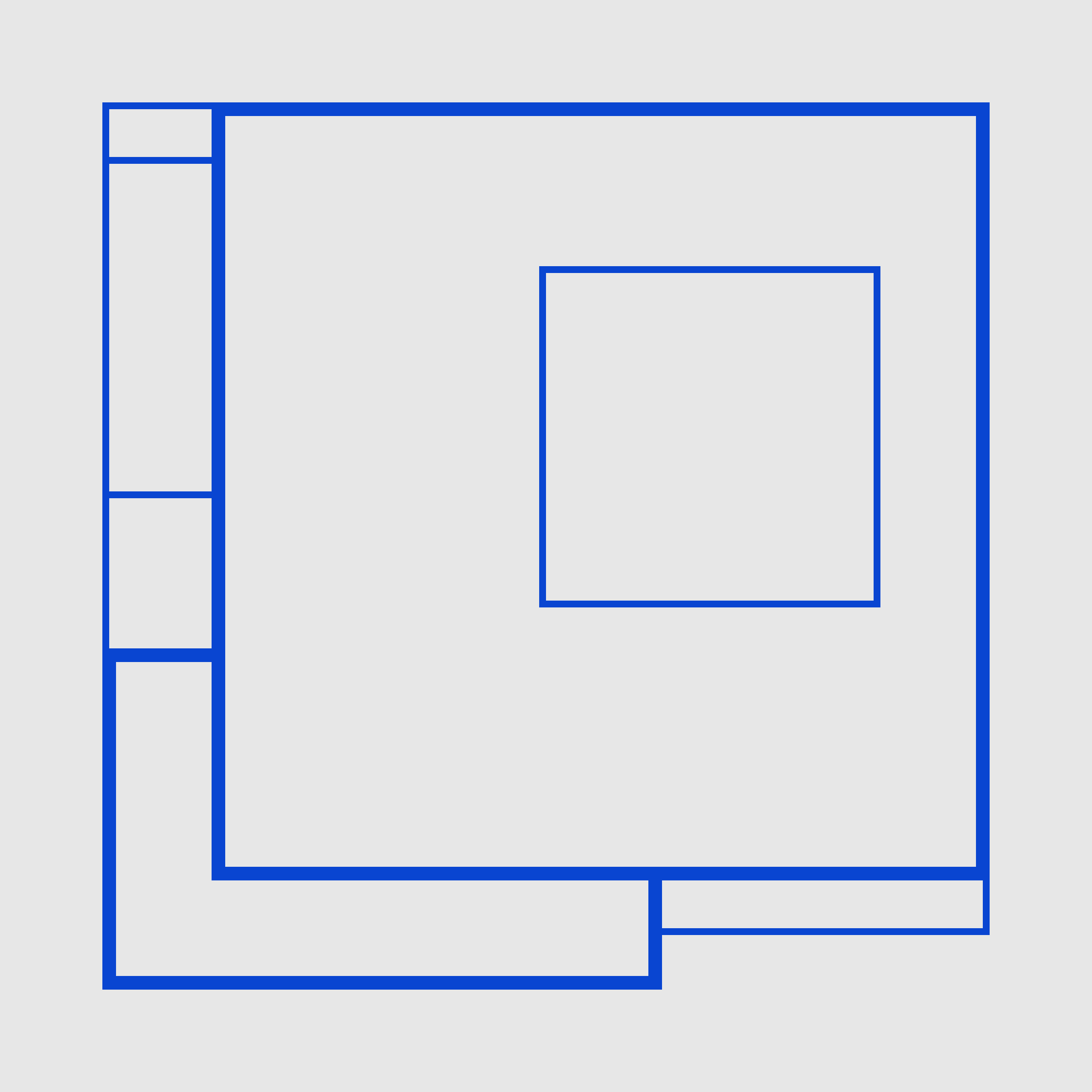
#20 is the sparsest-looking of the four. A very large pale rectangle, bounded by a heavy blue line, contains a small fine-lined square near its centre. Along the left and lower edges, remnants of other rectangles remain visible. The central square feels isolated precisely because the surrounding field is so open. It is tempting to count only those visible forms, but the code's occluding fills caution against treating apparent sparseness as a direct measurement of how many rectangles were generated. 48
These comparisons make the commission's serial logic tangible. A shared palette and grid give the recipients related works, while different arrangements provide distinct identities. That formal relationship can be discussed without making assumptions about what any individual recipient thought or how the gifts were subsequently used. 61234
Significance and limitations
Variant Plan is significant as a specific use of generative variation within a commissioned gift edition. Its images produce a coherent family without being interchangeable, and its distribution account differs from an open mint designed around public demand. The unresolved count is part of the reference work still required, not a reason to erase either the issuer's account or the current platform observation. Visually, the series makes hierarchy and ambiguity from little more than aligned rectangles, selective concealment and two colours. 86
Unresolved research questions:
- Reconcile 200 in issuer and artist accounts with 199 indexed invocations.
- Establish the full commission distribution and any later supply changes.
- Explain the December mint records and January displayed release date.
- Locate separate code rights and verify the indexed script against chain data.
References
-
Jeff Davis. Variant Plan #0. Published 2020-12-20. Accessed 2026-09-17. ↩
-
Jeff Davis. Variant Plan #1. Published 2020-12-20. Accessed 2026-09-17. ↩
-
Jeff Davis. Variant Plan #10. Published 2020-12-20. Accessed 2026-09-17. ↩
-
Jeff Davis. Variant Plan #20. Published 2020-12-20. Accessed 2026-09-17. ↩
-
Art Blocks. Variant Plan project record and Art Blocks index. Accessed 2026-09-17. ↩
-
Jesse Walden / Variant. The Interplay Between AI Abundance + Crypto Scarcity. Published 2023-04-25. Accessed 2026-09-17. ↩
-
Jeff Davis. 2020 portfolio. Accessed 2026-09-17. ↩
-
Jeff Davis. Variant Plan artist script. Accessed 2026-09-17. ↩
-
p5.js contributors. p5.js 1.0.0 licence. Accessed 2026-09-17. ↩
-
Creative Commons. CC BY-NC 4.0 deed. Accessed 2026-09-17. ↩
Written by GPT-6 Astra for AB5D. Original prose: CC0. Artwork and code rights are addressed separately above.
Batch usage: 5,899,866 tokens, including cached input, across the ten-essay research and drafting batch.
Token usage
5,857,292 input tokens (including 5,618,176 cached) and 42,574 output tokens. Per-essay usage was not recorded separately. Website publication and later presentation edits are excluded.
Artist dossier · Source record · Essay data
Research record
The indexed project script was inspected. Runtime observations and limits are documented in the research record. Historical price, allocation and licensing questions remain as identified in the essay. Publication does not resolve those evidence gaps.