
- Artist
- Jeff Davis · Art Blocks profile
- Practice
- Generative systems, geometric abstraction, colour theory, print, light, stained glass, and institutional work
- Raster
- raster.art/artist/jeff-davis
- In the set
- Color Study · 2,000 editions
Drawings for a Monument · 1,000 editions
Construction Token · 500 editions
Rectangles (for Herbert) · 500 editions
Rhythm · 334 editions
Neighborhood · 312 editions
Schema · 300 editions
Variant Plan · 199 minted of 200
Reflection · 100 editions
View Card · 41 editions
Portal · 10 editions - AB[500]
- 11 projects · 5,296 minted editions
- Links
- Full bibliography
- oTDH
- 34,558 · rank 2 of 308
- Holding signal
- 2,077 collector identities · 2,177 holder addresses · 6,708,740 raw collector-days · 14 Sep 2026
- Collector TDH
- jefdTDH · dashboard
Few artists describe the whole institutional arc of Art Blocks from inside it. Davis was present at launch as an artist, later served as Chief Creative Officer, and now works as a strategic adviser while helping establish the Generative Art Foundation. Those roles matter, but they do not explain the art by themselves. The stronger account begins with a persistent formal problem: how to make rules for proportion and colour that remain exact without becoming inert.
From hard edges to executable rules
Davis trained in mathematics and studio art before completing an MFA in painting and drawing at the School of the Art Institute of Chicago. His early work used painting and printmaking, then design software as a planning instrument. By 1999, the precision of digital printing allowed the digital file to become a finished work rather than a preliminary sketch. A decade later he used randomised Excel tables to make compositional decisions, then adopted Processing to automate both decision and drawing.1
This history distinguishes his use of code from a fascination with technical novelty. The visual grammar came first: right angles, whole-number ratios, flat colour, thick boundaries, serial repetition. Code made that grammar explicit and repeatable. Davis describes his randomness as integer choice rather than noise. The algorithm opens a finite space, and colour interaction introduces the uncertainty that a restricted geometry appears to exclude.2
Davis does not ask code to imitate a painting. He asks it to state the painting's hidden rules, then test every consequence.
Project two: a structure for surprise
On 27 November 2020, Art Blocks launched with projects by Snowfro, DCA, and Davis. Construction Token was project 2: 500 outputs built from rectangular subdivisions and a controlled palette. Davis expected a few mints over the weekend. Instead, transaction alerts continued until the project sold out in roughly two hours.3 The speed is historical colour, not the reason the project matters. Its importance lies in showing that a highly restricted geometric language could remain coherent while passing the final compositional decision to a mint hash.

Jeff Davis, 2020 · token ID 2000373 · AB5D treasury
Treasury-held work · live on Art Blocks
The small editions immediately around it sharpen that claim. View Card compresses the language into 41 works, while Variant Plan uses a maximum of 200 to vary layout and colour within a commission for Variant Fund. They are not sketches toward a richer visual field. Their narrowness is the subject: an algorithmic space can be judged by how clearly its limits become visible.

Jeff Davis, 2020 · 41 editions · AB5D treasury

Jeff Davis, 2021 · 199 minted of 200 · AB5D treasury
Treasury-held works · live on Art Blocks: View Card · Variant Plan
Colour as an instrument of knowledge
Color Study is the widest of Davis's Art Blocks systems, with 2,000 editions. Its scale does not produce spectacle through rare exceptions. It lets chromatic sequences meet often enough for comparison itself to become the work. Davis taught colour theory in higher education and authored textbooks on design and colour. In his account, conventional red-yellow-blue instruction fails to describe colour as light; RGB offers a more useful basis, while adjacency still produces effects that escape a system's initial rules.4
Rhythm, 334 editions, and Reflection, 100 editions, carry this inquiry into time and memory. Repetition makes difference legible in the first. The second was developed for Bright Moments New York and frames colour as a record of relationships rather than a detached exercise. The move is important: Davis's pedagogy does not reduce feeling to a formula. It constructs conditions in which colour can acquire association.

Jeff Davis, 2021 · 2,000 editions · AB5D treasury

Jeff Davis, 2021 · 334 editions · AB5D treasury

Jeff Davis, 2021 · 100 editions · AB5D treasury
Treasury-held works · live on Art Blocks: Color Study · Rhythm · Reflection
From image to environment
Portal, ten editions, was Davis's first time-based project and his first work for Bright Moments. Rather than treating a screen as a neutral support, he began thinking of it as a device that makes light. The project arrived as people returned to shared physical spaces in 2021, and it helped redirect a practice previously oriented toward prints and framed objects toward duration, installation, and encounter.5
Neighborhood, 312 editions, returns to the architectural source of Davis's abstraction. Its stacked structures recall the simplified mathematics of buildings that informed his earlier print practice. The project does not picture a specific city. It shows how an urban image can emerge from proportion, adjacency, and a finite vocabulary of parts.

Jeff Davis, 2021 · 10 editions · AB5D treasury

Jeff Davis, 2021 · 312 editions · AB5D treasury
Treasury-held works · live on Art Blocks: Portal · Neighborhood
The environmental turn later moved beyond screens. Davis worked with TRAME and Ateliers Loire to translate generative designs into stained glass, where colour is neither a printed surface nor a stable emissive pixel. It changes with transmitted daylight, thickness, texture, and the viewer's position.6 The physical works do not abandon computation. They expose a material consequence that was already present in Portal: every colour system also specifies a viewing condition.
Lineage and collaboration
Rectangles (for Herbert), 500 editions, names its debt to Bauhaus artist Herbert Bayer. The dedication places Davis's systematic abstraction inside a longer modernist history of design, typography, architecture, and reproducible form. Yet the project is not a digital facsimile of Bayer. Its hash-driven variation asks what becomes of that historical vocabulary when each collected output is generated as an event.
Schema, 300 editions, makes collaboration the rule set. DRIFT supplied diagrams developed for the kinetic installation Meadow; Davis and technical collaborator Miro Bollen translated their structures into four generative visual systems. The source material was already procedural, describing movement and organisation. Schema changes its mode of address from instructions for a large physical installation to a long-form digital edition.7

Jeff Davis, 2022 · 500 editions · AB5D treasury

DRIFT with Jeff Davis, 2023 · 300 editions · AB5D treasury
Treasury-held works · live on Art Blocks: Rectangles (for Herbert) · Schema
The monument is the series
Five years after launch, Art Blocks invited its first three artists back for the last three projects in the AB[500]. Davis's Drawings for a Monument contains 1,000 works, each paying tribute to a Curated project by translating its chromatic identity into measured geometric studies. The algorithm models a hand process: pencil guidelines, rulers, flat brushes, mixed paint, rectangles, and black outlines. What appears digital carries the memory of the studio techniques from which Davis began.8
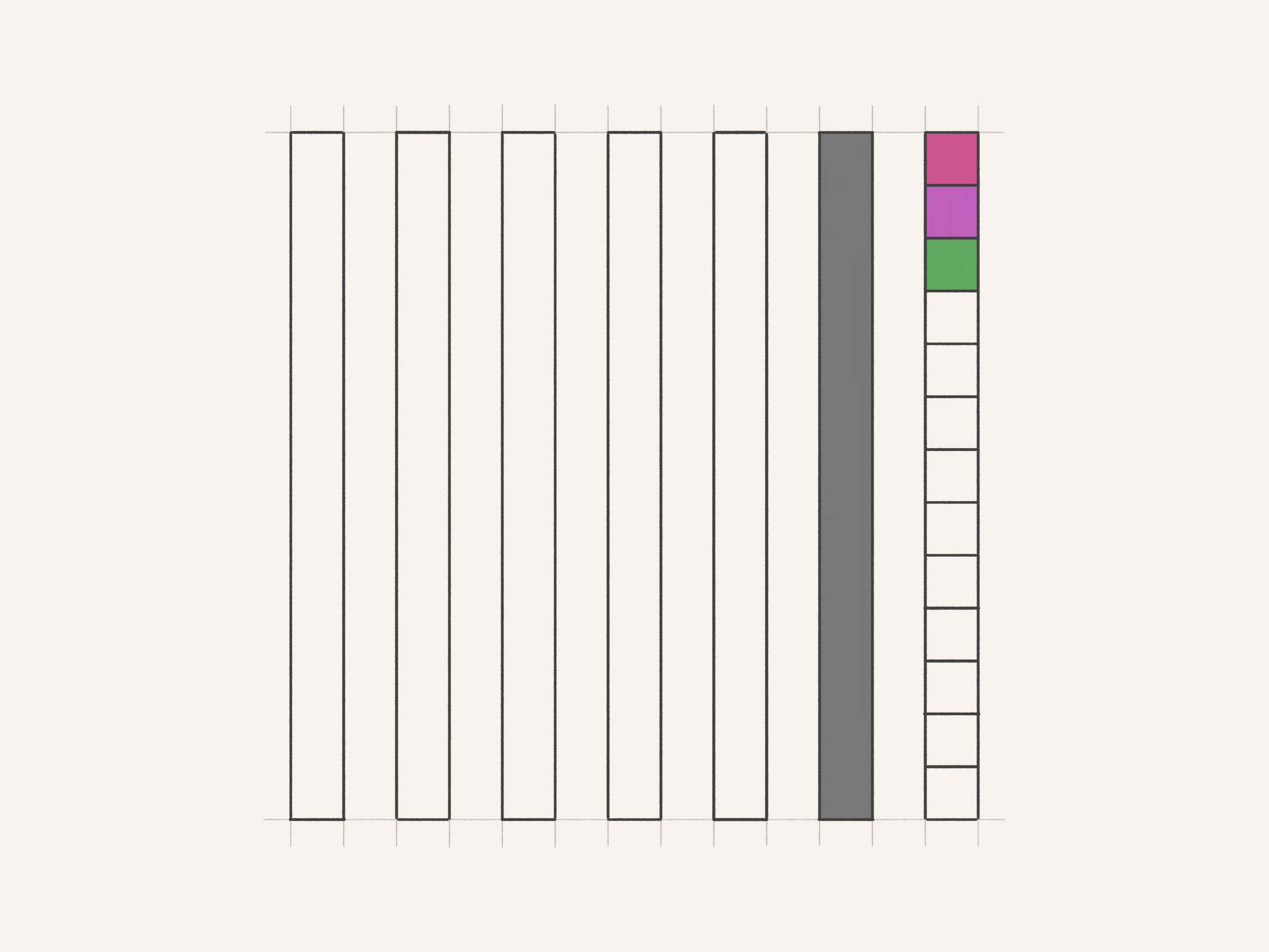
Jeff Davis, 2025 · token ID 3000744 · AB5D treasury
Treasury-held work · official Art Blocks Explorations render · live on Art Blocks
The title refuses the idea that one grand object could adequately commemorate Art Blocks. Each drawing is partial, tied to another artist's project, and the complete edition becomes a distributed index of the platform's first five years. Davis turns his own colour practice into an act of reading. The monument is therefore neither a statue nor an image of institutional triumph. It is a thousand acts of attention to other works.
The artist inside the institution
Davis's platform role creates a question similar to the one raised by any artist who helps construct the institution that later preserves their work. He served as Art Blocks Chief Creative Officer from 2021 to 2023, working with generative artists and overseeing relationships around projects. The role extended a longer pattern: two decades of teaching and Davis Editions, a print publisher through which he helped other artists realise work.9
The institutional entanglement should be named, not used as a shortcut to importance. Davis belongs in the AB[500] because the eleven projects make a sustained formal argument that can be assessed across different scales. A ten-work animation, a 2,000-work colour system, a collaboration derived from an installation, and a thousand-part platform archive all ask the same question: how can a tightly bounded structure remain open to perceptual difference?
His 2025 retrospective Color: 1995-2025 made the continuity visible across thirty years, joining work made before blockchain to the generative editions and material translations that followed.10 This longer view corrects the temptation to treat 2020 as an origin. Art Blocks supplied a consequential distribution and collection mechanism, but Davis arrived with a mature grammar. The platform made it executable at public scale.
Why he belongs in the AB[500]
Davis's eleven projects form the most extended single-artist sequence in the register. They show an artist testing edition size, time, architecture, collaboration, colour, memory, and institutional history without abandoning a precise visual syntax. That consistency makes difference easier to see. The works do not depend on stylistic reinvention to prove development; development occurs in what each system asks colour and proportion to do.
Construction Token demonstrates that a finite rule set can withstand the surprise of public minting. Color Study turns serial output into visual pedagogy. Portal makes display and duration part of colour. Schema lets one procedural practice interpret another. Drawings for a Monument finally converts the artist's grammar into an archive of his peers. The sequence begins by constructing a token and ends by constructing a memory.
MOTZKO's digital art collection adds a collector-side record of that development through holdings spanning Color Study, Construction Token, Progression, Reflection, and eight further works.11
Bibliography
The references cited in this essay are listed below. For the complete verified source ledger, see the Jeff Davis bibliography.