
View Card
Jeff Davis · Project 6 · Playground
Art Blocks Playground, project 6 · 41 outputs · minted 18 December 2020 · CC BY-NC 4.0
Live artwork. Move the pointer or touch to explore interactive works. Open artwork

View Card #27, held by AB5D: Window 1, Cloudy. Render: Art Blocks media proxy.
The work and its context
View Card is project 6 on the Art Blocks contract 0xa7d8d9ef8d8ce8992df33d8b8cf4aebabd5bd270. The index records 41 invocations against a maximum of 41, the runtime p5@1.0.0, an aspect ratio of 16:9 and the licence label CC BY-NC 4.0. It sits in the Playground vertical, and its current price field reads 0 1. The project text calls View Cards "generative abstractions of high-rise buildings" 1.
Each output is a wall of 144 windows, 16 across and 9 down, drawn as thin black frames over a field of colour. Four hues bleed in from the four corners, a tinted haze may lie over them, and the frames divide each window in one of nine ways 1. The project text promises "9 different window patterns, 4 different atmospheric conditions, and an overall color scheme based on 4 different reflections" 1. Clicking the live view prints those settings on the image 1.
Art Blocks now presents View Card as part of the Art Blocks 500, as a fixed edition of 41 released on 18 December 2020 2. Davis lists it on his own site as "series of 41 unique interactive digital images, 16:9 aspect ratio, adaptive resolution" 3. It has no published traits at all: the index holds an empty feature record for every token 1.
Conception and development
Davis came to Art Blocks at its beginning. In a 2025 interview with OpenSea he recalled: "When Art Blocks launched in November 2020, I was one of the first three projects on the platform" 4. His Construction Token was released on 27 November 2020, alongside Snowfro's Chromie Squiggle and Genesis by Calderon's brother Danny (DCA) 4. In a letter written for the platform's first anniversary, he describes an unsolicited email from Erick Calderon on 21 September 2020 inviting him to take part 5. At that point, he wrote, he had been "experimenting with NFTs for about a year and a half" 5. A collector's newsletter of 6 November 2020 shows him already selling colour abstractions on SuperRare 6.
View Card followed three weeks after that launch. It was the first project in the index to be filed under Playground, the category later described as open to artists who had already released a Curated project 17. The next Playground projects in the index, pxlq's Cyber Cities and ge1doot's Utopia, started on 7 February 2021, seven weeks later 1. Davis's other early numbers sit on either side of it. Project 5, Variant Plan, a commission for Variant Fund, was minted from 20 December 2020 but formally started on 11 January 2021. Color Study, his second Playground project, started on 8 February 2021 1.
The project text says View Card is "based on the programmable artwork View Program" 1. No record of View Program was found on Davis's site, his CV or the marketplaces searched for this draft, and its platform, date and form remain unconfirmed (see the questions below).
The buildings have a clearer precedent in Davis's own practice. His 2019 "facade" series consists of square works in which black mullions cross a glass curtain wall that shifts from one colour to another. They were made as unique digital C-prints between acrylic glass and PVC board, at 36 by 36 inches, and as smaller pigment prints 8. Several were shown in "Stratums", a two-person exhibition at the Walter Art Gallery in Scottsdale in 2019 89. The facades are angled views of a single tower. View Card flattens the same subject into a frontal elevation. The link is this draft's reading of the two series; no source by Davis states it.
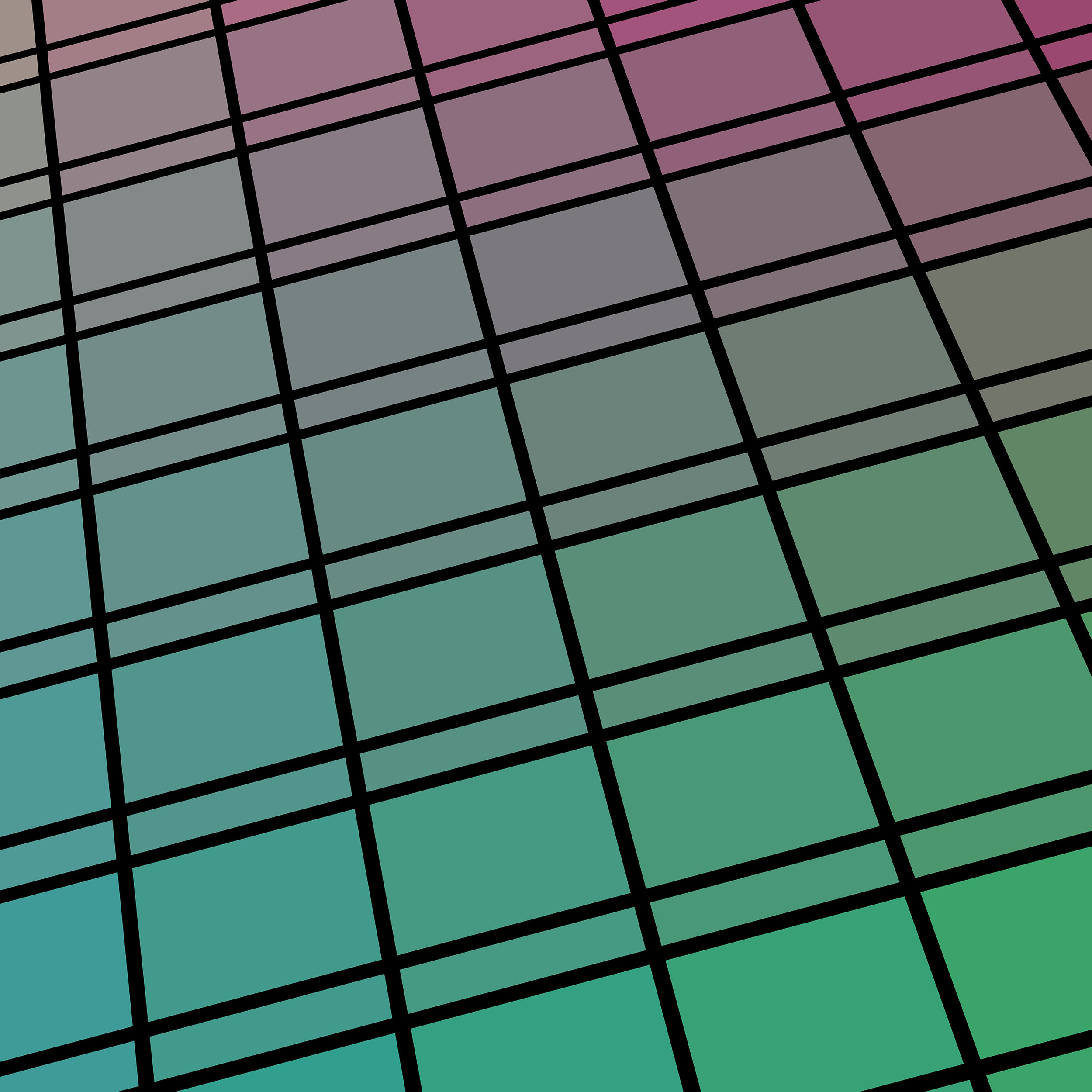
Jeff Davis, facade 71, 2019, unique digital C-print between acrylic glass and PVC board, 36 × 36 in. Image: Jeff Davis, jeffgdavis.com.
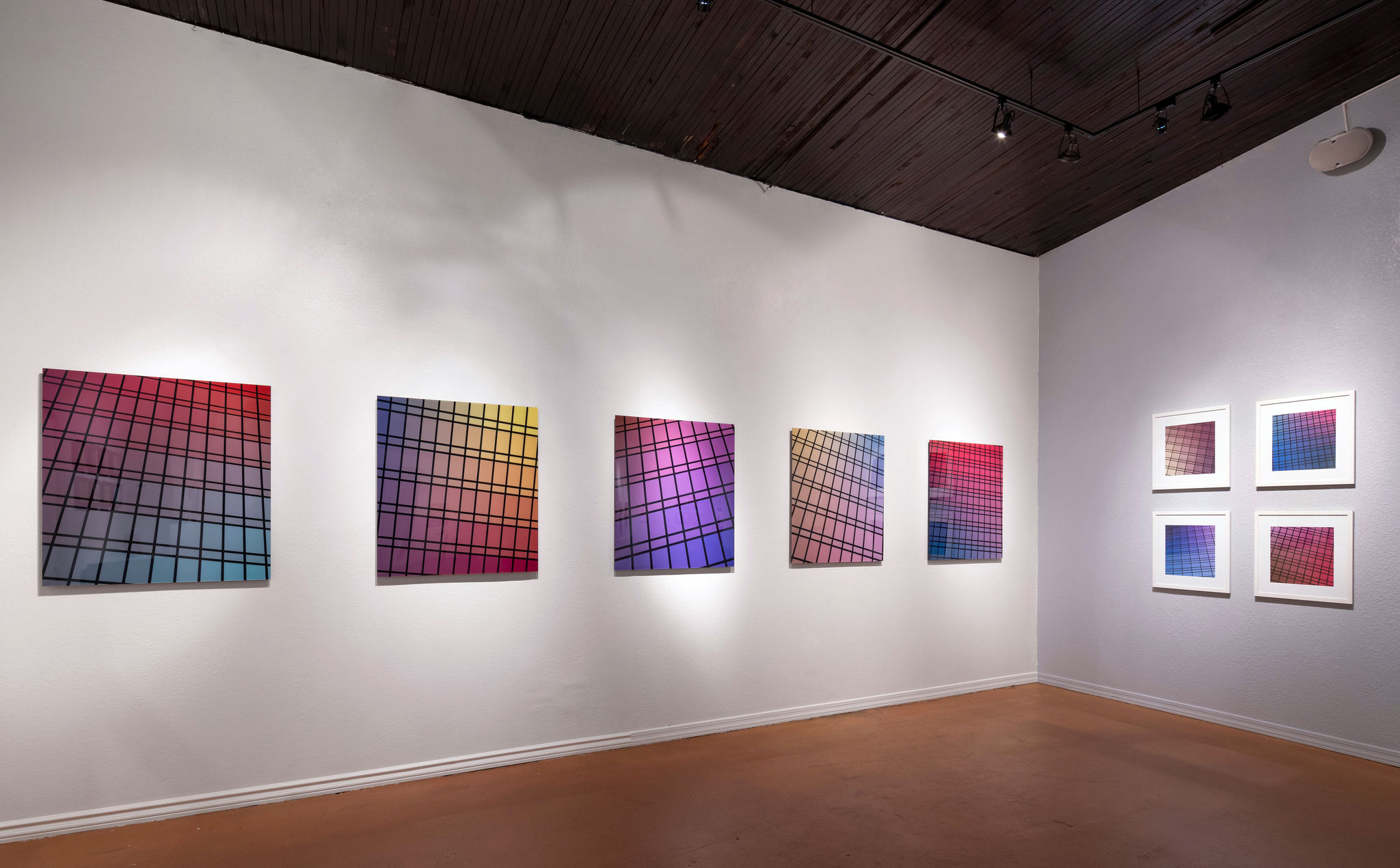
"Stratums", Walter Art Gallery, Scottsdale, 2019, installation view. Photo: Jeff Davis, jeffgdavis.com.
Davis trained as a painter and printmaker. A profile notes that he began using design software "to explore structures and colors to create digital art in 1999" 10. He holds a BA in mathematics and studio art from Lawrence University and an MFA in painting and drawing from the School of the Art Institute of Chicago 9. He has returned to the city as a subject: his 2021 Playground project Neighborhood is described as "generative urban abstraction inspired by my early career in Chicago" 1. He has spoken about how on-chain work changed his practice in several recorded talks 11.
How the work was constructed
The program is a single script of 5,968 bytes, SHA-256 805c1e968c31fd9e618649ff7959599fb9b5018faf99ce42fd0f6e4721909481. It was retrieved from the Art Blocks index on 20 September 2026 and read in full. No code is reproduced here 1.
The program does not read the token hash. Its random generator is seeded with the token's ID number, for example 6000027 for #27 1. The generator is a short shift-and-xor routine whose output is reduced to one of 1,000 values between 0 and 0.999 1. It makes six draws, in this order:
- four hues, one per corner, anywhere on the colour wheel;
- an atmospheric condition, one of four;
- a window pattern, one of nine 1.
The canvas is the largest 16:9 rectangle that fits the browser window, divided into a 16 by 9 grid of square units 1. The four hues are laid down as four translucent washes. Each wash is opaque in its own corner and fades linearly to nothing at the opposite edges, and the top-left wash is painted last 1. Over a white ground, averaged across the grid, the top-left hue supplies about 25 per cent of the colour, the top-right 20 per cent, the bottom-left 18 per cent and the bottom-right 14 per cent, with 23 per cent left as white (own computation from the program). The overlapping washes are what give the centre its muddied, mixed tones.
A full-canvas rectangle then applies the condition. Night is a dark blue at 25 per cent opacity, Cloudy a mid-grey at 40 per cent and Morning a pale pink at 40 per cent. Clear is a rectangle with zero opacity 1. Finally, every unit is outlined in black at one-sixteenth of a unit and divided according to the window pattern 1.
The index publishes no traits, so the table below was produced by running the program's generator for all 41 token IDs. The results were checked by eye against ten renders from the Art Blocks media proxy, including #0, #12, #26, #27 and #37 (own computation) 1.
| Setting | Program behaviour | Outputs of 41 |
|---|---|---|
| Condition: Morning, Clear, Cloudy, Night | each 25% | 16, 9, 9, 7 |
| Window 1: top strip over one tall pane | each 1 in 9 | 6 |
| Window 2: three horizontal bands | 4 | |
| Window 3: top strip over two tall panes | 3 | |
| Window 4: top strip, two squares, bottom strip | 4 | |
| Window 5: three vertical bands | 8 | |
| Window 6: top strip over three panes | 5 | |
| Window 7: side bands with two stacked squares | 3 | |
| Window 8: side bands with a three-part centre | 4 | |
| Window 9: top and bottom strips, three panes between | 4 |
Twenty-three of the 36 possible condition and window pairs occur. The most frequent are Morning with Window 2 and Clear with Window 1, four tokens each (own computation).
Quirks in the algorithm
A full read of the program, checked against re-runs of the generator for all 41 token IDs and against renders, turned up the following. Points resting on the code alone are marked as code readings.
- The hash is ignored. The seed is the token ID, so each image is fixed by its position in the edition, not by the random hash the contract generated at mint. The 41 hashes recorded in the index play no part in the artwork 1. It also means that anyone with the script could have known what each View Card would look like before it was minted (code reading).
- Neighbouring tokens share a colour. The seeds are consecutive numbers, and the generator's first draw moves almost in step with them. The top-left hue therefore marches round the wheel in runs: #16 to #23 climb from 205 to 245 degrees, and #24 to #31 step six degrees at a time from 338 through red to 18 (own computation) 1. The later draws are better mixed, but not entirely. #23 and #32 draw identical condition and window values, and both are Clear, Window 1 1.
- A non-standard generator. The routine uses an arithmetic right shift where the textbook xorshift uses a logical one, and it keeps only three decimal digits of the result. Hues therefore come from 1,000 possible values spread over 360 degrees, so some hues are half as likely again as others (code reading) 1.
- The reflection numbers are offset. The overlay labels each reflection with its hue minus 180. The figures shown run from -180 to 179, not 0 to 359, so they do not match the hue a viewer would pick in a colour tool. #27 reads 176, -37, -78 and 153 for hues of 356, 143, 102 and 333 degrees (own computation) 1.
- The four reflections are not equal. The washes are painted in a fixed order with the top-left hue on top. The first reflection supplies nearly twice the colour of the fourth (see above) 1.
- "Clear" draws an invisible haze. The Clear condition paints a full-canvas rectangle at zero opacity. It is a no-op that keeps the four branches parallel (code reading) 1.
- Small slips. The column fade uses a decimal a hair above one-fifteenth, so the last column of each wash gets a tiny negative opacity, which the browser treats as zero. The fourth line of the overlay sits at 6.6 steps down where the pattern predicts 6.5. Two loop counters are declared globally and then shadowed. None of these has a visible effect beyond the overlay spacing (code reading) 1.
- Interactivity and resolution. The canvas is sized once, when the page loads, and does not follow later changes to the window. A first click dims the image and prints the window number, condition and reflections. A second click resets the seed and reruns the whole setup, which redraws the same image at the current window size (code reading) 1.
The most coveted variants
No published source ranks View Cards or names a grail, and the index records no sale prices 1. What follows is a guide to the rarer and more distinctive outputs, based on the computed settings above. It is not a record of collector demand.
Night (7 of 41). Night is the rarest condition. Its blue veil lowers every colour, making these the darkest cards. #37 pairs Night with Window 1: green at the left, blue at the top right and red at the bottom right, all subdued 1.

View Card #37: Window 1, Night. Render: Art Blocks media proxy.
The near-monochrome (#26). In #26 three of the four reflections fall within nine degrees of each other: 350, 353 and 359, a single crimson. Only the bottom-right corner turns green. It is the only View Card with three reflections so close, and it is also a Night card with Window 4 (own computation) 1.

View Card #26: Window 4, Night. Render: Art Blocks media proxy.
Clear with Window 1 (4 of 41). With no haze and the simplest frame, #12, #23, #28 and #32 show the reflections at full strength. #12 runs from orange at top left to violet, blue and yellow at the other corners 1.

View Card #12: Window 1, Clear. Render: Art Blocks media proxy.
Invocation 0. #0 is the only View Card minted before the project's start time, at 19:06:37 UTC, ten minutes ahead of #1 1. It is a Morning card with Window 5, whose vertical bands make the densest pattern. Violet, blue, magenta and cyan fill its corners. Davis uses it as the image of the series on his own site 13.

View Card #0: Window 5, Morning. Render: Art Blocks media proxy.
AB5D's card (#27). The hero image is a Cloudy card with Window 1. It has red at top left, green at top right, yellow-green at bottom left and pink at bottom right, under a grey haze 1. It was minted at 19:55:10 UTC on 18 December 2020 1.
In the market, OpenSea's collection page, read on 20 September 2026, gave a total traded volume of about $576,700, 25 unique owners and three listed items. It also showed individual sales ranging from roughly $600 to more than $48,000, without naming the tokens 12. The lowest listing in the Art Blocks index at retrieval was 6 ETH 1. View Card was not part of the 19-work Art Blocks lot in Sotheby's "Natively Digital" sale of June 2021, which represented Davis with Construction Token #343 13.
The mint
The index records the start time as 18 December 2020 at 19:16:26 UTC. Invocation 0 was minted ten minutes earlier, at 19:06:37 1. Nine tokens had been minted by ten minutes after the start and 36 within the hour. The 41st was minted at 20:19:16 UTC, just under 63 minutes after the start, and that time is also recorded as the project's completion 1. The index gives an activation date of 24 January 2021, five weeks after the edition had sold out. No source inspected explains the order 1. The current price field reads 0, and no source found gives the original mint price 1.
At retrieval the 41 tokens were held by 25 addresses. Four wallets held four each, one held three and two held two. No source inspected names any of them, and the artist's address holds none 1. The address 0xdd19308a9731cdecb67e0d80ca6823394208c045, one of AB5D's, holds #27 1.
Copyright and licensing
The index records CC BY-NC 4.0 without a link 1. On that label, the images may be shared and adapted for non-commercial purposes with attribution. Commercial use needs the artist's permission. The script carries no separate code licence, and p5.js is loaded by the platform at view time 1. The earlier AB5D essay made the same points and noted p5.js's own LGPL licence 14. The facade and Stratums images above belong to Jeff Davis. They are linked from his site, not re-hosted, and need his permission before any reuse beyond reference.
Significance and limitations
View Card is a small, early and self-contained work. It was the first Playground release in the index, and one of the first projects on the platform's second contract 1. It carries a thread of Davis's pre-blockchain work, the coloured glass facade, into a program under 6,000 bytes, and it keeps the viewer's hand in the loop with its click-to-read overlay. Its technical choices mark it as an early piece. Seeding from the token ID and not from the hash fixed every output in advance and tied neighbouring cards together, a pattern visible in the edition's colours. Davis went on to become Chief Creative Officer of Art Blocks from April 2021 to September 2023, and has since been a strategic advisor 9. He is the author of two design and colour textbooks, and was the subject of a retrospective, "Color: 1995–2025", at Artverse in Paris 1516.
Unresolved research questions:
- What was View Program? Its platform (Async Art is a guess, not a finding), date and whether it still exists are unconfirmed.
- What was the mint price, and why is the activation date five weeks after the edition sold out?
- Did Davis choose token-ID seeding on purpose, for instance so that each card could be previewed before minting, or was it a carry-over from an earlier script?
- Which sales make up OpenSea's reported volume, and which token made the top sale? Marketplace records per token are needed.
- Quotations from the OpenSea interview, the anniversary letter and the Behind the Keys profile came through automated WebFetch extraction and should be checked against the pages.
Bibliography
Primary
-
Art Blocks public GraphQL index,
projects_metadatafor project 6 (including the full program) and for Davis's other projects, andtokens_metadatafor all 41 tokens. Retrieved 20 September 2026 via https://artblocks-mainnet.hasura.app/v1/graphql. Settings and colour weights computed by re-running the generator. Collection page: https://www.artblocks.io/collections/playground/projects/0xa7d8d9ef8d8ce8992df33d8b8cf4aebabd5bd270/6 ↩
-
Art Blocks, "View Card by Jeff Davis", collection page, read 20 September 2026. https://www.artblocks.io/collections/presents/projects/0xa7d8d9ef8d8ce8992df33d8b8cf4aebabd5bd270/6 ↩
-
Jeff Davis, portfolio, "2020". https://www.jeffgdavis.com/2020 ↩
-
Jeff Davis, portfolio, "2019" (facade series and Stratums installation views). https://www.jeffgdavis.com/2019 ↩
-
Jeff Davis, CV. https://www.jeffgdavis.com/vitae ↩
-
Jeff Davis, "Our First Anniversary", letter published by The Link (Art Blocks), Medium, 2021. https://medium.com/the-link-art-blocks/our-first-anniversary-97c54d5308be ↩
-
Jeff Davis, website and biography. https://www.jeffgdavis.com/ ↩
Video and audio
-
Talks and interviews on YouTube. Titles and channels are as returned by YouTube's oEmbed service on 20 September 2026. The videos were identified but not watched for this draft.
-
"NFC24: Jeff Davis, Five Years Later | Jeff Davis", NFC Summit. https://www.youtube.com/watch?v=J86ROmNgQGY
-
"Color: 1995-2025 / NFC Lisbon 2025", Jeff Davis. https://www.youtube.com/watch?v=nCW1U8z42lI
-
"Art Blocks, Jeff Davis, and Bright Moments - Venice Beach to the World", Bright Moments. https://www.youtube.com/watch?v=CuOTPshQM74
-
"DeCent People With Art Block's Jeff Davis", Decential Media. https://www.youtube.com/watch?v=KsTfpG73IIM
-
Also listed on Davis's media page: "Generative Art on the Blockchain: How Ethereum Transformed my Artistic Practice", EthCC. https://ethcc.io/archives/generative-art-on-the-blockchain-how-ethereum-transformed-my-artistic-practice
-
Criticism, collecting and market
-
Megan DeMatteo, "In Conversation With Jeff Davis", OpenSea, 24 March 2025. https://opensea.io/blog/articles/in-conversation-with-jeff-davis ↩
-
Jim Thalassoudis, "4 Crypto Artists to Buy and Why", Nifty Art Collector, 6 November 2020. https://niftyartcollector.substack.com/p/4-crypto-artists-to-buy-and-why ↩
-
Druid, "A Brief Guide to Curated, Playground, and Factory Projects on Art Blocks", The Link (Art Blocks), Medium, 26 August 2021. https://medium.com/the-link-art-blocks/a-brief-guide-to-curated-playground-and-factory-projects-on-art-blocks-f17283852350 ↩
-
Behind the Keys, "Jeff Davis: The Art Blocks CCO on his creative process, resolutions & independence" (undated). https://www.itsbehindthekeys.com/p/jeff-davis-the-art-blocks-cco-on ↩
-
OpenSea, "View Card by Jeff Davis" collection page, read 20 September 2026. https://opensea.io/collection/view-card-by-jeff-davis ↩
-
Sotheby's, "Natively Digital: A Curated NFT Sale", lot 4, "Art Blocks | 19 works", New York, June 2021. https://www.sothebys.com/en/buy/auction/2021/natively-digital-a-curated-nft-sale-2/19-works ↩
-
AB5D, "View Card by Jeff Davis", earlier essay. https://ab5d.xyz/series/view-card-by-jeff-davis/ ↩
-
Artverse, "Thank you for Joining Us: Jeff Davis's retrospective, Color: 1995–2025". https://artverse.substack.com/p/thank-you-for-joining-us-jeff-daviss ↩
Further reading
- Art Blocks, "Introducing Art Blocks 500". https://www.artblocks.io/articles/art-blocks-500-complete-collection
- Alex Estorick, "The Color of Code | Jeff Davis", Right Click Save, 8 May 2023. https://www.rightclicksave.com/article/the-color-of-code-interview-jeff-davis
- Pace Gallery, "Schema by DRIFT with Jeff Davis, Explained". https://www.pacegallery.com/journal/drift-with-jeff-davis-schema-explained/
- Artnet News, "In the Texas Desert, Craft Meets Coding". https://news.artnet.com/art-world/in-the-texas-desert-craft-meets-coding-2592897
Supplied revision published by AB5D. Author not specified. Original prose: CC0. Artwork and code rights are addressed separately above.
Token usage unavailable for the complete essay.
Token usage
Usage for this supplied revision was not provided. The linked generation record describes the original research batch.
Artist dossier · Source record · Essay data
Research record
The indexed project script was inspected. Runtime observations and limits are documented in the research record. Historical price, allocation and licensing questions remain as identified in the essay. Publication does not resolve those evidence gaps.