
I
308 artists, by surname.
Generative geometries and chromatic structures

0xphiiil advances generative art through precise investigations of form, color, and chance. The 2022 release Zupermat on Art Blocks Factory stands as a defining body of 200 unique editions that treat the rectangular cuboid as both subject and system.
0xphiiil contributes to the generative art field with works that fuse algorithmic logic and visual restraint. The artist, also identified as Phil Caya in exhibition contexts, maintains a dual engagement with on-chain systems and physical presentations. Zupermat remains the central project associated with the Art Blocks Factory phase1.
The collection comprises exactly 200 editions released on 6 May 2022. Each output functions as a frame in an ongoing documentary of pseudo-random rectangular cuboids whose positions, orientations, and chromatic relations shift according to internal parameters2. The resulting images range from dense linear accumulations to open architectural arrangements, all governed by a shared generative grammar.
Zupermat is the infinite documentary on the life of pseudo-random rectangular cuboids.
The script incorporates variables such as angle regime that modulate the spatial behavior of the cuboids. Outputs display orthogonal projections, angled clusters, and layered transparencies that evoke both digital minimalism and sculptural mass. Color application remains measured, favoring limited palettes that reinforce the structural emphasis rather than decorative effect. These choices align Zupermat with historical concerns in concrete art and color-field painting while updating them through procedural authorship3.
Each of the 200 editions is unique yet legible within a coherent family. Collectors encounter works that reward sustained viewing as the eye traces edges, intersections, and negative spaces created by the algorithmic assembly. The absence of overt narrative invites contemplation of system and variation as primary content.
0xphiiil released Zupermat during the active Factory period of Art Blocks, a platform that enabled artists to deploy fully on-chain generative systems at scale16. Parallel and subsequent projects, including physical-leaning generative sculptures such as Stormae, extend the same interest in constructed form into hybrid exhibition settings4. Gallery documentation from 2023 records the artist's inclusion in group presentations focused on generative and spatial practices in New York5.
The artist maintains profiles across specialized platforms that support discovery and secondary engagement with generative works. These channels complement the primary Art Blocks presentation and underscore a commitment to both technical rigor and accessibility within the wider ecosystem.
The references cited in this essay are listed below. For the complete bibliography see the 0xphiiil links page.
Pioneers of Ephemeral Tech

A.A. Murakami, the artist duo of Alexander Groves and Azusa Murakami, pioneers ephemeral tech in both physical installations and digital generative art. Their Floating World Genesis collection on Art Blocks comprises 250 unique works that visualize primordial life through animated bubbles and meditative scenes.
A.A. Murakami, the artist duo established in 2011 by Alexander Groves and Azusa Murakami, has forged a distinctive path in contemporary art by integrating scientific inquiry with sensory experience. 4 Operating between London and Tokyo, the pair employs what they describe as ephemeral tech to produce installations and digital works that materialize transient natural processes. 1 Their participation in the Art Blocks ecosystem through Floating World Genesis introduced 250 generative editions that translate these concerns into animated, collectible forms. 3
The duo's practice revolves around ephemeral tech, a term they coined to denote the use of technology to generate fleeting, atmospheric phenomena rather than fixed digital displays. 1 This approach manifests in large-scale environments where fog, bubbles, mist, and plasma create immersive fields that engage viewers physically and perceptually. Early works like New Spring (2017) established their method of orchestrating interactive natural simulations through engineered systems. 1
In a 2026 conversation with Le Random, A.A. Murakami sharpened the distinction between their work and the recreation of natural weather. Their bubbles and fog rings behave according to natural laws, but stage phenomena that do not occur in nature: membranes and energy flows that briefly hold a pattern together before it loses its identity and dissolves. The artists described these installations as handing control to matter, gravity, and entropy. Where light itself can be the medium for James Turrell, they proposed that in ephemeral tech, existence itself is the medium. 13
Exhibitions have amplified this vision on institutional stages. The 2025 Floating World presentation at the Museum of Fine Arts, Houston wove together five distinct yet interconnected installations, among them floating bubble clouds that dissolve into mist, radiating fog rings, and fields of flickering plasma tubes. 2 Comparable projects at M+ Museum in Hong Kong further demonstrated their ability to construct otherworldly yet grounded sensory encounters. 12 Public commissions, such as the Times Square Arts iteration of Floating World, extended these experiences into urban contexts where natural emulation intersects with everyday space. 11 Their investigations into the limits of human perception have informed exhibitions such as the 2023 presentation at Hyundai Motor Studio in Busan. 7
Philosophically, A.A. Murakami connects their output to longstanding human traditions of emulating nature through art and architecture, from cave paintings to celestial observatories. 6 Recent profiles highlight ongoing interests in time perception, the block universe, and how technology can render invisible processes tangible and contemplative. 4 9
Released in December 2022 as the opening chapter of the Floating World project, Floating World Genesis comprises precisely 250 unique artworks generated on the Art Blocks platform. 3 10 Each token renders one of three distinct animated scenes featuring bubbles as central motifs, drawing direct inspiration from the Miller-Urey experiment of 1953 that probed the chemical origins of life in a simulated primordial atmosphere. 1
Scene one depicts solitary or dividing bubbles symbolizing prebiotic matter. Scene two animates growing clusters suggestive of evolutionary transitions toward complex life. Scene three situates a central bubble within a dynamic seascape complete with procedurally generated waves and reflections, representing the stabilization of planetary biospheres. 1 The underlying code employs vertex shaders driven by sine and cosine functions to simulate fluid motion across point-based meshes, augmented by Perlin noise for naturalistic water effects and sophisticated color mapping that explores harmonic and contrasting palettes. Select outputs incorporate stereoscopic rendering via anaglyph techniques, underscoring the artists' fascination with perceptual thresholds and hybrid realities they term the mataverse. 1
The aesthetic sensibility leans toward hypnotic minimalism, evoking the contemplative stillness of Light and Space artists while harnessing generative variability to ensure each edition remains singular. 1 The resulting pieces offer tranquil viewing experiences that reward prolonged observation, much like the durational encounters fostered by their installations. 5 In this way, the collection functions as both a digital archive of primordial imagination and a bridge to the duo's physical Floating World environments, where similar bubble and fog motifs achieve monumental scale. 2 Critical coverage has situated the project as an exemplar of how generative art can model scientific and philosophical ideas about emergence and impermanence. 7 6
By limiting the series to 250 editions, A.A. Murakami maintains an intimate scale that contrasts with the expansive physical installations, inviting collectors into a meditative digital counterpart to their sensory practice. The work thus embodies a cohesive vision across media, where code and matter alike serve to honor the delicate systems sustaining life on Earth. 3 Coverage in specialist outlets and institutional archives has affirmed the project's significance within discussions of web3 art and sensory practice. 9 8
The references cited in this essay are listed below. For the complete bibliography see the A.A.Murakami links page.
Daïm Aggott-Hönsch
Apeirographer of the Infinite.


A Muslim algorist, apeirographer, and AI artist who deploys generative systems to reveal the timeless marvels hidden within mathematics, creating works that invite pareidolic interpretation and sustained contemplation.
Daïm Aggott-Hönsch (born 1982, Hungary) is a self-described Muslim algorist, apeirographer, and AI artist whose practice sits at the intersection of mathematics, spirituality, and computational aesthetics.1 Working under the moniker DaïmAlYad, he has spent over a decade developing what he terms apeirography: an artistic discipline devoted to recognizing mathematics as an exceptional, timeless subject worthy of creative exploration.2 His work seeks to convey visions of the myriad improbable marvels concealed within mathematical systems and complex algorithms, proposing that the beauty embedded in these structures whispers of the divine.3
Aggott-Hönsch's entry into the crypto art space marked a significant expansion of his practice, allowing him to distribute algorithmic works as non-fungible tokens and reach a global collector base. His works appear in notable international collections including that of Metakovan, the Museum of Crypto Art, and the Government of Hungary.4 His approach is characterized by a commitment to what he calls Slow Art: audiovisual and generative works that reward prolonged attention rather than immediate consumption, deliberately resisting the rapid-fire temporality of social media platforms.5
Cryptoblots (2020), Aggott-Hönsch's contribution to the Art Blocks Curated collection, comprises 1,921 unique editions generated through symmetrical random-walk algorithms.6 The series functions as an algorithmic homage to Hermann Rorschach's famous inkblot perception test, creating horizontally reflected abstract forms that entice the human compulsion for pareidolia: the tendency to perceive meaningful images in ambiguous visual patterns.7 Each output presents an indeterminate shape that the viewer is free to interpret in their own unique way, with no predetermined meaning imposed by the artist.
The series demonstrates remarkable chromatic and compositional range. Early grayscale prototypes eventually gave way to the more colorful final implementation, which Aggott-Hönsch noted is far easier on the eyes though the color tends to skew interpretations toward certain associations.8 The delight of the work lies in the uniqueness of each interpretation: one piece was nicknamed In the Times of Covid by its minter because it suggested a woman wearing a facemask, a pareidolic reading that became impossible to unsee once articulated.9 Cryptoblot #1044 from this series was later included in Sotheby's Natively Digital curated NFT sale in June 2021, part of the historic Art Blocks lot that established the marketplace legitimacy of generative art.10
Following the success of Cryptoblots, Aggott-Hönsch released Thereidoscope (2021) on Art Blocks, a series of 630 editions that extends his investigation into algorithmic image generation and perceptual psychology.11 The title suggests a telescope or kaleidoscope for theory (from the Greek theoria), implying a device for viewing mathematical concepts rather than physical objects. Where Cryptoblots invited free association through symmetrical abstraction, Thereidoscope operates through more structured geometric transformations, creating outputs that suggest both organic growth and crystalline mathematical precision.
The work reflects Aggott-Hönsch's broader philosophical project, which he articulates in The Apeirographer's Manifesto (2016/2019): mathematics is not merely a tool for art but its fundamental subject, an exceptional and timeless domain that reveals the connective tissues binding human experience to the cosmos.12 In his practice, Big Infinity (the unfathomable collection of numbers stretching upward) meets Small Infinities (the endless divisions between any two numbers), creating a framework where human beings are understood as one beautiful, perpetual, multifaceted Small Infinity within the larger universe.13
Aggott-Hönsch's commitment to Slow Art represents a deliberate counterposition to the rapid consumption patterns typical of crypto art platforms. Works such as Ancestral Memory (2020), a six-minute audiovisual GAN-assisted piece that was a finalist for the NFT Awards 2020 Most Innovative NFT, are designed to be experienced over time rather than apprehended in a glance.14 The artist explains that in a perfect world, his works would hang on walls in digital frames, subtly shifting over hours or days, rewarding the viewer who returns to look again and discovers that the piece has transformed in their absence.15
This temporal generosity extends to his most ambitious project, The Changelings (2021), an hour-long audiovisual installation that combines AI-generated imagery, algorithmic distortion, and mathematical sonification to create what the artist considers his magnum opus.16 The work was exhibited in Hungary in a darkened room with large screens and immersive audio, offering viewers the intended Slow Art experience of gradual, almost imperceptible metamorphosis.17 Its scale, at approximately nine gigabytes for the compromised mintable version, points to the technical challenges of bringing such expansive time-based work to the blockchain.18
Aggott-Hönsch's trajectory reflects the broader migration of generative artists from traditional computational art practices into the crypto space. Before his blockchain work, he exhibited in venues including the Royal Cornwall Museum in Truro, United Kingdom (2019) and various galleries in Toronto, Canada, where he was based for a period.19 His early algorithmic work explored Pickover biomorphs and fractal systems, visualizing mathematical functions that produce organic, often microscopic forms resembling biological specimens.20
The artist's intellectual framework draws equally from mathematical rigor and spiritual conviction. As a Muslim creator, he approaches computation as a form of devotion, seeking to reveal the anthropic conception of beauty within mathematical structures that whisper of the divine.21 This synthesis of faith and algorithm distinguishes his practice from purely secular generative art, infusing his systems with a sense of reverence for the underlying order of creation.
His more recent work has expanded into AI-assisted and GAN-based practices, including the adversarial portrait series Apprehension (Artifice & Insight) (2023) and the surrealist landscape series Hidden Mistress (Dreams of Xarané) (2022), both of which explore the human condition through intentional subversion of image synthesis systems.22 The 2022 series Isles upon Deemed Rivers & Other Wonders, released through UltraDAO, applies algorithmic pixel sorting to transform diverse source visuals into serene pseudo-natural scenery, demonstrating his continued evolution across platforms and techniques.23
For the complete bibliography see the Daïm Aggott-Hönsch links page.
Sadık Aksu | xnmtrc
Architecture released into algorithmic space

Working as xnmtrc, architect and creative coder Sadık Aksu treats architectural representation as both a visual language and a programmable system.
Sadık Aksu approaches generative art from within architecture. His practice connects architectural knowledge with computational systems, artificial intelligence, and experimental design research. Under the name xnmtrc, he uses architectural logic as a generative medium, translating spatial relationships and representational conventions into programmable structures.1 His images do not simply imitate technical drawings. They investigate how plans, partitions, grids, annotations, and other architectural elements can become the rules of an artwork.
That inquiry is concentrated in Freeplan, released through Art Blocks Factory on January 20, 2022 as a collection of 128 editions.2 The project places the conventions of the architectural plan inside a generative system. Its vocabulary of lines, fields, symbols, and labels recalls professional drafting, yet each composition is evidence of an algorithm making spatial decisions rather than documentation of a predetermined building.
Freeplan draws on the early twentieth-century open-plan tradition, in which conventional rooms and rigid visual boundaries give way to more freely arranged spatial elements. Aksu explains that partitions, floors, structures, and related components establish the sensation of space without returning to a closed architectural box.3 The transaction hash determines the overall composition, context, selection of components, and representation style. Each iteration is also scaled, oriented, and numbered like an architectural project.3
This procedure produces a tension between discipline and contingency. The drawings appear regulated because they retain the authority of plans, measured notation, and organized sheets. At the same time, their spaces have no client, fixed program, or completed building to validate them. The algorithm acts as a speculative designer, distributing recognizable architectural components without resolving them into a conventional commission.
The series consequently asks viewers to read as well as look. Walls suggest enclosure but may not complete it. Paths imply approach, while structural and landscape marks indicate possible conditions of occupation. The drawings remain recognizable as architecture while withholding the certainty expected from construction documents. Across 128 editions, repetition establishes a stable visual grammar, but variation prevents that grammar from settling into a single ideal plan.
Projects beyond Freeplan clarify the continuity of Aksu's method. ODA, created with Víctor Doval, begins with the room and develops contrasts such as inside and outside, transparency and opacity, visibility and concealment.4 Archi Doodles transfers the spontaneity of architectural sketching into a generative process, including extended intersection lines, marker-like colors, and human-scale figures.5 Junkspace likewise uses plan representation, partitions, flooring, paper types, and palettes to interpret the spatial residue associated with modernization.6
These works show that architecture is not merely a graphic style for Aksu. It supplies concepts, constraints, compositional relationships, and methods of representation. His writing similarly compares architecture and software through their shared dependence on systems and constraints, arguing that both translate rules into organized structures.7 A separate instructional essay recommends small visual coding experiments, including patterns, simple plans, and randomized variations, as an entry point for architects learning programming.8
Within this broader practice, Freeplan offers a concise statement about authorship. Aksu establishes the grammar, probabilities, and field of possible decisions, while the final plan is resolved through the generative process. The collection is neither a proposal for 128 buildings nor a set of arbitrary graphic variations. Its editions record a designed system repeatedly negotiating freedom and order. Architecture becomes the work's subject, its representational vocabulary, and its operational logic.
The references cited in this essay are listed below. For the complete bibliography see the Sadık Aksu | xnmtrc links page.
Ruben Alexander
Drawing botanical order from computational variation

Ruben Alexander’s Star Flower treats the blossom as both image and procedure. Across 1,000 editions, a tightly organized generative system repeatedly tests how geometry can suggest growth.
Ruben Alexander’s Star Flower appeared through Art Blocks Factory on 20 April 2021 as a collection of 1,000 unique artworks.1 Those facts place it within a particularly concentrated moment in the development of blockchain-based generative art. Yet the project is more rewarding when approached not simply as an artifact of that moment, but as a sustained investigation into how a small visual vocabulary can support meaningful difference. Its flowers are built from repeated units, radial organizations, layered colors, and patterned fields. Each output belongs unmistakably to the same family, while retaining its own balance of density, rhythm, and chromatic temperature.
Alexander describes himself as an artist and coder, a concise pairing that clarifies the project’s double address.2 Star Flower is visual art, but it is also the trace of a designed procedure. Its images are not variations painted one after another. They are outcomes made possible by a system that distributes choices across a bounded field. Art Blocks characterizes generative practice as the construction of an algorithm in which artist-defined parameters interact with controlled randomness.3 In Alexander’s collection, that interaction is legible without becoming merely demonstrative. The code is never the subject by itself. It operates as an instrument for producing emblems that feel at once botanical, heraldic, textile-like, and diagrammatic.
The title establishes an immediate tension. “Flower” invokes growth, softness, seasonality, and biological irregularity. “Star” introduces geometry, distance, radiance, and rotational symmetry. Alexander joins these terms through forms that can be read in both directions. Pointed petals resemble stellar rays, while concentric polygons acquire the layered depth of a corolla. The image hovers between living specimen and constructed sign.
This ambiguity is strengthened by the square format. Rather than placing a naturalistic flower in an illusionistic environment, the compositions tend to organize the entire surface. Borders, corners, background subdivisions, and central motifs participate in a common syntax. The flower becomes less an object represented within space than a rule for structuring space. In some outputs, a dominant central rosette stabilizes the image. In others, repeated segments and nested outlines draw attention outward, making the surrounding field feel as active as the core.
Serial algorithmic art depends upon the productive relation between constraint and difference. One critical account identifies seriality, algorithmic construction, and participation at the point of collection as defining properties of the form.4 Star Flower makes the first two especially visible. Repetition supplies coherence, while parameter changes prevent the series from collapsing into duplication. A petal count, boundary, palette, internal division, or degree of overlap may alter the reading of the whole. The collection therefore asks viewers to compare, classify, and revise their impressions. No single edition functions as a definitive flower. The work resides in the population of possible flowers and in the distances between them.
The project’s 1,000 editions are essential to that argument.1 At this scale, recurrence becomes perceptible, but sameness remains elusive. A viewer begins to notice families of structure and color, then encounters outputs that complicate those provisional categories. This oscillation between recognition and surprise is a central pleasure of the collection. It resembles looking at botanical specimens whose shared anatomy accommodates striking differences, although here the governing heredity is computational rather than biological.
Color in Star Flower does more than decorate an established drawing. It separates layers, controls apparent depth, and determines which symmetries become immediately visible. A dark center against a bright surround can make a rosette appear to advance. Closely valued hues can instead compress the image into a woven plane. Contrasting outlines isolate components, while related colors allow adjacent segments to fuse into larger masses. The same underlying logic can consequently register as crisp icon, kaleidoscopic aperture, ornamental tile, or luminous screen.
The project’s affinity with textiles is particularly suggestive. Radial stars, repeated diamonds, nested borders, and modular color changes recall quilting and patterned cloth without reproducing a single historical design. This resemblance matters because textile traditions also construct expansive visual fields from repeatable units. Their intelligence lies not only in motif but in arrangement, adjacency, inversion, and controlled variation. Alexander’s computational procedure translates comparable concerns into a digital register. The resulting images can feel handmade in their sensitivity to juxtaposition even though their production is algorithmic.
That apparent contradiction is less a problem than a productive condition. Alexander’s account of an earlier NFT project describes learning oil pastel techniques from his son before translating ideas across physical and digital processes.5 The episode indicates an artistic outlook in which tools and media are porous rather than hierarchically separated. It also helps explain why Star Flower avoids the sterility sometimes associated with geometric computation. Its sharp boundaries coexist with a fascination for organic growth, tactile pattern, and the emotional charge of color.
A profile predating the Art Blocks release records Alexander’s experience with graphics and rendering and identifies Hudson, Massachusetts, as his location at that time.6 Because that information is not current enough to establish a present residence, it is best treated as historical context rather than contemporary biography. Even so, it supports a picture of a practice developed through sustained engagement with digital image construction. Star Flower condenses that experience into a system whose technical organization remains subordinate to visual encounter.
The collection should not be reduced to ten representative images, or even to a sequence of favored outputs. Its medium includes the relation between individual image and total edition. An isolated flower can be appreciated for its balance, palette, or emblematic force. A group reveals something different: recurrence becomes rhythm, deviations gain significance, and the algorithm’s range begins to emerge. Looking across the series turns spectatorship into comparative attention.
This is where the Art Blocks format becomes materially relevant. The platform’s documented model joins an artist’s script with token-specific data so that individual outputs remain deterministic and reproducible.7 Its creator documentation identifies a token hash as the unique on-chain random seed for an output and warns against nondeterministic inputs that would produce different results on later loads. These mechanics do not explain Alexander’s aesthetic decisions, but they define the conditions under which those decisions proliferate. The artist composes not only images but a field of permitted transformations.
The collection’s Factory designation also carries historical specificity. Art Blocks describes Factory as an editorially open program launched in March 2021 and closed in October 2022.8 Released one month after that program began, Star Flower belongs to its earliest phase. Its directness suits that experimental context. Rather than burying generative logic beneath pictorial complexity, Alexander allows viewers to perceive how a bounded grammar expands.
Star Flower is strongest when understood not as one floral emblem multiplied 1,000 times, but as a visual ecology in which every emblem tests the limits of a common code.
The work ultimately makes variation feel like a form of growth. Each edition is complete, yet every edition also points beyond itself toward siblings that might confirm or disrupt its traits. Botanical metaphor and computational procedure converge in this structure. A seed produces a flower, but the seed here is data, and the species is an algorithm. Alexander’s achievement is to make that technical proposition visually immediate without exhausting its mystery.
Seen from the longer perspective of digital art, Star Flower occupies a productive middle ground. It is neither a single autonomous composition nor an undifferentiated collectible set. It is an authored distribution of possibilities. The individual works are recognizable because Alexander constrains their world, and they remain engaging because he leaves enough latitude for contrast, surprise, and occasional strangeness.
Its imagery also resists the claim that computational art must advertise technological novelty. Flowers and stars are ancient motifs. Symmetry, tessellation, and chromatic repetition have long histories across architecture, textiles, manuscripts, mosaics, and decorative arts. Alexander’s contribution lies in reorganizing those durable forms through a contemporary generative apparatus. The collection does not abandon ornament in pursuit of code. It shows how code can become an engine for ornament’s renewal.
The ten outputs reproduced here offer only a narrow transect through the 1,000-edition work. Their value lies in comparison: centers tighten or open, petals sharpen or soften, palettes establish different temperatures, and backgrounds alter the perceived scale of the central figure. Together they demonstrate that the collection’s identity survives substantial internal change. The governing system is coherent enough to be recognized and flexible enough to remain alive.
Star Flower therefore rewards two speeds of looking. At first glance, its radial figures communicate with the immediacy of signs. With sustained attention, they disclose layers of segmentation, overlap, border logic, and chromatic counterpoint. That movement from icon to system is the work’s enduring proposition. Alexander begins with a familiar motif, subjects it to computational variation, and returns it to the viewer as a garden of related but irreducible forms.
The references cited in this essay are listed below. For the complete bibliography see the Ruben Alexander links page.
Algorithmic minimalism and the philosophy of vibration

Good Vibrations marks the arrival of Taiwanese generative art on Art Blocks. Through 1,024 hash-seeded editions, Aluan Wang fuses procedural geometry with synchronized audio synthesis, treating code as both score and instrument in a meditation on universal vibration.
Aluan Wang entered the Art Blocks ecosystem in August 2021 as the first Taiwanese artist with a dedicated collection. Good Vibrations comprises exactly 1,024 unique outputs, each generated from a distinct transaction hash that simultaneously determines visual structure and sonic behavior.1 The project sits within a broader practice rooted in audiovisual performance, large-scale interactive installation, and creative coding that spans more than a decade of exhibitions and awards in Taiwan and beyond.
Born in Taichung in 1982, Aluan Wang trained initially in interactive design and quickly became known in Taiwan's audiovisual scene for merging geometric visuals with electronic breakbeat rhythms. His early installations treated code as a responsive material, capable of generating both image and sound in real time. Awards at the Taipei Arts Festival in 2012 and 2015 recognized this hybrid approach, which already privileged algorithmic systems over predetermined outcomes.2 By 2021 he had founded akaSwap, Asia's first Tezos-native NFT platform, and had begun exhibiting algorithmic works that explored migration, memory, and natural form through code.
Good Vibrations therefore arrived as both a technical culmination and a philosophical statement. It translated the artist's long-standing interest in rhythm and geometry into a fully on-chain, collector-minted format where every edition remains unique yet belongs to a coherent family of outputs. The collection's scale, 1,024 editions, reflects a deliberate engagement with the combinatorial possibilities of generative systems rather than an arbitrary cap.
The title and conceptual core of Good Vibrations derive from the principle that everything in life is vibration. Aluan Wang invokes this idea, often attributed to Einstein, to frame the work as a record of temporal experience in which audible and inaudible frequencies coexist without moral hierarchy.3 There is no dominant element between sound and image; both are generated from the same logical substrate. The artist describes the outputs as music sheets of Good Vibrations, in which past, present, and future occur simultaneously and the viewer-listener is invited to attend to the vibration itself.
Inspiration is drawn explicitly from musical minimalism. References to György Sándor Ligeti and Steve Reich appear in the artist's own account of the project, signaling an affinity for processes that unfold through repetition, phase, and gradual transformation rather than narrative development. The generative system inherits this aesthetic: small parametric differences, seeded by the transaction hash, produce outputs whose coherence emerges from underlying mathematical relationships rather than authorial imposition.
In a public reply to the AB5D thread, Wang made this time-based lineage more precise. Casey Reas's CENTURY was a major influence, while minimalist music shaped his approach to temporal progression. He also pointed back to A/V 5 and A/V 12, two small audiovisual studies from 2013 that he described together as tributes to Ligeti's Poème symphonique for 100 metronomes and Reich's Music for 18 Musicians. These works make Good Vibrations look less like a sudden blockchain-era experiment than a continuation of a decade-long study of pulse, duration, repetition, and gradual change.10
The past, present, and future all happen at the same time, requiring listening to the vibration, writing down the sheet in time.
Each edition begins with a unique transaction hash that serves as the sole source of entropy. This hash determines the distribution of geometric elements across the canvas, the selection and weighting of visual parameters, and the configuration of the audio engine. Position-calculation functions ensure consistent appearance across screen sizes while preserving the distinct character of every output.4
Rhythm and tempo are governed by a metronome whose size directly modulates trigger rate. The system employs modular arithmetic on the circle's circumference (2π) to derive precise beat lengths, creating temporal structures that feel both mechanical and organic. Waveform generation relies on elementary trigonometric and piecewise functions to produce sine, square, triangle, and sawtooth oscillations, which are then combined and filtered according to parameters also derived from the hash.
Visual traits include surface palettes (Sunset, Ocean, Forest, Cosmological, Monochromatical), line counts, melody numbers, color-dot densities, shape weights, background-object configurations, special-line modes, and ring structures. These elements interact continuously with the audio engine so that a dense linear composition may trigger rapid rhythmic events while a sparse cosmological surface may emphasize sustained tones. The result is a synchronized audiovisual object in which neither medium illustrates the other; both manifest the same underlying procedural logic.
Collectors and viewers encounter Good Vibrations as both static image and live audiovisual performance. Because sound parameters are computed from on-chain logic and rendered client-side, each edition can be experienced with synchronized audio that reflects its unique hash. The surfaces range from warm gradients to cool monochromatic fields; line densities vary from sparse constellations to dense rhythmic lattices; oscillator combinations produce everything from pure sine tones to complex, beating textures. The live AB5D holding above demonstrates the project's balance of precision and expressive variation; clicking the work enables its hash-derived sound.
Wang's reply also corrects a category error in how the later works can be displayed. InkField and Polypaths are live renders by default: the brush or growth process performs itself in the browser rather than presenting a recording. Rendering is part of the work, not a delay before it. His preference for a bespoke site or a dedicated browser tab over a marketplace grid has consequences for collectors: faithful display requires giving the work time and computational space to breathe.10
Subsequent projects such as Polypaths (2025) show the artist extending similar algorithmic thinking toward organic branching structures and interactive manipulation. In Polypaths, users drag lines and drop dots to generate plant-like forms whose growth rules remain legible yet surprising. The continuity with Good Vibrations lies in Wang's refusal to treat code as a neutral tool. It is a collaborator whose unforeseen solutions can exceed the artist's expectations.5
The three-part Chaos sequence makes inheritance between systems literal. Writing in Chinese from the position of a collector, 豆泥 traces how Chaos Research samples and transforms works from Wang's Tezos collection, how Chaos Memory resamples its predecessor alongside fragments associated with J. M. W. Turner's paintings, and how Chaos Culture grows again from remnants of both earlier works. The analysis draws on correspondence with Wang and inspection of files stored with the projects. It reveals an artist treating his collection, education, and previous code as active source material rather than as background biography.8
A later Chinese-language profile by c2x3 connects this method to Auto Messages. Its account describes Wang's apparent disorder as the product of disciplined repetition, closer to an improvising musician who internalizes a structure before departing from it. In Auto Messages, quadtree subdivision creates areas of negative space while accumulated points blur the paths from which forms emerge. The hidden path becomes a bridge between the sampled histories of Chaos, the growth rules of Polypaths, and the archived brush movements of InkField.9
Two Polypaths outputs can feel as if they came from different emotional climates. Number 412 erupts in yellow, its crowded lines and scattered marks pushing outward with almost comic agitation. Number 312 is spare and grey-green, a reticent structure that appears to conserve its energy. The contrast matters because both belong to the same system. The algorithm does not enforce a signature look so much as establish a field of possible dispositions: riot and reserve, density and hesitation, all latent in one set of growth rules.6
InkField (2026) changes the source material from transaction hash or simulated growth to the artist's own body. Wang recorded fifty painting sessions as data, preserving each brush's path, pressure, velocity, turns, and millisecond pauses. A browser then performs the gesture again, stroke by stroke. Each recorded session anchors an individual work rather than supplying a common script for fifty cosmetic variants.7
The distinction is between what persists and what remains vulnerable. The hand, path, and timing are deterministic; ink bleed, dry-brush texture, and edge behavior can shift when the work is performed. The archived gesture becomes a score and the simulated ink its performer. This division clarifies a concern running across Wang's career: Good Vibrations binds image and sound to the same hash, Polypaths lets one growth grammar produce contrary moods, and InkField asks how a fixed human action can remain alive through computational variation.67
Within the AB[500] archive, Good Vibrations occupies a distinctive position. It expands the sensory register of on-chain generative art by integrating real-time audio synthesis as a first-class compositional element. It also broadens geographic representation, bringing Taiwanese algorithmic traditions into sustained dialogue with the primarily North American and European lineages that dominated early Art Blocks releases. The project's philosophical framing, rooted in vibration as a non-dualistic principle, offers curators and collectors a conceptual bridge between minimal music, Eastern thought, and contemporary code practice.
Aluan Wang's contribution demonstrates that generative systems can sustain both technical rigor and cultural specificity without sacrificing one for the other. The 1,024 editions remain individually distinct while collectively articulating a coherent worldview in which every output, like every lived moment, participates in the same vibrational continuum.
For the complete bibliography see the Aluan Wang links page.
Isometric Generative Collaborations

AMNDA is recognized in the generative art community for the 2022 collaboration Isodream with developer henrysdev. The project stands as a refined early example within the Art Blocks Presents program of algorithmic systems that produce unique on-chain editions.
AMNDA participates in the generative art movement as a collaborator who brings conceptual clarity to technically precise algorithmic projects. Working with developer henrysdev, AMNDA co-created Isodream, a collection of 186 unique editions released on Art Blocks on 17 March 2022 1. The work occupies a distinctive position within the Art Blocks Presents series, where artists publish self-contained systems that collectors activate into singular outputs on the Ethereum blockchain.
Isodream centers on isometric projection as a generative strategy. This technique renders three-dimensional forms without vanishing points, allowing even distribution of visual weight and intricate interlocking structures across the picture plane. The algorithm explores parameters of form density, spatial layering, and color modulation to produce outputs that suggest motion through implied trajectories and rhythmic arrangements rather than literal animation. Each edition remains a fixed yet self-sufficient visual system, while the full set reveals a coherent aesthetic grammar that invites comparison and close study 2.
Isometric projection, historically employed in technical drawing and early video game graphics, functions here as an artistic constraint that yields both rigor and lyricism. By removing perspective distortion the system can stack and overlap geometric modules with architectural clarity. Color operates as a structural element rather than mere decoration. Discrete palettes, from saturated tropical registers to subdued atmospheric ranges, define spatial depth and emotional tone. Small shifts in these parameters generate markedly different compositions while preserving overall coherence, a balance that distinguishes successful generative practice 3.
The collaboration model itself is characteristic of early blockchain generative work. One partner shapes the visual and conceptual identity; the other encodes the deterministic rules that scale it to edition size. In Isodream this partnership produces outputs in which the technical realities of on-chain rendering, smart-contract determinism, and efficient computation become aesthetic assets rather than limitations. The modest edition count of 186 concentrates attention on variation within a tightly bounded parameter space, a deliberate choice that contrasts with larger later releases on the platform 4.
As part of the Art Blocks Presents program, Isodream helped establish the platform's early reputation for curatorial focus and technical ambition. Viewers encounter not static images alone but instances of a permanent generative script whose rules reside on-chain. Official media renders provide immediate visual access while the contract guarantees provenance, scarcity, and transferability 5. The six examples in the grid below sample the system's range: dense modular clusters sit beside more open atmospheric arrangements, and contrasting palettes shift the perceived temperature and spatial reading of each composition. This controlled diversity remains central to the appeal of generative collections; each collector owns a unique yet recognizably related work 6.
In the longer arc of digital art, Isodream connects to procedural traditions that extend from mid-twentieth-century computer art experiments to contemporary on-chain practice. Its geometric vocabulary echoes modernist graphic design and pixel-era aesthetics while updating them through contemporary algorithmic control. AMNDA's role in defining the visual sensibility ensures that technical achievement serves artistic intent rather than illustration alone 7. The project's accessibility further aligns with the democratizing impulse of blockchain art: full renders are publicly viewable, yet ownership establishes a direct, verifiable relationship to the underlying system 8.
Future consideration of generative art on public ledgers will likely treat early Art Blocks collections such as Isodream as foundational records of a medium defining its grammar. The work demonstrates how modest scale, precise constraints, and genuine collaboration can produce enduring visual intelligence within the new technical substrate of the blockchain 9.
The references cited in this essay are listed below. For the complete bibliography see the AMNDA links page.
Botanical systems, written in code

AnaPet is a generative artist working with code, organic form, and computational drawing. Her Art Blocks Presents project Fleur is a 300 edition meditation on flowers as systems, symbols, and evolving images.
AnaPet's public profile is concentrated around a small number of generative projects rather than a large institutional record. The artist describes herself in archival profile material as a generative artist based in Florida whose life is driven by code and art, with a practice oriented toward mathematical order, natural structure, and visual systems.1 In the context of Art Blocks, that identity is sharpened into a specific mode: flowers treated not as static motifs, but as rule based organisms that can be drawn, varied, animated, and remembered by software.
Her principal AB[500] work is Fleur, released through Art Blocks Presents on November 14, 2022 as a collection of 300 unique artworks.2 The project statement frames the work as "inspired by nature, executed by robots," and describes the flower as a place where complexity, simplicity, chaos, matter, and life become difficult to separate.3 That proposition gives the series its institutional usefulness: Fleur is legible as decorative botanical imagery, but its deeper subject is the way generative systems borrow from nature's own procedural logic.
Fleur belongs to a lineage of generative art that uses natural form to make abstraction accessible. Art Blocks lists the project as an Art Blocks Presents release, placing it in the post Factory and Playground phase of the platform's program, where reviewed projects sat alongside the Curated canon while widening the range of artists and styles shown to collectors.4 The 300 edition count is important because it gives the algorithm enough room to demonstrate variation without becoming diffuse. Each output can be read as a specimen within a bounded botanical study.
Secondary platforms preserve that reading in slightly different ways. Verse presents Fleur through traits and collection metadata, foregrounding the project's mathematical language and its interest in the architecture of the physical world.5 OpenSea records the collection as an Art Blocks project and repeats the idea that the canvas keeps evolving after it is painted, "living and breathing" as it captures small changes over time.6 Deca's token level archive shows the same project language attached to individual works, confirming that Fleur was not only a drop page narrative but a persistent description carried by the artworks themselves.7
The project's trait vocabulary makes the botanical theme operate as classification as well as image. Art Blocks token pages record flower names such as Peony, along with traits for zoom, shade, style, glitch, palette, pattern, material, and draw order.8 These categories convert a familiar flower image into a technical object. A collector does not only receive a bloom, but a position inside a parametric taxonomy.
The broader reception of Fleur has been modest but specific. Crysalis included the work in Blossom, a curated flower themed selection with RVig, Michael Kozlowski, and Beervangeer, describing Fleur as an encounter between nature and science in which each flower becomes a microcosm of a larger mystery.9 NFT Now's weekly drop listing identified the release as 300 algorithmic NFTs on Art Blocks, giving a contemporaneous record of the project's November 2022 market arrival.10 Zapper's collection page and Hug's artist archive further register Fleur as a circulating body of works across collector and portfolio contexts, rather than only as a single platform release.1112
Within AB[500], AnaPet's position is therefore compact but clear. Fleur is not a maximalist technical manifesto. It is a focused botanical generator, a work in which the flower becomes a user friendly interface for questions of emergence, mathematics, variation, and time. Its significance rests on that economy. Across 300 editions, AnaPet stages nature as something both observed and computed, a visual language where the softness of petals is produced by the discipline of code.
The references cited in this essay are listed below. For the complete bibliography see the AnaPet links page.
Alexis André
Human Engineered Art.


Alexis André is a French generative artist and researcher whose practice moves between code and craft, between the blockchain and the loom, between Tokyo and Paris. With seven projects in the AB[500], from the timekeeping minimalism of 720 Minutes to the community phenomenon of Friendship Bracelets, he has built a body of work that treats generative art as a discipline of engineering, narrative, and daily ritual.
Alexis André was born in 1982 in France and followed the elite engineering track through the French grandes écoles system, earning a degree in computer science before moving to Japan in the early 2000s. He completed a Master's in machine learning and then switched tracks to pursue a PhD in computer graphics at the Tokyo Institute of Technology. It was during this period that he discovered Processing, the creative coding framework that would become the foundation of his practice, and the work of generative pioneers such as Casey Reas, Jared Tarbell, and Robert Hodgin.123
In 2009 he joined Sony Computer Science Laboratories (Sony CSL) in Tokyo, where he spent over a decade researching new digital media and creative exploration. His inventions there include toio, a compact robotic toy platform released by Sony in 2019 that allows children to attach handmade creations to small cube-shaped robots and program their behavior through intuitive controllers. He also developed Tomonami, a creativity acceleration system that extracts an artist's characteristic features and translates them into generative parameters for exploration, and has collaborated with architect Kengo Kuma on a version for spatial design. André is currently based at Sony CSL Paris, and he serves as a Director of the Japan Generative Art Foundation.24
André's research practice regularly crosses into cultural collaboration. In 2019 he partnered with electronic musician Jean-Michel Jarre to create the visual algorithm for EoN, an iOS application that generates infinite, ever-evolving music and organic visuals from original compositions. Jarre described the project as one of his most exciting since Oxygene, and the app was featured in 143 countries. Earlier in his career, André worked with fashion house Issey Miyake on generative performances and collections, including an extraordinary performance in one of Tokyo's greatest gymnasiums. He collaborated with LIXIL, one of Japan's largest construction materials companies, to create a custom collection of generative ceramic tiles. His generative clock application, which displays time through algorithmic visuals, appears on one of Shibuya's massive digital screens every thirty minutes.35
Parallel to his institutional research, André maintains a daily generative art practice, posting under the handle MacTuitui. By early 2021 he had completed over 1,500 consecutive days of daily sketches, a discipline that forces constant experimentation and prevents creative stagnation. His technical curiosity pushes him to learn new programming languages periodically: after Processing came Scala, and then Rust with the Nannou framework. He favors Nannou for its WebGPU integration, which allows true floating-point color channels and eliminates the banding that plagues traditional 8-bit graphics. This precision gives his work a luminous quality, particularly in the gradient-rich pieces he calls glowcircles. The daily practice also built a community of followers who watch his technical and aesthetic evolution in real time, creating a feedback loop that informs his larger projects.36
André arrived on Art Blocks in March 2021 with 720 Minutes, a Curated project of 720 editions that displays the time remaining in a twelve-hour cycle. It was the first NFT to display time, and it was inspired by the scale of the Shibuya crossing screens. The work demands a certain scale to be experienced properly, and a custom version now runs on one of those Shibuya screens, validating his belief that generative art belongs in public space.78
The success of 720 Minutes led to a trilogy in the Playground sector that remains one of the most narratively ambitious sequences in the AB[500]. Void (April 2021, 500 editions, project id 42) presents planets and stars rendered with the glowcircles technique against empty space. André designed it as a cohesive collection where adjacent mints tell a story, a direct response to the Art Blocks community's habit of curating monochrome sets and thematic collections. The project id, 42, is a nod to The Hitchhiker's Guide to the Galaxy.910
Messengers (May 2021, 350 editions) followed, with ethereal structures generated through force-repulsion dynamics that resemble reverse gravity. The forms evoke the alien language from the film Arrival, and their palettes deliberately link back to Void. The title comes from the Japanese word for message, and the description reads: "Those structures suddenly appeared, yet they don't talk to us. Yet."1011
Obicera (August 2021, 529 editions) completed the trilogy. The title is Arecibo spelled backward, and the 529 mints (23 times 23) form a map puzzle that encodes a message from the Messengers. Collectors solved the riddle within hours of release, manually assembling the 529 images into a coherent star map. One team reverse-engineered the code before launch, though they flipped the coordinates and produced an incorrect map, which André discovered with panic and relief. The correct assembly revealed a message that linked Void, Messengers, and Obicera into a single science-fiction narrative.1012
Later in 2021 André released 24 Heures (October 2021, 137 editions), a commissioned piece depicting vehicles on an endless track, and Departed (350 editions), a meditation on absence and form rendered in his signature circular style. These smaller editions maintained his interest in narrative cohesion and limited supply.1314
In November 2022 he collaborated with Art Blocks founder Erick "Snowfro" Calderon on Friendship Bracelets, a project of 38,965 editions that was free to claim for anyone holding an Art Blocks NFT as of October 26, 2022. Conceptualized by Snowfro and programmatically designed by André, each token is a generative friendship bracelet in a spectrum of colors. The project became a community phenomenon, generating over 18,300 ETH in secondary volume and inspiring holders to weave physical versions from embroidery floss. It was designed as a token of appreciation to the creators, makers, builders, and collectors who had contributed to the Art Blocks community, and it remains one of the most widely distributed generative art projects on Ethereum.151617
André's practice extends consistently beyond the screen. In 2023 he created Navette, the debut collection of TRAME's Craft Nouveau series, marrying generative code with traditional Aubusson weaving. The algorithm outputs instructions directly to a Néolice digital loom, and eight large-scale physical tapestries were produced alongside 200 digital works. The collection was exhibited at Le Bon Marché in Paris, and it represents a new art movement where code becomes the brush and the loom the canvas.1819
In 2024 he released Frontline, his first collection on Bitcoin via the Ordinals protocol. The 10,000-piece generative work sold out to over 4,000 unique wallets and was inscribed directly on the Bitcoin blockchain, rendered live from the chain itself using recursive inscriptions and parent-child provenance. André described it as a personal journey about drawing lines between good and bad in an imperfect world, and he chose Bitcoin for its security and longevity. The work was created in collaboration with OnChainMonkey, and it linked on-chain to OCM Genesis Inscription 20219.2021
The AB[500] records the first five hundred Art Blocks projects, the moment generative art assembled its canon on-chain. André holds seven places in that set, a rare breadth that spans curated minimalism, science-fiction narrative trilogies, and community-scale drops. His work has been shown at Art Basel, Siggraph, and COP26, and featured in auctions at Sotheby's and Christie's. More importantly, he treats generative art not as a genre but as an engineering discipline: code is the brush, the loom, the toy, and the clock. That engineering mindset, combined with a deep narrative instinct and a daily practice of relentless experimentation, is why he belongs in the set.22
Alexis André’s work is held in the Anne and Michael Spalter Digital Art Collection. Its public catalogue records Code + Matter Portfolio (2025), artist's book and risographs on paper. This is a shared portfolio, catalogued under several participating artists.23 See the collection inventory and Art Blocks series.
The references cited in this essay are listed below. For the complete and growing bibliography on André, see the Alexis André links page.
Algorithmic Architects of Generative Systems

Aranda\Lasch, established in 2003 by Benjamin Aranda and Chris Lasch, develops architecture, installations, and digital art through deep engagement with algorithmic systems and generative geometry. Their Primitives collection, released in 2022, comprises 400 unique editions that merge engraving traditions with quasicrystalline structures.
The studio's commitment to process driven design emerged from early experiments following their graduation from Columbia University. Benjamin Aranda and Chris Lasch met during their studies and established Aranda\Lasch to pursue self initiated projects that tested the capabilities of computational tools in architectural contexts.1 Their approach treats algorithms not merely as efficiency aids but as means to reveal new formal and structural possibilities, often drawing parallels between digital simulations and physical material behaviors.
Over two decades the practice has scaled from small installations and objects to full buildings while maintaining a focus on discrete parts assembled into complex wholes. This methodology echoes natural and mathematical systems, particularly the aperiodic order found in quasicrystals, which the studio has explored extensively in both physical and digital realms.2 Benjamin Aranda was born in 1973.4 The studio maintains offices in New York City and Tucson.5
The integration of code and fabrication has defined key projects, including the 2008 Rules of Six installation at the Museum of Modern Art, which used simple recursive rules to generate snowflake like forms in physical materials.4 Collaborations with artisans, such as Tohono O odham basket weaver Terrol Dew Johnson, further blend traditional craft with algorithmic logic, resulting in hybrid objects acquired by major institutions.4
The turn toward blockchain based platforms represents a logical extension of their interest in decentralized systems and generative variability. In 2022, Aranda\Lasch released Primitives on Art Blocks Curated, a collection of 400 editions.3 Each work generates a unique three dimensional form inspired by the hatching techniques in Albrecht Dürer's Melencolia I engraving and the nonrepeating patterns of quasicrystals. Although presented as intricate two dimensional engravings with variable line weights, paper tones, and fragmentary elements, the underlying models are fully three dimensional and can be rotated or downloaded for fabrication.2
The Primitives series employs procedural generation to simulate crystalline growth and fractal depth within a quasicrystalline lattice. Variability arises from parameters controlling hatching density, background inking, and compositional fragments drawn from Dürer's studies, producing a family of forms that feel both ancient and newly minted.2 This project distills decades of studio research into a compact, editioned format accessible to collectors while preserving the interactive and material potential of the original computational models.
The six examples in the grid illustrate the range of outcomes within the 400 edition constraint, from dense linear patterns to more open lattice structures, each maintaining the signature tension between flat representation and implied spatial depth.
The references cited in this essay are listed below. For the complete bibliography see the Aranda\Lasch links page.
Color, Shape, and Generative Minimalism


Brad Damico, working under the name artplusbrad, has developed a distinctive voice in generative art that unites his foundations in photography and programming to produce compositions of structural clarity and chromatic resonance.
Brad Damico grew up in Raytown, Missouri, and currently lives and teaches near Kansas City, Kansas. His path to generative art began with photography and evolved through programming studies that included COBOL and later the Processing language. Early experiments with disc design in 2005 led to patterned works on canvas and a sustained engagement with digital manipulation of color and line. He entered the blockchain art field after encountering discussions of how distributed ledgers could secure provenance for digital works, prompting publication on early platforms including Rare Art Labs, SuperRare, Known Origin, and MakersPlace. 189
The artist favors minimalist compositions built from blocky hard edges and vibrant color fields. He has noted the difficulty of sustaining interest within such constraints while pursuing precisely those qualities. This sensibility carries into his generative projects, where code introduces controlled variation across editions while preserving an underlying commitment to clarity and optical presence. Early physical exhibitions of printed digital works gave way to on chain releases that foreground the algorithm itself as the site of artistic decision making. 112
artplusbrad joined Art Blocks with a series of projects that exemplify the platform's capacity for large scale yet coherent generative systems. Four of these collections form the core of his AB[500] presence. Each deploys custom code to generate unique outputs from defined parameter spaces, with edition counts reflecting the scope of exploration the artist deemed appropriate for the given system. The works reward sustained viewing across multiple tokens, revealing both the consistency of the underlying logic and the breadth of its expressive range.
Ode to Roy translates the visual language of Roy Lichtenstein into a generative framework. The system incorporates Ben Day dots, halftone patterns, angled stripes, and solid color patches as modular elements whose scale, density, density, orientation, and chromatic relationships vary with each mint. Released on Art Blocks on May 4, 2021, the collection comprises 906 editions. 211 The algorithm treats these pop art signatures as a vocabulary rather than fixed motifs, allowing the code to recombine them into compositions that range from dense optical fields to spare graphic statements.
The project demonstrates how historical reference can be activated through procedural means. Rather than reproducing specific Lichtenstein canvases, the system generates new instances that retain the source vocabulary while submitting it to algorithmic permutation. Collectors and viewers encounter both the familiarity of the referenced aesthetic and the surprise of its endless reconfiguration. The ten renders reproduced here illustrate the spectrum of outcomes the system produces, from tight dot clusters and bold diagonal divisions to layered juxtapositions of texture and hue.
The scale of 906 editions positions Ode to Roy among the more expansive Art Blocks projects of its period. This breadth allows the collection to function simultaneously as an archive of variations and as a body of work in which individual tokens gain additional resonance through comparison with their siblings. The generative process ensures that no two editions are identical while maintaining the project's overall coherence of voice.
Ode to Untitled, released September 19, 2022, comprises 240 editions. 3 The project marks a turn toward pure abstraction in which the artist explores the core concerns that have long animated his practice: color, shape, and texture. Without figurative anchor or explicit homage, the system generates fields and forms whose optical behavior emerges from the interaction of programmed parameters. The single render reproduced here exemplifies the project's characteristic balance of structured geometry and chromatic incident.
The reduced edition count relative to Ode to Roy reflects a tighter parameter space and a correspondingly focused inquiry. Each output nevertheless retains the capacity to surprise through unexpected alignments of edge, hue, and surface quality. The work continues the artist's interest in minimalist hard edge aesthetics while demonstrating how generative systems can sustain invention within self imposed limits.
Undercover, released February 1, 2022, contains 91 editions. 4 The project deploys systems of line, layer, and occlusion to produce compositions that suggest depth and partial revelation. Attribute ranges such as line count contribute to the structural variety across the edition. The render included here displays the project's capacity for both dense linear networks and more open, interrupted fields.
Mellifera, released March 6, 2023, comprises 58 editions. 510 The collection takes the western honey bee, Apis mellifera, as thematic point of departure. The generative system translates aspects of organic geometry, pattern, and social structure into abstract visual terms while remaining within the artist's established vocabulary of color and form. The included render illustrates the project's distinctive synthesis of natural reference and algorithmic abstraction.
Together these two later projects demonstrate the artist's continued refinement of his generative language. Smaller edition sizes allow for more concentrated exploration of specific formal or thematic concerns. Both works extend the dialogue between control and contingency that defines artplusbrad's contribution to the Art Blocks ecosystem.
artplusbrad's trajectory reflects a broader movement of artists who arrived at generative practice through photography and software rather than through traditional studio training alone. The integration of these disciplines yields works whose surfaces carry both the precision of code and the optical sensitivity of lens based seeing. Early participation in virtual exhibitions such as Pure Form: Geometric Abstraction in Blockchain Art placed his output in dialogue with peers exploring similar intersections of geometry and digital materiality. 6
The four Art Blocks collections examined here constitute a significant portion of the artist's on chain production to date. They share a commitment to legible systems that nevertheless generate substantial visual diversity. The artist's profile on Raster.art and other archival platforms documents the continuity between pre blockchain digital works and the later generative projects, underscoring a practice that has consistently prioritized clarity of form over spectacle. 713
Within the AB[500] framework these works exemplify the range of scales and approaches that have defined Art Blocks since its inception. From the expansive 906 edition Ode to Roy to the more intimate 58 edition Mellifera, artplusbrad demonstrates how a single artistic intelligence can sustain multiple generative logics while maintaining a recognizable voice. The collections reward both the casual viewer and the dedicated collector who assembles multiple tokens to trace the system's full expressive capacity.
The references cited in this essay are listed below. For the complete bibliography see the artplusbrad links page.
Kim Asendorf
Pixel systems, real-time animation, and algorithmic expressionism.

Kim Asendorf has shaped generative art through sustained inquiry into the pixel as material and concept, from open-source sorting algorithms to adaptive real-time systems. The Cargo series of 1,000 editions brings his distinctive visual language into the AB[500].
Kim Asendorf has pursued a coherent investigation of digital materiality for more than fifteen years, treating the pixel simultaneously as technical unit, aesthetic substance, and conceptual problem.1 Working across net art, generative systems, and blockchain platforms, he has produced work that is at once rigorously procedural and visually arresting. His open-source pixel sorting algorithm, released in the early 2010s, became a foundational tool for a generation of digital artists and designers. The Cargo project, released on Art Blocks in 2023, extends these concerns into real-time, screen-adaptive animation while preserving the precise, layered abstraction that has defined his career.2
Asendorf's earliest widely recognized contribution was the development of an open-source pixel sorting script. The algorithm isolates intervals along horizontal or vertical axes and reorders pixels according to brightness, hue, or other parameters, generating images that retain vestiges of their photographic or graphic sources while asserting new formal orders. Since its dissemination around 2012 the script has been used by thousands of practitioners, effectively seeding a recognizable strand of glitch and generative practice.3 Early series such as Mountain Tour demonstrated how systematic disruption of source imagery could produce compositions of intense optical presence without abandoning all referential trace.
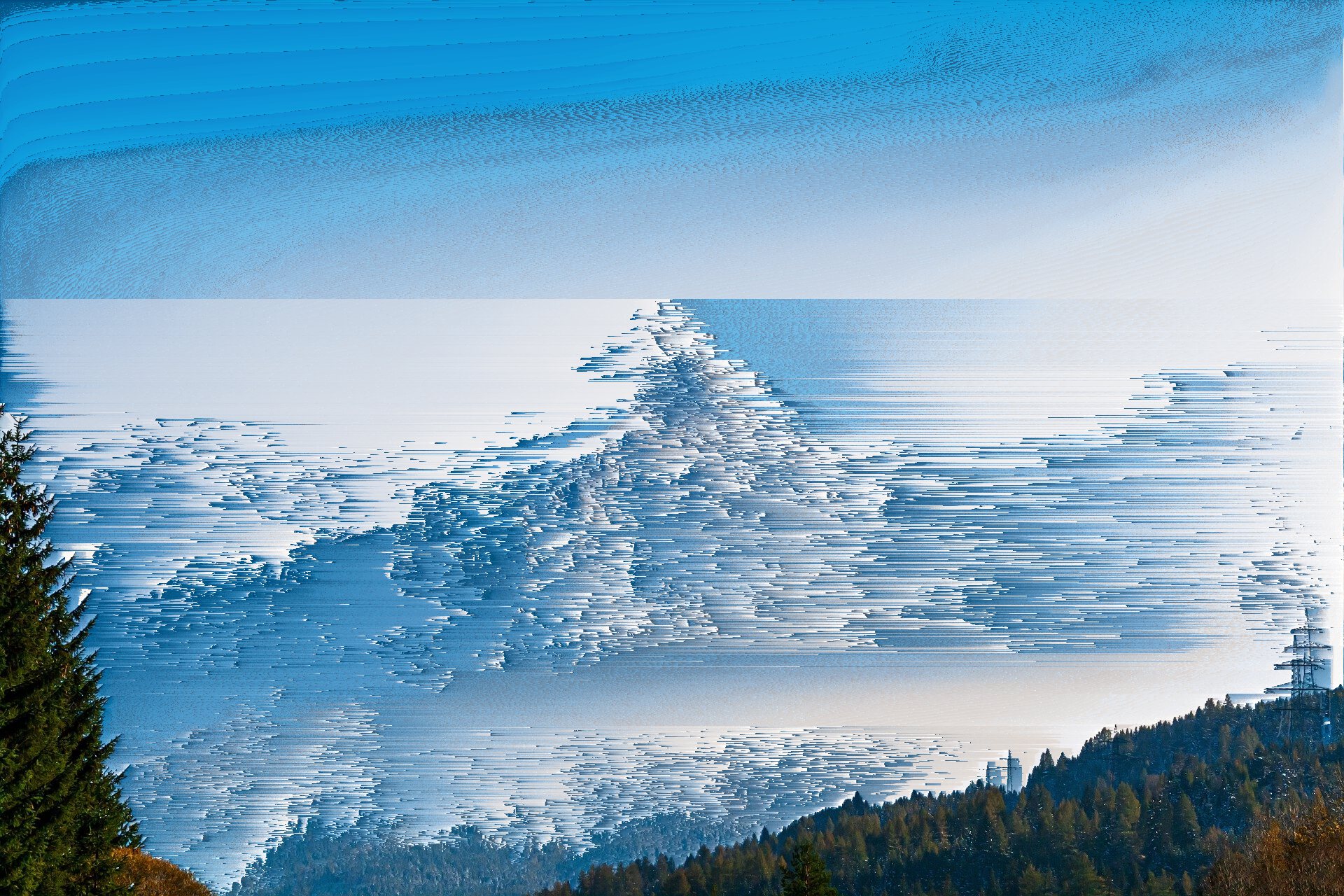
The technique operates at the level of the single pixel, treating the digital image not as a fixed representation but as raw material subject to rule-based transformation. This emphasis on process over product, and on the pixel as both carrier and subject of meaning, has remained constant even as Asendorf's technical means have evolved from desktop scripts to browser-based real-time systems.
With formative roots in net art, Asendorf has consistently favored accessibility and direct encounter. Many of his works exist primarily as browser experiences or shareable code rather than as unique physical objects. This orientation has allowed his projects to circulate widely while also securing sustained institutional attention. His work has appeared in programs at Transmediale, ZKM Karlsruhe, the Whitney Museum's Dreamlands exhibition, The Photographers' Gallery in London, and numerous other festivals and museums.4 These contexts have situated his pixel-level operations within longer histories of media art, experimental film, and digital culture.
The migration of Asendorf's practice onto blockchain platforms began with Monogrid in 2021, a project that translated his characteristic grid structures into mintable, interactive tokens. Cargo, released in March 2023 as a curated Art Blocks collection of 1,000 editions, represents a further step in this trajectory.5 Each output is a self-contained real-time WebGL animation written in JavaScript and GLSL. The work continuously redraws and resizes itself to the dimensions of the browser window, turning the collector's screen into an active compositional field rather than a passive frame.6
Visually, Cargo outputs present layered geometric forms, shifting color fields, and intricate interference patterns. The compositions suggest contained yet mobile digital matter, volumes that accumulate, disperse, and re-form without ever settling into a final state. The title evokes logistics and transport while the actual imagery remains resolutely abstract, continuing Asendorf's long-standing refusal of literal narrative in favor of systemic behavior.
Alongside his on-chain projects, Asendorf has continued to produce significant work outside blockchain contexts. Pixel Matter, a 2022 collaboration with net art pioneer Olia Lialina presented at Roehrs and Boetsch in Curuna Ardez, stands as a major canonical achievement.7 The exhibition treated the pixel as both the irreducible building block of all digital imagery and a subject worthy of sustained artistic scrutiny. Works moved between screen-based animation, print, and installation, tracing how pixel structures construct visual meaning across different material supports.
The project exemplifies Asendorf's ability to move fluidly between solo algorithmic production and collaborative, historically reflective frameworks while maintaining a consistent focus on the pixel as the primary site of digital aesthetics.
Subsequent projects have extended the same systemic logic into new registers. COLORS OF NOISE (2023), presented on Feral File, maps spectral characteristics of audio noise into visual fields, creating immersive, continuously shifting patterns.8 Sabotage (2022) introduces deliberate interference into grid structures, allowing a disruptive agent to rearrange pixels and thereby dramatize the tension between order and entropy that runs through much of Asendorf's oeuvre.9 These works, together with more recent explorations such as PXL DEX, demonstrate a practice that remains in active development rather than resting on earlier technical or aesthetic solutions.
Asendorf's influence extends beyond individual projects. His decision to release the pixel sorting algorithm as open source has shaped the visual vocabulary of countless digital works. Participation as one of the first fifteen artists in the MoMA Postcard project further signals recognition within the wider contemporary art conversation about digital media.10 The 2026 retrospective exhibition Complex at the Goethe-Institut Bangkok surveyed work from 2021 to early 2025, confirming his position as a central figure bridging pre-blockchain net art and the current generative ecosystem.11
In Cargo, the AB[500] presents an artist whose career demonstrates that the most compelling blockchain-based work often emerges from long, materially specific histories rather than from platform-native novelty alone. Asendorf's real-time, adaptive animations continue the essential project of generative art: to make visible the behaviors of systems that would otherwise remain abstract or invisible.
MOTZKO's digital art collection provides a collector-side view of that longer history through holdings spanning monogrid, SABOTAGE, Cargo, pixel works, and later on-chain animations.12
For the complete bibliography see the Kim Asendorf links page.
Hjalmar Åström
Systems of pressure, particles, and luminous emergence

Hjalmar Åström’s Nucleus treats the screen as a field of concentrated forces. Across 512 editions, particles, filaments, and luminous masses make computation visible as both structure and event.
Hjalmar Åström enters the Art Blocks record through Nucleus, a generative collection of exactly 512 editions. A contemporary market report places the project among the generative collections released during the second half of 2021, alongside works that helped define an unusually accelerated period for blockchain-based art.1 Art Blocks later framed its first five years as a finite group of 500 flagship projects, encompassing Curated, Playground, Factory, Presents, Collaborations, and Explorations releases.2 Within that historical construction, Nucleus is more than an isolated set of images. It is one element in a deliberately bounded archive of early on-chain generative practice.
The surviving public record is weighted toward the work rather than the biography. That imbalance should be treated as evidence, not filled with speculation. No reliable source located for this dossier establishes Åström’s birth year, birthplace, residence, training, or current institutional role. What can be examined with confidence is the visual proposition of Nucleus: a rule-governed field in which minute elements gather into larger bodies, color behaves as a spatial force, and every edition tests the capacity of one system to remain coherent while producing difference.
The title Nucleus establishes a productive ambiguity. A nucleus can be the compact center of an atom, the organizing core of a cell, or the initial concentration around which a larger structure develops. Åström’s images activate all three associations without settling into scientific illustration. Specks accumulate, strands bend, and dense zones appear to exert pressure on their surroundings. The results can resemble microscopy, astronomical imaging, fluid turbulence, or a map of invisible currents, yet those references remain unstable. The work continually moves between object and process.
This instability belongs to a longer history of computational image-making. The Victoria and Albert Museum traces algorithmic and generative art to experiments conducted in scientific and university laboratories during the 1960s, when artists such as Vera Molnár and Manfred Mohr used programming and plotters to produce complex geometric structures.3 The Toledo Museum of Art likewise connects early computer art with the recent expansion of algorithm-driven visual culture.4 Nucleus inherits that history of instruction, iteration, and machine execution, but exchanges the plotter’s visible line for a raster field whose particulate forms appear suspended in depth.
The images reward attention at several scales. From a distance, each output reads as a single atmospheric event. Closer inspection breaks that apparent unity into many local decisions: changes in direction, clustering, brightness, interval, and chromatic temperature. The whole is neither drawn as a conventional composition nor simply discovered by chance. It emerges from relationships encoded in advance and realized through a particular computational seed. Art Blocks describes this process as an artist-defined algorithm receiving an on-chain hash at mint, yielding a unique but deterministic result.5
The edition count is central to Åström’s proposition. Nucleus comprises 512 editions, not one privileged composition followed by copies. Each output is an individual articulation of a shared system. Holladay Saltz identifies serial algorithmic art through three linked conditions: serial production, execution by digital algorithm, and public realization through collection on a blockchain.6 This framework clarifies why the collection must be considered as both population and image. Its subject is not merely what any single output depicts. Its subject is the distribution of possibilities across the entire edition.
Seriality changes the viewer’s task. One image encourages close looking, while several invite comparison. Recurring structures reveal the algorithm’s commitments, and differences expose its range. Dense centers may be balanced by diffuse margins; bright chromatic incidents may interrupt darker fields; sweeping vectors may bind granular fragments into temporary order. The system’s identity resides in these family resemblances. Variation does not weaken authorship. It locates authorship in the construction of a space within which meaningful differences can occur.
Art Blocks explains that a mint transaction initiates a one-time execution of an artist’s algorithm, with controlled randomness generating an unforeseen output that nevertheless remains faithful to the system.7 The collector therefore encounters uncertainty at the moment of creation. This does not mean the machine becomes an autonomous artist. Åström determines the available behaviors, relationships, and limits. The algorithm performs those decisions under conditions that prevent the artist from selecting every final arrangement.
Nucleus makes a center without fixing one: order appears as an event distributed across particles, colors, and code.
Although Nucleus is delivered as a digital image, its spatial effects are notably material. Bright particles appear to advance while dimmer passages recede. Overlapping strands suggest layered matter. Gradients create the impression of illumination passing through vapor, membrane, or liquid. None of these effects proves the existence of a represented world. Instead, they demonstrate how a computational surface can generate depth through relative scale, opacity, density, and contrast.
This distinction matters because digital art is not a single medium. The V&A describes the field as spanning computer, generative, robotic, kinetic, net, virtual-reality, and augmented-reality practices.8 Nucleus occupies a specific position within that broad domain: it is an editioned, code-based system whose outputs are inseparable from their computational production. Its apparent organicism is therefore especially pointed. Forms that look biological or cosmic arise from formal instructions, while the regularity of computation produces images associated with growth, turbulence, and instability.
Recent museum programs have increasingly placed such practices within longer art histories. The Castellani Art Museum relates instruction-based work and infinite variation to later algorithmic methods.9 The Blanton Museum’s Run the Code presents algorithms as tools through which artists address nature, art history, internet culture, and human behavior.10 These contexts help resist a narrow reading of generative art as technical novelty. In Nucleus, code functions as a compositional material. It organizes rhythm, density, and optical pressure just as physical media organize gesture, surface, and weight.
The on-chain context also changes what preservation means. Art Blocks has described its early commitment to storing artwork code on Ethereum and its later effort to make projects reconstructible from blockchain data in a modern browser.11 This distinction between a displayed file and a reproducible system is essential. A screenshot can preserve appearance, but not necessarily the rules, dependencies, or behavior through which a generative artwork exists.
Art Blocks’ account of its preservation work notes that external creative-coding libraries once remained an important dependency, even when core project code was stored on-chain.12 The platform’s later technical documentation explains how a deterministic artwork can be regenerated from its script and hash.13 Such infrastructure gives Nucleus a double temporality. Each edition records a particular event of generation, while the collection’s code belongs to an ongoing problem of maintaining executable culture across changing browsers, standards, and interfaces.
The AB500 designation makes that preservation problem historical as well as technical. Art Blocks presents the 500 projects as a completed foundational era whose shared protocol allows preservation work on one project to benefit the larger group.14 An interactive institutional timeline similarly treats the platform’s development as a history of artists, collections, collectors, and community formation.15 Nucleus thus sits inside an archive that is simultaneously artistic, social, and infrastructural.
Åström’s contribution is concise but resonant. Across 512 editions, the artist uses repetition to test how centers form, how complexity coheres, and how a bounded system can produce images that feel volatile and alive. The collection’s force lies in refusing a simple opposition between calculation and atmosphere. Its particulate worlds are exact and indeterminate, programmed and emergent, finite in number yet expansive in implication.
The references cited in this essay are listed below. For the complete bibliography see the Hjalmar Åström links page.
Kinetic thresholds in code, light, and Panamanian geometry

Autonomoses is the generative-art identity of Panamanian artist Emmanuel Moses. His AB[500] work Túnel Dimensional extends a studio practice of portals, color theory, and optical-kinetic depth into long-form code.
Autonomoses is the on-chain name used by Emmanuel Moses for Túnel Dimensional, a 2022 Art Blocks Factory project of 320 unique artworks.1 Moses's broader biography places him in Panama's contemporary abstraction, with training in advertising design at SCAD and a practice that moves between graphic precision, hand-finished surfaces, mural scale, and digital systems.2
The generative project is best understood as an extension of a physical vocabulary already present in Moses's tunnels and portals. The artist's own published project text describes the series as beginning with light, where patterns and angles make the eye perceive distance, thresholds, and spatial distortion.3 In this sense, Túnel Dimensional does not abandon the studio. It translates a studio problem, how color, repetition, and contour can create an imaginary passage, into an editioned software system.
Moses's physical works are often discussed through order, calibration, and optical intensity. Artsy's overview describes a method based on mathematical color calibration, weight, pigmentation, and subtle shade selection, linking the work to his design background.4 Iconic Art System similarly identifies him as a Panamanian artist born in 1986 in Panama City, noting his study of advertising design at Savannah College of Art and Design and a turn toward art after work in advertising.5
This background matters for Túnel Dimensional. The work is not simply a digital tunnel effect. It is a coded framework for testing how an image can be made to pulse between flatness and depth. The Art Blocks collection page records its release on 19 April 2022 and identifies the project as 320 unique artworks.1 Verse's market and project archive preserves the same Art Blocks context and frames the work within the artist's Tunnel Series, emphasizing possible worlds, thresholds, and the viewer's escape into the unknown.6
The post-Art Blocks record shows Moses continuing to develop related concerns in physical space. Pinta's 2026 editorial on Geometría en Tránsito at NG Art Gallery describes an optical-kinetic language tied to the movement of water, the Panama Canal, sovereignty, vulnerability, and material history.7 This is a more explicitly territorial and political register than Túnel Dimensional, yet it shares a commitment to movement through geometry.
Square One Gallery's 2024 artist page and news item present Moses as a Panama-based contemporary artist whose works center on precise geometric forms, color, and original paintings.8 Oliver Cole Gallery's artist pages list Moses as Panamanian, born in 1986, and show 2025 portal works in acrylic on aluminum.9 Fair listings for Art Miami and Art Palm Beach also place Moses within a commercial contemporary-art circuit alongside optical, sculptural, and postwar-adjacent gallery programs.10
Within AB[500], Túnel Dimensional is a compact but coherent bridge between Latin American optical-kinetic abstraction and early-2020s Art Blocks Factory experimentation. The project's six sampled outputs show why the series belongs to that history: a portal is generated through color bands, depth cues, directionality, and variation, while the edition count, 320 works, fixes the algorithm as a finite collection. Art Blocks' 2022 Rio dispatch later listed Autonomoses among eight Latin American Art Blocks artists exhibited at NFT Rio, situating the project in a regional generative-art context rather than as an isolated drop.11
The references cited in this essay are listed below. For the complete bibliography see the Autonomoses links page.
Andrew Badr
Generative Asemic Typographer

Andrew Badr, a New York-based creative coder, writer, and explorer, has developed a distinctive practice that fuses computational precision with poetic sensibility, most prominently realized in the collaborative generative project Asemica.
Andrew Badr occupies a singular position at the intersection of software engineering, experimental typography, and generative art. His practice, rooted in early explorations of collaborative digital spaces and critiques of interface conditioning, reached a significant milestone with Asemica, a 980-edition collection released on Art Blocks in November 2021. Created in partnership with Emily Edelman and Dima Ofman, Asemica translates the tradition of asemic writing into a machine-driven typographic idiom, producing compositions that invite sustained visual engagement without the demand of semantic decoding. 1 2
Badr's trajectory reflects a consistent inquiry into how systems, whether textual, social, or algorithmic, shape human attention and expression. From the infinite collaborative canvas of Your World of Text, launched in 2009, to notification-subverting stickers developed during his time at the School for Poetic Computation, his projects consistently reposition familiar digital behaviors within new aesthetic and critical contexts. Asemica extends this line of inquiry into the realm of on-chain generative art, where code becomes both medium and collaborator. 3 4
Badr's engagement with computational creativity predates the mainstream emergence of blockchain-based generative art. His early project Your World of Text established an open, real-time shared surface where users could inscribe, overwrite, and navigate collectively across an unbounded plane. The work functioned simultaneously as creative studio, confessional space, and social experiment, attracting sustained use and cultural resonance over more than a decade. A 2020 podcast interview highlighted its capacity to foster unexpected human connection, including documented instances of profound personal impact. 5
In 2015, while completing a final project at the School for Poetic Computation in New York, Badr created Deconditioning Stickers. These interventions appropriated the visual language of app notification badges, relocating them into physical and contextual environments where their habitual pull on attention could be examined and redirected. The project articulated a broader concern with the subtle conditioning exerted by digital interfaces, a theme that resonates with Asemica's invitation to look rather than read. Badr's profile on the School for Poetic Computation site situates this period as formative for his subsequent artistic development. 6
Parallel to these artistic pursuits, Badr maintained deep roots in computer science. Earlier academic work on generalizations of deterministic finite automaton minimization, presented at the Conference on Implementation and Application of Automata in 2008, demonstrated an aptitude for formal systems and algorithmic elegance that later informed his generative practice. This technical foundation proved essential when he turned, in 2021, toward the construction of complex procedural typographic systems. 7
Asemica emerged from a close collaboration between Emily Edelman, whose practice centers on typography and design systems, and programmers Dima Ofman and Andrew Badr. The project originated in 2021 as Edelman sought to extend her long-form generative ambitions through partnership with coders attuned to both computational rigor and aesthetic sensitivity. The resulting algorithm generates typographic compositions described by its creators as asemic writing produced by the hand of a machine. 8 9
The system begins with a curated pool of abstract glyphic elements derived from English letterforms and symbols. These elements are combined according to precisely calibrated aesthetic rules governing connection points, rotation, inversion, and spatial rhythm. Individual outputs may isolate a single constructed character or assemble sequences that suggest words or phrases, all arranged within carefully considered typographic layouts. Color, density, and compositional balance vary across the edition, yielding a wide spectrum of visual densities from sparse, elegant arrangements to intricate, layered fields. The project site and contemporary interviews emphasize the deliberate tuning of these rules to produce outputs that reward prolonged, non-literal viewing. 10
A central conceptual anchor is the observation, attributed to type designer Gerard Unger, that it is nearly impossible to look and read simultaneously. Asemica operationalizes this insight by stripping away semantic function while preserving the visual cadence and structural logic of writing. The resulting forms evoke asemic traditions in concrete poetry and abstract calligraphy yet remain distinctly products of procedural generation, foregrounding the machine's capacity to invent new graphic languages rather than merely simulate existing ones.
Asemica was released on November 15, 2021, as part of Art Blocks Curated, appearing as project 206 on the platform. The collection comprises exactly 980 unique outputs, each minted as an on-chain generative artwork. The release occurred during a period of rapid expansion for Art Blocks, and Asemica quickly found collectors drawn to its distinctive fusion of typographic heritage and algorithmic invention. Official prints have since been made available to token holders, extending the project's presence beyond the screen. 2
Contemporary coverage situated Asemica within the broader maturation of generative art on blockchain. A 2022 article in the Big Bend Sentinel documented the display of multiple Asemica outputs in Marfa, Texas, during Art Blocks-related programming, noting the project's visual variability and its grounding in asemic mark-making traditions. 10 Exhibition contexts such as the Art Blocks Marfa Weekend further embedded the work within institutional and collector conversations about the history and future of on-chain art. 9
Market and archival platforms have tracked Asemica's secondary activity, underscoring sustained collector interest in its aesthetic range and conceptual clarity. Verse.works maintains both a project series page and a dedicated journal conversation with Edelman that situates Asemica alongside her wider exploration of symbol systems and generative processes. 8
Asemica represents a considered contribution to the expanding vocabulary of generative art. By translating asemic writing into a fully procedural, editioned, and on-chain form, Badr and his collaborators opened a space where viewers encounter typography freed from linguistic obligation. The work does not merely decorate or illustrate; it constructs new characters and spatial relationships that feel at once familiar in their graphic ancestry and alien in their machine origin. This tension between recognition and estrangement lies at the heart of the project's enduring appeal.
Badr's broader practice reveals a through-line of systems thinking applied to human perceptual habits. Whether subverting notification interfaces, building infinite collaborative text environments, or now generating asemic typographic fields, his projects consistently ask how code can reframe attention, collaboration, and meaning-making. As both artist and active collector within the Art Blocks ecosystem, Badr has also contributed to community discourse, participating in conversations that contextualize individual projects within larger histories of software art and digital poetics. 4
The 980 outputs of Asemica stand as a substantial, self-contained body of work that rewards serial viewing and comparative study. Collectors and institutions alike have recognized its distinctive position within the first wave of Art Blocks Curated releases. As generative art continues to evolve, Asemica remains a benchmark for projects that treat code not as neutral tool but as active co-author of new visual and conceptual languages.
The references cited in this essay are listed below. For the complete bibliography see the Andrew Badr links page.
Joshua Bagley
Generative simulations of subdivision, light, and emergent life.


Joshua Bagley employs code to trace the passage from simple procedural rules to intricate, lifelike structures. Across four projects in the AB[500], he examines how subdivision, photon physics, and differential growth yield forms that feel at once mathematical and organic.
Joshua Bagley began releasing work on Art Blocks in 2021 and has since contributed four distinct yet interrelated projects to the AB[500]. His practice sits at the intersection of his formal training in physics and aerospace engineering and a self-taught fluency in creative coding acquired in 2020. Working primarily in Processing, Bagley constructs systems in which minimal initial conditions and iterative local rules produce surprising global complexity. Biology and natural processes supply recurring metaphors, while an underlying interest in physics informs both the simulation logic and the aesthetic outcomes.1
Bagley was born and raised in New Hampshire. He earned a bachelor's degree in aerospace engineering and maintains a deep respect for the quantitative rigor of the physical sciences. In late summer 2020 he began experimenting with Python to generate cellular automata, an exercise that quickly led him to the broader field of generative art. He adopted Processing as his primary environment and has since incorporated pen-plotter output using an HP 7550 Plus. The transition from engineered systems to open-ended generative systems allowed him to retain precision while surrendering a measure of control to autonomous processes.2
Two themes dominate his mature work. The first is the conviction that complexity need not be imposed from above but can emerge from the patient iteration of simple local decisions. The second is an attraction to the uneasy beauty that arises when playful or organic motifs are shadowed by hints of mortality or systemic constraint. These preoccupations thread through Dreams, Ecumenopolis, Spotlight, and Spaghetti Bones, each project refining rather than discarding the lessons of its predecessors.
Dreams, released in 2021 as an Art Blocks Curated project, marks Bagley's debut on the platform. The series comprises 700 editions and centers on the tension between uniform and irregular linear elements. A single generative script, executed once per mint and recorded immutably on-chain, subdivides a field according to rules that permit both straight alignments and deliberate deviations. The resulting compositions range from crystalline lattices to tangled, almost topographic networks. What appears at first as graphic pattern reveals, on longer viewing, a record of successive decisions in which local irregularities propagate into larger structural identities.3
The six examples above illustrate the range Bagley achieves within a single rule set. Some outputs remain relatively sparse, preserving large negative spaces that emphasize the skeletal quality of the drawn lines. Others collapse into dense thickets in which crooked segments dominate and the original grid logic is almost obscured. The viewer is invited to read each image as a frozen moment in a process that could, in principle, continue indefinitely. Dreams therefore functions both as a collection of discrete artifacts and as a demonstration of procedural emergence.4
Ecumenopolis, released in July 2021 with 676 editions, extends the logic of structured complexity into speculative urbanism. The title evokes the science-fictional image of a planet-wide city, yet Bagley's renderings are deliberately unanchored in any recognizable terrestrial geography. Each output assembles layered architectural masses, circulation paths, and atmospheric effects that suggest habitation at an incomprehensible scale. Ten percent of minting proceeds were directed to the National Alliance to End Homelessness, binding the project's economic model to a real-world social concern.5

While Dreams remains resolutely abstract, Ecumenopolis introduces legible if fictional architectural elements. The same commitment to rule-driven generation persists: modules are placed, scaled, and occluded according to internal logics that reward both repetition and deviation. The result is a body of work that feels simultaneously futuristic and archaeological, as though the viewer were examining ruins of a civilization that never existed on Earth.
Spotlight, released in February 2022 with 625 editions, represents the most explicit engagement with Bagley's physics background. The project simulates the behavior of photons as they travel across a two-dimensional field, encountering and interacting with a population of shapes whose outlines are generated through differential growth. Upon collision, each photon may reflect or refract according to simplified physical equations. The history of these interactions is recorded not as vector paths but as accumulations of small colored circles, producing dense, luminous textures that evoke caustics, subsurface scattering, and the soft gradients of real-world illumination.6

The shapes themselves are not drawn as closed contours in the final image. They exist as invisible boundaries that guide photon behavior; only the cumulative trace of light reveals their presence. Pressing a key in the live generator displays the underlying differential-growth forms, which range from regular polygons to complex, folded blobs reminiscent of biological membranes. Bagley has noted that differential growth has been a sustained obsession since late 2020, and Spotlight marks its first large-scale integration with a physics simulation. The educational background in physics engineering supplied both the mathematical vocabulary for the reflection and refraction routines and an intuitive sense of how light behaves in the presence of translucent or refractive materials.7
Spaghetti Bones, the fourth and most recent AB[500] project at 600 editions, returns to differential growth as its central engine while adding an explicit temporal dimension. Each output simulates a single life-form whose nodes grow, branch, age, and eventually cease activity. Paths are traced through the evolving node network at every frame, and rules prevent self-overlap, producing dense, ring-like accumulations analogous to tree rings or growth strata. The life-form's "goal" is simply to occupy space; its trajectory from birth through senescence is recorded as a single static image that nonetheless encodes an entire developmental history.8

Bagley has described the project as a continuation of his effort to connect generative procedures with observable natural phenomena while introducing a darker affective register. The playful, almost whimsical quality of the growing forms is tempered by the knowledge that every output documents a completed life cycle ending in stillness. This combination of organic proliferation and inevitable termination recurs across his practice and distinguishes his contribution to the AB[500] from purely formal or decorative generative traditions.
Viewed together, the four projects reveal a coherent research program. Dreams established the core strategy of letting local irregularities scale into global character. Ecumenopolis applied similar modular logic to an architectural register. Spotlight fused that logic with an explicit physics engine, demonstrating that simulation of natural forces could enrich rather than constrain aesthetic invention. Spaghetti Bones closed the loop by embedding the differential-growth vocabulary within an explicit model of growth, aging, and death. Each step increases the temporal or physical depth of the simulation while preserving the commitment to on-chain immutability and collector-facing variability.9
Bagley's work participates in a broader conversation within generative art about the relationship between control and autonomy. By publishing both finished collections and, in several cases, live generators or test mints, he invites collectors and researchers to inspect the underlying systems. The educational dimension is never far from the surface: the same artist who once built cellular automata for personal exploration now supplies the AB[500] with rigorously engineered yet poetically open-ended artifacts. His trajectory suggests that the most durable contributions to on-chain art may come from practitioners who treat the blockchain not merely as a distribution mechanism but as a constraint that sharpens the relationship between rule and outcome.10
For the complete bibliography see the Joshua Bagley links page.
Network science as generative form

BarabasiLab enters AB[500] as a laboratory whose artworks are also arguments about complexity. Invasion Percolation brings an early scientific image into generative art, institutional exhibition, and on-chain provenance.
BarabasiLab is not a studio built around a single medium. It is a research environment that treats the diagram, the model, the dataset, the print, the sculpture, and the algorithm as related instruments. Led by Albert-László Barabási, the Lab is identified by Art Blocks as a group that brings together scientists, designers, and artists, with network science as its conceptual and technical basis.1 Its AB[500] work, Invasion Percolation, was released on Art Blocks as a collection of 550 editions, a count that matters because the project makes editioning part of a larger chain of generation, naming, printing, and institutional display.2
The Lab's practice is unusually direct about the passage from science to art. Barabási's biography includes an early study of sculpture before physics, followed by a career in complex networks at Northeastern University, Harvard-related medical research, and Central European University.3 That background is not anecdotal ornament. It helps explain why BarabasiLab's images often appear as scientific evidence and aesthetic proposition at once. Network thinking supplies the grammar, while exhibition formats test how that grammar can be read outside the paper, the laboratory, or the screen.
Invasion Percolation is presented by BarabasiLab as the first network visualization of modern network science and the first generative network art.4 The work depicts a network produced by water penetrating ground, with a square lattice structure that echoes crystal lattices familiar to physics.5 The algorithm was built by Barabási in 1994, and a surviving 1995 output became a key historical object in later exhibitions.6 This origin point gives the Art Blocks project a double status. It is a contemporary generative release, but it is also a reactivation of a pre-NFT scientific image whose visual logic predates the market and cultural language that later gathered around on-chain art.
The percolation model matters because it converts movement into structure. Each line is a record of local decision, constraint, resistance, and expansion. The image does not simply illustrate water flow. It visualizes a rule-based encounter between path and medium. In that sense, the project sits close to classic generative art, where an artist defines a system and allows its outputs to reveal the consequences of that system. Yet BarabasiLab's point of departure is not only computational aesthetics. It is an empirical culture in which networks are used to describe biology, infrastructure, science, mobility, institutions, and artistic careers.
Invasion Percolation is less a decorative network than a historical hinge: a scientific diagram returned as a generative artwork.
The Art Blocks release extended this hinge into a physical and social performance. BarabasiLab describes the project as a hybrid involving the metaverse and traditional gallery and museum space, with generated copies printed and titled by the NFT owner who generated the work.7 Rare outputs could become 3D printed sculptures, while 2D and 3D works were shown across venues including Cyberart Gallery in Boston, Postmasters Gallery in New York, Ludwig Museum in Budapest, and New Kriterion Gallery in Csikszereda.8 The collector is therefore not only a buyer. The collector activates an edition, supplies a title through ownership, and helps populate a distributed exhibition.
BarabasiLab's museum profile was consolidated through Hidden Patterns, an exhibition first associated with Ludwig Museum in Budapest and then ZKM in Karlsruhe.9 The ZKM presentation framed the Lab's output as a 25-year development of network visualization, with prints, sketches, videos, real data sculptures, and virtual data sculptures.10 This range is central to understanding Invasion Percolation. The project is not isolated as a blockchain-native novelty. It belongs to a body of work that asks how abstract systems become visible, how visibility produces knowledge, and how knowledge changes when it is staged for public looking.
The same institutional logic appears in The Art Network, where BarabasiLab used exhibition-history data from half a million artists to map the invisible connections shaping artistic careers.11 ZKM's account of Art Network explains that institutions are connected when artists have shown in both, turning museums and galleries into nodes inside a reputation structure.12 This is a crucial context for an Art Blocks release by BarabasiLab. The Lab had already studied art-world networks before entering the NFT field. It approached crypto art not as a rupture from institutional systems, but as another network in which visibility, reputation, access, and ownership form measurable patterns.
That research context is supported by Barabási's co-authored paper "Quantifying reputation and success in art," published in Science in 2018.13 It is also extended into "Quantifying NFT-driven networks in crypto art," published in Scientific Reports in 2022, which mapped Foundation and described network patterns governing artistic success in the NFT ecosystem.14 BarabasiLab's AB[500] position is therefore reflexive. It participates in the same field it has studied. Invasion Percolation is a generative artwork, but it also becomes a node in the systems of visibility and value that Barabási's research has described.
The Postmasters exhibition BIG DATA (networking the artworld) presented BarabasiLab as working on networks and data as a form of new realism.15 This phrase is useful because BarabasiLab's images are not abstractions in the ordinary sense. They often look abstract because the systems they record are too large, distributed, or invisible to be perceived directly. The line, node, cluster, and lattice become tools for making hidden structure visible. XIBT's account of the Postmasters show similarly emphasized the Lab's focus on art-world power and influence structures, across paintings, 3D sculpture, digital prints, and video.16
Invasion Percolation belongs to this data realist project while also introducing another kind of realism: the realism of tokenized provenance. The work's generative editions are not only images. They are transactions, ownership events, and naming acts. The title attached to each printed work records the owner who generated it, binding artwork, token, collector, and exhibition history into a visible system.17 This makes the Art Blocks platform more than a distribution mechanism. It becomes part of the work's conceptual apparatus.
The broader public reception of Barabási's art-science practice has often stressed the continuity between scientific discovery and visual form. Northeastern described his return to sculpture through network patterns, while Clot Magazine presented him as a figure revealing hidden order in complex systems.18 MEET Digital Culture Center's discussion of his immersive exhibition likewise placed sound, data, and image inside a multidisciplinary field of digital art.19 These accounts reinforce the central premise of the Lab: the network image is not a simplified diagram after the fact. It is a mode of inquiry.
Within AB[500], BarabasiLab is important because it broadens the category of generative art. The Lab's work does not begin with the collector-facing interface, the browser window, or the studio sketch. It begins with a scientific problem, a model of percolation, and a historical output from 1995. The 2022 Art Blocks collection of 550 editions turns that earlier system into a public generative edition, but it does not erase the earlier scientific context.20 Instead, it re-situates it among the institutions, markets, and collectors that now shape digital art.
The strongest reading of Invasion Percolation is therefore archival and procedural at once. It archives a foundational visualization from the history of network science, and it allows a contemporary editioning system to perform that history again. The resulting images carry a sparse elegance: black lines, branching paths, lattice pressure, and abrupt turns. Their beauty lies in the fact that they do not look designed in the decorative sense. They look discovered, as if the image is the visible trace of a rule negotiating with material resistance.
BarabasiLab's contribution to AB[500] is not simply that a distinguished scientific laboratory joined Art Blocks. It is that Invasion Percolation makes the AB[500] set address a longer history of computational visualization, from scientific model to museum object to generative NFT. It asks the collector to see a token as part of a network, and to see the network as both image and institution.
The references cited in this essay are listed below. For the complete bibliography see the BarabasiLab links page.
Loren Bednar
Generative abstractions of interference, motion, and chromatic chance


Loren Bednar has developed a singular practice in generative art, using code to stage dynamic encounters between mathematical order and the fertile disruptions of chance, colour, and motion.
Loren Bednar has established himself as a vital contributor to generative art by treating the algorithm as a collaborative partner capable of revealing unexpected visual truths. His long-form projects on Art Blocks, most notably the expansive phase alongside Parade, Traversals, and Divergence, map a sustained investigation into systems that sit slightly out of phase, where interference, layering, and controlled randomness generate both optical complexity and emotional resonance. These four collections, realised between 2021 and 2023, demonstrate how code can transform apparent limitation into a generous field of variation while remaining performant and accessible across devices. 4
Bednar began making digital art in 1993 as a teenager using the LOGO programming language to generate geometric spirals and patterns. 4 This early encounter with code as a generative medium evolved through freelance game development and the creation of interactive web experiences in Flash, where the precise mathematical placement of elements became inseparable from playful visual outcomes. He produced grids of small geometric shapes, each cell carrying distinct colour and form combinations, which he shared as sprite sheets. These experiments crystallised a visual language built on relational patterns, colour blending, and systematic yet open variation. By 2006 he had committed to generative artwork proper, maintaining an iterative, visually driven process that privileges emergent results over predetermined composition. He begins with loose thematic ideas, introduces small parametric changes, and leans into anomalies, allowing unexpected geometries and colour relationships to guide refinement. For motion-based works he typically starts with predictable colourful stripes or forms, then fragments them through increasing complexity while preserving consistent motion profiles and colour weight, seeking moments of unexpected alignment that resolve chaotic fields into fleeting harmony. This approach values technical performance, ensuring works run smoothly in browsers and on handheld devices, and extends accessibility through multiple interaction models including touch, mouse, keyboard, and gamepad. Bednar discussed this discovery of Art Blocks and his evolving creative approach in an early recorded conversation, and his biography and exhibition record are further documented across artist-profile platforms and the Art Blocks artist page itself. 789
Bednar first attracted widespread attention in the generative art community with Traversals, a collection of 150 editions released in May 2021. The series explores luminous colours in layered intersections, producing fields in which translucent planes cross and overlap to create atmospheric depth and shifting optical centres. Light appears to emanate from within the compositions, evoking pathways or membranes that both reveal and obscure one another.
Shortly after, phase was selected for Art Blocks Curated release. Comprising 1,024 editions and launched in August 2021, the project offers a visual meditation on realities that are out of phase. Interference patterns, colourful echoes, and emerging secrets arise from simulations that reference the compression artefacts social media algorithms impose on motion video. By encoding this external entropy into the system itself, Bednar ensures that each token behaves somewhat like a live performance: the act of sharing or re-encoding further transforms the image, underscoring the theme of perpetual, uncontrollable variation. The ten distinct renders presented in the grid below illustrate the remarkable breadth of the series, ranging from dense, vibrating lattices of overlapping geometry to quieter passages in which echoes soften into momentary calm. Each work stands as a unique instance of order yielding to disruption and then resolving again, a visual analogue for the beautiful unpredictability of lived systems. 1 6 The series was also the subject of an Art Blocks After Dinner Mints video discussion. 11
Parade, a collection of 400 editions released in November 2021, shifts emphasis toward explicit motion as subject. Forms and colour segments advance across the frame in rhythmic, processional sequences that feel at once ceremonial and hypnotic. The single render illustrates the optical parade at a characteristic moment: shapes progress with measured velocity while colour relationships shift continuously, generating a sense of forward momentum without narrative destination. The work celebrates pattern in motion yet remains open to the stochastic variations inherent in its generative rules. 13 Its traits and project description are further catalogued on Verse Works. 12
Divergence, comprising 100 editions released in March 2023, extends the exploration into explicitly interactive territory. The series presents never-ending abstract motion built from stacks of deterministic layers that respond to audio input and direct touch. Viewers may influence the rate and character of divergence, turning observation into a form of co-authorship. This responsiveness realises Bednar's broader interest in partial surrender of control, not only to the algorithm but to the audience, while the underlying code maintains structural coherence across all possible interactions. Together Parade and Divergence demonstrate how motion can function simultaneously as spectacle, material, and interface. 214 Unit London's coverage of the related Pressed Pause release situates this interactive turn within Bednar's broader exhibition history. 10
Throughout his practice Bednar returns to a core conviction: that apparent imperfections and the forces of randomness within systems can be transformed into generative assets rather than flaws. By finessing emergent geometry for moments of unexpected alignment amid fragmentation, he creates compositions that feel both chaotic and resolved, suspended and harmonically complete. This sensibility aligns with his commitment to accessibility. Works are engineered for high performance on any modern browser and handheld device, while interactive pieces accommodate diverse input methods. The same generosity extends to presentation: pre-rendered video loops remain downloadable for local playback when network constraints arise, a resource documented alongside the project's own catalogue entry 17.
Bednar's works have been exhibited internationally at LUME Studios and ZeroSpace in New York, Vellum in Los Angeles, Bright Moments in Berlin, and Museum Angewandte Kunst in Frankfurt, as well as in group exhibitions including Building Blocks with Unit London and Art Blocks x Samsung at Samsung 873, New York. Pieces from phase have entered significant collections and appeared at auction, confirming their place within the broader canon of digital art. 3 5 Platform-level cataloguing further situates the work across marketplaces and token archives. 151618
These four Art Blocks collections form a coherent arc. Traversals and phase establish the visual grammar of layered intersection and phased interference at ambitious scale. Parade and Divergence then activate that grammar through explicit motion and viewer participation. Across all four, colour operates as both structure and affect, mathematics supplies the skeleton, and chance supplies the life. Bednar's contribution to the AB[500] register lies in this sustained demonstration that generative systems, when approached with visual sensitivity and technical rigour, can model the very qualities of uncertainty, resonance, and relational beauty that define human perception.
The references cited in this essay are listed below. For the complete bibliography see the Loren Bednar links page.
Consciousness rendered through code, geometry, and the living signal


Beervangeer is a Dutch interactive media artist whose practice bridges biofeedback technology and generative computation, producing works that translate human physiology into symbolic visual languages.
Beervangeer, the working name of Beer van Geer, operates at the intersection of biological sensing and computational aesthetics. His practice emerged from early experiments with consumer neurofeedback devices in 2009, when affordable EEG headsets first reached the market 1. What began as interactive mandala systems responsive to brainwaves evolved into a sustained inquiry into the relationships between physiology, geometry, sound, color, and harmony 2. The artist describes his work as creating "modern day rituals, in which generative art is used to gain insight in the human unconsciousness" 3.
The transition from biofeedback installations to blockchain-based generative art represents not a departure but an extension of these concerns. Where early projects like the Biodome installation translated visitors' heart rates into immersive audio-visual environments 4, his Art Blocks releases encode similar principles of transformation and emergence into deterministic algorithms. The continuity lies in a fundamental question: how can invisible systems, whether cardiac rhythms or cryptographic hashes, be made visible and meaningful through geometry and color?
"The laws of sound, the use of harmonics and resonance are really the fundamentals of our universe. When you understand the working of sound, you can also understand the working of for example the human heart." 5
Beervangeer's generative work unfolds across five interconnected collections released on Art Blocks, collectively forming what the artist terms "The Realm of MU" 6. Each collection comprises 369 editions, a number carrying symbolic significance that recurs throughout the artist's practice.
HyperHash, released in January 2021, was the artist's debut on the platform and appeared in the landmark "Natively Digital" sale at Sotheby's alongside foundational Art Blocks projects 7. The collection explores "the possibilities of representing abstract data on Ethereum as intuitive color and geometry spaces" 8. Each of the 369 iterations generates unique colors, geometry, and motion signatures through shader code executed on the collector's GPU, creating what the artist describes as "a futuristic, telepathic & symbolic language for Etherians" 9.
EnergySculpture followed in February 2021 as part of the Art Blocks Playground collection. The project's narrative framing invites collectors into a mythic space: "To become an Energy Sculptor, you first have to find your way into MU. Once arrived, an extensive period of trials will test your capabilities for earning the right to be an Energy Sculptor" 10. This gamified, world-building approach distinguishes Beervangeer's work from purely formalist generative art, embedding each collection within a speculative fiction that rewards sustained engagement.
UltraWave 369, released in September 2021, extends this cosmology. The artist describes the collection as reflecting "our deep longing for unity, belonging and understanding of the universe" 11. The 369 units function as "light seeking enlightenment," merging harmonic principles derived from the artist's biofeedback research with the visual vocabulary of waveform propagation 12.
HashCrash, released in 2022, compresses and reconfigures the visual language developed across previous collections, treating the blockchain transaction hash as a generative seed that "crashes" into emergent form 13. The work demonstrates the artist's maturing technical approach, deploying more sophisticated shader techniques while maintaining the symbolic coherence of the broader MU narrative.
The Field, released in January 2023, represents the most conceptually ambitious collection in the sequence. The artist describes the work as "inspired by the current trend in image synthesis made possible by machine learning technology" 14. By compressing several hundred artworks from HyperHash, EnergySculpture, UltraWave, and HashCrash into a 64x64 matrix, Beervangeer created a noise image that serves as the generative substrate for new iterations 15. This meta-compositional strategy, in which the artist's own corpus becomes training data for further variation, raises questions about authorship, memory, and the recursive nature of generative systems.
Beervangeer's trajectory from physiological sensing to generative art reflects broader transformations in digital art practice during the 2010s and 2020s. His early work with the HeartLive device, developed in collaboration with Dutch harpist Gwyneth Wentink, created generative systems that responded to the performer's heart rate and breathing patterns 16. The resulting compositions visualized "how music and biofeedback flow as energy in motion," establishing a conceptual framework that would carry into his blockchain work 17.
The artist's involvement with the Biofeedback Art Research Network (BARN) situates his practice within an international community exploring "the intersection of biological data and creative expression" 18. BARN members investigate questions of embodiment, agency, and what it means to be human in an age of pervasive sensing and algorithmic systems, concerns that resonate throughout Beervangeer's generative collections 19.
This background in biofeedback informs the distinctive phenomenology of his Art Blocks works. Where many generative artists emphasize formal exploration or mathematical beauty, Beervangeer's outputs consistently evoke organic processes: pulsing rhythms, respiratory cycles, cardiac waveforms. The shader-driven animations in HyperHash and its successors suggest living systems rather than purely geometric abstractions, a quality that may account for the sustained collector interest in his work.
In 2025, Beervangeer launched MazeFlipper, a generative collection created in collaboration with SuperGood and the NGO Nouvelle Planète to support Shipibo communities in the Peruvian Amazon 20. The 96 animated artworks draw on Kene patterns, traditional Shipibo visual systems that represent spiritual communication through geometric tessellation 21. The project enables collectors to order physical embroideries handcrafted by Shipibo artisans, creating a bridge between digital generative art and indigenous craft practice 22.
This initiative reflects a mature social practice that extends beyond the gallery or blockchain. By drawing explicit parallels between "the recursive nature of Kene patterns and contemporary computational art," Beervangeer positions generative algorithms within a longer history of rule-based visual systems 23. The collaboration with anthropologist Jérémy Narby, a specialist in Amazonian indigenous knowledge, lends scholarly rigor to the project's cultural engagement 24.
Beervangeer's work has achieved significant recognition within the generative art market. Individual works from the HyperHash collection have appeared at major auction houses, with pieces offered in Sotheby's Digital Art Day Sale 25. The artist's inclusion in the "Natively Digital" sale alongside canonical Art Blocks projects like Ringers, Archetype, and Chromie Squiggle established his position within the first generation of platform-defining artists 26.
Technically, the collections demonstrate progressive sophistication. HyperHash relies on p5.js and GLSL shaders for real-time GPU generation 27. Later collections incorporate more complex noise functions and feedback systems, with The Field explicitly engaging machine learning aesthetics through its compressed matrix approach. Throughout, the artist maintains a distinctive visual identity characterized by saturated color fields, rhythmic pulsation, and symbolic geometry that resists easy categorization as either purely abstract or representational.
The 369-edition format across all five major collections creates a consistent scarcity model while enabling sufficient variety for the algorithmic systems to demonstrate their range. This edition size, combined with the artist's narrative world-building, has supported active secondary markets and sustained collector engagement over multiple years.
The references cited in this essay are listed below. For the complete bibliography see the Beervangeer links page.
Erin Beesley
Modular signals from a native digital imagination

Erin Beesley approaches code as both a drawing instrument and a system for finding unforeseen forms. Her Art Blocks project pseudomods converts the grammar of electronic equipment into playful, variable abstractions.
Erin Beesley belongs to a generation for whom digital culture is neither a specialist domain nor a metaphor imported into art. It is an ordinary environment, encountered through games, interfaces, creative software, online communities, and programmable systems. A 2021 TIME profile reported that Beesley first encountered blockchain collectibles through CryptoKitties in 2017, taught herself to code in 2019, and subsequently began making generative images and videos from her own programs.1 These details locate her practice within a lived continuum of computation. Code does not arrive as a conceptual supplement to an older studio discipline. It is one of the materials through which she learned to make and circulate images.
That directness is visible in pseudomods, Beesley’s Art Blocks Factory release of 1 March 2022. The official collection record identifies 808 unique artworks, the exact edition count of the project.2 Across the series, stacked panels, knobs, sockets, keys, oscillating lines, grids, and brightly colored controls suggest imaginary electronic instruments. Yet the works do not merely illustrate synthesizers or computers. They reorganize the expectations attached to those devices, making the control surface itself into a space of pictorial invention.
Early reporting often framed Beesley through age and market success. TIME presented her alongside other teenage artists who found audiences through NFT platforms, noting her North Carolina background and her preference for releasing work slowly and meticulously.1 Artnet News similarly described a practice inspired by keyboards, analogue synthesizers, and oscillators, while emphasizing that the works were made with code.3 Market Realist repeated the generative and coded character of the work in a broader survey of young NFT artists.4 Such profiles document an unusual public emergence, but their emphasis on youth and prices can obscure the more consequential aspect of Beesley’s development: a sustained curiosity about how tools structure imagination.
In a 2022 podcast conversation with Colborn Bell, Beesley described herself as a visual artist from North Carolina working with computers and digital media. Her statement named artificial intelligence, p5.js and Processing, plotting, CAD, 3D printing, and drawing as parts of an exploratory practice.5 DMINTI’s accompanying program page situates that conversation within a series devoted to exchanges among artists, curators, and technologists.6 The breadth of Beesley’s material vocabulary is significant. It joins screen-based procedures to physical output, automated processes to handwork, and established creative-coding environments to fabrication technologies.
This orientation gives the practice an experimental coherence. Generative art depends upon the artist’s ability to design relationships rather than dictate every mark. Rules establish a possibility space, but individual outputs reveal consequences that can surprise their author. An Art Blocks explainer describes this structure through the relationship between an artist’s algorithm and the variable seed used to generate a unique result.7 Beesley’s image systems are best understood not as mechanisms for producing interchangeable abundance, but as instruments for testing variation. The work lies in calibrating what remains stable, what can change, and how much difference a system can sustain before its visual identity dissolves.
pseudomods makes the interface less a tool to be operated than an image to be read, imagined, and mentally activated.
The title pseudomods joins simulation and modularity. “Pseudo” signals an object that resembles something without fulfilling its conventional function, while “mods” evokes modular components, modifications, and synthesizer modules. The compositions look potentially operable. Their keys invite pressing, sockets imply patch cables, and meters appear ready to register a signal. At the same time, the panels refuse practical explanation. Controls multiply without labels, components drift into decorative relationships, and color behaves according to pictorial rhythm rather than engineering convention.
Beesley’s podcast discussion explicitly connected the project to synthesizers and growing up online.5 The resulting works occupy a productive interval between hardware nostalgia and contemporary browser art. Their visual language recalls music equipment, early personal computers, toys, laboratory consoles, and game interfaces. Yet these associations remain unstable because each output recombines the vocabulary. The machine seems familiar at a glance and impossible upon inspection.
This ambiguity makes pseudomods a study in interface literacy. Contemporary viewers routinely interpret buttons, sliders, windows, and icons before understanding the systems behind them. Beesley isolates that learned confidence and turns it into aesthetic play. A rectangle becomes a display because of its frame. A repeated circle becomes a bank of controls because of spacing and alignment. A jagged line becomes a signal because it occupies something resembling a screen. The project demonstrates how little information is required to make an arrangement appear functional.
The official Art Blocks artist record connects Beesley to pseudomods and identifies the project as an Art Blocks Factory release.8 Art Blocks also maintains token-level records in which individual works can be viewed live and examined through their attributes, as illustrated by the record for pseudomods #7.9 This distinction between collection and output is fundamental. The collection page describes a bounded system of 808 editions, while each token page materializes one encounter with that system. The series is both a single authored program and a population of singular configurations.
Viewed together, the outputs reveal how Beesley balances modular repetition against compositional incident. Rectilinear chassis provide an underlying order. Inside them, controls and screens establish local densities, empty intervals, and points of emphasis. Some configurations read as compact desktop devices. Others expand into architectural stacks or improbable consoles. Repeated motifs create family resemblance, while scale, palette, placement, and internal division distinguish one work from another.
Color is especially important because it frees the series from the sober expectations of industrial design. Saturated hues can turn an apparent technical panel into a toy, diagram, or piece of speculative fashion. Artnet’s description of Beesley’s sources in keyboards and analogue sound equipment helps explain the project’s hardware cues, but the works consistently exceed those references.3 Their palettes and juxtapositions present electronic machinery as a site of personality rather than neutral efficiency.
The series also rewards movement between distant and close viewing. From afar, each output reads as a clear silhouette organized by blocks. At closer range, the abundance of small controls slows perception. The viewer begins to compare modules, infer functions, and imagine sequences of use. This oscillation between immediate graphic legibility and detailed inspection is one of the project’s strongest formal achievements. The program produces complexity without surrendering the visual economy of the icon.
The Art Blocks token record shows that formal variables such as module size and color palette are stored as legible attributes of an individual output.9 This information clarifies the relationship between visible composition and programmed differentiation. A named palette can organize the chromatic atmosphere of a work, while module size affects the density and apparent scale of its imagined apparatus. Neither parameter determines the viewer’s interpretation on its own. Meaning emerges from their interaction with placement, repetition, and the broader visual memory of electronic interfaces.
The April 2022 DXM episode framed pseudomods as the immediate context for a wider conversation about synthesizers, artistic influences, and online life.5 Together with the official Art Blocks record, the dated interview establishes the project as a focused moment in Beesley’s public practice rather than an isolated marketplace artifact. DMINTI’s wider programming archive places the episode amid exhibitions, lectures, and discussions concerning art and technology.10
Other coverage placed Beesley within an emerging discourse around young creators on blockchain platforms. NFT QT highlighted her coded generative practice in its discussion of young artists learning creative and technical skills.11 A report on the 2021 Nifty Pride program listed Beesley among artists participating in a digital event that combined exhibitions, presentations, and a charity auction.12 These records suggest how online art communities provided overlapping spaces for exhibition, conversation, collection, and peer recognition.
Beesley’s subsequent appearance in Sotheby’s 2023 My Body, My Business auction expands the account of her materials. The catalogue described lattice organism as a physical pencil drawing paired with an NFT, and characterized her expertise as spanning code, machine learning, Processing, and electrical engineering.13 Its discussion of traced digital elements and organic forms shows a practice moving between computational structures and embodied mark-making. That movement clarifies why the broad tool list in Beesley’s artist statement should not be read as technical novelty for its own sake. Digital and physical procedures offer different means of examining how systems become visible.
A second Sotheby’s catalogue records neural triptych as a unique digital work executed in 2020, offering evidence of Beesley’s image-making before pseudomods.14 MutualArt’s archive records both works in its auction history for the artist.15 These documents are market records, but they also establish a useful chronology: an earlier unique digital composition, the generative population of pseudomods, and a later work joining paper to a tokenized counterpart.
OpenSea’s Art Blocks archive supplies broader context for how generative collections are browsed and traded after minting, and distinguishes the historical Factory channel from other Art Blocks categories.16 The distinction between such an archive and the official project record remains important. Marketplace pages can trace visibility and ownership, while interpretation must return to the program, images, and artist’s own account.
Beesley’s achievement in pseudomods is ultimately formal and imaginative. She turns a familiar vocabulary of controls into a system that produces unfamiliar instruments. The project asks viewers to recognize function where no function has been supplied, then to enjoy the collapse of that assumption. Its 808 editions constitute neither illustrations of existing machines nor plans for future ones. They are propositions about how machines become images, how images solicit interaction, and how rules can generate objects that feel specific without ever becoming fully explicable.
The references cited in this essay are listed below. For the complete bibliography see the Erin Beesley links page.
Philip Bell
Print logic, programmed variation

Philip Bell brings the material vocabulary of printmaking into code. His Art Blocks project Staccato turns letterpress constraints into 200 distinct compositions.
Philip Bell approaches generative art through the joined disciplines of graphic design, printmaking, and software engineering. His practice is not simply a digital simulation of printed matter. Instead, code becomes a way to test the structural conditions of print: registration, repetition, pressure, modular form, restricted palettes, and the productive irregularity of a process that never yields two perfectly identical impressions. A biographical profile by Le Random identifies Bell as a Chicago-based generative artist and graphic designer, educated at the Maryland Institute College of Art, whose professional design experience preceded long-form releases on fx(hash) and Art Blocks.1
Bell’s earlier projects establish the continuity of this approach. In his account of PictoOptic, published in 2017, he describes an application that generated responsive compositions from pictograms returned by The Noun Project API. The project joined programming, interaction design, animation, typography, and poster-like composition, while allowing a viewer’s search term to initiate the visual result.2 This emphasis on a designed system, open to many outcomes yet governed by a clear visual identity, anticipates the logic of his later blockchain-based work.
Bell’s work treats print history as operational knowledge. In the artist note for Selvedge, he calls the series an ode to his print background and foregrounds process flaws such as offsetting and uneven ink coverage.3 Those qualities matter because they interrupt the frictionless polish normally associated with computational images. They also position variation as something perceived through texture, overlap, and imperfect repetition, rather than through complexity alone.
The relation between physical procedure and programmable transformation remains visible in risomotion. Bell describes that project as a method for combining JavaScript-generated animation with Risograph printing.4 A documented use of the tool shows a practical loop in which animation frames are arranged for printing, scanned after physical production, and recompiled as a GIF or video.5 Here the printed sheet is not a final translation of a digital original. It becomes an active stage within the animation pipeline, introducing material evidence that the software can preserve and reorganize.
Bell’s generative systems make the discipline of print visible through repetition, constraint, and controlled imperfection.
Released by Art Blocks on September 16, 2022, Staccato is a collection of 200 unique editions.6 The official collection description frames the work through letterpress constraints, including a limited supply of type, rectangular impression areas, the physical character of ink, and the compositional consequences of overlapping forms.6 Its title suggests short, separated articulations, an apt analogy for images built from discrete blocks whose intervals and collisions establish visual rhythm.
Across the collection, Bell’s geometric vocabulary remains direct: bars, blocks, fields, and layered color occupy a shallow pictorial space. The system’s interest lies in how these elementary components accumulate. Some outputs feel compact and architectural, while others disperse their elements across open ground. Overprinting creates darker junctions and implied depth, making color operate simultaneously as surface and record of sequence. The resulting images recall modernist print design without reducing that history to a fixed style.
Staccato clarifies how Bell locates authorship in the construction of a visual grammar. The individual image is one realization of rules that coordinate form, color, density, and overlap. Yet the collection does not present rules as neutral machinery. Its parameters carry the memory of letterpress equipment, typographic inventory, and ink transferred under pressure. The code therefore functions as a historically informed studio apparatus.
This continuity also explains why Bell’s outputs retain a strong graphic identity despite their variation. His archived projects encompass programming, visual design, animation, illustration, paper engineering, and letterpress.7 Within Staccato, those fields converge in a concise proposition: computation can extend the lessons of print without erasing their limits. The collection’s 200 editions offer not an exhaustive survey of possible geometry, but a controlled study of how a small vocabulary acquires cadence through repeated execution.
The references cited in this essay are listed below. For the complete bibliography see the Philip Bell links page.
Ryan Bell
Code as a vehicle for radical complexity and play

Ryan Bell approaches generative art as both a software problem and a field of visual discovery. His systems turn compact rules into intricate, variable images.
Ryan Bell is a software engineer, visual artist, and musician whose generative practice is grounded in what he calls radical complexity, recursion, and playfulness.1 Rather than treating software as a neutral production aid, Bell constructs new tools to address technical challenges and then follows the visual possibilities those tools disclose. The resulting works often combine dense organization with bright color, allowing algorithmic structure to remain legible without becoming diagrammatic.
Bell has described an early fascination with reverse-engineering games and visual systems, followed by sustained experiments with cellular automata, fractals, and Mandelbrot sets.1 Stephen Wolfram’s writing on simple programs and unpredictable behavior provided an important conceptual prompt. For Bell, code offers a type of depth unavailable to a single fixed painting: a concise system can support an extended domain of possible images, each related by shared rules yet distinct in its particulars.
Bell’s account of generative art emphasizes the design of a process rather than the composition of one final image. He has compared this mode of working to sculpture, with the artist shaping the conditions through which a work can be encountered from multiple angles.2 His projects commonly begin with an algorithm written to solve or explore a technical problem. Aesthetic direction then emerges through iteration, selection, and attention to unexpected results.
This method also places Bell within the blockchain-based generative-art communities that expanded during the early 2020s. He reported first taking an interest in NFTs in 2019 through smart contracts, zero-knowledge proofs, token standards, and metadata infrastructure, before art became his primary focus.3 On fxhash, he found a distribution framework suited to experiments made with p5.js and deterministic variation. Subsequent projects appeared through fxhash, PROOF, Verse, Blind Gallery, and Art Blocks, demonstrating a practice developed across several publishing contexts rather than around one platform alone.4
Bell’s exhibition history reinforces the participatory implications of this approach. At Art Basel in Basel in 2022, his algorithm was included in an interactive Tezos presentation where visitors initiated the creation of generative works that were minted and gifted in real time.5 In Hong Kong, his Microgravity was characterized through fractal mathematics, while Dreamcatcher Forest produced illustrative arrangements of leaves and flowers.1 These contrasting projects show that Bell’s systems do not resolve into a single signature motif. Recursion and autonomous behavior instead serve as adaptable structures for abstraction, simulated nature, and visual play.
Released by Art Blocks on January 11, 2023, Hyper Drive: A-Side comprises exactly 200 editions.6 The series concentrates Bell’s interest in structured complexity into images that suggest speed, circuitry, conduits, and layered spatial passage. Repeated linear elements establish direction, while interruptions, turns, and changes of density keep each output from settling into a stable schematic. Color functions as an organizing force, separating overlapping paths and giving the compositions a synthetic luminosity.
The title’s musical designation, “A-Side,” frames the collection as one part of a larger exploration. Bell later discussed the relationship between its A and B sides, as well as the differing publication contexts of Art Blocks and fxhash.4 Within the A-Side itself, the long-form format makes variation central: each edition is not an illustration of a pre-existing master image but one realized state of the generative system. Across the collection, continuity arises from the shared visual grammar, while difference is carried by route, rhythm, palette, and congestion.
Bell’s broader practice moves between machine-like organization and natural analogy. His PROOF profile associates him with Ephemeral Tides, while contemporary discussion places that work alongside projects spanning wave forms, mechanical structures, simulated forests, and experiments involving AI-assisted tools.74 What connects these varied subjects is a preference for systems capable of producing more complexity than their initial rules appear to contain.
That preference also clarifies the importance of play in Bell’s work. Play is not ornament added after computation. It is a working method that permits technical research to generate unfamiliar visual situations. Bell has identified new mechanisms within generative-art platforms as a continuing source of inspiration, suggesting that format, code, and distribution can each participate in artistic invention.3 Hyper Drive: A-Side exemplifies this position: its 200 editions present the algorithm not as hidden infrastructure, but as the active source of rhythm, multiplicity, and form.
The references cited in this essay are listed below. For the complete bibliography see the Ryan Bell links page.
Ben Benhorin
Primitive systems and Mediterranean palettes in algorithmic composition


Ben Benhorin, known as wuwa, distills decades of interaction design and systems thinking into generative compositions of primitive shapes and Levantine color. His Art Blocks collections trace a narrative arc from kinetic genesis through architectural order.
Ben Benhorin (b. 1977), known by the pseudonym wuwa, is a Tel Aviv-based designer, educator, and generative artist whose practice bridges systems thinking, interaction design, and algorithmic composition 1. An alumnus of the Bezalel Academy of Arts and Design in Jerusalem, he currently serves as senior faculty and head of Interactive Design Studies at the Shenkar College of Engineering & Design, Tel Aviv, where he mentors a new generation of digital designers 1. Beyond academia, Benhorin leads design system initiatives at Wix.com and founded the interactive studio wuwa.org, cultivating a practice that moves fluidly between commercial interface design and autonomous generative art 2.
Benhorin entered the Art Blocks ecosystem in 2021 with PrimiDance, the inaugural chapter of what would become his Primitive Trilogy 319. Released on the Factory tier on June 13, 2021, the collection of 256 editions demonstrated his fascination with primitive shapes: circles, rectangles, and lines that serve as the foundational building blocks of computer-generated imagery 3. The algorithm orchestrates these elements in rhythmic, dance-like compositions, employing a restrained palette that recalls Mediterranean light and coastal hues 4. This debut established wuwa as a distinctive voice within the generative art community, one equally concerned with the logic of code and the emotional resonance of color.
The trilogy continued with PrimiLife, a 1,024-edition Presents collection released on September 7, 2021 5. Here, the primitive vocabulary expands into more complex interlocking arrangements, generating unexpected drawings through a system that borrows its chromatic range from the Mediterranean environment 6. The larger edition count allowed the algorithm to explore a wider spectrum of compositional possibilities, from sparse, wire-like structures to dense, tapestry-like fields 5. Each output retains a sense of handcrafted intimacy despite its computational origin, a quality that distinguishes Benhorin's work within the broader Art Blocks catalog.
The final chapter, PrimiEnd, arrived on March 15, 2022, as a 256-edition Factory collection that brings the trilogy to a contemplative close 7. Where PrimiDance introduced motion and PrimiLife explored proliferation, PrimiEnd distills the series into stark, terminal configurations 7. The compositions feel like archaeological remnants: fossilized dances frozen in algorithmic amber. The reduced palette and elongated forms suggest a narrative arc moving from genesis through flourishing toward a quiet, geometric conclusion 8. The 256 editions include outputs that range from sparse linear arrangements to dense terminal fields, each carrying the distinct hash of its mint transaction 10.
Following the trilogy, Benhorin released Muttenz on October 2, 2023, a 71-edition Presents collection on the Art Blocks platform 9. The work shifts away from the explicit primitive vocabulary of the earlier series toward more architectural, modular compositions 9. Muttenz employs angular divisions and straight-edged geometries that evoke both modernist typography and digital interface components, reflecting Benhorin's parallel career in design systems 11.
The three collections that constitute the Primitive Trilogy represent a sustained meditation on the most elementary units of digital representation. In PrimiDance, the circle, rectangle, and line are not merely shapes but actors in a choreographed system 3. The algorithm assigns each primitive a role: some anchor the composition as gravitational centers, others orbit or intersect, creating a sense of kinetic energy that belies the static nature of the final image 4. The limited edition count of 256 ensures that each variation feels precious, a distinct performance of the underlying code.
PrimiLife scales this investigation to a broader population of 1,024 editions, allowing the system to test the limits of its own rules 5. The interlocking blocks game described in the project documentation produces drawings that range from minimalist diagrams to maximalist tangles, all unified by a color logic drawn from the Mediterranean basin 6. The palette names (Weak Coffee, Pastel Cream, Glitter Shock, Summer Night) suggest an autobiographical relationship to place, as if the artist were encoding his own sensory memories of Tel Aviv into the algorithm 5. This autobiographical inflection, rare in generative art, gives the collection a warmth that transcends its geometric vocabulary.
PrimiEnd compresses the trilogy's narrative into a final, elegiac statement 7. The compositions are sparser, the color range narrower, and the primitive forms more attenuated. Where earlier works celebrate the generative potential of the system, PrimiEnd seems to mourn its exhaustion, or perhaps to honor its completion 8. The archaeological quality of these images, their resemblance to fossil records or eroded inscriptions, positions them as artifacts of a process that has run its course. In this sense, the trilogy achieves something uncommon in the NFT space: a closed narrative loop, a story with a beginning, middle, and end.
Benhorin's chromatic sensibility is inseparable from his structural approach. In the Primitive Trilogy, color does not merely decorate form but actively constructs it 12. The systems he builds assign specific color roles to specific primitives: warm tones advance, cool tones recede, and synthetic accents punctuate the field like digital graffiti 14. This functional approach to hue derives from his professional work in design systems, where color must communicate hierarchy and state as well as aesthetic pleasure 15.
The Mediterranean reference is more than a romantic label. The palettes consistently evoke the material culture of the Levantine coast: the bleached whites of limestone architecture, the oxidized blues of fishing boats, the terracotta of rooftops, and the occasional jarring neon of contemporary urban signage 6. These colors carry historical weight, alluding to centuries of cross-cultural exchange in the region, while their algorithmic deployment insists on their modernity 4. The tension between the ancient and the digital, the organic and the computed, gives Benhorin's work its particular emotional texture.
Benhorin's career as a design system architect at Wix.com, where he oversees infrastructure for products used by hundreds of millions, provides a crucial context for understanding his generative practice 2. Enterprise design systems demand modularity, consistency, and scalability: precisely the qualities that characterize his Art Blocks collections 11. The primitives in his code function like UI components, reusable elements that combine according to strict rules to produce infinite variation within a bounded design language 12.
This background distinguishes him from generative artists who arrive at code through painting or sculpture. Benhorin thinks like a product designer, iterating on parameters, testing edge cases, and optimizing for visual coherence across large populations 18. The 1,024 editions of PrimiLife are not an arbitrary number but a stress test for the system, a demonstration that the algorithm can maintain its integrity across a thousand unique outputs without repetition or collapse 5. Similarly, the 71 editions of Muttenz suggest a tighter, more controlled system, one that has learned from the earlier experiments and now operates with greater precision 9.
As an educator, Benhorin occupies a significant position within Israel's design community. Shenkar College, where he leads the Interactive Design Studies track, has emerged as a leading institution for digital craft at the intersection of engineering and art 1. His pedagogical approach emphasizes meaningful interaction, systems thinking, and the social implications of design technology 1. This commitment to education mirrors the ethos of the Bezalel Academy, where he studied visual communication and where generative and computational approaches to design have gained increasing prominence 16.
Benhorin's presence on Art Blocks represents a broader migration of professionally trained designers and design-system architects into the generative NFT space 17, a movement continuing a much longer lineage of algorithmic art practice that stretches from 1960s plotter drawings to present-day blockchain-based systems 13. Unlike artists who arrive at code through fine-art traditions, Benhorin brings a product designer's sensitivity to user experience, scalability, and systematic iteration 18. His collections feel less like expressive outbursts than like carefully tuned instruments: each parameter calibrated, each output a variation on a rigorously defined theme 12.
If the Primitive Trilogy explores the organic life of geometric forms, Muttenz marks a turn toward the architectural and the modular 9. The 71-edition collection abandons the soft, interlocking primitives of the earlier work in favor of hard angles, straight divisions, and grid-based organization 9. The compositions in Muttenz resemble architectural plans, interface wireframes, or modular type specimens 11. This evolution suggests an artist who is not content to repeat a successful formula but is instead probing the adjacent possible, testing how far his design-system methodology can travel across stylistic registers. The result is a body of work that speaks simultaneously to the history of generative art, the legacy of systematic design, and the future of blockchain-based digital aesthetics.
The references cited in this essay are listed below. For the complete bibliography see the Ben Benhorin links page.
Ottocento: Algorithmic portraits of the nineteenth century

Berubara brings a background in freelance editorial illustration to generative art through the Ottocento collection on Art Blocks. The 35-edition project generates fictional historical portraits that reimagine the visual codes of the Ottocento period via procedural systems.
Berubara is a Japanese freelance illustrator who has extended a practice centered on editorial and character-driven work into the domain of on-chain generative art. The artist's primary statement on the Art Blocks platform is the Ottocento collection, comprising precisely 35 editions released in January 2023 1.
The project title references the Italian designation for the nineteenth century, and the works themselves constitute generative portraits of fictional historical figures. As described in project documentation, the series initiates an exploration of the male figure as it was represented during that era 2.
Ottocento is a collection of generative portraits of fictional historical figures. The series starts by exploring the nuances of the male figure as represented in the 19th century.
The portraits adopt a graphic, high-contrast illustrative style reminiscent of period engravings and modern graphic novels. Bold lines, simplified forms, and limited color palettes define figures in period attire, with varied hats, high collars, facial hair configurations, and accessories such as books or papers. These elements combine to evoke both the formal studio traditions of the Ottocento and the crisp economy of contemporary digital illustration.
The underlying system assigns traits including named palettes, outfit variations, headwear, facial hair, and invented names for each fictional subject. These parameters generate coherent yet distinct portraits that feel like plausible inhabitants of a nineteenth-century world while remaining unmistakably products of code. The limited edition size of 35 tokens concentrates visual diversity within a tightly controlled parameter space, ensuring each output retains individuality without dilution 5.
Secondary marketplaces archive the complete set and record trading activity, ownership concentration, and trait distributions across the edition. Collectors engage with specific tokens through these platforms, where details such as palette names and accessory combinations become points of discussion and differentiation 36.
The artist has maintained direct communication with the community. Posts on X have documented minting events, including the welcome of newly generated tokens, and have outlined allowlist mechanics that rewarded early collectors with additional minting opportunities 47.
Berubara's background as a freelance illustrator informs the sensitivity to character, silhouette, and narrative suggestion visible in every output. Skills honed through editorial commissions translate into the generative domain as an attention to expressive posture, balanced composition, and the quiet storytelling potential of clothing and accessories. By relinquishing final authorship to the algorithm, the artist allows procedural chance to produce variations that still feel authored and intentional.
The six representative images in the grid demonstrate the range achievable within the system. They display shifts in mood through palette and posture, from contemplative scholars to more animated gentlemen, while preserving a unified graphic language. This consistency across variations underscores a deliberate artistic position that honors historical source material without pastiche.
Ottocento remains Berubara's principal on-chain project. Its compact scale and focused thematic inquiry distinguish it within the Art Blocks ecosystem, where it has appeared alongside other generative collections as an example of illustration-rooted practice meeting computational methods 89. The series affirms that long-tail contributions can carry significant conceptual weight when executed with precision and respect for both tradition and the affordances of the medium.
The references cited in this essay are listed below. For the complete bibliography see the Berubara links page.
Matt Bilfield
From the peg piece to the generative possibility space

Matt Bilfield builds geometric wall sculpture from thousands of hand-painted wooden dowels, each placed like a single droplet of paint. The visual language of that physical practice is the origin of Transitions, his 4,712-edition generative collaboration with Jason Ting and his single entry in the AB[500].
Matt Bilfield is a mixed-media and sculptural artist based in Los Angeles, born in 1981. He describes himself as a minimalist who thrives on order and precision, and that temperament steered him first toward graphic design and then into three-dimensional work.1 His signature works are geometric wall sculptures constructed from thousands of individually painted wooden dowels, anchored into machine-drilled, digitally designed plywood boards. Each dowel functions as a single droplet of paint, and the cumulative placement of color across the grid resolves into an image that sharpens when viewed head on and dissolves as the viewer moves.2 It is a practice that sits exactly on the seam between digital logic and the hand, and it is the reason his name appears in a set otherwise populated by coders: he is the artist whose physical pixels learned to move.
Bilfield came to his medium through an interest in the moving image. He has cited the constant shifting of television graphics as a source: a screen image that changes while the viewer watches passively, and a wish to make work where the vantage point itself dictates the image and the saturation of color, in turn activating the viewer.1 Where the television is bounded by its screen, he wanted to extend that boundary to the dimensions of the room, so that everyone viewing the piece holds a slightly different image. The dowel, or peg, is the unit that makes this possible. A pixelated representation of a single image emerges from the carefully designed placement of each individually colored peg, and the placement of only a few pegs can shift the overall mood of a work.1
Bilfield frames the process as a dialogue between control and intuition. Each piece begins with a planned foundation of grids, concentric circles, or curvilinear forms, but he leaves room for improvisation during assembly. As he puts it, this interplay between structure and spontaneity is where he finds the balance that brings each work to life, and the final chapter of the story is written by the viewer, who completes the experience through a unique perspective.3 The subjects range from pure abstraction to representational imagery, from cherry blossoms to panoramic landscapes to bold monochromes, and the works are inspired by the hues of sunsets, space, and natural phenomena.3
That practice has accumulated a long exhibition record. Bilfield has shown with Krause Gallery in New York since 2013, including the solo exhibitions It's In The Eyes (2015) and Transitions (2018), and with galleries including Black Book in Denver, where he mounted the solo show Geometricize (2019), Oliver Cole in Miami, Lemon Frame in Tel Aviv, Artspace Warehouse in Los Angeles, and Kunstwarenhaus in Zurich. His work has appeared at the Scope and Affordable Art fairs and at Spectrum Miami during Art Basel week.4 He is now represented across a roster of galleries including JoAnne Artman in Laguna Beach, Whistler Contemporary in British Columbia, Woolff in London, and Krause in New York.4
Transitions, released on Art Blocks on July 27, 2021, is a collaboration between the generative artist Jason Ting and Bilfield, comprising 4,712 unique editions.5 The premise is a direct translation: the project takes the visual aesthetic of a Bilfield peg piece and moves it into the generative register. Pixels from the physical world take on new life as the limitations of reality are removed and they are free to assemble and morph without the rigidity or permanence of wood, paint, and glue.6 The dowels that, in the studio, are fixed forever at the moment of gluing become, on chain, elements that rotate, reconfigure, and settle into a different arrangement each time the script runs.
The possibility space is wide. Round and square variants incorporate multiple color palettes into four distinct styles, each with its own attributes, and further variation in dimensions, depth, color placement, animation, and light modes ensures that no two outputs are alike.6 The on-chain trait fields published with the collection bear this out, naming style, shape, size, peg length, target rings, confetti colors, monochrome, and a lights-on toggle as the axes along which the work varies.7 Each piece is interactive: a collector can use the mouse to rotate the assembly and inspect it from every angle, an action that returns the screen-based work to the embodied, perspective-dependent viewing that governs the physical pieces.6
The division of labor in Transitions is instructive. Bilfield supplied the aesthetic vocabulary, the peg grid, the palettes, the logic of an image that assembles from colored units, while Ting, a New Haven new media artist trained at the University of California, San Diego, supplied the generative system and the real-time rendering.8 Bilfield has recounted that what began as a relatively simple visual recreation grew over months into something far more elaborate, gaining animations, customizations such as a night mode, the ability to manipulate the image directly, and even the option to sync a piece to the owner's own music through a Spotify integration.9 The launch was a commercial and cultural success: the collection of roughly five thousand unique pieces sold out in about an hour, a result Bilfield has pointed to when discussing the value of natively digital and interactive art.9
Transitions has remained an actively traded early Art Blocks release, with thousands of unique owners on secondary markets in the years since the mint, a sign of the durability of the collection within the platform's catalogue.10 For Bilfield the project was not an isolated experiment but the start of an ongoing engagement with on-chain work. In March 2023 he released Gallery Ghosts, a collection of 1,500 generative digital characters that sold out in five minutes, and tied it back to the studio by hand-building six physical, peg-based versions of randomly selected ghosts as 15-by-15-inch works made from 729 painted wooden dowels each.11
What distinguishes Bilfield's contribution to the AB[500] is that the generative work is downstream of an established physical practice rather than the reverse. The peg piece is the source text, and Transitions is its translation. The same concerns govern both: a fixed grid that nonetheless yields an image only through the viewer's position, a palette drawn from natural light, and a tension between rigorous structure and the small, intuitive choices that give a composition its mood.3 The move on chain does not abandon those concerns; it lifts the constraint that, in wood and glue, each decision is permanent. Where the studio piece settles into one arrangement forever, the generative work proposes 4,712 of them.
That continuity has only deepened as Bilfield's physical practice has expanded in scale. His recent commissions include large architectural installations: a body of sculptural work for a corporate conference comprising eight artworks built from sixteen panels and 49,952 hand-painted dowels, including a twenty-foot-wide logo piece, color-matched to the client's brand identity and destined for permanent display.12 His pieces also live in private residences across the United States and abroad and have appeared on screen, including a commission for the HBO series Silicon Valley.13 In summer 2026 his work featured in Here Comes the Sun, a group exhibition at JoAnne Artman Gallery in Laguna Beach, where the gallery characterized his crisp graphic sensibility as distilling familiar, panoramic forms into striking, color-saturated statements.14
Within the AB[500], Bilfield occupies a particular and useful position. He is the set's clearest example of a generative work that begins outside the screen, in a craft tradition of placement and color, and arrives on chain as the natural extension of an existing idea. Transitions is at once a landmark of the early Art Blocks era and a faithful record of a sculptor's method: thousands of small color decisions, assembled into an image that only the viewer, moving, can complete.5
For the complete bibliography see the Matt Bilfield links page.
Dean Blacc
Generative simulations of painting and color interaction

Dean Blacc is a generative artist who constructs algorithmic systems in JavaScript and p5.js to produce long-form collections that evoke the textures, inconsistencies, and chromatic nuances of traditional painting.
Dean Blacc is a generative artist whose practice centers on the creation of algorithmic systems that investigate how code can approximate the look and feel of hand-painted surfaces. Working with JavaScript and the p5.js library, he builds long-form projects in which each output results from parametric rules that introduce controlled variability. The resulting images display layered color fields, irregular edges, and accumulations that suggest physical media while remaining distinctly computational. His flagship Art Blocks collection, Good, Computer, released in January 2023, comprises exactly 75 editions and serves as a focused study of these concerns.1
Blacc's approach engages directly with questions of authorship and perception in generative art. Rather than pursuing flawless geometric precision, the systems incorporate deliberate inconsistencies such as uneven borders and variable paint-layer densities. These small, cumulative inaccuracies allow the compositions to feel lived-in and specific, as if shaped by repeated human adjustments. The works thereby probe the degree to which an algorithm can be directed to conceal its own mechanical origins and instead produce images that reward prolonged, subjective viewing.
The conceptual foundation of Good, Computer draws explicitly on Josef Albers's Interaction of Color (1963). Blacc adopts Albers's theatrical framing of colors as actors within a cast, whose relationships shift according to quantity, dominance, recurrence, and placement. In the generative system, changes in these parameters produce entirely different perceptual "scenes" from the same underlying palette. The viewer encounters not a fixed set of hues but a dynamic field in which tone, intensity, and weight continually renegotiate visual hierarchy. This framework allows each edition to acquire a distinct personality shaped as much by the observer's response as by the code itself.
The project further examines how incremental deviations accumulate into coherent wholes. By allowing the computer to "hide" through the introduction of human-like errors, Blacc highlights the productive tension between rule-based generation and the contingency that characterizes physical painting. The resulting forms range from structured planar arrangements to more atmospheric, diffused fields, all rendered with a consistent attention to chromatic weight and spatial rhythm.
The six outputs reproduced in the grid below demonstrate the breadth of compositional and chromatic strategies within the 75-edition run. Some works emphasize high-contrast juxtapositions and crisp linear divisions, while others favor soft transitions and overlapping washes that evoke watercolor or thinly layered pigment. Textural suggestions of brushwork or impasto emerge from the algorithmic accumulation of marks rather than from any direct simulation of physical tools. The consistent use of the HTML canvas as output surface underscores the project's roots in web-native generative practice.
Technical execution relies on parametric geometry and iterative layering within p5.js. Each token is minted from a unique seed that drives variations in palette selection, layer ordering, edge treatment, and mark density. The edition size of exactly 75 keeps the set intimate while still allowing meaningful exploration of the system's possibility space. A related physical component, archival prints titled Good, Printer, extends selected outputs into material form, although production remains paused at present.
Blacc's work has circulated within the broader ecosystem of generative and digital art through platform exhibitions and marketplace presentations. Participation in projects such as the Evolving Pixels exhibition curated by Emily Xie on Proof.xyz placed his practice alongside other artists exploring computational approaches to color and form.2 Marketplace records on OpenSea and valuation platforms further document collector interest in the edition.3 These contexts affirm the position of Good, Computer within ongoing discussions about long-form generative art and its relationship to both historical color theory and contemporary platform infrastructures.
Blacc's restrained yet conceptually rigorous approach contributes to the diversity of voices within Art Blocks and related generative communities. By prioritizing perceptual nuance over spectacle and by embedding references to foundational color pedagogy within algorithmic systems, he offers collectors and viewers sustained opportunities for visual and intellectual engagement.
The references cited in this essay are listed below. For the complete bibliography see the Dean Blacc links page.
Claudia Hart Andrew Blanton
Generative explorations of reason and unreason

Claudia Hart and Andrew Blanton collaborate to produce generative artworks that stage encounters between computational order and psychological disorder. Their project Systems Madness (2023) reworks motifs from Charlotte Perkins Gilman's classic story of confinement and hallucination into interactive, animated digital wallpapers.
Claudia Hart emerged as part of a generation of 1990s intermedia artists who employed digital media to investigate issues of identity and representation.78 Her practice has long centered on the virtual body and the ways technology shapes perception and cultural memory. Andrew Blanton, working as composer, media artist, and programmer, supplies the technical foundation for real time generative systems in their collaborations. Through this partnership Hart and Blanton examine how algorithmic processes can embody conflicts between imposed rationality and the unruly forces of creativity and the unconscious.
Systems Madness comprises 42 unique editions released on the Art Blocks platform on April 14, 2023.1 The project takes its conceptual core from Charlotte Perkins Gilman's 1892 short story The Yellow Wallpaper, in which a woman confined under a medical rest cure becomes fixated on the patterns of her wallpaper and experiences a profound psychological breakdown.2 Hart employed DALL E to translate passages and motifs from the story into a series of AI generated wallpaper designs. These designs serve as source material that Blanton then translated into executable code using the p5.js library, producing infinite variations through layered procedural effects.3
Five poisonous flowers provide the thematic and visual anchors for the system: chrysanthemum, foxglove, hydrangea, poet's narcissus, and poppy. Each motif generates families of patterns rendered in warm, off primary hues accented by procedural noise, soft gradients, blurs, and transparencies. Fractal formations repeat at irregular intervals, creating self similar structures that pulse and evolve over time.2 The animations suggest ornamental excess tipping into visual overload, a digital analogue to the hallucinatory unraveling described in Gilman's text. Viewer interaction, triggered by subtle mouse movements, resets the temporal state of the pattern, introducing contingency and preventing the system from settling into fixed repetition.3
The project also exists as a physical installation proposition. Collectors can follow provided instructions to project the live animation onto architectural surfaces, creating responsive, room sized wallpapers that react to presence and movement in real space.4 This dual existence on chain and off chain extends the work's commentary on the domestic sphere as both site of confinement and potential liberation through imaginative projection.
The grid displays six distinct outputs from the system. They demonstrate the range of visual outcomes possible within the constrained yet flexible parameter space, from tightly organized floral lattices to more chaotic, atmospheric dispersions of color and form.
The work received its initial public presentation in April 2023 at Betaworks in New York as part of Experiments in Art and Technology and Art Blocks Presents programming.6 There it was experienced both digitally and as a projected environmental piece, affirming its status as conceptual art that operates across media and contexts. Hart's engagement with feminist literary sources and ornamental traditions continues in later projects developed with Blanton, indicating a sustained inquiry into how code can model states of sensory and psychological intensity.5
By framing AI generation as a contemporary counterpart to the 19th century wallpaper's oppressive yet generative pattern language, Systems Madness contributes to ongoing discussions about technology, gender, and the aesthetics of control and release in digital art. The choice of poisonous plants introduces an implicit critique of beauty's undercurrents of danger, while the interactive reset grants the participant a form of agency denied to the protagonist of the source story. In this way the artists transform a narrative of patriarchal constraint into a participatory system that invites playful disruption of ordered patterns.
Claudia Hart’s work is held in the Anne and Michael Spalter Digital Art Collection. Its public catalogue records The Looking Glass Tea Set (2014), porcelain, paper, and augmented reality, among 2 catalogue entries associated with the artist.9 See the collection inventory and Art Blocks series.
The references cited in this essay are listed below. For the complete bibliography see the Claudia Hart and Andrew Blanton links page.
Roni Block
Computation staged as drawing, sequence, and graphic narrative

Roni Block is the generative-art identity associated with programmer and artist Roni Kaufman. The practice treats code as a framework for drawing and interpretation.
Roni Block is the generative-art identity associated with programmer and artist Roni Kaufman. Kaufman’s 2022 KTH degree project, completed in Stockholm, documents experiments connecting human-powered art, electronic paper, and creative coding.1 Across these contexts, code is not simply a production tool. It establishes constraints within which images and encounters can unfold.
Machine Comics, released through Art Blocks on 22 February 2022, is the central work in Block’s AB[500] record. The official collection page identifies 96 unique artworks, matching the project’s edition count of 96.2 The title brings two systems of organization into contact: the machine, associated with procedural execution, and the comic, associated with panels, pacing, repetition, and reading. An independent NFT market report also places the collection among generative releases from the first half of 2022.3
The collection presents algorithmic image-making through the visual and conceptual language of comics. Each output can be approached as an autonomous composition, yet the title encourages attention to sequence and implied duration. Forms occupy panel-like spaces, marks recur, and differences between generated states suggest incidents without resolving into a fixed script.
Variation is therefore more than a source of visual diversity. It becomes a narrative device. The algorithm distributes graphic events while viewers infer transitions, causes, and possible stories. Repeated geometries establish continuity, while changes in density, scale, and placement interrupt it. The machine does not tell one story. It constructs a grammar through which many provisional stories can be read.
The results retain the directness of drawing while making authorship visibly procedural. Block defines a system and its possible behavior, but each output manifests one arrangement within that range. The project consequently shifts attention from the singular image toward relations among images, and from illustration toward the design of conditions for interpretation.
Block’s practice also participates in collaborative and open-source cultures. An OpenProcessing essay identifies Kaufman as one of ten artists invited to produce customizable generative projects for Crayon Codes. The initiative exposed source code and allowed collectors to alter selected variables, treating collection as a limited form of collaboration.4 An account of Genuary 2022 credits Kaufman with prompts concerning Sol LeWitt wall drawings and deliberately incorrect machine learning, indicating an interest in instruction-based art and critical play with computation.5 Kaufman’s work is also discussed in academic research on remixing within the OpenProcessing community, where iterations of one of his sketches illustrate how creative coders tune and extend shared code.6
Under the Kaufman name, this inquiry enters exhibition settings. PHOTO IS:RAEL lists Kaufman among the artists in the group exhibition Changing Rooms.7 The later re:creation exhibition placed Kaufman’s Portrait Robot in dialogue with Maria Kling’s Original Simulation, using algorithmic collage, physical prints, and virtual presentation to examine originality and authorship.8 The Finnish National Gallery subsequently named Portrait Robot among ten works shortlisted for Combine24, a competition based on its copyright-free collection data.9 The work was also included in Remix the Archive, presented in Helsinki and New York.10
Kaufman’s participation in the re|thread collective broadens the practice into audiovisual installation and research. The program for the 2023 Sound and Music Computing Conference credits Kaufman as part of the team behind sys|calls, in which routine software activity generated system calls translated into projected visuals and synchronized sound.11 The later Myriad People paper, co-authored by Kaufman, documents a Stockholm exhibition of nine artworks and a dataset encompassing 124 open-source projects used by those works.12
The collective’s un|fold offers another institutional context. Its project record credits Kaufman as a designer and developer of the multidimensional light and sound sculpture and records support from KTH, Nobel Week Lights, and WASP.13 More recently, Stockholm’s National Museum of Science and Technology listed Maria Kling and Kaufman in the gallery program for Dome Dreaming, its international fulldome festival.14 Seen in this wider context, Machine Comics is a compact statement of recurring concerns. Rules become images, systems become stages, and viewers complete meanings that code can organize but cannot fully determine.
The references cited in this essay are listed below. For the complete bibliography see the Roni Block links page.
Digital Botany

Blockchance contributed Bloom to the Art Blocks platform in October 2021, offering a generative study of organic growth realized as 285 unique on-chain editions.
Blockchance remains a pseudonymous contributor to the early Art Blocks ecosystem, with limited public biographical information available beyond the release of the artist's primary collection. Bloom functions as a self-contained generative project that models the life cycle of a flower through code, where each edition emerges from a unique cryptographic hash that governs every visual parameter. The collection launched on October 5, 2021, and comprises exactly 285 distinct artworks 21.
The project translates biological themes into computational form. Parameters such as the number and shape of leaves and petals, their spatial arrangement, color palettes, opacity levels, shading, and contrast are all derived directly from the token hash, producing coherent yet highly varied outputs. This method exemplifies core principles of generative art in which constrained randomness yields emergent complexity that echoes natural diversity.
The six renders selected for the grid illustrate the breadth of outcomes possible within the system's rules. Some compositions concentrate dense clusters of overlapping translucent polygonal forms against deep, saturated backgrounds, creating rich depth through color mixing and layering. Others distribute smaller elements across lighter fields, emphasizing negative space and delicate, floating structures. Background hues shift across editions from near-black purples to soft pinks and lavenders, while foreground palettes range from warm reds and oranges to cool blues and greens. These differences arise solely from the hash-driven parameter space and demonstrate the project's success in generating a genuine sense of botanical variety without literal representation.
Each artwork operates as both a static image and a live script on the blockchain, allowing collectors to explore the underlying generative system. The modest edition count of 285 supports broad accessibility while preserving the uniqueness of every specimen, a balance frequently observed in early Art Blocks releases.
Bloom participates in Art Blocks' model of artist-authored generative scripts that collectors instantiate through minting on Ethereum 34. The project aligns with the platform's emphasis on on-chain permanence and algorithmic authorship, contributing to the archival record of the first wave of dedicated generative NFT collections. Within the broader trajectory toward Art Blocks' 500-project milestone, early works such as this one helped establish visual and conceptual conventions for the medium, particularly the use of natural motifs processed through procedural logic 5.
Public discourse and secondary-market activity around Bloom occur primarily through platform-native tools and marketplaces rather than traditional art-world channels. This distribution pattern is characteristic of many long-tail generative projects that prioritize direct collector engagement over institutional mediation.
The references cited in this essay are listed below. For the complete bibliography see the Blockchance links page.
Generative roller coasters evoking childhood joy

Blockwares is the pseudonymous generative artist behind the 2022 Art Blocks Factory project Woah La Coaster. The series comprises exactly 199 unique on-chain artworks that translate roller coaster thrill into algorithmically composed digital scenes.
Blockwares maintains a compact profile within generative art, with a single documented release on the Art Blocks platform. Woah La Coaster 1 launched on July 1, 2022 through the Factory program as a tightly scoped series of 199 editions. The project employs code to generate roller coaster compositions that prioritize emotional resonance over technical spectacle.
The core premise centers on simple yet emotive digital art. Each output seeks to embody the happy narrative that appeals to an inner sense of play and motion 2. Procedural systems control track layouts, vehicle attributes, atmospheric conditions, and whimsical environmental details to produce cohesive yet distinctly individual results.
The algorithmic model supports extensive yet bounded variation. Track configurations alone admit more than one hundred possibilities, while car types, color assignments, and supplementary elements such as cloud formations, stars, and directional modifiers further differentiate each piece 3. Time-of-day shifts and wind parameters modulate mood, allowing scenes to range from bright, buoyant daytime rides to more contemplative evening compositions.
Despite the diversity of outputs, a consistent thematic thread persists: the roller coaster as a vehicle for uncomplicated delight. Abstracted forms and saturated palettes evoke speed and elevation without descending into literalism. The resulting works feel simultaneously nostalgic and contemporary, leveraging the precision of on-chain generation to deliver accessible joy.
This restrained approach reflects a broader pattern among Factory-era projects, in which artists explored emotional directness through tightly defined generative grammars rather than expansive conceptual frameworks 4.
Woah La Coaster was issued under the Art Blocks Factory initiative, which supplied the technical substrate for minting, metadata, and collector interaction 5. Individual editions remain viewable through native token explorers that preserve the original generative parameters and visual renders 810.
Archival platforms have incorporated the project and its creator into specialized indexes. Raster maintains both an artist profile and aggregated artwork records, ensuring persistent access to the series beyond the primary minting interface 67. Blockwares also appears in the Art Blocks artists directory, situating the project within the platform's documented community of contributors 9.
The absence of subsequent releases positions Woah La Coaster as a self-contained statement. Its persistence across marketplaces and archives underscores the durability of well-structured generative collections even within long-tail segments of the ecosystem.
The references cited in this essay are listed below. For the complete bibliography see the Blockwares links page.
Generative Artist and Musician

Boreta occupies a singular position in contemporary generative art, drawing upon his extensive experience in experimental electronic music to co create works that unite visual algorithms with dynamic soundscapes in service of mindfulness and communal emergence.
Boreta first gained prominence as a founding member of The Glitch Mob, the Los Angeles based electronic music collective formed in 2006 that blended glitch, bass, and cinematic elements to achieve widespread acclaim through festival performances and remixes.19 His parallel explorations in visual media include co founding the iOS glitch art application Hyperspektiv, which extended his interest in procedural distortion and digital manipulation into interactive tools for artists and audiences alike.20 This foundation in both sonic performance and visual glitch processes positioned him uniquely for deeper engagement with generative systems, where rules and parameters give rise to emergent forms rather than fixed outcomes.
The collaboration with Aaron Penne on Rituals - Venice marked a significant evolution in Boreta's practice, merging his expertise in generative music composition with Penne's sophisticated visual algorithms on the Art Blocks platform. Released on September 24, 2021, the project comprises exactly 1,000 editions, each a unique instantiation of a shared parametric universe in which visual compositions and musical passages are generated in tandem.1 The initiative was produced in partnership with Bright Moments and featured an innovative hybrid minting process that underscored the project's emphasis on community and embodied experience.11
As discussed in the Art Blocks After Dinner Mints episode with the artists, the project originated from a mutual desire to explore healing and presence through code driven creation.3 Profiles of Penne note his role as Director of Engineering at Art Blocks and his prior generative works, while Boreta's contributions bring a distinct musical intuition to the parametric framework.14
At its core, Rituals - Venice employs a single generative program to produce 1,000 distinct yet related artworks and accompanying sound works. The visual elements draw upon a curated palette of colors derived from personal photographs taken by Boreta, Penne, and Seth Goldstein, resulting in varied palettes that range from serene gradients to vibrant, op art inflected patterns across the editions. These visuals evoke windows or portals into contemplative spaces, often featuring layered geometries, radial symmetries, and subtle animations that suggest ongoing processes of emergence and dissolution. The music, crafted through Boreta's generative techniques, complements the visuals with evolving textures, drones, and rhythmic elements designed to induce states of mindfulness akin to a sound bath or meditative practice.
The parametric nature of the system ensures that no two editions are identical, yet all inhabit the same conceptual and aesthetic framework, fostering a sense of shared discovery among collectors and viewers. This approach aligns with broader trends in generative art where the artist defines the rules and the system reveals the possibilities, a philosophy Penne has explored in prior works such as Apparitions and Return and that Boreta extends through his musical lens.9 The integration of audio and visual generation from related parameter sets creates a multisensory ritual object, where engaging with one aspect enhances the other, deepening the immersive quality of each unique token.
The accompanying grid of ten outputs from the collection illustrates the system's expressive range. Some editions present dense, recursive structures that pulse with intricate detail, while others open into luminous fields of color and subtle interference patterns. Radial forms suggest mandalas or ritual diagrams, and shifts in hue and saturation evoke different emotional registers, from calm introspection to vibrant activation. This variety within unity demonstrates how a carefully tuned generative system can yield both coherence and surprise, rewarding prolonged viewing and listening.
The release of Rituals - Venice was distinguished by its launch strategy, which combined traditional online minting through Art Blocks with a physical event at Bright Moments gallery in Venice Beach, California.4 Approximately 200 editions were minted in person during a multi day gathering that transformed the gallery into a site of live generative art creation and communal celebration. This IRL component, rare in the NFT space at the time, allowed participants to witness the minting process directly and to experience the works in a shared physical context, reinforcing the themes of community and presence central to the project.16 The remaining editions were made available online, democratizing access while preserving the integrity of the generative system.
Such hybrid events have since influenced subsequent projects in the generative art ecosystem, demonstrating how physical gatherings can amplify the emotional and social resonance of algorithmically produced art. The Venice location itself, with its coastal light and cultural associations with mindfulness practices, provided an apt setting for a work intended to function as a contemporary ritual. Documentation and accounts of the event highlight the palpable excitement and sense of collective participation that characterized the minting days, setting Rituals - Venice apart as both an artistic and social experiment.5 Contemporary reporting on Art Blocks minting practices situates this event within a wave of innovative collector experiences that prioritized lived encounter alongside digital ownership.4
In 2022, Rituals - Venice received the inaugural NFT Award from the Lumen Prize, an honor presented in association with Gazelli Art House that recognized its innovative fusion of art and technology.7 The award underscored the project's success in expanding the possibilities of generative art beyond purely visual domains into multisensory experiences that engage both sight and sound. Following the win, selections from the series were exhibited at Gazelli Art House in London, where audiences could encounter the works in a gallery setting that emphasized their meditative qualities and perceptual effects rooted in op art traditions.6
The project has been discussed in numerous critical contexts, including analyses of generative worldbuilding and the role of longform collections in creating shared yet personalized narratives.8 Profiles of the artists note Penne's engineering contributions at Art Blocks and Boreta's background in electronic music and ambient exploration, illustrating the cross disciplinary dialogues that generative art facilitates.1315 Podcasts and conversations have further illuminated the personal motivations behind the work, including interests in healing, presence, and the therapeutic potential of algorithmic processes.214
Institutional and marketplace archives preserve the project for ongoing study. Verse and Archipelago host series pages that document the 1,000 editions and their audiovisual parameters, while auction house records reference the Bright Moments launch as a pioneering moment in IRL NFT experiences.171816 These records affirm the work's place in the evolving history of on chain generative art.
Boreta's engagement with generative art through Rituals - Venice and related endeavors reflects a commitment to using technology as a tool for introspection and connection rather than mere spectacle. By grounding the algorithms in personal photographic sources and musical intuition honed over years of performance and production, the artist ensures that the outputs retain a human trace even as they unfold autonomously. This balance between control and surrender mirrors philosophical traditions of ritual and mindfulness that the project explicitly invokes.
Early profiles trace Boreta's formation in the Los Angeles electronic scene and his trajectory from Glitch Mob performances to more introspective solo and collaborative work.19 His Raster.art profile further situates him within glitch art communities and ambient practices that inform his approach to generative systems.20 The summit appearances and curated profiles of his collaborator underscore the technical and conceptual rigor brought to these projects, while critical essays position the duo's output within broader discussions of worldbuilding and multisensory art.131012
As generative art continues to mature, projects like Rituals - Venice serve as benchmarks for how interdisciplinary collaboration can yield experiences that resonate on multiple levels, inviting repeated engagement and personal interpretation. The collection remains a touchstone for artists and collectors interested in the integration of sound and image under unified parametric control.
The references cited in this essay are listed below. For the complete bibliography see the Boreta links page.
Aaron Boyarsky (ixnayokay)
Generative meditations on change, memory, and the mathematics of living systems


Aaron Boyarsky, working under the pseudonym ixnayokay, is a generative artist and software engineer whose practice transforms chaotic mathematical systems into contemplative visual experiences. His work for Art Blocks has established him as a distinctive voice in long-form generative art, blending rigorous computer science with poetic sensitivity to time and change.
Aaron Boyarsky's journey into generative art began with creative writing in high school, where he curated poems for his school's literary magazine before turning to code as a means of artistic expression 1. He holds a degree in computer science with a minor in mathematics from Virginia Tech, a foundation that informs his methodical yet intuitive approach to algorithmic art 2. Working under the pseudonym ixnayokay, he has built a practice that sits at the intersection of software engineering and poetic visual inquiry, using the autonomous systems of generative code to explore themes of impermanence, growth, and transformation.
Boyarsky's artistic philosophy centers on what he calls "the emergent behaviors of chaotic systems" 2: cellular automata, fractals, and models of population dynamics that evolve unpredictably from simple initial conditions. Rather than seeking total control over the output, he designs frameworks that allow beauty to arise from mathematical rules, then steps back to observe how randomness and structure negotiate with each other. This approach aligns with a broader tradition in generative art that values the algorithm as collaborator rather than mere tool, a practice rooted in the conceptual traditions of Sol LeWitt and John Cage while enabled by contemporary creative coding platforms 3.
The artist's work is characterized by a distinctive emotional register. Where some generative art emphasizes geometric abstraction or technical spectacle, Boyarsky's projects often carry a melancholic or contemplative tone, reflecting his interest in Japanese aesthetic concepts and the poetics of change. His projects are deeply researched, frequently accompanied by extensive technical documentation and reflective essays that reveal the thinking behind the code 4. This transparency about process has made him a respected figure within the generative art community, where he is known for both the sophistication of his algorithms and the accessibility of his explanations.
"I often feel this way when looking at flowers. They have their inherent appeal, for sure, but there's something about knowing they have bloomed for a brief time, and having fulfilled their purpose, will soon fade away, that gives me a deeper appreciation for them." 5
Boyarsky's breakout work on Art Blocks, mono no aware (2021), established the thematic and technical vocabulary that would define his subsequent projects. Released as a collection of 414 editions on Art Blocks Factory, the piece is constructed from a cellular automaton with rules derived from but distinct from Conway's Game of Life 510. Each animation begins with a seed configuration of "living" and "dead" cells that determines how the composition will progress, with shapes appearing, twisting, and fading at the borders between existence and emptiness. The title, a Japanese phrase translated as "the pathos of things" or "the sigh of the world," captures the bittersweet feeling of appreciating something beautiful while knowing it is temporary 5.
The work was designed to evoke emotional attachment to emergent forms, with viewers wondering whether particular patterns would survive or die out. Boyarsky deliberately included "unlucky" seeds that die out quickly, treating these brief lifespans as meaningful events rather than failures 6. The collection explores a large parameter space for colors and rendering while keeping the underlying automata rules consistent, offering what the artist describes as "many different views of the same automaton, with slightly different starting conditions" 6. Technical features including "burst of growth" traits and variable topologies (such as Klein bottle wrapping) add complexity to the survival narratives of individual mints.
Following mono no aware, Boyarsky released Zoologic in April 2022 as an Art Blocks Presents collection of 300 editions. The work marked a significant technical evolution, incorporating neural network aesthetics into his cellular automata practice 7. Zoologic explores the visual territory between organic and artificial pattern-making, using generative algorithms to simulate the kind of morphological complexity seen in biological systems while maintaining the mathematical rigor of code-based art. The collection's title suggests a logical system for understanding life forms, a zoology of the algorithmic rather than the biological.
Implications, released in December 2022 as another 300-edition Art Blocks Presents collection, continued this trajectory with an explicit focus on symmetry and motion 8. The work explores the symmetry of a chaotic system in motion, with geometric shapes sliding, twisting, and resizing over time. Their intersections divide the canvas into regions governed by different rules for generating mathematical textures, creating a dialogue between predictable geometry and chaotic automata 8. Each animation is constructed from large virtual pixels, with scale, spacing, and alignment varied to produce patterns ranging from pixel art aesthetics to softer, larger-scale structures. The artist describes it as a meditative work best experienced over several minutes, with gradual color shifts and new forms emerging through carefully reflected changes that preserve symmetry throughout the transformation 8.
Boyarsky's most recent major release, because unless until, launched on Art Blocks Curated in October 2023 as a collection of 650 editions, representing his largest and most ambitious project to date 9. The work explores the experience of change moment-to-moment, building on the technical foundations laid in mono no aware, Zoologic, and Implications while introducing new levels of interactivity and temporal complexity. Where earlier works offered passive contemplation, because unless until invites active engagement, with hidden features and responsive behaviors that reward sustained attention.
The title itself suggests a grammar of contingency, the logical connectives that govern how events unfold in time. Boyarsky has described the project as an exploration of causality and consequence, using cellular automata to visualize how small changes in initial conditions propagate through a system 9. The work incorporates "Festive Friday" features where certain outputs shift hues on specific days of the week, creating a calendar-like rhythm to the collection's behavior that ties the digital objects to lived time 4. Other hidden features, including variable blur and color change rates, ensure that each output develops its own personality over repeated viewings.
In an interview with Art Blocks, Boyarsky reflected on how his creative writing background informs his coding practice, noting that both involve setting up constraints and then seeing what emerges within them 1. This literary sensibility is evident in the narrative quality of his work, where viewers find themselves rooting for particular patterns or mourning the disappearance of favored forms. The 650 editions of because unless until represent a significant expansion of his audience and ambition, cementing his position as one of the most thoughtfully ambitious artists working in long-form generative animation.
Beyond his major Art Blocks releases, Boyarsky maintains an active practice of creative coding and community engagement. His 100 Days of Ixnay project draws on daily artworks from his early years of making art, from 2010 to 2013, collected in a Manifold gallery that provides additional context to his development as an artist 11. He regularly participates in Genuary, the annual generative art challenge, producing sketches that explore polar inversion effects, RGB quadratic fields, and other algorithmic techniques.
Boyarsky's technical writing has become a valuable resource for the generative art community. His detailed posts about Implications technical considerations, because unless until appendices, and seed-by-seed analyses of mono no aware outputs offer rare insight into the decision-making processes of a sophisticated practitioner 4. These writings reveal an artist deeply committed to both the craft of code and the poetics of its outputs, someone who sees debugging and aesthetic refinement as continuous activities rather than separate phases of production.
The artist's work has been recognized by platforms and collectors across the generative art ecosystem. His pieces have been featured on Verse, Raster, and OpenSea, with secondary market activity indicating sustained collector interest 1214. Art Blocks' own Behind the Code video series has further documented the technical construction of Implications for a wider audience 1518. The Implications collection alone has generated significant trading volume, with individual pieces achieving notable prices on the secondary market 13. This commercial success, combined with his curatorial placement on Art Blocks, has established Boyarsky as a significant figure in the contemporary generative art landscape. Broader market context for this activity has been documented in collector-facing guides to generative and AI art. 1617
The references cited in this essay are listed below. For the complete bibliography see the Aaron Boyarsky (ixnayokay) links page.
Nadieh Bremer
Drawing systems into luminous motion

Nadieh Bremer brings the investigative habits of data visualization into generative art. In Rotae, circular systems become animated fields whose clarity never suppresses their capacity for surprise.
Nadieh Bremer’s practice begins with a productive tension: information must be structured, but an image must also be felt. Trained in astronomy, she moved through data science before concentrating on visualization, a trajectory that joined mathematical reasoning to an increasingly independent visual language. In a 2019 interview, Bremer described discovering that she preferred the visualization of analytical results to the analysis itself.1 That distinction is foundational. Her work does not merely decorate data or display technical competence. It asks how rules, relationships, and quantities might acquire rhythm, atmosphere, and emotional force.
The transition from data visualization to generative art was therefore less a rupture than an expansion. Bremer had already learned to treat each dataset as a distinct design problem, resisting the assumption that information should be pressed into familiar bars, lines, or Cartesian grids. Storybench characterized her approach as a willingness to think beyond conventional x and y axes, while recording her explanation that generative art introduces probability into a system of explicit rules.2 The computer becomes neither an autonomous author nor a neutral instrument. It is a collaborator whose permitted actions have been carefully delimited, then tested through iteration.
That balance of specification and emergence gives Rotae its particular character. Released through Art Blocks on 9 November 2021, the series comprises exactly 529 editions, each produced within one generative framework yet capable of establishing its own tempo and visual center.3 Across the collection, a continuous path loops and self-intersects around an implied center, while repeated turns build rosettes, wheels, knots, and diagrammatic constellations. The Latin title, meaning wheels, points toward rotation as both subject and procedure. Yet the works do not simply illustrate circular motion. They explore what becomes visible when rotation is chained, varied, and released into animation.
Bremer’s astronomy background matters less as an iconographic source than as an education in scale, abstraction, and indirect evidence. Astronomy asks researchers to infer structures from measurements, simulations, and patterns that cannot be grasped directly. Her later work in data science likewise involved cleaning, combining, and interpreting information before presenting it to others. An Experian interview traces this path from cosmology to consulting and then toward the creative side of visualization.4 The continuity lies in constructing a legible model of something initially inaccessible.
In Bremer’s hands, however, legibility does not mean immediate simplification. Her visualizations often reward sustained looking, using intricate forms and vibrant palettes to lead an audience through complexity. A 2024 interview describes her attraction to the synergy between mathematical and creative thinking, as well as her self-directed study of HTML, CSS, JavaScript, and D3.js.5 Code offered more than efficiency. It supplied a medium in which visual form could be designed as behavior, with relationships unfolding through time rather than remaining fixed on a page.
Her collaborative project Data Sketches, made with Shirley Wu, further clarified this method. The pair selected a topic each month, independently developed visualizations, and documented their work through the linked stages of data, sketching, and coding. An Aalto University conference profile emphasizes the project’s iterative transformation from rough beginnings into compelling results.6 The accompanying book eventually documented 24 projects and their practical design challenges.7 This commitment to showing process is important for understanding Rotae. Its polish is the visible surface of repeated experimentation, not evidence of an effortless formula.
Bremer has said that she enjoys the stage in which a visualization is gradually built up and refined.2 That preference is evident in the density of Rotae. Each composition feels accumulated. Curves do not merely occupy space; they register sequences of decisions. Color differentiates successive passages of a path, intensifies symmetry, and creates depth without conventional perspective. Small deviations prevent ornamental coherence from hardening into predictability. The result is an art of disciplined abundance.
The circle is among the most constrained forms available to an artist. Its continuity, symmetry, and closure are already determined. Rotae discovers variety by converting that constraint into a field of operations. Using the token hash as a seed, the system selects between three and eight chained wheels and an m-fold symmetry, then assigns wheel radii and frequencies that produce the intended symmetry. Bremer worked backward from symmetry to wheel settings so that paths could close without requiring tens or hundreds of turns. Drawing style, radial style, smooth or angular sampling, 17 color palettes, color flow, background, and sparkle create further variation, and each work begins to animate after a few seconds.13 Even when an output appears floral or cosmic, its imagery remains inseparable from its construction. What looks organic has emerged from geometry, and what looks geometrically exact has been made sensuous through color and movement.
This is where Bremer’s experience with networks and relational visualization becomes especially relevant. In a 2019 JSConf Japan presentation, she framed connections as structures that require custom and iterative visual approaches rather than a universal diagram.8 Rotae similarly makes relational structure visible. A single path gains complexity through its successive positions, self-crossings, proximities, and turns. No isolated segment contains the image. Form emerges from the path’s accumulated relationships across time.
Animation deepens this relational quality. A still image can reveal an edition’s composition, but motion discloses its underlying logic. Successive sections of the path seem to pursue one another, accelerate around pivots, or briefly align before separating. The visual field becomes performative. Repetition establishes expectation, then phase changes and layered rotations complicate it. The viewer does not receive a conventional narrative with a beginning and conclusion. Instead, duration permits recurrent discovery, as if the system were continually demonstrating different aspects of the same proposition.
Bremer’s preference for custom forms also separates Rotae from the generic visual effects sometimes associated with software. In a 2017 talk titled “Hacking the Visual Norm,” she argued that designers should adjust a visual form to the data rather than force data into predetermined charts.9 Within generative art, the equivalent principle is that code should serve an artistic inquiry rather than advertise its own technical novelty. Rotae is persuasive because rotation is examined with specificity. Parameters do not exist merely to maximize difference. They preserve a coherent family resemblance while allowing meaningful variation.
Long-form generative art changes the unit of artistic attention. The work is not only one output, or even the algorithm considered in isolation. It is the distribution of possibilities across the complete edition. The 529 works of Rotae make an argument through comparison: a relatively concise vocabulary can sustain substantial formal diversity when its variables interact rather than simply accumulate. Some outputs emphasize airy radial structures, others compress their paths into dense woven centers. Some privilege bilateral order, while others seem to scatter rotational energy across the frame.
This structure also changes spectatorship. Encountering several outputs encourages the viewer to infer the system behind them, but that inference remains partial. One begins to recognize recurring palettes, symmetries, path types, and spatial tendencies without exhausting the code’s potential. The collection consequently occupies a productive interval between classification and wonder. It activates habits familiar from data analysis, such as comparison and pattern recognition, while withholding the promise that every visual event can be reduced to a simple explanatory key.
Bremer’s related generative collection Anhedra identifies its Chaos palette as one also used in Rotae and her other long-form collections, demonstrating how chromatic choices can migrate across otherwise distinct systems.10 Such continuity suggests that her practice is not a sequence of isolated technical exercises. It is an expanding visual vocabulary. Color acts as a signature, but also as a structural device that lets complex paths remain perceptually distinct.
The broader generative-art context has increasingly recognized Bremer’s contribution. The Generative Art Museum included her in “She Codes,” an exhibition foregrounding women working in creative coding and generative art.11 Feral File’s 2023 exhibition “N=12” likewise placed her work among a group examining affinities across computational practices.12 These contexts illuminate a central quality of Rotae: it joins the communicative discipline of visualization to the open-ended encounter of art.
Ultimately, Rotae does not abandon information. It relocates information from an external dataset into the work’s own system of constraints, probabilities, and visible consequences. Every edition communicates how a particular configuration behaves. Across 529 editions, those behaviors form a corpus that can be read comparatively, aesthetically, and temporally. Bremer’s achievement is to make such reading pleasurable. The collection turns rule-based drawing into an experience of sustained attention, in which knowledge arrives not as a caption or conclusion, but as the gradually perceived intelligence of form.
The references cited in this essay are listed below. For the complete bibliography see the Nadieh Bremer links page.
Bryan Brinkman
Whimsical Generative Clouds


Bryan Brinkman creates generative artworks that transform simple cloud forms into expressive characters, bridging his extensive background in television animation with the possibilities of on-chain art. His two major Art Blocks collections, each of 400 editions, have established him as a distinctive voice in the generative art movement.
Bryan Brinkman (b. 1985) is an American digital artist whose practice spans traditional animation, motion graphics, and generative code. His work gained prominence in the NFT space through early participation on SuperRare and Nifty Gateway before his Art Blocks Curated debut. 1 This foundation in fast-paced television production informs a distinctive approach that balances technical precision with humor and personality.
A follow-up project expanded the visual language established in his first major on-chain series. Together these two bodies of work anchor his contribution to the AB[500] register. They demonstrate a sustained exploration of character-driven generative systems that treat code as both medium and collaborator.
His clouds are not merely decorative; they embody a philosophy of interconnectedness in the digital realm, where data storage and human connection share the same visual vocabulary.
Bryan Brinkman graduated from the University of the Arts in Philadelphia with a degree in animation. He built an early career in motion graphics and commercial work before moving into television. Over fifteen years he contributed to more than 1,500 episodes of The Tonight Show Starring Jimmy Fallon as well as Saturday Night Live, Late Night with Jimmy Fallon, and MTV series including Guy Code and Girl Code. 2 The constant churn of late-night production, with its demand for rapid iteration and visual wit, shaped his later digital practice.
In early 2020 Brinkman began releasing artworks as NFTs on SuperRare. A breakthrough drop titled Cloudy on Nifty Gateway in October 2020 sold out quickly and established a collector base that included prominent figures in the space. He left his full-time television role in April 2021 to pursue art exclusively, citing a responsibility to collectors who supported his transition. 3 This decision coincided with the release of his first Art Blocks project and marked a decisive shift toward code-based, on-chain creation.
His iconography draws directly from earlier experiments. Neon color palettes and cloud motifs first appeared in a SuperRare piece titled Explode. When he turned to generative systems he retained these elements, reinterpreting the clouds as containers for digital information and the strings as metaphors for connection. A collaborator, coder Manny Morales, assisted with the technical implementation of the first major collection, allowing Brinkman to focus on character design and narrative coherence. 4
NimBuds, released 16 January 2021 on Art Blocks Curated, comprises exactly 400 unique editions. Each artwork presents a distinct cumulonimbus character suspended against a colored string, rendered in a flat, graphic style that recalls both pop art and early computer animation. The generative system varies facial features, string colors, and subtle atmospheric details while maintaining a cohesive family resemblance across the entire set. 5
The collection introduced Brinkman's signature visual language to a wider audience. Collectors quickly recognized the works as both technically rigorous and emotionally accessible. Secondary market activity and institutional placements followed, including lots offered at Sotheby's. The project demonstrated that generative art could sustain long-form character development rather than rely solely on abstract variation.
NimTeens, released 13 January 2023 on Art Blocks, comprises exactly 400 unique editions. The series extends the NimBuds universe by aging the characters into adolescence. Generative parameters now include varied hairstyles and colors, hand gestures, facial accessories such as glasses and bow ties, and even simulated acne. These additions introduce narrative depth while preserving the core formal language of cloud forms and colored strings. 6
The project maintains the same edition count and on-chain rigor as its predecessor. Collectors encounter a recognizable yet evolved family, suggesting continuity across Brinkman's generative output. The single representative render illustrates the expanded trait set and the continued emphasis on personality within a constrained visual system.
Across both collections Brinkman employs a tightly controlled iconography. Clouds function simultaneously as characters and as metaphors for data storage in the cloud. Colored strings evoke both physical connection and the invisible networks that link digital objects and their owners. Neon palettes, first explored in pre-NFT works, provide visual energy and brand continuity. 7
A 2026 Museum Ghost essay, informed by direct conversation with Brinkman, argues that this bright vocabulary works at two speeds: its "candy coating" offers immediate pleasure while the clouds and wires carry concerns about storage, memory, market control, and digitally mediated connection. That reading sharpens the apparent simplicity of NimBuds and NimTeens. Their characters can operate as accessible companions while also staging the infrastructure on which those companions exist. 11
His process begins with hand sketches or Procreate studies that establish character personality. These studies are translated into code that governs trait distribution and rendering. The resulting system produces surprising combinations while remaining faithful to the original hand-drawn sensibility. This hybrid approach, rooted in traditional animation training, distinguishes his generative work from purely procedural abstraction.
Brinkman has spoken about the importance of community engagement and deliberate pacing. He divides his time among art production, marketing, and collector interaction, a discipline developed during years of television deadlines. The success of both Art Blocks projects reflects this balanced strategy as much as the formal qualities of the work itself.
Brinkman's work has appeared in auctions at Sotheby's and Christie's, including lots from the NimBuds series. 8 These placements placed his generative pieces alongside historical digital and traditional works, signaling institutional acceptance of on-chain art. A solo exhibition with Unit London in 2023 further expanded his reach beyond the primary NFT market. 9
In May 2022 he signed with Creative Artists Agency for representation, a move that reflected both his commercial track record and his growing profile across art and entertainment sectors. 10 His pieces continue to trade actively on secondary markets, supported by a collector base built through consistent output and transparent engagement.
Brinkman's contributions to the AB[500] register rest on two substantial, edition-capped collections that together total 800 unique artworks. By treating generative systems as vehicles for character and narrative rather than pure variation, he has helped define a subgenre of figurative generative art. His background in humor-driven television production supplies a distinctive voice that resonates with collectors seeking both technical sophistication and emotional accessibility.
In June 2026, that physical-digital direction became concrete with Azulejo Galo, a 250-slot generative series presented at NFC Summit in Lisbon. Each output combines Portuguese azulejo patterns with the Galo de Barcelos and doubles as a printable crease pattern that can be folded into an origami rooster. During booked sessions, collectors minted an output, printed it, and folded it with Brinkman; completed paper birds were added to strings above the booth. 12
The project extends rather than replaces Brinkman's established language. Museum Ghost reads it as a hinge in the practice: controlled palette, generative constraint, folk narrative, printed object, and collector participation converge in a work whose digital image also instructs its physical completion. The AB[500] contribution remains NimBuds and NimTeens, 800 editions in total, while Azulejo Galo shows how the same concerns with connection, memory, and playful identity now move between screen, paper, and social encounter. 11
The references cited in this essay are listed below. For the complete bibliography see the Bryan Brinkman links page.
Darien Brito
The poetics of noise and light.


An Ecuadorian audiovisual artist and creative coder whose generative works on Art Blocks explore colour, spatial distortion, and the boundary between micro and macro environments through meticulously crafted GLSL shaders.
Darien Brito (born 1987, Quito, Ecuador) is an audiovisual artist and creative coder based in The Hague, Netherlands, whose practice spans computer graphics, sound art, generative art, and complex systems.1 Trained as a composer, he holds a B.A. in composition from the Royal Conservatoire of The Hague and an M.A. from the Institute of Sonology, and his transition from music to visual art was driven by an autodidactic immersion in programming languages and algorithmic processes.2 His work is characterised by a fascination with noise, chaos, and the emergence of order from disorder, explored through real-time computer graphics, generative audio, and light.
Brito's entry into the generative art space was preceded by years of musical composition ranging from solo instrument pieces to chamber music, orchestral works, electronics, and music for theatre, film, opera, and contemporary dance.3 This musical foundation informs his visual practice: he often describes his relationship to generative art as systematic, beginning with an idea for a system and allowing the art to emerge from algorithmic behaviour rather than imposing a predetermined aesthetic outcome.4 In 2020, he was awarded a talent development grant in digital culture by the Stimuleringsfonds in the Netherlands, and in 2021, a company he co-created, Odd Publications, was nominated for the Dutch Creativity Awards for work on generative books based on data from online social media platforms.5
Pigments (2021), Brito's first Art Blocks Curated release, comprises 1,024 unique animated artworks that function as abstract representations of colour and spatial distortion.6 Each instance evokes impressions ranging from microscopic substances and oil on canvas to vast nebular formations, with the pieces designed to run indefinitely, offering an ever-evolving visual experience.7 The technical implementation employs domain warping and fractional Brownian motion to manipulate the digital canvas, resulting in intricate patterns and textures that resemble natural phenomena.8
The series features 13 distinct layouts and 109 carefully curated colour palettes, with outputs that can be computationally intensive; viewers may press the spacebar to toggle a static view if their GPU cannot sustain the animation smoothly.9 Pigments established Brito as a significant voice in the Art Blocks ecosystem, earning recognition as one of the top ten most popular Curated artists by volume and achieving substantial secondary market activity.10 The work has been auctioned at Sotheby's, with individual pieces achieving significant prices on the secondary market.11
Paths (2021), released on Art Blocks Playground, comprises 523 editions that take the viewer on an animated journey across various subterranean and aboveground environments.12 The project extends Brito's technical vocabulary into three-dimensional space, employing ray marching, Phong shading, and gamma correction to create immersive terrains that shift and deform over time.13 Where Pigments operates in the realm of fluid abstraction, Paths grounds the viewer in geological and architectural space, suggesting caverns, tunnels, and exposed landscapes viewed from a moving perspective.
The technical depth of Paths is considerable: Brito has discussed the project in extensive technical interviews, breaking down his approach to shaders, deformations, motion, and colour formation for audiences interested in the underlying code.14 The work demonstrates his commitment to transparency in creative coding, sharing not only the finished outputs but the conceptual and mathematical frameworks that produce them.
Vahria (2022), released on Art Blocks Playground, comprises 299 editions that constitute an inquiry into the breaking points between two and three dimensions.15 Using spheres and other regular bodies, Brito creates a dialogue between flatness and depth, distorting familiar geometric forms until they occupy an ambiguous perceptual space. The project is described by the artist as a playful comment on constructivism and its dominance as a visual language, suggesting both homage and critical distance from the historical movement.16
Vahria's techniques informed Brito's later non-Art Blocks work, including Laterals (2023), an isometric project constructed with fundamental primitives in 3D computer graphics that was showcased at the GEN/GEN: Generative Generations exhibition at Gazelli Art House in London.17 In this later work, the artist shifted from animated to static outputs while maintaining the same preoccupation with order emerging from noise.
Hashtractors (2021), Brito's first Art Blocks release on the Factory platform, comprises 128 editions of generative renderings of parametric equations commonly known as strange attractors.18 These mathematical objects, which describe the behaviour of certain dynamical systems, are visualised through Brito's code as intricate, swirling forms that suggest both scientific diagram and organic growth. The relatively small edition count of 128 makes Hashtractors a focused, intimate collection that predates his larger Curated and Playground releases.
Brito's work has appeared in numerous events, festivals, and publications internationally. His personal works have been exhibited and auctioned at venues including the Decentral Art Pavilion at the Venice Biennale, Sotheby's, TASCHEN, and Gazelli Art House.19 As a performer, he has appeared at festivals including Sónar (Spain), Societe des Arts Technologiques (SAT, Canada), TodaysArt Festival (Netherlands), the Greek National Opera, and The Holland Festival.20
In 2022, Art Blocks featured Brito's work at the Decentral Art Pavilion during the Venice Biennale as part of a generative art exhibition curated by Stefano Contiero, alongside artists including Alexis Andre, Nadieh Bremer, Anna Carreras, and Matt DesLauriers.21 In 2023, he was nominated for the Lumen Prize Crypto Art Award, and in 2024 he presented Luz Difuminada | Alpha Edition, a unique volumetric rendering work, for the Lumen Prize's 13th anniversary benefit auction at Sotheby's.22
Brito's practice extends beyond individual artworks into educational and collaborative contexts. He has delivered lectures and workshops at institutions including the Institute of Sonology, the Royal Academy of Art in The Hague, Breda University of Applied Sciences, and the Node Institute in Berlin.23 His collaborative projects range from brand experiences for Sephora to large-scale events like the World Expo Dubai 2022, and scientific installations at the GranTeCan Telescope.24
For the complete bibliography see the Darien Brito links page.
Sebastián Brocher (CryptoArte)
Systems of motion, data, and chromatic variation


Sebastián Brocher, known as CryptoArte, approaches generative art as a meeting point for engineering, mathematics, music, and visual composition.
Sebastián Brocher’s practice joins the analytical habits of a computer engineer to a sustained engagement with music and visual art. Born in Buenos Aires, he encountered programming through a Commodore 128 as a child, studied classical piano, and later earned a Computer Engineering degree from the Buenos Aires Institute of Technology. Art Blocks describes nature, physics, mathematics, and computer science as recurring foundations of his work.1 These interests are not separate strands. They converge in systems whose rules become visible through rhythm, repetition, and controlled variation.
Brocher adopted the name CryptoArte from the generative Ethereum project he initiated in 2018. The 6529 Museum records the collection’s first mint on July 13, 2018 and characterizes it as an early large-scale generative NFT collection.2 The Museum of Crypto Art likewise places the project in its 2018 timeline, describing its images as generative tokens and paintings derived from Ethereum transaction-block hashes.3 This early work established a durable concern in Brocher’s practice: computation is not merely a tool for producing pictures, but a means of translating systems into perceptible form.
Each CryptoArte painting represents 576 consecutive Ethereum blocks through a deterministic transformation of public blockchain information. Colors, forms, and decorative elements encode variables including transaction activity and miners.4 A technical overview further explains that red, green, blue, and transparency correspond to different kinds of network data, while recurring miner symbols and block hashes introduce additional structures of distinction.5 The project therefore occupies two registers at once. It is an abstract visual field, and it is a historical diagram of machine activity.
Brocher’s own account of the project’s 2018 development emphasizes accessibility alongside technical experimentation. During the pre-launch period, he built a direct store, mobile support, and a smart-contract sales system intended to make acquisition and high-resolution access less cumbersome.6 His broader technical writing from the same period documents practical work with Ethereum, IPFS, smart contracts, and browser-based applications.7 This engineering background helps explain the clarity of his artistic systems: rules, interfaces, and outputs are conceived as parts of one structure.
Released through Art Blocks Factory on June 17, 2022, Rotor comprises 285 editions.8 Across the series, circular and radial structures produce a sense of rotation without abandoning the flatness of the image. Segmented rings, repeated marks, and calibrated palettes make each output feel both mechanical and optical. The title identifies the organizing metaphor, but the results range from dense, instrument-like assemblies to open configurations in which negative space becomes an active component.
The series extends Brocher’s interest in rendering invisible rules legible. Instead of mapping historical blockchain records, Rotor organizes perception around recurrence and displacement. Its editions invite comparison because variation occurs inside a visibly stable grammar. The NFT Market Report’s inclusion of Rotor among generative releases from the first half of 2022 situates the project within a wider period of platform-based algorithmic production.9
Fluiroso, an Art Blocks Presents project of 106 editions, shifts attention from rotational order toward fluid, branching movement.1 Its layered contours suggest currents, filaments, topographies, or material under pressure. The work’s visual ambiguity is central to its effect. Forms appear governed by physical behavior, yet they remain unmistakably computational, generated through a designed field of possibilities.
This movement from encoded ledger history to simulated motion demonstrates the breadth of Brocher’s systems-based approach. In a 2022 podcast conversation, he discussed generative art from the combined perspectives of artist, engineer, and entrepreneur.10 Those roles converge in Fluiroso: the algorithm establishes conditions, the output materializes them, and the viewer encounters a singular event within a bounded edition. Together, Rotor and Fluiroso show a practice concerned less with a signature motif than with how rules acquire visual character.
The references cited in this essay are listed below. For the complete bibliography see the Sebastián Brocher (CryptoArte) links page.
Jason Brown - Shawn Douglas
Laboratory images translated into generative color

Jason Brown and Shawn Douglas bring scientific visualization and generative art into close contact. Their Art Blocks project Gels treats the laboratory image as both an analytical instrument and a field of color.
Jason Brown and Shawn Douglas approach generative art through an unusually specific visual language: the bands, wells, gradients, and controlled irregularities of gel electrophoresis. Brown identifies professionally as a software developer and visualization artist, and his portfolio credits Gels as a collaboration with Douglas.1 Douglas is a scientist and software designer whose laboratory works in DNA nanotechnology. Their partnership therefore joins two related forms of modeling, one directed toward scientific understanding and the other toward aesthetic variation.
Gels belongs to a longer history of collaboration between Brown and the Douglas Lab. The laboratory's downloads archive credits both artists with artwork used on its website, establishing a shared practice that predates their Art Blocks release.2 Brown's contribution to this environment is not simply decorative. It involves translating research, instruments, and processes into legible visual systems, while Douglas contributes detailed knowledge of how laboratory images are produced and interpreted.
Gel electrophoresis separates and visualizes molecules such as DNA, RNA, and proteins. Its results appear as bands distributed across a rectangular field. The Douglas Lab describes those patterns as abstract and sometimes ambiguous data that skilled researchers learn to interpret.3 This dual status is central to Gels: every image can resemble evidence from an experiment while also operating as a self-contained composition.
The collaboration's scientific context is made especially clear by Gelbox, an interactive simulation developed to connect experimental parameters with the resulting gel image. Its model accommodates a wide range of settings, including deliberately suboptimal values that help novices understand common mistakes.4 That attention to controlled error offers a useful framework for viewing Gels. Variation is not superficial ornament. It evokes the way adjustments, material conditions, and imperfect procedures can alter a laboratory result.
Brown and Douglas do not ask the viewer to decode each output as a scientist would. Instead, they isolate the visual grammar of electrophoresis: vertical lanes, horizontal bands, fluorescent color, soft diffusion, and uneven intensity. Across the series, these elements move between diagram and atmosphere. Dense clusters can suggest accumulated molecular material, while sparse compositions emphasize the empty support surrounding each band.
The 190 editions of Gels establish repetition as a structural principle. A gel is ordinarily meaningful because its lanes and bands can be compared. Here, comparison expands from the internal structure of one image to the full generative series. Recurring formats keep the collection coherent, while changes in palette, spacing, density, and distortion make each output a distinct proposition.
This repetition also complicates the distinction between representation and simulation. The works resemble laboratory records, yet they are generated images rather than documentation of individual physical experiments. Their credibility comes from the collaborators' sustained engagement with scientific visualization. The series can therefore be read as a study of how interfaces and images teach viewers to recognize evidence.
Gels makes the visual conventions of molecular research available as color, rhythm, and patterned uncertainty.
The project is strongest when its scientific origins remain visible without exhausting its meaning. Bands become marks, lanes become compositional scaffolds, and fluorescence becomes a palette. Through this conversion, Brown and Douglas show that scientific images are never neutral containers. They are designed representations, shaped by instruments, parameters, conventions, and acts of interpretation. Gels turns that condition into the subject of a compact generative collection.
The references cited in this essay are listed below. For the complete bibliography see the Jason Brown - Shawn Douglas links page.
Jake Brukhman
At the threshold of code, color, and digital ownership

Jake Brukhman approaches generative art from inside the technical and economic systems that sustain it. Event Horizon Sunset (Series C) transforms cosmological language into a serial meditation on color, distance, and perception.
Jake Brukhman occupies an unusual position in the history of blockchain art. He is an artist and collector, but also a technologist and investor whose public work has addressed the infrastructure, markets, and ownership conventions surrounding digital objects. A 2020 interview describes his involvement in NFT companies, collecting, and creating digital art.1 A 2021 conversation presents him as a technically informed commentator whose creative interests developed alongside his work in crypto investment.2 His artistic production therefore emerges from sustained contact with the systems that make digital works identifiable, scarce, transferable, and collectible.
That conjunction matters when reading Event Horizon Sunset (Series C). The project does not simply attach a token to an image. It belongs to a practice informed by questions about how digital objects acquire boundaries and how collectors recognize difference within reproducible media. Brukhman’s extended 2021 conversation with Delphi Digital addresses scarcity, pricing, liquidity, fractionalization, communities, and decentralized organizations as connected features of NFT culture.3 In the artwork, those systemic concerns become visual. Every output belongs to one generative family, while every appearance remains distinct.
The series consists of exactly 500 editions. The official Art Blocks collection record identifies it as an Art Blocks project, records a April 2021 launch, and confirms the population of 500 works.4 Its scale is fundamental to its meaning. Five hundred is neither the singularity of a unique object nor the anonymity of unlimited reproduction. It is a bounded population through which viewers can compare recurrence and deviation, treating the collection itself as the project’s larger field.
The title joins two familiar but conceptually different phenomena. An event horizon names a boundary beyond which information cannot return to an outside observer. A sunset is an everyday encounter with a visible threshold, where the apparent edge of the earth reorganizes light into bands, gradients, and silhouettes. Brukhman draws these ideas together without illustrating either literally. The outputs resemble distant atmospheres, radiant discs, dark apertures, or layered fields, but they resist settling into a single scene.
That resistance places the viewer between landscape and abstraction. Circular forms can read as suns, planets, voids, lenses, or targets. Horizontal divisions suggest land and sky, while abrupt contrasts return the image to the screen’s flat geometry. The work’s evocative force arises from this oscillation. It offers enough spatial information to trigger recognition, then exposes color and shape as calculated arrangements.
The title also makes looking itself a subject. A horizon is not an object that can be reached. It is a relation between observer and world, continually displaced by movement. An event horizon intensifies that logic by marking a limit to available knowledge. The series consequently makes variation feel epistemic as well as decorative. Each edition proposes another view of a system whose complete range can only be inferred through comparison.
Research on crypto art has emphasized that the field cannot be understood through technology alone. The position paper Crypto Art: A Decentralized View assembles perspectives from artists, collectors, galleries, scholars, and data scientists.5 Brukhman’s project is especially legible within that plural framework. Its images are aesthetic propositions, algorithmic outputs, collectible objects, and entries in a technical registry at the same time.
Across the sampled outputs, color behaves less like local description than like a variable with structural agency. Warm fields may suggest a conventional sunset, yet neighboring combinations produce nocturnal, synthetic, or otherworldly atmospheres. A dark circle against luminous color can appear to advance, while a bright circle against a muted field seems to recede. Small changes in contrast alter the inferred scale and depth of the depicted space.
This is where the grid becomes more than a display convenience. Seen together, the outputs disclose a grammar. Repeated motifs establish family resemblance, while changes in palette, placement, layering, and density demonstrate the system’s latitude. The viewer moves from asking what one image represents to asking what transformations the generating system permits. The collection becomes an instrument for thinking through possibility.
Art Blocks describes its foundational premise in direct terms: the algorithm is the artwork. Its documentation explains that a project’s creative code and the hashes used to generate individual outputs are recorded through its on-chain architecture.6 This account clarifies the conceptual force of variation within Brukhman’s collection. An edition is not merely a copy modified after the fact. It is one deterministic realization of a system designed to yield a population of related results.
Brukhman’s public discussions of NFT markets similarly emphasize systems rather than isolated commodities. In the Delphi Digital interview, questions of scarcity and valuation are discussed alongside community formation and market liquidity.3 The 2020 Inchained episode connects NFT use cases to creator support, collecting, financial products, and secondary exchange.1 These discussions do not provide a key for decoding the artwork, but they illuminate a recurring habit of thought. The significant unit is often a network of relationships: image and token, creator and collector, singular output and total series.
The 500-edition form gives that relational thinking an aesthetic body. No individual output can exhaust the project, yet the project is encountered through individual works. Rarity emerges from combinations of visible features, but resemblance prevents rarity from dissolving the coherence of the whole. Each edition is therefore both autonomous and indexical, a finished composition and evidence of an unseen procedure.
Event Horizon Sunset (Series C) asks viewers to see the horizon not only as a line, but as a rule that produces a field of possible views.
Brukhman’s collecting activity preceded and accompanied his work as a creator. Inchained explicitly identifies him as both a creator and collector while examining NFT use cases and markets.1 The Metaverse Musings interview likewise places his creative passion beside a strong technical background and influential commentary on NFTs.2 His SuperRare account preserves a platform record of his collecting identity and identifies the account as Jake Brukhman.7 Together these sources describe a participant who understood digital art through cultural commitment, technical infrastructure, and collecting practice.
That perspective complicates easy distinctions between artistic and financial value. In Event Horizon Sunset (Series C), formal experience remains immediate. Saturated color, radial tension, graphic silhouettes, and inferred depth do not require knowledge of token markets. Yet the bounded series invites taxonomic looking. Collectors compare traits, seek affinities, and assemble subsets. The same image can be contemplated as a composition, located as one event in an algorithm, and exchanged as a distinct digital asset.
Studies of NFT culture help clarify this dual condition. Research mapping NFT markets has treated transaction networks and visual features as parts of the same emerging system, analyzing millions of trades while finding that collections tend to contain visually homogeneous objects.8 A separate technical overview describes NFTs through their protocols, components, standards, desired properties, and challenges.9 Such accounts establish the institutional context in which a work can be simultaneously image, software output, tokenized record, and market object. Brukhman’s series does not resolve those categories into one. It allows them to remain active together.
The circular forms offer a useful emblem for this density. A circle can be read immediately, but its symbolic range is effectively inexhaustible. Here it can become celestial body, aperture, boundary, target, or absence. Code repeats the form without stabilizing its interpretation. The result is a series whose apparent simplicity supports prolonged comparative attention.
Brukhman’s later public profile has continued to center technical systems. A 2024 CoinDesk conversation identifies him as CoinFund’s chief executive and addresses decentralized computation, artificial intelligence, data ownership, algorithmic bias, and trust.10 Another 2024 interview traces his path through Bitcoin and crypto investing while discussing governance and decentralized infrastructure.11 A 2025 VatorNews conversation identifies him as CoinFund’s founder and CEO in a discussion of digital identity and proof of humanity.12 These dated sources support his continuing institutional role, but the artwork should not be reduced to an illustration of that career.
Instead, Event Horizon Sunset (Series C) demonstrates how technical fluency can generate ambiguity rather than explanation. The algorithm does not close meaning down. It creates the conditions for many related images, each poised between diagram and atmosphere. Its precision produces uncertainty, and its finite supply creates a collection too large to apprehend in a single glance.
This tension also distinguishes generative art from a simple set of interchangeable reproductions. Variation is not an incidental decoration placed over a stable template. It is the principal means through which the work becomes knowable. Each output reveals some capacities of the system and withholds others. The complete project exists conceptually as a bounded set, but perception advances edition by edition.
The work belongs to a historical moment when artists, platforms, and collectors were renegotiating the status of digital editions. Contemporary reporting described Art Blocks as a major venue in the rapid growth of NFT art during 2021 and emphasized the attraction of code-based works that riff on a shared theme.13 Broader art-market commentary noted that blockchain minting could establish records around digital files while also raising questions about speculation and power.14 Brukhman’s series participates in this contested environment through a notably restrained visual vocabulary. Rather than dramatizing blockchain technology, it organizes attention around repetition, difference, and the boundary between the visible and the inaccessible.
Its most durable achievement may be quieter. The project takes an overdetermined image, the sunset, and makes it strange again. By coupling it with the event horizon, then submitting both terms to generative variation, Brukhman replaces a familiar spectacle with a problem of observation. Which boundary are we seeing? Is the circle emitting light or withholding it? Does the field describe depth, or only simulate it?
Those questions remain unresolved across all 500 editions. The collection’s coherence does not arise from providing a stable answer, but from returning repeatedly to the same perceptual threshold. Every output is a new sunset and another limit, a view generated inside a system that can be sampled but never fully occupied. The series makes that partial knowledge visible, transforming code into an encounter with distance.
The references cited in this essay are listed below. For the complete bibliography see the Jake Brukhman links page.
Jack Butcher
Value, visibility, and the logic of the network

Jack Butcher treats networks as both medium and subject. His spare images clarify ideas, while his releases expose the incentives through which value becomes visible.
Jack Butcher’s work begins with reduction. A diagram, symbol, short phrase, or tightly constrained system is made to carry an argument that might otherwise require pages of explanation. This method developed through a decade in advertising and graphic design, followed by the founding of Visualize Value in 2019 as a daily practice of translating abstract ideas into black-and-white images.1 The apparent simplicity is functional rather than decorative. It allows a proposition to circulate quickly, then leaves its implications to unfold through repetition, ownership, and response.
That migration from commercial communication to conceptual art did not require Butcher to abandon design. Instead, he redirected design’s instruments toward the conditions under which meaning and value are produced. An interview about Visualize Value describes how an agency lead-generation system became a scalable publishing and education business once demand exceeded the capacity of individual consulting work.2 Another early account records his emphasis on consistent visual identity, organic distribution, and the conversion of specialized knowledge into products.3 These precedents matter because Butcher’s later blockchain works retain the structure of a public proposition. They are launched into a network, tested through participation, and completed by the decisions of others.
The image is concise, but the artwork extends into the behavior that gathers around it.
Butcher’s early internet practice treated publishing as cumulative proof. Visualize Value distilled ideas concerning leverage, independent work, and value creation into a recognizable visual language. In his own account of the business’s first major growth period, he describes narrowing a broad agency practice to the visualization of intangible concepts, then building products from the resulting audience and feedback loop.4 The trajectory established several principles that continue throughout his art: constraints can create recognition, distribution can become part of form, and an audience can act as an active interpretive system.
His entry into blockchain-based art expanded these principles from communication into ownership. In a 2021 discussion, Butcher framed visual storytelling as a way to provide an accessible entrance into technically difficult ideas surrounding digital property.5 The blockchain did more than certify an image. It enabled rules governing supply, transformation, participation, and provenance to become legible components of the work.
Checks made this transition especially clear. Released amid controversy over paid social-media verification, its grid of colored checkmarks converted a familiar status symbol into a meditation on authenticity, hierarchy, and collective recognition. Contemporary criticism noted that the original open edition invited holders into a process extending beyond a static image, with ownership and destruction becoming compositional acts.6 Butcher’s current project record documents the completed migration and composition protocol, through which collectors convert editions to onchain originals and burn multiple originals into works with fewer checks.20 Checks Elements subsequently joined digital instructions to unique physical monoprints produced with master printmaker Jean Milant and Cirrus Editions. Christie’s described the 152-piece project as an inquiry into digital and physical art, and into manual and automatic processes.7 The auction results, in which the offered works sold for a combined 50.10 ETH, also demonstrated how institutional sale structures had become another context for Butcher’s investigation of consensus and notability.8
With Opepen Edition, the fixed artwork gave way more decisively to an evolving social protocol. Its 16,000 tokens evolve through artist contributions, community creation, and collector consensus across 80 canvases.21 Rather than presenting ownership as the endpoint, the project made attention, selection, collaboration, and holder consent part of how works were revealed. This is consistent with Butcher’s broader insistence that blockchain art can use the token itself as a canvas for systems, rather than treating it merely as a receipt for an external image. A later critical profile positioned Opepen, Trademark, and Signature as evidence of his growing engagement with generative methods and networked collaboration.9
The consequences of this approach are visible across institutional and market contexts. Sotheby’s catalogued a group of Snowpepen works created through a collaboration involving Butcher, Snowfro, and the code of the Chromie Squiggle, placing a community-mediated project within the conventions of an auction lot.10 In a separate 2024 sale, Sotheby’s presented 1 of 1 as a Bitcoin inscription that compares a conventional dollar with a dollar differentiated by the artist’s signature. The work condensed a central Butcher question: what changes when an otherwise reproducible sign is declared singular?11
Such projects do not reject markets as corruptions of artistic meaning. They examine markets as systems of narration. Prices, burns, bids, opt-ins, and ownership histories become observable statements about preference. The network does not simply distribute the work after creation. It supplies the decisions through which the work becomes culturally and materially specific.
Gas Wars brings this logic to Art Blocks in a collection of exactly 500 editions. The official collection record dates its release to 17 September 2025 and identifies 500 unique artworks.12 Its conceptual point of departure is survivorship bias, commonly illustrated by Abraham Wald’s analysis of damage on aircraft that returned from combat. The visible bullet holes recorded survivable damage, while the missing aircraft contained the decisive evidence.
Butcher translates that epistemic problem into a generative and economic system. Art Blocks described a two-stage release: token #0, a pristine aircraft, entered a 24-hour no-reserve auction on Butcher’s platform; the remaining 499 simulations then became available simultaneously through a custom Art Blocks interface during a 500-second window. Tokens #1 through #499 were individually priced in one-dollar increments from $1 to $499, with one mint permitted per wallet.13 These exact mechanics make collection behavior part of the work. Lower-priced simulations appear safer because fewer shots are fired, while later-numbered and more expensive simulations disclose more information about vulnerability. A collector choosing apparent safety may therefore reproduce the very bias the work explains.
The title also folds Art Blocks history back into the release. Early generative drops were associated with competitive transactions and escalating network fees, commonly called gas wars. Here that history is neither quoted as nostalgia nor represented from a distance. The short window, simultaneous availability, and linearly priced token sequence establish conditions under which congestion and competitive urgency might recur. In Butcher’s account, each simulation is priced to represent the cost per bullet fired, while destroyed or absent aircraft may contain more information than intact survivors.14
An interview published immediately before the release emphasizes that damage was deliberately embedded in both the visual result and the minting experiment.15 The aircraft is an explanatory graphic, a generative subject, and an index of a buyer’s decision. The grid of 500 possibilities functions as a field of differentiated risk. Each choice makes one position visible while leaving other evidence unrealized.
The ten examples reveal how variation carries the project’s argument. Aircraft, impacts, trajectories, and empty space resolve into different balances of survival and erasure. Yet no individual output can represent the full system. Meaning emerges comparatively, through the interval between lightly marked planes, damaged bodies, and fields in which destruction overwhelms the object. The collection is therefore less an inventory of aircraft than a distributed model of incomplete knowledge.
This comparative structure connects Gas Wars to Butcher’s recurring interest in paired oppositions: original and copy, visible and absent, manual and automatic, consensus and truth. His Latent exhibition at Paris Photo similarly paired AI-generated digital negatives with physical silver-gelatin prints, bringing machine learning into dialogue with photographic history.16 A discussion recorded during Paris Photo described the project as a bridge between digital provenance and traditional photographic production.17 Although Gas Wars uses different materials, it shares the same concern with translation. Statistical reasoning becomes a visual system, that system becomes a market, and the market produces evidence about its participants.
Butcher extended this concern with systems into physical participation at Art Basel Hong Kong in March 2026. Work, Luck, Play linked sterling-silver sculptures, fixed-faced dice, randomly assembled resin sets, public rolling and trading, an accumulating physical archive, and an Opepen set. Visitors were invited to exchange duplicate numbers with one another to complete a sequence, turning effort and chance into actions rather than subjects observed from a distance.19
The project also clarifies why minimalism remains crucial to Butcher’s practice. A reduced image can travel readily between screen, contract, interface, print, and exhibition. More importantly, reduction gives rules and decisions room to register. The spare aircraft is not an end in itself. It is the stable sign against which price, damage, scarcity, and choice become visible.
Raster’s cross-platform artist archive places Butcher’s works within a broader oeuvre and transaction history, reflecting how digital practice is increasingly encountered through aggregated records as well as exhibitions.18 That archival condition suits an artist concerned with what networks remember. Across Checks, Opepen, and Gas Wars, Butcher repeatedly turns apparently neutral infrastructures into objects of attention. Verification systems classify people, markets rank desire, and archives determine which traces remain available.
Gas Wars ultimately asks viewers to distinguish information from reassurance. The surviving aircraft offers a clear picture, but clarity can conceal the missing evidence on which sound judgment depends. By embedding this problem in 500 editions and in the release mechanism itself, Butcher moves survivorship bias out of the textbook and into collective action. The work’s achievement lies in making a familiar lesson difficult again. Participants may understand the bias, recognize the trap, and still enact it through the pressure of price, time, and competition.
The references cited in this essay are listed below. For the complete bibliography see the Jack Butcher links page.
Daniel Calderon Arenas (DCA)
The hash learns to collect.


DCA wrote a working proof of concept before Art Blocks existed. Five years later he closed the AB[500] by letting each holder search, choose, arrange, and preserve a collection of their own. Between those acts, the transaction hash becomes image, interaction, language, landscape, and finally a tool for curation.
Daniel Calderon Arenas occupies a foundational but unusually quiet position in Art Blocks history. His Genesis was project 1, written years before launch to prove that a blockchain transaction hash could determine a coherent visual composition. The project arrived beside Snowfro's Chromie Squiggle and Jeff Davis's Construction Token on 27 November 2020. Yet DCA's five works in the AB[500] are more than a footnote to another artist's platform. Taken together, they trace a sustained inquiry into where meaning enters a generative system and who is permitted to complete it.
DCA grew up with a computer in his bedroom, experimenting with 3D modelling while networked culture was still arriving through CD-ROMs and chat rooms. He later earned an MFA in sculpture from the University of Houston and taught digital fabrication and creative coding at the Kathrine G. McGovern College of the Arts. The path into generative work ran through Stencyl, which made programming visible as connected blocks, and Processing, which made autonomous animation feel attainable.1
That sculptural background matters. DCA's code rarely treats the screen as a flat field for decoration. It creates things with edges, veils, growth patterns, shelves, rooms, and behaviours. His practice moves laterally among language, natural form, figuration, plotting, and interaction, held together less by a signature surface than by curiosity about what a rule can make possible.2
The constant in DCA's work is not an image. It is the moment a system reveals another way to be used.
Genesis was written in 2017 as a working proof of concept for what became Art Blocks. It accepts the hash string attached to a transaction and interprets it as a composition of lines, grids, triangles, and colour. The 512-edition project then remained dormant until the platform launched in 2020, when it moved from cold storage to a sold-out public edition within hours.3
Its importance is conceptual rather than pictorial. Genesis does not merely use a random seed to produce variation. It makes the chain's transaction record legible as artistic input, demonstrating the mechanism around which Art Blocks would organise creation, collection, and provenance. The image is evidence that a deterministic system can preserve surprise without giving up authorship.
DCA extended that first proposition through two Playground releases. Gen 2, 256 editions, hides a generated bitmap form behind a bitmap curtain inspired by a Chinese garden. A click reveals the form and sets subtle movement in play. The collector no longer encounters the hash only as a finished composition; an action is required to see what the system contains.
Gen 3, 1,024 editions, moves from seeing to reading. Three words selected from a fixed pool follow an adjective, adjective, noun structure. The resulting phrases may initially appear illogical, but repetition invites the viewer to supply rhythm, association, and plausible meaning. DCA described these three projects as the Gen Trilogy: the hash becomes a visual arrangement, then an interactive object, then a sentence fragment whose sense is completed by a reader.4
The trilogy also makes edition size part of the argument. Its sequence doubles from 256 to 512 to 1,024, although the release order begins at the middle. This numerical architecture is easy to treat as platform lore. More usefully, it describes an expanding field of interpretation: a compact interactive garden, a visual proof, and a thousand phrases whose meanings cannot be fixed by the code alone.
Marfa Yucca takes the system into an observed landscape. DCA studied soaptree yuccas on repeated visits to far west Texas and witnessed a field in mass bloom. He paired their branching, flowering growth with rectilinear boxes associated with Donald Judd and Marfa. The result is neither botanical illustration nor minimalist homage. It is a test of whether organic development and imposed geometry can occupy the same generative world.5
The open-edition format required an algorithm that could tolerate an unknown final population. Minting ended at 390 works, a far smaller realised edition than the project's technical maximum. In a long-form interview, DCA discussed the difficulty of designing enough variation for that open horizon while retaining the recognisable relationship between plant and box.6 Here the edition is not a fixed grid of possibilities planned in advance. It is a population whose size was determined by participation.
Five years after launch, Art Blocks invited its first three artists to close the AB[500]. DCA returned with Diggly Collects All, 1,000 deterministic worlds built around an imaginary digging creature. The holder searches their world for natural treasures, chooses among the finds, arranges them on a shelf, and saves that assembly as the ownership-defining token artwork.7
The work uses Art Blocks Post Parameters, on-chain configuration values that can be updated while remaining within rules defined by the artist. Post Parameters let a token evolve without surrendering the project's core logic.8 DCA uses that technical capacity to make collection an artistic action. The holder does not receive unrestricted authorship. They explore a world the artist has bounded, exercise judgment within it, and make the selected arrangement permanent.
This completes the arc begun by Genesis. In the first work, the transaction hash surprises artist and collector with an image. In the final work, the hash supplies a world of latent material and the collector decides what deserves display. The act of collecting moves inside the artwork.
DCA's work as an educator is not incidental to this progression. Teaching digital processes requires translating a tool into a sequence of discoverable decisions. His projects do the same for collectors. A veil explains interaction. A three-word pattern makes combinatorics readable. A plant inside a box makes competing formal logics visible. A shelf turns selection into a record.
Mexic-Arte Museum's 2022 Histories of Transformation catalogue placed DCA among Texas-based Latinx artists and described his practice as long-form generative algorithms designed for blockchain. It exhibited Self Portrait after Csuri, a real-time JavaScript work, while identifying his parallel roles as artist and teacher.9 The institutional frame matters because it situates the Art Blocks projects within a practice of computation as a teachable visual medium, not simply a market mechanism.
DCA belongs in the AB[500] because he helped make its founding mechanism testable, then spent five projects testing what that mechanism could become. His place is not secured only by chronology or family proximity to Art Blocks founder Erick Calderon. It rests on a distinct sequence of formal experiments in agency.
Genesis gives the hash visual form. Gen 2 asks the viewer to reveal it. Gen 3 asks the reader to make sense of it. Marfa Yucca lets participation determine the extent of a living population. Diggly Collects All lets the holder search and preserve a selection within it. The series begins with proof that an output can be generated at collection and ends by proving that collection itself can be generated as art.
Daniel Calderon Arenas (DCA)’s work is held in the Anne and Michael Spalter Digital Art Collection. Its public catalogue records Bosque de Chapultepec #0 (Chapultepec Forest) (2023), archival inkjet print on paper, among 4 catalogue entries associated with the artist.10 See the collection inventory and Art Blocks series.
The references cited in this essay are listed below. For the complete verified source ledger, see the Daniel Calderon Arenas bibliography.
Erick Calderon (Snowfro)
The proof becomes the institution.
Also a collector: Collectors, No. 1.


Erick Calderon opened Art Blocks with a line designed to make an unfamiliar system legible. Five years later he closed the AB[500] with a network that no single holder controls. Between Chromie Squiggle and send/receive, the proof of concept becomes a theory of collective authorship.
Snowfro occupies an unusual place in the AB[500]: artist, platform founder, collector, and author of both its first project and one of its last. The institutional story can easily swallow the artwork. Yet the art explains the institution more precisely than a corporate history does. Chromie Squiggle makes the encounter between code, transaction, and chance visible as one unmistakable line. send/receive turns that encounter outward, making each token responsive to the choices of every other participant. The first work demonstrates a protocol. The second asks what people owe one another inside it.
Calderon was born in Mexico City and grew up in Houston. For eighteen years he worked in ceramic tile, a material whose colour, finish, repetition, and durability trained the eye he later brought to code. His experiments moved through projection, programmable light, 3D printing, and sculpture before blockchain gave him a distribution mechanism suited to generative work.1 In 2018 he sold some of his CryptoPunks to pay developers to build Art Blocks. Calderon's answer was to make the transaction generate the work, so artist and collector would meet the result at the same moment.2
Art Blocks formalised that answer in 2020. An artist fixes a generative script and its parameters; the collector's mint transaction supplies the hash; the output is generated on demand. The work does not wait in a folder to be chosen. Collection is one of the events that completes it. Art Blocks describes this joining of code, creation, and collection as its founding model, with on-chain storage intended to keep the work reproducible beyond any single interface.3
Chromie Squiggle was project zero because it could explain all of this at a glance. A Catmull-Rom curve passes through a sequence of points while hue advances along the line. Variables alter height, segments, colour spread, direction, and one of six principal types: Normal, Slinky, Fuzzy, Ribbed, Bold, and Pipe. The 10,000 outputs remain recognisably one work while making the range of the algorithm immediately apparent.4
The simplicity is functional, not slight. Calderon has called proof of concept his medium. The Squiggle had to be identifiable enough to demonstrate that a coherent artistic voice could survive thousands of unknown outputs, and open enough for the mint hash to matter. Its movement when clicked and its changing backgrounds also resist reducing the work to the static thumbnail by which it circulates. A line that looks almost like a logo is in fact an executable system.
That distinction became clearer as the work entered museums. LACMA's Chromie Squiggle #9999 was a gift from Erick Calderon (Snowfro) himself, not part of the Cozomo de' Medici gift. For that acquisition, Calderon described the project as a functional demonstration that gradually became art in his own estimation. The acquisition conversation moved quickly from colour and curves to preservation: source code printable on paper, an output recoverable from its algorithm, and the possibility of reminting if a future chain failed while ownership records remained legible.5 Toledo Museum of Art, which holds only Chromie Squiggle #7583, acquired in 2025, likewise presents the series as an introduction to long-form generative art, where neither artist nor collector knows an output before minting and the algorithm must sustain difference without losing coherence.6
The Squiggle is not merely Art Blocks' emblem. It is a compact picture of how Art Blocks works.
Five years and 497 projects later, Snowfro returned with DCA and Jeff Davis for the final three AB[500] releases. The symmetry was deliberate: the artists who opened Art Blocks in November 2020 would close its foundational set in late 2025.7 Where Chromie Squiggle isolates a distinct output from a shared algorithm, send/receive makes the individual output dependent on a shared state.
Each holder can create a 64 by 64 pixel sprite, optionally compose a four-track tune, and set the token to send, receive, or do both. Receive mode displays sprites arriving through one of four visual systems; send mode keeps the holder's sprite at the centre as it broadcasts. The balance of choices across the whole collection changes the rhythm of transmission. More senders accelerate what receivers see; more receivers distribute each sender's presence more thinly. Every token is therefore local and networked at once.8
The project's language is explicitly ethical. Calderon began with the phrases people use when offering support or asking for it, then built a system in which taking and giving alter the experience of others. Empathy is not represented by a single image; it is enacted as a changing allocation of attention. The official Full Circle exhibition names the holder a co-creator, but co-authorship here is not the freedom to change the source work. It is the narrower and more demanding freedom to choose a position inside a common system.9
There is an unavoidable circularity in evaluating the founder's art through the platform he founded. Snowfro designed the system, released its first proof, and helped shape the culture that made the proof canonical. That history requires scrutiny, not dismissal. A useful distinction is that Chromie Squiggle did not become important only because Art Blocks promoted it; Art Blocks became intelligible because the work gave an abstract minting process a durable visual form.
The same circularity is productive in send/receive. By the end of the AB[500], Art Blocks was no longer merely a technical platform. It was a community with memory, status, achievements, and uneven concentrations of attention. The final work does not pretend that a network dissolves those differences. Instead it exposes dependency as its aesthetic material. Your token's behaviour is affected by strangers, and their experience is affected by you.
Calderon's public role has often been framed through entrepreneurship, market cycles, and the burden of building an organisation around an artistic proposition. In a 2022 interview, he described the original Art Blocks concept as a timed display and tipping mechanism that proved too difficult for artists to understand; the platform that succeeded was the one whose core exchange could be grasped through making and collecting an output.10 The lesson is visible across his two AB[500] projects: systems endure when their rules become experience.
Snowfro belongs in the AB[500] by definition, but definition is the least interesting reason. His two projects clarify what the set records. It begins with generative art as an encounter between a fixed algorithm and an unknowable output. It ends with generative art as a social field whose state cannot be understood from one token alone. In between lie 498 projects that test what artists can make when code, distribution, and collection happen together.
The 2022 Venus Over Manhattan exhibition translated more than fifty Squiggles into physical displays and organised them by type, making a vocabulary born in browser code legible in a gallery.11 send/receive moves in the opposite direction. Its fullest form cannot be isolated on a wall because the work is the traffic among its participants. The arc from one bright line to thousands of interdependent sprites is also the arc of Art Blocks itself: first prove that the mechanism can make art, then ask what kind of institution the mechanism has made.
The references cited in this essay are listed below. For the complete source ledger, see the Snowfro bibliography.
Galo Canizares (itsgalo)
Painting software, one luminous pixel at a time


Galo Canizares treats the screen as a material environment. Under the name itsgalo, he makes generative works in which pixels accumulate, flicker, and suggest depth.
Born in Madrid in 1989, Galo Canizares lives and works in Lexington, Kentucky, where he is an Assistant Professor of architecture at the University of Kentucky.12 He approaches computation neither as a neutral instrument nor as a spectacle of technical virtuosity. It is the subject, medium, and cultural condition of his work. Trained in architecture, he describes a practice spanning design, writing, education, digital art, and experimental software. His institutional profile characterizes that work through absurdity, computation, world-making, simulation, and parafiction, while his research examines relationships between software and architectural imagination.1 These concerns converge in the generative practice he presents as itsgalo, where familiar screen conventions become strange enough to be noticed again.
Canizares holds a Master of Architecture from the Massachusetts Institute of Technology and a Bachelor of Environmental Design from the University of Colorado Boulder.1 Architecture provided more than professional formation. It supplied an intellectual framework for thinking about procedural systems, representation, labor, and the reciprocal relationship between tools and creative decisions. His study of the computerization of architectural labor asks how CAD altered office infrastructure, professional roles, and the pace of design. It shifts attention from what software can do toward what its adoption does to a discipline.2
That distinction is central to his art. Canizares does not simply use code to produce images. He makes images that disclose habits embedded in code, screens, interfaces, and digital labor. In an Art Blocks interview, he traced his earliest creative coding to Flash, HTML, and ActionScript, followed by a return to programming around 2016 through browser-based graphics libraries. He began combining drawing and painting with custom digital tools, eventually recognizing animated outputs as autonomous artworks rather than demonstrations or academic experiments.3
The pixel is often treated as an invisible carrier, valuable only insofar as it disappears into the image. Canizares reverses that hierarchy. His works enlarge, repeat, dither, bevel, and animate pixels until their behavior becomes the image. This approach belongs to a wider inquiry into digital materiality, but it is unusually attentive to painting. Color is not merely selected from a palette. It is mixed through procedural layering, transformed by quantization, and perceived as emitted light.
RASTER crystallizes this inquiry. Released through Art Blocks Curated on September 7, 2022, the collection comprises exactly 400 unique artworks.4 Low-transparency procedural brushstrokes accumulate in a rhythmic loop until each work reaches an equilibrium. The mixtures are quantized and dithered into pixel patches, making the screen's grid perceptible while retaining the atmospheric force of color-field painting.3 The work therefore sustains two readings at once: from a distance, a shifting field of color; at close range, a visibly calculated structure of discrete units.
The loop is not an incidental display format. Canizares conceived RASTER around the physically impossible proposition of a painting that continues painting itself in real time. Each output builds toward a repeating state, so duration is part of its composition rather than an external condition imposed by playback.3 Gesture also changes meaning here. A brushstroke is no longer evidence of one bodily movement. It is a procedure capable of returning, overpainting, and recombining itself without exhaustion.
RASTER makes the screen legible as both luminous support and active painter.
The project's translation into a 2025 hardback book underscores the challenge of documenting time-based, browser-native art. The publication gathers all 400 iterations alongside descriptions, source code, and critical reflections.5 Rather than reducing the work to selected stills, this comprehensive archive establishes the series itself as an object of study. It also demonstrates that Canizares moves between software and print without pretending that the two media are equivalent.
If RASTER makes the flat grid palpable, SKEUOMORPHS asks how interfaces persuade users that flatness has depth. Released through Art Blocks Presents on March 22, 2023, the project consists of exactly 300 artworks.10 It continues Canizares's study of pixels while narrowing its attention to the shallow spatial cues associated with graphical interfaces: bevels, shadows, borders, highlights, and figure-ground reversals.
Skeuomorphic design ordinarily uses visual traces of physical objects to make a digital function familiar. Canizares extracts those traces from their practical setting and reorganizes them as painterly events. A bevel ceases to indicate a clickable button. A shadow no longer confirms the hierarchy of overlapping windows. Once stripped of their instructional purpose, these effects occupy an unstable zone between abstraction and representation. The viewer recognizes a language of usability without receiving anything to use.
This transformation gives SKEUOMORPHS a particular architectural resonance. Interfaces organize movement through information much as buildings organize movement through space. Both employ thresholds, frames, depths, and cues. Yet the project's spaces are deliberately shallow and unresolved. Their apparent relief may collapse into pattern, while a colored patch can oscillate between surface, aperture, and object. Canizares turns interface literacy into visual ambiguity.
The transition from RASTER to SKEUOMORPHS is therefore less a stylistic break than a change in scale. The later work combines limited palettes, low-resolution pixels, physics simulation, and R-sequence dithering. Its dithered pixels render at 1/1024 of the canvas height, while simulated particles acting as brushstrokes render at 1/256. The two resolutions produce a woven texture that sits between an early screen and an analog textile without pretending to be either.10 Together the two projects suggest that digital materiality is not limited to hardware. It also includes conventions, learned expectations, visual metaphors, and historically specific image-making techniques.
Canizares's artworks sit within a wider practice that studies software as a historical and social force. His research on CAD reconstructs the transition from mainframe systems to desktop computing and examines the labor reorganized by that change.2 A study of the modeling program Rhinoceros similarly treats a ubiquitous tool as an object with its own history rather than a transparent channel for design. Canizares argues that Rhino helped reshape design knowledge, working culture, and the roles of parametric designer and digital fabricator.6 This research helps explain why his generative art remains alert to interface conventions. The appearance of software is inseparable from the behaviors it normalizes.
His exhibition contexts connect those ideas to material and institutional settings. The Seattle NFT Museum included Canizares in its 2022 exhibition Bit by Bit, which considered pixels as components of digital images and brought together pixel, generative, and algorithmic practices.7 In 2026, the University of Sydney's Tin Sheds Gallery included him in Pressure: Architecture, Process and the Print Studio, an exhibition showing finished prints alongside the sketches, videos, tools, and labor that produce them.11 These settings position his work across digital-art display, architectural history, software criticism, and material process rather than within a single technological genre.
The same breadth appears in his publishing. His profile identifies him as the author of Digital Fabrications: Designer Stories for a Software-Based Planet, a collection of essays on computation, art, and design.1 The publisher describes the book as a set of essays and partly fictional stories addressing interfaces, post-digital labor, platform dependency, and the politics of design software.8 His study of digitally produced architectural archives also asks what methods historians need when evidence resides in files that require obsolete or specialized software to open.9 Across these projects, preservation becomes inseparable from interpretation.
Seen in this expanded frame, the AB[500] works are concise models of Canizares's critical method. They begin with ordinary technical features, brush simulation, pixel grids, dithering, shadows, then amplify those features until convention becomes experience. Their beauty is not a decorative layer applied to analysis. Color, rhythm, and ambiguity are how the analysis operates.
Canizares has described time, movement, pixels, and gestures as recurring elements in his art.3 These terms establish a productive tension. Time and movement suggest continuity, while pixels and programmed rules impose discreteness. Gesture implies a body, while automation disperses authorship across artist, algorithm, browser, and generated output. His practice does not resolve those oppositions. It constructs conditions in which viewers can perceive them.
This is why RASTER and SKEUOMORPHS matter beyond their immediate formal differences. The first asks how software can sustain painting as an endless temporal process. The second asks how digital surfaces manufacture familiarity and depth. Both refuse the fantasy that the screen is immaterial. It has scale, light, duration, conventions, and histories of labor. Canizares makes those properties available to vision, not by diagramming them, but by letting them flicker, accumulate, and misbehave.
The references cited in this essay are listed below. For the complete bibliography see the Galo Canizares (itsgalo) links page.
Anna Carreras
Generative artist of emergent complexity

Anna Carreras has established herself as a leading figure in generative art by developing proprietary algorithms that illuminate how intricate visual diversity and emergent behaviors arise from minimal construction rules and interactive participation.
Anna Carreras has established herself as a leading figure in generative art by developing proprietary algorithms that illuminate how intricate visual diversity and emergent behaviors arise from minimal construction rules and interactive participation. Based in Barcelona, she draws upon her dual formation in engineering and fine arts to treat code as both a precise instrument and a philosophical medium. Her works consistently return to the tension between order and chaos, demonstrating that richness of form need not require elaborate initial conditions but can instead flourish through iterative processes and the incorporation of human variability.
Carreras approaches generative systems with a commitment to accessibility and revelation. Rather than concealing the underlying logic, she designs algorithms whose operations remain legible even as their outputs surprise and delight. This ethos extends from on-chain collections to physical installations, where audience interaction further amplifies the diversity already latent in the code. Her practice thus bridges computational rigor with poetic sensibility, offering viewers models for understanding complexity in both natural and cultural domains.
Carreras was born in Barcelona in 1979 and has remained based there throughout her career. She earned an MSc in Engineering from the Universitat Politècnica de Catalunya and a second MSc in Audiovisual Technologies from the Universitat Pompeu Fabra. These technical foundations were later complemented by a PhD in Fine Arts, with her doctoral thesis examining complexity in generative digital art from the standpoint of artistic practice with code.4
Throughout her formation she has maintained an active teaching practice, instructing creative coding in several Barcelona design schools. Residencies at institutions such as Medialab Prado in Madrid and Ljudmila Lab in Ljubljana have provided opportunities to test ideas in collaborative environments and to refine the balance between deterministic rules and open-ended outcomes.5 Early projects frequently took the form of interactive installations commissioned by museums and festivals, including Cosmocaixa Barcelona Science Museum, Sónar, and MIRA Visual Arts Festival. These works already displayed her signature concern with emergent social behaviors and the capacity of code to generate novel collective experiences when human participants are invited into the system.
The 2021 project Trossets stands as Carreras's most widely recognized contribution to on-chain generative art. The collection comprises exactly 1,000 unique editions released on Art Blocks on 3 September 2021.1 The Catalan title, meaning small fragments or pieces, signals the modular logic at the heart of the work: twelve elementary construction blocks are combined according to algorithmic rules that generate an effectively limitless family of patterns, each realization remaining singular.
Trossets investigates the emergence of diversity within tightly bounded systems. Carreras has described the Mediterranean landscape and its fragmented visual culture as a point of departure, reinterpreted through geometric abstraction and a vibrant yet harmonious color palette.3 The algorithm does not merely permute elements; it stages encounters between order and variation, producing compositions that feel simultaneously constructed and organic. The project's swift adoption, with all editions claimed in an exceptionally brief period, confirmed both the technical sophistication of the system and the broader cultural appetite for thoughtful generative work on public blockchains.1
Critical and technical insights into the project's development appear in extended conversations hosted by Art Blocks, where Carreras discusses her coding methodology, iterative refinement of the block vocabulary, and the conceptual stakes of privileging emergence over authorial control.2 The ten token images reproduced here illustrate the range of outcomes the system affords, from dense interlocking fields to more open, rhythmic arrangements that retain legibility across widely varying densities and hues.
While Trossets exemplifies Carreras's on-chain practice, her broader oeuvre encompasses interactive installations and generative series that extend similar principles into physical and participatory contexts. Works such as Bancals, Arrels, and Ganxillo continue the investigation of growth, entanglement, and organic pattern, often drawing explicitly on landscape and agricultural metaphors.8 These pieces have appeared in exhibitions organized by Feral File, Verse.works, and physical venues including galleries in Milan and Barcelona, as well as decentralized presentations associated with the Biennale di Venezia and collective shows at Art Basel Miami.6
A consistent thread across these projects is the deliberate opening of the generative process to external influence. By designing systems that respond to audience presence or collective input, Carreras ensures that each realization carries traces of human diversity layered atop the algorithmic substrate. This approach transforms the artwork from a fixed object into an evolving situation, aligning with her long-standing interest in interaction as a generator of richer narrative outcomes.
Carreras's contributions have been recognized across both traditional and digital art infrastructures. Her profile appears on platforms dedicated to generative practice, including Raster.art, where her focus on algorithms and interactive technology is documented alongside a growing body of exhibited and collected works.9 The Generative Art Museum has featured multiple pieces from her studio, underscoring the resonance of her modular and emergent aesthetic within specialized digital collections.6
Critical writing has situated her practice within wider conversations about algorithmic aesthetics and the cultural implications of smart-contract art.7 Her participation in panel discussions and public programs, including those organized by Talking Galleries and Sónar, further positions her as a thoughtful interlocutor on the future of code-based art and its relationship to galleries, institutions, and audiences. Through this combination of making, teaching, and discourse, Carreras continues to shape the vocabulary through which generative art is understood and valued.
The references cited in this essay are listed below. For the complete bibliography see the Anna Carreras links page.
Daniel Catt
Code, colour, and the productive memory of print


Daniel Catt treats code as both compositional instrument and studio collaborator. His vivid generative works connect the contingencies of software with the material histories of graphic design and print.
Daniel Catt’s practice begins with a productive division of agency. He devises rules, evaluates results, and redirects promising variations, while code and drawing machines execute, repeat, and introduce contingencies. In his 2024 artist statement, Catt describes himself as the instigator and curator of a process in which software, technology, pens, ink, and machines assume much of the work of creation.1 This is neither a claim that the machine is independently artistic nor a defense of automation as efficiency. It is a studio method built around feedback, selection, and the aesthetic consequences of delegated action.
That method links his digital collections to a broader contemporary-print practice. Catt writes JavaScript systems that produce SVG files, then sends those files to pen plotters through an AxiDraw command-line workflow.2 The apparent immediacy of an on-screen image therefore sits beside the duration of a drawing machine tracing lines across paper. His work asks what changes when an algorithm can generate a composition faster than a printer or plotter can materialize it, and how imperfect production can interrupt the promise of exact computational reproduction.3
The five AB[500] collections gathered here record a concentrated chapter in that inquiry. Their serial titles evoke commercial packaging, compilation albums, bonus material, and decades organized as styles. Their grids, saturated colours, and playful parameters also test how strongly a generative system can establish family resemblance without collapsing individual outputs into sameness.
70s Pop Series One was released by Art Blocks on 7 April 2021 as a collection of 256 editions.4 Its title proposes the 1970s less as a historically complete decade than as a portable visual grammar. Rounded forms, stripes, tiled divisions, and assertive palettes recall the period through design signals that can be recombined. Nostalgia here is procedural. Rather than reproduce a single poster or textile, Catt builds conditions under which numerous images can feel retrospectively familiar.
This distinction matters. The collection does not merely imitate vintage surfaces. It translates graphic cues into variables, allowing proportion, line, fill, orientation, and density to negotiate each composition. The output is recognizable as part of a series, but its identity arises from the interaction of parameters. Catt’s earlier account of working with computers describes precisely this kind of collaboration: artist and machine guide one another toward results neither fully specified at the outset.5
Released on 13 June 2021, 70s Pop Series Two comprises 256 editions.6 The sequel format turns continuation into an explicit artistic problem. A second series must remain legible as part of the same world while creating enough difference to justify its existence. Catt approaches that problem through controlled expansion. The vocabulary persists, but additional combinations and altered emphases make seriality itself visible. A collection becomes not a closed inventory of images, but one stage in the development of a visual system.
The two 64-edition supplements sharpen this logic. 70s Pop Super Fun Summertime Bonus Pack 🍸 and 70s Pop Ghost Bonus Pack 👻 borrow the language of seasonal promotions, novelty compilations, and add-on content. Their modest edition counts distinguish them from the two principal series, while their titles loosen the sober terminology often attached to computational art. Humour becomes part of the interface between system and audience.
That playfulness also carried a material social consequence. Contemporary reporting by The Link states that Catt donated all primary-sale proceeds from the summertime and ghost projects to Women Who Code, raising a combined $28,000.7 The bonus-pack device consequently operated on several levels: as an extension of a generative family, as a knowingly commercial form, and as a fundraising mechanism. The works’ light tone does not preclude institutional or ethical purpose.
80s Pop Variety Pack - for experts only 🕹 extends the project into a different field of remembered media. Released on 17 August 2022, it contains 366 editions.8 The expanded supply is significant. It gives the algorithm more room to demonstrate range, while the phrase “variety pack” makes multiplicity the collection’s declared subject. The joystick in the title shifts the historical reference toward interfaces, games, and screen culture.
Across the ten examples shown here, repetition acts as a comparative tool. Each image can be read independently, yet the grid encourages attention to transformation: changes in segmentation, chromatic balance, spatial rhythm, and the relative dominance of graphic elements. The work’s historical evocation resides not in any single motif but in the cumulative effect of variations. The eighties emerge as a model of designed experience, bright, modular, and mediated through electronic display.
The qualifier “for experts only” is comic, but it also describes a mode of looking. Expertise in a generative collection is acquired through comparison. Viewers learn the system by encountering many outputs, recognizing common structures, and locating exceptions. Art Blocks’ collection record presents all 366 works as unique, emphasizing that the project exists simultaneously as code, editioned population, and set of individually owned outputs.8
Catt’s later work confirms that these collections belong to an ongoing negotiation between digital image and physical process. A 2024 studio visit presents him as a contemporary printmaker, pen-plotter artist, and educator whose practice combines mathematics, technology, and design.9 The studio contains drawing robots, papers, pens, and inks, material evidence that an algorithmic artwork need not be confined to a display. In Catt’s account, the digital and physical are intertwined rather than opposed.
His 2023 FALLiNGWATER project revisited mid-1990s graphic design and an imagined Windows 95 nostalgia through generative variation, connecting software history to print and poster design.10 In 2024, Trance Atlantic Glide drew on Swiss design grids and Late Modernist form and colour.11 These projects clarify the broader trajectory already evident in the AB[500] works. Catt does not treat historical style as a fixed archive. He extracts organizational principles, submits them to computation, and asks how many credible presents can be generated from remembered visual pasts.
The significance of the five Pop collections lies in this conversion of cultural memory into operational structure. Their approachable colours and comic titles can initially disguise the seriousness of their method. Yet each series stages questions central to generative art: where authorship sits, how variation becomes meaningful, how a collection establishes coherence, and what happens when visual history is encoded as a space of possibilities. Catt’s answer remains deliberately practical. Write the system, run it, observe it, select from it, and allow screens and machines to return unexpected forms.
The references cited in this essay are listed below. For the complete bibliography see the Daniel Catt links page.
Mitchell F. Chan
Instructions, transactions, and the social life of systems

Mitchell F. Chan makes systems available for inspection. His generative works, installations, and games ask how rules become images, values, and lived experience.
Mitchell F. Chan’s practice begins where an image usually ends: with the mechanisms that produce, distribute, price, and interpret it. Born in 1982 and based in Toronto, Chan works across code, physical installation, public sculpture, and gameplay.1 His projects often resemble accessible entertainments or technical demonstrations, yet their real material is institutional and economic structure. Ownership protocols, statistical rankings, executable instructions, and player choices become means of describing how power moves through ordinary life.
This approach places Chan within a conceptual lineage while remaining attentive to the distinctive conditions of networked culture. His 2017 project Digital Zones of Immaterial Pictorial Sensibility adapted Yves Klein’s inquiry into immaterial ownership for Ethereum, separating the tokenized commodity from any conventional image.2 Later projects transferred that investigation into generative art and games. Across these formats, Chan treats software as more than an image-making instrument. It is a medium capable of modeling causation, withholding information, assigning value, and implicating an audience in the rules it executes.
Chan’s central subject is not technology in isolation, but the conversion of rules into experience.
LeWitt Generator Generator was released through Art Blocks Factory on August 4, 2021 as a collection of exactly 750 unique artworks.3 Its title announces a recursive operation. Rather than simply generating compositions in the manner of Sol LeWitt, Chan generates architectural conditions within which a LeWitt-derived instruction can unfold. The project begins from the logic of Wall Drawing 118, in which randomly positioned points are connected by straight lines. Chan’s software places those relations across continuous virtual walls, then moves the viewpoint away from an orthogonal position and subjects the architecture to one of six distortion algorithms.14
The distinction is critical. A conventional homage might reproduce LeWitt’s visual vocabulary. Chan instead works on the chain of delegation that makes a conceptual artwork possible. LeWitt’s instructions separate conception from execution, allowing a wall drawing to be instantiated by others in different places. Chan adds another delegated layer: code generates the support, distributes the points, connects them, establishes the camera, and shapes the encounter. The artwork is therefore not a single composition but a rule-producing apparatus. Every output records one settlement among instruction, randomization, virtual architecture, and perspective.
The collection’s ten selected renders reveal how strongly perception depends upon the generated support. Lines that might appear orderly on a frontal plane become dense webs, oblique fans, or spatial traps when walls bend and viewpoints shift. The image does not merely decorate architecture. Architecture becomes a variable inside the image-making process. Chan thereby complicates the familiar distinction between conceptual instruction and material realization: the apparent support is itself procedural, unstable, and authored through code.
The project also extends Chan’s sustained analysis of ownership. Digital Zones had already asked what happens when the object being exchanged is a blockchain token while the experienced artwork remains deliberately immaterial. Contemporary scholarship situates that project within the longer history of Klein’s receipts and rituals, emphasizing how the structure of exchange helps constitute the work.4 LeWitt Generator Generator approaches the same problem through abundance. Its 750 editions share one executable concept, but each resolves that concept into a distinct visual and spatial event.
This tension between common system and individual output is foundational to generative art. A collector owns a particular realization, while the artist’s primary act may lie in designing a field of possibility. Chan sharpens that tension by invoking a historical practice already organized around the relation between idea and execution. The resulting collection asks where authorship resides: in LeWitt’s precedent, Chan’s reinterpretation, the program, the random seed, the platform, or the rendered edition. No single answer is adequate because the work is built from their coordination.
Chan has described his recent works as systems rather than isolated images, arguing that software can create analogues for the economic and cultural structures an artist wishes to examine.5 This formulation clarifies why the visual appeal of LeWitt Generator Generator is consequential but insufficient. Its lines, colors, and warped chambers invite sustained looking, yet they also make an abstract production chain perceptible. The viewer encounters an image and, simultaneously, evidence of a procedure that exceeds it.
Chan’s later games expand this procedural inquiry by giving audiences choices within modeled social systems. Winslow Homer’s Croquet Challenge entered the Buffalo AKG Art Museum collection in 2022 as a software artwork, according to the museum’s annual report.6 Its framing connects gameplay to Reconstruction-era American history, treating the game as an analogue for social rules. In a 2024 interview, Chan discussed sketching, level design, and the translation of research into interactive form, placing his game practice in continuity with both conceptual art and public participation.7
The Boys of Summer makes quantification itself the field of play. Built around baseball, character creation, and statistical performance, it asks players to experience how apparently personal decisions become data and how hidden structures condition possible outcomes. Critical accounts have emphasized the work’s treatment of systemic bias, constrained autonomy, and the uncomfortable slippage between playful choice and predetermined inequality.8 Clara Che Wei Peh similarly reads the web-based game as a reflection on markets and on the conversion of identity into measurable value.9
These projects illuminate the stakes already present in LeWitt Generator Generator. A rule can enable variation while also delimiting it. Randomness can produce difference without producing freedom. Participation can feel open even when every possible action has been anticipated by a system. Chan’s art does not resolve these contradictions. It gives them operational form, permitting the audience to see or play through the relation between agency and constraint.
Chan’s movement among public sculpture, installation, blockchain, and games is less discontinuous than it first appears. Earlier professional accounts identified him with architectural-scale technological installations and public art as well as new-media practice.10 Each field requires attention to how bodies enter a designed situation. A public work organizes movement through physical space; a browser work organizes attention and action through interfaces, permissions, cameras, and code.
The institutional reach of that practice has grown accordingly. Digital Zones appeared in Christoph Büchel’s Monte di Pietà at Fondazione Prada in Venice in 2024, an exhibition centered on debt, property, finance, and systems of value.11 In 2025, Nguyen Wahed presented Insert Coin(s) in New York and London, bringing together Chan’s video-game works in a dialogue among conceptual art, gaming culture, and blockchain technology.1213 These contexts demonstrate how his projects can operate as both autonomous experiences and analytical devices within broader exhibitions about economic life.
What distinguishes Chan’s work is its refusal to treat digital culture as a separate realm. The blockchain transaction, the baseball statistic, the game loop, and the generative instruction are all social technologies. They classify and coordinate people, objects, expectations, and prices. In LeWitt Generator Generator, this argument arrives with unusual economy. A familiar conceptual instruction enters a new computational architecture, then returns as 750 distinct images. The series asks viewers to look through each image toward its conditions of possibility, and to recognize those conditions as part of the artwork itself.
The references cited in this essay are listed below. For the complete bibliography see the Mitchell F. Chan links page.
Dmitri Cherniak
The system and the social contract.


Ringers made a complex algorithm readable through one elementary proposition: wrap a string around pegs. Its 1,000 outputs became a collective artwork, an icon, and a market phenomenon. Cherniak answered that success with two smaller projects that shifted automation from the image to the behaviour around it. The code generated the works. The holders completed the experiment.
Dmitri Cherniak calls automation his artistic medium. The phrase is more exact than calling his medium code. Code is the material by which he constructs an automated process, but the artwork begins when that process is allowed to act: quickly, repeatedly, and without asking the artist to approve each result. Born in Toronto in 1988, Cherniak studied physiology and computer science at McGill University, worked as an engineer, and brought the creativity of solving technical problems into an art practice based in New York.1
The route was neither a conventional studio education nor a sudden conversion during the NFT boom. In a university artificial-intelligence course in 2010, Cherniak wrote a Go-playing program that generated Taylor Swift portraits in ASCII for its defeated opponents. When he posted one of the images in 2015, friends immediately asked to buy it. A San Francisco exhibition followed, and a print purchased with Bitcoin connected his automated images to cryptocurrency years before Art Blocks existed.2
His first NFT was minted in 2019. The more decisive encounter was with Larva Labs' Autoglyphs, whose on-chain system suggested that a collector could receive an output from the algorithm itself rather than a file the artist had selected in advance. Cherniak wanted a comparable structure in JavaScript. He experimented with a Raspberry Pi that would generate works and eventually destroy itself, and tried unsuccessfully to persuade an existing marketplace to support live code. When Erick Calderon introduced the early Art Blocks platform, Cherniak recognised the distribution mechanism he had been seeking.3
Automation is not the absence of authorship. It is authorship exercised through permissions, probabilities, and the decision to let a system finish the work.
The premise of Ringers is immediately graspable. Place circular pegs on a grid and wind a string around some of them. The apparent simplicity makes the results legible, but it conceals the geometry needed to produce them. The algorithm samples peg positions, sorts them by angle around their centroid so paths do not cross arbitrarily, calculates tangent lines between circles, then draws the arcs that carry the string around each peg. Peg count, scale, arrangement, wrap direction, recursion, body colour, background, and occasional extra colour open that system into a large field of variation.4
Cherniak developed the form for roughly three years before its release. This duration matters because the finished algorithm is not merely a competent diagram of wrapped string. It has been tuned so that sparse and dense compositions, monochrome and coloured bodies, orderly grids and displaced structures all remain recognisably part of the same family.5
Art Blocks released the 1,000-edition Curated project on 31 January 2021. Each buyer and the artist saw the generated work at the same moment. No later selection converted favourable seeds into the official series; all 1,000 outcomes constituted it.6 Cherniak has argued that the complete set is more compelling than any one Ringer because the distribution of traits is the artwork's larger structure. The code determines the probability of a property, but chance determines how often it actually appears and beside which other properties.7
This makes a wall of Ringers qualitatively different from a row of unrelated images. Repetition teaches the system. A viewer begins to infer the variables by comparing peg layouts, colour relationships, and wrap behaviours. Curated's close reading of the series connects that formal clarity to precedents in geometric and systematic art, while emphasising how the public mint exposed the entire output space rather than a portfolio chosen after generation.8
Ringers #879 is the series' most famous edge case. Its yellow body, black loops, and arrangement of pegs happen to suggest a bird with an outstretched neck. The Goose was not drawn into the algorithm as a figurative result. It emerged from the same abstract permissions that produced every other Ringer, then acquired its name and status through collective recognition.
That emergence explains the work better than its auction record does. The image shows how human interpretation can attach itself to a system without being specified by the artist or discovered by the computer. The algorithm produces geometry. Viewers produce the goose. Ownership, memes, repeated circulation, and the story of its rarity then produce an icon.
On 15 June 2023 the Goose sold at Sotheby's for USD 6,215,100, a record for Cherniak and, at the time, the second-highest auction result for a work of generative art. The house described the sale as the centre of an USD 11 million Grails auction and noted that the work had already sold privately for 1,800 ETH in 2021.9 The price amplified the image, but the accident made it significant. It is a grail because it condenses the relation among authored probability, random output, and public interpretation into one immediately readable form.
Ringers #962 entered LACMA through the promised gift of the Cozomo de' Medici Collection, a group of 22 blockchain works by 13 artists announced in 2023. LACMA described the gift as the first and largest private collection of blockchain artworks to enter an American art museum at that time.10 Cherniak then reconfigured the token into The LACMA Iterations, a physical silkscreen whose nine panels sweep one parameter while retaining the work's yellow peg. The edition directs proceeds to the museum and makes the system visible through controlled comparison.
The museum problem is not simply how to put an NFT on a screen. Ringers is a program, a set, and 1,000 individually owned outputs. Toledo Museum of Art's Infinite Images addressed that distributed form by exhibiting 25 prints together. Le Random's review argues that the installation allows viewers to deduce the variables at play, finding pleasure in the legibility of the algorithm and comparing Cherniak's clarity to Sol LeWitt's procedural structures.11
These presentations refuse two reductions. The token is not treated only as a financial instrument, and the code is not treated only as a technical curiosity. A grid of outputs shows how the system thinks. A parameter sweep shows what changes when one variable moves. The work becomes historical not because a museum freezes it into one ideal image, but because the institution learns to display the relations among its images.
Ringers sold out in eighteen minutes and its secondary market accelerated quickly. Cherniak's next Art Blocks project arrived only three weeks later, after the Curated programme's then-customary invitation to release in Playground. The Eternal Pump, 50 animated works released on 22 February 2021, borrows its title from the crypto injunction to respect the pump.12
The title is comic, but the experience of its release was not. Bots, fear of missing out, and immediate speculation made the drop feel to Cherniak as though something had broken. The attention that had legitimised generative art also risked converting the artist into an instrument for other people's profit. In his later account, The Eternal Pump became a way to acknowledge the market's absurdity while gathering a small fellowship of collectors around it.13
The work's animation turns pumping into a perpetual condition. Its machines swell, cycle, and return. It is not an external satire pasted onto crypto culture; it is an edition whose scarcity and immediate demand made its buyers participants in the phenomenon it names. Cherniak's response was to use that concentration of collectors as material for a more demanding project.
The Wrapture was released on 15 December 2021 to holders of The Eternal Pump. Its initial 50 works carried a rule. If none was transferred, sold, or listed for one year, the edition would remain at 50. If a holder broke the agreement, hundreds of additional works could become available. The visual system generated each token, but the final scarcity of the series depended on collective behaviour.14
The 50 tokens were distributed among 37 holders. They had different levels of wealth, liquidity, and exposure, yet every one had to preserve the agreement. The experiment survived the 2022 collapse of Three Arrows Capital, whose Starry Night fund held four Wraptures. Liquidators transferred hundreds of other NFTs but left those four unmoved until the rule expired. On 17 December 2022 the project closed at 50, with no holder having listed, moved, or sold during the year.15
This outcome turns the blockchain from a provenance ledger into a stage for observable restraint. Every prohibited action could have been recorded. Not acting therefore became legible. The work asked whether collectors who had benefited from scarcity could collectively choose not to realise it through a sale, even when the market around them deteriorated.
The title holds several meanings at once: wrap as form, rapture as belief, and rupture as the consequence of defection. A holder owned an individual image, but the project's decisive property was shared and indivisible. No collector could preserve the final supply alone. The Wrapture automated neither loyalty nor trust. It designed conditions under which both could be tested in public.
Art Blocks Playground was established so Curated artists could extend and test ideas beyond their accepted project. Cherniak used that freedom less to repeat Ringers than to interrogate the culture that had formed around it.16 The Eternal Pump names speculative momentum. The Wrapture converts market conduct into an enforceable narrative. Together they make the social consequences of a successful algorithm part of the practice.
Other Cherniak projects push the same question from the opposite direction. The Rinkeby Sessions preserves nearly 1,000 Ringers minted while testing on Ethereum's valueless Rinkeby network, then presents them as grouped physical prints. The images are genuine outputs from the project's development, but they lack mainnet provenance. The work asks whether the value lies in the visual system, the chain on which it ran, or the ownership history attached to the result.17
In January 2022, Dead Ringers generated a work each day and sent it to a random Ethereum address, most likely one for which no private key would ever be found. A final open edition reversed that radical scarcity, allowing 23,469 mints and raising funds for Food Bank for New York City. Cherniak described the work as a response to the intensity of hype around rare digital objects and to the uncomfortable way financial success turned artists into instruments.18
Across these projects, scarcity is never accepted as a neutral fact. It is made, withheld, multiplied, threatened, or assigned to an inaccessible address. The code does not merely generate an image. It arranges a situation in which collectors must decide what they believe gives the image value.
Light Years (2022) brought Cherniak's practice into conversation with László Moholy-Nagy and the history of experimental photography. Made with the artist's estate, the project comprises 100 generative works, each paired with a physical silver gelatin print. Cherniak travelled to research Moholy-Nagy's archives, generated the compositions in code, prepared them by hand, transferred them to film negatives, and used those negatives to produce the prints.19
The algorithm draws track-like structures that can also read as telephone poles and wires, linking Cherniak's automated system to the modern technologies represented in Moholy-Nagy's work. The path from digital output to negative, print, scan, and token is intentionally circular. No medium serves as the unquestioned original. Code, light-sensitive paper, physical negative, and blockchain record each contribute a different form of reproducibility and evidence.20
Light Years #051 entered the Buffalo AKG Art Museum as a gift from Fellowship in 2023.21 The acquisition extends the institutional story beyond Ringers and demonstrates that automation, for Cherniak, is not confined to a browser. It can organise a photographic process, a print edition, and the movement among historical and contemporary technologies.
Cherniak belongs in the AB[500] because his three projects show the platform operating at three different scales. Ringers is an algorithmic system whose full set exceeds any individual output. The Eternal Pump is a compact animated response to the speculative demand that system generated. The Wrapture is a coordination mechanism in which ownership itself becomes the medium of a year-long performance.
The Goose is the iconic image, but it should not eclipse that sequence. Its accidental bird demonstrates emergence inside a visual system. The Wrapture demonstrates emergence inside a group: a collective result no participant could guarantee. In one, the artist authors probabilities and the public discovers an image. In the other, the artist authors rules and the public produces an outcome.
Cherniak's later physical works strengthen this reading. At Art Basel Miami Beach's Zero 10 in 2025, AOTM presented Floor Ringer, prints from Ringers, and the new Polygon Etcetera as a multimedia installation about how digital art occupies physical space.22 The translation does not abandon the algorithm. It reveals the many objects and behaviours an automated system can organise.
In 2026, Ringers in Motion extended that argument into live generative software for the Tel Aviv Museum of Art. Cherniak describes a system of almost fifty scenes, running for more than an hour without repeating its animations, that moves through Ringers' parameter space rather than replaying a prerecorded sequence. The screen becomes an instrument for showing how the algorithm constructs, varies, and relates its possible outputs over time.23
Announcing a live event at TAMA for 12 October 2026, Cherniak situated the installation within a wider institutional shift. He wrote that major museums are engaging with digital art and establishing specialist departments, and framed the event with El Barba Roja and the museum's curatorial team as support for Ringers in Motion.24
In September 2026, Cherniak began documenting selected exhibitions on his own website. Announcing the change, he recalled that the site had consisted entirely of Taylor Swift ASCII art for ten years. The expanded site retains ASCII art alongside the developing exhibition record.25
The claim that automation is a medium is therefore neither a slogan nor a denial of human agency. It identifies where Cherniak places artistic judgment: in the construction of a process, the deliberate surrender of control, and the social consequences that follow. Ringers, The Eternal Pump, and The Wrapture belong in the canon because they make those consequences visible as form.
Dmitri Cherniak’s work is held in the Anne and Michael Spalter Digital Art Collection. Its public catalogue records Ringers #993, 886, 867, 888 (2021), archival inkjet print on paper.26 See the collection inventory and Art Blocks series.
The references cited in this essay are listed below. For the complete source ledger, see the Dmitri Cherniak bibliography.
Martijn Cohen
Impossible geometries cultivated through code

Martijn Cohen approaches generative art through graphics programming, mathematical form, and visual play. Escherly Seeds turns impossible geometry into animated growth.
Martijn Cohen’s Escherly Seeds translates the visual language associated with M. C. Escher into a browser-based generative system. Rather than reproduce a particular print, Cohen organizes the project around recognizable spatial problems: impossible perspective, recursive growth, interlocking solids, and the tension between a convincing object and a geometric contradiction. Caleb Levy describes its forms as colorful trees built from connected cubes, with impossible figures appearing as fruit.1
The project contains exactly 30 editions. Each edition presents an individual configuration produced by the same governing system while remaining visibly part of a compact, coherent body of work. Marketplace documentation independently records 30 digital items on Ethereum and gives a release date of December 4, 2023.2 The limited scale frames the collection as a concise sequence of related specimens rather than an exhaustive survey of every possible output.
The tree gives Escherly Seeds an immediately legible structure: trunk, branches, extremities, and fruit. Yet its components do not obey the stable spatial order that this botanical metaphor appears to promise. Chains of cubes turn, reconnect, and loop through viewpoints that cannot be reconciled as ordinary physical construction. Levy identifies both the Penrose triangle and the compound commonly called Escher’s Solid among the project’s terminal forms.1
This use of contradiction belongs to a broader history of Escher’s investigations into repetition, symmetry, and spatial deception. Escher in The Palace identifies the regular division of the plane as a recurring core of his practice and explains how his tessellations typically depend on repetition, reflection, recognizable forms, and color contrast.3 Cohen shifts that inheritance from the printed plane into animated three-dimensional space. Pattern is no longer confined to a tiled surface. It becomes an articulated object whose apparent coherence changes as it rotates.
The arboreal motif softens the rigor of the geometry. Growth supplies an organic analogy for procedural generation: a small set of instructions can branch into a complex whole. The title’s “Seeds” consequently works at several levels. It names botanical beginnings, evokes the seed value from which a generative output is determined, and suggests that every edition is one realization of a shared latent structure.
Animation is central to how Cohen tests spatial certainty. Rotation allows a form to appear plausible from one angle and contradictory from another, making duration part of the work’s construction. The project’s blocks normally rotate together, while pointer proximity changes their periods before they return toward their default positions.1 The viewer does not redesign the tree, but temporarily disturbs its coordination.
That distinction matters. Interaction here is neither a decorative button nor an unrestricted editing tool. It is a controlled interruption of an otherwise determined performance. The work retains its identity while briefly exposing the separately moving units from which its apparent organism is assembled.
Art Blocks describes its protocol as joining an artist’s on-chain generative script to a token-specific hash, with the same hash producing the same visual output.4 In Cohen’s project, this computational relationship gains a particularly apt metaphor. The seed is both technical input and imagined biological origin. The resulting tree appears to grow, but its growth is the unfolding of rules.
Escherly Seeds is strongest when these registers remain inseparable. Its references to graphic art establish a historical vocabulary, its 3D construction converts that vocabulary into an object, and its interactive motion makes perception an event. Research into generative Escher meshes likewise demonstrates the continuing computational potential of Escher-like tilings.5 Cohen’s contribution is more intimate and playful: a small grove of 30 editions in which code repeatedly cultivates the logically impossible.
The references cited in this essay are listed below. For the complete bibliography see the Martijn Cohen links page.
Michael Connolly
Systems of colour, recursion, and controlled surprise


Michael Connolly builds generative abstractions from elementary forms, layered grids, recursive divisions, and calibrated randomness. His Art Blocks projects turn graphic discipline into a field of collective discovery.
Michael Connolly describes his practice as a machine-based approach to concrete art, an objective investigation of line, form, and colour conducted within artist-defined parameter spaces.1 The formulation is precise. His programs do not surrender composition to unrestricted chance. They establish visual grammars, determine permissible relationships, and then let individual outputs negotiate those constraints. Across Elementals and Divisions, the grid acts less as a visible template than as an organising intelligence, holding together works that range from restrained emblems to dense, syncopated fields.
Connolly was born in Leeds in 1981 and completed a BA in Graphic Media Communication at Bradford School of Art in 2007.2 His route into generative art began through music and graphic design. Record sleeves made him attentive to visual communication, while experiments connecting sound, data, and image led him to Processing during his studies. His final degree project used that software for an audio-responsive installation and prints derived from recordings of the gallery space.3 This history helps explain why his generative work retains the directness of designed communication even when its outcomes escape prediction.
His professional experience included print, web, motion, interaction, three-dimensional work, and commercial production. After creative burnout, he returned to generative strategies because code allowed ideas to be tested and revised rapidly.3 The resulting practice combines a designer’s concern for hierarchy and cohesion with an artist’s appetite for emergence. Connolly’s systems are recognisably authored, yet they remain open enough to surprise their author.
Released through Art Blocks Curated in April 2021, Elementals comprises exactly 600 editions.4 The project distilled interests accumulated across Connolly’s earlier design and coding practice. Its visual vocabulary begins with circles, squares, triangles, lines, and fields of colour, invoking physical printmaking and early Bauhaus principles. Connolly has specifically connected the work to Wassily Kandinsky’s teaching on form and colour, treating the algorithm as a contemporary response to that pedagogical legacy.3
The project’s apparent simplicity is structurally layered. Each composition is assembled from three principal grids of differing densities, with two sublayers in the base grid. Blend modes produce interactions where colours and forms overlap.5 A transaction hash governs variations in grid scale, offset, background, stroke, orientation, and one of two parent palettes. Dots and vent-like bars interrupt the elementary geometry as visual punctuation. The algorithm therefore works through accumulation: modest rules, repeatedly superimposed, generate complex relationships that could not be designed individually at the scale of the full series.
Connolly wanted every generated result to remain credible as a finished work. He iterated the program to balance variation against family resemblance, then accepted the loss of final-output curation inherent in the minting process.5 This transfer of selection from artist to system and collector is central to Elementals. Six hundred works were generated in under an hour, each appearing in response to another participant’s action.5 Authorship resides in the construction of possibility rather than the manual approval of every image.
The series moves between optical fullness and pause. Some outputs pile translucent geometries into energetic colour mixtures. Others retain broad areas of quiet around a few sharply placed forms. Across the set, repeated circles, diagonals, and rectangular interruptions establish rhythm without becoming a fixed motif. The strongest images appear composed in the conventional sense, although their compositional decisions emerge from a system designed to perform consistently across hundreds of unpredictable seeds.
Elementals makes constraint legible as abundance: a small alphabet of forms becomes a sustained exercise in difference.
The project was longlisted in the still-image category of the 2021 Lumen Prize.6 Connolly submitted the series as a whole, emphasising both its visual outputs and its fully on-chain generative construction. He regarded the recognition as a step toward broader understanding of generative art and as inseparable from the Art Blocks context that enabled the work.7 The longlisting affirmed that the project’s significance lies not only in isolated images, but also in the relationship among code, distributed production, and the complete edition.
Divisions, released through Art Blocks Playground on 2 July 2021, consists of exactly 500 editions.8 It extends Connolly’s earlier experiments with subdivision and recursion while shifting toward a more explicitly graphic register. Its premise is concise: define an area, split it, and repeat. From this elementary procedure, the program develops arrangements that can resemble posters, flags, mosaics, architectural elevations, or textiles without representing any of them.
Connolly connects recursion to natural and constructed structures, from branching trees to subdivided city blocks.9 In Divisions, that logic is not merely a technical device. It produces the work’s tension between order and irregularity. Each subdivision inherits the authority of the containing frame, yet introduces new proportions, colours, and decorative possibilities. The eye can read the whole composition immediately, then move inward through nested decisions.
The project developed through adjustments to horizontal and vertical division, palette, and layout. Connolly has cited Auguste Herbin’s rule-like abstract structures as a meaningful encounter during development, while noting that his own experiments with related principles had already been underway.9 The affinity is especially visible in the use of hard-edged colour and elementary shape, but Divisions translates that inheritance into an executable system. Historical concrete abstraction becomes not a style to imitate, but a problem of procedural organisation.
Four overarching modes regulate the set: Regular, Macro, Deconstructed, and Quilt.9 Regular maintains the clearest expression of the initial recursive structure. Macro enlarges components into bold, sparse layouts. Deconstructed rotates grid elements at right angles according to the transaction hash, unsettling the parent structure. Quilt increases grid density and subdivision, producing textile-like intricacy. Seven palettes further modulate these structures, with shared near-black and off-white tones helping otherwise varied outputs retain continuity.9
These categories make the algorithm’s range intelligible without exhausting it. A Macro output can feel monumental despite the screen’s scale, while Quilt compresses numerous decisions into a patterned surface. Deconstructed works introduce a productive friction between the governing rectangle and its rotated internal fragments. What remains consistent is Connolly’s sensitivity to graphic weight. Dense passages are countered by open ones, bright colour by neutral ground, and repetition by a carefully rationed break.
The rapid collection of all 500 works demonstrated the communal temporality of long-form generative art, but the project’s lasting force comes from slower comparison.9 Seen as a series, Divisions reveals recursion as a curatorial instrument. The program does not simply manufacture variety. It organises differences into families, edge cases, and unexpected correspondences. Collectors can pair works by palette, scale, rhythm, or structural opposition, effectively continuing the artist’s investigation through acts of selection.
Connolly’s later projects clarify that Elementals and Divisions established a method rather than a closed signature. Repeater began with an even grid of stripes and triangles, then applied successive copy-and-paste operations that could preserve repetition or fragment it into digital disorder.10 District grew from a tiled exercise and an accidental rotation behaviour, using stacked forms to pursue concrete art through algorithmic means.11 In both cases, a simple initial structure is subjected to operations that produce outcomes beyond straightforward planning.
The lineage also shows Connolly testing how digital images can imply physical qualities. Elementals evokes layered ink and print registration through blend modes. The Quilt mode in Divisions suggests fabric through density and repeated partition. Later work including Elefante incorporated photographic material and collage-like remixed canvases, seeking texture without literal imitation of physical media.12 These are not attempts to disguise computation. They explore how code can summon material associations while remaining visibly systematic.
Connolly’s practice is consequently best understood through the relation between control and release. His design background supplies economy, legibility, and a conviction that every element must earn its place. Generative procedure introduces duration, multiplicity, and encounters he could not author one by one. The work succeeds when neither side dominates. Rules remain palpable, but they do not become diagrams. Surprise remains active, but it does not dissolve coherence.
Within AB[500], Elementals and Divisions form a compact account of that balance. The first layers a finite alphabet until interactions proliferate; the second subdivides a field until structure becomes rhythm. Together they demonstrate how long-form generative art can operate as both a set of individual compositions and a single distributed artwork. Their grids are frameworks for variation, but also social structures through which artist, algorithm, platform, and collector participate in the final form.
The references cited in this essay are listed below. For the complete bibliography see the Michael Connolly links page.
Stefano Contiero
Algorithmic fragments and the poetics of creative becoming.


Italian-Dominican self-taught artist Stefano Contiero has constructed a generative practice that treats code as both mirror and instrument for exploring cultural hybridity, memory, and the emotional labor of artistic release. His four projects in the AB[500] trace a coherent arc from fragmentation to saturation and, ultimately, to acceptance.
Stefano Contiero was born in 1991 in Bassano del Grappa, Italy, to an Italian father and a Dominican mother. This dual heritage produced a fragmented sense of belonging that became central to his artistic inquiry. A self-taught coder who began programming at age eight, Contiero first pursued a career in technology before turning to generative art as a means of reconciling cultural currents and emotional undercurrents through algorithmic systems.1 His practice operates as a continuous feedback loop between subconscious intuition and code, yielding layered compositions that feel at once mathematical and deeply organic.
Released as part of Art Blocks Curated Series 3 in 2021, Frammenti comprises 555 outputs that treat memory not as a fixed archive but as an ever-shifting assembly of fragments. Each composition assembles delicate geometries, textured fields, and chromatic incidents that suggest the incomplete and recombinant nature of recollection. The project draws directly from Contiero's experience of cultural hybridity, rendering identity as a perpetual negotiation among disparate parts rather than a resolved whole.2
The visual language of Frammenti favors restraint and suggestion over spectacle. Thin lines and modulated textures evoke torn paper or faded fresco, while subtle color shifts imply the passage of time and the erosion of certainty. In this sense the work aligns with traditions of Process Art, in which the record of making remains visible, yet it updates those traditions for a generative context where each output constitutes a unique slice through an infinite possibility space.
Rinascita, released in August 2021 as an Art Blocks Playground project, contains 1,111 editions. It emerged from a sudden creative breakthrough that Contiero has described as an epiphany of gratitude, joy, and renewed connection to family and heritage. Where Frammenti mapped fragmentation, Rinascita celebrates recombination and renewal. The algorithm generates luminous fields, radial bursts, and layered veils that suggest both cosmic phenomena and intimate emotional states.3
The variety grid above demonstrates the range of compositional strategies the algorithm employs: from dense, almost painterly accumulations to sparse, diagrammatic arrangements. Each output remains recognizably part of the same family yet asserts its own emotional temperature. This balance between consistency and surprise became a signature of Contiero's approach and prepared the ground for the more introspective projects that followed.
Essenza (444 editions, released fall 2022) represents the emotional and technical culmination of a three-year arc that began with a single sketch and passed through Rinascita before reaching its final form. The project is among Contiero's most charged statements on the creative process itself. Gestural vectors sweep across richly textured fields with an intensity that recalls the abstract expressionist canvases of Franz Kline and Willem de Kooning, yet every mark is generated and refined algorithmically.4
Contiero has written that the work embodies a central paradox of generative practice: algorithms permit infinite revision, yet this very capacity can induce creative paralysis. The decision to release the collection therefore constituted an act of deliberate surrender. The oft-quoted line from the project statement, that if one truly loves something one must learn how to set it free, functions simultaneously as personal confession and commentary on the ethics of algorithmic authorship. In Essenza the artist records the struggle toward perfection and then stages its necessary abandonment.
Released in November 2021 as another Art Blocks Playground project, Saturazione (111 editions) explores the experience of being immersed in overwhelming sensory and emotional detail. The algorithm produces dense, chromatic fields in which forms appear to float, collide, and dissolve. Color here operates not as accent but as environment, a sea in which the viewer must learn to stay afloat.5
The reduced edition count relative to the other projects signals a deliberate concentration of intensity. Each output feels like a single sustained breath or a moment of heightened perception in which ordinary boundaries between self and surroundings momentarily dissolve. In this respect Saturazione complements the more architectural concerns of Frammenti and the luminous optimism of Rinascita, completing a quartet that moves from analysis of memory to celebration of renewal, then through struggle toward acceptance, and finally into immersive presence.
Taken together, the four AB[500] projects constitute a sustained meditation on the generative process as a form of emotional and cultural autobiography. Contiero's Italo-Dominican background supplies the thematic substrate of fragmentation and hybridity, while his technical facility with code supplies the means of externalizing and transforming that substrate. The progression from Frammenti through Rinascita and Essenza to Saturazione traces a movement from diagnostic disassembly to joyful recomposition, then to the difficult recognition that creative labor must eventually be released, and finally to a state of attentive immersion in the flux of experience.6
Contiero's work has been exhibited internationally at venues including collateral events of the Biennale di Venezia, Bright Moments during Art Basel Miami, Unit London, and Sotheby's Digital Art Day auctions, among many others. These presentations have positioned his generative output within both the historical lineage of Process Art and the contemporary discourse around long-form on-chain art.7 His participation in the AB[500] affirms that the four projects are not isolated experiments but chapters in a single, evolving inquiry into how algorithmic systems can register and transmute the textures of lived identity.
The institutional recognition also underscores a broader shift in the field: generative art has moved from the margins of digital experimentation into sustained dialogue with museums, galleries, and auction houses. Contiero's trajectory, from solitary coding sessions to global exhibitions and top-tier NFT recognition in 2021, exemplifies this transition without abandoning the intimate, introspective core of the work. Each collection remains available for collectors to mint or acquire, preserving the original promise of generative art that every output is both unique and part of a larger, artist-authored system.8
In an era when artificial intelligence often promises frictionless production, Contiero's projects insist on friction as a creative virtue. The visible labor of refinement in Essenza, the patient accumulation of fragments in Frammenti, the ecstatic release in Rinascita, and the chromatic immersion of Saturazione all testify to a practice that treats the algorithm not as a shortcut but as a demanding collaborator. The result is a body of work that feels simultaneously contemporary and timeless, rooted in personal history yet open to collective resonance.
For the complete bibliography see the Stefano Contiero links page.
Guido Corallo
Systems poised between signal and instability

The Buenos Aires artist and programmer treats code as a visual medium, constructing systems whose disciplined rules produce unstable, organic images.
Guido Corallo’s practice emerged from an unusual visual education. Born in Buenos Aires in 1978, he studied biology at the University of Buenos Aires and worked in molecular-device and integrative-neuroscience laboratories before turning decisively toward programming in 2007.1 Corallo has described scientific illustrations, zoology, botany, histology, cinema, and music video as formative sources. Rather than applying biological motifs literally, he carries forward a scientific sensitivity to systems, observation, and the presentation of complex information.2
That background helps explain why Corallo’s images frequently resemble organisms, fields, or populations without depicting any one of them. His stated concerns include generativity, complexity, emergent properties, natural-system modelling, autonomous agents, neural networks, and artificial intelligence.3 Code is not simply a production tool in this practice. It is the medium through which elements acquire behavior, interact, and settle into provisional compositions.
Corallo’s 2018 solo exhibition Apariencia del derrumbe clarified the aesthetic stakes of this approach. The exhibition presented failure as a deliberately constructed condition located near the “edge of chaos,” where regular behavior approaches disorder without dissolving into it.4 Its drawings were described as controlled, deterministic searches for the precise instant when a geometric pattern begins to transform. This account establishes a useful framework for the wider practice: Corallo does not surrender authorship to randomness, but designs conditions in which instability becomes visible.
The distinction matters because his work balances procedural autonomy with sustained compositional judgment. In a 2023 interview, Corallo explained that apparently minor revisions to code may involve prolonged adjustments to the number, position, and interaction of elements. He wanted the resulting work to remain accessible as an aesthetic experience, without requiring an elaborate conceptual apparatus.2 The apparent immediacy of the image therefore rests upon extended calibration.
His exhibition history also places this research within Argentina’s developing digital-art ecology. Corallo’s audiovisual work has appeared at the Centro Cultural Kirchner, Centro Cultural San Martín’s PlusCode festival, The Wrong digital-art biennial, and galleries in Buenos Aires.1 In 2021, a large moving work occupied the entrance of Diderot Digital Exhibition, an online presentation that joined digital and NFT works with a broader selection of contemporary art.5 An earlier presentation at the FACA art fair described his drawings as personal maps of forms inspired by generative systems and situated them within a passage from digital processes to manual production.6
Within AB[500], Antennas is a 250-edition Art Blocks collection. Across its outputs, slender linear forms accumulate into fields that can suggest aerials, filaments, circuitry, grasses, or sensing structures. The title guides perception toward transmission and reception, while the images resist becoming diagrams of a particular device. Their visual identity instead arises from recurrence, spacing, orientation, density, and interruption.
The series extends Corallo’s established interest in trajectories and relational systems. Individual marks remain simple, but their aggregation produces a more ambiguous environment. Some outputs gather into compact architectures, while others distribute their activity across open ground. This oscillation between constructed and organic appearance echoes Corallo’s observation that algorithmic outputs can look biological even when architecture is the stronger conscious influence.2
The collection also belongs to a longer investigation of how minimal rules can sustain visual variety. Corallo’s later Vértigo Las Luces used particle systems and simple attractors to evoke Buenos Aires through the distortion of long-exposure photography.7 Antennas can be read alongside that project: it is neither representation nor pure technical display, but a tuned population of marks whose collective behavior produces each composition.
Corallo’s trajectory is inseparable from the communities through which generative art became more visible in Buenos Aires. He recalls finding a small Processing scene roughly fifteen years before his Bright Moments interview, then watching it expand alongside live coding and other digital subcultures.2 His participation in the 2023 exhibition Un jarrón en el ciberespacio subsequently situated his work within an intergenerational discussion of virtual environments and Argentine computer art.8
That local grounding does not narrow the work’s address. Vértigo Las Luces, presented during Bright Moments Buenos Aires, translated long-exposure photographs and the speed of the city into interacting particle systems.7 Bright Moments identified Corallo as one of the local contributors central to its Buenos Aires program,9 while an archived generative-print project records his participation in an earlier international network of code-based image makers.10 Across these contexts, Corallo’s contribution remains consistent: systems are made legible through images, and images remain open enough to exceed the systems that generated them.
The references cited in this essay are listed below. For the complete bibliography see the Guido Corallo links page.
Mark Cotton
Playful systems, restless polygons, and the poetics of coded variation


Mark Cotton builds generative artworks by treating code as a space for improvisation. His Art Blocks projects move from comic robotic ensembles to animated geometric forms.
Mark Cotton’s generative practice is grounded in experimentation. He identifies himself as a multimedia artist whose activities include generative and one-of-one digital work, while a gallery profile describes a broader field encompassing creative coding, JavaScript, photographic colorization, fiction, travel, and ambient electronic music.12 This range matters because Cotton’s algorithms do not read as exercises in technical purity. They carry traces of several creative identities at once: painter, animator, tinkerer, storyteller, and musician.
His two AB[500] projects reveal this plural approach with unusual clarity. Gizmobotz, released through Art Blocks Factory on July 17, 2021, comprises exactly 1,000 editions.3 Space Birds, released through the same program on October 14, 2021, comprises exactly 48 editions.4 Together they form a concise study in how a single artist can use related computational methods to pursue sharply different visual affects. One project is populated, comic, modular, and busy. The other is abstract, spacious, translucent, and continuously becoming.
Cotton’s account of his working method helps explain the difference. He describes beginning with materials or procedures rather than a fixed destination, allowing trial, error, and unexpected results to redirect the work.5 Code, in this formulation, is less a tool for executing a settled image than a responsive studio environment. Each adjustment exposes another possible branch. The algorithm develops through encounters between intention and surprise.
Gizmobotz presents animated robots in clusters of nine. The project description explains that every robot runs an individual algorithm while coordinating with the others, with colors and arrangements derived from the mint transaction hash.3 This mechanism gives the work two scales of organization. Each figure has its own face, motion, and implied temperament, yet every figure also belongs to a larger grid whose rhythm depends on repetition and contrast.
The nine-part layout recalls a contact sheet, control panel, toy cabinet, or wall of small screens. Cotton uses that stable framework to contain a high degree of internal incident. Eyes turn into circles, crosses, dials, or apertures. Bodies stretch, rotate, and pulse. Saturated colors separate adjacent compartments while also binding the full composition together. The result is systematic without appearing austere. Computation becomes a source of slapstick timing and synthetic personality.
That comic emphasis is deliberate. When reflecting on his move from Gizmobotz to Space Birds, Cotton characterized the earlier project as playful, fast-moving, and filled with comical character faces.5 The description identifies not only an appearance but a theory of animation. A face can emerge from a small set of graphic signs, and personality can arise through the coordination of repeated procedures. The robots do not need narrative backstories to appear social. Their proximity, simultaneous movement, and visual differences produce the impression of a miniature cast.
The collection’s 1,000-edition scale is integral to this effect. It provides a broad field in which a fixed nine-cell grammar can yield numerous communities of machines. Marketplace records preserve the project as a collection of 1,000 works and expose its extensive trait vocabulary, including distinct robot types and colors assigned across every grid position.6 A separate token record demonstrates how those positional features are attached to an individual output.7 These records are not substitutes for seeing the work move, but they clarify how Cotton converts an animated scene into a legible combinatorial system.
The grid is not a cage in Gizmobotz. It is a stage on which nine small systems learn how to look like a crowd.
Cotton began formulating a second Art Blocks release while Gizmobotz was still new. For Space Birds, he wanted to leave overt character behind and pursue something he considered more traditional and more directly artistic.5 The distinction should not be read as a rejection of the first collection. Instead, it marks a change of register. The quick, figurative legibility of robot faces gives way to forms whose references remain unstable.
The project originated in Cotton’s examination of the p5.js functions for constructing shapes and contours. He imagined moving the corner points of an outer polygon and its interior opening in random directions. Pushing an interior point beyond the outer boundary created what looked like a fold or twist. He expanded the experiment through triangles, pentagons, layered forms, alpha transparency, rotation, and animation.5 The finished system therefore begins with a simple geometric relation, outside perimeter and interior void, then subjects that relation to sustained deformation.
Transparency is crucial. Layered forms retain visible evidence of what lies beneath them, producing depth without conventional modeling. Their overlapping colors recall panes, gels, petals, wings, and folded sheets. Cotton also developed shifting background gradients through color interpolation, allowing the surrounding field to change over time.5 Figure and ground consequently participate in the same temporal structure. The polygon is not merely animated over a background. Both are events.
Cotton’s feature system broadens the composition further. Outputs can contain one or several polygon groupings arranged horizontally, vertically, or in compact formations. Stroke weights bear the names Mucha, Picasso, and Peter Max. Other possibilities include a dark X-Ray mode, framed and unframed presentations, floating irregular objects called Inertials, and orbiting Magneto Rings.5 These names reveal a descriptive imagination working alongside the mathematics. Cotton turns parameters into a vocabulary, giving technical differences memorable cultural or fictional identities.
The title arose after alternatives including “Twisted Polygons” and “Qlusters.” Cotton connected the generated forms first with the bird-of-paradise flower and then with Constantin Brancusi’s Bird in Space, whose treatment of avian form had impressed him when he was young.5 The reference does not make the outputs illustrations of birds. It establishes flight as an analogy for abstraction, a way of condensing living motion into continuous form.
Space Birds clarifies a studio logic that extends beyond the two Art Blocks releases. Cotton’s later writing about Visible Spectrum Series Two again begins with observation, in that case the phosphene-like rings he perceived with closed eyes, and proceeds through iterative coding decisions.8 Moving a background command from one portion of the sketch to another unexpectedly allowed animated rings to accumulate into forms that resembled metallic pipes. He then captured, curated, sampled, and rearranged these images. The episode confirms that accidents are not peripheral to his practice. They become material when the artist recognizes their visual potential.
That later project also demonstrates continuity between digital experimentation and Cotton’s earlier engagement with painting. He relates its sectioned compositions to his longstanding interest in James Rosenquist and recalls the impact of encountering a large Rosenquist painting in New York.8 The connection offers a useful frame for Gizmobotz and Space Birds. Both organize pictorial space through divisions, layers, and collisions, even when their surfaces appear native to the screen. Cotton’s code does not abandon art history or physical making. It reactivates habits of looking acquired through them.
His profile also records a subsequent return from pixels to paint through a project of small physical landscapes made for Art-o-mat machines.1 The shift suggests that “digital artist” is too narrow a category. Cotton moves between code and material production while retaining a preference for constrained formats that permit variation. A vending-machine block and an Art Blocks output differ radically in technology and circulation, but each asks how much difference can be generated within a repeatable container.
The social history of Space Birds supplies another dimension. An Art Blocks community report records that the project generated $6,400 for five cancer-related organizations during the platform’s first-anniversary charity initiative.9 This dated record situates the work within the collective culture that surrounded generative art on Art Blocks in 2021. The project was not only a visual system or collectible edition. It participated in a network of artists, collectors, platform structures, and philanthropic decisions.
Market archives likewise place both collections within the rapid expansion of blockchain-based generative art in the second half of 2021.1011 Such records are most valuable here as historical traces, not measures of artistic importance. Cotton’s enduring contribution lies in the works’ distinct attitudes toward rule-based creation. Gizmobotz asks how algorithmic modules can perform character and collectivity. Space Birds asks how polygons can appear organic, weightless, and perpetually unresolved.
Across exactly 1,000 editions of Gizmobotz and exactly 48 editions of Space Birds, Cotton makes variation visible as a creative condition. His systems are structured, but their appeal depends on instability: a robot’s eccentric face, a contour pushed through its boundary, a transparent plane turning into a wing. The works preserve the moment when a procedure begins to exceed its description. In that interval, code behaves less like a command and more like an invitation to look again.
The references cited in this essay are listed below. For the complete bibliography see the Mark Cotton links page.
Sterling Crispin
Algorithms between ornament, organism, and technological unease


Sterling Crispin treats software as both an artistic medium and a way to examine how technological systems model nature, identity, and possible futures.
Sterling Crispin is a conceptual artist and software engineer whose practice moves between code, images, sculpture, virtual environments, and networked editions. Born in Maui in 1985, he earned both an MFA and an MS in Multimedia Engineering at the University of California, Santa Barbara, and is based in California.1 He has described his method as idea-led, with digital processes often preceding even his physical objects.2 This mobility across media is not incidental. It permits Crispin to approach software as a cultural material, one that can produce beauty while encoding assumptions about identity, labor, nature, and control.
His recurring subject is technological ambivalence. Computation appears as an instrument of surveillance and abstraction, but also as a field in which unfamiliar organisms and visual languages can emerge. That double position distinguishes the work from either technological celebration or uncomplicated critique. Crispin instead asks what kinds of images machines make possible, what models of the human they impose, and how an artist might redirect those systems toward contemplation.
Crispin’s earlier Data-Masks established this inquiry through objects generated by reverse-engineering facial-recognition systems. BOMB described the resulting masks as visualizations of how machine-learning algorithms abstract faces, while emphasizing their unsettling mixture of technological reverence and political protest.3 Their spectral forms turn computational classification into something physically encounterable. The Museum of Data similarly situates the series at the junction of biometric datasets, military-derived fabrication technology, and activist material culture.4
A related negotiation between embodied gesture and computation runs through Crispin’s later generative art. His virtual-reality application Cyber Paint was presented as a laboratory for algorithmic mark-making rather than a conventional painting simulator.5 Across these projects, code does not simply automate an established aesthetic. It becomes an active studio structure through which the artist defines rules, observes deviations, and selects meaningful results.
Flourish develops that structure through architectural ornament. Released through Art Blocks on 30 August 2023, the collection comprises exactly 270 editions.6 Its layered lines and geometric frameworks evoke archival drawings from an alternative history, one in which computational design extends the ornamental experiments of the late nineteenth and early twentieth centuries.11 The images balance planned symmetry with accumulated variation, making architectural order appear to grow rather than merely repeat.
This emphasis on growth links decoration to natural process. In Crispin’s practice, generative systems are valuable because they can stage relations among simple instructions, mutation, emergence, and judgment. A 2023 conversation about art and technology identifies the computational beauty of nature as a central concern, while locating generative art within broader changes to artistic authorship and evaluation.7 Flourish turns those concerns into precise, meditative surfaces: imagined artifacts shaped by both historical reference and algorithmic possibility.
Neophyte MMXXII condenses a longer investigation into artificial growth. The project’s earlier software generated plant-like models for 3D printing, joining the status of an autonomous artwork with that of a production tool.8 The 2022 Art Blocks release contains exactly 168 editions and was released on 22 March 2022.9 Each edition presents a changing species of simulated flora, allowing growth, blooming, fading, and regeneration to unfold over time.12
The project demonstrates that simulation need not imitate nature literally. Instead, it can make visible the procedural qualities shared by living and computational systems: inheritance, variation, instability, and recurrence. Crispin’s participation in KW Institute for Contemporary Art’s Poetics of Encryption placed his broader practice within an institutional discussion of opacity, technological infrastructure, and the contemporary image.10 Read beside Flourish, Neophyte MMXXII clarifies the continuity of his practice. One collection imagines ornament as an evolving archive, while the other treats the screen as a habitat. Both ask how carefully written constraints can yield forms that exceed the appearance of deliberate design. In 2026, both projects were selected for EMULATION at the Museum of Art + Light.13
Crispin’s generative systems do not resolve the tension between nature and technology. They give that tension a visual life of its own.
The references cited in this essay are listed below. For the complete bibliography see the Sterling Crispin links page.
A compact study of coded Bauhaus inheritance

cryptobauhaus is a generative artist whose Art Blocks work Exhibition: 3291 treats Bauhaus graphic discipline as a programmable system.
cryptobauhaus occupies a focused position within Art Blocks history: a long-tail artist whose public record is narrow, but whose project is legible because it declares its visual inheritance plainly. Exhibition: 3291 was released through Art Blocks Factory on 24 February 2022 as a generative collection of 400 different artworks, and the collection page frames the work as an "ode to the Bauhaus art and design philosophy and style."1 The project's importance is not in biographical mythology, but in its disciplined translation of a historical design language into a tokenized, algorithmic edition.
The artist has described a professional background in UX design and a master's degree in Communication Design from the Institute of Design, connecting the practice to a lineage that descends from the New Bauhaus in Chicago.2 That context matters because Exhibition: 3291 is not simply a pastiche of modernist shapes. It takes the poster, the grid, the circle, the rectangle, the limited palette, and the problem of reproducible variation, then asks how those elements behave when minting replaces printing as the editioning mechanism.
The stated source for Exhibition: 3291 is a 1923 Bauhaus poster, used as a compositional template from which the code generates variants.2 The artist has said the challenge was to remain faithful to the simplicity of the poster while adding enough variation to make each mint visually distinct.2 This is the core tension of the project: the work must look like it belongs to a single design system, but it must also justify 400 individual outcomes.
That tension has a strong historical fit. Bauhaus pedagogy joined art, craft, design, and production, with Walter Gropius's school founded in Weimar in 1919 and active until 1933.3 Museum accounts of the movement emphasize the union of art and design, workshop discipline, materials, and modern production.4 cryptobauhaus maps those ideas onto a blockchain context, where the "workshop" becomes code, and the edition is simultaneously visual object, token record, and collector-specific output.
The collection's public metadata reinforces the graphic nature of the system. Art Blocks identifies Exhibition: 3291 as a 400-artwork collection, with traits such as circle size, drop shadow, and color scheme appearing at token level.1 OpenSea likewise records the collection as 400 items launched in February 2022, while secondary platforms such as Verse preserve the series as a browseable marketplace object.56 These listings are not critical essays, but they are useful evidence of how the work circulates: as a numbered Art Blocks set, as an image system, and as a market-recognized collection.
cryptobauhaus also extended the project into print. A 96-page Blurb book, Exhibition: 3291, is described as a visual exploration of the project's properties and as an attempt to bridge the physical world with the digital world.7 That book clarifies the artist's logic. The NFT edition is not treated as a closed screen object, but as a set of graphic data that can be catalogued, printed, and studied in a format closer to design publishing.
The project is most convincing when read against Bauhaus reception rather than against broader crypto spectacle. Tate and other public art resources define Bauhaus through simplicity, functional form, and the integration of art with design.8 MoMA's major Bauhaus exhibition emphasized workshops and modernity, while the Metropolitan Museum of Art presents the school as a radical reimagining of the material world through the unity of the arts.49 Exhibition: 3291 borrows that premise at a smaller scale: an image can be a system, and a system can create a family of related objects.
Within AB[500], cryptobauhaus should therefore be filed as a compact but clear case of historical design translation. The artist's contribution is not a large body of Art Blocks work, nor a public-facing institutional career. It is one precise Art Blocks Factory project, 400 editions, that turns the grammar of Bauhaus poster design into a generative collection whose variations remain disciplined, legible, and visually economical.12
The references cited in this essay are listed below. For the complete bibliography see the cryptobauhaus links page.
Pixel Vienna, on chain and in the metaverse.

A Viennese artist collective that translates local culture into hand pixelated NFTs, generative on chain citizens and hybrid physical digital exhibitions.
CryptoWiener is a collective of Viennese artists and technologists who have, since 2018, used blockchain and pixel art to immortalize Austrian cultural icons and everyday life in digital collectibles. Their practice spans hand drawn pixel portraits, generative systems stored fully on chain, metaverse environments and physical exhibitions that blur the boundaries between analog and digital realms.1
Formed out of curiosity about crypto, blockchain and NFTs, the collective began creating unique hand pixelated portraits of Viennese personalities. From Sigmund Freud to Niki Lauda, these 32 by 32 pixel works captured the spirit of the city and its cultural figures. Early projects like the original CryptoWiener collection established the collective as pioneers in the Austrian crypto art scene, emphasizing playfulness, accessibility and community.2
Subsequent series such as PixelRebels and CryptoPersonalities expanded this visual language, creating a growing archive of Viennese originals that now numbers in the hundreds.3
CryptoWiener built Little Vienna in Cryptovoxels, a virtual recreation of the city that serves as their metaverse home base. This environment hosted live events, performances and exhibitions. Their landmark PIXELS exhibition at OK Linz (2022-2023) brought these digital works into physical space with 3D prints, QR code portals to the metaverse and live webcam feeds connecting the real gallery to the virtual world.4
The exhibition allowed visitors to move between worlds, learning to navigate the metaverse while their presence was streamed back into the virtual space.5
In 2021 the collective released geVIENNAratives on Art Blocks, a fully on chain generative project of 2,048 unique pixel citizens. Each artwork is algorithmically composed yet rooted in the hand drawn aesthetic that defines their practice. The collection celebrates Viennese life through generative variation, creating a living population of algorithmic inhabitants.6
Projects like Proof of History further explore blockchain milestones through collectible art, while audio NFTs and virtual performances extend their multidisciplinary approach.7
CryptoWiener has participated in major exhibitions including participation in Snowcash at Kunsthalle Zürich contexts and DYOR. Their work foregrounds the social dimension of crypto art, knowledge sharing and the democratization of digital creation. By maintaining a strong local identity while operating globally on chain, they exemplify how regional culture can thrive in decentralized networks.8
The collective continues to push boundaries between physical and digital, analog and algorithmic, local and global. Their citizenry of pixel figures stands as both archive and living community, a testament to the playful yet serious project of preserving and evolving cultural memory on the blockchain.
For the complete bibliography see the CryptoWiener links page.
Generative explorations of algorithmic form

cyberia produces generative artworks that simulate processes of growth and transformation using code. The Fermented Fruit series stands as his contribution to Art Blocks, consisting of 140 unique, browser-rendered editions released in 2022.
cyberia is a generative artist based in San Francisco, California, whose practice centers on the creation of form through algorithmic processes 7. His work on Art Blocks, particularly the Fermented Fruit collection, exemplifies a commitment to real-time, browser-based generative art that draws parallels between computational systems and natural fermentation 12.
The artist employs p5.js to generate outputs where cellular automata evolve and shapeshift across an asymmetrical grid, proposing each unique token as a distinct fermented fruit. This conceptual framing situates the series within traditions of emergence and transformation in code-driven art.
Fermented Fruit comprises 140 editions released on July 6, 2022, through the Art Blocks Factory and Presents programs 134. Each edition is generated from a unique seed and rendered live in the browser, allowing collectors to experience the algorithmic process directly 28.
The series features variations in parameters such as subdivisions, margins, palettes, and other traits that influence the visual outcome of the cellular automata simulation. These parameters produce a range of outputs that emphasize asymmetry and organic evolution over static composition.
As a long-tail project within the Art Blocks ecosystem, Fermented Fruit contributes to the diversity of generative practices supported by the platform 56. The work's emphasis on real-time rendering and on-chain presence reflects ongoing explorations in blockchain-native art 910.
The references cited in this essay are listed below. For the complete bibliography see the cyberia links page.
The Cyclops Group
Glyphs, puzzles, and the architecture of concealment

The Cyclops Group approaches generative art as a problem of encoded perception. Its Art Blocks project Crypt invites viewers to read images as puzzles.
The Cyclops Group maintains a deliberately spare public profile, placing the artwork, rather than a conventional biography, at the center of its presentation. The clearest institutional record is Art Blocks’ collection page for Crypt, which identifies The Cyclops Group as the artist and records the project as an Art Blocks Presents release comprising 54 unique artworks, released on May 17, 2023.1 This compact edition makes Crypt less a survey of limitless variation than a bounded puzzle space: a finite set of outputs whose differences can be inspected, compared, and interpreted.
Art Blocks describes its publishing model through the proposition that the algorithm itself constitutes the artwork. At minting, a unique on-chain hash enters an artist’s script, which deterministically produces an output from that input.2 Within this framework, Crypt can be understood as both image and procedure. Each token is a stable visual result, but it also remains evidence of a hidden rule set connecting it to the other 53 works.
The available outputs establish a visual language of compact signs, hard-edged structures, and repeated motifs. Their effect is archaeological and computational at once. Forms resemble inscriptions or diagrams recovered from an unknown technical culture, yet their repetition signals that they belong to a designed grammar. The title Crypt reinforces this double register: a crypt is an enclosed chamber, while the root also evokes concealed or encoded information.
That tension between legibility and secrecy is visible in the project’s published attributes. The official record for Crypt #21 lists “Puzzle Group 1,” 21 glyphs, and “Puzzle 4” as attributes, demonstrating that the images are organized through named variables rather than differentiated solely by appearance.3 These traits do not disclose a complete solution. Instead, they offer a partial vocabulary through which collectors can compare outputs and infer relationships. The project therefore distributes interpretation across the edition, making close comparison part of the encounter.
The grid also clarifies why the static image is only one layer of the work. Art Blocks distinguishes token metadata, live generator views, and canonical media-proxy renders within its access infrastructure.4 The supplied PNGs provide consistent records of particular outputs, while the generative work remains tied to its script and token hash. The platform’s GraphQL reference further specifies that project records can contain scripts, invocation counts, maximum supply, and token relationships.5 These fields describe a collection as a coordinated computational object, not simply an album of pictures.
This distinction carries implications for preservation. Art Blocks documents its V3 core contract as managing project scripts, token hashes, ownership, and project details, with token identifiers encoding project and invocation numbers.6 Its storage documentation explains that token outputs can be assembled by retrieving scripts and dependencies from blockchain records.7 The on-chain generator combines those scripts, hashes, and dependencies into browser-viewable documents.8 These mechanisms situate Crypt within a technical lineage in which continued interpretation depends on retaining both the visual result and the conditions that generated it.
Crypt asks the viewer to move from seeing a sign to suspecting a system.
The project’s achievement lies in making that movement perceptible. Its 54 editions do not merely vary a motif. They stage a relationship among code, classification, secrecy, and collective inquiry. The Cyclops Group withholds a definitive key, allowing the edition to function as an open interpretive structure whose images remain precise even when their underlying puzzle is unresolved.
The references cited in this essay are listed below. For the complete bibliography see the The Cyclops Group links page.
Neural music, compressed code, and the sound of systems misbehaving

dadabots treat music as a programmable organism. In ♫ ByteBeats, that practice becomes compact on-chain code, with 512 editions that synthesize sound and image from terse mathematical expressions.
dadabots is the collaborative project of CJ Carr and Zack Zukowski, a duo whose public language oscillates between band, research lab, hackathon team, and machine learning studio. Their work begins from a refusal to separate music from software: they make tools, train models, build listening systems, and then perform through those systems. Profiles of the duo trace their origins to Berklee College of Music and Music Hack Day MIT in 2012, grounding their practice in musicianship before it moved into code, neural networks, and live generative performance.1
The project's notoriety first formed around neural synthesis rather than image generation. dadabots trained models on extreme musical idioms such as black metal, math rock, punk, and free jazz, then released albums and livestreams that sounded like degraded genre memories being reconstructed by an alien ear. Their research paper Generating Black Metal and Math Rock: Beyond Bach, Beethoven, and Beatles describes the use of a modified SampleRNN architecture to generate raw audio directly in the time domain, an approach that mattered because timbre, distortion, density, and space are not decorative in these genres, they are the composition itself.2
dadabots make the machine audible not by hiding its errors, but by letting its artifacts become musical material.
The early dadabots position was not simply that AI could imitate music. It was that machine learning could expose hidden assumptions inside genre, authorship, and style. Their second research line, Generating Albums with SampleRNN to Imitate Metal, Rock, and Punk Bands, presents album generation as a proof of concept for machine-assisted production, including generated artwork and titles, while still distinguishing between fully automated and human-curated approaches.3 This distinction remains central to their mature work: the system is never just autonomous, and the human is never simply outside it.
Their public FAQ described dadabots as a cross between a band, a hackathon team, and an ephemeral research lab, a formulation that helps explain why their output appears across papers, livestreams, collaborations, competitions, talks, music releases, and NFTs.4 The press page and project archive document a practice that treats publication and performance as part of the same circuit: papers lead to code, code leads to streams, streams lead to collaborations, and collaborations feed back into new methods.5
♫ ByteBeats, created with KAI and released through Art Blocks Factory on 2 April 2021, condenses this history into a blockchain-native form. Art Blocks records the collection as 512 unique artworks by Kaigani Turner (KAI) and dadabots.6 Verse describes the project's premise with unusual precision: generative music in 40 to 140 bytes on-chain, where bytebeat expressions synthesize audio and video through bitwise operations.7 The work therefore belongs to both generative art and generative music, but it does not illustrate one with the other. Sound and image share a common computational source.
Bytebeat music has a compactness that suits blockchain art. A short mathematical expression can produce a stream of samples, often crude, buzzing, rhythmic, and surprisingly musical. In the dadabots and KAI implementation, that compression is not nostalgia for early computing alone. It becomes a way to ask how little code is required for an artwork to feel alive. Each edition of ♫ ByteBeats is therefore a tiny instrument, an encoded audiovisual score, and a collectible output of an on-chain system.
The project sits at a productive distance from dadabots' neural work. SampleRNN and diffusion models are heavy, data-hungry systems that learn by ingesting large corpora. Bytebeat code is small, explicit, and procedural. Yet both methods share a fascination with emergent excess: a tiny formula or a trained model can generate more output than a human could reasonably precompose. This is the bridge between ♫ ByteBeats and the later dadabots language of infinite livestreams, prompt jockeying, and genre engines.
dadabots' long-running livestreams made this tension visible to a broader audience. Press coverage of Relentless Doppelganger described a 24/7 AI death metal stream generated by a neural network, an event that turned research into an ambient public spectacle.8 Other outlets framed the work through the uncanny persistence of the system, noting that the software could churn out technical death metal in real time while listeners gathered around the stream.9 These reports sometimes sensationalized the work, but they also registered its central innovation: dadabots changed AI music from a file into a situation.
The duo's work has repeatedly entered institutional and interdisciplinary contexts. The Bell Labs and Reeps One collaboration We Speak Music positioned machine learning and generative audio as performance tools, not merely studio utilities, and connected dadabots to histories of experiments in art and technology.10 A related account of Reeps One's project described how Dadabots could model a vocal essence, producing speech-like output that sounded like the performer without simply repeating recorded language.11 In these settings, the voice became both source material and contested identity.
Their public interviews also clarify the ethics of their practice. In the FAST45 interview, Carr and Zukowski present themselves as musicians, machine learning researchers, programmers, and hackers, emphasizing the hybrid nature of the work rather than claiming machine autonomy as a spectacle.12 In a later Art Blocks Marfa interview, dadabots linked their roots in metal, punk, and electronic music to their continuing interest in lo-fi sounds, live neural synthesis, and the Art Blocks community.13 These statements matter for ♫ ByteBeats, because the project can be misread as a technical novelty when it is better understood as a compact expression of a larger performance philosophy.
dadabots have also appeared within broader debates about AI music. TIME placed them among artists exploring AI as a creative collaborator, quoting Carr on the value of weird, broken, and unfamiliar sound.14 Pitchfork's wider account of musical AI supplied the cultural background against which dadabots emerged, a field concerned not only with composition, but with imitation, authorship, taste, and the limits of machine style.15 The dadabots answer to that field is not polished automation. It is noisy, unstable, genre-literate, and deliberately excessive.
Since ♫ ByteBeats, the duo's work has continued to expand. The AI Song Contest pages document dadabots entries across multiple years, including accounts of human-AI process, model building, genre fusion, and open-source commitments.16 Their music archive lists projects such as PROMPT JOCKEYS, PHỞ QUEUE LIVE, Bandschleifer, Nuns in a Moshpit, and I Throw My Things Down The River, showing how the project moves between contests, livestreams, collaborations, albums, and experimental tools.17
The later technical lineage reaches Stable Audio. Stability AI's 2024 announcement describes Stable Audio 2.0 as a system capable of generating structured songs up to three minutes long, while the 2026 Stable Audio 3 paper, co-authored by CJ Carr and Zack Zukowski, presents fast latent diffusion models for variable-length audio generation and editing.18 The continuity is striking: from raw SampleRNN experiments, to byte-sized on-chain instruments, to diffusion-based music systems that run at consumer scale, dadabots have repeatedly worked at the point where research infrastructure becomes cultural form.
Within AB[500], ♫ ByteBeats is significant because it insists that Art Blocks history is also a history of sound. Its 512 editions are not silent images with musical associations, but audiovisual computational objects. They connect early bytebeat minimalism to NFT-era on-chain generativity, and they connect Art Blocks to a longer experimental lineage of hackers, musicians, neural networks, and live systems. dadabots' contribution is to make the artwork behave like a machine you can listen to.
The references cited in this essay are listed below. For the complete bibliography see the dadabots links page.
Cities seen from code-height

daLenz enters AB[500] through a single Art Blocks Curated project, Aerial View, a 1,000-edition system that looks down on the city as pattern, light, and procedural event.
daLenz is a compact but important presence in the early Art Blocks canon. The public record is anchored less in biography than in one project, Aerial View, released by Art Blocks on March 28, 2021 as a generative collection of 1,000 unique artworks.1 The work belongs to the formative period when Art Blocks Curated was establishing how algorithmic systems could be presented, collected, and remembered as editioned bodies of digital art rather than as single-image drops. It is also one of the projects that closed the platform's early Curated Series 2 sequence, a point noted in contemporary collector coverage of Art Blocks minting culture.2
Aerial View proposes a simple premise with considerable visual range: a bird's-eye view over a city block, where illuminated and twisted buildings, light trails, and gridded spatial cues are generated through an on-chain stored algorithm.3 The work's title is literal, but its effect is not merely descriptive. It turns overhead vision into a syntax. Streets become vectors. Buildings become extruded signs. Movement is compressed into luminous traces. The viewer is placed above the scene, but not outside it, because the system keeps producing a sense of urban tempo, density, and nighttime circulation.
Aerial View treats the city as a programmable field, not a fixed map.
The project sits within a longer art-historical relationship between aerial perspective, abstraction, and modern forms of technological seeing. Aerial landscape art has often been associated with the new viewpoints made possible by aircraft, photography, mapping, and later satellite imagery.4 daLenz's contribution translates that lineage into the logic of the blockchain mint. The overhead city is not photographed, surveyed, or painted from memory. It is executed by code at the moment of token creation, with each edition becoming a distinct instance within a shared urban grammar.
Art Blocks describes itself as a place where artists publish algorithmic systems that collectors bring to life as one-of-a-kind artworks on the blockchain.5 In the 2021 context, this proposition was still being stabilized for a wider collecting public. Projects such as Aerial View were not simply images offered for sale. They were demonstrations of a new contract between artist, platform, algorithm, and collector. The artist authored the rules. The platform hosted the minting interface. The collector triggered an output. The resulting token carried both visual specificity and membership in a broader editioned system.
This matters because Aerial View is structured around repeatability without sameness. Its 1,000 editions are not variations in the conventional printmaking sense, nor are they manually selected images uploaded in advance. They are outputs from a generative system, each belonging to the same visual language but resolving into a unique configuration. Marketplaces and archives now list the project as a 1,000-item Ethereum collection, reinforcing its identity as both artwork and indexed digital object.6 Raster's project page likewise frames it as a 2021 Art Blocks work by daLenz, with 1,000 items and the artist's description preserved for contemporary browsing.7
The urban motif also places Aerial View in dialogue with Art Blocks' early interest in systems, grids, spatial logic, and computational composition. Sotheby's later grouped an Aerial View token with a 19-work Art Blocks lot from the 2020 to 2021 period, alongside projects such as Chromie Squiggle, Ringers, Archetype, and Inspirals.8 That auction context is useful not because it defines daLenz's project by resale, but because it shows how Aerial View has been folded into the institutional story of Art Blocks' first phase. It appears there as one part of a platform history, an example of the early grammar through which generative NFTs entered auction catalogues.
The project description preserved by Verse and Raster gives the key to the work: daLenz interprets aerial view as a bird's-eye view over a city block with illuminated or twisted buildings and light trails.3 This phrasing is direct, but it also clarifies the project's internal drama. It is not a neutral plan view. The city is energized by distortion. Buildings bend away from pure geometry, while light trails imply traffic, time, and occupation. The grid is therefore both map and performance space.
This distinguishes Aerial View from a purely cartographic image. A map tends to clarify location. daLenz's image clarifies rhythm. The viewer can read the output as a city, but the city is already abstracted into repeated blocks, angles, and luminous flows. The result is closer to a coded nocturne than a diagram. Its overhead perspective organizes the composition, while its chromatic and structural variation gives each token a different tempo. Some outputs feel dense and electric. Others feel more open, with the city appearing as a suspended circuit or a fragment of infrastructure seen through darkness.
Contemporary writing on generative art has often emphasized how artists move from fixed images to systems capable of producing families of related outcomes. Right Click Save's discussion of Marcelo Soria-Rodríguez places daLenz's Aerial View beside Tyler Hobbs's F(l)ight as works that reimagine ideas associated with earlier computational and modernist art through new media and formats.9 That comparison is valuable because it locates daLenz within a field of visual problems rather than a market category. The aerial city becomes one answer to a broader question: how can code transform modern abstraction, movement, and viewpoint into a collectible edition system?
The work also belongs to a cultural moment in which aerial imagery had become ordinary through drones, satellite interfaces, mapping platforms, and real-estate visualization. Nearmap's glossary, for example, describes aerial view as a top-down perspective above the Earth's surface, used to understand landscapes, structures, and terrain.10 daLenz takes that familiar instrumentality and re-enchants it. The overhead view is no longer only for planning, surveillance, or orientation. It becomes a means of aesthetic compression. The city is made strange again.
Because daLenz's public presence is sparse, the project's institutional footprint carries unusual weight. Art Blocks' own page supplies the core data: title, artist, release date, and count.1 OpenSea records the collection as an Art Blocks Ethereum project with 1,000 items.6 NFT Price Floor presents it as an Art Blocks Curated project released in March 2021 and tracks it as a market collection.11 These sources are not interchangeable. Together they show how a generative artwork circulates across platform, marketplace, archive, and analytics layer.
The AB[500] relevance of daLenz therefore rests on concentration rather than breadth. There is one qualifying work here, Aerial View, and its exact edition count is 1,000. In a survey of Art Blocks history, that single project gives daLenz a specific role: an early Curated artist whose contribution crystallized the aerial city as a procedural motif. The later history of Art Blocks, including the completion of its numbered Curated series and the platform's expansion into exhibitions, institutional partnerships, and new forms of display, makes the early 2021 projects look increasingly foundational.12
The curatorial language around NFTs has also changed since Aerial View was released. Sotheby's 2021 Natively Digital materials framed NFTs as a field spanning early digital art, crypto-native practice, and technical innovation.13 Later auction and press coverage placed Art Blocks within a broader history of digital and generative art rather than treating it only as a speculative market phenomenon.14 Within that shift, Aerial View reads as a concise historical object: a 1,000-edition code work from the point when collectors were learning to value the algorithm, the output, and the edition system together.
AB[500] is strongest when it treats the Art Blocks catalogue not only as a list of famous projects, but as a distributed record of experiments. daLenz matters because Aerial View captures one of those experiments with clarity. It asks what happens when the city is seen from above, not by a camera or surveyor, but by a generative procedure. It turns architecture into notation and traffic into light. It also shows how a single system can hold a thousand variations while remaining recognizably itself.
The work's restraint is part of its value. daLenz does not require a large public biography for the project to function. The available record points to an artist using code to build an urban image-machine, then allowing the minting process to distribute its possible states. That condition aligns closely with the early Art Blocks ethos described by Erick Calderon in interviews: the platform made the generative script, the collector's action, and the blockchain record part of one artistic mechanism.15 Aerial View is not simply a picture of a city. It is a city-producing system, released as 1,000 editions, now embedded in the early history of on-chain generative art.
The references cited in this essay are listed below. For the complete bibliography see the daLenz links page.
James Dalessandro
Systems, gaps, and computational form

James Dalessandro treats the generative system as the primary creative object. His work connects code, computational geometry, and machine-assisted fabrication.
James Dalessandro is a computational artist whose practice moves between software, design, and physical production. In a 2026 interview, he described his central concern as building systems rather than composing images directly. That approach draws on computational geometry, cellular automata, robotic manufacturing, and digital fabrication, with finished images and plots functioning as records of a rule-based process.1 Earlier professional profiles likewise identify an industrial-design education and a sustained interest in algorithms, generative design, and usability.2
This background places Dalessandro’s art within a working culture in which code is both medium and method. A computational-design profile connects him with Emergent Design and describes the firm’s focus on complex problems in architecture, design, and engineering.3 A 2021 institutional talk presented Dalessandro and Jason Hasko under the heading “Computational Creativity in Design & Art,” documenting the overlap between technical design practice and artistic experimentation.4
Dalessandro’s account of his process begins with discovery: a pattern, technique, or concept prompts research, system building, and sustained iteration. He identifies Grasshopper, C#, and pen plotters as important tools, while emphasizing that their value lies in supporting a systems-first practice.1 The distinction matters. Software does not merely execute a predetermined picture. It establishes relationships among geometry, repetition, variation, and constraint, then makes those relationships visible through multiple outputs.
His public technical activity reinforces this practical orientation. In a Grasshopper discussion, Dalessandro recommended Patterns in Nature as a resource for understanding natural processes that computational designers might imitate.5 Other forum contributions address the material and computational consequences of handling hundreds of thousands of lines, including whether geometry is intended for fabrication or rendering.6 A separate technical thread records his effort to manage Grasshopper plug-ins across several Rhino versions.7 Together, these traces show an artist attentive not only to visual results, but also to the infrastructure through which generative work is made.
Lacunae entered the Art Blocks ecosystem as a long-form generative project of 111 editions.8 Dalessandro’s launch announcement described a development period extending from his July 2021 application through acceptance later that year and a planned release on March 3, 2022. He framed the task as ensuring that every output remained part of a cohesive collection while retaining individual variation.9
The title suggests gaps, missing intervals, or spaces within a larger structure. Across the selected outputs, compact fields of colored geometry bend, split, cluster, and recede. Forms appear governed by shared rules, yet their internal densities and directional movements vary. The series consequently stages cohesion as a problem solved through parameters rather than repetition. Each image belongs unmistakably to the same system, but no single image exhausts that system.
Marketplace documentation confirms the collection’s 111-work extent and records traits including blending, color, layout, shape, shrink speed, and vortex amount.8 These labels help identify the dimensions along which the program differentiates outputs, but the work’s visual force lies in their interaction. Color separates layers, while curvature and contraction create apparent depth. Dense passages sit beside openings that give the compositions their rhythm.
Dalessandro’s broader practice clarifies why Lacunae should be understood as more than a family of digital images. His interview discusses plotted works derived from checkerboards, cellular automata, signed-distance-field wood grain, and bitwise operations.1 A software listing for QuickDrawGH similarly credits him with a Grasshopper tool for loading and drawing from Google’s Quick, Draw! dataset, with proposed uses in digital art and laser fabrication.10 Such projects treat translation as a creative operation: data becomes geometry, geometry becomes line, and line may become ink, light, or fabricated matter.
Within this practice, Lacunae is a concise statement of method. Its 111 editions demonstrate how a bounded program can sustain difference without abandoning identity. The project’s significance rests in that balance, and in Dalessandro’s insistence that the generative system itself carries artistic intention.
The references cited in this essay are listed below. For the complete bibliography see the James Dalessandro links page.
Nicolas Daniel
Generative Artist of Algorithmic Sound and Form


Nicolas Daniel has emerged as a distinctive voice in generative art by treating code as both instrument and collaborator. Through his partnership with Han, he has delivered two expansive collections on Art Blocks that unite intricate visual systems with generative audio, each comprising exactly 1,000 unique editions.
Nicolas Daniel approaches artistic production as an ongoing negotiation between human intention and machine autonomy. A French artist based in Nantes with a background in computer science, he constructs generative systems in which randomness and procedural logic yield outcomes that remain coherent yet surprising. His practice spans multiple registers, from screen based animations to plotter drawings and physical prints, always anchored in the conviction that algorithms can reveal unforeseen aesthetic territories when seeded by unique inputs. The two collections he developed with Han for Art Blocks, AlgoRhythms and AlgoBeats, represent the most ambitious public manifestations of this approach to date.
AlgoRhythms, released on 13 May 2021 as part of the Art Blocks Curated program, established the core vocabulary of the collaboration. 1 Each of its 1,000 editions functions as a self contained audio visual sculpture whose parameters are determined by the token's unique hash. Musical scales, color palettes, and geometric patterns are combined according to deterministic yet richly variable rules, producing what the artists have described as digital music boxes. The work marked an early and influential attempt to embed playable sound directly within long form generative art on the blockchain, expanding the sensory scope of the medium beyond the purely visual.
AlgoBeats, released on 5 April 2022 and positioned within the Art Blocks 500 initiative, extends and intensifies the same conceptual framework. 4 Where AlgoRhythms emphasized melodic and harmonic structures, AlgoBeats shifts attention toward percussive rhythm and tighter visual auditory synchronization. The 1,000 editions again rely on hash driven generation, yet the underlying system incorporates additional layers of rhythmic complexity and real time audio synthesis, resulting in works that feel more dynamic and bodily in their temporal unfolding. Together the two projects demonstrate a sustained inquiry into the artistic possibilities of code that listens as well as sees.
The technical architecture of AlgoRhythms rests on a carefully balanced interplay between constraint and variation. A single hash seeds multiple independent yet interrelated subsystems responsible for scale selection, oscillator behavior, color mapping, and pattern density. The resulting compositions range from sparse, contemplative arrangements to densely layered fields in which visual motifs pulse in time with generated tones. Because every token carries its own immutable seed, ownership of a particular edition is simultaneously ownership of a unique instrument whose performance is fixed yet infinitely replayable. 5
The ten renders reproduced below, drawn from distinct token identifiers within the series, illustrate the breadth of outcomes the system can produce. Some emphasize geometric regularity and primary color relationships, while others explore organic clustering and muted, atmospheric palettes. In each case the audio component remains integral: the same parameters that govern visual form also shape pitch material, rhythmic subdivision, and timbral character. The grid therefore functions not merely as a visual survey but as a set of entry points into the sonic identities embedded in the collection.
Released the following year, AlgoBeats represents a deliberate deepening of the research initiated in AlgoRhythms. The artists retained the fundamental hash driven architecture yet introduced new subsystems dedicated to percussive event generation and tighter coupling between visual events and sonic attacks. 4 The result is a collection whose members often feel more propulsive and rhythmically articulate, with visual elements that appear to respond directly to the beat patterns unfolding in the audio layer.
The single render reproduced below exemplifies the heightened rhythmic focus characteristic of the series. Dense clusters of forms align with sharp transient sounds, while broader color fields modulate in sympathy with sustained rhythmic cycles. Because the system operates in real time within the collector's browser or compatible environment, each token continues to function as a living instrument long after minting, its performance parameters fixed by the original hash yet open to repeated exploration.
Beyond the two Art Blocks collections, Nicolas Daniel has pursued parallel lines of inquiry that illuminate the consistency of his underlying concerns. His System 1 series, presented at Bright Moments Venice in 2024, translates generative logic into the domain of plotter drawing and animated line work. 3 6 Here propagation algorithms, entropy parameters, and cartographic references produce compositions that evoke both natural terrains and urban infrastructures. The same sensitivity to density, rhythm, and emergent structure that animates AlgoRhythms and AlgoBeats reappears in these works, now expressed through the material trace of pen on paper or the temporal unfolding of screen based animation.
Daniel's decade long engagement with code based art has consistently emphasized collaboration, whether with human partners such as Han or with the autonomous behavior of algorithmic systems. This stance aligns him with a lineage of artists who view the computer less as a tool for realizing preconceived images than as a participant capable of introducing productive deviation. The physical outputs he has developed, including prints and plotter drawings, further extend the reach of his practice beyond the screen, insisting that generative processes retain relevance across material registers.
The placement of both AlgoRhythms and AlgoBeats within flagship Art Blocks programs, together with their appearance in institutional collections and major auction catalogues, confirms their status as reference works in the still young history of blockchain based generative art. 2 7 By embedding generative audio within the token itself, the projects helped normalize the expectation that a digital artwork might address multiple senses without requiring external media files or centralized servers. Collectors acquire not only an image but a self sufficient instrument whose behavior remains verifiable on chain.
Daniel's trajectory also reflects the geographic and cultural diversification of the generative art community. Working from Nantes rather than from the more frequently cited centers of digital practice, he has contributed to a distributed network of practitioners who bring distinct regional perspectives to shared technical and conceptual questions. 3 His emphasis on sustained collaboration and iterative refinement offers a model for how artists can develop ambitious bodies of work within the constraints and affordances of decentralized platforms.
The grids and pair presented here capture only a fraction of the formal and sonic diversity contained in the two collections. Each of the 2,000 tokens across both series constitutes a unique proposition, yet all participate in a coherent artistic inquiry into the aesthetic potential of hash seeded, multisensory generative systems. Nicolas Daniel's work with Han thus stands as both a technical achievement and a sustained argument for the continued expansion of what generative art on the blockchain can be and do.
The references cited in this essay are listed below. For the complete bibliography see the Nicolas Daniel links page.
Charlotte Dann
Generative Sgraffito and Digital Craft

Charlotte Dann (b. 1993) is a British creative technologist and maker based in Brighton, England. Her practice fuses jewellery design, web development, and generative art to treat the web itself as a material with distinct properties that reward both precision and deliberate misbehaviour.
Charlotte Dann (b. 1993) is a British creative technologist and generative artist based in Brighton, England. 1 Her work synthesizes formal training in jewellery design and silversmithing with deep expertise in web technologies and computational arts, producing projects that probe how code can evoke the tactile qualities and happy accidents of physical making. 2 She holds a BA in Jewellery Design and Silversmithing from The Cass at London Metropolitan University and an MA in Computational Arts from Goldsmiths, University of London. 3 Prior to her focus on long-form generative art, Dann founded Hexatope, a web application that allowed users to design and fabricate custom jewellery, and developed a series of generative jigsaw puzzles that extended her interest in algorithmic processes yielding handmade results. 4
Her consideration of the web as a material with its own constraints and affordances began around 2018. 5 She observed that, unlike clay or metal, the screen-bound output of code is confined to a flat cartesian grid of red, green, and blue pixels, yet this very constraint can be pushed toward organic, imperfect outcomes that feel surprisingly physical. This perspective underpins her approach to generative art, where she deliberately introduces human-scale decision making and material resistance into otherwise deterministic systems.
"I like to imagine a person creating each piece, carving meandering lines with hand tools. By humanising the creation process viewers can empathise with the decision-making the computer has to undertake to render each piece."
In March 2023 Dann released Ceramics through Art Blocks' Curated programme. 6 The collection comprises exactly 300 editions. Each artwork simulates the sgraffito technique familiar from pottery, in which a coloured slip is applied to a leather-hard clay slab and then carved away with metal tools to reveal the clay body beneath. 7 A virtual hand selects implements, cuts a slab, and wanders across its surface, leaving intersecting, meandering lines whose density, orientation, and layering vary according to a carefully authored set of rules.
Ten primary features govern each output: the base clay material and its firing state (raw, bisque, or glazed), glaze colour and viscosity, stroke thickness, tool profile, mishima inlay application, placement strategy, layer orientation and overlap rules, density controls, flow-field scale, and frame margins. 8 These parameters interact to produce results that range from dense, almost chaotic fields to sparse, contemplative compositions. The algorithm employs vector fields driven by noise, layered stroke systems with custom overlap logic, and three.js rendering pipelines that add realistic three-dimensional texture, lighting, and glaze behaviour. Canvas API techniques further impart a hand-drawn quality to the marks. 9
The resulting images possess a striking material presence. Ridges catch light, glazes pool and thin, and the underlying clay colour shows through in ways that reward close inspection, much as a physical ceramic tile invites the finger. By embedding an imagined human carver inside the generative loop, Ceramics makes the computational choices legible and empathetic. Viewers sense the small decisions (tool choice, stroke weight, layer order) that accumulate into each unique surface. This humanising strategy distinguishes the project within the broader field of generative art on the blockchain, where many works celebrate pure procedural elegance. Dann instead foregrounds friction, serendipity, and the trace of a maker's hand.
The fixed edition of 300 editions aligns the project with traditions of ceramic production while exploiting code's capacity for controlled variation. Ceramics has appeared on secondary platforms including Verse Works and has been discussed in artist talks and collector spaces as an example of craft thinking migrating into long-form generative practice. 10 Its release on Art Blocks' Curated track placed it alongside other projects that prioritise conceptual depth and technical refinement over pure novelty.
The references cited in this essay are listed below. For the complete bibliography see the Charlotte Dann links page.
Generative artist exploring reality through algorithmic form

Danooka creates generative art that uses code to investigate fundamental aspects of reality, perception, and geometric structure. His Art Blocks project AlphaModica stands as a significant contribution to on-chain generative practices.
Danooka emerged within the generative art community during the expansion of platforms dedicated to algorithmic creation in the early 2020s. Associated with the Mystery Labs collective, the artist first gained recognition through the RIBONZ trilogy hosted on Verse.works before releasing work on Art Blocks.12
The broader context of generative art on these platforms emphasized the autonomy of code in producing one-of-a-kind outputs, often exploring abstract themes through mathematical and procedural methods. Danooka's practice aligns with this by focusing on the interplay of simple elements to evoke deeper inquiries into existence and observation.
Released on January 13, 2022, AlphaModica comprises 137 unique editions minted on the Art Blocks platform.3 The project description highlights its aim to explore the nature of our reality and assist in grounding viewers during periods of uncertainty through the use of primary shapes and evolving modular compositions.4
Outputs from the series display a range of visual characteristics, including variations in grid structures, color applications such as monochromatic or vibrant palettes, and stylistic treatments like radianized bands or clustered forms. These elements interact to create compositions that balance order and complexity, reflecting the algorithmic underpinnings of the work.5
The six example renders illustrate the diversity within the limited edition run, showcasing how parameter changes yield distinct yet related visual experiences. As a compact-tier contribution to the Art Blocks ecosystem, AlphaModica exemplifies the potential for focused, conceptually driven generative projects to resonate within niche audiences interested in the intersection of technology and abstraction.
Prior to AlphaModica, Danooka developed the RIBONZ series on Verse.works, a trilogy investigating concepts of space and time emerging from fundamental generative processes.6 This earlier body of work established the artist's interest in using code to model abstract philosophical and physical ideas.
Public statements from the artist reflect on technical aspects of the medium, such as the on-chain storage of generative scripts that allow for reconstruction of the artworks from blockchain data.7 The completion of the mint, reaching the full 137 editions, marked a milestone for the project in the dynamic NFT market of 2022.811
Community announcements highlighted excitement around the launch and included live discussions with the artist.5 The artist's engagement with the community included reflections shared via social channels on technical implementation and project milestones.910
Given the long-tail status of many generative artists from this period, documentation remains primarily on platform archives and community announcements rather than extensive institutional coverage. Nevertheless, AlphaModica contributes to the historical record of Art Blocks as one of the pioneering platforms for curated generative releases, underscoring the diversity of voices in the field during its formative years.
The references cited in this essay are listed below. For the complete bibliography see the Danooka links page.
Abhishek Das
AI scientist and collaborative generative artist

Abhishek Das is a scientist whose work in artificial intelligence extends into generative art through sustained collaboration with Devi Parikh. Their joint projects on Art Blocks, including Cushions, merge computational methods with explorations of organic form and texture.
Abhishek Das approaches generative art from a foundation in artificial intelligence research and software development. Born and raised in New Delhi, India, he moved to the United States in 2016 to pursue a PhD at Georgia Tech, where he contributed to early work on agents that can see, talk, and act.1 His day job involves building algorithms to mimic intelligence, and he has extended this interest to algorithms that mimic textures from the physical world such as paper, ink, cloth, and sand.2
Collaboration with Devi Parikh, an AI researcher and generative artist, dates back to 2015 across numerous projects in AI and art. Abhishek introduced Devi to generative art in 2018, and together they have produced works that question boundaries between human and machine creativity.1
Beauty often lives in our unique, individual oddities. To break the uniformity and add an element of imperfection, some regions may be rendered as a dark void.
The Cushions project exemplifies this shared sensibility. Launched in December 2021 on Art Blocks, it consists of 200 editions generated from a system of Truchet tiles and connected component analysis that identifies cushion-like shapes in negative space.345
Cushions begins with a grid of randomly oriented diagonal lines. Connected component analysis then isolates contiguous regions resembling cushions or pillows. These regions receive uniform color fills drawn from palettes inspired by digital illustrations, pastels, and diverse artistic traditions. Optional dark voids within some regions incorporate textures to heighten the organic quality. Thirteen features control aspects such as scale, curvature, density, bias, thickness, style, color count, contrast, composition, accents, and void characteristics, yielding more than five billion possible variations.3
Abhishek Das contributed the webpage design and participated in the collaborative development of the project, which Art Blocks credits to both artists.48 The series sits within the broader movement of long-form generative art, where artists define systems that produce diverse, high-quality outputs over many iterations rather than single images.6
The six examples below illustrate the range of compositions, from dense interlocking forms to sparse arrangements with prominent voids and textured accents. Each token draws randomness from the transaction hash at mint time, ensuring unique yet coherent results across the edition of 200. Vibrant yet restrained palettes shift between soft pastels and bolder accents, while line weights and curvatures produce effects that range from architectural to fluid. Some outputs emphasize packed, pillow-like clusters; others open into airy fields punctuated by dark, textured voids that suggest depth and material tactility.
Beyond Cushions, Das and Parikh developed Aragnation, a long-form AI generative art project on Art Blocks that employs tiny probabilistic models rather than large neural networks to construct abstract imagery with watercolor and art-paper aesthetics.1 A probabilistic graphical model learns prototype shapes and colors from training photographs taken by Das, while a small multilayer perceptron generates color gradients. The project name is an anagram of "No-GAN AI Art," signaling a deliberate turn away from contemporary diffusion or transformer pipelines toward hand-crafted, lightweight systems trained from scratch without GPUs. Features include paper textures, subject categories such as flower, bird, urban, and landscape, and optional reflections that add depth. The approach underscores Das's interest in constrained systems that still permit rich emergence and variation.
Das maintains a personal practice in p5.js, creating generative pieces that simulate physical media and processes. He describes himself as relatively new to the field yet draws on a lifelong engagement with code that began in middle school and a parallel passion for music as a trained pianist.2 His scientific research on AI for catalyst discovery in renewable energy storage informs a precise, systems-oriented approach to art making, developed through academic and industry roles.9
These efforts position Das within a lineage of artist-scientists who treat code as both tool and medium. The resulting works emphasize emergence, imperfection, and the beauty of constrained systems, qualities evident across the Cushions variations and his other collaborative outputs. Secondary market activity on platforms hosting the edition further attests to sustained collector interest in the series.7
The references cited in this essay are listed below. For the complete bibliography see the Abhishek Das links page.
Dominique Dautheribes
Systems of signs, structures, and synthetic motion

Dominique Dautheribes works across generative art, motion design, real-time graphics, and creative technology. His Art Blocks project transforms a vocabulary of geometric signs into varied graphic compositions.
Dominique Dautheribes, also known as petitsapin, approaches image-making through the combined disciplines of programming and visual design. His professional profile identifies experience in motion design, creative technology, and engine programming, with a technical vocabulary that includes Houdini, TouchDesigner, WebGL, Unreal Engine, C++, and JavaScript.1 That range matters because it places his generative work within a broader practice of constructing visual systems, rather than treating code as a separate or purely instrumental activity.
The resulting practice moves between still composition, procedural animation, simulation, installation, and interactive media. A documented collaboration for Montreal's MAPP_MTL credited Dautheribes alongside Andy Duboc for direction and visuals, connecting his work to projection, performance, and time-based digital display.2 Elsewhere, credits for FIELD's experimental Meta brand-management tools place him within a team exploring generative systems and interfaces shaped by artificial intelligence.3 These contexts reveal a practitioner accustomed to translating technical processes into legible visual experiences.
Such A Lovely Time concentrates that experience into a generative edition of 325 works. The project belongs to Art Blocks Presents, and its outputs are organized through recurring attributes including glyphs, grids, palettes, columns, triangles, tubes, outlines, mountains, punch cards, and other primitives.4 These descriptors point to a modular system whose character emerges from selection, placement, interruption, and combination.
The compositions evoke diagrams, speculative alphabets, electronic interfaces, and fragments of modernist print design. Blocks of color establish a firm architectural ground, while circles, bars, lines, and letter-like signs introduce rhythm and ambiguity. Individual marks can resemble useful information, yet the images resist settling into a stable code. Their pleasure lies in the friction between apparent instruction and visual play.
This balance distinguishes the series from generative work built primarily around organic growth or painterly accumulation. Dautheribes instead makes structure visible. Grids align forms, columns establish cadence, and isolated glyphs interrupt the image like punctuation. Even when an output becomes dense, its components retain the crisp separateness of designed objects. The system produces variation without abandoning a recognizable graphic grammar.
Dautheribes's wider production clarifies the technical curiosity behind the Art Blocks project. His moving-image studies test procedural animation, cloth behavior, particle systems, pixel sorting, and connections between Houdini and TouchDesigner. These experiments suggest that he treats software environments as materials with distinct behaviors. Parameters are not simply production shortcuts. They determine how an image can move, vary, and respond.
Within Such A Lovely Time, that exploratory attitude is compressed into static outcomes. The six examples shown here demonstrate how a shared toolkit can sustain markedly different balances of mass, openness, symmetry, and visual noise. Repetition creates coherence across the edition, while changes in palette and arrangement preserve the autonomy of each output.
The project is therefore best understood as a meeting point between graphic design and procedural authorship. Its signs look engineered but remain playful, and its layouts feel controlled without becoming fixed. Across 325 editions, Dautheribes constructs a field in which code repeatedly reorganizes the familiar elements of visual communication. The result is less a decipherable language than a productive simulation of one.
The references cited in this essay are listed below. For the complete bibliography see the Dominique Dautheribes links page.
Eric Davidson
Systems for structures, landscapes, and remembered places


Eric Davidson’s generative practice moves between compressed architectural form and atmospheric landscape. His Art Blocks projects treat code as a building method and an instrument of recollection.
Eric Davidson is a generative artist and programmer whose work joins systematic construction to an accessible visual language. His public code archive identifies him by name and preserves experiments made with Processing, shaders, Python, and game scripting.1 Davidson’s wider creative record includes small independently developed games. His itch.io archive introduces its creator as Eric and gathers projects released under the name TheBuffED.2 One game page credits Davidson with producing its art, mechanics, music, and sound effects alone.3 Together, these records situate his Art Blocks collections within a broader practice of designing complete, rule-bound environments.
The visual distinction between Masonry and Thoughts of Meadow is substantial, yet both projects depend on the same underlying proposition: a concise system can establish a recognizable world while preserving meaningful variation. On Art Blocks, the official record for Masonry exposes traits generated across individual outputs, making this negotiation between consistency and difference visible.4
Masonry is an Art Blocks Factory collection of 200 editions. The official record identifies Davidson as the artist and lists traits including size, palette, symmetry, deformation, border behavior, and background treatment.4 These traits indicate a system built from several interacting decisions rather than a single repeated motif. Across the selected outputs, block-like silhouettes gather into dense central bodies, but their edges bend, swell, and escape the discipline implied by the title.
The collection’s achievement lies in this friction. Masonry ordinarily names a durable assembly of standardized units. Davidson instead makes construction appear elastic. Outlines retain the authority of diagrams while the masses they contain behave like soft material, geological deposits, or animated architecture. Color separates adjacent zones and clarifies the algorithm’s subdivisions, but it also supplies mood. The result is an architecture whose stability is continuously negotiated.
Masonry appears in a 2022 NFT market report among generative collections released in the first half of that year.5 A contemporaneous generative-art podcast also selected the project for a market overview, evidence of its circulation beyond the platform’s own token records.6
Thoughts of Meadow, issued in 150 editions, redirects Davidson’s system-building toward landscape. Its title is carefully qualified: these are thoughts of a meadow, not documentary views of one. The distinction permits the project to operate through suggestion, translating spatial memory into accumulated marks, chromatic fields, and a horizon-like organization.
The supplied output sets a dark, textured foreground against a lighter upper field. Fine elements imply grasses, stems, or drifting particles without resolving into botanical description. Where Masonry concentrates attention on a bounded object, Thoughts of Meadow distributes it across an environment. The viewer encounters depth, atmosphere, and a sense of looking through growth rather than inspecting a discrete structure.
This movement from object to environment remains consistent with Davidson’s procedural experiments. His public gist archive preserves a Processing sketch based on deformed circles, randomized color selection, and variable palettes.1 His interactive projects similarly test how limited rules can generate varied experiences. The Last Knight, for example, is described as a two-hour Godot challenge structured around constrained movement and timed decisions.7 We Three Heads documents a solo programming and sound project made in less than 48 hours, with its source code made publicly available.8
Davidson’s systems do not merely multiply images. They test how a stable visual idea can remain open to deformation, atmosphere, and surprise.
Seen together, the two Art Blocks projects establish complementary poles. Masonry asks how far a constructed body can deform without losing coherence. Thoughts of Meadow asks how few cues are needed for an image to acquire the emotional and spatial charge of landscape. Their respective edition sizes, 200 and 150, give each algorithm room to demonstrate difference while retaining a strong collective identity.
The references cited in this essay are listed below. For the complete bibliography see the Eric Davidson links page.
Jeff Davis
The system becomes an archive.
Also a collector: Collectors, No. 15.


Jeff Davis entered Art Blocks with its third launch-day project and returned for its final three releases. Across eleven works, colour is never merely applied to a system. It is the system through which a platform learns to see its own history.
Few artists describe the whole institutional arc of Art Blocks from inside it. Davis was present at launch as an artist, later served as Chief Creative Officer, and now works as a strategic adviser while helping establish the Generative Art Foundation. Those roles matter, but they do not explain the art by themselves. The stronger account begins with a persistent formal problem: how to make rules for proportion and colour that remain exact without becoming inert.
Davis trained in mathematics and studio art before completing an MFA in painting and drawing at the School of the Art Institute of Chicago. His early work used painting and printmaking, then design software as a planning instrument. By 1999, the precision of digital printing allowed the digital file to become a finished work rather than a preliminary sketch. A decade later he used randomised Excel tables to make compositional decisions, then adopted Processing to automate both decision and drawing.1
This history distinguishes his use of code from a fascination with technical novelty. The visual grammar came first: right angles, whole-number ratios, flat colour, thick boundaries, serial repetition. Code made that grammar explicit and repeatable. Davis describes his randomness as integer choice rather than noise. The algorithm opens a finite space, and colour interaction introduces the uncertainty that a restricted geometry appears to exclude.2
Davis does not ask code to imitate a painting. He asks it to state the painting's hidden rules, then test every consequence.
On 27 November 2020, Art Blocks launched with projects by Snowfro, DCA, and Davis. Construction Token was project 2: 500 outputs built from rectangular subdivisions and a controlled palette. Davis expected a few mints over the weekend. Instead, transaction alerts continued until the project sold out in roughly two hours.3 The speed is historical colour, not the reason the project matters. Its importance lies in showing that a highly restricted geometric language could remain coherent while passing the final compositional decision to a mint hash.
The small editions immediately around it sharpen that claim. View Card compresses the language into 41 works, while Variant Plan uses a maximum of 200 to vary layout and colour within a commission for Variant Fund. They are not sketches toward a richer visual field. Their narrowness is the subject: an algorithmic space can be judged by how clearly its limits become visible.
Color Study is the widest of Davis's Art Blocks systems, with 2,000 editions. Its scale does not produce spectacle through rare exceptions. It lets chromatic sequences meet often enough for comparison itself to become the work. Davis taught colour theory in higher education and authored textbooks on design and colour. In his account, conventional red-yellow-blue instruction fails to describe colour as light; RGB offers a more useful basis, while adjacency still produces effects that escape a system's initial rules.4
Rhythm, 334 editions, and Reflection, 100 editions, carry this inquiry into time and memory. Repetition makes difference legible in the first. The second was developed for Bright Moments New York and frames colour as a record of relationships rather than a detached exercise. The move is important: Davis's pedagogy does not reduce feeling to a formula. It constructs conditions in which colour can acquire association.
Portal, ten editions, was Davis's first time-based project and his first work for Bright Moments. Rather than treating a screen as a neutral support, he began thinking of it as a device that makes light. The project arrived as people returned to shared physical spaces in 2021, and it helped redirect a practice previously oriented toward prints and framed objects toward duration, installation, and encounter.5
Neighborhood, 312 editions, returns to the architectural source of Davis's abstraction. Its stacked structures recall the simplified mathematics of buildings that informed his earlier print practice. The project does not picture a specific city. It shows how an urban image can emerge from proportion, adjacency, and a finite vocabulary of parts.
The environmental turn later moved beyond screens. Davis worked with TRAME and Ateliers Loire to translate generative designs into stained glass, where colour is neither a printed surface nor a stable emissive pixel. It changes with transmitted daylight, thickness, texture, and the viewer's position.6 The physical works do not abandon computation. They expose a material consequence that was already present in Portal: every colour system also specifies a viewing condition.
Rectangles (for Herbert), 500 editions, names its debt to Bauhaus artist Herbert Bayer. The dedication places Davis's systematic abstraction inside a longer modernist history of design, typography, architecture, and reproducible form. Yet the project is not a digital facsimile of Bayer. Its hash-driven variation asks what becomes of that historical vocabulary when each collected output is generated as an event.
Schema, 300 editions, makes collaboration the rule set. DRIFT supplied diagrams developed for the kinetic installation Meadow; Davis and technical collaborator Miro Bollen translated their structures into four generative visual systems. The source material was already procedural, describing movement and organisation. Schema changes its mode of address from instructions for a large physical installation to a long-form digital edition.7
Five years after launch, Art Blocks invited its first three artists back for the last three projects in the AB[500]. Davis's Drawings for a Monument contains 1,000 works, each paying tribute to a Curated project by translating its chromatic identity into measured geometric studies. The algorithm models a hand process: pencil guidelines, rulers, flat brushes, mixed paint, rectangles, and black outlines. What appears digital carries the memory of the studio techniques from which Davis began.8
The title refuses the idea that one grand object could adequately commemorate Art Blocks. Each drawing is partial, tied to another artist's project, and the complete edition becomes a distributed index of the platform's first five years. Davis turns his own colour practice into an act of reading. The monument is therefore neither a statue nor an image of institutional triumph. It is a thousand acts of attention to other works.
Davis's platform role creates a question similar to the one raised by any artist who helps construct the institution that later preserves their work. He served as Art Blocks Chief Creative Officer from 2021 to 2023, working with generative artists and overseeing relationships around projects. The role extended a longer pattern: two decades of teaching and Davis Editions, a print publisher through which he helped other artists realise work.9
The institutional entanglement should be named, not used as a shortcut to importance. Davis belongs in the AB[500] because the eleven projects make a sustained formal argument that can be assessed across different scales. A ten-work animation, a 2,000-work colour system, a collaboration derived from an installation, and a thousand-part platform archive all ask the same question: how can a tightly bounded structure remain open to perceptual difference?
His 2025 retrospective Color: 1995-2025 made the continuity visible across thirty years, joining work made before blockchain to the generative editions and material translations that followed.10 This longer view corrects the temptation to treat 2020 as an origin. Art Blocks supplied a consequential distribution and collection mechanism, but Davis arrived with a mature grammar. The platform made it executable at public scale.
Davis's eleven projects form the most extended single-artist sequence in the register. They show an artist testing edition size, time, architecture, collaboration, colour, memory, and institutional history without abandoning a precise visual syntax. That consistency makes difference easier to see. The works do not depend on stylistic reinvention to prove development; development occurs in what each system asks colour and proportion to do.
Construction Token demonstrates that a finite rule set can withstand the surprise of public minting. Color Study turns serial output into visual pedagogy. Portal makes display and duration part of colour. Schema lets one procedural practice interpret another. Drawings for a Monument finally converts the artist's grammar into an archive of his peers. The sequence begins by constructing a token and ends by constructing a memory.
MOTZKO's digital art collection adds a collector-side record of that development through holdings spanning Color Study, Construction Token, Progression, Reflection, and eight further works.11
The references cited in this essay are listed below. For the complete verified source ledger, see the Jeff Davis bibliography.
Joshua Davis / PrayStation
Code as a machine for disciplined surprise

Joshua Davis made the browser a studio, the source file a teaching instrument, and randomness a compositional partner. Organized Disruption carries that history into an edition of 1,000 generative works.
Joshua Davis belongs to the generation of artists who discovered that the early web was not merely a channel for distributing finished work. It could be the medium, workshop, exhibition space, and social infrastructure at once. Beginning in the mid-1990s, he developed an image-making practice in which code establishes rules, probabilities, and behaviors, then produces compositions whose precise outcomes remain unknown until execution. The result is neither automation without authorship nor a digital imitation of painting. It is a practice built around designing conditions under which images can occur.
The biographical route into that practice was indirect. A 2006 profile recounts Davis growing up near Denver, moving to New York after an early public-art success, studying at Pratt Institute, and leaving as the commercial web began to open a new field for visual experimentation.1 His personal projects, including PrayStation, Once Upon a Forest, and Dreamless, gave that experimentation a public identity. They also placed his work within a late-1990s culture in which independent websites could function as authored worlds rather than standardized containers.
PrayStation was especially consequential because Davis treated publication as an invitation to inspect and reuse. A 2002 account described the site as a one-person research and development environment whose educational and community-building dimensions had already received international recognition.2 The gesture mattered aesthetically as well as socially. By releasing source files, Davis exposed process, showing that apparent visual abundance could arise from compact systems of instructions. The audience encountered not only an image but also a proposition: software could be a legible artistic material.
Davis’s work is often described through the language of chaos, but the more useful term is negotiation. His systems negotiate between a stable grammar and unstable outcomes, between the artist’s preferences and the computer’s capacity to permute them. In a 2003 interview, he characterized PrayStation as a laboratory for ideas and emphasized continual reinvention over the repetition of a successful style.3 That position explains why recognizable motifs in his work, dense fields, vivid palettes, botanical fragments, geometric scaffolds, and layered movement, do not amount to a fixed signature. They are ingredients repeatedly reorganized through new procedures.
Randomness, in this context, is not the absence of judgment. Davis chooses the elements, establishes their ranges, weights probabilities, tests failures, and decides which kinds of surprise remain productive. The computer expands the field of possible arrangements, but the artist constructs and edits that field. A 2007 profile aptly framed him as an artist looking for patterns, noting the daily exchange between visual work and self-taught programming that shaped his early career.4 Pattern is both subject and method: something perceived in the output and something encoded before the output exists.
This approach also complicates conventional ideas of completion. A painting commonly presents one resolved arrangement. A generative system may instead define a family of related arrangements, each complete yet inseparable from the rules that connect it to the others. Davis has described decades of moving among JavaScript, ActionScript, Processing, GLSL, and Python, treating changing tools as occasions to manipulate his own habits and recover surprise.5 The continuity lies less in a particular language than in a persistent question: how can an artist build a machine that exceeds prediction without abandoning intention?
Organized Disruption answers that question with an explicit compositional tension. Released by Art Blocks on August 11, 2021, the project comprises exactly 1,000 unique artworks.6 Its circle-packing system positions and scales objects into an initially orderly plane. Weighted probabilities then interrupt that order by selecting among squares, slightly elevated spheres, and dramatically elevated rectangles. Further probability governs nine color sets, three animation speeds, and possible mouse interactions.7
Those mechanics establish a layered distribution of agency. Circle packing supplies a spatial logic based on adjacency and fit. The disruptive forms introduce depth, obstruction, and changes of visual tempo. Color and animation vary the affective register, while optional interactions make some outputs responsive rather than merely kinetic. Each token is therefore a local resolution of several nested decisions. What appears exuberant is held together by carefully separated systems.
The edition count is central to the work’s meaning. Across 1,000 editions, recurrence makes the algorithm perceptible. Viewers learn the system by comparing what persists with what changes: circular accumulation against rectilinear interruption, planar organization against simulated elevation, chromatic families against rarity, and autonomous animation against possible user response. No single output fully represents the project. The collection is the scale at which Davis’s grammar becomes visible.
The Art Blocks project extends rather than abandons the ethics of Davis’s web practice. PrayStation made process public by circulating experiments and editable files. Organized Disruption makes process public through a generative script whose outputs are instantiated across a finite collection. The technical and economic structures differ, but both formats direct attention from isolated images toward systems, versions, and participation.
There is also an important difference. Source-file distribution invites users to alter a work after receiving it. An on-chain generative edition asks collectors to witness a constrained system resolve itself into an output. In Organized Disruption, mouse behaviors partially reopen that resolved object, allowing proximity to affect displacement, scale, mutation, or rotation when those interactions are enabled. Yet the project’s strongest continuity with PrayStation is conceptual: Davis builds an authored framework, then allows code and users to activate possibilities within it.
His broader career demonstrates how adaptable that framework can be. Presentations and teaching materials show him translating generative procedures into animation and explaining how programmed graphics move into publishable formats.8 That pedagogical impulse is not secondary to the artwork. It reveals an understanding of creative coding as a culture of transferable techniques. The artist’s distinction lies not in concealing a trick, but in developing choices, combinations, and sensitivities that remain unmistakably purposeful even when the underlying tools are shared.
Davis’s reception has often stressed rebellion, speed, or punk attitude. Those descriptions capture part of the atmosphere around early browser culture, when technical limits encouraged improvisation and institutional categories lagged behind practice. Yet the lasting importance of his work lies in a slower achievement: he helped make computational procedure intelligible as visual authorship. His systems show that rules can carry temperament and that a probability distribution can be as consequential as a drawn line.
This is why Organized Disruption is more than a reprise of an established style. It condenses several decades of inquiry into a collection whose title describes both its appearance and its method. Organization is the prerequisite for disruption. The more clearly a system establishes rhythm, hierarchy, and expectation, the more forcefully a deviation can register. Davis does not ask the computer to invent without limits. He gives it a designed territory in which accidents can become visible, comparable, and worth keeping.
The 1,000 editions make that territory social. Collectors and viewers encounter different samples, compare rarity and behavior, and collectively map a system larger than any individual image. In this respect, the project preserves a defining feature of PrayStation: art unfolds not only in the artifact but also in the circulation of experiments around it. Davis’s work remains a sustained argument that code can be generous, expressive, and exacting, especially when it is designed to surprise its own author.
The references cited in this essay are listed below. For the complete bibliography see the Joshua Davis / PrayStation links page.
Eric De Giuli
Executable worlds at the threshold of order and ambiguity


Eric De Giuli writes algorithms that behave less like tools for composing pictures than like compact laws for possible worlds. Across three Art Blocks collections, matter, mark, and life become unstable categories.
Eric De Giuli’s practice begins from a productive overlap. He is both a theoretical physicist concerned with the emergence of complexity and an artist who constructs generative systems. His education in mathematics, physics, geophysics, and applied mathematics was followed by research appointments in New York, Lausanne, and Paris before his return to Canada. In a 2023 Art Blocks interview, he described scientific work on the origin of life and the structure of language alongside an artistic history stretching from adolescent experiments in BASIC, Turbo Pascal, and C to virtual landscapes made with Mojoworld in the early 2000s.1 The parallel is substantial, but the art is not an illustration service for the science. It is a domain in which a serious question can be loosened from the demand for empirical proof and experienced through color, motion, variation, and interaction.
That distinction helps explain the peculiar authority of De Giuli’s images. They often resemble phenomena without settling into depictions of phenomena. A surface might suggest mineral growth, stained glass, circuitry, roots, sediment, tissue, or an aerial map, yet the code continually frustrates any single identification. The Art Blocks profile places this movement within a longer trajectory, from early geological forms through speculative languages and beings to abstraction, quantum interpretation, and the question of life.2 His Raster archive, meanwhile, gathers the work as an oeuvre whose continuity lies not in a signature motif but in repeated tests of how simple rules become visually and conceptually dense.3
Ambiguity in De Giuli’s work is not a decorative haze. It is the perceptual condition through which viewers confront the limits of recognition.
De Giuli’s scientific research supplies more than subject matter. It establishes a way of thinking in terms of ensembles, transitions, competing states, and macroscopic order arising from microscopic rules. His research on random language models asks how structured syntax can emerge within weighted grammars, with an ordered phase requiring broken symmetry.4 Later work with Fatemeh Lalegani tests the robustness of this transition and relates the model to language acquisition.5 Research on Markov models similarly examines how broad timescales and predictive complexity can emerge near a phase transition.6 These studies do not decode the artworks, but they clarify why his algorithms so often stage a passage from latent possibility to organized form.
The artistic process retains room for judgment. De Giuli has explained that he begins with a clear concept, works directly toward it, and only starts to play once the code captures the intended spirit. Parameters and variations are then assessed for whether they widen the system without betraying it.1 This is an important account of long-form generative art. The artist does not select a single resolved composition. He designs a bounded field within which many compositions can arrive, each testing the coherence of the system. The release is therefore both an edition and an argument about what belongs.
Glass, released in 2022 as 300 editions, makes this argument through crowded, crystalline organizations. The collection’s attributes include alternate styles, palettes, waves, shadows, focus states, flow, and ziggurat structures, evidence of a system designed to vary at several interacting levels.7 Its title encourages a material reading, but the images resist becoming pictures of panes or shards. Forms pack, buckle, refract, and overlap as if pressure were being applied to a field whose physical laws remain just beyond comprehension.
The conceptual prompt is quantum ambiguity. De Giuli connects Glass to the interpretation of quantum mechanics, while describing its relation to Mazinaw and Calian through a shared concern with ambiguity.1 The strongest outputs make this concern spatial. Figure and ground exchange roles, local structures imply incompatible global organizations, and color seems simultaneously embedded in and projected across the surface. The viewer encounters not a diagram of uncertainty but a visual system in which certainty cannot stabilize.
Mazinaw, 256 editions released by Art Blocks on April 7, 2022, offers a different route into uncertainty.8 Its linear networks can evoke drawing, engraving, topography, weather, or an invented notation. The title recalls a place, while the system produces markings that appear culturally or geologically deposited. Loops, branching paths, roots, poles, echo effects, hatching, attenuation, and degrees of complexity are among its recorded variables.9 Such features give the work the appearance of an encoded procedure whose purpose has been lost.
De Giuli characterizes Mazinaw as suggesting the hand of an unknown creator.10 That phrase identifies the collection’s central tension. The marks look authored, but their authorial agency is distributed between artist, algorithm, and generated instance. They invite the interpretive habits used for archaeological traces or diagrams, then withhold the referent that would complete interpretation. A path can feel intentional without leading anywhere. Repetition can imply a writing system without producing legible speech. The collection thus converts generative procedure into a fiction of incomplete cultural knowledge.
Its historical position within De Giuli’s practice is equally revealing. Mazinaw and Glass both use p5.js, yet their visual grammars diverge sharply.1 One organizes linear traces that seem left by an absent maker; the other builds saturated fields that trouble material and spatial perception. Their shared achievement is not stylistic consistency. It is the construction of systems that make viewers actively negotiate what kind of thing they are seeing.
Calian, 256 editions released on March 1, 2023, expands the practice from generated image toward navigable, persistent behavior.11 Written as a GLSL shader in JavaScript, it harnesses GPU computation and shares little code with the two p5.js collections.1 The technical break matters because the work’s subject is not simply biological appearance. It is the behavior of an ecosystem that can be explored, disturbed, and watched.
The collection is infinitely zoomable and scrollable. Species grow, compete, move with elemental forces, and undergo boom, bust, and echo, while interaction affects the ecosystem indirectly. As viewers travel, the shader rebuilds the world from its initial condition and allows the laws governing its dynamics to evolve.10 These mechanics support the precise philosophical pressure of the project: lifelike behavior is recognizable, but recognition is not an adequate definition of life. Organic and digital forms become deliberately difficult to separate.
This question connects with De Giuli’s research into chemical systems and emergence. His recent theoretical work interprets noise as a form of endogenous control and uses that mapping to address multistable chemical reaction networks, unstable fixed points, and the emergence of agent-like behavior.12 Again, Calian is not a visualization of a paper. Its freedom lies in making a speculative system available to intuition. The viewer learns through wandering, delay, scale, and consequence.
There are sixteen styles in Calian, each governed by different physics and responding differently to interaction.1 The number is less significant as a trait count than as evidence that variation reaches into behavior itself. Two outputs can differ not only in palette or morphology, but in how they feel under navigation. The artwork becomes a relation among code, hardware, duration, and a viewer’s interventions.
This performative understanding continues in Zero (Broken Symmetry), presented by SOLOS and Verse in 2025. That series amplifies floating-point instabilities until uniform bands develop into evolving fields, sourcing indeterminacy from the hardware environment at execution rather than fixing it at mint.13 The project makes explicit a principle already active across the Art Blocks works: an algorithm can be an event whose identity exceeds any screenshot.
De Giuli’s place in generative art rests on the equality he grants his two practices. Science offers verified laws, disciplined abstraction, and models of emergence. Art offers permission to bend those laws, construct alternate worlds, and communicate intuition through experience.1 Neither practice merely adorns the other. Their exchange produces artworks that are technically specific and epistemically unsettled.
His participation in the 2024 Generative Art Summit at Berlin’s Akademie der Künste situated this exchange within a longer history of art and science. The program joined seven decades of generative practice and included De Giuli in a session with William Latham, P1xelboy, and Joerg Stelkens.14 Such a context is apt. De Giuli’s work inherits the systems orientation of computer art while insisting that contemporary computation can generate not only forms, but responsive environments with their own temporal and behavioral character.
Across Glass, Mazinaw, and Calian, ambiguity progresses from unstable perception, to uncertain authorship, to uncertain life. Yet the sequence should not be mistaken for a closed thesis. Each collection is an instrument for sustained looking. Their systems produce evidence without a final verdict, asking viewers to recognize pattern while remaining alert to the assumptions through which pattern becomes meaningful.
The references cited in this essay are listed below. For the complete bibliography see the Eric De Giuli links page.
Simon De Mai
Signals poised between electronic memory and computational variation


Across two Art Blocks projects, Simon De Mai treats code as signal processing: a means of recovering the instability, texture, and temporal charge of early electronic images.
Simon De Mai’s practice begins with a productive contradiction. He is a computational artist drawn to technologies that resist the clean appearance commonly associated with computation. Instead of treating code as an instrument of perfect geometry, he uses it to retrieve flicker, interference, softness, distortion, and the elusive physical presence of electronic signals. An Art Blocks interview identifies him as an artist and designer whose research has encompassed cyanotypes, software anomalies, custom tools, and early video synthesizers. It also describes his interest in both systems and the formal character of their results.1 That double attention is fundamental: De Mai does not merely imitate an obsolete visual style. He reconstructs behaviors through which a style can emerge.
The distinction matters because his images are not static exercises in retro design. They are events assembled from rules. Their lines bend, duplicate, and interfere; their colors appear transmitted rather than filled; their compositions hover between diagram and malfunction. De Mai has said that a generative element was already present in his earlier work, whether through human-produced data or random values supplied to a script.1 In this account, generative art is less a sudden conversion than a clarification of a long-standing method. A system establishes the conditions, yet its visible outcome remains partially withheld until execution.
This dossier centers on two Art Blocks releases: Spectron, a Curated project comprising exactly 400 editions, and Drifting, a Playground project comprising exactly 360 editions. The former asks how software might inherit the procedural logic of analog video synthesis. The latter turns displacement itself into a compositional principle. Together they show an artist moving from the concentrated simulation of an electronic instrument toward a looser study of images whose identities emerge through motion, overlap, and instability.
Spectron is grounded in De Mai’s research into video art of the 1960s and 1970s, especially machines that generated shapes and patterns without external visual input. Sotheby’s catalogue note for Spectron #249 emphasizes this lineage and describes the work as sharing procedural logic with its analog predecessors despite being made with contemporary technology.2 The project therefore operates through translation. Electrical voltages become programmable values, circuitry becomes code, and the live variability of a studio instrument becomes long-form generative output.
The historical reference is precise rather than decorative. An exhibition record describes Spectron as particularly informed by the EMS Spectre, a 1974 instrument combining analog signals with digital logic.3 That hybrid ancestry helps explain the project’s unusual visual register. Its outputs can look bodily and electronic at once: luminous bands compress into spines, oscillating contours suggest topographies, and fields of color seem to have passed through an imperfect transmission channel. The image is calculated, but it presents calculation as vibration.
De Mai’s own account positions Spectron as his first fully generative work. He began by asking whether random parameters could control his synthesizer, then developed a project in which variation was intrinsic to the instrument rather than applied after an image had been composed.1 This is the conceptual core of the series. Each edition is not simply a different picture made with the same palette. It is evidence of a shared apparatus encountering a different state.
The project’s 400-edition structure makes difference legible at collection scale. An official Art Blocks token record exposes recurring attributes such as palette, orientation, bitwise operators, and frequency modulation, showing how individual outputs occupy positions within a designed parameter space.4 The collection record on OpenSea also reports a supply of 400 works.5 Yet taxonomy only partially explains the experience. The most compelling outputs exceed their trait labels because local incidents accumulate: a boundary shivers, a waveform folds back on itself, or two colors meet in a seam resembling light leaking through a damaged screen.
The apparent imperfections in Spectron are not failures to be corrected. They are signs that a system has material consequences. De Mai’s practice repeatedly returns to processes whose constraints become visible, from cyanotype chemistry to software anomalies and the characteristic distortions of video hardware.1 Within Spectron, this interest produces a digital image that seems to remember cathode-ray displays, voltage-controlled oscillation, and unstable synchronization without pretending to be an archival artifact.
The series has entered the developing auction history of generative art. Sotheby’s included one Spectron output in its 2021 Natively Digital Art Blocks lot, a group of nineteen works representing projects from the platform’s early history.6 In 2024, the auction house separately offered Spectron #249, identifying it as an interactive animation and a unique iteration within a long-form series of 400.2 A MutualArt record preserves the same work’s auction chronology and medium.7 These contexts position Spectron at an intersection of media archaeology, blockchain-native distribution, and market cataloguing.
The project has also circulated through online exhibition and moving-image contexts. Techspressionism’s NFT Now exhibition listed De Mai among the artists in a juried presentation of digitally mediated work.8 A Vimeo record for Spectron 0002, accompanied by music by Warner Jepson, preserves another presentation mode in which the series is experienced temporally rather than as a still.9 This temporal dimension is essential. Even when encountered through a captured frame, a Spectron output implies ongoing modulation. Its forms appear caught mid-transmission.
De Mai’s achievement is not the simulation of an old screen, but the construction of a contemporary system that can behave as though images remain electrically unsettled.
If Spectron concentrates attention on a virtual instrument, Drifting expands the question toward displacement. A market report’s chronology lists Drifting among generative collections associated with the first half of 2022.10 Its exact edition count is 360. Across that bounded field, drift functions not as incidental movement but as an organizing condition: forms slide from alignment, layers lose their stable correspondence, and the image develops through controlled separation.
The title carries both spatial and temporal implications. To drift is to move without arriving at a fixed destination, but also to accumulate difference gradually. This principle connects Drifting to De Mai’s broader fascination with systems whose outputs cannot be reduced to a single ideal state. Where conventional design often seeks a definitive arrangement, De Mai allows arrangement to remain provisional. Edges become traces of prior positions, repetition becomes a record of delay, and color behaves like information distributed across time.
The Art Blocks context is important because Playground provided a designation for further projects by artists already active on the platform. De Mai’s own link archive identifies Spectron as Curated and Drifting as Playground.11 In this setting, Drifting reads as a conceptual continuation rather than a sequel. It retains Spectron’s concern with signal behavior while relaxing the earlier project’s direct association with a specific class of historical machine. The visual field becomes less like an instrument panel and more like an unstable landscape, one in which figure and ground exchange roles.
De Mai’s broader significance lies in how he translates between technical generations without collapsing their differences. Early video synthesis, creative coding, blockchain minting, and browser-based display each impose distinct conditions. His work does not claim that these media are interchangeable. It asks what can pass between them: procedural logic, susceptibility to noise, temporal variation, and an image’s capacity to appear alive.
That position distinguishes his practice from nostalgia. The analog past is not treated as a storehouse of effects. It becomes a methodological prompt. What happens when an image is generated rather than depicted? How can a bounded machine produce outcomes that feel excessive? Which irregularities persuade a viewer that a signal has encountered resistance? Spectron answers through frequency, logic, palette, and modulation. Drifting answers through displacement and the persistence of forms across altered positions.
Reception records demonstrate the range of frames through which the work has been understood. MutualArt associates De Mai with the 2022 exhibition Growing Out? Growing Up? Contemporary Art Collecting in the Baltics at Zuzeum Art Centre in Riga.12 The exhibition Singularity, presented in Venice in 2022, included De Mai among more than 80 international artists contributing to an extensive presentation of NFT art.13 Collection databases continue to document Spectron’s supply and secondary-market history.14 None of these records alone defines the art, but together they show how De Mai’s images move among aesthetic, institutional, archival, and economic systems.
The strongest account remains the work itself: patterned yet unruly, historically conscious yet native to executable code. Across 400 editions of Spectron and 360 editions of Drifting, De Mai makes variation carry critical weight. Difference is not a decorative bonus added to a finished design. It is the subject and substance of the design, a demonstration that every image is one temporary settlement within a larger field of possibility.
The references cited in this essay are listed below. For the complete bibliography see the Simon De Mai links page.
Matt DesLauriers
Artificial surveys.


Subscapes and Meridian resemble landscapes, but they do not describe existing places. They survey the parameter space of their own algorithms. Across 1,650 works, Matt DesLauriers builds mountains from rules, hashes, and hundreds of thousands of marks, then carries those worlds between browser, blockchain, book, and print.
Matt DesLauriers writes software to discover images he could not draw in advance. A Canadian artist based in the United Kingdom, he works across code, prints, installations, websites, and physical drawing systems. He is also an active open-source contributor, building tools through which other artists can develop and export generative work.1
He had coded since adolescence, but around 2014 began joining that knowledge to an artistic practice. An early JavaScript sketch transformed a photograph into an autonomous impressionistic painting. The browser became a studio in which a brief program could be run, adjusted, and run again. DesLauriers later built workshops and public libraries around that same iterative method.2
The landscape is not the subject placed inside the algorithm. It is the evidence left by the algorithm's behaviour.
Subscapes, released through Art Blocks Curated on 23 April 2021, comprises 650 isometric terrains. DesLauriers wanted his first Art Blocks project to feel natural and familiar while remaining clearly artificial. Each output occupies its own ecosystem of colour, topology, structure, and rendering style. Together they form a multiverse of possible worlds rather than views of one continuous planet.3
The isometric view recalls strategy games and simulated construction. DesLauriers grew up with games such as SimCity, where a world is presented as a system that can be inspected and changed. In Subscapes, however, the viewer has arrived after the process. The terrain sits like a collected specimen or a survey model from an inaccessible dimension.
DesLauriers has described the project as an artificial survey. A conventional surveyor converts measurements of an existing place into a diagram. His code reverses the relation: equations and parameters produce the terrain, and the image records a place that exists only within that generative space. Nature supplies not a picture to copy but examples of how local rules can create coherent large-scale form.4
The project's independence is part of its meaning. Its code has no external dependencies and can run in a command-line terminal. DesLauriers imagined it moving beyond the original browser into mechanical plotters, emulations, and remixes. The blockchain stores not only a receipt for an image but decentralised drawing software capable of being performed again.5
Meridian followed through Playground on 28 September 2021. Its self-contained JavaScript program is only 15 kilobytes, yet each output constructs a stratified landform from hundreds of thousands of small coloured strokes. The token hash becomes a coordinate within a multidimensional parameter space, locating one composition along one of many possible longitudes.6
The title refers to longitude, but there is no corresponding Earth. Cryptographic seeds replace physical coordinates. A holder's token does not point to a mountain waiting elsewhere; it supplies the position from which the algorithm resolves one mountain from its field of possibilities.
DesLauriers spent months developing the single program, a marked change from the short sketches that had previously circulated briefly on social media. Long-form release meant all 1,000 results would be collected, compared, and scrutinised. The system therefore needed to sustain both individual composition and population-scale variety.7
Meridian gains its tactile character from accumulation. Thousands of short strokes produce strata, atmosphere, and depth. DesLauriers compares the system to pen plotting, except that a physical pen would have to change colour with nearly every mark. Many outputs use only two or three ink-like colours, but their interleaving creates tonal richness beyond that limited palette.8
This makes print more than merchandise attached to a digital work. At large scale, the marks become individually visible. The 272-page Meridian book reproduces all 1,000 outputs with code examples, technical essays, trait analysis, and large details. It also records how to recover the project from the chain if Art Blocks' own interface disappears.9
The work's preservation model is distributed. DesLauriers imagines the code suspended by invisible threads among network nodes. Old web sketches can vanish when hosting lapses or platforms close; the on-chain projects persist because many participants maintain the shared system. Permanence remains contingent, but responsibility is no longer attached to the artist's server alone.
That distributed work has also entered museum stewardship. On 1 September 2026, DesLauriers announced that the Victoria and Albert Museum had acquired Meridian #686 and #870 as a gift from the artist for its permanent collection, and that a framed print of #870 would appear in Degrees of Disruption.15 The V&A describes the display as an account of Vera Molnar's influence across more than fifty historical and contemporary works. It opens at V&A South Kensington on 16 October 2026.16 The placement joins the work's on-chain life to an institutional history of computer art and plotter drawing.
DesLauriers' contribution to generative art extends beneath his own images. His canvas-sketch framework gives artists a common JavaScript workflow for rapid sketches, browser preview, high-resolution export, animation, print dimensions, and shareable builds. Companion utilities provide seeded randomness, geometry, colour, shaders, and pen-plotter output.10
That infrastructure now extends into formal research. In the 2026 ACM pictorial Synthetic Gestures: An Evolutionary Sketching Machine, DesLauriers presents a gradient-free system that turns text prompts into plotter drawings. Drawing gestures are represented as implicit neural forms and optimised through an evolution strategy, with semantic guidance from CLIP. Because the browser-based system runs locally and gives the artist real-time feedback, it supports noise, discontinuities, discrete operations, and multicolour marks that are difficult to accommodate in end-to-end differentiable renderers. Machine learning appears here as an artist-built drawing instrument, not a finished-image endpoint.13
A collector's statement by SonOfLasG gives that research a view from inside one work. Writing about the Bicycle drawing from Latent Dispatch: Studies, he reads its continuous line as a pre-entanglement artefact: the system's distilled idea of a bicycle before audience drawings, noise, disconnected strokes, and multicolour operations complicated its certainty. His own history with cycling sharpens the distinction between a computationally legible archetype and the particular bicycles through which a life is actually lived. The study records the assumptions of one model at one moment, not a universal form.14
Open-source infrastructure rarely appears in a museum display, yet it shapes what a field can make. A tool encodes assumptions about scale, export, reproducibility, and material translation. By making those decisions reusable, DesLauriers turns private workflow into a public resource. The framework supports other artists while continually feeding back into his own practice.
This reciprocal model also appears in his teaching and historical work. Workshops introduce creative coding to new practitioners; the ongoing documentary project Generative reconstructs lineages that the rapid rise of blockchain art risked flattening. Producing tools and producing history are related forms of maintenance.
Wayfinder, made with the National Film Board of Canada, turns procedural landscape into an ephemeral journey. Players cross forest, grassland, and tundra, collecting words that combine into poetry while vegetation and animals respond. Visual assets, verse, and terrain are assembled in real time, so each traversal becomes a temporary work that will not recur exactly.11
Later projects continue to move between natural model and artificial trace. The Sferic Project records low-frequency atmospheric radio far from electrical interference. Sierra began with a generative mountain whose chance arrangement suggested alpenglow, then translated the digital palette into fifteen layers of silkscreen ink and four CMYK-linked tokens.12
DesLauriers is careful not to claim that code surpasses nature. His interest is in simulating a system rather than simulating an image of nature. The distinction keeps the work from becoming landscape illustration. What matters is how parameters interact, where order breaks, and when an artificial process produces a form that feels inevitable.
Matt DesLauriers belongs in the AB[500] because Subscapes and Meridian demonstrate two complementary models of the generative landscape. One presents discrete isometric worlds as surveyed objects. The other maps hashes into a continuous high-dimensional terrain and renders each coordinate through accumulated marks.
Both projects connect code to material practice. Their systems can become terminal drawings, pen plots, archival prints, large displays, or a complete book. They are digital-first without treating the screen as the only legitimate surface.
The canon also needs the infrastructure around the works. DesLauriers did not only use a creative-coding ecosystem; he helped build it. His art and tools share a principle: a compact system should open a large field of possible action. The mountains are the visible evidence. The deeper work is the space that makes them possible.
The references cited here are listed below. For the complete 26-source ledger, see the Matt DesLauriers bibliography.
Michael G Devereux
From mathematical systems to imagined geographies

Michael G Devereux brings scientific habits of observation and testing to an art practice spanning photography, printmaking, and generative code.
Michael G Devereux’s practice is built around translation: physical systems become images, mathematical relations become visual structures, and code becomes a means of staging controlled surprise. He studied applied physics before completing a doctorate in applied mathematical modelling, while his artistic development moved through wildlife photography, drawing, painting, and traditional printmaking.1 This combination of technical research and studio practice matters because it positions computation not as an isolated novelty, but as one instrument within a longer investigation of pattern, observation, and material process.
His early photography already joined empirical curiosity to image-making. A 2011 long exposure of a double pendulum used light to register chaotic movement, turning a physical demonstration into an abstract drawing.2 The photograph later appeared in 50 Visions of Mathematics and was featured by Plus Magazine as an image of chaotic behaviour.3 In this work, as in his later generative practice, the image is evidence of a system unfolding through time.
Devereux describes his printmaking as an effort to connect science, mathematics, and nature across forms that range from colourful abstractions to single-colour etchings.4 That practice received peer recognition through Printfest’s 2019 McClures Award.5 Traditional printmaking also supplied a working logic for his digital art: images are conceived in layers, interactions among elements are tested, and the quality of the final output remains central.1
His move into generative art emerged from experiments with code and from an interest in the complexity produced by simple mathematical inputs. Devereux’s process begins with a compelling idea, then advances through documentation, research, prototypes, and extensive iteration. He moved from MATLAB to JavaScript and p5.js, tools that allowed scientific knowledge and visual composition to meet within a browser-based medium.6 The resulting practice values discovery without surrendering precision. Unexpected outputs are not treated as errors by default, but as material to be evaluated and refined.
The continuity between physical and digital print is visible in Deep Below, which Gamma included in its account of blockchain-based prints. That presentation places Devereux’s work within a model where a shared image matrix produces individually recorded digital impressions.7 His broader interest in archival durability later drew him toward Bitcoin Ordinals, whose numbering and inscription structure he understood as a way to associate works with particular moments and preserve them over time.1
CryptoCountries: The Unpublished Archives of a Mythical World Traveler was Devereux’s first long-form Art Blocks project.6 Released through Art Blocks Factory on 29 August 2022, the collection comprises exactly 67 editions.8 Its title establishes a layered fiction: these are not direct maps of known territories, but documents attributed to an absent traveler and recovered from an unpublished archive. The project therefore frames procedural generation as speculative cartography.
Across the series, map-like divisions, fields of colour, marks, and diagrammatic structures suggest territories without fixing them to a single political or geographic reality. Variation operates as world-building. Each output reads as one possible page from the same imagined record, while the finite set gives that record the coherence of an editioned atlas. The project’s appearance in a 2022 market report among generative releases also locates it within the wider field of long-form blockchain art active during that period.9
The connection between Devereux’s art and scientific work is methodological rather than merely biographical. His research has addressed image processing, machine learning, computer vision, and the automated interpretation of inspection footage.10 A peer-reviewed study on nuclear-reactor inspection, for example, considers how objects and defects can be localized and measured in imagery affected by distortion, uneven illumination, and limited depth information.11 Those specific engineering problems should not be collapsed into the meanings of his artworks, but they clarify his sustained attention to how images encode uncertain information.
Photography records light, printmaking transfers marks through a matrix, and generative code renders instructions as variable images. In each case, Devereux constructs a procedure and studies what becomes visible through it. CryptoCountries concentrates that approach into an imagined archive whose authority remains playful and unstable. Its maps do not resolve the world. They demonstrate how systems, stories, and visual conventions can repeatedly produce one.
The references cited in this essay are listed below. For the complete bibliography see the Michael G Devereux links page.
Ivan Dianov
Emergent narratives in modular block compositions

Ivan Dianov contributes to the Art Blocks platform a refined exploration of how simple generative rules can produce rich perceptual experiences. His project Click presents 1,024 editions that demonstrate the capacity of coded systems to evoke human-like qualities from abstract arrangements of blocks.
The release of Click on March 4, 2022, introduced a distinctive voice to the Art Blocks roster of on-chain generative projects. 1 The collection comprises precisely 1,024 editions, each an autonomous output of an algorithmic system centered on the arrangement of rectangular blocks. 2 Rather than pursuing photorealism or intricate figuration, Dianov constructed a deliberately reduced visual vocabulary that nevertheless supports wide expressive range. Collectors and subsequent viewers encounter compositions whose apparent simplicity belies a sophisticated interplay between controlled parameters and emergent visual effects.
The conceptual foundation of Click rests on the observation that viewers readily assign personality, emotion, and narrative to configurations of geometric elements. 3 Blocks of varying dimensions, colors, and placements interact to suggest faces, figures, architectures, or dynamic scenes. The system does not depict these subjects directly. Instead, it supplies the raw material from which perception constructs them. This approach aligns Click with broader traditions in generative art that prioritize process and viewer completion over authorial prescription. The title itself evokes both the decisive act of minting an edition and the incremental, almost mechanical assembly of its constituent parts.
In the wider context of Art Blocks, Click exemplifies the platform's capacity to surface projects that treat the blockchain not merely as a distribution mechanism but as a site for sustained perceptual inquiry. 4 Dianov's background as an educator and organizer of generative art communities informs the work's accessibility. The underlying code remains legible enough for technical appreciation while the resulting images reward prolonged, non-technical contemplation. Across the edition range, certain traits recur with statistical regularity yet combine in ways that continually surprise. Layout density, vertical emphasis, element count, and the occasional presence of eye-like accents function as compositional levers rather than narrative directives.
The algorithm governing Click operates through a constrained yet flexible parameter space. Traits such as layout type, overall height, number of blocks, and the presence or absence of eye features modulate the distribution and character of elements on the picture plane. 5 These variables do not dictate subject matter. They establish conditions under which subject matter may appear to the viewer. Sparse configurations can read as architectural or diagrammatic, while denser aggregations suggest organic clusters or crowded interiors. The introduction of eye-like elements in certain outputs shifts the register toward the figurative without ever crossing into literal portraiture.
Color application further enriches the perceptual field. Palettes range from muted, almost monochrome schemes to more saturated combinations that emphasize spatial layering or rhythmic repetition. Because each edition is generated once and fixed on-chain, the specific color and proportion decisions embedded in a given token remain immutable. This permanence contrasts with the fluidity of interpretation that the images invite. A single arrangement may appear playful to one viewer and melancholic to another, depending on momentary attention and cultural associations brought to the encounter.
The ten representative outputs selected for this dossier illustrate the breadth of the system. They display variations in density, orientation, chromatic temperature, and the degree to which emergent figuration asserts itself. Some images present balanced, almost symmetrical structures that convey stability. Others introduce asymmetry or directional thrust that implies movement or tension. Across all examples the block vocabulary remains consistent, yet the combinatorial possibilities ensure that no two editions feel repetitive. The viewer who examines multiple tokens begins to recognize recurring motifs while also registering the inexhaustible nuance produced by the generator.
A central achievement of Click lies in its orchestration of pareidolia within a digital, rule-based environment. 6 Human visual cognition habitually seeks recognizable forms in ambiguous stimuli. Dianov harnesses this tendency without exploiting it crudely. The blocks never resolve into unambiguous icons. Instead, they hover at the threshold where suggestion becomes sufficient for recognition yet insufficient for certainty. This threshold state sustains engagement. Each encounter can yield new readings as attention shifts from global structure to local detail and back again.
The psychological dimension of the work extends beyond individual perception to questions of shared meaning. Because the editions circulate within a community of collectors and commentators, interpretations circulate as well. One viewer may emphasize the architectural resonances of a particular token while another highlights its resemblance to a group of figures. These conversations themselves become part of the work's reception history. In this sense Click participates in the social life of generative art, where the fixed on-chain artifact serves as a prompt for ongoing, collective sense-making.
Dianov's decision to limit the visual lexicon to blocks of varying scale and proportion proves consequential. The restriction prevents the system from defaulting to overly familiar representational strategies. At the same time, the modular nature of the elements allows complex hierarchies to emerge. Larger blocks can function as structural anchors while smaller ones articulate surfaces or imply depth. The resulting images therefore support both macro and micro readings, rewarding both distant appreciation and close inspection.
Beyond the production of individual artworks, Dianov maintains an active role as educator and community builder. He teaches generative and data art at HSE University in Moscow and founded GenClub, a Russian-speaking network dedicated to creative coding and generative practices. 7 These activities position Click within a pedagogical continuum. The same concern for legible processes and emergent complexity that animates the Art Blocks project also informs his teaching and live-coding performances. In public demonstrations he writes code in real time, allowing audiences to witness the translation of algorithmic logic into visual and sonic form.
Live-coding events underscore the performative dimension of his practice. Rather than presenting finished objects alone, Dianov stages the generative act itself. Audiences observe parameters being adjusted and visual outcomes unfolding in synchrony with music or spoken commentary. This approach demystifies the technical substrate of generative art while preserving its capacity for surprise. The discipline required to maintain coherence under live conditions parallels the disciplined parameter design evident in Click.
The broader field of generative art benefits from such dual commitments to production and transmission. Artists who also teach and organize communities help sustain the technical and conceptual literacy necessary for the field to mature. Dianov's contributions in this register complement the specific achievements of his on-chain work. The 1,024 editions of Click exist not in isolation but within an ecology of practice that includes classroom instruction, public performance, and peer exchange.
Click occupies a distinctive position among Art Blocks projects. While many collections emphasize elaborate procedural systems or high-fidelity simulation, Dianov pursues expressive power through reduction. The work demonstrates that a modest set of visual primitives, when combined with thoughtful parameterization, can sustain extended aesthetic inquiry. This economy of means aligns Click with certain strands of minimalist and systems-based art of the twentieth century, updated for the context of blockchain distribution and collector-driven curation. 8
The project's timing, early in the maturation of the Art Blocks platform, also merits note. Released in March 2022, Click arrived when the ecosystem was actively defining its curatorial identity. Its presence helped establish that projects rooted in perceptual psychology and modular construction could find audiences alongside more technically ornate or narratively explicit works. Subsequent projects have explored related territories, yet Click retains its clarity of purpose and consistency of execution.
Collectors who acquire editions participate in the preservation of a specific moment in generative art history. Each token carries not only its visual content but also the metadata of its generation and the cultural associations that have accrued around the collection. The fixed edition count of 1,024 ensures scarcity without artificial rarity, allowing broad distribution while maintaining the integrity of the series as a coherent body of work.
The references cited in this essay are listed below. For the complete bibliography see the Ivan Dianov links page.
Planetary systems, coded as distant first encounters

DisruptedStar brings an astrophysicist's sense of scale to generative art. Voyager turns the Art Blocks token into a changing observatory for imaginary planets, moons, and deep-space phenomena.
DisruptedStar is a French algorithmic artist and astrophysicist whose public materials describe a practice moving between fxhash, Art Blocks, and a personal archive of code-based projects.1 The artist's name itself frames the practice through astronomy, evoking stellar disruption, orbital force, and the speculative image of a star torn apart by a massive black hole. Within AB[500], the central work is Voyager, an Art Blocks Presents collection released on April 17, 2023, in exactly 300 editions.2
Voyager is best read as a compact but technically dense world-building system. Its premise is not a single space image, but a generative observatory: each token constructs a planetary system, then allows the collector to encounter it through fixed output, live rendering, and parameter-driven views. DisruptedStar's own project notes point to the historical Voyager 1 and 2 missions, launched in 1977, and to the emotional force of seeing newly imaged planets and moons at astronomical scale.3 The artist's declared aim is to restore that sense of first discovery, the feeling of receiving a distant image of a world that has only just become visible.
The work's fiction is deliberately simple: Voyager approaches a planet and its moons, then sends an image back to Earth.4 The simplicity matters because the visual system carries the complexity. Planet categories, moon counts, clusters, nebulae, gravitational waves, monochrome and bichrome palettes, and encounter phases become the grammar of the series. These traits do not claim scientific realism in a literal sense. The artist is explicit that some objects are enlarged, compressed, or interpreted for pictorial legibility.5 The result is an image language that borrows from science without becoming illustration.
This is also why the Art Blocks Presents context is important. Presents was positioned by Art Blocks as a successor to Playground and Factory, selected to complement Curated while maintaining standards of creativity, concept, and technical execution.6 Voyager fits that mandate through restraint. Its surfaces are often quiet, with a planet or moon held in a dark field, but the underlying system is broad: it can produce remote observatory views, far encounters, near encounters, eclipses, clusters, gravitational distortions, and high-resolution renderings.
The collector-facing interactivity is central to the work's identity. The artist documents keyboard and URL controls for saving images, changing resolution, entering live mode, fitting the work to screen, forcing monochrome, removing gravitational wave effects, offsetting the image generation, and adjusting grain for display.7 This turns Voyager into a repeatable viewing instrument rather than a static token thumbnail. Live mode, especially, expands the work's premise: the token becomes access to many possible views of the same imagined planetary system.
The surrounding record also helps locate DisruptedStar in the generative art ecosystem. An Art Blocks After Dinner Mints episode placed the artist and Voyager within Art Blocks' conversational archive soon after release.8 Earlier fxhash work, including Cables and Clouds, shows a consistent interest in systems that transform physical or atmospheric phenomena into programmable image structures.9 Raster's artist profile consolidates the broader oeuvre, including Organic Diffusion, Voyager, DisOrder, Cables and Clouds, and other works across 2021 to 2025.10
For AB[500], DisruptedStar is therefore a long-tail artist whose importance lies in a focused contribution rather than a broad Art Blocks catalogue. Voyager adds 300 editions to the set and demonstrates how Art Blocks Presents could host personal, technically legible, and conceptually narrow projects. It is a work of quiet scale: small in number, expansive in implied distance, and anchored by the old drama of deep-space images arriving from somewhere almost unreachable.
The references cited in this essay are listed below. For the complete bibliography see the DisruptedStar links page.
Organic systems for a computational cosmos

DistCollective is the multidisciplinary duo of Bilge İçözü and Ilgın İçözü. Their generative practice searches computational systems for forms that feel organic, atmospheric, and alive.
Founded in 2019 by Bilge İçözü and Ilgın İçözü, DistCollective, also known as dist.cs, works across generative art, visual production, animation, and music. The duo describes its central concern as an exploration of organic elements within computational aesthetics, pursued through custom algorithms and an exchange between precision and unpredictability.1 This formulation positions code not simply as a production tool, but as an environment in which visual behavior can develop.
That approach is visible in the duo's movement between screen, blockchain, installation, and print. Their digital works encompass long-form collections and curated series, while their physical practice translates selected computational textures into prints. Selection is essential to this process: large fields of algorithmic outputs are reviewed for images whose structures retain complexity when transferred from luminous display to tangible surface.1
DistCollective's institutional exhibition history began with Now in Digital Art: Alternate Realities + NFT at Akbank Sanat in 2022. Curated by Zeynep Arınç, with Selçuk Artut as NFT consultant, the exhibition brought together practices concerned with relations among art, technology, society, and changing ideas of embodiment.2 Its catalogue identifies the duo's Morphosis as generative creative coding, establishing the work within a wider Turkish digital-art context.3
Later that year, DistCollective presented UDNĒ in Performance in Code: Deciphering Value in Generative Art at Art Basel Miami Beach. The Tezos and fx(hash) presentation paired an interactive live-minting installation with public discussions about algorithms, blockchain, and artistic value.4 The project examined computational aesthetics through asymmetrical textures and organic composition, concerns that would continue to structure the duo's subsequent work.5
In 2023, DistCollective appeared in Seçici İletken, organized by the Contemporary Istanbul Foundation. The exhibition considered how human perception and software transform information, and how generative structures shape expression.6 The duo also participated in Galerie Data's MINERAL in Paris, where its multidisciplinary and algorithmic practice was presented within a program focused on generative creation.7
Released through Art Blocks Presents on December 6, 2023, Lumina comprises exactly 81 editions.8 The series develops a cosmological visual language from curves, layered color, radiating fields, and abstract bodies that seem to expand, orbit, or collide. Across the collection, recurring structures supply coherence while variations in hue, density, scale, and spatial tension preserve the autonomy of each output.
The project extends DistCollective's established interest in giving computational form an organic character. Its images do not imitate astronomical observation. Instead, they construct speculative spaces in which illumination behaves as both subject and organizing force. Bright cores anchor some compositions, while others distribute attention through rippling strata or broad chromatic atmospheres. The result is a controlled tension between apparent depth and the flat logic of the rendered surface.
As a long-form work, Lumina also makes variation part of its meaning. The 81 editions form a bounded study rather than a single definitive image. Repetition reveals the grammar of the system, but difference demonstrates its range. Curves can read as waves, membranes, or trajectories, while granular fields evoke dust, energy, or distant matter. Such associations remain open, allowing the algorithm to produce a family of related images without resolving them into a fixed narrative.
The collective structure matters to DistCollective's visual identity. Two artists negotiate the parameters of systems that themselves distribute agency among intention, code, randomness, and output. This layered authorship helps explain the practice's recurrent balance: controlled enough to establish recognizable families, but open enough for unforeseen forms to appear.
Lumina concentrates that method into a compact proposition. Its cosmic associations widen the imaginative field, yet its strongest achievement is formal. Light becomes a means of describing procedural difference, and the collection turns 81 related computations into a sustained inquiry into rhythm, atmosphere, and synthetic organic form.
The references cited in this essay are listed below. For the complete bibliography see the DistCollective links page.
Rob Dixon (Radix)
Hand-coded generative geometries


Rob Dixon (Radix) has established himself as a distinctive voice in generative art through his commitment to hand-coded algorithms that generate complex geometric abstractions. His practice, informed by decades of experience in software and game development, emphasizes the expressive potential of code to evoke emotion, movement, and structural harmony.
Rob Dixon (Radix) entered the blockchain art scene in 2021 with his first Art Blocks Curated release, marking a pivotal moment in his transition from traditional software development to on-chain generative practice. 1 His earlier career included contributions to Adobe Flash technologies and co-founding a game studio focused on metaverse experiences, experiences that honed his ability to craft interactive and visually compelling systems. 511 The artist approaches code as both tool and collaborator, beginning with conceptual intentions around brightness, emotional tone, or narrative fragments before iterating through thousands of parametric variations to arrive at resonant compositions. 5
His work demonstrates how simple design rules, when layered and varied, can yield unexpectedly expressive and contemplative results.
The following sections examine his major Art Blocks collections from 2021, highlighting their formal innovations, exact edition counts, and the broader context of a practice rooted in precision and poetic emergence.
Dixon's engagement with generative processes dates to the late 1990s, when tools like Flash enabled artists to explore code-based creation on the early web. 10 This foundation in procedural generation and animation informed his later adoption of p5.js, three.js, and other modern frameworks for 2D and 3D generative works. 5 The move to Art Blocks represented an opportunity to deploy long-form generative projects to a dedicated audience of collectors and enthusiasts, shifting his focus from client-driven game development to autonomous artistic exploration. Collections released in rapid succession in 2021 quickly established his reputation for precise yet organic-feeling abstractions that balance mathematical rigor with emotional resonance. Interviews reveal a practitioner who begins each project with a clear thematic intent, such as conveying brightness for happiness or exploring disconnection in digital life, then refines parameters through extensive testing to achieve desired visual and affective outcomes. 5 6
Released on March 20, 2021, Inspirals comprises 1,000 unique editions. 2 The series presents looping, spiraling geometries that create a sense of perpetual motion and meditative depth. Each piece employs algorithmic rules to generate concentric or radiating forms, often with shifting color palettes that evoke both digital luminosity and natural phenomena such as celestial mechanics or microscopic structures. The works reward close inspection, revealing subtle variations in line weight, overlap, density, and rhythm that emerge from the underlying code. Dixon has described the series as inviting viewers into infinite patterns that encourage prolonged engagement and personal interpretation, functioning as visual meditations on continuity and change. 5 The ten distinct renders below, drawn from different token outputs, illustrate the remarkable range of compositional possibilities, color harmonies, and spatial organizations within the single generative system. 161718
Following Inspirals, Dixon released Eccentrics on June 30, 2021, a collection of 400 editions that playfully subverts expectations of symmetry and order. 3 The works feature eccentric layouts, towers, and unbalanced compositions that nonetheless achieve visual coherence through careful algorithmic calibration of spacing, scale, and color relationships. This series examines the beauty that arises when strict rules are bent or intentionally offset, creating outputs that feel characterful and individual rather than mechanically perfect. 12 Later in 2021, on August 25, Eccentrics 2: Orbits expanded the investigation with 500 editions. 4 Orbital motifs and circular dynamics come to the fore, suggesting planetary systems, gravitational fields, or abstract cycles rendered in precise line work and layered color fields. The two example renders below capture the distinctive eccentric and orbital qualities of these related yet formally distinct collections, demonstrating how small shifts in algorithmic emphasis produce entirely different emotional registers.
Dixon has extended his generative systems beyond the screen into physical and hybrid forms. The Eccentrics algorithms directly informed a series of physical playing cards produced in collaboration with Verse Works and supported through a dedicated crowdfunding campaign, translating digital eccentricity into a playable, collectible format that bridges on-chain art with traditional game culture. 8 9 His work has appeared in significant exhibitions and events, including presentations at Art Basel Miami Digital Art Week 2024, galleries and fairs in Paris and Milan, institutional spaces in Japan, and California venues such as the Sausalito Center for the Arts and Marin Open Studios exhibitions. 5 15 Public conversations and recorded talks, including sessions at Marfa Art Blocks Weekend and Art Blocks programming, reveal a thoughtful artist who views generative practice as a means to explore human experience, memory, longing, and resilience in an increasingly mediated world. 6 7 Dixon has expressed optimism about the gradual integration of code-based and algorithmic practices into the broader contemporary art conversation, regarding new tools as extensions of intentional artistic direction rather than replacements for it. 5 Later series such as Windwoven extend the same hand-coded methodology into new formal territory. 1314
The three collections featured in this dossier represent foundational achievements within his Art Blocks catalog. Through precise control of algorithmic parameters and a deep understanding of visual perception, Dixon achieves a rare balance of complexity and accessibility. Viewers and collectors are invited to find personal meaning in the emergent patterns, finding both intellectual satisfaction in the underlying systems and affective resonance in the resulting forms. His ongoing evolution continues to demonstrate the enduring vitality of hand-coded generative art as a site of innovation, contemplation, and cross-medium experimentation.
The references cited in this essay are listed below. For the complete bibliography see the Rob Dixon (Radix) links page.
Algorithmic renderings of psychological space

Dominikus Baur is a generative artist and professor based in Germany whose practice fuses data visualization expertise with algorithmic explorations of perception and inner experience. His principal contribution to the Art Blocks ecosystem is the collection The Inner World, which comprises exactly 400 editions and was released on September 2, 2022.
Dominikus Baur approaches generative art as a means to externalize the complex, often invisible architectures of human cognition and emotion.1 Drawing on his academic foundation in data visualization, he constructs algorithmic systems that generate glimpses into fictional yet resonant inner worlds. The Inner World stands as his most prominent project in this vein, a series of 400 unique generative artworks released on Art Blocks.2 The collection visualizes processes of thought and feeling through evolving forms that radiate from central circular cores. These cores symbolize the centers of personalities from which thoughts, emotions, and associations branch outward in varied patterns and textures. Public descriptions emphasize the richness of inner lives rendered through code, producing outputs that range across abstract compositions with geometric precision and organic variation.3 Additional generative pieces by the artist appear on platforms such as Raster.12
Baur holds a professorship in Generative Design and Creative AI at Hochschule München, where his teaching and research bridge technical innovation with artistic inquiry.6 He earned his doctorate from Ludwig-Maximilians-Universität München in 2011, with a focus on personal data visualization. This background in structuring information and revealing patterns informs his generative works, where randomness and rules coalesce into coherent visual narratives. Earlier profiles situate his practice within broader explorations of data, interaction design, and exhibition contexts focused on unstable media.78 He has participated in events and discussions that explicitly compare data visualization practices with data art and generative art traditions.10 He has been featured as a speaker in contexts focused on creative technologies and design innovation.9 A dedicated gallery profile underscores his fascination with computational glimpses into fictional worlds.4
Released in collaboration with platforms and galleries attuned to digital art, The Inner World exemplifies Baur's interest in procedural generation as a tool for psychological inquiry.1 The 400 editions demonstrate a wide parameter space, yielding diverse yet thematically linked outputs that invite prolonged viewing and interpretation. Support from Kate Vass Galerie included promotional context and exhibition opportunities, such as the PHYGITAL presentation that situated his work alongside other generative practitioners.5 Beyond this collection, Baur has pursued related projects on alternative platforms, underscoring his ongoing engagement with on-chain and code-driven art ecosystems.3 His contributions extend to community and educational spheres through talks and profiles that articulate the conceptual overlaps between his visualization research and artistic output.11
The six example renders illustrate the range of compositional strategies within the series, from dense, multi-layered arrangements to more sparse, flowing configurations, all anchored in the core motif of emergent form from a central origin point.
The references cited in this essay are listed below. For the complete bibliography see the Dominikus links page.
Systems of distance, perception, and computational possibility


donnoh approaches generative art as both image-making and systems research. Across planets and Mental pathways, code organizes variation into compact visual propositions about distance, cognition, and perception.
donnoh is the artistic identity of Luca Donno, an Italian programmer, blockchain researcher, and digital artist whose practice sits unusually close to the technical infrastructure of crypto art. A university curriculum vitae describes him as a generative and minimal crypto artist active since 2018, working chiefly across Ethereum and Tezos, while also recording professional work in blockchain research and smart-contract development.1 This dual position matters. For donnoh, code is not simply a tool applied after an artistic idea has formed. It is a medium whose rules, constraints, and institutional contexts shape what an artwork can become.
The two works represented in AB[500] offer a concise view of that practice. planets comprises exactly 512 editions, while Mental pathways, made with Fabiano Speziari, comprises exactly 128 editions. Both belong to the Art Blocks Factory context, where an artist publishes an algorithmic system and collectors activate individual outputs. Art Blocks describes its broader model as one in which artists publish systems that collectors bring to life as unique blockchain-based works.2 Scholarship on long-form generative art further clarifies the structure: a program uses a token hash as a deterministic source of variation, producing distinct outputs from a bounded system rather than presenting a single manually selected image.3
This framework places authorship in the design of possibility. The artist determines the visual grammar, permissible transformations, and limits of difference, then allows each mint to disclose a particular state. donnoh's work is compelling because those abstract mechanics are made legible through subjects already associated with systems: orbital bodies, spatial coordinates, routes, signals, and cognitive pathways.
planets belongs to the first half of Art Blocks' 2021 history. A contemporary NFT market report lists the project among the generative collections added during that period, situating it within the rapid expansion of long-form work on the platform.4 An indexed Art Blocks marketplace record identifies the collection as an Art Blocks Factory project by donnoh,5 while an individual marketplace record confirms the collection title and its Ethereum contract context.6
The series' title encourages astronomical reading, yet these are not conventional illustrations of the solar system. Across the supplied outputs, circles and orbital structures become occasions for examining balance, interruption, scale, and chromatic hierarchy. The planet is both object and diagram. It can appear as a compact disc, an eclipsed body, a field under observation, or a coordinate around which other marks acquire meaning.
This ambiguity is central to the work. Scientific visualization commonly translates inaccessible phenomena into graphic form, but planets does not pretend to deliver empirical data. Instead, it borrows the authority of the diagram while retaining the openness of abstraction. Repeated forms establish a family resemblance across 512 editions, yet changes in placement, density, color, and spatial tension prevent the system from settling into a single emblem.
The edition count is aesthetically significant. At 512 outputs, the project is large enough for repetition to become visible as method, but sufficiently bounded for the collection to read as a designed population. Each image asks to be viewed twice: first as an autonomous composition, then as evidence of the algorithmic rules shared with every other output. The work therefore moves between singularity and class, a tension fundamental to long-form generative art.
If planets turns outward, Mental pathways redirects the system toward an interior metaphor. The project is a collaboration between donnoh and Fabiano Speziari. Art Blocks' indexed discovery material identifies both artists in connection with the work,7 and its OpenSea collection record preserves the joint attribution while confirming the collection's 128 editions.8
The phrase “mental pathways” suggests the routes through which sensation, memory, and decision are organized. Yet the work should not be mistaken for a literal image of the brain. Its significance lies in translation: invisible cognitive movement becomes a visual network of direction, density, and encounter. Lines appear less like illustrations than traces of process. They imply that thought is neither a stable object nor an isolated event, but a passage shaped by constraints and branching possibilities.
Collaboration complicates the question of authorship in productive ways. A generative project already distributes agency among artist, program, platform, token hash, and collector. Here, two artists must also negotiate the system before any output is produced. The resulting work is not merely a blend of recognizable signatures. It is evidence of shared rule-making, a jointly authored space in which neither participant controls every final configuration.
This interest in collective and distributed authorship extends beyond the two AB[500] projects. Dreamverse listed both donnoh and Speziari among the artists in its international program,9 while a 2024 account of Davide Aichino's Cryptoverse photographic project named both figures among the Italian crypto-art practitioners portrayed in their working environments.10 These appearances locate the collaboration within a broader community whose art is produced through screens, networks, peer exchange, and technical experimentation.
The strongest account of donnoh's practice must include the artist's work beyond image production. Donno co-authored ERC-5375, an Ethereum standard addressing NFT author information and consent.11 The proposal treats authorship not as decorative metadata but as a technical and ethical relationship requiring explicit representation. That concern echoes the generative works, where the structure surrounding an image is inseparable from the image's cultural meaning.
His later co-authorship of a draft proposal for native Ethereum rollups demonstrates sustained engagement with protocol design.12 Although such research is not itself an artwork, it reveals a practice fluent in the infrastructures on which blockchain-based art depends. The distinction between artist and engineer remains useful, but donnoh repeatedly tests its boundary. Code can produce a planetary composition, specify a pathway through an output space, record consent, or reorganize the conditions under which digital objects circulate.
Donno also co-authored research on the environmental impact of crypto-art technologies. The paper models emissions associated with on-chain Ethereum activity and discusses approaches for reducing that impact.13 This work adds another dimension to his infrastructural practice. It recognizes that computational art is never immaterial, since protocols, transactions, and networks carry measurable social and environmental consequences.
Institutional exhibitions have recognized this expanded field. MoCDA's 2022 exhibition Not Only RGB included 38‰, the collaborative identity of Mattia Cuttini and Luca Donno, in a group show examining how digital environments translate color from the natural world.14 A subsequent MoCDA interview explains that the duo combined complementary mathematical, programming, and visual approaches, and identifies color and geometry as central to its optical and generative practice.15 The exhibition's movement from microcosm to macrocosm offers a productive context for planets: both consider how computational color can mediate between perception and environments too large or abstract to grasp directly.
Donno's institutional curriculum vitae also records presentations at Dreamverse in New York, Museo della Permanente in Milan, and Galleria Cristiani.1 An Art Innovation Gallery press release likewise names Donnoh among artists in a 2022 digital-art exhibition using LED walls and QR-linked NFT information.16 These contexts move the work beyond the browser, placing algorithmic images within architectural, social, and curatorial settings.
donnoh's generative systems do not picture technology from the outside. They reason from within its rules.
Seen together, planets and Mental pathways articulate a consistent proposition. Space is never empty. It is structured by relations, whether those relations describe bodies in orbit, routes through cognition, or outputs within an algorithm. Variation is likewise not randomness without limits. It is the visible consequence of decisions embedded in code.
This is why the works remain pertinent within AB[500]. They represent an early period when artists, collectors, and platforms were collectively defining the conventions of long-form blockchain art. Research on crypto art has described the field as a decentralized network joining artists, platforms, and collectors through shared technical infrastructure.17 An early critical profile of donnoh, published in 2020, already identified his interest in minimalism and geometry and discussed the continuous animation of Solar Wind.18 The account helps place planets within a longer investigation of geometric restraint, motion, and cosmological imagery.
The works ultimately reward attention to restraint. Their motifs are economical, their systems bounded, and their meanings allowed to emerge through comparison. The 512 editions of planets convert a familiar cosmic symbol into a population of graphical events. The 128 editions of Mental pathways use collaboration and controlled difference to visualize thought as movement. Neither project resolves its subject into a definitive picture. Instead, each constructs a field in which viewers can observe how rules generate difference, and how difference makes a system perceptible.3
The references cited in this essay are listed below. For the complete bibliography see the donnoh links page.
Tara Donovan
From material intelligence to generative form

Tara Donovan makes repetition a method of discovery. In QWERTY, the keyboard becomes another ordinary structure whose latent visual possibilities can be released through rules.
Tara Donovan’s work begins with a deceptively simple proposition: submit an ordinary material to sustained attention and discover what it can do. Plastic cups, drinking straws, pins, buttons, tape, paper, and index cards arrive in her studio as standardized products. Through stacking, clustering, folding, pressing, or repeating, they cease to behave as isolated commodities and become fields. The transformation is neither disguise nor theatrical illusion. It is an inquiry into how a unit, multiplied under consistent conditions, produces properties that the unit does not possess alone.
Born in New York in 1969, Donovan received a BFA from the Corcoran College of Art and Design in 1991 and an MFA from Virginia Commonwealth University in 1999.1 Her first museum survey at the Institute of Contemporary Art, Boston, assembled sixteen works and described a practice in which a single action applied countless times could overturn expectations of familiar materials.2 That account remains useful for approaching QWERTY. The project changes the instrument and the site of encounter, but it preserves the central drama of her sculpture: a bounded procedure opens onto results that are difficult to predict from its component parts.
Donovan’s institutional history has repeatedly foregrounded this relationship between repetition and perceptual instability. At the Metropolitan Museum of Art, her 2007 site-responsive installation accumulated metallic Mylar loops across an entire gallery, producing an environment altered by the viewer’s movement and the material’s changing reflections.3 The MacArthur Foundation similarly emphasized her capacity to transform shifts of color, form, light, and surface into perceptually unfamiliar experiences.4 These are not incidental effects laid over an object. They are consequences generated by the interaction of rule, material, scale, and attention.
Donovan’s materials are common, but her treatment of them is highly particular. An early critical conversation situated her installations in relation to Pop and Minimalism while stressing their labor-intensive, systemic construction.5 The comparison clarifies both her inheritance and her difference. Like Minimalist sculpture, her work depends on units, seriality, literal materials, and the viewer’s embodied encounter. Yet its forms often appear unstable, atmospheric, or organic. They look less like fixed industrial propositions than like systems caught in the act of organizing themselves.
The Hammer Museum characterized Donovan’s process as one of “growing” everyday materials through accumulation. Pattern, configuration, and light guide the work, while the material’s own structure helps determine its final form.6 This balance between decision and release is crucial. Donovan does not surrender authorship to chance, nor does she impose a predetermined image on passive matter. She establishes conditions under which matter can disclose behaviors. In a Louisiana Museum interview, she compared her approach to scientific investigation and explained that her sculptures become activated through the observer’s movement.7 Seeing, in this account, is an event distributed among object, space, light, and body.
Her works on paper extend the same logic. Smith College Museum of Art notes that Donovan initially resisted two-dimensional practice before exploring printmaking, while also connecting works such as Moiré and Ripple to her manipulation of repeated linear units.8 The apparent divide between sculpture and image is therefore porous. A repeated mark can acquire density, volume, and optical depth, while a physical accumulation can behave like drawing. In a 2017 interview, Donovan described her card compositions as combining drawing’s linearity, painting’s materiality, and sculpture’s volumetric depth.9 That hybrid condition provides an important bridge to generative work, where an image can remain simultaneously flat, spatial, procedural, and responsive.
The mid-career exhibition Fieldwork made these continuities especially visible. Occupying MCA Denver’s building, it brought wall-based and freestanding works together and framed Donovan’s repeated manipulation as a passage from practical object to surreal or sublime form.10 Critics observed how Mylar, straws, and other manufactured substances could evoke geological, cellular, or atmospheric structures without literally representing them.11 The resemblance to nature arises from shared processes, including aggregation, modular growth, variation, and the emergence of large structures from small events.
The title QWERTY identifies a standardized interface so familiar that it often disappears from conscious notice. Donovan’s engagement with it predates the Art Blocks project. In a Pace panel on her exhibition Intermediaries, curator Nora Burnett Abrams discussed a 2018 artist’s book titled QWERTY. Each page used a typewriter to construct one letter within established boundaries, allowing the letter itself to determine the resulting image. Abrams connected that book to an earlier student work, Clicked, and to Donovan’s broader interest in letting a material define its own limits.12
The keyboard thus enters Donovan’s practice as both object and rule set. Its grid partitions space. Its letters are repeatable signs. Typing converts touch into inscription, while differences of density, interval, overlap, and alignment turn language into texture. The procedure also revisits a persistent concern in her art: how does a prescribed unit become visually strange through iteration? In the physical book, pressure, ink, paper, and the mechanical travel of a key remain palpable. In the generative project, code carries the operation into a variable system capable of producing a finite family of related outcomes.
QWERTY was released through Art Blocks × Pace Verso on October 10, 2022, as a collection of exactly 500 editions.13 Pace describes it as Donovan’s first NFT project, realized with Art Blocks and Digital Practice. Each output arranges a single repeating keyboard letter or symbol, with character type, quantity, scale, amplitude, and wave pattern among its variable traits.14 The edition count matters formally. Five hundred outputs are not five hundred reproductions of one image. They constitute a population in which common rules generate individual configurations. Seriality becomes a way to see difference.
The outputs shift between sparse, diagrammatic arrangements and dense optical concentrations. Characters may read as linguistic fragments in one work and as near-material particles in another. Some compositions suggest architectural elevations, woven screens, maps, or atmospheric interference, but these associations remain provisional. As in Donovan’s sculpture, recognition oscillates between the constituent unit and the larger field. The eye moves inward to inspect marks, then outward to apprehend mass, rhythm, and spatial pressure.
Generative presentation changes the temporal structure of Donovan’s art without severing it from her sculpture. A room-sized installation asks the viewer to walk, refocus, and observe changing reflections. A screen-based output asks for another form of traversal: movement between local marks and global organization, and between one edition and the logic inferred from many. Both situations delay stable comprehension. Their subject is not simply a finished form, but the conditions under which form becomes legible.
This emphasis on perception has long shaped the reception of Donovan’s work. A review of Fieldwork described the difficulty of visually fixing her constructions, particularly where repeated units concentrate light into a glow.15 Another account emphasized the way a mirrored Mylar screen changed with bodies and natural light, joining separate rooms through an optically active surface.16 Such observations illuminate QWERTY even though its substrate differs. The project uses contrast, density, spacing, and repetition to make the visual field seem alternately open, compressed, shallow, and deep.
Donovan’s practice also complicates the language of the handmade and the digital. Her sculpture is associated with sustained labor, but labor is not presented as an expressive signature. It establishes the repeated conditions from which unexpected structure emerges. Code performs a related function in QWERTY: it formalizes constraints and executes variations, while the artist’s authorship resides in designing the system, selecting its terms, and recognizing what kinds of difference matter. The computer does not replace material inquiry. It becomes the latest site of that inquiry.
Her longstanding resistance to easy symbolism is equally relevant. In interviews, Donovan has stressed work, testing, and determination over sudden inspiration.17 The resulting objects may evoke fog, cliffs, cells, textiles, or architecture, but no single metaphor exhausts them. QWERTY likewise begins with a culturally loaded technology of writing, yet it does not settle into a statement about communication alone. It turns inscription into accumulation and language into an optical substance.
A Brooklyn Museum collection record classifies Donovan’s work within sculpture, while its presence in a broad institutional collection also points to the durability of her investigations beyond any single material.18 QWERTY expands that investigation into generative art while retaining the grammar that has made her work distinctive for decades: one unit, one operation, many repetitions, and a result whose perceptual complexity exceeds the apparent simplicity of its origin.
In Donovan’s work, repetition is not duplication. It is the threshold at which a familiar unit begins to produce unfamiliar space.
The 500 editions of QWERTY make that threshold visible as a collection. Each output is autonomous, but each also functions as evidence of a larger system. Together they show how constraint can sustain abundance and how a standardized interface can become a field of difference. Donovan’s achievement lies in making the ordinary newly available to sight, whether the unit is a cup, a pin, a strip of tape, an index card, or a typed character.
The references cited in this essay are listed below. For the complete bibliography see the Tara Donovan links page.
Mechanical nature, rendered as code
DRIFT, founded by Lonneke Gordijn and Ralph Nauta, works between sculpture, choreography, light, engineering, and natural systems. In Schema, that practice is reframed as an Art Blocks generative edition.
DRIFT is the collaborative practice of Dutch artists Lonneke Gordijn and Ralph Nauta, founded in Amsterdam in 2007 after their studies at Design Academy Eindhoven.1 Its work is usually encountered as moving sculpture: illuminated flowers that open and close, airborne blocks, choreographed drones, responsive light systems, and environments that translate natural behaviour into engineered form.2 Pace Gallery frames the studio's work as a search for reconnection between humanity and nature through technology, an institutional positioning that helps explain why Schema sits naturally inside Art Blocks rather than beside it.1
Schema is DRIFT's AB[500] entry, made with Jeff Davis and released on Art Blocks as Schema by DRIFT with Jeff Davis, a collection of 300 unique animated digital artworks.3 The project adapts the diagrammatic planning language behind DRIFT's installation Meadow, in which suspended mechanical flowers perform cycles of opening and closing. Rather than simulating the sculptural installation as a single digital replica, the edition treats the drawing, the plan, and the choreography as generative material.4
DRIFT's larger practice has long depended on a visible paradox: the studio uses advanced engineering to stage phenomena that feel organic, unstable, and vulnerable. The Stedelijk Museum's Studio Drift: Coded Nature described the work through changing relationships between nature, technology, and humans, presenting early works and new installations that made natural logic legible through motion and light.5 At Amos Rex in Helsinki, works such as Drifter and other installations occupied the border between design, visual art, and technology, foregrounding the studio's ability to make physical laws feel negotiable.6
This background matters for Schema because the collection does not begin with the blockchain. It begins with a production diagram. Pace's project essay identifies Meadow as the point of departure and describes the new series as a collaboration between Gordijn, Nauta, and Davis, with DRIFT leading the animated qualities and Davis directing visual and compositional nuance.4 Davis's background in algorithmic systems, colour, and form gives the project a second register: not only how a flower moves, but how a system distributes colour, spacing, drawing mode, and rhythm across an edition.
The project's formal vocabulary is deliberately schematic. Pace's explainer identifies four drawing styles: Diagram, Color Study, Sketch, and Blueprint.4 Each work can vary by number and placement of flowers, apparent viewing position, day and night conditions, ambient effects, colour systems, and the speed and frequency of each flower's motion.4 The crucial detail is that the flowers do not move as one synchronized mass. Each runs on its own cycle, producing a field of asynchronous behaviour that evokes Meadow without reducing it to documentation.
Within the AB[500] frame, Schema is a compact but highly legible bridge between institutional kinetic sculpture and long-form generative art. The Art Blocks collection page records the release on November 13, 2023 and identifies the edition as 300 unique artworks.3 Verse's market page likewise presents the series as Schema by DRIFT with Jeff Davis, connecting it to the AB[500], Pace Gallery, and Art Blocks context.7 For collectors, the collection's significance lies less in rarity mechanics than in translation: a studio known for physical choreography treats the algorithm as a continuation of studio planning, not a separate medium.
DRIFT's institutional record gives Schema unusual weight for a digital edition. Pace lists exhibitions and collections including the Victoria and Albert Museum, the Met, Stedelijk Museum, LACMA, Rijksmuseum, SFMOMA, and others.1 Earlier press around the Mint Museum's Immersed in Light: Studio Drift emphasized the studio's collaboration with scientists, research facilities, programmers, and engineers.8 Architectural Digest similarly situated DRIFT's light installations at the intersection of nature and technology, noting the studio's development from works such as Fragile Future and Shylight.9
Schema therefore reads as a concise statement of method. It preserves the studio's interest in natural cycles, mechanical precision, and collective perception, while allowing the plan itself to become the artwork. In 300 editions, DRIFT and Davis turn the hidden labour of installation design into a visible, animated, collectible system.
The references cited in this essay are listed below. For the complete bibliography see the Drift links page.
Jean-Jacques Duclaux (Eko33)
Sedimented code, perception, and machine-trained abstraction

Jean-Jacques Duclaux, known as Eko33, is a Swiss digital artist whose long-running generative practice joins coded structure with perceptual ambiguity. His Art Blocks Curated project Neural Sediments placed that inquiry inside a compact 300-edition series.
Jean-Jacques Duclaux, working as Eko33, belongs to a strand of generative art that treats code not as a finishing tool, but as a studio method. Art Blocks identifies him as a Swiss digital artist born in 1980 who lives and works in Switzerland, with a practice concerned with cognition, decision-making, environmental preservation, and the relation between technology and perception.1 Profiles by ARTXCODE and Le Random extend that description into a longer chronology: Eko33 has been exploring algorithmic systems since the 1990s, combining custom code, self-trained AI models, and nonfigurative abstraction.23
Eko33's biography is unusually useful for reading the work because it situates the images between older generative traditions and contemporary machine collaboration. Fellowship describes him as a French artist with a background in computer science who began making algorithmic images before AI art became a mainstream category, while ARTXCODE emphasizes the move between experimental sound, creative coding, plotted surfaces, and machine-trained models.45 The result is not a clean division between analogue and digital. His process often appears as a layered negotiation: drawing, parameter selection, software construction, texture, and output.
That negotiation is also institutional. Art Blocks records exhibitions and recognitions including Le Monde Non Objectif at Unpaired Gallery in Zug, Art Dubai with Galloire Gallery, Art Basel, the Venice Biennale in collaboration with Tezos, Bloomberg Philanthropies, and Serpentine, and the Unpredictable Lines exhibition at Cortesi Gallery Milano.1 Kate Vass Galerie and Galloire both frame the work through nonfigurative generative abstraction, with emphasis on clear geometrical structures, custom algorithms, and the artist's interest in pure art made through computational systems.67
Neural Sediments is Eko33's AB[500] work: an Art Blocks Curated collection of exactly 300 editions, released in 2023.8 The title is precise. It suggests accumulated deposits rather than instant image production, and it aligns with the project's visual language of strata, soft gradients, cellular densities, and partially legible forms. Verse presents the series within Art Blocks Curated and repeats the 300-artwork structure, connecting the project to an art-historical concern with observation, objectivity, and trained judgment.9
The work's significance lies in how it makes machine vision feel geological. Forms seem to emerge through pressure and time, but they remain computationally bounded. ARTXCODE's interview asks directly about the algorithm for Neural Sediments, and the artist describes a careful developmental process rather than a single prompt-like act.5 In that sense, the series is less an illustration of AI than a disciplined system for making uncertainty visible. Each edition holds a different balance between contour and atmosphere, procedural control and painterly drift.
The compact tier is appropriate because Eko33 is not yet supported by a large museum literature, but the available record is substantive across Art Blocks, galleries, digital art platforms, and press. His 2023 Solana Artists in Residence participation at Art Basel Miami Beach placed him alongside Lisanne Haack and Sleepr in a live studio format, and NFT Now later described the residency as part of his broader embrace of Solana after decades of generative practice.1011 Raster's profile reinforces the same continuity, describing a generative practice active since 1999 and presenting works across the platform's market and archive interface.12
Within AB[500], Neural Sediments functions as a concise bridge between early computational art commitments and a newer visual culture shaped by AI, blockchain editions, and platform-native distribution. Its 300 editions are enough to display breadth, but contained enough to keep the series legible as one formal proposition: a study of how coded systems can produce images that feel observed, remembered, and deposited over time.
The references cited in this essay are listed below. For the complete bibliography see the Jean-Jacques Duclaux (Eko33) links page.
Paweł Dudko
Code as architecture, light as material


Trained as an architect and working across code, installation, and digital fabrication, Paweł Dudko treats generative art as a spatial encounter.
Paweł Dudko approaches computation with an architect’s sensitivity to orientation, enclosure, scale, and passage. Born in 1987, he studied architecture at Białystok University of Technology and completed a doctorate in art at the Academy of Fine Arts in Gdańsk in 2018.1 His practice has developed across spatial installations, photography, scenography, digital fabrication, and generative systems, with virtual and physical experience treated as adjoining conditions.2
That continuity is important. A City of Białystok account records installations, performances, photography, public-space projects, and workshops, including an electroluminescent intervention in the Biała River.3 In the 2021 solo exhibition Ex Machina, a purpose-built machine produced distinct objects, making automated creation and machine agency explicit subjects.4 Code, in this trajectory, is not merely a tool for producing images. It organizes relations among material, viewer, environment, and duration.
Released by Art Blocks on October 28, 2021, Chroma Theory comprises 106 unique artworks.5 The series established Dudko’s concern with luminous abstraction, but its significance lies in how color behaves. Chromatic fields overlap, recede, pulse, and open uncertain depths. The image functions almost like a shallow room whose dimensions remain unstable.
Dudko has described photography as an early route into art and digital manipulation as a bridge toward later computational work.6 This history helps explain why illumination in Chroma Theory feels both optical and constructed. Light is simultaneously subject, medium, and spatial cue. The project does not imitate a physical installation, yet it asks viewers to read a flat display through habits formed by embodied perception.
Ingress, released through Art Blocks on November 23, 2022, extends these concerns into an edition of 256 unique artworks.7 Dudko traces its origin to a shader experiment made while developing Chroma Theory. The subsequent work introduced three-dimensional rendering, moving lights, desktop navigation, and device-orientation controls.8 These mechanics support a precise conceptual turn: color is no longer only perceived as depth, but encountered as an environment that can be surveyed.
The generated spaces offer few stable measures. Pulsating lights can suggest walls, thresholds, chambers, or unbounded darkness, while the viewer remains attached to a central position. Desktop controls encourage deliberate exploration, while a mobile device can become a movable window into the scene. Interaction therefore changes the act of looking without turning the work into a conventional game with objectives or progression.
Dudko’s broader work confirms that this concern with situated perception is not confined to blockchain projects. For the Rothko Museum’s 2022 exhibition New Spirituality, he created a virtual Totem conceived as a reflection on the values, relationships, virtues, or beliefs that people revere.9 Across these projects, abstraction is not a retreat from context. It is a framework through which context becomes newly perceptible.
Seen together, Chroma Theory and Ingress mark a shift from image as luminous field to image as traversable proposition. Their algorithms generate variation, but variation is only the starting condition. Dudko’s central subject is the encounter that follows: how a viewer locates the body before light, navigates ambiguity, and assigns scale or meaning to synthetic space.
The references cited in this essay are listed below. For the complete bibliography see the Paweł Dudko links page.
From Modular Pixels to Generative Blots

eBoy, the pixel art collective founded in Berlin in 1997, has shaped digital illustration for nearly three decades through precise, modular compositions. Its 2021 Art Blocks project Blockbob Rorschach applies that same disciplined aesthetic to algorithmically generated works, confirming the continued vitality of pixel-based methods within contemporary generative art.
eBoy emerged in the late 1990s as a defining voice in digital art, translating the constraints of early screen-based graphics into elaborate, reproducible compositions that bridged underground net culture and mainstream commercial design. 1 The three founders, Kai Vermehr, Steffen Sauerteig, and Svend Smital, built a shared vocabulary of pixel elements that allowed complex scenes to be assembled with architectural precision. Their work rejected nostalgia in favor of technical logic: pixels offered perfect reproducibility and demanded rigorous simplification, qualities that aligned naturally with both advertising campaigns and gallery installations. 2
By the early 2000s the collective had moved from floppy-disk experiments to large-scale cityscapes and character portraits that appeared on magazine covers, billboards, and limited-edition toys. Clients such as Coca-Cola, The New York Times, and Paul Smith commissioned works that retained the handmade density of pixel labor while meeting industrial deadlines, a mode of commercial commission exemplified by a 2007 project for the band Groove Armada. 315 This commercial fluency never diluted the core commitment to a self-imposed system of modular parts, a database that eventually exceeded five thousand reusable components. The same system later proved adaptable to code, enabling the leap to fully generative, on-chain production.
Blockbob Rorschach represents the most direct translation of that system into contemporary generative art. Released on Art Blocks on 29 October 2021, the collection comprises exactly 1,024 unique editions. 4 Each work generates pixelated head-like forms whose bilateral or near-bilateral arrangements recall Rorschach inkblot protocols, yet remain unmistakably eBoy in their vibrant palettes, crisp edges, and layered detail. The project sits within Art Blocks' Presents and Factory heritage series, underscoring how an established pixel practice can inhabit algorithmic frameworks without losing its distinctive voice. 5
The collective formally constituted itself on 2 May 1997 after Sauerteig and Vermehr began sharing pixel sketches online and invited Smital to join. 1 Sauerteig and Smital had grown up in East Berlin amid restricted access to Western media; both later studied at the Berlin Institute of Design, where they encountered typography, video, and the first widely available design software. Vermehr, who had lived in Venezuela and Guatemala, brought early computing experience with Apple II graphics and a background in corporate design at MetaDesign. Their different trajectories converged on a shared fascination with the pixel as both limitation and liberation: a unit small enough to force abstraction yet flexible enough to construct entire worlds. 2
Early distribution occurred through personal websites and physical media before the trio adopted the name eBoy and began accepting commissions. The decision to work exclusively in pixels was pragmatic rather than stylistic. It allowed exact digital reproduction, eliminated concerns over print fidelity, and created a consistent visual language that could scale from screen savers to large murals. By the turn of the millennium the group had already exhibited at the Museum für Gestaltung Zürich and contributed to Expo 2000 in Hanover, establishing institutional recognition while maintaining a deliberately small, three-person operation. 114
eBoy's signature achievement lies in its evolving library of modular components. Cars, windows, faces, signage, and architectural fragments are designed once, catalogued, and then recombined across projects. A single complex cityscape could require six to eight weeks of coordinated labor, with each member advancing sections that others would refine during overlapping time zones. 2 The process is described as meditative: artists zoom to individual pixels, adjusting placement until optical balance is achieved. This labor-intensive yet rule-bound method produces images that feel simultaneously handmade and mechanically precise.
Philosophically, the collective has consistently rejected retro framing. Pixels were chosen because they are logically consistent with digital production, not because they evoke 1980s video games. 213 The collective's isometric pixoramas, in particular, have been analyzed as a distinct genre within pixel-based practice. 17 The aesthetic rewards close viewing, where small decisions accumulate into dense visual fields. Commercial projects for brands and publications demonstrated that the same density could function at scale, while gallery works such as the 2008 eBoy LA exhibition at Concrete Hermit in London and the 2014 Digital Revolution presentation at the Barbican Centre showed the work's capacity to occupy physical space without translation loss. 6 7
Exhibitions accumulated steadily from the late 1990s onward. Venues included Künstlerhaus Vienna, the Festival of Posters in Chaumont, Typo conferences in Berlin, and later surveys such as 64 Bits at Here East in London. 1 Museum für Gestaltung Zürich hosted Game Over in 1999; the Barbican included eBoy in its landmark digital art survey fifteen years later. These placements confirmed that pixel art, when executed with sustained rigor, belonged in the same institutional conversations as other post-conceptual graphic practices.
Parallel to exhibitions, the collective produced two major monographs: HELLO (Laurence King, 2002) and Pixorama (self-published, 2008). Both volumes documented the modular methodology and the expanding range of applications, from apparel graphics to architectural interventions. Commercial campaigns continued alongside fine-art activity, yet the core identity remained rooted in the three-person studio rather than expansion into a larger agency model. This restraint preserved the hand-tuned quality that distinguishes eBoy works from more generic pixel output. 81216
In 2021 eBoy applied its modular logic to an on-chain generative framework. Blockbob Rorschach generates 1,024 distinct pixel compositions centered on head-like forms whose internal patterns suggest psychological test imagery while remaining playful and graphic. 4 The algorithm varies symmetry, color distribution, facial structure, and background elements within strict pixel-grid constraints, producing results that range from near-mirror blots to more asymmetric, character-driven arrangements. Because every token is fully on-chain, the media renders served by Art Blocks faithfully reproduce the original generative output at any scale.
The ten variants reproduced in the grid below illustrate the project's range. Each image demonstrates how eBoy's established vocabulary of crisp edges, saturated palettes, and layered micro-detail translates into code-driven variation. Some compositions emphasize bilateral mirroring reminiscent of classic inkblots; others introduce slight offsets or additional figurative elements that retain the collective's characteristic density. The series thus functions both as a continuation of long-standing concerns with modularity and as an exploration of how those concerns behave when handed to an autonomous system. 5 9
eBoy's move onto Art Blocks did not require abandoning its established language; rather, the generative format amplified the combinatorial possibilities already latent in the modular database. Where earlier works assembled elements by hand, Blockbob Rorschach lets the algorithm explore permutations at scale while preserving the visual signatures, density, and wit that have defined the collective for twenty-five years. The project thereby participates in a broader conversation about how pre-digital or early-digital aesthetics can be re-animated inside blockchain environments without devolving into mere citation. 10 11
Critics and historians have situated eBoy within lineages of net art, graphic design, and pixel-based practices that prioritize constraint as a creative engine. The 2023 discussion in Right Click Save, for example, groups the collective with other artists who treat pixels as both material and conceptual unit. 11 Such framing underscores that Blockbob Rorschach is less a departure than an intensification: the same attention to every pixel that once produced weeks-long cityscapes now operates across one thousand distinct on-chain outputs. The result expands the audience for eBoy's work while demonstrating that rigorous, hand-tuned pixel logic remains compatible with contemporary systems of algorithmic authorship, a continuity also visible in documentary coverage of the collective's process. 18
The references cited in this essay are listed below. For the complete bibliography see the eBoy links page.
Emily Edelman
Reading the machine before meaning arrives

Emily Edelman treats typography as a field of visual possibility. Her systems ask what remains of writing when legibility gives way to rhythm, structure, and feeling.
Emily Edelman’s work begins where reading becomes uncertain. Letters, numbers, grids, and typographic conventions remain visible, but their ordinary responsibility to deliver a stable message has been suspended. What replaces semantic clarity is not disorder. It is a carefully designed encounter with proportion, repetition, spacing, color, and expectation. Edelman’s systems preserve the recognizable behaviors of communication while loosening their attachment to language.
This approach follows from her training in graphic design at the Rhode Island School of Design and a decade spent producing experiential narratives and large-scale environments. An institutional profile describes her movement from immersive design into generative art, while noting her continued investment in traditional craft.1 EXPANDED.ART similarly identifies typography and the design of physical spaces as foundations of a practice that applies classical grid systems in unfamiliar ways.2 The result is work in which code does not replace design judgment. It extends that judgment across a field of possible outputs.
Asemica is the decisive early statement of this position. Created with Dima Ofman and Andrew Badr, the project is a generative algorithm for typographic compositions. It starts with predefined abstract elements derived from English-language letters and symbols, then assembles those elements into characters according to tuned aesthetic rules. Some outputs isolate a single monumental glyph. Others accumulate characters into apparent words, sentences, columns, and page structures.3
The title invokes asemic writing, mark-making that resembles writing without yielding a fixed linguistic reading. Yet Asemica shifts that tradition from the gestural hand toward procedural typography. Its project text proposes a concise analogy: as asemic writing relates to handwriting, Asemica relates to typography. The machine appears to write, but what it produces is an invitation to look.3 Released through Art Blocks on November 15, 2021, the collection comprises exactly 980 editions.4
That edition count is integral to the project’s argument. Across 980 outputs, the algorithm demonstrates how a restricted vocabulary can sustain difference without abandoning coherence. Variation appears through scale, density, margins, baselines, paper-like grounds, color relationships, and the organization of characters. Art Blocks places the project within Edelman’s practice alongside later releases, providing an institutional record of her continuing investigation of generative systems.5
Edelman has described the project’s development as a collaboration between verbal design and code. She wrote a detailed flow chart that specified the algorithm in English, while Ofman and Badr implemented the system. For Edelman, this was continuous with graphic design, a discipline organized around setting rules, breaking them selectively, and exhausting the possibilities contained inside constraints.6 Authorship here is distributed but precise. The artist’s contribution lies not only in individual forms, but in defining the conditions through which form can proliferate.
Edelman’s grid is never merely a neutral support. It carries the history of graphic organization, but it also evokes architecture, screens, event spaces, and systems for gathering people. This broader spatial intelligence is visible in Agar, a 100-piece project built from distinct color palettes. At its New York launch, collectors named those palettes, and the names were recorded as enduring on-chain traits.7 The event joined the logic of a generative collection to Edelman’s experience in graphic and spatial design.
This movement between screen and room clarifies why Edelman resists a simple opposition between digital and physical art. She has argued that digital work still depends on physical modules: pixels, glass, hardware, light, and environment. In this account, code is a tool, while digital art is a medium constituted by material conditions.6 Her practice therefore treats exhibition design, print, display, and computation as mutually informing activities.
The same logic extends into curatorial work. For On Water, presented at New York’s Seaport, Edelman assembled work by 26 digital artists living in and around the city. Her accompanying interview described generative art as a favored category within the broader NFT field and linked the exhibition to downtown New York’s maritime setting.8 Curation becomes another kind of system design: a set of relations among artists, works, architecture, and publics.
This emphasis on collective infrastructure also appears in Token Art, the art and technology unconference she co-founded. Arab Bank Switzerland describes the initiative as a community forum for exchanging ideas, experiences, and mutual support.1 Edelman’s systems thus operate at several scales. A character is assembled from elements, a page from characters, a collection from outputs, and an artistic community from encounters.
In Twos, Edelman returns to a familiar typographic object and subjects it to concentrated variation. The number 2 is both readable sign and abstract contour: diagonal, curve, base, and transition. The project comprises exactly 64 editions.9 Its compact field makes repetition conspicuous. Each output belongs unmistakably to a shared numerical premise, yet the series redirects attention from what the sign denotes toward how it occupies space.
Edelman explains that the numeral emerged from a long graphic-design obsession. She drew and redrew the form hundreds of times over roughly a year and a half, seeking balance, weight, and drama. The generative series tests this perfected form by changing its context, viewpoint, framing, structure, color, and surface.10 Pixel-like texture recalls both early digital constraints and traditional mark-making. The code-driven image remains tethered to the artist’s hand through the history of the form and the small square module from which its texture is made.
The project continues Edelman’s fascination with character objects, but its numerical anchor alters the experience established by Asemica. Where Asemica invents characters that promise language without delivering it, Twos begins with an unequivocally legible character and gradually estranges it. Recognition is immediate, then prolonged looking destabilizes that certainty. The numeral becomes architecture, motif, rhythm, and personality.
Materials associated with Twos: Artifacts further position the finished series within an extended creative process. Ensemble’s profile gathers sketches and objects related to Edelman’s sustained attention to the numeral, including vector, sand, stamp, coding, and coloring-book studies.11 Such process material matters because Edelman’s polished systems can conceal the density of testing behind them. The final algorithm is not an automatic shortcut. It is the compressed record of many decisions about boundaries, exceptions, and acceptable surprise.
Edelman’s wider exhibition history demonstrates how productively this work moves among design, poetry, and digital art. Illuminated reused the character-building logic developed for Asemica while drawing on medieval illuminated manuscripts. Two works entered Vellum LA’s 2022 Artists Who Code, an exhibition foregrounding women and nonbinary practitioners using algorithms and other generative methods.12 The exhibition framed computational processes as tools for developing new visual languages while also addressing unequal representation in digital art.
Her inquiry also belongs to an expanded field of technologically mediated poetry. A Right Click Save essay on poetry and blockchain reproduces The Beginning is Feminine: spark, made by Edelman with Tina Chang, within a discussion of language that is seen and heard as well as read.13 Edelman’s work is particularly suited to this field because it does not treat the literary and visual as separate categories. It asks how the appearance of language can communicate before, beside, or beyond translation.
That question also carries social implications. In a FEMGEN conversation, Edelman described Cosmico as a series fixing a specific moment and place through handwritten text and generative processes. She also argued that exhibitions committed to amplifying women can create concrete places of welcome and visibility in digital art.14 The comments connect formal concerns with the conditions under which art circulates. A system of communication is never only visual. It also determines who is recognized, addressed, and invited to participate.
Institutional and market contexts have begun to preserve this inquiry. Arab Bank Switzerland’s collection includes Asemica #401 and identifies it as part of the 980-work series.1 Raster likewise maintains a verified oeuvre profile for Edelman, aggregating her activity within a cross-platform artist record.15 These archives place her practice within a developing history of generative art while showing how digital works acquire continuity across platforms, exhibitions, and collections.
Edelman’s central subject is not illegibility itself, but the human desire to organize marks into meaning.
Across Asemica and Twos, the viewer repeatedly confronts the threshold between seeing and reading. One project removes semantic certainty from invented writing; the other intensifies a known numeral until it can be seen anew. Both depend on constraints strong enough to produce identity and flexible enough to permit surprise. Edelman’s achievement lies in making those constraints palpable without reducing the work to a technical demonstration. Her algorithms behave as graphic propositions, spatial scores, and invitations to interpret. Meaning persists, but it no longer belongs exclusively to words.
The references cited in this essay are listed below. For the complete bibliography see the Emily Edelman links page.
Generative Explorations of Digital Ego

Electralina is a husband-and-wife artistic collaboration that merges visual art practice with engineering and code to create generative works on blockchain platforms. Their project Ego Death exemplifies this approach through 222 algorithmically generated pieces released on Art Blocks in late 2022.
Electralina emerged in the early Web3 art scene as a partnership between visual artist Alina Karo and technologist Ryan Junee, whose background in engineering and startup ecosystems informs the technical sophistication of their generative systems.310 The duo has contributed to platforms such as Hypercube.art, which Junee co-founded, and Art Blocks, where their work participates in the broader movement of on-chain generative art.1457811
Ego Death stands as their primary contribution to the Art Blocks ecosystem. Released on December 2, 2022, the collection comprises exactly 222 distinct generative artworks.1 The project functions as a meditation on identity in an age saturated by digital avatars and profile pictures, where the boundaries of self are constantly negotiated through code and networks.2
Who am I? The moment we feel ourselves begin to grasp an answer it recedes further out of reach leaving us in free fall. The good news is there is no ground.
The 222 outputs of Ego Death are produced through custom generative algorithms hosted on the Art Blocks platform. Each piece presents unique variations of form, color, and composition that evoke the fragmentation and recombination of personal identity. Rather than fixed portraits, the works suggest processes of becoming and unbecoming, where facial or figural elements may dissolve into geometric fields or reassemble in unexpected configurations. This visual language aligns with philosophical and psychological notions of ego death, the temporary loss of a stable sense of self often associated with transformative experiences.2
The decision to limit the edition to 222 editions emphasizes both scarcity and the infinite potential of the underlying system, a common tension in generative NFT projects. Collectors receive unique token-gated renders, yet the code remains a living system capable of further exploration. The selected images from the series demonstrate the range of outputs, from dense abstract interplays to more structured compositions that retain hints of humanoid or energetic forms.
Electralina's method relies on close integration of artistic intent and technical implementation. Alina Karo brings a sensibility rooted in visual exploration, while Ryan Junee contributes expertise in software, blockchain, and systems design honed through prior ventures in technology and investment.10 This synergy allows for complex, rule-based artworks that operate autonomously once deployed yet carry the imprint of their makers' dialogue.
Beyond Art Blocks, Electralina has released works on Hypercube.art, including projects such as Window to the Soul and Eyeverse, expanding their inquiry into perception and inner states through generative means.459 Their presence on artist directories and valuation platforms underscores a growing, if specialized, recognition within the generative art community.67
In the context of AB[500], Ego Death represents a compact yet conceptually dense contribution to the platform's archive of long-form generative projects. The work invites viewers to consider how algorithmic processes can mirror inner psychological dynamics, offering not resolution but ongoing generative potential for reflection on the self.
The references cited in this essay are listed below. For the complete bibliography see the Electralina links page.
Protocols for an unpredictable public realm


Eltono’s algorithms do not abandon the street. They formalize its central lesson: an artist can establish conditions, but the finished work emerges through contingency.
Eltono is a French artist born in Paris in 1975 who now lives in southern France.217 His route to on-chain generative art begins along railway lines outside Paris, where he started writing graffiti in 1989. He later studied visual art, moved to Madrid in 1999, and replaced the aerosol vocabulary of his early work with geometric forms made using brushes, acrylic paint, and masking tape.1 This transition was not simply stylistic. It redirected attention from the repeated name toward the circumstances of each encounter: the dimensions of a wall, its existing marks, its architectural divisions, the duration of an unauthorized action, and the behavior of people passing nearby.
The artist describes public space as support, studio, and source of inspiration.2 Such a formulation makes context an active material. Weather, damage, removal, pedestrian response, and institutional regulation can alter what a work becomes. In a 2012 interview, Eltono rejected any hierarchy between street and gallery practice while insisting that an image made furtively outside cannot be equated with the same image comfortably reproduced in a studio.3 The distinction concerns conditions of production. Risk and interruption are not incidental to the street work. They participate in its form.
That position explains why Eltono’s generative practice feels continuous with his public interventions. Rules offer a way to preserve uncertainty without imitating the surface appearance of graffiti. His protocols specify a field of possibilities, then yield decisions to dice, software, participants, or environmental events. The resulting compositions remain recognizably his, but authorship is distributed across a system.
Eltono’s mature geometric language developed through close attention to found surfaces. Javier Abarca characterizes his small contextual paintings as unusually lucid responses to their surroundings, noting their integration with architecture rather than their imposition upon it.4 A later ARTIUM account similarly describes works improvised from a limited visual vocabulary after the artist encounters a particular support.5 The wall is therefore not a neutral rectangle. It is the first instruction.
Projects made for exhibition spaces transformed this contextual sensitivity into explicit procedures. In Pubblico, prepared for Rojo Art Space in Milan in 2009, Eltono installed groups of unique posters around the neighborhood and allowed public interaction to determine their condition and eventual presentation.6 In Deambular at ARTIUM in 2012, walking, pedestrian flow, and experiments conducted before and after the opening connected the gallery to the surrounding city. The exhibition room operated as workshop, control center, and documentary site rather than as an isolated container.7
These projects clarify the ethical dimension of his protocols. Eltono does not invoke chance merely to diversify visual outputs. Chance limits sovereign control. It lets the artist become, in part, a spectator of a process that he designed. A 2023 profile emphasizes his recurring interest in facilitating accidents, often through dice, while an Artsy presentation of Modo 7 (Fluctuo) explains that he defines rules and parameters before execution so the outcome remains unknown even to him.89
Participation can perform the same function. A documented 2011 project in Tokyo offered participants random choices among figures, colors, orientations, and positions, producing a collective painting through 85 individual contributions.10 The social encounter and the algorithmic operation are thus related forms. Both accept that a work may retain coherence without being completely predetermined.
Swing brings this history into a browser-native Art Blocks project. Released through Art Blocks Factory on November 2, 2021, the collection comprises exactly 310 artworks.11 Its protocol uses a 3 by 2 grid, two layers, seven line types, and an empty shape. Position and rotation are selected randomly, while backgrounds, margins, paper fields, stripes, corners, and line colors introduce additional controlled variation.12
The outputs demonstrate how a strict framework can produce divergent visual identities. Some resemble emblems or fragments of lettering; others reduce themselves to a few directional strokes. Rectangles suggest sheets of paper, signs, windows, or pasted matter, while colored divisions recall architectural panels. The title identifies the system’s central ambition: not maximum complexity, but a calibrated rhythmic balance. Each output must carry enough asymmetry to move while retaining enough structure to hold together.
The project also reframes Eltono’s earlier departure from letter-based graffiti. Swing sometimes appears to generate letters, yet it does so without spelling a name. Recognition remains provisional. A bent line can become a glyph, a route, an architectural edge, or an abstract gesture depending on its neighbors. The work occupies the threshold between designed sign and accidental configuration.
Released through Art Blocks Factory on May 25, 2021, Andradite comprises exactly 222 artworks.13 It adapts Modo n.°7, one of Eltono’s wall-painting protocols, into an interactive digital drawing system. Nine basic shapes derive from points organized around a square. In the on-chain work, two layers of six shapes occupy a 2 by 3 grid with a slight offset. White accents along oblique edges introduce cuts and depth into otherwise flat, dark masses.14
Where Swing disperses movement across a bright graphic field, Andradite compresses it into something apparently mineral and architectural. The generated forms suggest brutalist construction, rock faces, or troglodytic spaces. Gradient backgrounds recall conventions of mineral photography, while the title refers to the sharply faceted garnet that supplied the project’s analogy.14 Yet these images do not imitate particular stones. They make algorithmic accumulation appear geological.
The project emerged through movement among media. Eltono had used Modo n.°7 for wall paintings, drawings, wooden assemblages, and sculptures. Concrete studies made in 2020 allowed him to observe how the protocol’s shapes interacted in three dimensions before the digital series translated those observations back into a luminous plane.14 This circulation complicates any simple division between physical and digital practice. Code is one instrument among brushes, tape, concrete, wood, CNC equipment, and dice.
His Stylus drawings make that continuity especially clear. Processing-generated files directed a CNC machine fitted with a stylus across a tablet screen, moving from digital instruction through mechanical execution and back to a digital image.15 The point was not technological novelty alone. Each translation exposed the protocol to another material interface and another opportunity for variation.
Eltono encountered blockchain art after years of generative mural practice. In a 2022 interview, he dated his use of generative wall protocols to 2010 and described testing rules in Processing before executing them manually with dice. He also explained why Art Blocks was consequential: it enabled a collector to commit before the work was generated, making the unknown result intrinsic to the exchange.16 This mechanism matched an artistic concern already present in his gallery experiments, namely how to create work whose final state remained unresolved at the point of commitment.
Seen in this context, minting is less a rupture than another public procedure. The blockchain records an edition and its provenance, but the decisive aesthetic event is still the encounter between a prepared rule and an uncontrollable variable. Eltono’s long-standing refusal to reproduce street images as detached studio commodities finds an unexpected counterpart here. The on-chain work does not simulate a mural. It transfers the mural practice’s logic of bounded uncertainty.
This logic also distinguishes his work from a narrow account of generative art as automated abundance. Limits are everywhere: a fixed grid, a restricted set of shapes, chosen palettes, a defined edition, and carefully weighted parameters. Constraint makes difference legible. The 310 editions of Swing and 222 editions of Andradite are not demonstrations that a machine can produce endlessly. They are finite studies in how much unpredictability a visual language can absorb without losing identity.
That continuity remains active. In April 2026, Eltono completed Modo n.º70 at Dalle du Colombier in Rennes, a mural and floor painting designed to be activated through basketball. Developed with a local under-13 girls’ team, the playable work uses a game of chance to determine actions along routes defined by geometric shapes.19
Eltono’s institutional history reinforces the same continuity. His projects have appeared in settings ranging from neighborhood interventions to ARTIUM. In 2008, he participated in Tate Modern’s Street Art Walking Tour, which placed site-specific works by five Madrid-based artists around the museum rather than inside its galleries.10 Gallery representation has likewise emphasized his integration of color, line, and form with architectural surroundings rather than treating the mural as a scalable signature.17 An Uprise Art profile summarizes the connection succinctly: his interest in generative art arose from observing how unsanctioned works evolved after installation in the street.18
For Eltono, unpredictability is not noise introduced after composition. It is a collaborator invited in by the protocol.
The resulting oeuvre asks where a work is actually located. It may reside on a wall, in a set of instructions, in the actions of participants, in a machine’s path, in a browser, or in the differences among hundreds of outputs. Across those locations, Eltono preserves a consistent proposition. Form becomes most alive when authorship establishes a framework, then makes room for the world to answer.
The references cited in this essay are listed below. For the complete bibliography see the Eltono links page.
Writing between code, image, and interpretation

Known as Michelangelo, encapsuled is an Italian artist whose generative practice tests how marks acquire meaning through context and interpretation.
Encapsuled approaches language as material rather than transparent communication. Writing, in this practice, can be broken into lines, symbols, gaps, and rhythms, then reorganized by code. The artist, also identified as Michelangelo, is described by NEORT++ as an Italian artist working with conventional and asemic language, with meaning and simplicity as core themes. The same profile treats the audience and context as parts of the experience.1 This positioning makes interpretation active: viewers participate in deciding whether marks are letters, images, or invitations to imagine.
A 2023 profile and group interview places encapsuled within a broader field of artists using Web3 for experimentation. The artist describes entering the field while relatively new to crypto and NFTs, then learning through the VerticalCrypto Art Residency.2 The profile also emphasizes education, collaboration, and experimentation rather than sales alone. These priorities help explain why encapsuled does not equate generative complexity with visual excess. Constrained systems instead produce spare compositions whose typographic incidents imply narratives larger than what is visibly written.
Released through Art Blocks on December 5, 2022, Your Story consists of 102 unique editions.3 The collection presents individual outputs as pages within a dispersed book. Its visual vocabulary includes typographic blocks, annotations, illustrations, footnotes, changes of line height, highlighted passages, and apparent printing errors. OpenSea's trait record confirms that these page-like variables are distributed across the collection.4 The result resembles a publication whose sequence and content have been unsettled, leaving collectors and viewers to reconstruct relationships among fragments.
The title shifts authorship toward the reader. There is no fixed narrative to decode and no single ordering that restores a complete original. Each page offers evidence of a possible story while withholding enough information to keep that story provisional. Code therefore functions less as an automated storyteller than as an editor of narrative conditions. It determines the page, while the reader supplies continuity, character, and consequence.
Encapsuled's later statements clarify the conceptual framework visible in Your Story. In a conversation with poet and curator Elisabeth Sweet, the artist connects generative art's seeded randomness to the way ideas emerge from prior perceptions. What appears new or random is understood as a recombination of existing experience.5 This also describes the experience of reading Your Story: familiar signs and publication conventions are rearranged until they suggest, but do not enforce, meaning.
A later movement distinguishes arbitrary marks from marks that retain an intention capable of being interpreted. Encapsuled argues that asemic writing can invite a private act of decoding, activating the viewer's imagination and allowing the audience to complete the work.6 The project consequently occupies a threshold between semantic language and abstraction. Its marks look available to reading, yet their significance remains contingent on attention, memory, and expectation.
This inquiry has continued through public presentation. The 2025 exhibition Computational Poetry included encapsuled alongside four other artistic positions under the name michelangelo (encapsuled).7 A critical exhibition account described his two exhibited generative works as JavaScript-based NFTs and examined their use of time-derived seeds and cursive-like lines.8 The exhibition context reinforces a central feature of the practice: language is not merely represented by the algorithm. It becomes an event unfolding through execution.
Across these works, the page is both interface and metaphor. It offers order through margins, lines, emphasis, and hierarchy, while code introduces variation that destabilizes that order. Your Story turns this tension into a compact model of authorship. The artist defines a grammar, the algorithm realizes one configuration, and the viewer constructs a possible account. Meaning is neither wholly encoded nor entirely free. It arises in the exchange among system, output, and reader.
The references cited in this essay are listed below. For the complete bibliography see the encapsuled links page.
Land, sky, and the measured passage of light

Ento’s Heavenly Bodies builds imagined landscapes from code, balancing grounded terrain against open celestial space. Its 120 editions study variation, atmosphere, and time.
Ento is a pseudonymous generative artist whose documented public practice centers on Heavenly Bodies. Released through Art Blocks in January 2022, the project belongs to the platform’s former Factory program, an editorially open channel for generative projects that operated from March 2021 until October 2022.1 Contemporary release coverage identified the work as an Art Blocks Factory project and published its extended statement about the emotional opposition between stable land and an inviting, uncertain sky.2
The series is written in code and produces landscapes that appear at once terrestrial and invented. A release archive describes the work as celebrating land and sky while using motion to suggest passing time and the formation of terrain.3 That account provides a useful entry point, but the visual system is more precise than a generalized appeal to nature. Across the series, horizon lines, mountain silhouettes, reflective bands, suns, night skies, and bordered formats recur in changing combinations. OpenSea’s collection record identifies 120 editions and enumerates traits including theme, time, sky, medium, line, mountain shape, mountain gap, and sky reflection.4
The project’s central structure is a division between above and below. Mountains or low landforms stabilize the lower field, while celestial gradients and luminous discs activate the upper register. Reflections occasionally complicate that division, creating a second sky beneath the horizon. The image can therefore read as landscape, diagram, or slowly changing stage. Ento’s emphasis on time is carried not by narrative incident but by shifts in illumination, atmosphere, and apparent weather.
This controlled variability places Heavenly Bodies within the long-form generative model associated with Art Blocks, where an artist defines a program and the collector encounters an output generated from that system. Art Blocks’ contemporary guide distinguished Factory from its Curated and Playground channels, explaining that Factory projects underwent onboarding without the Curated collection’s selection process.5 A separate platform introduction describes an Art Blocks project as a generative script whose output is determined through the collector’s mint transaction.6 These conditions matter critically: Ento’s achievement is not a single landscape composition, but a rule set resilient enough to sustain 120 distinct editions.
The project statement frames land as home, roots, family, and community, then casts the sky as possibility and an invitation toward the unknown.2 The opposition could have remained merely illustrative. Instead, the generative system repeatedly rearranges it. Some outputs compress the land into a narrow threshold. Others give mountains greater weight, split the scene with reflection, or shift attention toward a sun, moonlike body, or star field. The border variants further turn each vista into an image within an image, emphasizing that these are constructed views rather than transparent windows.
A period market report lists Heavenly Bodies among generative collections from the first half of 2022, situating it beside other algorithmic releases from the same moment.7 Broader contemporary writing described Art Blocks as a platform that brought generative art to a rapidly expanding collector audience.8 Public projects such as SaveArtSpace’s Generative Generation moved Art Blocks outputs into shared urban space and paired the exhibition with generative-art education.9 Museum initiatives soon addressed blockchain art more directly, including Buffalo AKG Art Museum’s 2022 Peer to Peer, which the institution described as the first survey organized by an American museum of leading artists engaged with blockchains.10
Within that wider history, Ento’s contribution remains modest in scale and unusually focused. Heavenly Bodies does not depend on technical spectacle or dense geometry. Its strength lies in the legibility of its visual grammar: grounded silhouettes, open skies, reflected light, and the suggestion that time is always passing beyond the still frame. The 120-edition series treats landscape as both a place of return and a machine for imagining what lies ahead.
The references cited in this essay are listed below. For the complete bibliography see the Ento links page.
Patterns at the threshold of order and emergence


Across two Art Blocks releases, espina treats generative code as a way to observe how patterns cohere, mutate, and evade control.
espina’s public body of work is unusually concentrated. The Art Blocks record identifies two releases, Sigils and Warp, while the artist’s biography for The Sphere describes a practice spanning generative art, technology, and research, with particular attention to patterns, ecology, and emergence.12 This concise archive encourages close looking. Rather than treating each collection as an isolated demonstration, it allows the two projects to be read as related investigations into how simple graphic decisions acquire complexity through iteration.
The institutional context matters. Art Blocks describes its model as one in which an artist writes an algorithm and a collector’s transaction initiates the creation of a previously unseen iteration.3 Its protocol documentation is more precise: a unique on-chain hash enters the artist’s script as a random seed, and deterministic execution ensures that the same hash generates the same result.4 espina’s works consequently occupy two scales at once. Each token is a stable composition, but each collection is the larger artwork, a bounded field of possible outcomes disclosed serially.
This dual status helps explain the visual tension in both projects. An individual image can appear emblematic, almost resolved, while the series reveals that resolution as temporary. The recurring line, cell, band, or sign belongs to a grammar rather than a single picture. Repetition does not merely multiply an image. It tests a system, showing where consistency becomes variation and where variation still retains family resemblance.
Released through Art Blocks Factory on June 19, 2021, Sigils comprises exactly 133 editions.5 Factory, launched in March 2021, was conceived as an editorially open venue for generative projects before closing in October 2022.6 That positioning is useful for understanding the work’s exploratory character. Sigils does not present a conventional alphabet with stable correspondences. It offers compact visual structures that suggest writing, diagrams, seals, circuitry, and heraldic devices without settling into any one of those categories.
The title invites a symbolic reading, but the series withholds an explicit key. Its forms can look purposeful because they are organized, centered, and internally repeated. Yet purpose is not the same as translatable meaning. The work places viewers before signs that appear to carry information while refusing ordinary linguistic decoding. This unresolved condition shifts attention from what a mark means to how it produces the expectation of meaning.
That expectation emerges through formal discipline. Symmetry, adjacency, interruption, and contrast allow a relatively economical vocabulary to generate distinct identities. The supplied example demonstrates the point: a dark, dense figure occupies the image as both object and notation. Its authority comes from graphic compression. It seems discovered rather than illustrated, as though the algorithm had exposed one specimen from a larger, latent taxonomy.
Art Blocks’ account of generative art emphasizes the artist’s control over parameters such as palette, size, position, and interaction, even as randomness differentiates outputs.7 In Sigils, this balance becomes the subject as much as the production method. Each edition appears singular, but no edition is fully autonomous from the rules that make the set legible. The collection turns seriality into an epistemic problem: how many variations must be seen before a viewer begins to infer the unseen system?
Warp followed on September 9, 2021, also through Art Blocks Factory, and consists of exactly 444 editions.8 The expanded edition count changes the scale of the experiment. Where Sigils concentrates attention on discrete emblematic entities, Warp distributes visual incident across the full picture plane. The series replaces the apparent autonomy of the sign with a field whose elements bend, bunch, separate, and redirect one another.
Across the selected outputs, line behaves less like contour than force. Repeated trajectories establish order, but local deviations prevent that order from becoming neutral texture. Bands fold into denser passages; waves collide with quieter intervals; strong directional currents can imply depth without constructing a conventional perspectival space. The result is neither pure geometry nor representation. It is a simulation of pressure expressed through graphic rhythm.
The title names transformation rather than a motif. To warp is to alter an existing relation, making deformation legible against an implied prior state. These images continually produce that comparison even though the undeformed state is never shown. A viewer imagines a grid, weave, or regular array underneath the visible disturbance. The work’s perceptual energy resides in this absent reference system, a hypothetical order inferred from its deviations.
The ten selected renders show how effectively the algorithm maintains coherence across substantial variation. Some outputs emphasize broad oscillation; others organize themselves around compression, directional conflict, or nearly architectural segmentation. Palette changes alter the emotional temperature, but color is not simply decorative. It clarifies layers, separates adjacent currents, and occasionally intensifies ambiguity by making a passage seem simultaneously near and far.
Art Blocks’ technical documentation explains that its media proxy provides static PNG captures of token artworks, while the generator runs the artist’s script with the token hash.9 The distinction is significant here. A static render is a durable view of an edition, but the conceptual object remains tied to executable rules. Art Blocks’ on-chain generator assembles the project script, hash, and dependencies into a browser-viewable document.10 Warp should therefore be understood not as 444 unrelated images but as one coded instrument capable of producing 444 fixed encounters with deformation.
Read together, the projects move from bounded figure to distributed environment. Sigils asks how a generated mark acquires the aura of a symbol. Warp asks how a generated field can make invisible forces perceptible. Both are concerned with emergence, not as an ornamental theme but as a relationship between local rules and global form. The Sphere’s description of espina’s interest in ecology is especially resonant here.11 Ecology need not mean landscape imagery. It can describe an attention to interdependence, feedback, and structures whose collective behavior exceeds any single component.
This reading also distinguishes the work from the idea that generative art is merely automated variation. The artist does not withdraw from authorship. Authorship moves into the construction, testing, and delimitation of a possibility space. Art Blocks’ creator guidance requires deterministic randomness seeded by the token hash rather than uncontrolled functions such as Math.random().12 Chance is consequently designed, framed, and made reproducible. What looks spontaneous is supported by a carefully specified technical boundary.
The collection is not an archive of preliminary possibilities. It is the artwork’s completed field of difference.
The serial form changes spectatorship as well. An essay on Art Blocks identifies serial, algorithmic, and performative dimensions as defining features of this model: related outputs arise from artist-programmed code and become concrete through public collection.13 Looking at espina’s projects involves moving repeatedly between specimen and system. A single output rewards formal analysis, while multiple outputs provoke comparative reasoning about invariants, exceptions, and rarity.
Marketplace records demonstrate another layer of circulation. OpenSea identifies individual Sigils and Warp tokens as ERC-721 assets on Ethereum, preserving collection attribution alongside token-specific ownership and activity records.1415 These records are not substitutes for aesthetic interpretation, but they show how the works operate simultaneously as images, executions of code, and transferable blockchain objects. A 2022 NFT market report likewise classified Warp among generative collections released in the second half of 2021, locating the project within a broader historical surge of long-form generative publishing.16
The durability promised by on-chain generative art rests on code and seed data rather than on any one screenshot. Art Blocks’ protocol overview states that project scripts and token hashes are stored on-chain so outputs can be reconstructed deterministically.17 Its account of a four-year preservation effort reports that, by November 2024, 90 percent of projects across its principal Ethereum programs could be constructed entirely from blockchain data and rendered in a modern browser.18 These claims provide an important framework for espina’s 2021 releases, but they should not encourage the fiction that technical persistence supplies complete historical context.
The surviving public record remains sparse. There is no need to fill that silence with an invented biography or unsupported account of tools and intentions. The strongest interpretation begins with what can be verified: two Factory collections, their release dates and edition counts, the works’ visible structures, the platform’s documented mechanics, and espina’s stated fields of inquiry. Restraint is especially appropriate for an artist whose images themselves depend on withholding. Sigils offers signs without a glossary. Warp offers deformation without an original grid. In each case, absence becomes productive.
espina’s achievement across these 577 editions is to make rule-based structure feel contingent without becoming arbitrary. The works demonstrate that a generative system can produce recognizable kinship while preserving meaningful difference. Their patterns neither collapse into sameness nor dissolve into noise. They remain poised at a threshold where an observer can sense the rule, witness its disturbance, and continue looking for the larger order that no single output can disclose.
The references cited in this essay are listed below. For the complete bibliography see the espina links page.
Pedro Falco
Pixels stirred by wind and activated by viewers


Pedro Falco writes images with computers, treating pixels as relational material shaped by code, motion, and participation.
Pedro Falco is an image and sound designer, digital artist, technology developer, and teacher born in Buenos Aires in 1997. His research concerns the computational image, the reinterpretation of data, and the appropriation of the internet. He uses generative systems, databases, blockchain technology, and procedural modeling to create online experiences, interactive installations, electronic objects, and data visualizations.1 His curriculum vitae records an Audiovisual Design degree from the University of Buenos Aires in 2021 and a technical repertoire that includes JavaScript, Python, TouchDesigner, Blender, Arduino, and Raspberry Pi.2
Falco's practice is defined less by one technology than by an inquiry into how computational images acquire meaning. Code establishes a field of possibilities, while token hashes, simulated forces, interfaces, and viewers determine what becomes visible. Art Blocks describes AB[500] as its first 500 projects, published across several platform categories from 2020 to 2025.3 Falco applies the generative format to two familiar acts of perception, detecting movement among leaves and constructing figures among stars.
Foliage begins with something that cannot be pictured directly: moving air. The series translates wind into repeated colored forms whose angles and alignments suggest leaves responding collectively to an unseen force. Falco's documented interest in real-time processes and the reinterpretation of data provides the conceptual framework for this conversion of information into movement.1
Across its 250 editions, Foliage varies density, orientation, palette, and visual rhythm while retaining a coherent vocabulary. Individual marks remain discrete, but their accumulated direction produces the impression of a gust passing through a canopy, textile, or field of notation. The relationship between local variation and systemic order is central to the work. A 2022 market report places Foliage by Falko within its chronology of generative collections, while Falco's curriculum vitae records the project's presentation at NFT Rio that year.42
The project also belongs to a wider professional history spanning online work and physical presentation. Falco's curriculum vitae records exhibitions in Buenos Aires, Bogotá, and Rio de Janeiro, as well as talks and workshops concerned with pixels, blockchain storage, and digital culture.2 In 2022, the Spanish Cultural Center in Buenos Aires presented his two-part workshop on storing pixels on a blockchain within a broader program about crypto art and Web3.5 These contexts clarify that Foliage is not merely a pattern generator. It forms part of a sustained inquiry into how code organizes images and how digital works circulate between screens, networks, and exhibition spaces.
Released on April 20, 2021, Asterisms makes participation explicit. Its 100 editions present generatively produced skies that viewers can alter by placing stars, zooming, entering a title, and saving the resulting composition. The token hash supplies a starting field, but the experience does not conclude with that initial output. Falco's proposition, “To be a user is to be a creator,” locates authorship in an encounter between artist, algorithm, token, and participant.6
An asterism becomes meaningful when someone recognizes or constructs a pattern among stars. Falco converts that perceptual habit into interface mechanics. The viewer does not merely receive an algorithmic variation but inscribes a personal figure within it. This interaction also tests rigid definitions of the digital artwork: the work may be understood as code, token, initial sky, saved drawing, or the process connecting them. Falco states that the project emerged amid debates about whether a blockchain artwork was the displayed image or the information held by its token.6
Together, the projects move in complementary directions. Foliage converts invisible environmental pressure into collective visual movement. Asterisms begins with a visible field and asks viewers to project meaning into it. Both demonstrate Falco's interest in systems that remain legible without becoming fixed, and in pixels whose identities emerge through relation and use.
The references cited in this essay are listed below. For the complete bibliography see the Pedro Falco links page.
Junia Farquhar
Fields, forces, and the texture of computation

Junia Farquhar brings the habits of a physicist to generative art, constructing rule-bound images that remain richly tactile and visually uncertain.
Junia Farquhar is a British generative artist and physicist whose work joins scientific models to an attentive study of mark, motion, and visual texture. Art Blocks identifies her as born in Oxford in 1997 and describes her as a DPhil physicist studying magnetic quantum materials.1 That combination matters to the work without reducing it to scientific illustration. Farquhar uses computation to establish relationships among many small elements, then allows their collective behaviour to produce images that feel drawn, weathered, or physically deposited.
Her practice connects rigorous academic research with creative coding and an interest in plotter output.1 This concern with emergence, in which local instructions accumulate into an organic-looking whole, provides a useful context for the concentrated system of Dipolar. The work treats physical ideas as a basis for abstraction rather than presenting a literal scientific diagram.
Released through Art Blocks Curated on 14 December 2022, Dipolar comprises exactly 256 editions.2 Its title places the project in the conceptual territory of interacting poles and fields, but the results resist the cleanliness of a textbook illustration. Across the series, repeated linear components gather into bands, vortices, partitions, and turbulent enclosures. Individual marks appear coordinated by invisible pressures, so that each image reads less as an arrangement of objects than as a record of forces.
The compositions balance continuity and interruption. Dense currents can suddenly open into pale channels, while adjacent groups of strokes adopt competing orientations. Color often clarifies these regions, yet it also introduces ambiguity: contrasting fields can seem layered, colliding, or passing through one another. The visual effect depends on multiplicity. No single line explains the image, just as no single particle adequately describes a collective physical state.
This framework also separates Farquhar's project from a literal simulation. Dipolar uses the cultural and visual associations of physics as material for abstraction. Its algorithm produces animated, browser-native works, while individual records remain identifiable as Ethereum tokens. Raster's presentation of edition 11 provides animation controls alongside options for a high-resolution image and an SVG suitable for plotting.3 Those viewing modes reveal how the project can move among screen, file, and physical trace.
The series gains meaning through comparison across its 256 editions. Recurring structures establish a recognizable grammar, while differences in density, orientation, palette, and spatial division demonstrate the range held inside that grammar. The edition is therefore not merely a supply figure. It defines a bounded experiment, large enough for patterns and exceptions to become legible.
Dipolar treats the image as evidence of a system in motion, not as a fixed diagram of that system.
The project subsequently entered an exhibition context beyond its original release. Assembly included Farquhar in Collecting the Future: Photography and Generative Art on the Blockchain, a 2023 exhibition that placed recent generative projects beside works associated with the earlier history of Art Blocks.4 The presentation connected Farquhar with artists including Matt DesLauriers and Aranda\Lasch, while Art Blocks identifies Dipolar as her work shown there.1
Farquhar's position between laboratory research and creative coding encourages a precise reading of her abstraction. The work is neither a decorative application of scientific imagery nor a claim that code removes artistic judgment. Instead, it presents system design as a form of composition. Rules establish the field, but the artist's choices determine which behaviours, textures, colors, and temporal effects become perceptible. In Dipolar, computation becomes a way to see relationships that no isolated mark could carry alone.
The references cited in this essay are listed below. For the complete bibliography see the Junia Farquhar links page.
Armaghan Fatemi
Code, craft, and feminist resistance


Armaghan Fatemi is a multidisciplinary artist whose practice fuses Persian weaving traditions with generative code to explore labor, identity, and resistance in Iran.
Armaghan Fatemi is a London-based Iranian artist whose work bridges traditional craft and contemporary technology. She draws on her background in architecture and mathematics as well as personal experience of migration and cultural displacement to create pieces that address labor conditions, gender, and political agency. Her two Art Blocks collections demonstrate this synthesis at scale: algorithmic systems generate variations rooted in Islamic geometry and protest iconography. 34
Fatemi approaches pattern and code as tools for both aesthetic exploration and critical reflection. Her projects often originate in extended research, whether archival study of carpet production or direct engagement with community workshops, before translating those insights into visual systems that retain material memory.
Fatemi trained initially in architecture, graduating in 2014. She emigrated to Germany during the 2015 migrant crisis, where encounters with xenophobia shaped early works on cultural exchange and belonging. In 2017 she moved to London and completed a BA in Fine Art at London Metropolitan University in 2020. 1
Her degree project, the documentary and installation Invisible Hands, examined the Persian carpet weaving industry in Iran. Over three years she interviewed weavers, dyers, and factory workers. The resulting film and accompanying installation, featuring an unfinished carpet on a loom with synchronized audio of tools and domestic sounds, contrasted the physical toll of professional weaving with the romanticized image of the craft. 1
Fatemi merges hand weaving and computation to produce textiles, objects, installations, and generative works. Pattern, rhythm, and time structure her investigations. She has described her approach as one in which mathematical rules provide a framework within which creative play and cultural memory unfold. During the pandemic she also pursued painting as an introspective medium focused on the body. 2
She collaborates in the web3 sphere under the BYMA name with developer Michael Elsdörfer, treating smart contracts and on-chain mechanisms as extensions of her conceptual practice rather than ends in themselves. She has led public workshops introducing Persian rug motifs to East London communities, extending her engagement with craft traditions beyond the studio. 5
In February 2022 Fatemi released Two Mathematicians on Art Blocks. The collection comprises 300 editions that generate Islamic geometric patterns drawing on historical mathematical studies of polygons in contact. Rule-based algorithms incorporate controlled randomness to produce diverse yet coherent ornamental variations, reflecting the artist's dual training in mathematics and fine art. 23
Woman, Life, Freedom followed in September 2023 as a smaller series of 37 editions. The generative works respond to the Iranian women's protest movement of the same name, translating slogans of resistance into abstract visual fields that continue Fatemi's examination of socio-political conditions through algorithmic form. 4
The references cited in this essay are listed below. For the complete bibliography see the Armaghan Fatemi links page.
Gerard Ferrandez (ge1doot)
Recursive worlds written in light, structure, and motion


Gerard Ferrandez, known as ge1doot, approaches generative art as an encounter between an authored system and its unforeseen behavior. His browser-native works make computation visible as structure, movement, and light.
Gerard Ferrandez came to generative art through programming rather than formal artistic training. An early familiarity with 8-bit home computers led him to write games and publish type-in program listings for computer magazines, an experience that joined visual invention to the material constraints of code. He later became an IT manager in the aerospace industry while maintaining a sustained creative-coding practice in Toulouse. Art Blocks describes him as a self-taught generative artist whose algorithmic systems grew from this longer technical history.1 A 2019 HackerRank interview had already identified him as an influential CodePen contributor, demonstrating that his public reputation preceded his entry into blockchain-based art.2
This history matters because Ferrandez does not treat code as an invisible production aid. Code is the medium through which forms acquire rules, limits, agency, and duration. In conversation with Jeff Davis, he described an empirical process of trying, failing, and modifying until the program began to suggest directions he had not predicted. He consequently located creativity not only in establishing an initial idea but also in recognizing which computational accidents should remain.3 That position gives his practice a distinctive tension: the artist authors the conditions, yet the finished system must retain enough autonomy to surprise both maker and viewer.
Ferrandez’s works are not illustrations of algorithms. They are staged negotiations between rules and emergent form.
Ferrandez’s earlier practice centered on real-time browser demonstrations, interactive animation, and openly inspectable code. HackerRank’s profile emphasized the intersection of programming, design, and art in his work, while an older software-directory record documents his distribution of Dynamic HTML experiments as early as 2004.24 These contexts encouraged short feedback loops: a visual proposition could be coded, tested, shared, adapted, and refined. Other CodePen users’ documented recreations and adaptations of works such as never force and Metaballs show how those experiments circulated as technical and aesthetic references within creative-coding communities.56
By 2021, Ferrandez had also moved toward static SVG compositions for an AxiDraw pen plotter and toward WebGL, whose GPU-level processing supported more complex real-time scenes.3 His transition to Art Blocks therefore did not represent a sudden conversion from conventional studio production to digital art. It extended a mature browser practice into a setting where an algorithm, a transaction hash, and a collector’s act of minting jointly determine an edition.
Ignition crystallized that transition. Released through Art Blocks Curated on January 8, 2021, it consists of exactly 512 editions.7 Ferrandez based the work on context-free grammar rules, developing a JavaScript ecosystem in which native objects direct the recursive assembly of cubic and pyramidal structures.3 The resulting objects resemble satellites, vessels, monuments, or machines without settling into a single category. Their science-fiction associations arise from construction rather than narrative illustration: repeated modules become bodies, gaps become apertures, and projected rays turn geometry into an emissive event.
The work is also interactive. Its live rendering permits the viewer to propel the object, alter the zoom, and switch its beams, while hash-selected traits govern structural spacing, geometry, lighting, and day or night presentation.3 These mechanics establish several levels of authorship. Ferrandez defines the grammar and interaction model, the token hash selects a particular configuration, and the viewer temporarily composes its orientation and illumination. The ZKM exhibition CryptoArt placed examples from both Ignition and R3sonance within an institutional account of blockchain art in 2021, confirming the early museum visibility of this body of work.8
Ferrandez’s three Playground projects extend the spatial questions of Ignition while refusing a single signature composition. Utopia, released February 7, 2021 in exactly 256 editions, builds city-like structures whose attributes include temporal setting, sky color, and architectural type.910 Its title invites an urban reading, but the generated environments remain deliberately uninhabited. Towers, slabs, bridges, and horizons operate as signs of settlement without supplying a fixed society or story. Perspective becomes the organizing intelligence. The viewer encounters not a mapped city but an algorithmic proposition about density, elevation, atmosphere, and the desire to project collective life into architectural form.
R3sonance, released February 28, 2021 in exactly 512 editions, turns toward a more concentrated interaction of repeated structure and optical vibration.11 Its substituted numeral, “3” for “e,” can be read as a nod to the three-dimensional computational space that Ferrandez repeatedly explores. The series can be understood as a study in how repetition becomes affective. Modules do not merely accumulate; their intervals, alignments, and luminous contrasts generate a visual frequency. The ZKM presentation of R3sonance #440 and R3sonance #56 alongside several Ignition outputs made that continuity legible: both projects use articulated geometry to transform a screen into an unstable spatial field.8
Aurora IV, released through Art Blocks Playground on April 24, 2021, is the smallest of Ferrandez’s four AB[500] collections, comprising exactly 128 editions.14 The reduced edition count gives the series a different cadence from the broad combinatorial surveys of Ignition and R3sonance. Its title evokes luminous atmospheric phenomena while the Roman numeral positions the work within an iterative sequence, suggesting that a generative idea is not exhausted by one implementation but can be revisited through altered rules and technical capacities.
Across all four collections, light is less a finishing effect than a structural agent. In Ignition, rays announce an internal source of energy. In Utopia, illumination distinguishes atmosphere and time. In R3sonance, contrast makes repetition pulse. In Aurora IV, radiance appears to organize the field itself. This approach connects Ferrandez’s experience in real-time graphics with the temporal expectations of interactive art. Even when represented by a still image, each work implies a state within a system rather than a final, singular composition.
Ferrandez’s importance lies partly in how clearly his work exposes the layered authorship of generative art. The artist writes a grammar, but does not draw every form. The hash fixes an output, but does not alone explain its aesthetic coherence. The collector initiates a mint, but does not choose every trait. The viewer manipulates the live work, but cannot escape the system’s boundaries. Authorship is therefore distributed without becoming anonymous. Ferrandez remains present in the decisions that determine how much variation the system can sustain and where randomness must yield to composition.
This balance also explains the works’ relationship to historical computer art. Context-free rules, recursion, constrained variation, and plotted SVGs link his practice to long-standing procedural methods, while browser-native interaction and on-chain generation situate it within a newer technical economy. A 2023 publication on plotter materials listed ge1doot among contemporary practitioners in a lineage of machine drawing, reinforcing the connection between his screen work and physical plotting.12 Materia’s collection archive, meanwhile, includes Utopia among its generative-art holdings.13
Ferrandez’s public code practice remains active. In January 2026, he released Where the Shadows Wait, an open-source browser work that builds a generative city from CFDG-inspired rules and WebGL2 procedural geometry, revealing it through temporal ambient occlusion and soft shadows.15 The project makes the continuity between his early browser experiments and his current rule-based spatial systems explicit.
The strongest works retain the provisional energy of experiments while achieving the internal discipline of editions. Their recurring spacecraft, towers, matrices, and radiant fields do not resolve into a closed iconography. Instead, they demonstrate how a limited vocabulary can produce persistent difference. Ferrandez’s practice asks a foundational question of generative art: not whether a computer can make images, but how an artist can build a system capable of yielding many images that remain recognizably related, individually compelling, and open to further encounter.
The references cited in this essay are listed below. For the complete bibliography see the Gerard Ferrandez (ge1doot) links page.
Olga Fradina
Intuition translated into generative form

Olga Fradina approaches code as an intuitive material. Her generative practice joins formal experimentation to the emotional language of abstraction.
Olga Fradina is a Ukrainian generative artist and interior designer whose images bring disciplined systems into contact with intuition, accident, and feeling. Trained in graphic design at the Kyiv Art and Industrial Institute, she worked across photography, digital image processing, ceramics, and interiors before concentrating on generative art. Her first professional digital experiments date to 1998, when she scanned film and manipulated photographs while working for a newspaper. She began studying creative coding more intensively after encountering generative art and blockchain-based publishing in the early 2020s.1
That route matters because Fradina does not treat computation as a departure from design. It extends a long concern with surfaces, spatial atmosphere, material combinations, and the emotional effect of color. Her more than two decades in interior design sharpened an attention to texture and restraint that remains visible in her digital work.2 Yet generative practice also offered a different kind of authorship, one in which rules could be tested against chance and discoveries could emerge beyond an initial plan.
Fradina began sustained experiments with procedural software and creative coding in 2022. Early works moved between procedural 3D graphics, artificial-intelligence tools, and programmed systems, with abstract and biomorphic forms becoming recurring elements.3 Her development was accelerated by long-form generative practice, which requires an algorithm to sustain visual coherence across many distinct outputs. She has described this format as a fundamental change in how she understood her coding tools.4
Her work consequently resists a simple opposition between human intention and machine autonomy. Fradina establishes a visual field, adjusts its constraints, and remains attentive to productive mistakes. The resulting works often appear tactile despite their digital origin. Layers resemble fibers, pigment, graphite, or worn surfaces, while muted palettes and compressed compositions recall her experience arranging physical spaces.
Texture Part II, presented by Verse in the 2023 exhibition Imperfections, made this relationship explicit. Its generative surfaces were conceived through sensations such as warmth, coolness, touch, and subtle color variation. Verse presented the project as 100 digital works within a broader exhibition about imperfection and the paradox of pursuing artistic perfection.5 Fradina’s contribution positioned texture not as decoration but as a carrier of atmosphere.
Naïve was released through Art Blocks Curated on November 22, 2023.6 The project consists of exactly 300 editions. It draws upon Ukrainian primitivism, particularly the color and imagery associated with Maria Prymachenko, while framing technical inexperience as a temporary creative freedom rather than a deficiency.1 Its title therefore describes both an art-historical affinity and a working attitude: an openness to play, emotional decision-making, and solutions found outside established coding habits.
The project began as monochrome, pencil-like experiments. Colored strokes redirected it, and an unintended behavior in the code altered how color was deposited. Fradina retained that accident because it helped produce the series’ distinctive folk-like energy. She subsequently revised the palettes to strengthen their relationship to Ukrainian visual culture.1 This account is central to the work’s mechanics. Randomness alone does not explain the imagery. The series arose through repeated acts of recognition, in which the artist selected, refined, and preserved computational behavior that carried the desired emotional charge.
Across the collection, irregular contours gather into figures that hover between organisms, ornaments, masks, and improvised signs. Dense black structures anchor brighter passages of red, yellow, green, pink, and blue. Individual forms remain ambiguous, allowing associations to develop without settling into illustration. Art Blocks characterized the project as a meeting of mathematical structure, curiosity, and play, grounded in the vibrant hues and raw forms of Ukrainian primitivist art.6
Fradina’s practice has circulated through digital-art galleries and international exhibitions. EXPANDED.ART has emphasized the role of chance and discovery in her procedural work, describing the relationship between artist and machine as a form of co-authorship.7 Her 2024 Berlin exhibition INTUIT extended this inquiry through generative automatic drawing, using randomness to approximate the movement of a hand following subconscious impulses.8
These projects clarify the broader stakes of Naïve. Fradina uses code neither to erase subjectivity nor to demonstrate technical mastery for its own sake. Instead, systems become instruments for making uncertain feelings visible. Her work locates authorship in sustained attention: building rules, observing their consequences, and recognizing when an unforeseen form begins to speak.
The references cited in this essay are listed below. For the complete bibliography see the Olga Fradina links page.
Julien Gachadoat
Drawing systems into radiant form

Julien Gachadoat treats programming as a drawing practice. His systems organize simple lines into fields where repetition produces difference, structure invites surprise and digital instructions acquire physical presence.
Julien Gachadoat belongs to a generation for whom code is neither a backstage utility nor simply a metaphor for contemporary life. It is the material through which an image becomes thinkable. Growing out of his experience making coded visuals in the 1990s demo scene, his practice uses programming languages to establish graphic rules, introduce random operations and test the emergence of abstract form.1 The result is a body of work that appears rigorous at first sight, yet continually complicates the distinction between order and contingency.
Gachadoat's characteristic vocabulary is economical: lines, grids, rotations, waves, monochrome contrasts and repeated modules. Economy does not mean predictability. His algorithms establish bounded situations in which small changes propagate across an entire composition. Galerie Charlot describes this as an exploration of possible patterns built from simple graphic rules, with randomness opening the system to the improbable.2 Each image therefore records a negotiation between authored constraints and computational execution.
Gachadoat's lines do not merely illustrate an algorithm. They make its decisions, hesitations and accumulated consequences visible.
The pen plotter is crucial to this negotiation. It converts vectors into movements of a drawing implement across paper, giving programmed geometry duration, friction and material specificity. In a 2022 interview, Gachadoat described producing images with code he writes himself and using an articulated drawing machine to realize them.3 The resulting works link textual instruction to graphic trace. Their precision remains unmistakably machinic, but variations in ink, paper and mechanical movement prevent the physical object from becoming a neutral printout.
Gachadoat's practice can be understood as an art of carefully delimited possibility. The artist does not select every line individually. He designs a procedure capable of producing relationships among lines, then evaluates how that procedure behaves. A 2024 interview concerning his Bordeaux exhibition explained the process succinctly: rules govern the drawing, while pseudo-random sequences generate multiple proposals within those rules.4 Authorship resides both in constructing the system and in recognizing which behaviors deserve development.
This working method carries historical resonances. Plotters were central to early computer art because they translated numerical instructions into tangible marks. Gachadoat consciously extends that lineage while working with contemporary, accessible machines. A 2023 interview about plotter practice discusses the transition from early institutional equipment to machines used in artists' studios and considers the distinct status of digital and physical manifestations.5 His work does not nostalgically reproduce an earlier technical condition. It asks what the plotter can mean after screens, browser-based art and blockchain distribution have become ordinary contexts for computational images.
The physical trace also changes how repetition is perceived. On screen, a pattern can seem instantaneous and immaterial. On paper, its density implies the elapsed time of hundreds or thousands of coordinated movements. In Gachadoat's compositions, accumulated strokes can resemble textiles, topographies, mineral structures or optical fields without settling into representation. The imagery emerges from local relationships rather than from a preliminary sketch of an external subject.
This principle is especially evident in Mineral. Feral File explains that autonomous agents wander through a grid according to simple movement rules, producing unpredictable sparse and dense regions.6 The project demonstrates a recurring feature of Gachadoat's thinking: complexity is generated through interaction, not inserted as ornament. The artist's own archive identifies four Mineral prototypes as research made for the later +GRAPH series.7 Code becomes less a mechanism for perfect command than an environment in which form can unfold.
Radiance concentrates these concerns into a study of modular connection. The project combines simple line patterns at different scales, creating geometric forms whose character ranges from minimal to intricate. Its arrangements generate a sense of pressure, illumination and directional flow. Gachadoat's project record identifies Radiance as a 2021 Art Blocks release. The official collection record classifies it as Art Blocks Factory and confirms exactly 512 works, released on 19 July 2021.18
The edition count matters because the work is not a single master image reproduced 512 times. Each output is an encounter with the same generative logic under different conditions. Across the series, line segments may form compact emblems, broad lattices, arcs or fragmented architectures. Changes in pattern, scale and radiating line spacing establish family resemblance without erasing individuality.8 The collection makes variation itself available for comparison.
A single Radiance output may initially register as an optical composition, but sustained looking reveals how its visual energy is constructed. Bands align and diverge. Repeated elements cross scales. A centralized pulse competes with the rectangular logic of the frame. The title directs attention toward emission, yet the images achieve luminosity without depicting light. Radiance becomes a structural effect, produced by spacing and contrast.
The series also clarifies Gachadoat's relationship to the minting encounter. His algorithm defines a field of possible works, while the collector activates one result without knowing its final configuration in advance. As his podcast interview observed, the Art Blocks model asks a collector to acquire an image that has not yet been generated.3 Uncertainty is therefore not only internal to composition. It structures the work's release, reception and distribution.
Gachadoat's later projects have expanded the dialogue between executable systems and physical formats. In Pathways, made with Vetro Editions, 121 uniquely covered books form an eleven-by-eleven grid that reveals a fictional map when assembled.9 Here the edition is simultaneously publication, modular artwork and distributed landscape. Each book can circulate independently, while the total configuration remains conceptually present.
The standard Pathways catalogue surveys plotted work made between 2018 and 2023 and includes material on the artist's coding processes and references.10 Its book form is particularly apt. Code and bookmaking both depend on sequences, structures and acts of reading. By placing generated imagery on covers that combine into a larger topology, Gachadoat gives the relationship between part and whole a social dimension: no single owner necessarily possesses the complete image.
Exhibition contexts further disclose the range of this practice. The 2024 Sinusoïdes exhibition paired Gachadoat with Pierre Braun, bringing together two generations of programmed drawing through shared interests in line, monochrome aesthetics and sinusoidal repetition.11 The comparison situated contemporary computational practice within a longer history of computer-assisted graphics. That year, Déambulations in Bordeaux presented Gachadoat's generative drawings and his pen-plotter process. The artist explained how algorithms, pseudo-random calculation and physical variables such as pen wear and paper quality contribute to works that cannot be reproduced identically.4
Gachadoat has also worked within explicitly digital institutional formats. Feral File included him in +GRAPH, curated by Casey Reas, where six artists presented generative software alongside thirty selected plotted variations apiece.5 Such presentation resists any simple opposition between digital original and physical derivative. Software and drawing are related manifestations with different behaviors, contexts and temporalities.
This distinction is explicit in Mineral: Feral File states that each software work contains millions of possible images, while the corresponding drawing remains physically separate and may circulate independently.6 The plot is not proof that the digital work is real, nor is the software merely a recipe for manufacturing paper objects. Each makes another dimension of the system perceptible.
Collaboration offers Gachadoat another way to reconsider control. His practice has included silkscreen production and drawings made with an industrial robot, extending his systems across different tools and workshops.1 In 2023 he collaborated with generative-art pioneer Vera Molnár on the unique plotter drawing Deux générations pour un sommaire.1 The encounter condensed a historical continuity: rule-based abstraction passed between generations not as a fixed style, but as a shared willingness to delegate, test and discover.
His works have consequently entered several overlapping narratives. They belong to the history of geometric abstraction, to the development of generative drawing, to plotter culture and to the recent market for blockchain-based art. An auction catalogue from FauveParis identified geometry, monochrome repetition and random sequences as central to his method, while noting his activity across Art Blocks and Feral File.12 None of these contexts alone exhausts the work.
The most productive way to view Gachadoat's practice is therefore through translation. Instructions become movements; movements become lines; local rules become global structures; digital systems become collectible outputs and physical drawings. At every passage, the work retains enough irregularity to avoid becoming a diagram of its own production. Its appeal lies in this balance. The images are lucid about being constructed, but their final forms exceed what their premises seem to promise.
Radiance remains exemplary because it transforms a modest toolkit into a broad visual population. Across 512 editions, connected line patterns demonstrate how constraint can sustain abundance. Gachadoat's achievement is not simply to make machines draw beautifully. It is to construct systems in which computation develops a graphic touch of its own, one guided by the artist yet kept open to consequence, variation and surprise.
Julien Gachadoat’s work is held in the Anne and Michael Spalter Digital Art Collection. Its public catalogue records Mineral #14 (2023), plotter drawing in ink on paper.13 See the collection inventory and Art Blocks series.
The references cited in this essay are listed below. For the complete bibliography see the Julien Gachadoat links page.
The architecture of algorithmic space.


A collaborative duo exploring procedural city generation, atmospheric geometry, and the poetics of built environments through meticulously coded systems that balance architectural fidelity with emergent unpredictability.
Generative Artworks is the collaborative practice of Alex and Stephen, an artist duo based in the New York City area who have been working together since 2020.1 Their work sits at the intersection of computational aesthetics, architectural visualization, and procedural generation, distinguished by a shared fascination with built environments: cities, structures, and the atmospheric conditions that define how spaces are experienced. Operating under a name that boldly claims the medium itself, the pair have produced four major collections on Art Blocks, each investigating a different facet of generative space-making.
The partnership operates with clear complementary roles. Alex, who is red-green colorblind, focuses on structural and algorithmic development while Stephen handles color systems and palette design.2 This division of labor has become a defining feature of their practice, ensuring that their outputs benefit from both technical rigor and chromatic sensitivity. Their collaborative process involves extensive research into real-world architectural precedents, urban planning systems, and the visual languages of specific historical moments.
The duo discovered Art Blocks in February 2021 and released their first NFT project, Empyrean, in March 2021 as one of the first artists on Art Blocks Factory, followed by Enchiridion and Democracity.3 Their work has been featured at the Art Blocks Exhibition #0: Genesis exhibit in Marfa, Texas, and they have spoken at NFT.NYC alongside Erick Calderon (Snowfro), founder of Art Blocks, and other notable figures in the generative art community.4
Enchiridion (2021), the duo's first Art Blocks Curated release, takes its title from the ancient Greek word for manual or handbook, most famously associated with Epictetus's Stoic text.5 In this context, the title suggests a compact, self-contained system of geometric rules. The collection of 1,024 editions explores alchemical and esoteric visual traditions through rigid geometric constructions, presenting outputs that resemble diagrams from forgotten scientific or mystical treatises. The work establishes the duo's early interest in structured, rule-based composition where every element must earn its place within a larger compositional logic.
Democracity (2021), their second Art Blocks collection, represents a significant expansion in both conceptual scope and technical complexity. The project generates unique urban environments inspired by the 1939 New York World's Fair Democracity model, which envisioned the city of the future as a harmonious integration of residential, industrial, and commercial zones.6 Each of the 1,024 editions presents a distinct cityscape complete with zoning districts, building typologies, weather systems, and ground coverage patterns.
The technical implementation reveals the duo's architectural preoccupations. The algorithm begins with block splitting: large parcels are recursively divided into smaller lots according to probabilistic rules, creating the street grid and parcel boundaries that define each city's morphology.7 Building structures are then generated on these parcels using a library of architectural forms drawn from real-world precedents. The artists have noted their interest in recreating elements from actual cities, studying how different cultures and eras organize their built environments.8
Weather systems introduce atmospheric variability, with some cities appearing under clear skies while others emerge through fog, rain, or dramatic lighting conditions.9 Ground coverage parameters determine whether a city sits amid lush vegetation, arid desert, or snow-covered terrain. Camera rotation capabilities allow for multiple viewing angles, presenting each metropolis from perspectives that emphasize different aspects of its planning logic. The most sought-after combinations tend to feature unusual weather paired with dense architectural complexity or surprising juxtapositions of building styles.10
Empyrean (2021) shifts focus from terrestrial cities to celestial geometries. The title refers to the highest heaven of medieval cosmology, the sphere of pure light and fire beyond the terrestrial, lunar, mercurial, venereal, solar, martial, jovial, and saturnine spheres.11 In this collection of 500 editions, the duo explores atmospheric and luminous phenomena through abstract compositions that suggest cosmic structures, light refraction patterns, and the geometry of heavenly bodies.
Where Democracity grounds its aesthetics in urban planning and architectural history, Empyrean operates in a more rarefied register, using similar procedural techniques to evoke the immaterial rather than the constructed. The outputs range from radiant mandala-like compositions to turbulent atmospheric fields, all unified by a preoccupation with light as both physical phenomenon and metaphysical symbol. The work demonstrates the duo's ability to transpose their technical framework across conceptual domains without losing visual coherence.
Coalition (2022), their fourth Art Blocks release, brings the duo's architectural and atmospheric investigations into a new synthesis. The collection of 37 editions presents gatherings of geometric and architectural forms that suggest temporary assemblies, constructed pavilions, or aggregations of modular units.12 The title implies both political alliance and physical assemblage, hinting at how individual elements come together to form coherent wholes.
The duo's practice extends beyond their Art Blocks releases into notable collaborations. In January 2022, they partnered with renowned artist James Marshall, known as DALEK, and Doodle Labs to create NEOGEN Space Monkeys, a collection of 5,000 generative artworks that bridge street art aesthetics with algorithmic generation.13 The collaboration brought together DALEK's iconic Space Monkey character with Generative Artworks' code-based systems, creating what the partners described as a first-of-its-kind bridge between two distinct parts of the NFT ecosystem.
The NEOGEN Space Monkeys project, powered by Art Blocks Engine technology, demonstrates the duo's capacity to work with established visual artists and brands while maintaining their commitment to on-chain generative processes.14 The collection explores themes of freedom of movement through randomized combinations of character attributes, backgrounds, and accessories, all generated at the moment of mint.
The progression across their four Art Blocks collections and collaborative projects reveals a consistent methodology: research into spatial systems, decomposition of those systems into algorithmic rules, and recombination through controlled randomness to produce outputs that feel simultaneously architectural and emergent. The duo's work stands within the Art Blocks ecosystem as a sustained meditation on how code can capture the poetry of built and imagined environments.
For the complete bibliography see the Generative Artworks links page.
John Gerrard
Worldbuilding at the end of the oil age.


For two decades he has built living simulations about the things that run the world and stay out of sight: petroleum, power, the carbon we cannot see. Two of those works, Petro National and World Flag, sit in the AB[500], the point at which a museum artist took his worlds out of the gallery and onto the chain.
John Gerrard makes worlds, not pictures. Since the early 2000s his medium has been the real-time game engine, the same software that renders video games, turned to a wholly different purpose: slow, exacting simulations of real sites that run live, in step with the sun and the seasons, with no beginning and no end. The subject underneath nearly all of them is energy, and the power it buys. He arrives in the AB[500] not as a painter trying on a new tool but as an artist who has spent twenty years arguing that the simulation is the native art form of the petroleum century.1
Gerrard trained as a sculptor (the Ruskin at Oxford, then the School of the Art Institute of Chicago and Trinity College Dublin), and a residency at Ars Electronica in Linz put a team of programmers and a game engine in front of him. His first developed engine work, One Thousand Year Dawn (2005), shows a young man on a beach watching a sunrise that the code will take a thousand years to complete. Time becomes a sculptural material. He came to think of the engine as a stage, with the sun as an actor that can be told to rise over ten seconds or ten centuries in a single line of code.2
The lineage he names runs through Bruce Nauman and the minimalists: resolved, hermetic objects placed on a platform and left to perform. What follows that first work, the Smoke Trees, the Dust Storms, the Grow Finish Units and the Google Farms, are all portraits of industrial systems most people never see. Gerrard insists they are not films. "This is information," he says, "this is not image, this is not a record." You are watching data, rendered frame by frame and discarded, the way the real flows of capital and energy move and vanish.3
The work that carried Gerrard to the broadest public is Western Flag (Spindletop, Texas) (2017), commissioned by Channel 4 for Earth Day. It rebuilds the site of the 1901 Lucas Gusher, the first great American oil strike, now barren, and plants in it a flagpole streaming black smoke: an invisible gas, carbon dioxide, given an image and a banner. Gerrard calls it an invisible sculpture and a flag of mourning for the Anthropocene. It has since stood at Somerset House, in Madrid, in Hamburg, and at Desert X in the Coachella Valley.45
Around the same flag idea grew the Flags series: simulations of gasoline spreading across the surface of major rivers, the Danube, the Amazon, the Nile, the Yangtze. Working with his programmer Helmut Bressler, Gerrard modelled the iridescent sheen of oil on water with a thin-film refraction algorithm, the same physics that makes a petrol rainbow in a puddle. The result is a beauty he calls a toxic sublimity: the allure of petroleum and its danger held in one image.6
Petro National (2022, Art Blocks × Pace, 196 editions) takes that algorithm on-chain. Each of the 196 works is a nation or region rendered as a gasoline spill on the world ocean, its thickness and iridescence set by that country's per-capita petroleum consumption: thin and blue-green for the low consumers, thick and lustrous for the high. Each world runs on the local time of its capital, with its own seasons. It was Gerrard's first WebGL piece, a spatial, temporal world placed directly in the browser, and the first Web3 project in the Art Blocks and Pace Verso collaboration. In 2023, Petro National #16 (Nigeria) entered the collection of the Centre Pompidou.7
World Flag (2023, 195 editions) reimagines the national flag as a banner of coloured virtual smoke, each one sited in a fictitious future desert. The premise is bleak: the state as a ghost of itself, the flag a militaristic sign for a doomed, place-based order. All 195 are generated from a single 112 KB script stored on-chain, using WebGL so the worlds render directly in a phone or a browser, post place, post geography. The works were released in the order of their countries' greenhouse-gas emissions, highest to lowest, and Gerrard dedicated a tenth of his proceeds to Hometree, the nonprofit restoring temperate rainforest on Ireland's Atlantic coast.8
The two AB[500] works are bookends of a single argument. Petro National reflects what each nation burns; World Flag ranks what each nation emits. Together they turn the most ordinary instruments of the state, the flag and the fuel gauge, into a ledger of the climate crisis, written in code that will keep running for as long as the chain does.
Gerrard's current work pushes the same instinct further into everyday screens. SPIRITS (2025–26), presented by the LACMA Art + Technology Lab, is a year-long, browser-based solo that unfolds across the four solstices and equinoxes. He gathers plastic sandals washed up on beaches around four great bodies of water, photoscans each into a high-resolution Gaussian splat, and lets you turn the object on a touchscreen until it reveals what it is made of: solidified petroleum, the oil age washed back ashore. He argues the browser is now the most important site we have for public art, and the touchscreen a cultural superpower artists have been locked out of.910
LACMA describes 96 recovered sandals and shoes, released one per hour across four 24-hour events: Pacific on 21 December 2025, Indian Ocean on 20 March 2026, Mediterranean on 21 June, and Atlantic on 22 September. Viewers can drag the scanned objects and press to transform their surfaces with oil slicks or ocean currents. The seasonal rhythm joins the work's ecological subject to a form of public participation that happens through touch.10
Writing for Art Basel on 22 September 2026, Gerrard develops this argument through the touchscreen, where audiences can manipulate spatial images rather than merely scroll past them. He describes SPIRITS as the result of sustained human judgement and weeks of iteration with programmers, even where AI assists the process. His preferred term, “art token,” connects that practice to Petro National and World Flag: the token brings a work's identity, provenance and software together. For the flag triptych at Zero 10, he reports assigning tokens to existing software editions, with access through a token-gated archive being established. The browser and the token serve different parts of the same project: public encounter and a durable structure for collecting software.11
I suspect the game engine is the most important medium of these times.
In June 2026 the argument reached the largest stage. Zero 10, Art Basel's initiative for the art of the digital era, made its Basel debut from 17 to 21 June 2026, co-curated by the artist Trevor Paglen and Eli Scheinman under the theme The Condition, which traces seven decades of instruction-based and computational art.12 Gerrard showed Western Flag, Flare (Oceania) and Standard with Fellowship, and during the opening sales his STANDARD (2023), a simulation of a white flag rising from desert water vapour, sold for USD 500,000.13 On 21 June, the longest day, the SPIRITS summer-solstice phase launched with a dance at LACMA led by the electronic musician Richie Hawtin.9
The AB[500] records the first five hundred Art Blocks projects, the moment generative art assembled its canon on-chain. Gerrard is among the few in that set who came to it already established in the museum world (Tate, MoMA, SFMOMA, LACMA, the Hirshhorn, IMMA, M+) and chose the blockchain anyway, because WebGL let him put a living, spatial world in anyone's pocket.14 Petro National and World Flag are not a blue-chip artist dabbling in NFTs; they are the logical next move for a practice that always wanted the broadest possible public and the most direct possible image of power. That is why they sit in the set, and why they read as foundational.
MOTZKO's digital art collection adds a collector-side record of that practice through holdings of Smoke Hands, Petro National, Bone Work (Gulf of Mexico), World Flag, and crystalline work (arctic) 20.2.17.1.15
The references cited in this essay are listed below. For the complete and growing bibliography on Gerrard, see the John Gerrard links page.
Kristy Glas
Pixel sorcery and generative storytelling


A self-taught digital artist who turned pixel cats and fantasy landscapes into a generative art practice, producing two landmark on-chain collections for Art Blocks.
Kristy Glas is a self-taught digital artist from Estonia whose work sits at the intersection of fantasy illustration, pixel art, and generative systems. She entered the NFT space in 2020 after discovering the technology through the Hive blogging community, and quickly established herself as a prolific creator across multiple platforms.1 Her practice is characterized by vivid color palettes, narrative depth, and a recurring cast of feline companions that have become her signature motif. Within the Art Blocks ecosystem, she is represented by two collections: CatBlocks (512 editions, released May 2021) and Scoundrels (2,048 editions, released November 2021), both of which remain touchstones for collectors interested in character-driven generative art.2
Glas began her artistic journey as a traditional painter, working with oil paints as a teenager to capture seascapes and cloud formations.3 She transitioned to digital art and spent years developing her craft before encountering NFTs. In a 2020 interview, she described taking a week off to research the technology after noticing increasing discussion on Hive (then Steemit), eventually applying to KnownOrigin and MakersPlace and beginning her tokenization journey.4 Her early work on MakersPlace included the Adventure Series, a sequence of painted fantasy landscapes each accompanied by original prose that established her reputation for narrative-driven digital art.5
Her first sales came quickly. She tokenized her initial works before sleep and woke to find them sold, a reception that motivated her to commit fully to the medium.6 By late 2020 she had expanded to Rarible with her Pixel Cats collection, an ongoing series of ERC-721 tokens depicting quirky feline characters that developed what she described as a cult following.7 The collection eventually grew to encompass hundreds of unique cats, with genesis pieces minted on Rarible and later entries appearing on SuperRare and OpenSea.8
Released on Art Blocks in May 2021, CatBlocks (512 editions) marked Glas's entry into generative art. The collection presents carefully bred kittens expressing a wide range of emotions and personalities, each rendered as on-chain pixel art.9 The project was notable for its animated eyes, which brought a living quality to the blocky feline forms, and for the diversity of breeds and traits that the generative algorithm could produce.10
The collection was released under the Art Blocks Factory banner and has since accumulated significant secondary volume, testament to its enduring appeal among collectors.11 Individual pieces have achieved notable valuations, with rare trait combinations commanding premium prices on the secondary market.12

Following the success of CatBlocks, Glas returned to Art Blocks in November 2021 with Scoundrels, a collection of 2,048 generative pixel art characters. Where CatBlocks emphasized charm and domesticity, Scoundrels introduced a darker, more mischievous tone: a ragtag assembly of thieves and misfits rendered in the same meticulous pixel style.13 The expanded edition count allowed for greater trait diversity, producing a wide spectrum of rogues from the comic to the menacing.
The collection exemplifies Glas's ability to infuse generative systems with narrative personality. Each Scoundrel carries the suggestion of a backstory, conveyed through costume details, facial expressions, and accessories that hint at criminal specialties and personal histories.14 The work has been cited in market analyses of the generative art sector as a representative example of character-based generative collections.15
Glas's practice extends well beyond her Art Blocks collections. In 2021 she was selected for The Artifex Project, a historical time capsule of the digital art NFT space that honored 100 artists with original 1/1 artworks and accompanying 3D sculptures.16 Her contribution, Sibyl, was released as both a painting and a metaverse-optimized 3D sculpture in September 2021.17 She has also participated in major community initiatives including Punk6529's Meme Cards, contributing Meme Card #39 with the characteristic Glas wit: "CAuTion! The Cats have Seized the Memes of Production!"18
Her work has been exhibited in physical and virtual spaces alike. In May 2021, The Artifex Project mounted a takeover of Times Square billboards and Brooklyn Bridge projections featuring Glas among 23 artists.19 She was also featured in Pixel Art Week, a June 2021 celebration of the medium organized by Genuine Human that brought together 18 leading pixel artists for gallery openings, Twitter Spaces, and Discord discussions.20 More recently, her work appeared in the DYOR exhibition at Kunsthalle Zurich, where XCOPY's panel featured derivative works including a contribution from Glas alongside other notable crypto artists.21
Glas has maintained a consistent presence across multiple platforms and formats. Her Doodle Cats collection on OpenSea, launched in December 2020, offered 114 unique items with varying editions.22 She released work on SuperRare beginning in September 2019, and her pieces have been collected and traded across KnownOrigin, Foundation, Async Art, and other venues.23 In 2023 she joined Reddit's Gen 3 and Gen 4 Collectible Avatar programs, bringing her distinctive style to a mainstream audience through the platform's Polygon-based avatar system.24
Glas describes her working method as inconsistent but prolific, often maintaining multiple projects simultaneously to allow for creative rotation when one piece stalls.25 She cites a broad range of influences, from the concept art tutorials of Feng Zhu to the illustrated young adult fiction of Septimus Heap, Artemis Fowl, and Harry Potter.26 Writing plays a central role in her practice: even when challenging, she finds that accompanying her images with prose helps focus her thoughts and gives the work greater emotional weight.27
Her color sensibility, perhaps the most immediately recognizable aspect of her work, draws from observation of the natural world and from the vibrant palettes of indie video games. She has spoken of collecting visual references on Pinterest and allowing each piece to gather inspiration from multiple sources rather than following a single aesthetic program.28 This eclectic approach, combined with her technical skill in both painting and pixel art, has produced a body of work that feels simultaneously cohesive and surprising.
Within the Art Blocks canon, Glas occupies a distinctive position as one of the few artists to produce multiple character-driven generative collections. CatBlocks and Scoundrels demonstrate that generative art need not abandon narrative or personality in favor of pure abstraction: her algorithmic rogues and kittens carry the same storytelling impulse that animates her painted landscapes.29 The 2,560 total editions across both collections represent a significant contribution to the Art Blocks Factory and Presents programs, and the continued activity in their secondary markets suggests that collectors recognize their enduring value.
Her broader practice, spanning paintings, pixel art, 3D sculptures, and generative systems, offers a model of artistic versatility in the NFT space. From her early days tokenizing oil-inspired cloud studies to her current work across multiple platforms and formats, Glas has maintained a commitment to craft, narrative, and the joyful possibilities of digital color.30
For the complete bibliography see the Kristy Glas links page.
Jacob Gold
Algorithms with a human pulse


Across three Art Blocks projects, Jacob Gold turns computational variation into a sustained inquiry into surprise, authorship, and human touch.
Jacob Gold’s practice begins with a deceptively simple proposition: an artist can understand every component of a generative system and still be surprised by what it produces. Gold has made generative art since 2021, building programs that distribute agency between authored rules and computational outcomes. His stated concern is not novelty for its own sake, but the relationship between people and images. How, he asks, can an algorithmically generated picture remain human or surprising?1 The question runs through Coquina, Primordial, and Through Curved Air, three Art Blocks releases that progressively complicate the relation between shape, arrangement, texture, and intention.
Gold’s works occupy an unsettled zone between control and contingency. He does not treat the algorithm as an autonomous artist. Nor does he reduce it to a neutral implement. Instead, code becomes a designed environment in which unexpected forms may emerge while remaining accountable to an artist’s judgment. In Primordial, Gold describes this balance directly: granting the computer greater control can yield exciting discoveries, but it also increases the likelihood of uninteresting results. His response was to develop heuristics that steer an emergent system toward arrangements he considered compelling.2 The resulting practice is less a surrender of authorship than an exercise in conditional authorship, one that locates artistic decision-making in rules, thresholds, palettes, exclusions, and the interpretation of results.
Released in 2021, Coquina established the visual and conceptual foundation of Gold’s Art Blocks work. The project comprises exactly 387 editions, minted between November 11 and December 30, 2021.3 Its layered organic forms arose from experiments with flow fields, computational structures that assign directional movement across a plane. Gold associated the resulting shapes and intersections with coquina, a sedimentary stone composed of compressed shell fragments. That geological analogy is useful because each output appears simultaneously accumulated and constructed: individual forms retain their contours even as they lock into a larger visual mass.
Color extends this material fiction. Gold connected the palettes to bright island colors remembered from childhood travel with his family, anchoring the work’s computation in autobiographical memory.3 This detail complicates any easy distinction between impersonal procedure and expressive image. The program determines the specific output, but its visual world is bounded by remembered places, selected techniques, and an artist’s sensitivity to how forms congregate. Some arrangements appear cellular, others architectural or floral. Across the series, repetition does not standardize the image. It supplies a vocabulary through which difference becomes legible.
The series also makes variation visible at more than one scale. A viewer first encounters the broad organization of shapes, then the local changes produced by their intersections, contours, and color relationships. Gold occasionally adjusted the nature of the underlying flow field to produce livelier forms or more structured arrangements.3 The important point is not merely that outputs differ, but that their differences seem to share a common physical logic. This coherence allows the collection to read as a family of specimens rather than an inventory of disconnected effects.
Primordial, released on May 13, 2022, enlarges the role of emergence within Gold’s practice.2 Its exactly 333 editions move away from the assembled shell-like units of Coquina toward structures that suggest embryology, atmospheric turbulence, microscopic imaging, and speculative anatomy. The project’s black ground gives these structures a shared void from which they appear to arise. Gold described their associations as ranging from abstract color fields to alien embryogenesis, a spectrum that captures the work’s movement between painterly surface and imagined biological event.2
The project’s central system was capable of generating a very large number of structures, including many that Gold found uninteresting. He therefore built evaluative heuristics into the process. This is a crucial distinction. Randomness alone does not produce meaningful variety, and abundance does not guarantee difference worth attending to. By encoding criteria that narrow the system’s possible results, Gold makes selection part of the generative architecture itself. The work’s authorship lies partly in constructing possibility and partly in deciding which regions of that possibility should remain accessible.
Color is similarly procedural. Gold likened the palette algorithm to a random walk in which certain colors are replaced by strongly contrasting ones.2 Neighboring layers may consequently blend or become sharply articulated. The palettes are not simply picked from a fixed list, but participate in the same logic of interaction that governs form. This correspondence between structural and chromatic emergence helps each image feel internally determined, as though its coloration belongs to the organism or phenomenon depicted.
Primordial does not stage a contest between artist and machine. It shows judgment operating inside uncertainty.
The collection also clarifies Gold’s interest in surprise as a disciplined condition. Surprise must remain possible, yet it must occur within a system robust enough to sustain attention across hundreds of outputs. Marketplace records corroborate the collection’s total of 333 works, while also documenting the trait vocabulary through which its axes, mappings, and origins are differentiated.4 Such traits provide a descriptive index, but the images exceed that taxonomy. Their most persuasive variations occur through interactions among parameters, in the ways layers gather, contrast, or dissolve.
With Through Curved Air, released on Art Blocks on January 9, 2023, Gold turned from arranging recurring forms toward generating the character of the forms themselves.5 The project consists of exactly 186 editions, a count independently reflected in its marketplace collection record.6 Gold describes it as a continuation of the technical exploration begun in Coquina and Primordial. In the earlier projects, variation largely concerns how characteristic shapes are arranged. Here, the many small shapes composing an output are themselves generated through techniques related to those used for composition.5
This shift has significant visual consequences. Texture ceases to be a secondary effect applied to a structure and becomes evidence of the system at work. Marks may read as brush, filament, current, or notation. The title, borrowed from the language of motion and sound, encourages viewers to imagine an invisible medium being displaced. Curvature becomes less an outline than a record of force.
Gold connected this technical development to a larger concern about meaning. He asked how generative art might feel as though a human being is responsible for it, even when an algorithm determines the particulars of an output.5 That concern does not lead him toward simulated handwriting or digital imperfection as easy signs of authenticity. Instead, the human presence resides in accumulated decisions: the framing of the problem, the transfer of methods from one scale to another, the calibration of difference, and the willingness to let a project acquire meaning during development.
A published description of Through Curved Air further identifies repetition, musical minimalism, Joan Mitchell’s expressive marks, and the possibility of surprise as important conceptual coordinates.7 These references do not reduce the project to a translation of painting or music. They sharpen its attention to contextual change. A repeated shape acquires meaning through its relation to neighboring shapes, while layers may obscure earlier structures without removing their influence from the final image.
The progression across the three Art Blocks works can therefore be read as a deepening investigation of where variation resides. Coquina varies arrangements of recognizable organic units. Primordial uses emergent interactions and heuristics to construct stranger composite structures. Through Curved Air carries generative difference into the units themselves, making texture and articulation variable alongside composition. Each project retains continuity with its predecessor while relocating the boundary between fixed vocabulary and open outcome.
Gold’s later experiments demonstrate that this inquiry is not confined to blockchain presentation. Linescapes, released on fxhash in June 2022, sends particles through several flow fields, leaving trails that can become lines, rings, flowers, starbursts, or square-like grids.8 Gold distinguished among “Wild,” “Coherent,” “Cohesive,” “Patchwork,” and “Vast” arrangements, terms that reveal his sustained attention to how multiple systems behave within one image. His accompanying essay connects the project’s bold outlines and familiar geometries to pop art while insisting that its core remains algorithmic emergence rather than stylistic quotation.9
In Field Recordings, Gold translated related concerns into pen-plotter drawings. Acquiring a plotter in 2023 required him to build images entirely from lines. He adapted a technique inspired by Coquina, interpolating between flow fields, then introduced collision rules that halt an expanding outline when it meets an existing line.10 Ordered repetition produces structures and shading that resemble scientific drawings of organisms. Each mint was associated with a signed physical plot, making the relation between digital provenance and physical object explicit.10
These projects illuminate the Art Blocks trilogy retrospectively. Gold’s organic imagery is not a fixed signature placed over different technologies. It is an outcome of recurring procedural interests: flow, collision, layering, emergence, and the controlled transfer of agency. The works ask viewers to look for intention without expecting every contour to have been manually positioned. They also resist the idea that human touch must be equivalent to direct inscription.
Gold’s move into independent game development since 2024 offers another context for this concern. His statement describes games that reduce an experience to a small number of consequential decisions, with visual design rooted in his generative practice.1 Games and generative artworks distribute agency differently, but both depend on constructing a field of possible outcomes. In each, the maker authors conditions that another agent, whether player or program, activates.
Seen together, Coquina, Primordial, and Through Curved Air present code as a medium of negotiated responsibility. Their achievement lies not simply in producing hundreds of distinct images, but in making those distinctions feel consequential. Gold’s algorithms do not erase the artist behind procedure. They render authorship as a structure of invitations and limits, one capable of admitting accident, memory, evaluation, and surprise.
The references cited in this essay are listed below. For the complete bibliography see the Jacob Gold links page.
Kjetil Golid
Structure made visible.


Kjetil Golid does not begin with a picture and ask code to reproduce it. He begins with a system whose appearance is still unknown. Across Archetype and Paper Armada, 3,600 AB[500] works make structure legible through partition, repetition, symmetry, colour, and controlled disorder.
Generated Space, Golid's long-running online studio, describes a year-long attempt to make computers do unexpected things. The archive moves from organic flow fields and particle systems to rigid fractals, cellular automata, and grammar-based forms. Its code is public, and many sketches remain interactive. A viewer can operate the system rather than encounter only a selected result.1
That openness is inseparable from the work's intellectual origin. Golid studied cognitive science and later specialised in computer science. He initially used visualisation to understand algorithms, then gradually allowed correctness to give way to aesthetic curiosity. The underlying process remained the subject, but colour, composition, and irregularity turned explanation into expression.2
The image is not a destination specified in advance. It is a reading of the system that produced it.
Archetype, released through Art Blocks Curated in February 2021, begins with rectangle partitioning. The program divides a rectangle into sections, overlays each section with a grid, then places a second partition inside every cell. Within a section, that inner partition repeats. A locally irregular shape becomes a motif; repetition converts accident into intention.3
The series' 600 outputs distribute six explicit properties: frame, shading, scene, palette, colouring strategy, and layout. Layout names the core balance directly. Order uses one large section and emphasises repeated pattern. Chaos breaks the plane into many smaller sections. Balance occupies the interval between them. Scene can keep the construction flat, fold it into a corner, or resolve it as a complete cube.4
These categories explain the generator without exhausting it. Collectors identified further traits through close comparison: monochrome works, long cells, frameless compositions, and rare cubic structures. Curated's thirty-work study treats collecting as an attempt to hold the shape of the algorithm, not merely its most immediately attractive outputs.5
Archetype #397, one of ten Cube outputs, makes the series' conceptual mechanism unusually visible. Its partitions appear to occupy three-dimensional space while remaining generated from the same rule system as the flat works. Sotheby's connected this construction to rule-based conceptual practice, especially Sol LeWitt's systematic exploration of incomplete open cubes.6
Golid's palettes are often mistaken for another automated layer. They are instead assembled manually. He gathers colour relationships from photography, illustration, film, and design, stores them in the open-source chromotome library, then tests them against a particular system. A palette that clarifies one structure can obscure another. Colour is therefore delayed until the generative mechanism has begun to reveal what it needs.7
This order of operations matters. Golid begins by building general tools for structure, adds parameters that expose unexpected behaviours, and uses a rough renderer to inspect them. Only once the formal system stabilises does he refine its surface. The resulting colours are vivid, but they are not decoration laid over finished geometry. They separate sections, establish depth, and make recurrence easier to read.
The tension between visual clarity and structural complexity defines the practice. A highly complicated generator can produce an image that appears immediate. Conversely, a spare output may require severe constraint, because one misplaced relationship can dominate the whole composition. Golid's systems seek the point where rules stay evident without collapsing into diagrams.
Paper Armada followed through Art Blocks Playground in March 2021. Its 3,000 outputs are perfectly symmetric and imperfectly drawn. Each resembles a spacecraft diagram, folded toy, crest, mask, or imagined machine assembled from coloured paper. The title turns the whole edition into a fleet while keeping every vessel visibly individual.8
Where Archetype asks how repeated partitions stabilise chaos, Paper Armada asks how symmetry and imprecision can coexist. Bilateral organisation gives each output an emblematic centre. Wavering edges and dense appendages prevent the form from becoming sterile. The craft metaphor makes algorithmic construction feel tactile, as if the screen were showing a set of instructions for an object that might be cut, folded, and held.9
The large edition is central to that reading. One ship is an illustration; three thousand form a taxonomy. Differences in silhouette, palette, density, and implied function invite the viewer to compare families. The work demonstrates Golid's belief that a generative system is expressed through variation between outputs, not only through a single selected image.
Golid treats access to the mechanism as a form of invitation. Generated Space lets visitors adjust systems in the browser; GitHub exposes the code beneath them; chromotome allows other artists to work with his palette archive. The point is not that code itself automatically becomes art. It is that a system can be understood, modified, and shared without losing the distinct judgement of its maker.10
Crosshatch Automata makes this pedagogy visible. Standard cellular automata are often represented as black and white squares. Golid substitutes lines in four orientations, assigns a rule to each direction, then uses the intersections as dividers for colour. The work begins with a familiar computational model and changes its visual vocabulary until the structure can be seen differently.
This is an important contribution to the culture around generative art. Open tools distribute technique, but they also distribute curiosity. A visitor who changes a parameter becomes attentive to cause and effect. The system ceases to be a sealed image machine and becomes a space for learning how form emerges.
Golid's later work extends the same questions across media and dimensions. Curvescape VII sends particles through a noise flow field, producing lines that resemble contour maps, pencil marks, or charcoal. MoCDA reads its apparent handwork against the precision of its computational origin.11
Expanse divides a plane into a grid and extrudes its cells into cuboids. Change of Basis develops partitioning more radically: a cube is recursively subdivided, then sliced along different planes. Simple rules yield structures that can suggest cathedrals, machinery, or impossible architecture. Eight prints and their on-chain counterparts translate those sections into saturated linework.12
Orbifold approaches planar symmetries through colourful maze-like structures. A mathematically exact classification meets dimensional play and an imperfect grid. Across these projects, geometry is never merely clean. Golid introduces noise, hand-drawn edges, colour clashes, or false depth so that the rule remains active rather than resolved.
In 2021 selected Archetype works appeared on the ZKM Cube as part of CryptoArt: It's Not About Money. The exhibition placed blockchain-based work within a media-art institution already committed to the histories of computation and electronic culture.13
That movement from browser sketch to on-chain series, museum display, auction catalogue, and authorised print does not replace the original system. It reveals its portability. Golid's work can occupy a web page, a token renderer, a paper edition, or an architectural screen because the underlying rules are stable enough to survive translation.
Verse describes the practice through an equilibrium of chaos and intentionality, structural complexity and visual clarity. That formulation also explains why Golid's work persists across platforms. A recognisable style emerges not from one repeated image but from a repeated way of asking what an algorithm can make visible.14
Kjetil Golid belongs in the AB[500] because Archetype is one of the clearest demonstrations of long-form generative art as the collection of a system. Its 600 outputs do not merely vary colour around a fixed design. They move between flat pattern, corner, and cube; order, balance, and chaos; dense fragmentation and broad repetition. The edition gives viewers enough evidence to infer the procedure while preserving surprise.
Paper Armada adds another model. Its 3,000 works use symmetry and deliberate imprecision to turn procedural drawing into a fictional material culture. Together, the projects show that technical legibility need not produce coldness. Systems can be rigorous, generous, playful, and strange at once.
The canon also requires the ecology around the works: an artist site full of operable sketches, public source code, shared colour tools, essays that explain the method, and physical translations that keep the algorithm visible. Golid's practice makes computation available for inspection without reducing art to instruction. The rules are there to be seen. What they will produce remains open.
The references cited here are listed below. For the complete 34-source ledger, see the Kjetil Golid bibliography.
Amy Goodchild
Systems of nonsense, structure, and felt meaning

Amy Goodchild is a London-based generative artist and creative technologist whose work uses code to explore randomness, nonsense, and meaning.
Amy Goodchild describes herself as a multidisciplinary artist from London, with formal study in photography and design for performance and interaction, and with a practice built around code, technology, randomness, nonsense, and meaning.1 Her work sits in a legible strand of contemporary generative art: images are produced by rules, but they invite the viewer to read intention, character, and emotional charge into arrangements that have no human hand in their final decision path. Goodchild's own writing frames this tension directly, arguing for an inclusive definition of generative art that can include autonomous processes, rules, natural systems, and other forms of procedural making.2
In the AB[500] context, Goodchild is represented by Meaningless, an Art Blocks Presents project released on 30 May 2023 in an edition of 270 unique artworks.3 The collection's title is not a retreat from interpretation. It is a precise provocation. The work asks how an image can feel purposive when its maker has delegated composition to a program, and how a viewer can locate significance in a system that does not itself possess intention.
Goodchild's practice is unusually explicit about the philosophical problem that many generative collections imply. On her site, she connects algorithmic art to the rule-bound nature of the universe, then returns to the human habit of searching for meaning even where none may be intrinsic.1 This language is not decorative biography. It is useful for reading Meaningless, where geometric marks, compositional balances, density, edges, and colour interactions create images that seem to communicate, despite having been made through a procedural structure.
Her essay on Meaningless explains that the program uses geometry and structural rules to build varied forms, while allowing chaos and variety to remain visible.4 That balance is the key. The collection does not present randomness as noise alone. It turns randomness into an arena where the viewer can test pattern recognition, projection, and aesthetic trust. The title therefore operates almost against itself: the work may be meaningless as a system, yet meaningful as an encounter.
Goodchild's Art Blocks artist page places Meaningless alongside later work with The Generative Art Museum, including The light where we meet, a 2025 generative collection of 128 artworks.5 Raster's artist archive also lists Meaningless with 270 works and situates it among a broader oeuvre that includes projects such as Matter Waves, Skyscapes, Maplands, Tiny Endless Things, and The light where we meet.6 The profile is useful because it shows the continuity of Goodchild's interest in serial systems across Ethereum and Tezos contexts, rather than treating Meaningless as an isolated Art Blocks appearance.
The secondary market and platform record for Meaningless is also visible through Verse, which identifies the collection as a May 2023 Ethereum ERC-721 release with 270 items.7 This matters for an AB[500] dossier because Goodchild's collection belongs to the period when Art Blocks Presents was broadening the public language of long-form generative art beyond a purely technical audience. The collection's conceptual accessibility, geometric clarity, and written explanation make it a useful bridge between collector culture and general art discourse.
Goodchild's public role extends beyond image production. Her writing is part of the work's reception. Her Substack introduces her as a generative artist and creative technologist writing about art, code, creativity, and interconnected topics for a broad audience.8 That pedagogical stance is also visible in video and festival contexts. The Generative Art Museum's presentation of The Light Where We Meet identifies her as a multidisciplinary artist from London and situates the project within a responsive digital arts framework.9 The Responsive Dreams project page likewise frames the work as a collectible digital artwork by Goodchild.10
Her inclusion in Gucci and Christie's Parallel Universes: From Future Frequencies to Gucci Cosmos placed her in a commercial and fashion-adjacent generative art context, alongside artists invited to respond to Gucci archives and house codes.11 Artnet's coverage similarly lists Goodchild among the participating generative artists in the Gucci and Christie's auction programme.12 Earlier institutional visibility includes mowna's OUTRAGEOUS! exhibition, which listed Goodchild among a wide group of digital and NFT artists gathered through women-led and Web3 art networks.13
For AB[500], Meaningless is compact but consequential. It gives Goodchild's practice a clear Art Blocks anchor: 270 editions, one procedural system, and a title that names the central paradox of generative art. The computer does not mean, but the image can still gather meaning in public.
The references cited in this essay are listed below. For the complete bibliography see the Amy Goodchild links page.
Martin Grasser
Systems, symbols, and the productive life of repetition

Martin Grasser is an artist and designer whose work moves between public symbols, experimental typography, and coded systems. His Art Blocks project Squares turns a basic geometric unit into a study of controlled variation.
Martin Grasser approaches design and art through iterative structures. Educated in illustration at ArtCenter College of Design, where he received a BFA in 2009, he developed a practice spanning identity, type, books, products, packaging, and spatial applications.1 That breadth is held together by a consistent method: isolate a recognizable element, define constraints around it, and discover how much difference repetition can contain.
His best-known commercial work helps clarify this method. Grasser was part of the three-person team, with Todd Waterbury and Angy Che, that developed Twitter's 2012 bird mark.2 Constructed from overlapping circles, the symbol reduced a complex animal form to a small set of geometric relationships. Grasser later described the circles as a means of giving the drawing neutrality and simplicity, qualities that also made it legible at very small scales.3 The episode established a recurring concern in his work: a rule is not merely a limit, but an infrastructure for producing coherence.
Typography gave Grasser another way to test that proposition. His experimental Color Dot project replaced alphanumeric characters with colored circles, converting written language into a field poised between communication and abstraction.4 An associated type generator similarly allowed users to manipulate color and shape through an accessible interface. These works redistribute authorship: Grasser designs the system, while each user activates one of its possible states.
This emphasis on participation and serial development links his design practice to generative art. An ATypI presentation described his method as isolating core concepts and expanding them through repetition, with type serving as a central medium.5 In this context, the apparent distance between a corporate mark, an experimental font, and an on-chain artwork becomes smaller. Each depends upon a compact visual grammar that can remain identifiable while undergoing transformation.
Released through Art Blocks on July 20, 2022, Squares comprises exactly 196 editions.6 Its title names both its subject and its fundamental unit. Across the series, square forms accumulate, overlap, rotate, divide, and shift in scale and color. Some outputs present orderly grids; others compress geometry into dense stacks or open it into sparse arrangements. The works do not treat the square as a neutral container. Instead, it becomes an active character whose identity persists through repeated disturbance.
The series is especially revealing when viewed against Grasser's earlier identity work. A logo condenses an organization into a repeatable sign, while a long-form generative system distributes identity across many related outcomes. Squares occupies the latter condition. No single image exhausts the project, yet every edition must remain recognizably part of the same visual family. Its 196 editions therefore operate less like copies than demonstrations of a shared grammar.
Grasser's later collaboration with Vera Molnár on Themes and Variations extended these questions into an intergenerational exchange. Molnár supplied drawings based on the letters N, F, and T, which were translated through an algorithm governing position, scale, weight, distribution, and color.7 The collaboration foregrounded a continuity already visible in Squares: simple forms can sustain extensive variation when rules and randomness are carefully balanced.
Grasser's contribution to generative art is consequently grounded in design knowledge rather than a rejection of it. His systems value clarity, reproducibility, and disciplined reduction, but use those properties to invite multiplicity. In Squares, geometry becomes both framework and event. The project demonstrates how a highly familiar shape can remain productive when treated not as a finished emblem, but as material for repeated inquiry.
MOTZKO's digital art collection offers a collector-side view of that continuity through holdings of LOVE, Squares, and Themes and Variations.8
Martin Grasser’s work is held in the Anne and Michael Spalter Digital Art Collection. Its public catalogue records Themes and Variations (2023), artist's book.9 See the collection inventory and Art Blocks series.
The references cited in this essay are listed below. For the complete bibliography see the Martin Grasser links page.
Portrait systems built from controlled variation

greatjones approaches the face as a flexible visual structure. In Faceless, identity emerges through variation in eyes, contours, palettes, textures, and compositional arrangements.
The available record for greatjones is concentrated around Faceless, an Art Blocks release comprising exactly 250 editions. Art Blocks dates the collection to May 18, 2022 and describes its outputs as 250 unique artworks.1 That concise publication history calls for equally focused interpretation. Rather than treating the collective's relative anonymity as a biographical puzzle, this dossier considers what the project itself makes visible: a sustained experiment in constructing portrait-like images without supplying stable personal identities.
The title Faceless establishes a productive contradiction. Each output strongly suggests a face, but no image functions as a conventional likeness. Eyes, chins, necks, borders, textures, palettes, and spatial arrangements operate as selectable components within a generative system. Art Blocks records these as collection attributes, including eye and chin types, the presence or absence of a neck or border, mosaic and collage states, palette, texture, symmetry, and arrangement.2 The face is therefore not erased so much as rebuilt from variables.
Across the series, bilateral cues and centralized forms prompt rapid facial recognition. Yet the images interrupt that recognition through flattened color, coarse pattern, asymmetry, displaced contours, and fields that blur figure and ground. This tension between legibility and indeterminacy gives the collection its coherence. Viewers repeatedly encounter something face-like, then discover that the apparent subject is an arrangement rather than a person.
The system's attributes also reveal unequal distributions. On the documented edition 27, for example, Art Blocks identifies an oval eye, standard chin, neck, no border, a Cave palette, comprehensive texture, no symmetry, and a Glide arrangement.2 Edition 59 combines a round eye, standard chin, no neck, a border, mosaic treatment, a Vibrance palette, comprehensive texture, no symmetry, and the same Glide arrangement.3 These records show that variation is structured across several coordinated dimensions. A work changes not through one decorative switch, but through the interaction of anatomy, framing, surface, color, and layout.
Faceless treats portraiture as a probability space: recognizable enough to invite identification, variable enough to withhold it.
The individual outputs reward comparison. Some appear mask-like, others resemble diagrams, emblems, or cropped figures. Palettes can make adjacent forms merge or separate, while borders alternately stabilize the composition and emphasize its constructed frame. Texture introduces another register, making mathematically selected shapes feel printed, worn, layered, or materially handled. The result is a body of digital work that borrows the visual authority of portraiture while denying portraiture's usual promise of access to a particular sitter.
This serial logic is central to the work. Art Blocks explains that its token identifiers encode both a project number and an invocation number, linking each output to a shared generative project while distinguishing its place within the sequence.4 The 250 editions of Faceless are consequently best understood as one distributed artwork with many states. No single image exhausts the project. Its subject becomes clearer through recurrence, difference, and the viewer's effort to infer the underlying rules.
Faceless also belongs to the historical set later formalized as Art Blocks 500, the platform's first 500 projects from 2020 through 2025. Art Blocks frames that set as a record of artists working within on-chain constraints and as a foundation requiring long-term preservation.5 Within that broader account, greatjones occupies a specific position: the collective used a compact generative vocabulary to test how little a portrait can disclose while remaining insistently face-like. The project's enduring interest lies in this balance between system and suggestion, anonymity and recognition, repetition and difference.
The references cited in this essay are listed below. For the complete bibliography see the greatjones links page.
Ryan Green
Emergent patterns, narrative systems, and the poetics of code


Ryan Green approaches generative art with the precision of a systems designer and the sensibility of a storyteller. His collections on the Art Blocks platform extend a career-long investigation into how procedural rules can surface emotional resonance, collective dynamics, and layered cultural meaning.
Ryan Green occupies a distinctive position within contemporary generative art. His practice draws upon deep experience in interactive media to create works that treat code not merely as a tool for image production but as a medium for modeling relational dynamics and emotional states. 1 2 The two Art Blocks collections featured here, Beauty in the Hurting (1,024 editions) and flora, fauna, false gods & floods (400 editions), exemplify this approach. 3 4 They demonstrate how carefully authored generative systems can evoke both the ordered beauty of natural phenomena and the unruly complexities of human experience.
Green's trajectory began in game design and interactive narrative. As co-founder of Numinous Games he helped shape That Dragon, Cancer, a landmark work that used procedural and interactive structures to convey personal and familial confrontation with terminal illness, faith, and hope. 5 6 That project established a template for emotionally rigorous system-based storytelling that continues to inform his generative output. The move to Art Blocks represents not a departure but an evolution: from authored interactive experiences to open-ended algorithmic fields in which viewers encounter emergent form rather than linear narrative.
The patterns which emerge from the herding of sheep and the murmuration of starlings an apt metaphor for our collective experience.
Green's background supplies the conceptual architecture for his generative work. That Dragon, Cancer (2016) was developed with his wife Amy Green and a small team at Numinous Games. The game translated lived experience of pediatric cancer into a fragmented, poetic interactive space that resisted conventional gameplay resolution. 7 8 9 It received widespread critical attention for expanding the expressive range of the medium and for its integration of personal testimony with procedural elements. 10 11
Public discussions and profiles have repeatedly highlighted Green's interest in technology as a means of revealing rather than replacing human presence. 12 Speaker appearances and organizational affiliations have further situated his thinking at the intersection of narrative craft, ethical technology, and meaning-making systems. 13 These concerns migrate directly into generative art, where parameter spaces and rule sets stand in for authored scenes, and where the viewer's encounter with variation replaces fixed progression.
The continuity is conceptual rather than technical. Where game design required careful orchestration of player agency and emotional beats, generative practice requires the design of possibility spaces whose outputs retain affective charge across thousands of iterations. Green's collections demonstrate this transfer of sensibility: each work remains legible as the product of intentional constraints even as individual outputs surprise and accumulate meaning through difference.
Released on 21 October 2021, Beauty in the Hurting comprises 1,024 unique generative artworks. 3 The project takes as its generative engine the study of flocking and herding behaviors, most explicitly the coordinated movement of sheep and the murmuration of starlings. These natural phenomena, governed by simple local rules, produce global patterns of extraordinary visual complexity and apparent intentionality.
Green frames the resulting imagery as metaphor. The emergent order visible in the works stands for the possibility of coherence and even beauty arising amid fragmentation or distress. Color fields shift and pulse, particle systems cohere into recognizable yet transient formations, and layered transparencies suggest both depth and ephemerality. The aesthetic is simultaneously organic and constructed, inviting prolonged viewing as individual tokens reveal their internal logic only across multiple instances.
The collection also carried a philanthropic dimension. A portion of proceeds supported The Playability Initiative, aligning the project's themes of collective movement with tangible community benefit. 14 In the broader 2021-2022 context of on-chain art, the project contributed to discussions of how generative platforms could sustain not only aesthetic experimentation but also social purpose. 15
The ten renders reproduced in the grid below sample the range of compositional strategies within the collection. They illustrate the consistency of the underlying system alongside the wide variation in color, density, and directional energy that the algorithm permits.
Released on 26 September 2022, flora, fauna, false gods & floods comprises 400 generative artworks. 4 The title signals an expanded thematic register. Where Beauty in the Hurting concentrated on abstract collective motion, this collection incorporates recognizable natural and cultural referents: plant and animal morphologies, figures suggestive of mythological or divine presence, and aqueous or inundated landscapes that evoke both ecological process and narrative cataclysm.
The generative logic here supports hybrid forms. Individual outputs combine botanical structure with chimeric anatomy, architectural fragments with organic growth, and serene atmospheric passages with turbulent water or shifting ground. The effect is of a world in which categories remain permeable: nature and culture, the real and the storied, the stable and the inundated. Floods function simultaneously as destructive reset and generative force, aligning with longstanding mythic structures in which deluge precedes renewal.
The reduced edition count relative to the earlier project concentrates attention on each token while preserving sufficient population for pattern recognition across the set. The single render included below exemplifies the atmospheric density and iconographic layering typical of the series. It demonstrates how the algorithm sustains both micro-detail and macro-compositional coherence, inviting viewers to oscillate between taxonomic observation and narrative projection.
Green's projects participate in the maturation of the Art Blocks ecosystem and the wider field of on-chain generative art. Industry surveys from 2022 positioned Beauty in the Hurting among notable collections that helped define the visual and conceptual vocabulary of the platform. 16 17 Critical writing on his earlier interactive work has emphasized the ethical and emotional stakes of system design; the same attentiveness to consequence and resonance appears in the generative output. 18
Public conversations around technology, creativity, and human values have further contextualized Green's trajectory. 12 13 These framings resist any simple opposition between hand-authored narrative and algorithmic generation. Instead they suggest a continuum in which both practices stage encounters between authored constraint and emergent outcome.
Within the AB[500] context, Green's presence underscores the platform's capacity to accommodate artists whose primary formation lies outside traditional studio or gallery pathways. His collections demonstrate that rigorous generative practice can carry forward questions of grief, faith, community, and environmental imagination without requiring explicit figuration or didactic messaging. The works reward sustained attention precisely because their systems remain open enough for individual viewers to complete the circuit of meaning.
The references cited in this essay are listed below. For the complete bibliography see the Ryan Green links page.
Jimmy Griffith (remnynt)
Worlds flattened into fields of digital paint

Jimmy Griffith treats software as both studio and material. In Proscenium, simulated terrain, gravity, and elastic paint converge in a system designed to reveal its own making.
Jimmy Griffith, working as remnynt, describes himself as a systems artist. His practice joins a long engagement with digital media to the procedural thinking he developed in game design. Griffith studied computer science at the University of North Carolina at Chapel Hill, spent approximately a decade in the games industry, and created EverWing, named Facebook Game of the Year in 2016. He subsequently left that industry to concentrate on generative art, approaching software as an unusually open medium for constructing rules, worlds, and unexpected behavior.1
His first encounter with programming came through making games on a TI-83 calculator. In 2008, while studying computer graphics, he built a generative terrain system based on a custom height-map algorithm. The pleasure of finding unplanned forms within that system established an enduring method: Griffith creates relatively simple interacting rules, then works through the emergent visual field they produce.1
Proscenium began when Griffith revisited those early terrain experiments while learning WebGL. Its premise is deliberately counterfactual: paint behaves like rubber, falling and bouncing across a three-dimensional landscape while leaving marks at every collision. Once the motion ends, the terrain collapses into a flat plane, preserving the paint traces while concealing the world that shaped them. Art Blocks characterizes the result as generative geometry that begins with a world and ends as paint on canvas.2
The project comprises exactly 400 editions, released through Art Blocks Curated in 2024. Each edition is not merely a static composition but the conclusion of a live simulation. The finished image retains evidence of gravity, topography, and impact, even though the underlying terrain has disappeared. This tension gives the title its force. A proscenium marks the boundary between theatrical action and its audience, while Griffith’s digital surface similarly separates the visible picture from the coded event behind it.
Griffith worked on Proscenium for nearly 600 days and wrote more than 9,000 lines of JavaScript. He avoids relying directly on libraries where possible, preferring close contact with graphics APIs because technical constraints, errors, and extreme parameter changes can become aesthetic discoveries. One breakthrough came from making the simulated terrain dramatically taller. When projected back into two dimensions, its exaggerated heights stretched the paint traces into forms that the artist had not anticipated.3
Color is handled with comparable deliberation. The system contains 17 palettes, most derived from physical pigments or pigment mixtures, alongside monochromes and palettes informed by photographs taken while hiking. Nineteen terrain styles alter the routes along which paint falls and pools, ranging from rugged mountains to structures recalling science-fiction cities and low-polygon game graphics.1 These parameters do more than diversify appearance. They establish relationships among environment, motion, and residue, making each output a record of a particular world’s internal conditions.
Proscenium makes abstraction legible as the remains of an event.
This causal structure distinguishes the work from an image generator concerned only with visual variation. The live render allows viewers to follow individual drops through repeated impacts before the landscape is flattened. Looking becomes retrospective: each mark can be understood as evidence of a trajectory, while the final composition withholds much of the mechanism that produced it.
Griffith’s experience in games remains fundamental, particularly his understanding of pseudorandomness as a multiplier of possibility. Yet Proscenium redirects that logic away from goals and toward sustained attention. There is no level to complete. Instead, the simulation stages a passage from virtual world to painterly field, asking viewers to consider code not simply as a tool but as an artistic substance with its own affordances.3
A participatory physical interpretation presented during Art Blocks Weekend in Marfa clarified this concern. Visitors sent paint-covered bouncing balls across canvas laid over plywood ramps. Although the physical action shared the digital work’s initial idea, its result diverged because matter and software guided the process differently. Griffith used the comparison to argue that software constitutes a medium in its own right, rather than an invisible substitute for paint.3
The broader practice supports that position. Griffith released the color-focused on-chain series vibes in 2021 and the evolving smart-contract work the reliquary in 2022. Art Blocks placed Proscenium within its Curated program, whose stated criteria include innovation, technical rigor, and aesthetic quality.4 Across these works, Griffith’s recurring subject is not randomness alone but the expressive capacity of rule-bound systems. Their wonder arises when a constructed world begins to exceed the artist’s initial picture of it.
The references cited in this essay are listed below. For the complete bibliography see the Jimmy Griffith (remnynt) links page.
Maksim Hapeyenka
Elementary geometry set into algorithmic motion

Maksim Hapeyenka is a programmer and generative artist whose Art Blocks project turns two elementary shapes into intricate fields of rhythm, rotation, and color.
Maksim Hapeyenka came to generative art through software development. In a 2021 account, he described beginning to code at fifteen, taking his first software engineering job at eighteen, and working across mobile applications, games, and backend services.1 A project translating Xbox Kinect data into particles introduced him to Processing, whose rapid visual feedback encouraged experiments beyond conventional application development.1
That experience produced a self-imposed exercise: make images from only one or two simple shapes. Hapeyenka initially worked with squares, scaling them repeatedly at a fixed point while rotating the sketch. Triangles entered later, after he found that their angles complemented the square structure.1 The resulting work treats limitation as a generative resource. Its visual complexity does not come from an expansive vocabulary, but from repetition, layering, opacity, color, and motion.
Squares and Triangles was released through Art Blocks on December 16, 2021, as a collection of 80 editions.2 The official record identifies it as project 218 and confirms both its artist and final edition count.3 Across the series, nested outlines accumulate into spirograph-like formations that can resemble apertures, flowers, tunnels, or rotating mechanical diagrams. Those associations remain unstable because the images are generated from squares and triangles rather than modeled objects.
Hapeyenka states that the shapes move linearly and that the core movement does not use sine or cosine functions. Sine appears only in the pulsating color effect assigned to certain outputs.4 This distinction matters to the project’s construction: an appearance associated with curved, cyclical motion emerges from straight-edged primitives and comparatively direct transformations. The work therefore stages a productive disagreement between what the viewer perceives and how the system operates.
The collection organizes variation through three named tiers: Normal, Rare, and Legendary.4 Normal outputs use unfilled shapes. Rare outputs can introduce filled forms, while Legendary outputs add rotation, shifting opacity, overlap glow, and consistently bright color behavior.4 These distinctions make rarity visible as a change in the program’s conduct, not simply as a metadata label.
Interaction further reveals the work as software. The space bar pauses or resumes the animation, while number keys control the visibility of square, triangle, and filled-shape layers. Legendary outputs also allow their spin to be paused.4 The collector can consequently isolate components of the composition or arrest a preferred moment. Each edition remains a bounded algorithmic object, yet its presentation is temporally variable.
Hapeyenka’s account of the project emphasizes trial, interruption, and return. The first version emerged during a night of experimentation, followed by weeks of refinement; years later, encountering Art Blocks prompted another sustained period of adaptation for release.1 This extended development clarifies the series’ compact formal premise. Two shapes become a framework for testing how little code and geometry are needed to produce perceptual abundance.
His later writing on Birth, an algorithmic project conceived for Bitcoin, indicates a continuing interest in on-chain generative systems and symbolic narratives.5 Within that trajectory, Squares and Triangles remains the foundational public statement: 80 editions in which elementary forms behave less like static geometry than like instruments for drawing time.
The references cited in this essay are listed below. For the complete bibliography see the Maksim Hapeyenka links page.
Licia He
Algorithms as scores for color, matter, and machines

Licia He treats code as a visual language and the plotter as a collaborator. Her practice gives computational systems the texture, variability, and emotional charge of painting.
Licia He works where the procedural logic of software meets the physical behavior of pigment. Trained across studio art, computer science, and information science, she writes algorithms that organize color and form, then extends their operation through drawing robots, brushes, watercolor, paper, and other responsive materials. The resulting images are neither conventional paintings translated into code nor digital compositions merely transferred to paper. They are records of a distributed process in which artist, program, machine, tool, and material each shape the final appearance. Her description of systems, robots, and materials as the three pillars of her practice provides a concise account of this deliberately hybrid method.1
That method emerged through an unusually integrated education. He studied studio art and computer science as an undergraduate, initially concentrating on photography and printmaking, and later pursued doctoral research in information science. Restricted access to conventional studios during graduate school helped turn her attention toward web-based generative systems. An encounter with an AxiDraw plotter then offered a practical bridge between computation and the satisfaction of making a physical object.2 Her work since 2018 has developed that bridge into a sustained inquiry: what kinds of feeling become possible when an algorithm issues instructions but a brush, machine, and liquid medium remain susceptible to friction, saturation, drift, and error?
The plotter is often associated with precision. It follows coordinate paths, repeats instructions, and converts vectors into controlled movement. He values that precision, but her practice gains force from testing its limits. She has adapted plotting systems to carry brushes and reload them with paint, treating the robot less as an industrial printer than as a participant in a studio routine. In an early account of her process, she explained that experimentation with eyeshadow helped prompt the automatic brush-reloading mechanism that later supported her watercolor work.3 A seemingly eccentric material trial therefore became technical research, while the machine became a means of enlarging what painting could encompass.
Watercolor complicates the plotter's promise of exact reproduction. Pigment concentration changes, brushes deform, water spreads through paper fibers, and one mark may alter the surface encountered by the next. These events introduce consequential differences without dissolving the algorithmic structure. He has characterized her practice as a search between structure and fluidity, precision and error.1 The formulation is important because it refuses a simple opposition between human expression and mechanical regularity. Expressiveness arises through their contact. Code specifies relations, the robot performs gestures, and matter interprets both.
This position also connects He to the longer history of computer-generated drawing. Early practitioners used plotters because screens and color printing were limited or unavailable, making the drawing machine a primary route from computation to visible form. The Feral File exhibition +GRAPH, curated by Casey Reas, placed He among artists renewing that historical relationship between software and plotted objects.4 Each participant created generative software capable of producing many drawings and selected thirty variations for physical realization. In He's contribution, custom software repeatedly directed a brush between paint and paper, with individual drawings requiring extended periods of robotic rendering.5 The process makes duration tangible. What appears as an immediate composition is also the residue of thousands of instructed movements.
He’s plotter does not eliminate the hand. It redistributes gesture across code, mechanism, brush, water, and paper.
Running Moon brought this material intelligence into an Art Blocks long-form release. Issued through Art Blocks Curated on 13 July 2022, the project consists of exactly 500 editions.6 Its compositions investigate an encounter between moonlight and clouds through layered fields of translucent color, segmented contours, and irregular luminous openings. Rather than illustrating a particular sky, the system constructs atmospheric relationships. Circular or partially obscured light sources appear to press against veils, bands, and cellular regions whose shifting densities suggest weather without fixing a location.
He developed the work through extensive physical sketching before translating its visual concerns into a generative system. She has said that elaborate projects such as Running Moon begin with groups of sketches, preserving observation and hand-led experimentation within the later computational process.7 Watercolor and stained glass informed the rendering mechanism. Their shared qualities are especially apt: both organize light through colored material, both depend upon adjacency and transparency, and both make boundaries active rather than neutral. In stained glass, a dark framework separates luminous panes. In watercolor, edges arise through pooling, overlap, and absorption. Running Moon synthesizes these effects into code while retaining their visual memory.
The edition structure allows the project's central conditions to be tested repeatedly. Across 500 outputs, the moon may dominate, recede, fragment, or become legible only through the behavior of surrounding color. Palette and geometry alter the apparent temperature and depth of the scene. Some outputs read as nocturnes, while others approach radiant abstraction. Repetition here is not duplication. It establishes a field in which viewers can compare how small procedural changes redirect mood.
Long-form generative art can make variation visible at collection scale, but He's wider practice insists that computation also has bodily and social dimensions. A plotted watercolor occupies time, requires preparation, and carries evidence of contact. Her exhibition I Have To Talk To A Plotter made this relationship explicit. Presented by GAZELL.iO in 2024, the solo project combined mixed-media plotter paintings with a live machine producing works during the exhibition.8 The title frames operation as conversation: instructions travel from artist to code and machine, while resistance and unforeseen behavior return information to the artist.
The works in the exhibition's A Conversation series were generated through an original Python-based system and rendered with customized extra-fine brushes and watermedia.8 Their production demonstrates that the digital and physical are not successive, sealed stages. Material tests can reshape software, while algorithmic structures suggest new tools and gestures. This feedback distinguishes He's work from accounts of automation centered on replacement. The machine extends the studio's range because it demands care, adjustment, and interpretation.
Her public activities likewise reposition the plotter as an accessible creative instrument. At the Victoria and Albert Museum's 2024 Digital Design Weekend, Painting with Plotters invited visitors to explore the technology behind her practice and participate in generative plotter painting.9 A collaborative creative-coding studio developed with Jasmine Jones similarly proposed plotters as approachable CNC machines capable of connecting programming with immediate physical artifacts.10 These educational settings make process legible without reducing the artwork to a demonstration. They show that the conceptual questions in He's practice, including authorship, control, translation, and material agency, can be encountered through making.
He consistently describes algorithms as vehicles for stories and emotions rather than exercises in mathematical display. This emphasis is evident in the nocturnal atmosphere of Running Moon, but it extends across her practice. Fictional Lullaby, created for +GRAPH, addresses anxious thought at night through a system that could generate millions of compositions, from which thirty plotter-rendered paintings were produced.11 The enormous space of possible images contrasts with the intimacy of sleepless experience. Computation does not distance the subject. It models the recursive, shifting patterns through which emotion occupies attention.
This emotional orientation also helps explain the importance of color. He's compositions often contain sweeping arcs, translucent cells, and clustered geometries that can suggest meteorological, botanical, or bodily processes without settling into representation. Color carries transitions between calm and intensity. The algorithm supplies a framework for those transitions, yet the resulting images resist the coldness often projected onto computational art. As one critical discussion of contemporary plotter practice observes, these artists exploit papers, pigments, inks, and hybrid media to make objects materially distinct from ordinary digital prints.5
The significance of He's work lies in this refusal of purity. Her programs are not immaterial concepts, her robots are not neutral executors, and her paintings are not autonomous objects detached from computation. Each work is an assembly of decisions and behaviors. Running Moon offers a particularly clear statement of that position. Across its 500 editions, a stable system continually encounters difference, producing images in which light seems structured but never immobilized. The moon becomes less a depicted object than a condition for observing how code can hold atmosphere, how variation can carry feeling, and how a machine can participate in the making of tenderness.
Licia He’s work is held in the Anne and Michael Spalter Digital Art Collection. Its public catalogue records Fictional Lullaby (2024), plotter-rendered generative painting, Python, mixed media on paper.12 See the collection inventory and Art Blocks series.
The references cited in this essay are listed below. For the complete bibliography see the Licia He links page.
Colour, structure, and the logic of variation

Barcelona-based artist and architect Heeey builds minimal generative systems from colour, geometry, and rule-based variation.
Heeey approaches code as a means of organizing visual thought. Art Blocks describes the artist's practice succinctly as exploring, collecting, and designing generative art, and places Bright alongside later projects including Transit and Monochronos.1 Across these works, the image is not treated as a fixed composition. Instead, Heeey establishes relationships among units, boundaries, proportions, and chromatic fields, then allows a generative process to articulate their possible states.
This method links digital image-making to architectural thought. Each output functions as an autonomous arrangement, while the larger edition reveals the range and constraints of the system that produced it. A documentary record likewise identifies Heeey as both a generative artist and architect, locating the practice within a broader inquiry into code as a contemporary artistic material.2
Released in May 2023, Bright consists of exactly 360 editions.3 Its visual language is economical: bands and repeated geometric elements occupy dark or coloured grounds, producing images that can evoke diagrams, façades, woven structures, or luminous instruments. Marketplace trait records identify variables including background, girth, gradient, grid, hue, saturation, shape, stretch, and style.4 These categories show that variation is distributed across both form and colour, rather than being confined to a single compositional device.
The title directs attention toward luminosity, but brightness here is relational. Saturated colour gains intensity against darkness, narrow bands become sharper beside broad ones, and gradients soften otherwise rigid divisions. Across the edition, the algorithm tests how small parameter changes alter visual weight and rhythm. The grid is not merely a container. It behaves as a field in which repetition makes difference perceptible.
Heeey's wider activity clarifies why Bright can be read architecturally. In 2024, the artist joined a Responsive Dreams round table devoted to Barcelona's generative-art ecosystem.5 In 2025, The Generative Art Museum included Heeey in its mobile Bootleg Gallery during Art Blocks Weekend in Marfa. The presentation featured the unreleased work And When Rome Falls, described as a time capsule moving through moments of darkness and colour.6
These appearances place the practice within collective and situated encounters, rather than limiting it to isolated collectible outputs. A 2025 Art Blocks Weekend programme also situated the Bootleg Gallery among a dense network of exhibitions, screenings, and participatory events in Marfa.7 The documentary Emergence in Marfa, completed that year, presents Heeey among artists examining the boundary between digital and physical materiality.2
Institutional recognition continued with Heeey's selection for Barcelona Producció 2026. La Capella lists Totxana as a solo project for Espai Rampa, chosen through a competitive programme supporting new artistic production in Barcelona.8 This context reinforces the architectural and spatial implications already visible in Bright: division, proportion, surface, repetition, and the organization of visual experience.
Bright demonstrates how a restricted grammar can yield a visually expansive field.
Within Heeey's practice, the work is a compact statement about seriality. Its 360 editions do not illustrate 360 separate ideas. They expose the breadth of one deliberately bounded system, making colour and structure inseparable from the computational rules that organize them.
The references cited in this essay are listed below. For the complete bibliography see the Heeey links page.
Systems for shared, dreamlike encounters
Henry is a developer and generative artist whose work turns computational systems into spaces for improvisation, collaboration, and visual discovery.
Henry’s practice emerges from software development but is oriented toward experience rather than technical demonstration. Writing as henrysdev, he describes a recurring desire to build software that he personally wants to encounter, particularly systems that make solitary creative activity shareable.1 That position provides a useful frame for Isodream, his collaboration with AMNDA. The project is a long-form generative artwork in which code establishes the conditions for numerous related but nonidentical images.
The official Art Blocks collection record identifies Henry and AMNDA as the artists, dates the release to 17 March 2022, and records 186 unique artworks.2 Isodream consequently operates as both one authored system and 186 editions, each presenting an individual resolution of its rules.
Henry’s account of developing Midi Matches supplies evidence for the broader logic of his work. Conceived while he improvised on an electric piano, that project translated an intimate musical activity into a browser-based multiplayer game. Henry envisioned a shared experience that would not require participants to occupy the same physical space, then selected the web browser as its most accessible medium.1
The Recurse Center’s Joy of Computing archive describes Midi Matches as a MIDI-compatible multiplayer game in which participants create short piano improvisations over backing tracks.3 Across that earlier project and Isodream, the browser functions as more than a neutral delivery mechanism. It becomes an instrument for coordinating variable encounters, translating authored rules into experiences that depend upon participation, timing, and difference.
This background also clarifies the importance of collaboration. Henry’s first-person account emphasizes making through sustained inquiry, testing an idea by building it, and allowing enthusiasm for a particular domain to guide technical decisions.1 In Midi Matches, software connects improvising players. In Isodream, a generative system connects two credited artists, a distribution platform, individual outputs, and their viewers. The resulting work is collaborative at both the level of authorship and the level of its public realization.
The sampled outputs reveal the collection through difference. Forms, colors, and spatial relations recur without settling into one fixed composition. Such variation is fundamental to long-form generative art. The work cannot be exhausted by a single exemplary image because its identity resides partly in the system’s capacity to produce a field of outcomes. Each image is autonomous, but it also functions as evidence of a larger, only partially visible structure.
The wider historical context reinforces this reading. Phillips’s 2022 Ex-Machina: A History of Generative Art traced generative practice from early computer art to contemporary blockchain-based work, presenting rule-driven production as a history broader than any single technology.4 Isodream belongs to this expanded field while retaining a distinct emphasis on atmosphere, iteration, and collaborative authorship.
The collection’s title is instructive. “Iso” suggests sameness or equivalence, while “dream” invokes unstable perception. Its outputs hold those tendencies in productive tension: they belong recognizably to one system, yet no single edition can represent the whole. Henry’s earlier interest in shared improvisation offers an illuminating parallel. In both music and generative image-making, rules establish continuity while variation gives each encounter its particular character.
Isodream is therefore a concise statement of Henry’s practice. Code appears not as spectacle but as a score, capable of coordinating collaborators, platform, and collector-facing output. Its 186 editions preserve the legibility of a common structure while affirming the singularity of every generated event.
The references cited in this essay are listed below. For the complete bibliography see the Henry links page.
Algorithmic Explorations of Emergence and Form


Hevey has developed a distinctive practice within generative art, deploying algorithmic systems on Art Blocks that transform simple rules and transaction hashes into rich visual expressions. His four collections offer sustained meditations on growth, geometry, iteration, and construction.
Hevey occupies a considered position in the generative art field, distinguished by a methodical yet poetic approach to code as a medium for visual inquiry. Working pseudonymously, the artist has released several collections on Art Blocks since 2021, each functioning as a self-contained system in which the blockchain transaction hash serves as the generative seed. This integration of minting and creation ensures that every edition is both unique and verifiably produced by the published algorithm. The resulting body of work demonstrates consistent technical command paired with a clear conceptual focus on how complexity arises from defined parameters.
The four collections presented here, Cells, Abstraction, Recursion, and Structures, span 2021 to 2022 and together map an artistic trajectory from organic metaphor through geometric reduction and iterative logic to constructed spatial order. Across these projects Hevey maintains a commitment to on-chain generation, large yet manageable edition sizes, and visual outcomes that reward sustained attention. His practice aligns with the broader Art Blocks model in which the code itself constitutes the artwork and collectors participate directly in its realization. 11
Released on 3 August 2021, Cells comprises 1,024 editions and introduced Hevey to the Art Blocks audience with a project explicitly grounded in biological reference. 2 The artist has described the initial inspiration as the particular branching morphology of neurons, subsequently expanding the parameter space to encompass variations in size, branches, form, colors, style, position, added elements, effects, and further surprises. 1 Every output is determined by the unique transaction hash, producing a wide yet coherent spectrum of results that range from sparse linear networks to densely interwoven clusters.
The visual character of Cells emphasizes organic irregularity and emergent connectivity. Compositions frequently suggest living systems in which individual elements appear to grow toward or away from one another, creating rhythms of density and void. Color application varies dramatically across the edition, with some tokens employing restrained, almost monochromatic palettes and others deploying saturated fields that amplify the sense of vitality. The selected tokens displayed in the grid below illustrate this range, moving from delicate open structures to more compact and colorful aggregations that retain legibility even at small scale. 12
The collection established Hevey as an artist capable of sustaining visual interest across a large edition while preserving a recognizable hand. Secondary market records confirm ongoing collector engagement, with documented sales reflecting appreciation for both the conceptual premise and the aesthetic diversity of the outputs. 3 Cells remains a foundational statement of Hevey's interest in systems that simulate natural growth through purely computational means.
Abstraction preceded Cells by several months, releasing on 22 May 2021 in an edition of 256. 4 The project turns from biological reference to the construction of purely geometric and compositional arrangements. Parameters governing small colored shapes, frames, circle types, borders, directional axes, and light effects allow the algorithm to generate balanced yet dynamic abstract fields. Many outputs feature overlapping or nested elements that imply depth and directional movement within a contained pictorial space.
Hevey's handling of these elements demonstrates sensitivity to proportion, alignment, and chromatic interaction. The system appears calibrated to favor compositions that avoid both emptiness and congestion, achieving a measured visual equilibrium. Trait distributions visible across the edition reveal recurring motifs such as framed fields and variable circle clusters, while individual tokens introduce distinctive variations in density and orientation. 5 The reduced edition size relative to Cells concentrates the parameter exploration, yielding a tightly curated set of high-resolution outputs. Ownership distribution and trading activity for the series are documented on secondary marketplaces. 13
This collection complements the organic emphasis of Cells by showing Hevey's facility with hard-edged form and precise relational logic. The works function equally well as individual statements and as a collective demonstration of algorithmic composition.
Recursion (256 editions, released 2021) takes the mathematical principle of recursion as both method and subject. 6 Each composition originates from an initial irregular block or form that is repeatedly transformed according to a defined rule set, generating self-similar or progressively evolving patterns. The process produces outcomes that range from tightly packed recursive clusters to more open, branching configurations, all governed by the same underlying system.
The explicit focus on iteration foregrounds a core mechanism of generative art. Simple starting conditions and repeated application of rules yield results whose complexity exceeds what could be manually specified. Close viewing reveals nested levels of structure in which smaller elements echo or invert larger ones, creating a visual analogue to fractal or recursive mathematical sequences. 7 The hypnotic quality of many outputs arises from this layered self-reference, inviting prolonged examination of how order and variation coexist within a single algorithmic performance.
By centering recursion, Hevey isolates and aestheticizes one of the primary engines of generative complexity, making visible the cumulative power of iterative processes. 18
Structures (256 editions, released 4 November 2022) extends Hevey's inquiry into the algorithmic generation of built or assembled form. 8 Thematic palettes, including the warm "Honey" set, combine with structural parameters to produce compositions that evoke scaffolds, frameworks, and interconnected spatial organizations. 9 Outputs vary from minimal linear constructions to more intricate, multi-layered assemblies that suggest both physical architecture and abstract diagrams of relation.
The series demonstrates Hevey's capacity to translate systemic logic into representations of construction and order. Color application softens the geometric severity, introducing tonal warmth that humanizes the otherwise cool structural language. Market records indicate continued collector interest, with the collection maintaining visibility alongside earlier works. 10 Structures thus completes a coherent arc: from the simulation of natural growth in Cells, through geometric and iterative concerns, to the algorithmic depiction of constructed space.
Viewed together, the four collections reveal a unified artistic intelligence. Hevey consistently employs the blockchain hash as generative seed, ensuring that authorship resides in the code while uniqueness is guaranteed by the distributed ledger. Edition sizes are calibrated to permit thorough exploration of each system without saturation. Visual languages shift deliberately from organic to geometric to iterative to structural, yet a shared emphasis on clarity, relational balance, and emergent pattern persists throughout. 16
Hevey's contribution lies in the disciplined application of generative methods to distinct conceptual domains while preserving an identifiable aesthetic sensibility. The works participate in the wider conversation around on-chain art by demonstrating that large-scale, high-variation projects can retain conceptual focus and visual refinement, a point echoed in broader press coverage of the platform's generative economy. 17 As the field continues to evolve, collections such as these provide durable examples of how code, when guided by clear artistic intention, can generate experiences of lasting formal and intellectual interest. Hevey's artist profile aggregates this activity across all four releases. 1514
The references cited in this essay are listed below. For the complete bibliography see the Hevey links page.
Jess Hewitt
Chromatic systems at the edge of control

Jess Hewitt is a generative artist whose code-driven abstractions turn repetition, geometric structure, and chromatic intensity into unstable visual systems.
Jess Hewitt’s practice is grounded in the design of visual systems that remain open to surprise. Her Alba profile describes an interest in hypnotic and psychedelic imagery.1 Across the available record, Hewitt repeatedly works with saturated palettes, layered forms, pattern, and movement. The resulting images are neither wholly ordered nor conventionally chaotic. They occupy a productive middle ground in which a legible structure is continually unsettled by variation.
This tension is especially clear in Boundary Issues, a 2023 project conceived as an exploration of minimal maximalism and opposing forces such as order and chaos, flatness and depth, unity and freedom. Written in GLSL and vanilla JavaScript, the work uses animated geometric forms, numerous palettes, offset placement patterns, and optional texture.2 The project provides a useful framework for understanding Hewitt’s broader practice: code is not simply a production tool, but a way to stage friction between compositional discipline and visual excess.
Haywire Café brought this approach to Art Blocks Factory as a long-form collection of 256 editions. The collection’s outputs combine nested fields, sharply differentiated palettes, and patterns that appear to bend, rotate, compress, or radiate. An official Art Blocks token record identifies the project and exposes traits including palette, pattern, scale, skew, rotation, loop scale, and a “Dusty” state.3 These parameters indicate a system constructed from interdependent decisions rather than a fixed composition with superficial color changes.
The café of the title is less a depicted place than an atmosphere. Checkerboards, stripes, concentric loops, and warped grids behave like competing decorative signals. Some outputs evoke tiled floors, signs, tabletops, or printed packaging, yet the work does not settle into illustration. Its spatial cues remain deliberately unstable. Pattern can read as surface in one area and depth in another, while abrupt color boundaries make the eye alternate between individual shapes and the total field.
That instability gives the series its particular energy. Repetition establishes a visual rule, but changes of scale, direction, and curvature prevent the rule from becoming passive. The system cultivates near-collisions between motifs. Hewitt’s images consequently reward both immediate recognition and extended inspection: their bold graphic impact arrives first, followed by smaller discrepancies in alignment, layering, and rhythm.
Hewitt’s exhibition history reinforces the importance of graphic flatness in her work. Dawn Contemporary included Boundary Issues in Flatlands, its June 2023 exhibition devoted to the intersection of code-based generative art, graphic design, and printed media.4 Within that context, Hewitt’s crowded outlines and animated contractions could be understood as an inquiry into how a flat image can suggest depth without surrendering its identity as a designed surface.
The development of Boundary Issues lasted almost a year and involved repeated transformation as Hewitt tested different formal elements.2 That account complicates any assumption that generative work emerges automatically from a compact rule set. Hewitt’s method instead appears iterative and editorial: a system is written, observed, revised, and constrained until its range of outcomes holds together.
Her work has also circulated through broader presentations of generative art. Danielle King’s curatorial archive records Hewitt as one of five artists or collaborations in Arts and Sciences, an exhibition presented during NFT Show Europe 2022 in Valencia.5 The exhibition emphasized distinct approaches joined by an interest in technology and aesthetics. In 2023, Flatlands placed Hewitt alongside practitioners drawing on poster design, comics, architecture, pop art, and modernist abstraction.4 These contexts locate her practice within a networked field of creative coding while preserving its distinctive qualities: emphatic color, optical rhythm, crowded geometry, and a sustained appetite for systems that feel almost, but never entirely, under control.
The references cited in this essay are listed below. For the complete bibliography see the Jess Hewitt links page.
Systems, symbols, and computational play

hex6c works where computation becomes both an artistic instrument and a subject of inquiry. His generative practice joins systems thinking, visual symbolism, and blockchain-native distribution.
hex6c is the artistic identity of Massimo Franceschet, a data scientist and generative artist whose practice developed alongside his research into networks, computation, and blockchain culture. A 2022 interview describes him as an associate professor of computer science at the University of Udine and identifies the meeting of art and science as the central force in his work.1 That conjunction is not merely biographical. It determines how his images are conceived: as rule-bound structures capable of producing variation, surprise, and visual metaphor.
His entry into crypto art dates to 2018. A SuperRare editorial places him in the scene by June of that year and notes that his nickname and artworks reflect a dual character, at once rational and spiritual.2 The description is useful because hex6c does not treat code as a neutral production tool. Across projects involving logical propositions, astronomical models, hashes, networks, and invented organisms, computation becomes a language for staging relations between order and uncertainty.
In conversation, hex6c has located inspiration at the boundaries between disciplines. He has connected astrology with the historical geometry of Ptolemaic epicycles and joined computer science to Gödelian incompleteness through self-referential images containing both theorem and generating code.1 These examples establish a recurring method: begin with a formal or intellectual structure, translate it into visual rules, then allow the system to yield outcomes that exceed a single fixed composition.
This approach belongs to a broader account of generative art in which algorithms define a field of possibilities rather than one predetermined image. Franceschet's scholarly writing situates the recent growth of the form within blockchain culture and the emergence of non-fungible tokens, which made generative systems newly distributable as individually instantiated digital works.3 His position as artist and researcher therefore matters. The same computational environment can be examined as an aesthetic medium, a technical infrastructure, and a social network.
That breadth also shaped hex6c's early crypto-art activity. SuperRare highlighted his statistical analysis of frequently used words in artwork metadata, where terms including abstract, animation, AI, glitch, and generative appeared prominently.4 The exercise turned a marketplace archive into cultural material. It also demonstrated that his data practice and artistic practice are connected modes of attention, both concerned with patterns emerging from aggregated information.
InC was released through Art Blocks Factory on January 25, 2022, as a collection of exactly 64 editions.5 Its compact scale focuses attention on variation across a shared generative vocabulary. The outputs present graphic, creature-like figures assembled from strong contours, segmented appendages, contrasting fields, and repeated motifs. They appear simultaneously diagrammatic and animate, as if a coded taxonomy had begun inventing its own inhabitants.
The series demonstrates how constrained parameters can sustain distinct identities. Changes in body organization, color, background, leg form, and surrounding elements alter the apparent temperament of each output without dissolving the collection's coherence. Some figures read as solitary specimens, while others suggest crowds, environments, or moments of transport. The visual economy is direct, but the system underneath supports a broad range of encounters between figure and field.
hex6c's significance within early crypto art lies partly in this movement between making and analysis. His work treats the blockchain not only as a distribution mechanism but as a source of forms, records, and collective behavior. The resulting practice is deliberately hybrid: scholarly without becoming illustrative, playful without abandoning formal rigor, and technically informed without reducing the artwork to its code.
A 2022 public exhibition in Milan placed hex6c among more than forty international digital artists, indicating how this blockchain-native practice circulated beyond marketplace interfaces into urban exhibition space.4 Within that wider history, InC offers a concise statement of his method. Its 64 editions transform a controlled program into a population of singular images, each one carrying the recognizable grammar of the whole while retaining its own peculiar presence.
The references cited in this essay are listed below. For the complete bibliography see the hex6c links page.


HIDΞ0 is a Venezuela-born artist and computer scientist based in Santiago. He describes more than a decade of development experience, an early practice in drawing, painting, and sculpture, and a turn toward generative art in late 2020. His stated interest is the intersection of art and gaming, particularly the way interaction can make a computational work feel inhabited rather than merely displayed.1
dino pals, released in May 2021 in 100 editions, begins with the recognizability of a character. Its small 3D dinosaurs vary in color, expression, species, and setting. The first token was auctioned for the UNICEF Innovation Fund, while the collection's limited scale gave each output the directness of a cast member rather than a sample from a vast trait matrix.2
The project's importance in HIDΞ0's sequence is methodological. It demonstrates that long-form generation can organize emotional cues as readily as abstract form. A face, posture, or accessory changes how a token is read. Code does not only distribute visual rarity; it distributes personality.
celestial cyclones, 628 editions released in July 2021, shifts from character to action. Each token is an interactive 3D field in which the viewer plays through barriers toward the center of a cyclone. Hideo connects the work to arcade play, sound, scoring, and the short feedback loops of classic games.3 Art Blocks records it as a live browser work rather than a static image set.4
This matters because interactivity is not an accessory to the composition. The token contains a visual state, a rule set, and a role for the viewer. Collection screenshots can document its appearance, but not the timing, resistance, or repetition through which the work is experienced.
mecha suits, released in October 2021 in 256 editions, turns the generative object into equipment. The suits are presented as designed machines whose modular variation suggests different capabilities and operators. Art Blocks' record establishes the project's date, scale, and place in HIDΞ0's five-project platform sequence.5
A suit is never narratively neutral. It implies a body, an environment, and a reason for armor. In retrospect, the project acts as a bridge between the discrete character generation of dino pals and the explicit worldbuilding of Metaterra.
Legends of Metaterra, 1,024 editions released in February 2022, makes the surrounding world explicit. Its pixel-art warriors draw on the visual grammar of role-playing games. Hideo has named Final Fantasy, Pokémon, and EarthBound as reference points for a planned game adaptation, locating the project within a history of characters whose meaning grows through exploration and encounter.6
The project also changes the relationship among outputs. A generated warrior can be read independently, but the title asks the collector to treat it as one legend among many. Repetition no longer demonstrates only algorithmic range. It begins to populate a setting.
undead wyverns, 100 editions released in August 2022, returns to the compact scale of dino pals but remains inside the Metaterra orbit. The generated creature is both a complete image and an addition to a bestiary. Art Blocks records the series as HIDΞ0's fifth AB[500] project.7
Read together, the five projects reveal a practice moving from isolated outputs toward connected systems. Characters lead to play; equipment implies operators; warriors establish lore; creatures extend the world. Later work such as quasar fighter develops the playable side of this practice beyond Art Blocks, while Isotopias extends its collector-facing systems.8
HIDΞ0's AB[500] contribution offers a useful counterpoint to accounts of generative art centered only on abstraction. These works use procedural variation to build characters, games, and narrative potential. Their accessible surfaces are not a retreat from systems thinking. They show that a system can organize affection, agency, and lore as deliberately as it organizes color or geometry.
See the HIDΞ0 bibliography for the verified source ledger.
Anthony Hiley-Mann (MountVitruvius)
Code as a contemplative medium: perception, memory, and the algorithmic hand


Anthony Hiley-Mann, working under the name MountVitruvius, is a London-based generative artist whose practice transforms code into a medium for exploring perception, memory, and the nature of creativity itself.
Anthony Hiley-Mann, known professionally as MountVitruvius (or MV for short), has established himself as a distinctive voice in contemporary generative art through a practice that treats code not merely as a tool, but as a contemplative medium capable of carrying history, emotion, and experimentation 1. Growing up in a creative household where his mother worked as a fashion designer, Hiley-Mann developed an early appreciation for process and materiality, witnessing firsthand the care that went into every stage of garment creation, from sourcing wool to finishing details 2. Unlike many artists who transitioned from analogue to digital media, Hiley-Mann came to creation with the computer as his primary medium, beginning his creative journey as a teenager making music and programming his own instruments when existing tools proved insufficient 2.
This self-directed approach to tool-making established a creative cycle that remains central to his practice: building custom systems, using them to explore ideas, and refining both the tools and the output through iteration. Over nearly two decades, he has created procedural graphics and art with code, though he initially struggled to define this work as "art" within conventional frameworks 2. His trajectory shifted in the late 2010s when he observed procedural graphics entering popular culture through television, web design, and VJ systems, and again in late 2020 when he encountered Art Blocks and recognised how on-chain generative art could resolve longstanding questions of permanence, provenance, and ownership that had troubled code-based artwork 2.
"I distinctly remember the moment I realized how on-chain generative art worked: It was like a huge slap in the face. It felt so obvious." 2
Hiley-Mann's work is characterised by a deliberate oscillation between technical complexity and conceptual clarity. Each project begins with a simple idea that is encoded, explored, deconstructed, and reimagined, with the generative aspect of his practice enabling discoveries that controlled execution might never yield 2. His creative process today, he notes, resembles the bedroom experimentation of his teenage years more than the corporate methodologies he later encountered, albeit informed by years of experience 2.
Before his Art Blocks releases, Hiley-Mann established his generative practice through a series of self-published and platform-based collections that explored fundamental concerns of colour, constraint, and mark-making. In October 2021, he released Z-Huge, a collection of 512 generative sketches examining curl noise, colour relationships, and formal constraints 3. This was followed in February 2022 by Mind the Gap on gmStudio, a 999-edition series inspired by childhood memories of painting and the playful, carefree nature of creative exploration 4. The collection's title references the London Underground announcement, reflecting the artist's origins and the rhythmic spacing systems he developed for the algorithm 4.
In June 2022, Hiley-Mann released Shapes on a Plane on fxhash, a series exploring imaginary structures and worlds through simple geometric forms, designed specifically for smaller-scale print outputs 5. These early works established his interest in creating algorithmic systems that could produce outputs ranging from the boldly graphic to the subtly detailed, while maintaining a consistent conceptual through-line. The technical approach across these projects favoured simplicity and limitation: working without 3D rendering or shaders, using only point and vector mathematics, lines, and colour to evoke the feeling of hand-drawn illustration 4.
Hiley-Mann's relationship with Art Blocks began with Renders Game, released in February 2023 as a 325-edition Factory collection 6. The project represented a self-reflective examination of his own creative process, taking its title from Orson Scott Card's 1985 novel Ender's Game and the countless outputs generated during development 6. The artist describes the work as "a note to myself on creativity," reflecting his practice of believing strongly in an idea, confronting its realised output, deconstructing it, and growing something new from a beloved detail 7. The generative structure draws inspiration from cubism: procedurally generated curves are layered, intersected, and fragmented at shifting scales, with each fragment rendered using ink-like outlines and bold, loose colour application that balances organic imperfection with digital precision 6.
Trichro-matic, released in November 2023 as a 600-edition Art Blocks Curated project, marked a significant evolution in Hiley-Mann's practice 8. The work meditates on perception through rhythmic colour and form, displacement, and juxtaposition to create structures that invite interpretation and exploration 7. The title derives from "trichromatic" (the ability to perceive using three primary colours), hyphenated to "o-matic" as a nod to the fictional machinery of the generative system 8. The piece uses both hand-selected and algorithmically-generated colour palettes, with the latter designed to evoke emotions comparable to the former 9.
The technical realisation of Trichro-matic represented Hiley-Mann's most complex release to date, relying on a custom GPU render process that demands significant computational resources despite outputs that may appear deceptively simple 9. The artist dedicated the work to his father, who suffered vision loss from a stroke in September 2023, adding a layer of personal resonance to the project's exploration of how perception shapes understanding 9. The work's interactive quality, in which the viewer's understanding of spatial relationships shifts depending on their starting point, functions as a broader commentary on empathy and the validity of multiple perspectives 8.
In May 2025, Hiley-Mann released Materialistic through The Disruptive Gallery, a curated edition of 92 works exploring surface, texture, and the boundaries of digital materiality 10. The project examines the striking connection between Cubism and early computer graphics research, two disciplines separated by less than twenty years that shared fundamental goals: representing a broader view of the world than single-perspective vision allows, and codifying formal systems to achieve this 10. Materialistic employs TypeScript and GLSL to reconstruct output across multiple perspectives using deconstructed geometry and primitive objects, with a mark-making process that embodies a "virtual material" inspired by pen, paint, and ink 10.
Each curated work in the Materialistic series is accompanied by a plotted representation of the underlying data structure, created during the piece's generation. These physical plots form a deliberate contrast with their parent digital prints: feeling more digital than the digital works themselves despite being rendered in real-world physical media, furthering the project's conceptual exploration of reconstruction and materiality 10. The algorithm bypasses browser resolution and colour depth limitations, allowing any piece to be progressively rendered at arbitrary resolution with significantly expanded colour gamut 10.
Hiley-Mann's work has gained increasing institutional recognition, culminating in his selection for EMULATION: Selections from the Art Blocks 500, a major exhibition opening March 4, 2026, at the Museum of Art + Light (MoA+L) in Manhattan, Kansas 1. The exhibition, running through August 16, 2026, brings together ten internationally recognised artists who write code as their primary creative medium to commemorate the completion of Art Blocks' 500th flagship project 1. The museum, which opened in November 2024 with an inaugural exhibition featuring Art Blocks founder Erick Calderon and generative artist Tyler Hobbs, positions EMULATION as a significant expansion of its engagement with on-chain generative art 1.
The exhibition roster spans algorithmic drawing, interactive systems, textile translation, machine intelligence, and conceptual abstraction, with each piece generated by the artist's algorithm at the moment of execution 1. Museum executive director Erin Dragotto emphasised that the exhibition highlights artists "using code not as a novelty, but as a deeply intentional medium, one capable of carrying history, emotion, and experimentation forward in meaningful ways" 1. Hiley-Mann's inclusion alongside artists such as Kelly Milligan, Carolina Melis, Harvey Rayner, Grant Oesterling, Sterling Crispin, Licia He, Iskra Velitchkova, Marcelo Soria-Rodriguez, and Loie Hollowell confirms his position within the leading generation of generative practitioners 1.
Hiley-Mann's work has attracted sustained collector interest across primary and secondary markets. Trichro-matic, his 600-edition Curated release, has achieved significant trading volume on secondary platforms, with individual works commanding prices well above their original mint value 11. The collection's floor price and trading activity reflect sustained demand for outputs that range from bold geometric compositions to more subtle, textured explorations of colour and depth 11.
Critical attention has focused on the conceptual sophistication underlying Hiley-Mann's technical execution. His Trichro-matic project, in particular, has been noted for its meditation on perception and the shifting nature of visual understanding, with outputs that challenge depth perception conventions while manipulating explicit structural cues and intentional imperfections 9. The work's interactive dimension, in which the viewer's position and attention determine their experience of the structure, has been recognised as a significant contribution to generative art's capacity for creating personalised aesthetic encounters 9.
The artist's practice of embedding personal narrative within algorithmic systems, whether through the dedication of Trichro-matic to his father or the childhood memories informing Mind the Gap, has distinguished his work within a field often characterised by formal abstraction 49. This synthesis of emotional content and computational method represents a mature approach to generative art that privileges meaning-making alongside visual innovation.
The references cited in this essay are listed below. For the complete bibliography see the Anthony Hiley-Mann (MountVitruvius) links page.
Tyler Hobbs
An algorithm with nowhere to hide.


Fidenza made long-form generative art legible as an artistic discipline. Its 999 outputs were not a portfolio from which Tyler Hobbs selected the strongest images. They were the work itself, an entire system released in public. Incomplete Control then turned from mastery toward imperfection, asking what happens when code is made to admit the instability of the hand.
Before Hobbs became identified with blockchain-based generative art, he was trying to reconcile two educations. Painting gave him colour, surface, composition, and the pressure of a mark. Computer science gave him systems, iteration, and a professional life in software. He studied computer science at the University of Texas at Austin, kept painting alongside his technical work, and began bringing the two together through Matplotlib and then Processing. By the time Jeff Davis interviewed him for Art Blocks in 2021, flow fields had become a recurring structure through which he could balance order and disorder.1
That balance sounds conventional until the scale of a long-form release is considered. A single generative image can be refined around a favourable seed. A set of 999 cannot. Hobbs argued that long form removes the artist's final act of curation: the output space is large, public, and collected as it is generated. Viewers learn the work not through one exemplary composition but through the family resemblance and edge cases of the entire population.2
Long form turns the algorithm inside out. Every success, weakness, surprise, and exception becomes part of the public artwork.
Fidenza begins with a flow field, a grid in which each point carries a direction. Curves follow that directional terrain, bending and accumulating across the image. Hobbs complicated the structure through seven scales, collision detection, margins, outlines, sharp turns, spirals, broad super blocks, softer forms, and fourteen colour palettes. The system does not draw a fixed motif in different colours. It distributes related behaviours across a broad visual territory.3
These outputs already demonstrate the problem Hobbs set himself. Line weight, density, scale, palette, and the degree of interruption shift dramatically, but neither output leaves the system's visual language. The achievement is not unlimited difference. It is bounded variety: enough coherence that an output is recognisably Fidenza, and enough latitude that recognition does not collapse into repetition.
Released on Art Blocks on 11 June 2021, Fidenza comprises 999 works. Hobbs described it as his most versatile algorithm to that point, while Art Blocks identified the flow field as its central organising device.4 In a later Christie's conversation, he described the standard imposed by long form in blunt terms: roughly 99 percent of outputs needed to be good, because an artist could no longer discard the awkward results in private.5
This is why Fidenza became more than a particularly successful release. It offered a clear demonstration of what an on-chain generative edition could demand from its maker. LACMA's discussion of the work focuses on that 999-output problem and on the viewer's encounter with a whole possibility space rather than a chosen image.6 The Toledo Museum of Art later borrowed multiple outputs for its exhibition, and Sotheby's placed the project within a longer history of generative art while recording major secondary-market results.7 Market value accelerated the canonisation, but the formal argument preceded it.
Six months later, Incomplete Control refused the implication that mastery meant polish. The 100-edition Art Blocks Playground project is built from analogue-looking marks, broken alignments, wavering fields, blocks, scratches, and accumulations that seem exposed to pressure or erasure. Hobbs framed it as a study of imperfection, entropy, and the tension between human and computational work.8
The release made incompleteness procedural as well as visual. All 100 works were generated and revealed during a four-day Bright Moments exhibition in New York from 9 to 12 December 2021. Hobbs compared the event's pace to jazz improvisation: a designed system meeting the pressure of live variation, with artist, collector, and audience present for the reveal.9 Art Blocks describes the series as an effort to let disorder and imperfection remain visible inside the code.10
Fidenza and Incomplete Control therefore approach the same problem from opposite directions. The first proves that a highly articulated system can sustain 999 public outcomes. The second asks the system to simulate vulnerability, interruption, and loss of authority. One makes control expansive. The other makes its limits productive.
Hobbs did not leave physical art behind when the digital work became widely collected. In Mechanical Hand at Unit London, plotted structures, paint, pencil, and hand intervention occupied the same works. The exhibition's title names neither pure automation nor a nostalgic return to craft. It describes a relay, with code producing conditions for physical decisions and physical processes feeding new computational structures.11
LACMA's 2024 acquisition of Connected for the Moment 1 and Discrete Affection #3 confirms that this relay is central to the wider practice. Hobbs told the museum that he began combining programming and art in 2014 and uses the computer to explore human questions, not to escape them. The resulting works test intimacy, memory, error, and gesture through a medium usually associated with exactness.12
Hobbs belongs in the AB[500] because he supplied both an exemplary work and a language for understanding the form it exemplified. His writing describes code as a material that structures contemporary life and therefore deserves sustained artistic scrutiny.13 At the same time, he warns against allowing technical cleverness or explanatory theory to substitute for visual force.14 Those positions keep the work from being reduced either to software engineering or to market history.
Fidenza is the defining case because its visual authority survives complete exposure. The algorithm has nowhere to hide behind a single ideal seed. Across 999 editions, its rules remain visible, its exceptions count, and its failures would be public. Incomplete Control deepens the proposition by making imperfection itself something that must be designed without becoming cosmetic. Together the projects establish the artist's contribution to the canon: not the elimination of chance, but the construction of a system strong enough to meet it in public.
Hobbs's account of long form changes the unit by which a generative artwork is judged. In an ordinary portfolio, the artist controls the sequence of encounters. Preparatory drawings, failed compositions, and weak experiments remain in the studio; a finished image arrives already separated from the field of alternatives that produced it. Long form reverses that arrangement. The artist designs a space of possible images, then gives up the privilege of presenting only the best route through it.
This surrender is limited but real. The code remains authored, and every permitted range, collision rule, palette, and probability expresses a decision. What leaves the artist's control is the exact combination of those decisions at mint. Right Click Save's two-part interview with Hobbs places this condition at the centre of the blockchain-based form: the public receives a series whose distribution, provenance, and output space are bound together, while the artist must accept that minor, eccentric, and difficult results belong to the work as fully as the immediately attractive ones.15
That condition also changes the viewer's work. A single Fidenza can be described in terms inherited from painting: rhythm, chromatic balance, density, figure and ground. The collection demands a second kind of attention, closer to comparative morphology. Viewers learn which properties are stable, which are rare, which combinations generate harmony, and which push the system toward an edge. Cozomo de' Medici's Art Blocks essay captures this collector's education, in which repeated looking turns possession of an output into knowledge of the algorithmic family.16
Long form therefore produces two simultaneous objects. One is the token, an individual work encountered and owned. The other is the population, a distributed work that no single collector possesses. Fidenza's cultural force depends on both. Its individual outputs can sustain attention as images, while the 999-piece whole teaches the rules by which difference was made.
The flow field is often treated as the project's signature, but it is better understood as its invisible ground. A field supplies direction without supplying an image. What becomes visible is the negotiation between that direction and every later decision: where a curve begins, how long it travels, how much room it occupies, what happens when it approaches another path, and whether it resolves into a fine ribbon, a broad block, or an interrupted cluster.
Colour operates with the same combination of limitation and flexibility. Hobbs did not ask the generator to choose freely from a digital spectrum. He constructed palettes and then developed ways to distribute their colours across the composition. His essay on colour arrangement distinguishes palette selection from colour placement, showing that a harmonious list of colours does not itself make a coherent picture. Sequence, clustering, repetition, contrast, and the local relation between adjacent marks remain compositional problems.17
Randomness, in this practice, is never a synonym for the absence of judgment. Hobbs describes it as a tool for varying decisions that have already been framed. A useful random choice opens a region of the output space; an unbounded one merely delegates the composition to noise. His writing on randomness emphasises that the artist remains responsible for the consequences of every range made available to the system.18 The seed makes each result reproducible, but reproducibility is not predictability. The same code can return to an output exactly once its seed is known, while the next seed still arrives as a surprise.19
Texture completes the argument. A screen-based vector curve can appear frictionless, as if the computer's natural style were perfect geometry. Hobbs developed broken edges, stippling, subdivision, tonal shifts, and accumulations of small marks to resist that default. His process essay on soft textures treats tactility as something an algorithm can construct through layered irregularities rather than imitate with a photographic surface.20 In Fidenza, the result is a curious double perception: one sees a rigorously calculated structure and, at the same time, something like cut paper, dry pigment, woven material, or a brush pulled across an uneven ground.
This attention to physical sensation explains why Fidenza travels so easily between technical and art-historical accounts. Its algorithm is legible enough to be discussed as code, but the outputs refuse to become diagrams of that code. They retain the ambiguity of images. Flow becomes architecture, textile, map, current, crop, or writing without resolving into any of them.
Fidenza's status was not created by one auction result, though auction prices made that status visible to a broader public. ARTnews reported on the rapid emergence of Art Blocks and algorithm-generated NFTs in 2021, with Fidenza becoming a central example of a market learning to value the generative system as well as the individual token.21 The project entered a vocabulary of grails, rarity, floor prices, and trait combinations almost as soon as viewers had learned how to describe its formal range.
Sotheby's later assembled five Fidenza works in the Grails sale from the 3AC collection, recording distinct results for a group that had already become a reference point in digital-art collecting.22 The house's wider generative-art essay placed token #725 alongside historical algorithmic practices and recorded its sale for USD 1,016,000. Such figures matter as evidence of reception, but they explain neither the work's durability nor the intensity with which collectors compare outputs. A price can certify demand. It cannot produce a convincing output space.
The more consequential shift is from market recognition to institutional stewardship. The Toledo Museum of Art borrowed Fidenza #314 and Fidenza #871 for its exhibition, two works loaned so the show could represent variation rather than reduce the project to a single icon.2324 LACMA's engagement extends beyond one token or exhibition. Its acquisitions of Hobbs's later physical works and its public conversations with the artist frame computation as a continuing studio practice whose blockchain chapter belongs within a longer institutional history.
That history remains unsettled, which is part of the significance. Artforum's review of Toledo's Infinite Images: The Art of Algorithms considered contemporary work in relation to decades of rule-based and computational art.25 Hobbs enters that lineage from a platform whose minting mechanism made very large output spaces publicly inspectable and individually ownable. The inheritance is real, but so is the change in distribution.
After defining long form through the removal of artist selection, Hobbs and Dandelion Mané made QQL, a project that put curation back into the system in altered form. Its parametric algorithm could be explored by a wide public before final works were selected and minted. Pace Gallery showed QQL: Analogs in New York from 30 March to 22 April 2023, paintings made from that algorithm.26
The apparent contradiction is productive. Fidenza asks whether an artist can design a population that survives without post-generation editing. QQL asks what artistic judgment becomes when thousands of people can search the space and propose outcomes. The algorithm remains authored, but discovery is distributed. Curation no longer happens privately before the public sees the work; it becomes a visible social layer placed on top of generation.
In conversation with LACMA, Hobbs used QQL to discuss selection as an artistic process rather than a neutral filter.27 This development clarifies his contribution to long form. The point was never that curation should disappear from art. It was that the relation among code, chance, selection, and audience could itself become the subject of a work.
Hobbs's place in the AB[500] rests on an unusual convergence of artwork, theory, reception, and subsequent practice. Fidenza provides the exemplary object. His essays explain the structural stakes without claiming that explanation can replace looking. The collector community supplied an intensive comparative reading of the output space. Museums and galleries then carried the work into a broader history of systems, plotters, abstraction, and digital distribution.
Incomplete Control prevents that account from hardening into a myth of technical mastery. It shows Hobbs treating smoothness, optimisation, and consistency as aesthetic conventions rather than unavoidable properties of computation. The project does not reject control. It uses control to construct the appearance and experience of instability, then exposes that construction to a live public release.
The two AB[500] projects form a compact argument about authorship after automation. An artist writes every permission into the system but cannot determine the exact result. A collector owns one result but encounters it through knowledge of a much larger population. A market assigns unequal value to traits that the code distributed without knowing their future status. An institution acquires a token while confronting a work that is also a program and a series.
That argument has become foundational because Fidenza meets it visually. The project does not ask to be respected only for its mechanism, chronology, or sales. It survives as 999 images whose coherence and difference can be tested directly. In the canon of Art Blocks, Hobbs's achievement is not simply that he made one of its most coveted collections. He made the conditions of long-form generative art visible, demanding, and impossible to ignore.
Tyler Hobbs’s work is held in the Anne and Michael Spalter Digital Art Collection. Its public catalogue records Fidenza #517 (2021), pigment print on paper.28 See the collection inventory and Art Blocks series.
The references cited in this essay are listed below. For the complete 67-source ledger, see the Tyler Hobbs bibliography.
Robert Hodgin
Algorithmic Cartographer of Natural Systems


Robert Hodgin is a pioneering generative artist whose procedural simulations of natural and cosmic phenomena have helped shape the language of on-chain digital art. Through four substantial collections on Art Blocks he has produced more than two thousand unique works that explore emergence, erosion, light, and recollection.
Robert Hodgin occupies a distinctive position in contemporary generative art. With roots in sculpture and more than three decades of engagement with code, he brings a rigorous, research-driven sensibility to the creation of editioned digital objects. His four collections on Art Blocks, Ancient Courses of Fictional Rivers, Latent Spirits, Solar Transits, and Recollection, together comprise 1,972 unique works. Each body of work demonstrates a sustained attention to the ways simple rule sets, executed repeatedly, can yield images of surprising emotional and visual complexity. Hodgin's practice sits at the intersection of scientific visualization, landscape tradition, and the poetics of simulation. The resulting artworks feel simultaneously precise and open-ended, archival and alive.
His trajectory from analog sculpture to real-time generative systems informs every project. Early experiments with flocking algorithms, particle systems, and interactive installations established a vocabulary of movement and emergence that continues to underpin his mature work. The move to blockchain platforms allowed these long-standing concerns to reach new audiences while preserving the integrity of the generative process itself. On Art Blocks, Hodgin has produced collections that function as both aesthetic experiences and quiet arguments for the enduring value of hand-crafted algorithmic thought in an age of automated image production.
Hodgin studied at the Rhode Island School of Design, initially focusing on sculpture before shifting toward digital media in his final semester after encountering early web technologies1. This transition proved decisive. He has worked with code as an artistic medium since the 1990s, developing real-time simulations and interactive environments that predate widespread interest in generative systems2. As co-founder and Head of R&D at Rare Volume, with studios in New York and Austin, he has maintained a parallel practice of studio-based generative work alongside commercial and experiential projects3.
Early recognition came through projects such as the default iTunes visualizer, which introduced generative graphics to a mass audience, and installations presented at venues including the Victoria and Albert Museum's Decode exhibition, the Smithsonian Design Museum, the San Francisco Exploratorium, and the Wing Luke Asian Museum45. These institutional contexts underscore a consistent thread in Hodgin's career: the desire to make complex systems legible and affecting without sacrificing their underlying logic. Guest lectures at RISD and appearances at conferences such as FITC and Eyeo have further positioned him as a mentor figure within the creative coding community6.
Ancient Courses of Fictional Rivers (March 2022) stands as Hodgin's most ambitious Art Blocks project to date, comprising 1,000 editions. 8 The collection deploys procedural algorithms to construct entirely invented river systems. Parameters control river path morphology, delta formation, biome type, color treatment, and overall composition. The resulting images range from austere arctic vistas to richly atmospheric, diagonally organized landscapes whose palettes evoke faded geological maps or aged photographic processes. Hodgin's long engagement with fluid dynamics and erosion finds direct expression here. Each token presents a self-contained world shaped by the same underlying logic of flow, deposition, and boundary formation that governs real rivers, yet freed from geographic specificity.
The ten distinct tokens reproduced below demonstrate the system's remarkable range. Variations in drifting behavior, biome, border treatment, color style, and composition produce outcomes that feel both systematic and deeply individual. 17 Collectors encounter not a single signature image but an expansive territory of possible landscapes, each authenticated on-chain and editioned at a scale that rewards sustained viewing. The project exemplifies Hodgin's approach to generative art as a form of speculative cartography: the artist defines the rules, the system draws the map, and the viewer completes the act of discovery.
Released in July 2022 with 400 editions, Latent Spirits turns inward to examine emergent figurative suggestion. 9 The works generate layered fields in which spectral or aura-like forms appear to coalesce and dissolve. Drawing on principles of pareidolia and chromatic vibration, the series produces images that hover between abstraction and the recognition of presence. Color treatments described as chromotypes or auras modulate emotional temperature, while structural parameters govern the density and orientation of emergent elements. Hodgin has long been interested in the threshold where algorithmic output begins to feel inhabited. Latent Spirits makes that threshold its explicit subject.
The paired example below captures the characteristic delicacy of the series. Soft gradients and localized concentrations of form suggest figures or energies that remain just beyond full articulation. Like the river works, these pieces reward prolonged attention: what first registers as atmospheric abstraction gradually reveals internal hierarchies and focal points. The reduced edition count relative to Ancient Courses further concentrates the viewer's encounter with each unique output.
Solar Transits (April 2023, 400 editions) extends Hodgin's investigative gaze into the domain of astronomical representation. 10 The collection procedurally generates images that evoke the visual language of early astrophotography and solar observation. Each work depicts a fictional celestial event, transit, or atmospheric solar phenomenon rendered with the tonal softness, plate-edge artifacts, and observational framing associated with historical scientific imagery. Hodgin's background in data visualization and his sustained interest in the aesthetics of measurement here converge with a romantic appreciation for the sublime scale of cosmic processes. The series transforms quantitative simulation into quiet, almost devotional studies of light and motion.
The paired token illustrates the project's distinctive fusion of scientific reference and poetic effect. Graduated skies, subtle lens or plate effects, and precisely placed solar or transit elements create images that feel archival yet entirely invented. 15 In an era when machine learning can fabricate astronomical imagery at speed, Hodgin's insistence on transparent, rule-based generation offers a counter-model rooted in craft and intentional constraint.
Recollection (October 2023, 172 editions) represents both a thematic and ethical extension of Hodgin's practice. Released as part of the reGEN charitable auction benefiting the Cure Alzheimer's Fund, the collection explores themes of memory, fragmentation, layering, and gradual dissolution7. The generative system produces compositions that suggest accumulated impressions, fading overlays, or reconstructive acts of remembrance. Reduced edition size and philanthropic framing distinguish the project within Hodgin's Art Blocks output, yet the underlying concern with temporal processes connects it directly to his earlier investigations of erosion and emergence. Memory here is figured not as static archive but as an active, rule-governed process subject to drift, occlusion, and partial recovery.
The paired example demonstrates the series' characteristic handling of translucency and residual form. Elements appear to build and erode within a single frame, mirroring the reconstructive and lossy nature of recollection itself. 11 By aligning this meditation on impermanence with tangible support for Alzheimer's research, Hodgin extends the ethical dimension of his generative project beyond the platform.
Across these four collections Hodgin has articulated a coherent artistic position: generative systems, when shaped by deep attention to natural and physical processes, can produce works of sustained visual and conceptual richness. His edition counts (1,000 for Ancient Courses of Fictional Rivers, 400 each for Latent Spirits and Solar Transits, and 172 for Recollection) reflect deliberate calibration between accessibility and rarity. 16 The works participate in broader conversations about simulation as artistic method, the relationship between code and landscape tradition, and the capacity of on-chain objects to carry emotional and mnemonic weight. Hodgin's institutional history and his ongoing role at Rare Volume further locate him as a figure who moves fluidly between studio practice, education, and public presentation. 12131418
His presence within the AB[500] register underscores the platform's capacity to support artists with established histories in creative coding rather than solely those who emerged with the blockchain moment. The collections reward both rapid scanning and slow, comparative viewing. They demonstrate that procedural art on-chain can honor its analog and early-digital precedents while claiming new forms of provenance and distribution. In an expanding field, Hodgin's example remains one of disciplined curiosity and formal generosity.
The references cited in this essay are listed below. For the complete bibliography see the Robert Hodgin links page.
Loie Hollowell
The body translated into generative light

Loie Hollowell’s art treats the body as both intimate evidence and a structure for abstraction. Contractions carries that inquiry into code, color, and controlled variation.
Loie Hollowell builds a visual language from experiences often excluded or idealized in art: sexuality, abortion, pregnancy, childbirth, breastfeeding, pleasure, and pain. Born in Woodland, California, in 1983, she studied at the University of California, Santa Barbara, and Virginia Commonwealth University before establishing her practice in New York. Her paintings occupy a deliberately unstable zone between abstraction and representation. Orbs, mandorlas, clefts, and vertical axes can register simultaneously as formal geometry, bodily anatomy, and radiant cosmology.1
The physical construction of those paintings is central to their meaning. Hollowell attaches shaped high-density foam and other relief elements to supports, producing surfaces on which actual illumination interacts with painted shadows and gradients. Art21 connects this manipulation of real and illusory light to her California upbringing, her artist parents, and the Light and Space movement.2 The result is neither disembodied abstraction nor conventional self-portraiture. It is a body translated into pressure, symmetry, protrusion, color, and glow.
The vocabulary of Contractions emerged from Hollowell’s Split Orb paintings, which use paired rounded forms and radiating bands to evoke labor. In related physical works, openings within the lower orb correspond to cervical dilation, while shifts in color and spatial tension register changing intensities of pain.3 Hollowell’s 2024 survey placed this vocabulary within a decade-long development that joined autobiography to art history and biology to emotion. It also documented a process beginning with pastel drawings and extending into dimensional paintings made with CNC-milled foam or cast-resin appendages.4
Contractions, released through Art Blocks × Pace on October 28, 2022, consists of exactly 280 editions, a number chosen to reflect the average days in a full-term pregnancy.5 It was a co-branded release under Art Blocks’ Collaborations designation, which launched with Pace Verso in 2022.10 The system has 11 scene states: one pair of closed orbs for the final phase of pregnancy and ten progressively opened states corresponding to one through ten centimeters of cervical dilation. The upper orb represents the brain; the lower represents the pregnant belly and cervix. Hue, saturation, texture, shadow, and radiating rings vary across outputs, reorganizing Hollowell’s recurring forms as a generative system rather than reproducing her paintings as static digital images.5 Each edition becomes a distinct negotiation between bodily reference and computational possibility.
Hollowell described the collaboration as an education in relinquishing control. She initially constrained the palette to muted flesh tones, reds, magentas, and purples, then accepted neon greens, oranges, and other colors difficult to realize in oil. She also emphasized digital shadows, rings, and emanating light as ways to suggest the emotional and physical force of birth without a three-dimensional object.6 Code therefore became less a neutral production tool than a means of testing how far her established language could expand.
Across the grid, repetition behaves like rhythm rather than replication. The paired forms remain recognizable, but changes in hue, glow, texture, shadow, and apparent pressure give each image a different emotional temperature. The editions can suggest breath cycles, waves of pain, dilation, or the alternation between concentration and release. Their serial structure also reframes the single monumental painting as a distributed field of related states.
This translation matters because Hollowell does not treat abstraction as an escape from lived experience. She has argued that childbirth was too intense and abstract to represent adequately through a literal body, while insisting that pregnancy and birth require more images made from both internal and external perspectives.7 Geometry supplies distance without erasure. It permits intimate testimony to become legible as shared sensation while retaining the specificity of its source.
The project also folds back into Hollowell’s studio practice. Pace reported that six paintings in her 2023 exhibition The Third Stage were inspired by editions minted through Contractions. The gallery further stated that 25 percent of net project proceeds supported Midwest Access Coalition and ARC-Southeast, organizations assisting people seeking reproductive care.8 The exchange between code and painting was therefore reciprocal: an existing relief vocabulary shaped the algorithm, and generated images subsequently became prompts for new physical works.
That exchange remains part of an active exhibition practice. As of July 2026, Hollowell’s work is on view in Regift, Swiss Institute’s 40th-anniversary exhibition at Luma Westbau in Zürich, through September 6, 2026.9
Within AB[500], Contractions marks a productive encounter between an established painter and generative art. Its significance rests not on converting painting into a digital collectible, but on exposing the artist’s grammar to multiplicity and chance. Across 280 editions, Hollowell’s bodily cosmology becomes a system that can surprise its author while remaining unmistakably her own.
The references cited in this essay are listed below. For the complete bibliography see the Loie Hollowell links page.
Samuel Honigstein (Samsy)
Code between order, atmosphere, and productive error


Samuel Honigstein, known as Samsy, builds generative art from the visual languages of real-time graphics, data visualization, and interactive media. His two AB[500] projects frame computation as both a precise instrument and a source of ambiguity.
Samuel Honigstein’s practice is grounded in the conviction that code can behave as an expressive medium rather than a neutral delivery system. Art Blocks identifies him as a creative coder, technical director, teacher, and digital artist whose experience spans virtual festivals, augmented reality, virtual reality, VJ work, generative systems, and data visualization.1 That range matters because his autonomous artworks do not emerge from an isolated studio language. They consolidate years spent making images respond to sound, data, viewers, hardware, and the timing constraints of live computation.
His early interests included light painting, photography, graffiti, beat-making, graphic design, and filmmaking. He subsequently studied design, became drawn toward interactive art, and coded an installation in 2013 that transformed static light-painting photography into a real-time video experience. While studying at Gobelins in Paris, he taught himself WebGL, then worked at Google Creative Lab London before developing an independent practice around interactive 3D and computational images.2 This history helps explain the unusual density of his Art Blocks work. Each image is not simply a static composition selected by code. It appears as a view into an operating environment, one whose geometry, shading, movement, and atmosphere remain visibly interdependent.
For Honigstein, real-time generation compresses the distance between intention and perception. He has described calculated frames as spaces for live parameterization and retouching, and coding as a means of converting speculative ideas into interactive form.2 The formulation is revealing. It places artistic agency neither entirely in advance of execution nor entirely in the autonomous system. Agency is distributed across writing, testing, observing, adjusting, and preserving those outcomes in which order remains close to instability.
His professional projects demonstrate the scale at which this sensibility has operated. Dogstudio’s account of Tomorrowland, Around the World records an immersive WebGL island developed for desktop and mobile audiences during the 2020 lockdown period. Honigstein received credits in technical direction and 3D development, within a production seen by more than one million viewers.3 A project video likewise identifies him as technical director and 3D developer, emphasizing stability, optimization, and detailed world building.4 These are production concerns, but they also illuminate his art. His images rely on the tension between complex simulation and lucid presentation, between abundance inside the system and an output that can still be apprehended as a coherent visual event.
The same continuity is visible in the 2018 KIKK augmented reality exhibition in Namur. Honigstein helped conceive and curate a citywide presentation of seven code-generated works and collaborated with Henry Daubrez on Mimêsis, an artificial ecosystem of organisms, viruses, algae, and a damaged gravitational center.5 The festival program confirms the work’s placement within an augmented reality tour and credits Honigstein and Daubrez together.6 Here, computation produces a world with internal conditions, not an illustration of technology. That distinction carries into the Art Blocks projects, where formal traits feel like consequences of an environment rather than decorations applied to a surface.
Released through Art Blocks Curated on December 20, 2021, Jiometory No Compute - ジオメトリ ハ ケイサンサレマセン comprises exactly 1,024 editions.7 Honigstein traced its premise to artistic data visualization: every iteration behaves as the expression of an input dataset, so altered data changes shapes, behaviors, and appearances within a randomly deterministic system.2 The project’s title announces a paradox. Geometry appears emphatically computed, yet the resulting space resists reduction to calculation. Reflective planes, neon accents, clustered units, symmetry, interference, and darkness give numerical relationships an atmospheric and sometimes cinematic force.
The series stages a negotiation between abstract geometry and organic perception. Honigstein associated its aesthetic with rainy Tokyo at night, neon palettes, and reflective floors. He also encouraged viewers to notice contrasts between crowded and minimal outputs, vertical and horizontal organizations, double-deck structures, noisy floors, symmetry, glitches, and pixel sorting.2 These variations make the collection feel less like a catalogue of motifs than a study in thresholds. Repetition can become architecture, a curve can read as a creature or current, and a mirrored field can approach the psychological suggestion of a Rorschach image.
The official collection description defines the live work as a motion study in which each unit’s movement contributes to a larger generative path. Viewers can zoom and drag laterally through the output. It also announced handmade, working Game Boy cartridges for holders, produced in small batches for an additional fee.7
The work’s most consequential gesture is its treatment of error. Honigstein retained selected mistakes as compositional glitches, recognizing that an imperfect system might yield a compelling result while an idealized one might not.2 Error here is neither random damage nor nostalgic digital styling. It is evidence of an artist testing the borders of legibility. The system becomes expressive when it can disclose its own instability without collapsing into noise.
Fushi No Reality - フシノゲンジツ was released through Art Blocks Presents on May 8, 2023, in exactly 255 editions.8 Honigstein defines fushi as Japanese for immortality or eternal life and frames the work as an invitation to concentration and contemplation. Placed beside Jiometory No Compute, it suggests a shift from the earlier project’s reflective geometries toward a more concentrated encounter with perceptual uncertainty.
Each edition is a real-time organic system in perpetual motion, generated through explorations of chaos and noise domains. Slow movement, peaceful palettes, cloth-like forms, landscape associations, and a traveling beam structure the experience. The work supports both portrait and landscape display, and moving the cursor toward the top or bottom changes its speed.8
The title’s invocation of reality is productive because the image does not offer a stable opposition between the real and the simulated. Instead, it asks how a computed scene acquires presence. Forms appear modeled, lit, and spatially coherent, but their status remains unsettled. They can be read as terrain, machinery, organisms, sculpture, or visual residue. Such ambiguity continues Honigstein’s long-standing interest in abstract structures that intermittently evoke recognizable landscapes or bodies.2
This perceptual instability is not a rejection of technique. It depends upon technique being sufficiently controlled to sustain uncertainty. Honigstein’s broader record includes an audio-reactive WebGL experiment, Arkade London, in which users trigger real-time visual effects through a keyboard.9 Google’s Chrome Experiments archive describes the 2016 work as a personal web VJ experiment built with WebGL.10 In another professional context, Communication Arts credited him with animation for Black Foundry’s website, a project designed to connect typographic presentation with technological experimentation.11 Across these examples, responsiveness and graphic articulation are mutually reinforcing. Technical systems establish the conditions through which an image can appear alive.
Honigstein has compared putting a generative system on-chain to engraving one outcome from an effectively boundless field of variants.2 The comparison clarifies what is preserved in these collections. A token records an edition, but the artistic object is also the rule set that made the edition possible. The output carries traces of a larger possibility space, including paths that were rejected, tuned away, or admitted as useful mistakes.
This is why his practice rewards attention to both surface and mechanism. The surface offers color, reflection, depth, rhythm, and suggestion. The mechanism establishes relationships among those qualities and permits them to vary without losing the project’s identity. Honigstein’s profile in a creative technology directory similarly emphasizes 3D interactive graphics, virtual reality prototypes, computational code, and visual art, presenting these activities as connected aspects of a sustained technical vocabulary.12 The AB[500] works bring that vocabulary into an editioned form while retaining the sensibility of live media.
That continuity remains visible in Honigstein’s current SMSY-Gen02 portfolio. In a recent first-person account, he describes a multiplayer cyberpunk city with synchronized avatars, quests, a request-driven DJ, and a navigable project display. Vue manages the interface, three.js Shading Language targets WebGPU with a WebGL fallback, PartyKit handles multiplayer state, and a custom post-processing pipeline produces bloom and reflections.13
Together, the two projects resist a narrow account of generative art as automated picture production. Jiometory No Compute makes structured variation atmospheric, then lets error disturb its precision. Fushi No Reality compresses that inquiry into a darker question about how synthetic space becomes perceptually credible. In both, code is most compelling when it produces conditions that exceed a simple reading of the algorithm. Honigstein’s systems calculate relentlessly, but what they disclose is the unstable interval between data and image, instruction and event, geometry and imagined world.
The references cited in this essay are listed below. For the complete bibliography see the Samuel Honigstein (Samsy) links page.
Craig Hughes & Eric Hughes
Irrigation geometry as rural abstraction

Center Pivot treats the American farm as a machine-made drawing, where water, code, and aerial vision turn fields into circles.
Craig Hughes & Eric Hughes enter AB[500] through one precise work, Center Pivot, a 222-edition Art Blocks Factory project released on May 9, 2022.1 Its subject is not an abstract circle in the modernist sense, but a working agricultural machine: the rotating irrigation apparatus that inscribes circular fields across rectangular American land divisions. Art Blocks records the project as a generative collection by the two artists, while Raster lists the same oeuvre entry as 222 works, placing it within a secondary market and archival context for generative editions.2
The project's central image has a double register. From the ground, center-pivot irrigation is infrastructure, a mobile arm, a pump, and a line of sprinklers. From above, it becomes composition. NASA's Earth Observatory describes these crop circles as fields watered by long pipes that rotate around a central pivot, drawing groundwater from a well at the centre of the field.3 That aerial legibility is crucial to the work. Center Pivot reads landscape as output, land as substrate, water as plotting medium, and agriculture as a slow printer whose marks are visible only at distance.
The historical machine behind the work has a specific technical lineage. Frank L. Zybach's self-propelled sprinkling irrigating apparatus was patented on July 22, 1952, describing a mobile irrigation system for large sections of land.4 Nebraska historical accounts connect Zybach's prototype to the broader spread of center-pivot agriculture and to the postwar transformation of farming on the Great Plains.5 Wired's account of the invention emphasises how the apparatus converted repeated human labour into automated circular movement, eventually producing the familiar crop patterns visible from aircraft and satellites.6
Hughes and Hughes do not simply illustrate that device. They translate it into a generative grammar. The project treats each field as a system of arcs, grids, overspray, broken parts, evaporation, road grids, and palette decisions, all terms that also appear as marketplace trait structures on OpenSea.7 In this sense, the work is both landscape and inventory. Its visual order derives from the same managerial logic that governs modern agriculture: measurement, rotation, optimisation, repetition, and variation.
The work's compactness should not be mistaken for neutrality. Center-pivot irrigation is visually seductive because it makes order appear effortless. NASA's images of desert agriculture show circular fields as crisp geometric units, often about one kilometre across, formed by the rotation of irrigation systems.8 But the same geometry is tied to extraction. USGS research identifies the High Plains, or Ogallala, aquifer as the groundwater resource with the greatest long-term depletion in the United States, with declines exceeding 50 metres in some areas.9
That environmental tension gives Center Pivot its institutional interest. The project's circles are not merely decorative. They are diagrams of dependence, on aquifers, pumps, chemicals, subsidies, land subdivision, and remote sensing. USDA Agricultural Research Service material on modified pivots also shows how the technology became a platform for precision control, capable of variable watering and fertilising across many small zones.10 In generative-art terms, the field is therefore already algorithmic before the artwork begins. Agriculture supplies the ruleset, the artists supply the translation.
Markets have treated Center Pivot primarily as a long-tail Art Blocks Factory collection rather than as a headline canonical set. Verse preserves individual item records for the series, including token-level sale history, while NFT Valuations indexes the collection as 222 unique NFTs with a Factory universe designation.1112 For AB[500], that modest profile is part of the case. Hughes and Hughes made a concise project that links code art to agricultural imaging, the history of American mechanisation, and the ecological cost of beautiful systems.
Within AB[500], Center Pivot represents one project by Craig Hughes & Eric Hughes, with 222 editions. It is a compact but conceptually legible entry: a generative landscape work that takes a real machine, a real environmental problem, and a real visual culture of satellite abstraction, then compresses them into editioned computational form.
The references cited in this essay are listed below. For the complete bibliography see the Craig Hughes & Eric Hughes links page.
Marcin Ignac
Synthetic organisms at the threshold of image and system

Marcin Ignac treats code as both an instrument of inquiry and a material for image-making. His generative organisms reveal how a bounded system can produce startling visual difference.
Marcin Ignac’s practice begins with a productive contradiction. He uses precise instructions to create images that feel organic, unstable, and alive. A Polish artist and programmer with backgrounds in computer science, new media art, and interaction design, Ignac works where software, information, and aesthetics meet.1 Through Variable, the studio he founded in 2012, he has pursued this encounter across artworks, installations, visualizations, and generative identity systems.2 The work moves readily between cultural and commercial settings, yet its central question remains consistent: how can an authored system make complexity perceptible without reducing it to a diagram?
Ignac’s answer is rarely a single image. It is more often a space of possible images, defined by relationships among parameters, behaviours, materials, and constraints. Biological structures provide recurring points of departure because they reconcile recognizable organization with extraordinary variation. Algorithms do something similar. A compact grammar can generate families of bodies, gestures, textures, and environments whose individual members were not explicitly drawn in advance. Ignac’s art therefore locates authorship in the design of conditions, then allows execution to disclose what those conditions contain.
Ignac’s early Cindermedusae project established many of the terms that continue through his work. Contemporary accounts described the project as a system for generating three-dimensional jellyfish through adjustable or randomized parameters.3 Ignac later presented the creatures as products of interconnected controls governing heads, connection points, tentacles, hair, and surface treatment. The larger achievement was not simply a distinctive rendering style, but a continuous parameter space capable of producing seemingly limitless species.4 The image became evidence of a system rather than its final destination.
This distinction is fundamental. Conventional illustration moves from intention toward a resolved depiction. Ignac instead constructs a model of possible relations and asks what forms can emerge from it. Variation is not decorative abundance added after composition. It is the compositional principle itself. The artist determines the vocabulary, dependencies, and permissible ranges, while the program performs innumerable negotiations among them. Each output is complete, but none exhausts the work.
The aquatic creature is especially suited to this method. Its silhouette can remain legible even as appendages, curvature, orientation, and ornament change. It can appear plausible without being anatomically literal. In Cindermedusae, iterative transformations controlled and randomized bodily parameters, joining simulation to stylization.5 More than a decade later, Seadragons revisited the marine organism with a clearer graphic economy and the distributive structure of an on-chain generative edition.
Seadragons comprises exactly 1,000 editions. The Art Blocks marketplace collection record identifies the project and its population of outputs.6 Across the series, bodies curl through fields of seaweed, branching fins echo vegetal growth, and strong palettes organize the scene into bands of contrast. The results alternate between specimen, emblem, character, and imagined ecology.
The title directs attention toward a real category of marine life, but the series does not function as natural-history illustration. Its creatures are computational relatives. Repeated structural features establish kinship, while changes in pose, colour, anatomy, layering, and surrounding vegetation establish difference. This balance allows the viewer to recognize the collection immediately without collapsing its outputs into interchangeable variations.
Ignac’s account of his 2017 Eyeo Festival presentation helps clarify the series. The talk concerned the relationship between computer graphics and data visualization and its influence on his practice as an artist and creative director.4 Its discussion of geometry, shading, texture, biological inspiration, and parameter systems explains why Seadragons feels neither mathematically austere nor pictorially conventional. Geometry supplies coherence, but texture and organism-like articulation complicate it. The algorithm is visible through repetition, yet it is never the only subject.
The series also rewards comparison. Encountering one output establishes a provisional rule; encountering another revises it. A feature that initially appears essential may prove contingent, while a minor detail may reveal itself as a stable part of the grammar. Looking becomes an inductive process. The viewer infers the system through its manifestations, much as a naturalist might infer a species through a population rather than a single specimen.
Ignac’s biological forms belong to a broader investigation of data. His studio practice does not treat data solely as information to be communicated efficiently. It also treats data as a material whose scale, rhythm, gaps, and internal structure can generate visual experience. In a 2020 Data Stories interview, Ignac discussed the scope of data art, Variable’s working process, its custom visual-programming tools, and the relationship between visualization and generative design.7 A later account of his presentation at a Data Visualization Society event characterized his position as a meeting of evaluative visualization, which enables reading, and generative abstraction, which makes data tangible or experiential.8
This middle ground has consequences for spectatorship. A chart is judged partly by whether it delivers a stable statement. A generative artwork can instead keep interpretation open, turning evidence into an environment for attention. Data becomes a place to enter, compare, and navigate. That lens need not disguise computation. It can expose processes through motion, multiplication, and transformation, making the system’s activity part of the aesthetic event.
Projects outside Seadragons demonstrate the breadth of this approach. Tangent, created for the art+bits festival, used agents tracing lines across generated, morphing geometry to explore surface curvature.9 Algorithmic Memory 001: City employed custom software to procedurally generate every part of real-time paintings associated with places Ignac had visited.10 Museum Week transformed activity from 2,207 museums in 64 countries into customized digital structures and flows, exhibited online and in Paris.11 Each project begins from a different source, but all replace the static picture with a rule-bound field of transformation.
Ignac’s practice extends beyond finished artworks into the design and teaching of tools. This is not secondary activity. A tool formalizes assumptions about what can be manipulated, connected, or seen. Building one is therefore an aesthetic and epistemic act. Variable describes Ignac as specializing in data visualization and computational design, with biological structures, emergent patterns, and algorithmic complexity as continuing sources of inspiration.2 His public talks and workshops translate those concerns into forms of computational literacy.
At the Victoria and Albert Museum in 2018, Ignac led a data-visualization workshop connected to The Future Starts Here, inviting young participants to transform complex information into visual narratives with open-source tools.12 His earlier FITC profile described an artist and programmer focused on generative systems and procedural graphics, with art understood as the visualization of an evolving idea.1 Variable’s record of the Eyeo presentation similarly positions his work between computer graphics and data visualization.4
These educational contexts reveal an ethical dimension in the work. Code is not presented as an autonomous intelligence that displaces the artist. It is a constructed medium whose rules can be examined, altered, and shared. The system matters because someone designed its affordances and exclusions. The output’s surprise does not erase intention; it returns attention to intention at another scale. Variable’s PEX toolkit makes this principle concrete by joining reusable WebGL components, data-processing nodes, rendering tools, and an extensible visual programming environment.13
In Ignac’s work, the individual image is not the opposite of the system. It is the moment when the system becomes visible.
A major institutional project confirms the durability of Ignac’s interest in artificial life. For the Poland Pavilion at Expo 2025 Osaka, Spirit Plant allowed visitors to compose parametric plants through selected variables, while Generations gathered those contributions into a changing collective gallery.14 The official exhibition account identifies Ignac as author of both installations and frames visitor participation as a form of co-authorship. The project enlarges an idea already active in Seadragons: bounded parameters can generate a population in which identity is simultaneously individual and relational.
Seen in this longer trajectory, Seadragons is neither an isolated collectible project nor merely a revival of an earlier marine motif. It condenses Ignac’s sustained research into biological morphology, parameter spaces, custom software, and plural spectatorship. Its 1,000 editions constitute a population through which viewers encounter the consequences of a visual grammar. The series asks not which output is definitive, but how difference acquires meaning inside a shared structure.
That question resonates beyond generative art. Contemporary life is increasingly mediated by systems whose outputs are visible while their organizing assumptions remain obscure. Ignac reverses that condition. His images invite pleasure in colour, rhythm, texture, and character, but comparison gradually discloses the rules beneath them. The work makes systemic thinking sensuous. In doing so, it turns computation from an invisible infrastructure into a field of forms that can be observed, questioned, and imagined otherwise.
The references cited in this essay are listed below. For the complete bibliography see the Marcin Ignac links page.
Shaders, memory, and the patterned architectures of the early web

ilithya writes visual systems that turn code into color, motion, and atmosphere. In Net Net Net, internet nostalgia becomes a field of patterned disorder.
ilithya is a multidisciplinary artist, technologist, and educator from México, based in Hamburg. A background in creative development and design informs a practice built principally with code and algorithms, especially fragment shaders written in OpenGL Shading Language. Her images often combine saturated color, layered forms, rhythmic repetition, and real-time motion. Artpoint characterizes this work as an effort to create emotionally compelling encounters at the intersection of art and technology.1
The artist’s route into generative art began through creative coding. In a 2020 essay, she recalled discovering the field around the end of 2018 and recognizing that algorithmic images had already surrounded her in concerts, galleries, video, and television.2 That retrospective recognition remains useful for understanding her practice: computation is not treated as a detached technical subject, but as an image-making culture embedded in everyday screens.
Shaders became ilithya’s preferred instrument after she began learning WebGL and Three.js. In a 2022 CodePen Radio interview, she described their appeal for web work and large-scale installations, emphasizing both their visual immediacy and scalability.3 Because fragment shaders calculate pixels in parallel, they support the dense patterns, fluid transitions, and continuous animation that recur throughout her work. Yet her stated method begins with introspection as much as with algorithms. The resulting compositions use emerging technologies to explore feeling, consciousness, sanity, and hypnotic sensation.4
This combination of technical specificity and affective intention has moved across formats. At Hamburg’s Pop Up Art Galerie in 2022, thirteen real-time animations were projected onto two walls, allowing visitors’ moving shadows to become an analogue layer within the installation.5 In 2024, Floral Neurons at MARKK Museum used GLSL shaders, a webcam, and browser-based hand tracking so visitors could alter kaleidoscopic patterns derived from flowers, sugar skulls, and Mexica symbols associated with Día de Muertos.6 These projects demonstrate a consistent concern with images that behave as environments rather than fixed illustrations.
Created with Erin Wajufos in 2022 and released in 2023, Net Net Net is a long-form generative project shaped by net art, glitch aesthetics, and memories of early graphical interfaces. Its imagery stages a productive conflict between chaos and order: colored geometric fragments accumulate like unstable windows or corrupted interface elements, while repeated grids and pathways attempt to organize the screen. The collection comprises exactly 33 editions.7
The collaboration treats nostalgia as a structural condition rather than a decorative filter. Limited graphics hardware, unfamiliar interfaces, command-line cultures, and the exploratory character of the early internet are translated into rules governing patterned architectural collages. Each output is distinct, but recurring colors, frames, lattices, and interruptions make the series legible as one system. The screen functions simultaneously as picture plane, remembered desktop, and speculative ruin.
ilithya’s practice also extends through teaching and live presentation. The 2022 Generative Art Learning Summit in Mexico City listed her among instructors teaching shaders, p5.js, and randomness in Spanish.8 This educational activity complements the accessibility she advocates in interviews, where visual feedback becomes a way to approach mathematical ideas without requiring mastery at the outset.
Her exhibition contexts reinforce the portability of shader work. Refraction’s 2024 Dig Shibuya program included ilithya among artists shown on the large screen at Shibuya Scramble Crossing.9 The 2024 exhibition After Dark: Around the Fire situated her work within a group of animated generative projects conceived as contemplative presences for domestic screens.10 Across browser, projection, installation, performance, and on-chain edition, the central proposition remains stable: a computational image can be systematic without becoming impersonal, and technologically exact while still carrying memory, emotion, and atmosphere.
The references cited in this essay are listed below. For the complete bibliography see the ilithya links page.
Quantum states made visible, mutable, and shared

Insigħt is an Italian digital art trio working where quantum physics, generative systems, and viewer participation meet.
Insigħt’s current trio comprises physicists and artists Salvatore Savasta, Alberto Mercurio, and Danilo Rovito. Savasta founded the collective in March 2021 with Mercurio and an earlier cofounder whom the team identifies as O. After O left, Rovito joined following a September 2021 collaboration with Savasta and Mercurio. Savasta directs research and art, Mercurio contributes quantum-physics expertise, and Rovito serves as creative coder.1 A 2024 profile describes the three current members as physicist-theorist-artists and identifies the collective’s name with intuition, a useful key to a practice that makes difficult scientific ideas available through sensuous experience.2
The collective’s work does not simply illustrate quantum mechanics. It adopts quantum concepts as rules for generating images, movement, interaction, and uncertainty. This position has also entered public scholarship. A University of Messina event presented Savasta’s account of Insigħt as a case study in how contemporary technologies influence art and how cross-disciplinary encounters can produce innovation.3
Quantum Collapses was released through Art Blocks Factory on 18 March 2022 as a collection of 404 editions.4 Each edition visualizes one or more computationally generated quantum superpositions. Its evolving forms occupy a dark pictorial field as colored clouds, filaments, voids, and paired structures. Rather than resolving into a fixed emblem, an output behaves like a state under observation. The viewer’s interaction triggers a collapse, connecting an action on screen with one of quantum theory’s most recognizable interpretive problems.56
This translation produces an unusual distribution of authorship. The artists establish a system, the minting process assigns parameters, quantum randomness contributes contingency, and the viewer changes the work through interaction. Advisor and collector Niwin characterizes the project as a fusion of quantum formulas, artistic representation, and blockchain distribution, while emphasizing its capacity to make complex concepts approachable.7 The result remains didactic without becoming a diagram. Knowledge arrives through change, duration, and response.
Across the series, atmospheric density alternates with graphic economy. Some compositions resemble turbulent nebulae, while others isolate luminous events against black space. Paired forms invoke entanglement, and palette names drawn from jazz suggest that color can operate rhythmically as well as descriptively.5 This range matters because the project’s scientific premise never dictates a single visual signature. The system supports difference within a coherent conceptual structure.
The project also belongs to the institutional and market history of early blockchain-based generative art. Its technical documentation identifies JavaScript, WebGL2, on-chain code, Wigner-function visualization, and real-time numerical solutions of the Schrödinger equation as the system’s infrastructure.6 A 2024 French auction catalogue subsequently included an example from the project in a sale of Art Blocks heritage, describing it as an interactive journey through Hilbert space and estimating the lot at €2,500 to €3,000.8 Its presence in that catalogue marks a shift from live computational work to an object framed by auction language, provenance, and print accompaniment.
Insigħt has continued this inquiry through collaboration. Hackatao’s account of Aleph-0, created with Insigħt, presents the work as a convergence of art, mathematics, nature, and quantum physics, with interaction again positioned as an agent of collapse.9 A TEDx presentation likewise asked whether quantum mechanics could influence mass culture, indicating the collective’s ambition to move quantum thought beyond specialist discourse.10
Insigħt’s central medium is not the quantum image alone, but the passage from possibility to encounter.
Raster’s archive identifies a dedicated Insigħt artist record, providing an additional index of the collective’s digital oeuvre and market activity.11 Within AB[500], Quantum Collapses is significant because its 404 editions treat collecting not as possession of a static result, but as entry into a changing system. Observation becomes participation, and scientific abstraction becomes an unstable visual experience.
The references cited in this essay are listed below. For the complete bibliography see the Insigħt links page.
Luca Ionescu
Code, colour, and the logic of wandering

Luca Ionescu approaches generative art as an encounter between authored rules and computational variation. Roamings translates this approach into 128 distinct works.
Luca Ionescu is a generative artist whose practice is grounded in computers, code, and algorithms.1 His published resources describe custom JavaScript tooling for generative SVG, an experimental WebGL live-coding environment, and a framework for browser-based text art.1 This technical inventory establishes computation as more than a production aid. Code is the medium through which visual rules are articulated, tested, and permitted to vary.
A documented 2021 experiment, made with JavaScript and HTML canvas, further situates Ionescu's practice in the direct manipulation of programmable graphics.2 The browser functions simultaneously as studio, display surface, and testing environment. Within that setting, the artist can define a system while leaving the appearance of each individual result open to computation.
Roamings is Ionescu's AB[500] work, a generative collection comprising exactly 128 editions.3 OpenSea records the collection as an Art Blocks release launched in January 2022 and identifies traits including background colour, band course, band movement, band size, band spacing, palette size, and saturation.3 These variables describe a system organised around relationships rather than isolated motifs.
The selected outputs demonstrate how one visual grammar can sustain markedly different rhythms. Coloured bands gather into currents, separate into layered paths, or traverse fields of contrasting tone. Repetition produces continuity, while changes in direction, density, spacing, scale, and chromatic sequence prevent the structures from settling into fixed emblems. The results can suggest routes, currents, strata, or topographies without resolving into literal maps or landscapes.
This ambiguity distinguishes Roamings from a purely decorative exercise in permutation. The viewer first recognises a family resemblance across the collection, then attends to the deviations that make each output singular. Roaming consequently describes both the movement represented inside the frame and the viewer's comparative passage through the edition.
Ionescu's archive of tools and experiments indicates sustained attention to the technical culture of creative coding.1 Yet Roamings makes that foundation visually accessible. Viewers need not inspect the source code to understand that a coherent system is at work. Its logic becomes visible through recurring structures and controlled differences among the outputs.
Ionescu was subsequently named among the artists in Companions of Code, a London group exhibition presented by VerticalCrypto Art at The NFT Gallery in February 2023.4 A participating artist's exhibition record confirms the event's dates, location, and curatorial framework.5 This setting placed long-form generative projects within a physical gallery context, connecting computational variation and tokenised editions with installation, display, and collective viewing.
The broader curatorial programme surrounding VerticalCrypto Art has emphasised research, emerging artists, and blockchain-based cultural production.6 Within this context, Ionescu's public profile remains notably focused on tools, experiments, and systems. Roamings is the clearest statement of that orientation within AB[500]: a finite collection in which movement, spacing, and colour repeatedly reorganise themselves, turning a compact set of rules into a sustained field of visual inquiry.
The references cited in this essay are listed below. For the complete bibliography see the Luca Ionescu links page.
Bård Ionson
Algorithmic planets, divination systems, and simulated realities


Bård Ionson's Art Blocks projects translate personal source material, chance systems, and machine aesthetics into compact generative editions.
Bård Ionson is a United States based digital artist whose practice sits between early crypto art, generative systems, AI image making, and older electronic media. Public profiles describe him as an artist exploring distortions between the physical, digital, and spiritual, and gallery texts extend that field to oscilloscopes, VCRs, CRTs, lasers, scanners, photography, smart contracts, blockchains, and sound.12 In the Art Blocks context he is represented by two Factory projects: Color Magic Planets, a 256 edition collection released in May 2021, and 8, a 128 edition collection released in October 2021.34
Ionson's own accounts of the work emphasize a longer trajectory rather than a single NFT moment. A SuperRare editorial traces his movement from programming and writing toward video, sculpture, oscilloscope experiments, and digital art, with Nam June Paik's networked media legacy presented as a formative reference.5 That background matters for the Art Blocks projects because both collections are compact systems for translating cultural and personal inputs into autonomous visual variation.
Color Magic Planets is the earlier and larger of the two Art Blocks works, with 256 editions. Art Blocks records it as a Factory collection released on May 1, 2021, and the artist later wrote that the project was based on art made by his daughter, "Playform Multiverse."36 A 2025 Art Blocks Weekend announcement adds two further points of context: the work drew on his daughter Liza Grace's artwork and on a Metropolitan Museum of Art Color Magic Sticker Play Book, while the generative code used transaction hashes to determine shapes and colors.7
The resulting collection is direct, bright, and deliberately legible. It relies on repeated geometric components, centered compositions, and chromatic decisions that read as playful but are structured by the minting system. Its importance within Ionson's Art Blocks output is less about technical maximalism than about the compression of source material. A child's drawing, a museum activity book, blockchain randomness, and software authorship are folded into a set of planetary icons.
8 followed in October 2021 as a 128 edition Art Blocks Factory collection.4 Ionson's preparatory note for the project described it as a follow up to Color Magic Planets, then framed it around fate, luck, future, fortune, trigrams, and the Book of Changes, the I Ching.8 Art Blocks lists the final project under the concise title 8, while later summaries connect the same system to the Magic 8 Ball and to blended edges and objects that appear to meld together.47
The difference between the two Art Blocks projects is significant. Color Magic Planets turns a familial and educational image source into a modular planetary field. 8 moves toward cultural symbolism, divination, and interpretive uncertainty. The single digit title is both numerical and ritualistic, a small sign used to hold a wider structure of references. Within AB[500], this makes Ionson's contribution useful as a case study in early Factory diversity: modest edition sizes, accessible visual systems, and an artist using Art Blocks as one channel within a broader crypto art and AI practice.
Ionson's later activity widened the same concerns into AI and institutional contexts. Expanded Art has presented Naked Flames, a body of work combining fire, the nude, and artificial intelligence, and the artist's exhibition archive lists the project at Expanded Art, Berlin in 2024.910 Sovrn's text for Painting With Fire describes a GAN based project that treats fire as both metaphor and training history.11 Other public profiles place Ionson across digital art platforms and display networks, while Raster maintains a profile for his work under the slug bard-ionson.1213
The later record should not be allowed to obscure the specific compactness of his Art Blocks contribution. In Color Magic Planets and 8, Ionson uses generative art to make small symbolic machines. One begins with a child's visual universe and produces 256 planetary variations. The other turns luck and divination into 128 abstract images. Together they mark a modest but distinct position inside AB[500]: early, personal, and system driven.
The references cited in this essay are listed below. For the complete bibliography see the Bård Ionson links page.
Systems engineered to bend perception


ippsketch treats code as both drafting instrument and experimental apparatus. Across Bent and Imposter Syndrome, orderly systems become engines for perceptual ambiguity.
ippsketch’s work begins with a productive contradiction: the computer promises exact repetition, yet the artist uses it to cultivate surprise. The name itself expands as “i++ sketch,” joining the increment operator used in programming to the provisional act of sketching. It is an apt statement of method. A sketch is tested, advanced, and tested again, while each computational increment becomes another opportunity for the system to diverge. Art Blocks identifies the artist as Jeff and places him in Austin, while a 2023 interview documents his training and work as a mechanical engineer and connects computational simulation directly to his visual practice.12 Code, in this account, is neither a neutral production tool nor a claim to technological novelty. It is the medium through which engineering habits are redirected toward aesthetic uncertainty.
That background clarifies why ippsketch’s images often appear rigorously constructed even when they refuse immediate spatial explanation. Computational simulations translate forces and physical relationships into visual information. His artworks perform a related translation, but without an obligation to resolve ambiguity. Grids, sine waves, dynamic equations, and adjustable parameters become materials for compositions whose apparent depth can shift while one looks.2 The artist has described the precision and repeatability of coding as qualities that suit his engineering mind, while also providing a creative outlet distinct from professional engineering.2 The crucial term is not precision alone, but repeatability: a generative program can execute the same rules repeatedly while producing a population of related, nonidentical results.
Bent emerged from experiments with tiling an isometric grid. The artist has recalled that, after filling such a grid with lines and selectively shading areas, an unexpected structure seemed to stand out from the screen.2 This origin story matters because it locates discovery inside the act of programming. The defining form was not simply illustrated after being conceived. It appeared through an encounter between a chosen framework, iterative testing, and the perceptual consequences of the code.
Released through Art Blocks Curated on 29 November 2021, Bent comprises exactly 1,023 editions.3 Its scale makes variation a central artistic problem. An isolated output may be read as a crisp exercise in optical geometry, but the collection reveals how many distinct spatial propositions can arise from a shared grammar. Parallel paths kink, divide, climb, or gather into structures that resemble folds, cliffs, stairs, ribbons, and architectural projections. Shading lends apparent thickness to linear arrangements, yet this thickness remains unstable. A plane can read as a wall in one moment and a recess in the next.
The official Art Blocks record exposes traits including size, border, ribbon, shading, line color, primary and secondary lines, background color, bending mechanism, and dividing mechanism.4 These categories describe the system without exhausting the experience of its outputs. They also demonstrate that variation is organized across several interacting decisions rather than supplied by color substitution alone. A “bending mechanism” determines one family of structural behavior, while division, scale, line weight, shading, and palette alter how that behavior is perceived. The result is a system whose legibility at the level of traits coexists with ambiguity at the level of vision.
The live work also reveals its own assembly. Number keys 1 through 7, or the left and right arrows, step through grid, division, tiling, bending, shading, color, and texture.3 This interaction makes construction part of the viewing experience. A completed image can be walked backward into procedure, then rebuilt stage by stage.
Bent makes the grid behave less like graph paper than a material under stress.
The collection’s achievement lies in its balance between coherence and individuation. ippsketch explicitly sought enough variability for a set of more than one thousand works while preserving a recognizable identity across the whole.2 That goal distinguishes long-form generative art from the production of loosely connected variants. Each output must be able to surprise, but it must also provide evidence of the same underlying authorship and system. Here, the isometric grid acts as a visual constant. Bending, division, color, density, and shading create difference around it.
The apparent economy of Bent can conceal the complexity of its perceptual action. Its lines often remain clean, its fields relatively uncluttered, and its geometric vocabulary constrained. Yet the images do not deliver the calm certainty associated with a diagram. A technical drawing normally clarifies an object. Bent borrows the authority of technical drawing while withholding a final object to be clarified. Its structures can feel simultaneously manufactured and impossible.
This tension places the work in a wider history of programmed and generative abstraction without reducing it to historical quotation. At Arte Fiera in Bologna in 2022, C-Verso presented ippsketch alongside Ben Kovach, Stefano Contiero, and herman de vries, explicitly staging a dialogue between emerging crypto art and postwar practices shaped by mathematical, statistical, and programmed procedures.5 The comparison is useful because it shifts attention away from blockchain novelty and toward a longer artistic concern: how rules, chance, and serial production can redistribute agency between artist and system.
A later Feral File context emphasized another dimension of this practice. The 2023 exhibition N=12, curated by Aaron Penne, brought twelve generative artists together after months of online exchange across seven time zones.6 Its catalogue describes a network in which participants shared works in progress, debugged code, discussed artistic and personal difficulties, and allowed collaboration to redirect individual outcomes.7 ippsketch’s contribution was characterized through twelve interconnected shapes, making relation itself both a working condition and a formal subject.7 Such contexts complicate the myth of the solitary programmer. Generative art may execute through autonomous code, but its systems emerge within communities of critique, technical exchange, and mutual influence.
Released through Art Blocks Presents on 28 November 2022, Imposter Syndrome consists of exactly 100 editions.8 The smaller set alters the relationship between system and population. Where Bent establishes breadth through more than a thousand permutations, Imposter Syndrome concentrates attention on a more bounded sequence. ippsketch describes it as an expression of a dual existence: a pseudonymous artist maintaining an engineering career and family life while questioning whether what he brings to either world is enough.8
The work extends ippsketch’s interest in orderly components that produce perceptual instability, but does so through deliberate minimalism. He identifies simple composition, compelling structure, and broken symmetry as its central concerns. That broken symmetry carries two meanings: the artist-engineer split, and the generative balance between design and order on one side and constrained random variation on the other. Palettes echo Bent, using bold color with stark black and white support; the default 3:4 poster format adapts to other screens.8
Interaction again exposes procedure. Pressing 1, 2, 3, or 4 reveals successive steps of construction.8 The polished output can therefore be read beside its assembly, allowing confidence and doubt to occupy the same structure without treating the title as a diagnosis.
The movement from Bent to Imposter Syndrome is therefore less a stylistic break than a change of emphasis. Both works depend on rule-bound geometry and serial generation. Both ask the eye to negotiate between surface and depth. Yet the later title makes explicit what the earlier project already enacted: a stable framework can produce unstable judgments. Code guarantees that instructions are followed, but it cannot guarantee a single reading. The artist authors the conditions under which uncertainty can recur.
ippsketch’s later projects show that this systems thinking is not confined to formal composition. Giving Shape, released on 5 May 2023 through Art Blocks Engine for the Foundation for Art and Blockchain, uses geometric abstraction and a revenue share to support other artists.9 The project joined geometric generation to an institutional experiment, treating an edition not only as a set of images but also as a mechanism for directing resources.
The public portfolio currently leads with Paradigm as its latest dated selected work. fx(hash) records it as a fully minted 128-work on-chain project.1011 This extends a central feature of the oeuvre: systems are never merely technical. A grid structures perception, an algorithm structures variation, a platform structures distribution, and a group exhibition structures exchange. Each framework establishes constraints, but each can also make unanticipated forms possible.
Seen together, Bent and Imposter Syndrome demonstrate an art of disciplined instability. Their clean lines and repeatable procedures are not ends in themselves. They are instruments for making vision hesitate. ippsketch’s distinctive contribution lies in the conversion of engineering logic into an open perceptual field, one where every increment can disclose another version of the system and another reason to look again.
The references cited in this essay are listed below. For the complete bibliography see the ippsketch links page.
Mathias Isaksen
Simple rules, unruly structures

Oslo-based artist Mathias Isaksen treats creative coding as an experimental practice in which elementary forms and productive errors generate complex visual systems.
Mathias Isaksen entered generative art through a convergence of mathematical training and self-directed experimentation. He completed a master's degree in applied physics and mathematics at the Norwegian University of Science and Technology in 2020, briefly worked as a technology consultant, and subsequently made art his full-time occupation. Art Blocks characterizes his practice through a do-it-yourself ethos, resistance to established procedures, and an interest in balancing opposing qualities.1 Isaksen has described his first sustained coding experiments as attempts to reconstruct a perspective-drawing process in R. That encounter led toward geometric subdivision, flow fields, domain warping, and eventually long-form generative systems.2
The trajectory from those early studies to Factura and Gumbo is not simply one of increasing technical sophistication. It also records an effort to determine when technique should be restricted. Factura, released through gm.studio in 2022, developed from recursive cutting and subdivision, allowing simple operations to produce forms that register as both monumental structures and minute fragments.3 In Isaksen's work, code is less a mechanism for illustrating a predetermined composition than an environment for testing how modest rules behave across many outputs.
Released through Art Blocks Curated in July 2023, Gumbo comprises exactly 400 editions.4 Its title names the project's governing metaphor: basic ingredients combine into a result richer and stranger than their individual parts. Spheres, boxes, cylinders, and toroidal forms are assembled into objects that can suggest machinery, organs, architecture, or spacecraft without settling into representation. Le Random identifies the series as an exploration of fragment shaders and ray marching, emphasizing how intentionally reduced ray-marching steps produce a loose, stylized appearance rather than conventional photorealism.5
The work's visual tension arises from a meeting between volumetric construction and graphic color. Fragment shaders calculate color at the level of individual pixels, while signed-distance functions establish an implied three-dimensional scene. Isaksen then disrupts the expected polish of that apparatus. He has explained that he limited ray-marching iterations, made deliberately poor gradient estimates, and assigned color through simple spatial boxes. These choices turn technical insufficiency into pictorial character.2 Flat chromatic fields slice across modeled structures, making depth appear and disappear as forms pass through color boundaries.
Gumbo demonstrates that procedural rigor need not produce visual obedience. Its strongest images preserve the evidence of a system while allowing that system to look unstable, tactile, and surprising.
Isaksen has connected Gumbo to Cold War propaganda graphics and Japanese ukiyo-e, particularly the incremental registration of solid colors in nishiki-e printing.2 This lineage helps clarify why the series never reads as a straightforward exercise in three-dimensional rendering. Its modeled volumes are repeatedly reorganized by layered color, silhouette, and texture. The screen behaves simultaneously as a window into computed space and as a flat surface carrying discrete impressions.
Marketplace and collection records preserve another aspect of the project: Gumbo is not one image with variations applied afterward, but a long-form system instantiated as 400 unique works. Art Blocks records the release date and full collection size, while OpenSea independently identifies the collection as 400 works launched in July 2023.46 The edition is therefore integral to the artistic problem. Isaksen had to build an algorithm capable of maintaining coherence without eliminating surprise across hundreds of executions.
His subsequent participation in Please Respond extended this concern from variation within one artist's system to transformation across several artists. The project began with an algorithm passed sequentially among ten contributors, asking each participant to inherit, alter, and transmit a codebase.7 Isaksen's contribution drew on the subdivision of Factura and the ray-marched space of Gumbo, shifting an inherited two-dimensional grid into an imposing three-dimensional construction.8 A contemporary critical account describes the larger project as a generative-art exquisite corpse whose visual and coded inheritance remains perceptible even as authorship changes.9
A filmed discussion of Isaksen's contribution emphasizes the compressed fourteen-day working period and his decision to preserve the inherited palette while rewriting the spatial logic.10 The episode makes visible a principle already central to Gumbo: constraint is not merely a limit placed on expression. It is the condition through which accidents, technical deviations, and unfamiliar forms become legible as artistic decisions.
The references cited in this essay are listed below. For the complete bibliography see the Mathias Isaksen links page.
Vebjørn Isaksen
Algorithms at the pressure line between structure and nature


Across Strata and Dendro, Vebjørn Isaksen uses code to translate natural accumulation into graphic structure. His systems balance legible rules with color, noise, mutation, and surprise.
Vebjørn Isaksen’s art begins from a productive mismatch. Code is exact, but the phenomena that attract him are weathered, irregular, and alive. Sedimentary rock records particles settling through water or air. A tree adds growth rings while responding to seasons and environmental conditions. Isaksen does not reproduce these subjects as illustrations. He abstracts their formative logic, then constructs algorithms capable of producing families of related images. His two AB[500] projects, Strata and Dendro, make this method unusually clear.
A gallery profile identifies Isaksen as an Oslo-based generative artist and former computer scientist whose largely static work combines the structural character of the digital with the relative disorder of the physical world.1 That biography matters because his practice does not treat programming as a neutral production tool. The algorithm is the compositional field. Isaksen develops it through repeated experimentation, beginning with a basic technique or idea and testing it until something compelling emerges.1 Such iteration situates authorship not in a single image but in the design, calibration, and limits of a system.
The resulting works possess a notable visual directness. Their sources can be named quickly, yet their behavior cannot be exhausted by the source metaphor. Layers buckle, split, and change direction. Contours gather around displaced centers. Color behaves as both material and signal. Across each edition, a common grammar remains visible while individual outputs disclose the breadth of the generative space.
Strata was released through Art Blocks on March 11, 2022 as a collection of exactly 650 unique artworks.2 Its premise is geological layering. The project account explains that sedimentary strata form as particles settle, while Isaksen’s digital system generates successive colored layers to evoke rock formation.3 The token hash determines the route each output takes through the project’s generative space.3 This distinction is essential: the algorithm does not simply add a texture resembling stone. It stages accumulation as the image’s governing event.
In the ten outputs assembled here, horizontal ordering repeatedly yields to disturbance. Some compositions appear compressed, as if subjected to lateral force. Others open into broad shelves, narrow seams, or cliff-like interruptions. The visual analogy is geological, but the images also recall maps, woven bands, stacked paper, and stratigraphic diagrams. Their ambiguity allows Strata to move between landscape and abstraction without settling fully into either category.
The collection’s documented traits include variables for density, direction, surface, symmetry, palette, outlining, and coloring strategy.4 These parameters help account for the series’ range, but a trait list alone cannot describe the perceptual result. Variation is coordinated. A sparse structure exposes the path of individual bands, while a dense one makes layering feel like mass. Outlines sharpen separation; neighboring colors can instead make boundaries vibrate or dissolve. Symmetry may establish monumental stability, only for directional changes to introduce pressure and drift.
Strata is most convincing when geology is understood not as subject matter alone, but as a model for how an image acquires time.
The project also crossed deliberately from screen to paper. Kate Vass Galerie offered token holders the opportunity to request a single signed print associated with an individual output, produced on Hahnemühle Photo Rag paper in one of two formats.3 The gallery stipulated that only one such print would be made for a token.3 This arrangement extends the project’s concern with uniqueness into physical circulation. The printed surface does not replace the computational work. It gives the generated layers weight, scale, ink, and texture.
An earlier work, OBSTACLES, clarifies the importance of bounded disorder to Isaksen’s practice. The composition uses an underlying isometric grid and a coordinate-based placement system to arrange objects of differing height, length, and depth.5 Isaksen described its governing idea as “controlled chaos,” with a frame enclosing randomized colors, variable transparency, and occasional outlines.5 The phrase is an effective key to Strata as well. Randomness produces difference, but only within an authored architecture of relations.
The artist’s participation in the gallery exhibition PHYGITAL further placed his work in a conversation between computational generation and material presentation. The exhibition brought contemporary generative artists together with historical computer-art figures including Harold Cohen and Hans Dehlinger, and presented Isaksen among its participating artists.6 The gallery’s exhibition archive dates the show from April 8 to September 1, 2022.7 Its framework is pertinent because Isaksen’s images consistently test how computational structures register differently as emitted light and deposited ink.
His inclusion in the 2023 Koami Art Festival likewise situated the work within a wider discussion of digitalized art and automated markets. The festival combined a virtual gallery, streamed talks, performances, and interactive environments, listing Isaksen among an international group of contributing artists.8 These appearances show a practice circulating through formats that range from browser-native generation to physical print and virtual exhibition space, without requiring the image to abandon its algorithmic origin.
Dendro comprises exactly 275 artworks. OpenSea’s collection record associates the project with Art Blocks and records its May 2023 launch and supply.9 Its conceptual anchor is dendrochronology’s most familiar visual evidence, the rings through which a tree records growth. Yet Isaksen alters the expected circular image. The project description states that the algorithm begins with the outermost ring and grows inward toward an arbitrarily selected center, adding forms inside previous forms according to rules and parameters.10
That reversal changes the temporal intuition of the work. A biological trunk expands outward, but Dendro computationally works toward an interior destination. Growth becomes excavation. The image appears to search for its own center, which may be stable, displaced, fragmented, or visually contested. Noise and geometric variation pull the rings away from naturalistic circles and ovals, while mutations interrupt smooth continuity.10 The natural process supplies a grammar, not a template.
The palette follows the same principle. Rather than confining the system to realistic bark and earth tones, Isaksen drew color from the perceived richness of the natural world.10 This permits sharp chromatic contrasts and synthetic harmonies while retaining the project’s organic proposition. Traits documented for the collection include background, brush, brush weight, canvas, density, edges, fragmentation, margin, palette, and coloring strategy.9 These variables govern not only appearance but the apparent temperament of each virtual organism.
Where Strata often stretches time laterally across a field, Dendro concentrates it around a center. The former can resemble a cross-section cut through terrain; the latter behaves like an eccentric record of duration. Both translate incremental natural formation into repeated computational operations. Both also rely on noise to prevent the system from becoming diagrammatically inert. The comparison demonstrates Isaksen’s recurring interest in processes that are ordered in principle but irregular in manifestation.
Isaksen’s natural references should not be mistaken for a retreat from technology. Rather, they allow him to ask what code can perceive about formation. Geological strata and tree rings are already records. Each stores the effects of duration, pressure, interruption, and environment in visible structure. By choosing such subjects, Isaksen establishes an analogy between natural inscription and generative output: both make histories legible through accumulated marks.
This analogy also exposes a productive limit. A token hash does not reproduce the environmental causes that shape stone or wood. It initiates a deterministic computational sequence designed to yield a persuasive visual event. The artistry lies in the conversion between domains, from settling matter to colored layers, from seasonal growth to nested contours. Isaksen preserves enough of the source process to make it intelligible, then introduces sufficient geometric and chromatic freedom to keep the result from becoming simulation.
Across 650 editions of Strata and 275 editions of Dendro, repetition therefore functions critically. No single output defines either work. The collection is the proper scale at which the algorithm becomes visible, because similarities reveal its rules and differences reveal its reach. Market and archive pages can enumerate supply, traits, ownership, and transaction histories,49 but the aesthetic achievement resides in the tension among these many outputs. Each image is complete, while also acting as evidence of a larger possibility space.
Isaksen’s earlier professional formation provides another context for this disciplined system building. The ACL Anthology records his co-authorship of a 2020 paper evaluating transfer-based language models for detecting hateful and offensive language online.11 The research belongs to a different domain, but it confirms sustained engagement with computational models, classification, and the gap between formal systems and complicated real-world phenomena. In the artwork, that gap becomes generative rather than merely technical.
Isaksen’s contribution to generative art is grounded in the patient construction of systems that look back toward material processes. His algorithms do not erase nature’s irregularity in the name of computational order. They make order porous to variation. In Strata, layers become compressed histories of settling and pressure. In Dendro, contours become an inward-growing record of virtual life. Together, the works propose code as a means of attending to how forms accumulate, mutate, and endure.
The references cited in this essay are listed below. For the complete bibliography see the Vebjørn Isaksen links page.
Cities assembled from geometry, code, and controlled chance

Trained as an architect, IsmaHelio uses code to construct speculative spaces poised between plans, projections, and imagined cities.
IsmaHelio, also identified as Ismael Sanz, approaches generative art through architectural training. An auction catalogue describes him as a Spanish architect born in 1986 who specializes in parametric and generative design.1 The Generative Art Museum records that he has worked and lived across Spain, Mexico, India, China, and Hong Kong, experiences it connects to the cultural formation of his practice.2 His images translate spatial thinking into dense two-dimensional projections. Lines, blocks, planes, and perspectival cues suggest structures that might be buildings, maps, machines, or fragments of cities.
This ambiguity is central. IsmaHelio does not use code merely to automate a recognizable architectural style. Instead, he builds systems in which order and contingency remain visibly entangled. His documented interests include automated detail, chaos held within boundaries, semi-controlled randomness, and the representation of three-dimensional forms as two-dimensional drawings.2 The museum’s exhibition brochure similarly describes a practice grounded in computational design, geometry, latent spaces, and highly complex coded illustration.3
The artist’s architectural vocabulary emerged through early blockchain projects on Tezos. A project essay reports that he began using JavaScript and p5.js in 2021 to control a personal library of three-dimensional objects, perspectives, intersections, and block projections.4 That account identifies Helio World as an early fx(hash) release and describes Wandering Line and BAI as important precedents. The former introduced an agent moving through three-dimensional space, while the latter evoked urban plans without resolving into literal representations.4
Institutional presentation accompanied this development. The Generative Art Museum’s history records IsmaHelio alongside Marcelo Soria-Rodríguez and Synesthesia in its first exhibition, For the love of art, which opened in December 2021.5 The exhibition brochure characterizes his compositions as geometric structures holding chaos and randomness within defined limits.3 A 2022 account of NFT Show Europe also places him within a live generative-art program involving artists and an fx(hash) minting experience.6 These contexts position his work within a wider discussion of algorithms as creative systems rather than neutral production tools.
Invisibles brings these concerns to the scale of the metropolis. Released through Art Blocks Presents in 200 editions, the project draws on Italo Calvino’s Invisible Cities and Hong Kong, where the artist lived for nine years.7 Contemporary release coverage emphasized the source novel’s algorithmic qualities and the project’s movement among imagined lands, cultural encounter, reality, and fiction.7 A collection record independently confirms a supply of 200 works and identifies the series as part of Art Blocks.8
The compositions do not illustrate particular buildings. Instead, they gather architectural signs into intricate, impossible wholes. Repeated blocks imply density, lines establish routes and edges, and layered projections frustrate any stable distinction between elevation, plan, and aerial view. The eye is invited to navigate rather than identify. In this sense, the city becomes both subject and method: a rule-bound accumulation whose local details remain intelligible even when the total structure exceeds immediate comprehension.
The series’ exhibition life clarifies its spatial character. Responsive Dreams presented works titled Invisibles: Eufemia and Invisibles: Isidora alongside BAI and the collaborative Proxima in its Local Art Wall.9 The festival’s broader presentation also lists IsmaHelio among its participating artists, situating these works within an exhibition devoted to generative art as creative expression.10 Across such appearances, his output reads less as a catalogue of fixed objects than as a family of systems for considering how structures accumulate, intersect, and become legible.
His later Bitcoin project, The Machine, extends that inquiry through a JavaScript algorithm that combines blocks and cubes into projected three-dimensional compositions.4 Its restricted colors, proportional relationships, and architectural projections make the continuity with Invisibles explicit. Both projects treat the image as a site where construction and interpretation occur together. The viewer encounters a rigorously bounded system, yet cities, sculptures, machinery, and rooms remain available as perceptual possibilities.
The references cited in this essay are listed below. For the complete bibliography see the IsmaHelio links page.
rahul iyer
Code, textiles, and the shifting presentation of self

Rahul Iyer uses generative systems to examine how identity changes under social pressure. In Semblance, woven textures become a visual language for private and performed selves.
Rahul Iyer’s Semblance begins with a distinction between inward identity and outward appearance. Released through Art Blocks Presents on July 11, 2023, the collection comprises exactly 185 editions.1 Its title names the visible surface of a person or thing, but the project treats that surface as unstable. Each composition stages a negotiation between an expansive private self and the constrained figure presented to a surrounding culture.
The work belongs to a broader code-based practice in which personal experience supplies both subject and structure. Foundation’s profile of Iyer describes his generative work as a vehicle for deeply personal narratives, particularly where coding, heritage, and memory meet.2 A contemporary survey likewise identified him among a small group of digital artists to watch in 2023, the year Semblance entered public circulation.3
Semblance draws on Iyer’s experience as an Indian American growing up in Atlanta. The project converts the tension between cultural inheritance and social conformity into an abstract figure assembled from patches and lines. Rectangular areas suggest a head and torso, while linear extensions evoke arms and legs. These manifestations do not function as portraits. They are provisional bodies whose visibility changes according to the system governing an output.
Interaction is central to that argument. The algorithm assigns a suppression level and focal point, establishing the manifestation initially available to the viewer. A toggle then permits movement between states, turning looking into a repeated choice between disclosure and concealment. This mechanism makes the project’s metaphor operational: identity is not simply represented as contextual, but experienced through an interface that alternately releases and restricts the figure.
The collection record identifies Semblance as an Art Blocks Presents project and provides a live-view environment through which its generated works can be encountered.1 Marketplace archives preserve the collection’s secondary circulation as a set of blockchain-native artworks,4 while an independent market archive also records its fixed supply of 185 works.5 These records situate the project simultaneously as an interactive artwork, a finite generative edition, and a distributed collection.
The visual field recalls textiles from Iyer’s childhood home. Horizontal, vertical, and crosshatched structures give the digital image the grain of something woven, handled, and inhabited. Color combinations suggest cultures meeting within a particular environment, while diffusion registers a response to that environment. The result is neither a simulation of cloth nor a simple autobiographical symbol. Textile structure becomes a computational model for the way identity is formed through overlapping contexts.
Iyer’s subsequent projects clarify the continuity of this approach. Interpretations of the Sun used p5.js and WebGL to generate ten selected works from memories of natural light, Hindu imagery, and personal experience.6 Roll Some Bones later explored pseudorandomness, desire, and human-machine authorship through crayon-like textures and digitally native artifacts.7 Art Blocks records the latter as a 250-work Studio collection,8 and Verse maintains an additional series archive.9 Across these projects, code does not displace lived experience. It organizes memory into rules, variations, and encounters.
Within that trajectory, Semblance is distinguished by the precision of its interactive metaphor. Suppression, focus, palette, diffusion, and weave are not decorative traits appended to a narrative. They are the narrative’s working parts. The viewer’s ability to alternate between manifestations gives formal consequence to the question at the project’s center: how much of a self can become visible within the expectations of a given setting?
Semblance makes context legible as a force that can color, diffuse, reveal, or suppress the figure.
The six outputs gathered here demonstrate how consistently that premise survives variation. Figures surface through layered color, broken edges, and textile-like fields without resolving into a single stable image. Their differences affirm the generative system’s range, while their shared construction holds the collection together as an inquiry into cultural memory and performed identity.
The references cited in this essay are listed below. For the complete bibliography see the rahul iyer links page.
Matt Jacobson (NumbersInMotion)
Systems of color, motion, and mathematical attention


Matt Jacobson, working as NumbersInMotion, makes generative art in which mathematics becomes movement and code acquires the atmospheric qualities of paint.
Matt Jacobson describes himself through several overlapping roles: recreational mathematician, educator, and generative artist. Born in 1990 and based in New York, he studied mathematics at the University of Colorado Boulder before developing a practice centered on creative computation. Art Blocks characterizes his work as an investigation of mathematical aesthetics and the frequently obscured rules that organize the surrounding world.1 This language is instructive. Jacobson does not employ mathematics merely to decorate a surface with complex geometry. He uses systems to make structures perceptible, then gives those structures enough visual latitude to behave in ways that seem fluid, contingent, and alive.
His route into art began not with conventional studio training but with looping GIFs encountered online around 2015. Learning that code could produce those moving images transformed programming, a medium in which he already felt capable, into an artistic instrument. He later attended the School for Poetic Computation, where Zach Lieberman's course Recreating the Past introduced him to foundational practitioners including Vera Molnár, John Whitney, Ken Knowlton, Lillian Schwartz, and Nancy Burson.2 That education situated computation within an artistic history rather than treating it as a novelty. Jacobson's stated preference for “more poetry, less demo” defines the resulting practice: technical sophistication matters, but only when it sharpens an aesthetic proposition.
Watercolor Dreams brought this position to Art Blocks Curated on April 30, 2021, as a collection of exactly 600 artworks.3 The title announces an encounter between two apparently opposed material conditions. Watercolor is associated with pigment, absorbent paper, gravity, and the irreversible spread of moisture. A browser-based algorithm operates through formal instructions, numerical variables, and repeatable execution. Jacobson does not attempt to erase this difference. Instead, he asks what computation can disclose about painting's temporal logic.
In conversation before the release, he explained that the project grew from an interest not only in finished watercolors but also in the process through which a blank surface becomes an image. He directed viewers toward the moments when colors meet, the directions in which movement develops, and the relation between a composition's beginning and its end.2 These cues encourage a procedural mode of looking. The image is not simply a field of translucent color. It is evidence of successive decisions made by a system.
The official p5 program makes that process literal. A token's hash seeds a noise-driven flow field, and paired streams move through it in opposite directions from weighted layouts of circles, rectangles, lines, and occasional letterforms. Translucent trails accumulate for roughly 30 seconds through varied palettes and optional mirrored, rotated, striped, inverted, or wave-like behavior. The space bar restarts the animation, while the D key exports a still.3
The ten selected outputs demonstrate the collection's range without dissolving its coherence. Soft-edged bands can resemble diluted pigment pulled through wet paper, while sharper circular and linear organizations disclose the computational armature beneath the wash. Color functions as both sensual material and information. Each meeting of hues records an interaction among rules, yet the result avoids the sterile finish often associated with digital precision. The algorithm has been tuned to preserve uncertainty as an aesthetic effect.
This tension between control and contingency is central to Jacobson's historical position. Holladay Saltz identifies serial algorithmic art as serial, algorithmic, and performative: a system generates related but distinct works, code structures their emergence, and public participation activates individual outputs. Saltz illustrates this argument with Watercolor Dreams, placing it within a broader account of constraints as engines of novelty.4 Jacobson's collection makes that theory tangible. Its unity belongs not to one privileged image but to the bounded space of possibilities expressed across 600 editions.
Released through Art Blocks Playground on September 30, 2021, Blaschke Ballet is likewise a collection of exactly 600 artworks.5 Its title joins mathematical terminology to embodied choreography. A Blaschke product is a construction from complex analysis associated with mappings of the unit disk. Jacobson translates this abstract domain into a stage on which repeated forms gather, separate, turn, and sweep across pictorial space. Mathematics establishes the conditions of movement, while “ballet” supplies an interpretive vocabulary of rhythm, balance, ensemble, and controlled variation.
The project extends concerns already visible in Watercolor Dreams, but it changes their expressive register. The earlier collection evokes diffusion, flow, and layered translucency. Blaschke Ballet appears more explicitly choreographic. Shapes seem to occupy positions relative to one another, as though responding to a score. Repetition becomes a form of phrasing, and rotational movement suggests dancers tracing prescribed paths while retaining individual presence.
Its p5/WebGL program selects 10, 20, 30, 40, or 50 moving points and one of three named choreographic layouts: La Sylphide, The Nutcracker, or Swan Lake. Token-derived choices alter time, spatial, angular, and color mappings while a fragment shader recomputes the Blaschke-inspired complex-plane field every frame.5
The relationship between discipline and surprise is especially important. Ballet depends upon practiced constraints, yet a performance is experienced as continuous motion rather than as a catalogue of rules. Jacobson's algorithm works similarly. Its mathematical apparatus is neither concealed nor offered as an end in itself. The viewer perceives ordered behavior, but that order produces visual events whose grace cannot be reduced to a formula. The work thus proposes computation as a choreographic medium, capable of distributing agency between an artist's authored system and the output generated through its execution.
The project also clarifies why Jacobson's alias, NumbersInMotion, is more than a convenient signature. Numbers here do not remain inert quantities. They become positions, rates, curves, intervals, and relationships. Motion is the perceptible state of calculation. Across the collection, an equation's consequence is encountered visually and temporally, even in a still output, because every form implies the path that placed it there.
Jacobson's wider practice shows that his investment in systems is not confined to the screen. His Art Blocks biography records his use of plotters and notes that he launched the Art Blocks Engine platform Plottables in 2022.1 The platform's marketplace includes his Streamlines and the collaborative Endless (5,607,250 to Infinity), situating his own production within an infrastructure built for other artists as well.6 An independent collaboration with illustrator Jocelyn Renouf similarly combines generative plotting with traditional ink sketches, placing programmed patterns into dialogue with observed urban subjects.7
This movement between code and material production matters because it complicates any simple division between digital and physical art. A plotted line is calculated, but it also encounters pen pressure, paper texture, registration, and mechanical duration. More recently, Stitchables, created by Jacobson and Luke Shannon, has translated algorithmic outputs into machine embroidery. Art Blocks describes the platform as bridging code and craft through physically embroidered objects, an initiative that developed from a live activation at Art Blocks Marfa Weekend.8 Its first onchain collection, connect-close, was released on November 11, 2024.10 In each case, the system reaches outward into a material process whose constraints alter what the code can become.
A 2023 collaboration with Samsung offered another translation of generative logic into domestic space. Jacobson created 100 generative designs based on colors from the company's Bespoke appliance range, with imagery inspired by the flow of water and air. The works were intended for customized refrigerator panels, making the appliance surface a site for algorithmic variation.9 Although commercial in setting, the project remained consistent with Jacobson's interest in revealing how rules generate perceptible difference.
Education is not incidental to this practice. Art Blocks records that Jacobson began teaching creative computing at Parsons School of Design in 2019.1 His work as an educator, artist, and platform builder suggests a shared commitment: systems become culturally meaningful when people can inspect, modify, and activate them. Code is therefore not a private mechanism hidden behind an image. It is a medium with histories, conventions, and teachable methods.
This orientation also explains Jacobson's emphasis on precedent. He has described his art as standing on the shoulders of earlier figures spanning computer art, design, photography, and conceptual practice.2 Such acknowledgments resist the rhetoric of technological rupture. Generative art did not suddenly appear with blockchain distribution. Its contemporary forms extend decades of experiments in rule-based composition, computational graphics, instruction, chance, seriality, and machine drawing.
The distinctive achievement of NumbersInMotion is not the simulation of painting or dance, but the conversion of mathematical relations into conditions for sustained attention.
Seen together, Watercolor Dreams and Blaschke Ballet form a concise statement of that achievement. Both contain exactly 600 editions, yet neither treats multiplicity as simple abundance. Each collection is an argument made through variation. One renders procedure as atmospheric color; the other renders mathematical mapping as choreography. Their individual outputs matter, but their deeper subject is the system that holds difference together. Jacobson asks viewers to look across a series, infer its boundaries, and recognize that an algorithm can be simultaneously rigorous and expressive. In his hands, computation becomes less a demonstration of technical power than a means of making relations visible.
The references cited in this essay are listed below. For the complete bibliography see the Matt Jacobson (NumbersInMotion) links page.
Cooper Jamieson
Systems for looking, from code to color


Cooper Jamieson treats generative art as an exacting study of perception. Across Placement and Libra, rule-based structures become fields of color, rhythm, and material possibility.
Cooper Jamieson's practice begins with a proposition that is at once perceptual and procedural: an artwork can make its system visible without reducing the experience of looking to an explanation of code. His Art Blocks profile describes a practice concerned with phenomenology and digital materiality, while also recording experience in art conservation, computational chemistry, and synthetic biology.1 These fields do not simply supply biographical color. Together they establish a working method founded on controlled variation, close observation, and a sensitivity to how abstract structures acquire physical consequences.
Jamieson studied both art and chemistry at Lewis & Clark College, completing bachelor's degrees in the two subjects in 2016, before earning graduate degrees in theoretical and computational chemistry at UCLA.2 Lewis & Clark included him in its 2016 senior art exhibition, placing his early work within a studio-art context before his later engagement with blockchain-based generative practice.3 The coexistence of these disciplines matters. Chemistry asks how transformations proceed through constrained pathways. Generative art similarly establishes a bounded system, then studies the plurality of forms that system can produce.
His formation also passed through Marfa. Jamieson worked in conservation at the Chinati Foundation and assisted Robert Irwin during the fabrication of untitled (dawn to dusk).4 Chinati's own account names him among the people whose work helped realize Irwin's installation.5 Jamieson has described the experience as an education in looking, particularly in relation to Irwin's situational approach to light, architecture, and perception.6 That history clarifies why Jamieson's digital works resist the visual rhetoric of technological spectacle. Their algorithms do not announce complexity for its own sake. They organize circumstances in which color, boundary, interval, and duration can be encountered with unusual concentration.
Placement is a generative series of exactly 500 editions. Its outputs organize hard-edged color fields within framed compositions, combining elementary geometry with extensive chromatic variation. The operative word in the title is spatial but also conceptual. To place a color is to determine its neighbors, scale, edge conditions, and weight within the whole. Every decision is relational. A rectangle that appears calm in one configuration can become emphatic in another, while a narrow band can act as separator, hinge, or optical pulse.
The series is iterative rather than merely repetitive. An algorithm establishes the grammar, but individual outputs test how that grammar behaves across 500 resolved works. Art Blocks records traits such as light or dark mode, palette, and compositional type, indicating that variation occurs through coordinated parameters rather than undirected accumulation.7 The value of this structure lies not in the count of possible combinations, but in the demand that each realized composition sustain attention as an autonomous image.
This priority was already explicit in Jamieson's account of curatorial judgment. Discussing Art Blocks, he emphasized both diversity across a project and the capacity of every output to stand independently.6 Placement embodies that dual criterion. Viewed serially, its editions disclose the breadth of a system. Viewed singly, each work suppresses the system's statistical scale and returns the spectator to the immediate facts of adjacency and proportion.
The project's relationship to physical display extends this inquiry. Works by Jamieson were exhibited alongside Leo Villareal's Cosmic Reef at the Art Blocks Gallery in Marfa during 2022, and contemporary reporting documented additional works by Jamieson in the exhibition.8 Art Blocks also announced that silkscreen prints from Placement would be shown there.9 That translation is more than an editioning exercise. Screen and paper produce color differently: emitted light and deposited ink have distinct luminosity, texture, and edge behavior. By allowing a generative structure to operate across those conditions, Jamieson makes medium itself a variable in perception.
Jamieson's use of hard-edge abstraction belongs to a lineage in which apparently simple forms intensify awareness of seeing. In his Art Blocks curation-board interview, he identified Robert Irwin, Donald Judd, Doug Wheeler, Hanne Darboven, Blinky Palermo, and Charlotte Posenenske among significant points of reference.6 This constellation joins perceptual installation to systematic drawing, modular construction, and serial production. It also explains the restraint of Placement. The compositions do not illustrate those precedents, but share their confidence that carefully calibrated limits can yield an expansive encounter.
The algorithm establishes the conditions, but color completes the event in the spectator's vision.
Within this framework, the digital frame is neither a neutral support nor an obstacle to be overcome. It is a luminous site with its own material logic. Jamieson's professional experience in conservation sharpened his attention to how materials endure and how viewing conditions shape an object.2 His work as an assistant to Irwin, Zoe Leonard, and Jeff Elrod further exposed him to installation, photography, painting, and fabrication as distinct technical cultures.2 Placement converts that practical sensitivity into a digital grammar whose edges, margins, and internal divisions continually refer back to the conditions of display.
A UCLA exhibition in 2022 presented Jamieson's silkscreen #85, confirming that printmaking remained an active component of his practice alongside computational research.10 The institutional account notes his combined education in art and chemistry and his earlier work at Chinati. The print is useful evidence because it prevents a simplistic division between digital production and hand-mediated objects. Jamieson's practice instead treats code, screen, ink, and paper as different stages through which a system may become perceptible.
Released in 2023, Libra is a compact series of exactly 50 editions. Its smaller scale changes the terms established by Placement. Where 500 editions permit an expansive survey of a grammar, 50 create a more concentrated ensemble. Contemporary release coverage identified the project as an Art Blocks Presents work scheduled for January 30, 2023.11
The title invokes balance, but not necessarily symmetry. In visual composition, balance is dynamic: areas of color exert unequal pressures, shapes redirect the eye, and apparent stability is produced through managed difference. The selected Libra image uses a reduced arrangement of chromatic planes whose relationships feel measured without becoming inert. Its precision resembles an experimental setup. Variables are restricted so that subtle changes become legible.
That analogy should not collapse art into science. Jamieson's research record documents substantial work in computational chemistry, enzyme mechanisms, and machine learning, including a 2021 doctorate from UCLA.2 His ORCID record indexes research on biosynthetic pathways and catalytic transformations.12 Yet the significance of this scientific formation for Libra is methodological, not illustrative. Both practices require models, constraints, and iteration, but the artwork remains accountable to perception rather than prediction.
Jamieson's scientific work also complicates conventional ideas of artistic authorship. In laboratory research, knowledge emerges through collaboration, testing, and revision. In generative art, the artist similarly authors rules whose consequences cannot be reduced to a single compositional gesture. Jamieson's stated interest in collaborative projects, including systems in which artists might contribute small portions of a shared script, demonstrates that he regards generative authorship as a structure open to distributed agency.6
Across Placement and Libra, Jamieson constructs a productive tension between explanation and encounter. The works can be described through parameters, edition structures, and algorithms, but none of those descriptions substitutes for seeing. This is why his emphasis on phenomenology is decisive.1 The code determines possibilities, while perception gives those possibilities duration and consequence.
The two projects also demonstrate different approaches to the collection as form. Placement, with 500 editions, invites comparative browsing and makes variation itself monumental. Libra, with 50 editions, compresses the field and heightens the sense of selection. In both, the edition count is integral to the work's public structure. A generative collection is not simply a folder of related images. It is a bounded population whose individual members and aggregate identity continually redefine one another.
Jamieson's contribution to generative abstraction lies in this careful coordination of system, material, and attention. His biography offers unusually direct contact between studio art, conservation, installation practice, chemistry, and computational modeling, but the work avoids becoming a demonstration of interdisciplinary credentials. Instead, those experiences converge in a disciplined economy of means. Color fields, divisions, and frames are asked to do exact work.
The result is an art of calibrated openness. Jamieson sets constraints with scientific clarity, then leaves their perceptual effects unresolved. Placement and Libra do not tell viewers what to see. They establish conditions under which seeing becomes newly active, attentive to minute shifts in color, proportion, and relation. Their achievement is to make an algorithm recede at the moment its visual consequences become most vivid.
The references cited in this essay are listed below. For the complete bibliography see the Cooper Jamieson links page.
Roman Janajev
Code, symmetry, and the architecture of feeling

Roman Janajev approaches generative art as both an engineer and an image-maker. In a heart and a soul, code becomes a framework for reconciling symmetry with disruption, and the intimate with the architectural.
Roman Janajev’s a heart and a soul begins with a proposition that is at once technical and metaphorical: a complex image can grow from a small, unstable root. Released through Art Blocks in 2021, the collection comprises exactly 1,024 editions. Its outputs arrange a central heart-like figure inside radiating fields of lines, echoes, corridors, and chromatic bands. The result resembles neither an anatomical illustration nor a conventional emblem. Instead, the familiar sign is submitted to a procedural architecture, becoming an aperture, a shrine, a signal source, or a machine whose purpose remains deliberately uncertain.
Janajev has described the central structure as a heart constructed from a primitive he calls the “heart root.” That root is divided into corridors of constant width, then reflected and elaborated through ordered transformations. He wanted the underlying form to remain sufficiently chaotic to yield variation while preserving enough order to hold the composition together.1 This balance defines the project. Randomness is not presented as freedom from structure. It is a material whose visual force becomes legible only when constrained.
The artist’s professional record helps explain this disciplined treatment of systems. The Art Directors Club of Europe identifies Janajev as a programmer from Slovakia and records work across interactive media, social campaigns, film, and technological innovation.2 In that context, programming is not merely a production service. It is a way of organizing encounters among images, interfaces, institutions, and audiences. a heart and a soul redirects that experience toward a self-contained generative artwork, but retains an applied technologist’s sensitivity to behavior, legibility, and controlled variation.
The collection’s emotional charge does not sit outside its algorithm. Feeling emerges through the pressure that order and disturbance exert upon one another.
The title divides the work into two linked systems. The heart occupies the center as a dense, bilateral construction. The soul appears less as an object than as an atmosphere: rays, repetitions, halos, echoes, and spatial interference extending outward from the core. Janajev’s own account establishes the desired setting as a nonexistent geometric church, with the viewer looking toward a central fresco.3 That comparison clarifies the images without fixing them to a single iconography. Their symmetry recalls sacred plans, rose windows, reliquaries, and vaulted interiors, but their flicker and compression also belong to screens, signal processing, and computational error.
The heart root is especially important because it prevents symmetry from becoming merely decorative. Bilateral reflection often produces instant coherence, yet here it amplifies irregularities embedded in the source. A kink, gap, or deviation becomes a paired event. Small disturbances accumulate into arches, chambers, ribs, and branching passages. The symmetry promises stability while continually exposing the unstable material from which stability has been made.
This construction places Janajev within a broad history of rule-based image-making, but the project’s emphasis is distinct. The algorithm does not demonstrate impersonality. It stages a negotiation between a deliberately authored grammar and the contingencies of individual outputs. Art Blocks records expose named parameters including palette, heart type, soul beams, soul echoes, heart glitch, soul deviation, and heart-root regions.4 These attributes indicate that variation operates at several scales, from color and overall silhouette to repetition, displacement, and local interruption. No single trait explains an image. Each edition is an encounter among interacting decisions.
The palette is equally structural. Some outputs evoke stained glass through saturated bands set against darkness. Others use chalky pinks, mineral greens, pale blues, or earthen reds that support the fresco analogy. Color separates nested layers, turns line density into apparent depth, and establishes whether the center seems to emit light or absorb it. What might initially appear to be ornament therefore participates in spatial construction.
Glitch enters the collection as a condition of form rather than a superficial effect. Janajev’s published explanation distinguishes disruptions associated with the heart from deviations and echoes attributed to the surrounding soul structure.5 This vocabulary gives technical events an emotional role. A displaced region can read as fracture, memory, vibration, or doubt. Repetition may suggest persistence, while a dark echo can resemble an afterimage left by something no longer present.
The devotional associations are therefore produced through contemporary means. Historical sacred architecture used proportion, axial organization, color, and controlled light to orient bodies toward a focal presence. Janajev uses a browser-based generative system to create a related mode of attention. The central emblem draws the eye, but dense peripheral activity prevents it from settling. Looking becomes oscillation: inward toward the heart, outward through the soul, then back toward the irregular root concealed inside the apparent order.
This movement also complicates the familiar opposition between machine calculation and human feeling. The heart is recognizably symbolic, but it is not manually drawn as an expressive gesture. Its affective force arrives through segmentation, reflection, iteration, palette selection, and selective failure. The title asks viewers to read these operations poetically. Code is neither celebrated as autonomous intelligence nor hidden behind an illusion of effortless expression. It remains visible as the work’s organizing condition.
Janajev’s wider technical practice reinforces this interpretation. Award records credit him as programmer or developer on projects in which software changes how users encounter saving, social messaging, typography, and interactive media. One project inserted an alternative saving action alongside online shopping controls, making interface modification the core communicative act.6 Another transformed molded beeswax letters into a working digital font and fundraising platform, with Janajev credited as developer.7 These projects differ substantially from autonomous art, yet they reveal a recurring interest in systems that turn an abstract proposition into an operational experience.
Art Blocks gives that operational thinking a particular cultural form. The program executes at minting, translating a shared algorithm into distinct outputs. In a heart and a soul, editionhood is not the reproduction of a finished master image. It is the bounded realization of a visual grammar. The exact count of 1,024 editions establishes a field large enough for recurring families to appear while allowing exceptional combinations to retain their specificity.
The edition count also changes how the project should be viewed. Ten selected images can demonstrate the system’s breadth, but none functions as the definitive work. Meaning accumulates through comparison. Viewers learn to recognize stable principles, then notice where an output bends them: a compressed center, an unusual palette, an intensified echo, a sparse field, or a break that makes the bilateral structure feel momentarily vulnerable. Seriality becomes a mode of knowledge.
A market report situates the project among the generative collections released during the second half of 2021, placing it within a period when long-form generative art reached an expanded collecting public.8 Yet the collection’s lasting interest is not reducible to that moment. Its imagery joins an ancient symbolic pair, heart and soul, to a distinctly computational account of identity. Each output shares the same generative ancestry, but expresses that ancestry through a singular arrangement of inherited constraints and contingent differences.
This is where Janajev’s project is most persuasive. It treats the algorithm as architecture rather than spectacle. The system builds a place for uncertainty, then gives uncertainty formal edges. Symmetry supplies the promise of coherence; glitch reveals the labor and fragility behind that promise. The heart is constructed, the soul is distributed, and neither can be separated from the procedure that makes it visible.
The references cited in this essay are listed below. For the complete bibliography see the Roman Janajev links page.
Motion, atmosphere, and play translated into generative systems


Across three Art Blocks releases, JEANVASCRIPT treats code as a machine for transforming embodied experience into color, rhythm, and spatial play.
JEANVASCRIPT’s three works in the AB[500] describe a compact but unusually legible progression. Lava Glow converts the appearance of flowing heat into fields of luminous color. Beauty of Skateboarding translates paths, balance, and improvisation into graphic choreography. VOXΞL moves from the plane into an architecture of cubes. Together, these projects make a case for code as an instrument of sensation, a way of rebuilding experiences that are fleeting, physical, or difficult to hold still.
The sequence also traces the expanding ambitions of long-form generative art. Each collection is a bounded system capable of producing many related outputs, yet each approaches variation differently. Lava Glow contains 500 editions, Beauty of Skateboarding contains 360 editions, and VOXΞL contains 250 editions. The official Art Blocks records identify Lava Glow as an Art Blocks Factory release of August 11, 2021, and VOXΞL as a release of November 18, 2022.12 A contemporary market report places Beauty of Skateboarding among generative collections released in the second half of 2021.3
The importance of this progression lies less in technical novelty considered alone than in the consistency of the artist’s attention. Heat, skating, and voxels appear at first to belong to different visual cultures. In JEANVASCRIPT’s practice, however, all three become problems of controlled motion. Lava runs, a skateboarder carves, and a viewer’s eye navigates a volumetric scene. The algorithm does not merely illustrate these subjects. It establishes conditions through which their characteristic energies can recur.
Lava Glow begins with an elemental proposition: color can imply temperature, pressure, and flow even on a static screen. Across the collection, intense reds, oranges, yellows, violets, and electric blues gather into channels and cellular formations. Dark intervals function like cooling crust or shadow, while brighter seams suggest energy passing beneath a surface. The official collection record describes 500 unique artworks and supplies the release date, establishing both the scale of the generator and its place in the expansion of Art Blocks Factory during 2021.1
The work’s visual force comes from a productive ambiguity between landscape and abstraction. An output may resemble a satellite view, mineral cross-section, marbled pigment, or molten rock without settling into any single representation. This uncertainty keeps the image active. Viewers can read depth into adjacent bands, then flatten them into pattern. They can imagine geological time, then become absorbed by the immediate optical force of complementary colors.
Variation is central to that effect. In a 500-edition collection, the generator must preserve a recognizable identity without reducing its outputs to minor rearrangements. The selected works reveal how palette, density, direction, and the relative dominance of light and dark establish distinct atmospheres. Some feel torrential, others granular or atmospheric. The series therefore makes multiplicity visible as an artistic decision. Its subject is not one ideal image of lava, but a family of plausible states.
The collection’s marketplace archive confirms its circulation as an Ethereum-based Art Blocks body of work, while an individual asset record preserves the relationship between a named output and a tokenized object.45 These records matter because long-form generative art is encountered simultaneously as code, image, edition, and collectible. Lava Glow holds those categories together without allowing the market record to exhaust its aesthetic meaning.
If Lava Glow evokes movement through a fluid field, Beauty of Skateboarding places motion closer to the body. Its 360 editions treat skating as an art of paths, pivots, repetitions, and risk. Skateboarding offers an especially rich subject for procedural image-making because every maneuver joins a learned vocabulary to local improvisation. A skater reads a surface, chooses a line, adjusts to speed, and accepts the possibility of failure. A generative system likewise combines rules with contingencies, producing an outcome that belongs to a family without being wholly foreseeable.
The project’s title participates in a broader discourse that understands skateboarding as more than competitive sport. The Museum of the Moving Image’s Recording the Ride presented skate videos and production artifacts as a history of artistic expression, instruction, circulation, and community formation.6 Skateboarding.com likewise described the exhibition as a celebration of skate-video art and its influence within and beyond skating.7 JEANVASCRIPT’s collection can be read within that context, yet its medium introduces a decisive transformation: rather than recording a performed trick, it abstracts the forces that make a trick compelling.
The selected image suggests this translation through sweeping bands, sharp changes in direction, and layered marks that can be interpreted as trajectories. Figure and ground exchange roles. A dense passage may resemble an obstacle, a shadow, or accumulated motion. Color supplies tempo, while repeated linear elements create something like frames in an animation. The work does not need to depict a recognizable skateboarder in order to communicate acceleration, balance, impact, and release.
A market study listing Beauty of Skateboarding among generative releases from the latter half of 2021 offers an external chronological anchor.3 More importantly, the 360-edition structure turns the collection into a sustained inquiry rather than a single emblem. Each output can be approached as another run through the same conceptual terrain, comparable to successive attempts at a line through a skatepark. Difference is not noise around a definitive image. Difference is the work’s governing condition.
VOXΞL advances the practice into a more explicitly spatial register. The official Art Blocks record identifies 250 unique artworks and a release date of November 18, 2022.2 Its title replaces the central letter of “voxel” with the Ethereum symbol, binding the basic volumetric unit of computer graphics to the blockchain environment in which the collection was released. The substitution is compact but telling: digital space and digital ownership appear as intertwined layers of the project.
A voxel is often understood as a three-dimensional counterpart to the pixel, but JEANVASCRIPT uses the form for more than a demonstration of digital construction. Cubes accumulate into architectural masses, suspended pathways, platforms, and miniature worlds. Their modular regularity gives the system an intelligible grammar. Every scene is assembled from comparable units, yet differences in placement, scale, palette, lighting, and viewpoint can create radically different spatial impressions.
The wider history of browser-based voxel tools helps clarify the accessibility of this grammar. Voxel.js presents voxels as modular building blocks for three-dimensional games in web browsers and emphasizes an ecosystem of reusable components.8 That context does not establish JEANVASCRIPT’s specific implementation, and it should not be mistaken for project documentation. It does show why the voxel carries immediate associations with play, construction, navigation, and participatory world-making.
VOXΞL also completes a movement already latent in the earlier projects. Lava Glow offers a surface that appears to contain depth. Beauty of Skateboarding maps bodily movement across a field. VOXΞL turns depth into its primary subject and invites the eye to travel through an assembled environment. Across the three collections, the viewer progresses from looking at flow, to following a line, to mentally inhabiting a world.
The collection’s 250-edition limit is the smallest of the three, but its conceptual space is the most overtly expansive. Each output operates like a proposition for a place. Repetition of the cube makes the scenes coherent, while generative variation prevents that coherence from hardening into a single map. The result is an art of bounded world-building, one in which constraints are not merely technical limits but the means by which difference becomes perceptible.
JEANVASCRIPT’s contribution to the AB[500] rests on the clarity with which three familiar subjects become generative structures. The artist does not impose one signature motif across every release. Instead, a deeper continuity emerges through motion, modularity, and the conversion of experience into rules. Color behaves as heat, lines behave as physical trajectories, and cubes behave as inhabitable units.
This approach also resists a narrow opposition between abstraction and representation. Each collection begins from something recognizable, yet none is confined to illustration. Lava becomes a chromatic system, skating becomes graphic rhythm, and the voxel becomes both object and environment. The algorithm occupies the interval between source and image, allowing the source to remain legible while multiplying its possible forms.
Seen together, the 500 editions of Lava Glow, the 360 editions of Beauty of Skateboarding, and the 250 editions of VOXΞL amount to 1,110 distinct negotiations between rule and event. Their achievement is cumulative. Every output belongs to a named collection, but the collections themselves form a larger argument: code can preserve the character of movement without freezing it, and a system can remain coherent while continually producing difference.
The references cited in this essay are listed below. For the complete bibliography see the JEANVASCRIPT links page.
Fernando Jerez
Procedural architectures and machinic ecologies in the AB[500]


Fernando Jerez builds worlds twice: once in concrete and steel through his architectural practice, and again in code on the blockchain. His three projects in the AB[500], Stations, Metropixeland, and UMK, translate principles of systemic design, procedural generation, and simulated ecologies into on-chain generative art of unusual depth and technical sophistication.
Fernando Jerez occupies a distinctive position at the intersection of architecture and generative art. An award-winning practitioner and Associate Professor at the University of Western Australia, he brings decades of experience in procedural design, systems thinking, and constructed environments to his work on Art Blocks.1 His projects do not merely generate images; they simulate worlds whose internal logics, economies, and temporal behaviors reward sustained attention. Across Stations, Metropixeland, and UMK he explores how code can host autonomous processes that echo, critique, or extend the built environment and our relationship to technology.5
Launched on Art Blocks in February 2022, Stations comprises 900 unique outputs. Each depicts a procedurally generated outpost in a fragmented virtual space. Nine factions compete and cooperate across primary and secondary blockchain layers. Utopians develop the main network while other groups build nodes, trade, and contend with persistent threats from scammers and hackers. Draft blueprints await acquisition and construction. The entire system is seeded by the mint transaction hash, ensuring true on-chain provenance and uniqueness.2
Visually, the works present intricate architectural assemblies, elevated platforms, connecting infrastructure, and layered signage that suggest both functional utility and speculative futures. The aesthetic sits between technical drawing and inhabited simulation. Collectors receive not only a static image but an interactive experience; the project site includes a playground for exploring parameters and behaviors before and after mint.
The conceptual strength of Stations lies in its embedding of economic and social systems within the generative substrate itself. The presence of adversarial actors (scammers, hackers) as integral rather than external threats mirrors real blockchain ecologies. Ownership of a Station therefore carries a sense of participation in an ongoing, collectively authored simulation rather than possession of a finished picture. This approach aligns Jerez with artists who treat the blockchain not merely as a distribution mechanism but as a live, rule-governed environment.
Released in July 2022 with 450 editions, Metropixeland shifts from abstract infrastructure to a fully inhabited, animated pixel metropolis. The works adopt a vibrant isometric perspective reminiscent of classic city-building games and early online social spaces. Buildings, traffic systems, parks, transit networks, and atmospheric effects are generated through layered procedural algorithms executed in realtime via JavaScript and three.js. No external assets or pre-rendered loops are used; every frame is calculated live.3
Key systems include recursive subdivision for urban blocks, custom facade pattern generators, random-walk traffic with directional handedness, recursive-backtracker mazes for parks, and GLSL shaders for clouds, northern lights, and day-night gradients. A full diurnal cycle modulates lighting and activity. Rare elements (rainbow trains, specific bus types, pink or sakura trees, light columns) emerge according to mint-derived probabilities. Camera controls allow viewers to orbit, switch to orthographic side views, or toggle transparent backgrounds, turning each output into a small, explorable toy.

Metropixeland functions as both homage and critique of digital urbanism. It evokes the pleasure of simulated city life while foregrounding the algorithmic substrate that makes such simulation possible. The realtime animation and extensive parameter space invite repeated viewing; the work changes with time of day and viewing angle in ways that static generative images cannot. In doing so it expands the expressive range of on-chain art toward lived, temporal experience.
UMK (Ultramechanika), released May 1 2023 on Art Blocks Presents, contains 762 long-form outputs. It marks a decisive turn toward abstract, high-detail renderings of imaginary technological forms. Developed over nearly a year of iterative coding, the project orchestrates multiple independent algorithms whose interactions produce surprising compositions, rarities, and morphologies. All geometry and surface detail are generated in pure JavaScript without imported textures or models.4
Conceptually, UMK forms the core of Jerez's Defrag Trilogy, which examines the toxic yet intimate relationship between humans and machines. The outputs suggest autonomous technical organisms or evolving infrastructures whose internal logics have begun to diverge from human intention. Diversity of composition, unexpected symmetries or asymmetries, and a wide range of densities and color behaviors reward close inspection across the edition. The work positions generative art as a medium for speculative fiction about technological agency.

Subsequent evolution of the project into UBK (Ultrabionika) incorporated AI image generation to extend the narrative into symbiotic machine environments. While UBK itself lives off-chain, its conceptual dependence on the UMK corpus demonstrates Jerez's interest in hybrid pipelines that connect pure generative systems with contemporary AI tools. This trajectory situates his AB[500] works within broader conversations about the future of procedural authorship.
Across the three projects a consistent set of concerns emerges: the construction of rule-based worlds, the autonomy of generated processes, and the aesthetic and conceptual potential of algorithmic complexity. Jerez's architectural background supplies both technical fluency in procedural methods (recursive subdivision, agent-based movement, shader logic) and a thematic interest in how environments shape behavior and meaning. The blockchain adds immutability, collective minting as world-building participation, and a native economic layer that Stations in particular makes explicit.
His presence in the AB[500] therefore strengthens the collection's representation of sophisticated simulation practices. Where some generative projects emphasize single visual signatures or rapid iteration, Jerez invests in deep, multi-layered systems whose internal narratives unfold over time and across viewings. The works reward both casual encounter and sustained study, a quality that aligns them with the most durable contributions to on-chain art. As his practice continues to evolve, bridging physical architecture, pure code, and AI-augmented processes, Fernando Jerez remains a vital figure for understanding how generative art can sustain architectural speculation at the scale of entire simulated worlds.
For the complete bibliography see the Fernando Jerez links page.
Inner states, rendered as living systems

Jiwa builds generative systems in which pixels behave as both formal units and carriers of human experience. His 2023 Art Blocks project Axo makes mental change visible as shifting order, disruption and awareness.
Jiwa, also known as S. Ryan O'Connor, is an American artist and coder whose practice treats algorithms as instruments for examining process, progress and the self. Born in Virginia Beach and now based in Berlin, he studied Information Systems at George Mason University before developing a career in creative technology, full-stack architecture and smart-contract engineering.1 This technical history is not merely biographical context. It provides the working vocabulary through which his art connects computation to emotion, bodily perception and social experience.
His entry into generative art followed years of programming alongside drawing, music and spray-paint practices. Jiwa has described the expansion of on-chain generative art in 2021, particularly around Art Blocks, as the moment when coding became legible to him as a fine-art medium.2 The resulting practice is deliberately human-facing. Rather than presenting software as an autonomous spectacle, he asks how code can preserve imperfection, narrate inner life and sustain meaningful encounters.
Released through Art Blocks Presents on 27 November 2023, Axo comprises exactly 400 editions.3 The project translates the apparent disorder of mental states into a responsive generative system. Its pixels gather into pathways, grids and pulses that can appear ordered in one moment and unsettled in the next. The project text positions awareness, stress and personal change as forces capable of spreading across a network.4 Consequently, the visual field operates less like a static picture than a behavioral diagram.
Interaction makes that diagram experiential. Viewers can trigger awareness, induce a "freak out," center the composition, interrupt automatic changes, preserve particular states or record a sequence for replay. The system was written in JavaScript using Jiwa's own pixel-easing algorithm, with no external dependencies.4 These controls do not promise mastery. They stage a negotiation among intention, programmed fate and unpredictable transition.
A contemporary response compared Axo to a tartan-like structure repeatedly unraveling into dots and lines, punctuated by frenetic, colony-like movement.5 The comparison identifies a central tension in Jiwa's visual language: coherence is always provisional. Patterns form, break and reform, allowing mental instability to appear not as an exceptional failure but as one condition within a larger adaptive system.
Axo belongs to a broader body of work that gives personal development a spatial and social form. Earlier in 2023, Jiwa's PETLS unfolded across five generative releases in an immersive exhibition at OBEY Art Space in Berlin. Digital displays, prints, flowers, fragrances and paired drinks extended the work beyond the screen, framing growth as a multisensory passage shared by an audience.6 His collaboration with Bernar Venet likewise connected coding to a longer conceptual history of mathematics, indeterminacy and sculptural collapse. Sotheby's identified O'Connor and River Davis as collaborators on Venet's generative EVENT series,7 while Venet's project site links Jiwa's contribution to the pixel-based self-inquiry of Axo.8
The social dimension became especially explicit when Art Blocks and OpenSea selected Jiwa as the inaugural artist for their Marfa residency in 2025. The program emphasized his generative narratives about inner worlds, technical practice and activist commitments.9 Its outcome, DDUST, transformed observations of West Texas into an on-chain storm whose movement responds to Ethereum activity. Jiwa described dust and pixels as equivalent small units whose accumulation produces landscapes and communities.10 Raster's project record further notes that collectors can permanently change palettes derived from his photographs of West Texas through Art Blocks PostParams.11
This trajectory clarifies Axo's importance. Its network is simultaneously neuronal, computational and communal. A single input can alter a composition, just as awareness or distress can propagate through connected people. Jiwa does not reduce consciousness to software. Instead, he uses software to construct a mutable analogy for consciousness, one in which instability, agency and relation remain visible at once.
The references cited in this essay are listed below. For the complete bibliography see the Jiwa links page.
Algorithms as instruments of nature.


Jimmy Herdberg, known as JMY, is a Swedish generative artist whose work explores the connection between math, music, art, and nature. Through carefully crafted algorithms, he creates works that range from introspective meditations on creative process to interactive audiovisual installations.
Jimmy Herdberg began coding at age twelve and has spent decades exploring how to create experiences in the digital world. In 2001 he founded the creative studio KOKOKAKA, producing digital experiences for luxury brands including Louis Vuitton, Burberry, Prada, and Dolce & Gabbana.1 His transition to generative art emerged naturally from this background: a self-taught programmer who saw algorithms not as technical constraints but as instruments for expressing natural phenomena.
His artistic practice centers on what he calls the connection between math, music, art, and nature. Through algorithms, he gives instructions to the computer to draw his ideas, creating systems that produce outputs as varied as fungal growth patterns, flow fields of charged particles, or vibrating strings that generate sound.2 In 2022 he founded KOAMI, an art lab dedicated to uniting traditional and digital art, reflecting his belief that generative work should not remain confined to screens but should extend into physical space through installations, laser engravings, and plotted artworks.3
Released in September 2021, Gravity 16 is JMY's most comprehensive Art Blocks collection to date, comprising 1,024 editions across fourteen distinct themes.4 The work is about movement, transformation, and exploration: different stages of thought from the birth of an idea through journey, exploration, getting lost, discovery, and finally fading away. Each theme corresponds to a phase of creative process, named The Beginning, Journey, Exploration, Lost, Discover, Mindblowing, Brightening, Flowing, Logic, Growing, Maturity, Aging, Heritage, and The End.
The algorithm behind Gravity 16 was first created in December 2020 and refined through sixteen versions, each building upon the previous. The core code is approximately 1,000 characters, with the full script around 4,000 characters, written in JavaScript using p5.js.5 Five palettes structure the visual output: Paper (bright, subtractive color mode), Screen (dark, additive color mode), Silk screen (single contrasting color), Gradient (varying intensity), and Monochrome (black and white, the only palette containing all fourteen themes). A gliding hue value adds subtle variation between works, reflecting natural imperfection.
The collection includes an exponential gravity parameter that enables new thematic possibilities, optimized for faster rendering and finer detail. The Monochrome palette contains only fourteen black and fourteen white editions total, making these among the scarcest outputs.6
Gravity 12, released in July 2021 with 512 editions, represents an earlier iteration of the same algorithmic lineage. Where Gravity 16 expanded the system to fourteen themes and five palettes, Gravity 12 established the foundational vocabulary: the gravitational pull of ideas, the tension between order and chaos, and the visual language of flowing lines that would come to define JMY's work on the platform.7
Released in March 2022, Time travel in a subconscious mind comprises 256 editions that explore what JMY calls the hidden part of mind. The project uses a flow field consisting of charged nodes that either attract or repel a pen, creating organic pathways through the composition.8 The algorithm originated in 2020 from an idea about how everything relates to each other on micro and macro levels. Early versions took approximately ten minutes to render a single image; by 2021, optimization reduced this to under thirty seconds, though some functionality was sacrificed for speed.
For the Art Blocks release, JMY replaced the CPU-intensive flow field generation with a GPU shader, enabling real-time rendering and far greater line density. The color palette is deliberately constrained to cyan, blue, purple, red, orange, and yellow spectra, with green largely removed, creating a dreamlike, nocturnal atmosphere appropriate to the subconscious theme.9 The project also offered a physical component: the first 100 minters received a free 30x30cm pen plot of their edition, bridging the digital and physical in a gesture that has become characteristic of JMY's practice.10
Mycelia, released in 2023 with 200 editions, marks JMY's most direct engagement with biological processes. The generative animated artwork mimics mycelium growth in nature, with each piece possessing its own token that makes the growth pattern unique.11 The algorithm models how fungal networks locate and distribute nutrients, creating wave functions that alternate between frequencies to generate nutrient fields. The visual expression emerges from this distribution: where nutrients cluster, the mycelium grows dense; where they are sparse, the threads remain delicate and wandering.
The project extends beyond the screen into physical space. At the Art Blocks Marfa Weekend in 2023, JMY presented Mykorhizae, a companion project that laser-engraved fungi-inspired designs into thin pieces of wood, symbolizing the symbiotic relationship between fungus and tree.12 The Boletus series of 26 laser-engraved artworks were given away to visitors, while the Amanita series was distributed to the first five collectors of the digital Mycelia release. This interplay of digital generation and physical fabrication exemplifies JMY's approach through KOAMI: generative art need not remain virtual.
JMY's most recent Art Blocks project, Strings, released in October 2025 with 1,000 editions, represents an evolution into interactive audiovisual work. Each artwork is a unique instrument: lines represent playable strings where sound is affected by length, tuning, and playing style.13 The project draws on string theory, the physics of vibration, and nostalgic color palettes inspired by childhood comic books. Each string's pitch is determined by its length and tension; shorter strings produce higher pitches, while bending increases tension and raises frequency.
The sound engine uses sine, triangle, square, or sawtooth waves, shaped by vibrato, tremolo, or filter effects, then played through light reverb. The grids range from 3x3 to 15x15, with a main string always dividing the artwork into two sections. Colors include yellow, red, green, blue, and pink, combined with white or black backgrounds, plus black, white, and gray variants. The project is designed for pairing: collectors can align strings across multiple artworks, creating larger compositions.14
Across his practice, JMY maintains a consistent methodology: start with a natural phenomenon or mathematical principle, refine it through iterative algorithmic development, then release it into a system that produces unique outputs. His creative process, as articulated in the Gravity 16 essay, involves crossing a threshold of understanding into the unknown, embracing the discomfort of lostness, and emerging with expanded perception.15 This is not merely a metaphor for his art but a description of how the algorithms themselves evolve, each version building on the last, the line of understanding moving upward with each iteration.
His work is deeply Swedish in its combination of technical precision and natural romanticism. Gothenburg, his base, is a city of shipyards and design schools, heavy industry and delicate craft. JMY's art carries this dual inheritance: the algorithmic exactitude of the programmer and the organic sensitivity of the naturalist. Whether plotting the growth of fungal networks or the vibration of theoretical strings, he treats code as a form of attention, a way of watching the world closely enough to simulate its processes.
The AB[500] set captures JMY at a pivotal moment: four Art Blocks releases that trace an arc from the foundational Gravity series through introspective psychological exploration to biological simulation and finally to interactive sound. Each project is distinct in theme and output, yet all share the same underlying commitment to generative systems as a means of understanding the patterns that connect mathematics, nature, and human perception.
For the complete bibliography see the JMY links page.
Computational structures poised between measure and meditation

Working under the name johan, Johan Ismael brings mathematical training and graphics engineering into a contemplative generative-art practice.
Johan Ismael’s practice joins two modes of attention that are often treated as opposites: exact computation and spiritual contemplation. A 2025 exhibition biography identifies him as a Paris-born artist and electronic musician based in Alameda, California, with work rooted in mathematics and spiritual practice.1 His professional record adds a technical foundation in computer graphics and human-computer interaction, as well as experience in shaders, rendering, virtual reality, and creative coding.2 These contexts matter because his images do not use computation merely as a production convenience. The algorithm becomes a framework through which order can approach, without fully containing, ambiguity.
His wider body of work moves among still images, interactive graphics, sound, and performance. As one half of the French-American duo Night Sea, formed with David Grunzweig, Ismael participates in ambient music and generative audiovisual work shaped around hypnotic, meditative experience.3 Grunzweig’s project archive confirms their collaboration on algorithmic audiovisual works made with web audio, Three.js, and GLSL.4 The resulting practice is technically fluent but oriented toward perception: code establishes a field in which rhythm, repetition, and gradual variation can be experienced rather than simply decoded.
Released through Art Blocks Factory in 2022, Steps is johan’s AB[500] project and comprises exactly 360 editions. The official token record identifies the collection as Steps by johan and exposes system-level traits including size, style, curvature, palette, reflection, and palette count.5 These categories show how each output is not an isolated drawing but one realization of a parameterized visual grammar.
The series builds compositions from repeated, step-like units. Across the edition, linear structures gather into bands, turns, and layered passages whose behavior can appear architectural, topographic, or woven. The title is therefore both literal and conceptual. A step is a discrete increment, yet accumulated steps describe continuous movement. The artist’s exhibition statement frames the project around precisely this relation between the discrete and the continuous, connecting that uncertainty to tensions between conceptual and spiritual experience.1
Rather than staging randomness as spectacle, Steps uses variation with restraint. Changes in curvature, density, scale, and color alter the temperament of each composition while preserving the series’ recognizable syntax. Some outputs read as measured diagrams; others soften into atmospheric fields. The work’s force lies in this controlled instability, where a countable sequence can suggest duration, depth, and states that resist measurement.
Other projects clarify the range behind the apparent quiet of Steps. Code Sketches Series #1 used GLSL shaders and a custom Cinder application supporting live reloading, multiple render passes, and parameter control through GUI, OSC, MIDI, and low-frequency oscillators.6 In the 2018 AR Doodle, Ismael implemented an augmented-reality drawing tool with tapered geometry, animated gradients, and a Fresnel rim inside Facebook’s mobile application.7 His later Horizon Worlds skydome translated procedural shading into an efficient, user-configurable environment for constrained virtual-reality hardware.8 Together, these projects establish an artist accustomed to treating technical limits as compositional conditions.
That approach expands from image to event in Sonatina for Plotter & Laptop (2023), made with Grunzweig and presented during Art Blocks’ Marfa gathering. A microphone captured the mechanical sounds of a pen plotter, algorithms processed them into an ambient soundscape, and visitors received small plotted cards.9 The installation made drawing audible, converting a fabrication device into an instrument. Night Sea’s l.o, released by Art Blocks in 2023, similarly joined generative image and sound across 176 unique artworks.10
Seen in this larger context, Steps is neither a detached formal exercise nor a simple demonstration of code. It concentrates johan’s recurring concerns into a spare visual system: discrete operations accumulate, mechanical procedures acquire atmosphere, and mathematical structures become invitations to sustained attention.
The references cited in this essay are listed below. For the complete bibliography see the johan links page.
Stina Jones
Characters assembled at the threshold of drawing and code

Stina Jones turns the graphic economy of the doodle into a generative language. In Algobots, modular robot parts become a population of distinct characters shaped jointly by drawing, code and chance.
Stina Jones works where illustration meets the generative system. Her images are economical but rarely simple: bold contours, vivid color and compact arrangements produce characters that appear immediately legible, then grow stranger under sustained attention. Jones describes a practice moving among character, symbol and abstraction, with technology, absurdity, the subconscious and everyday experience serving as recurring subjects.1 That movement is central to her importance within early blockchain-based generative art. Rather than treating code as a departure from drawing, she uses it to reorganize the instincts of a practiced illustrator.
The resulting works often behave like diagrams for machines that cannot exist. Bodies are assembled from recognizable graphic signs, yet their purposes remain obscure. A screen, antenna, claw or wheel may suggest function without confirming it. This tension gives Jones's work its distinctive tone: playful without being merely cute, precise without becoming clinical. A 2021 profile observed that beneath the bright colors and clean lines of her characters sit emotions including tenderness, sadness and bewilderment.2 The same emotional ambiguity animates Algobots, where a comic robot can seem confident, anxious, officious or lost according to minute changes in posture and equipment.
Jones's path toward generative art developed through an early affinity for both craft and computers. In an Art Blocks interview, she recalled making art from childhood and described digital media as a natural extension of traditional roots.3 Her introduction to crypto art came through KnownOrigin, whose original Manchester launch joined physical works, QR codes and blockchain records in 2018.4 The local encounter matters because it locates her adoption of blockchain within a working artistic community, not as an abstract conversion to financial technology.
Before Algobots, Jones had already tested the productive friction between hand and machine in GANOODLES. She trained a generative adversarial network on her own character drawings, selected compelling transformations and reworked those results by hand.5 In the programmable GANOODLE [Async Edition], owners could alter the body, eyes, frame and canvas layers, making variability part of the work's public life.6 These projects established a durable method: create a coherent vocabulary, expose it to a system, then exercise judgment over what the system makes possible.
This process complicates any clean opposition between illustration and computation. Jones told Art Blocks that discovering generative and programmable art had blurred the boundaries between code and traditional drawing in her practice.3 Her systems do not erase authorship. They relocate it into the preparation of components, compatibility tests, constraints and iterative decisions. The artist draws not only the visible element but also the conditions under which elements may meet.
In Jones's work, a character is both an image and a temporary agreement among parts.
Released by Art Blocks on April 6, 2021, Algobots comprises exactly 500 editions.7 Jones began with two enduring interests, SVG graphics and doodled robots, then drew components, tested how they combined and revised the library through iteration.3 Each output therefore belongs to a common visual grammar while presenting an individual configuration. The collection's achievement lies less in maximizing complexity than in showing how efficiently personality can emerge from controlled difference.
The vector basis is conceptually significant. Jones identified Algobots as her first blockchain work delivered in a fully scalable vector format.3 Scalability preserves the crisp authority of her line at different display sizes, but SVG is more than a technical convenience here. It suits an art of discrete pieces, clear edges and recombinable structure. The same forms can read as limbs, tools, ornaments or communication devices depending on placement. Code conducts an inventory that remains visibly grounded in drawing.
Across the 500 editions, repetition becomes the condition for close looking. A viewer learns the collection by comparison, noticing how an antenna changes a silhouette or how an asymmetrical attachment can turn a frontal figure into a performer, worker or improbable appliance. Jones has said that her collections are best viewed as wholes, since themes and meanings pass between individual pieces.3 Algobots rewards precisely that serial attention. No single output exhausts the project because each robot clarifies the shared system and reveals another of its exceptions.
Algobots also joined image-making to a practical proposition about use. Jones released the works with a NIFTY license, telling collectors that it would permit commercial use of the artwork.3 This choice extended generativity beyond the moment of minting. An output could circulate as an identity, design element or source for further production, while the collection retained an on-chain record of its origin. The project thus asks how a bounded edition can also become a usable cultural object.
The series circulated beyond marketplace interfaces. SaveArtSpace's Generative Generation placed Art Blocks works in public advertising spaces around the San Francisco Bay Area, including Algobots #0 and #222.8 There, Jones's graphic clarity met the scale of the street. The robots' compact silhouettes could operate quickly at billboard distance, while their anomalous machinery resisted the instant legibility normally demanded by advertising. Their public appearance exposed a useful paradox: these born-digital images possess the visual directness of posters, icons and signs, yet decline to deliver a fixed message.
Collector writing also records the project's early reception. Zeneca recalled that the release sold out rapidly and that missing the mint helped draw him more deeply into Art Blocks collecting.9 Such testimony is not a neutral market history, but it shows how affection and scarcity became intertwined around an accessible visual proposition. The robots offered an entry point into generative art because their variation could be grasped immediately, without reducing their formal sophistication.
Jones has continued to explore constraint as a means of intensifying choice. Her 2025 project Sprites comprises 32 compact on-chain works released under a Creative Commons license.10 In an interview about the series, she described compressionism as working with reduced canvases and elements so that each decision carries greater weight.11 This principle was already visible in Algobots. The apparent ease of the robots depends upon disciplined limitation: a controlled palette of components, a stable graphic syntax and enough difference to keep the population alive.
Her broader archive demonstrates how this language moves among illustration, sketchbook work, animation, collaboration and generative art.12 Characters sometimes resolve into figures, while other compositions approach symbols, glitches or abstract signals. What persists is an interest in recognition at its unstable edge. The viewer sees a face or machine, but cannot fully name its purpose. Humor is the invitation, not the conclusion.
Algobots therefore occupies a key position in Jones's practice. It translates the intimacy of doodling into a public system of 500 editions without sacrificing the irregular charge of the drawn character. Code supplies scale and variation, SVG supplies precision, and the component library supplies a cast. Yet the project finally depends on a less technical capacity: Jones's ability to make a few bold forms appear to think, worry, pose and improvise. These machines do nothing useful, and that is why they remain so expressive.
The references cited in this essay are listed below. For the complete bibliography see the Stina Jones links page.
Aleksandra Jovanić
Glasshouse, code, and resistant growth

Aleksandra Jovanić is a Belgrade-based artist, programmer, and educator whose generative practice links computational structure with observation, optical play, and systems of growth. In AB[500], she is represented by Glasshouse INAT, a 20-edition Art Blocks Presents project.
Aleksandra Jovanić belongs to the generation of artists for whom code is not a production shortcut, but a method for sustained visual inquiry. Her biography is unusually explicit about that double formation: she is described across artist profiles and interviews as both artist and programmer, with a doctorate in Digital Arts, a BSc in Computer Science, and an academic role in Belgrade.1 Her practice is correspondingly hybrid, moving between interactive art, games, generative systems, data visualization, optical illusion, and questions of what a system can make visible.2
Within AB[500], Jovanić appears through Glasshouse INAT, released by Art Blocks Presents on November 1, 2023. The collection consists of 20 unique artworks, a deliberately compact edition count that suits the scale of its investigation.3 The project can be read as a chamber work: a limited generative environment in which architecture, plant form, pattern, and defiant vitality are held under glass.
Jovanić's position as an educator matters because her art often treats computation as a teachable grammar. In her 2024 Gorilla Sun interview, she traces a path from computer science into digital art, describing the move from technical training into an art research environment at the University of Arts in Belgrade.4 That background gives her work a notably analytic surface. It is not merely decorative abstraction. It is built from rules, constraints, and procedural decisions that remain legible in the final image.
Profiles by Le Random, Kate Vass Galerie, and Right Click Save converge on similar terms: Belgrade, code, interactive art, generative art, data visualization, optical illusion, and concepts of truth and reality.5 This consistency is useful, since it places Jovanić less as a stylist chasing a market category and more as a system-builder with stable intellectual concerns. Her images often make the viewer aware that perception is structured, partial, and sometimes misleading.
The Art Blocks page records Glasshouse INAT as a 20-work collection, and that small number should be treated as part of the work's public identity rather than a footnote.6 In a platform context often associated with long-form breadth, Jovanić's edition count concentrates attention. Twenty outputs are enough to demonstrate variation, but few enough to preserve the feeling of a curated enclosure.
Her broader comments on generative art help frame that choice. In Right Click Save's interview on plotter art, Jovanić discusses the constraints of moving from digital systems into physical plotting, noting that generative practice requires constant awareness of the medium's limits.7 The same discipline is visible in Glasshouse INAT: the images stage enclosed growth, patterned architecture, and ornamental density, while holding their logic inside a clearly bounded field.
Jovanić's practice has circulated through many of the institutions that shaped post-2021 generative art. Right Click Save lists exhibitions and contexts including Unit London, VERTICAL, Feral File, Vellum LA, and Art Basel.8 Feral File's artist page situates her among artists who connect generative code to curated online exhibition formats.9 Her discussion of +GRAPH on Right Click Radio further connects her work to the plotter renaissance and to a lineage of computational drawing.10
That network also extends into collaborative and inherited-code formats. In Right Click Save's 2026 coverage of Please Respond, Jovanić appears as one of ten artists responding to and modifying a chain of generative code initiated by Tyler Hobbs. Her comments there emphasize continuity, respect for the previous artist, and the search for micro-narratives inside a larger compositional field.11 That is a useful lens for Glasshouse INAT: it is not only a visual set, but a compact ecosystem of cues, repetitions, and local decisions.
AB[500] is a record of Art Blocks as a historical field, not only a checklist of large collections. Glasshouse INAT adds a compact, intellectually coherent project by an artist whose work bridges academic research, code-based image-making, plotter discourse, and networked generative exhibition. Its 20 editions make it a small but precise entry: a greenhouse of algorithmic forms, structured by constraint and animated by refusal.
Aleksandra Jovanić’s work is held in the Anne and Michael Spalter Digital Art Collection. Its public catalogue records The Space Between (2023), digital print on paper.12 See the collection inventory and Art Blocks series.
The references cited in this essay are listed below. For the complete bibliography see the Aleksandra Jovanić links page.
Signals between organic growth and electronic decay


Across code, moving image, performance, and music, k0ch treats technology as both an expressive instrument and a condition of contemporary life.
k0ch is the working name of Emiliano Canedo, an interdisciplinary artist and programmer born in Mar del Plata, Argentina, in 1989. A biography published by Corvus Project traces his first approaches to art through drawing and experimental music, followed by software development studies beginning in 2010. Programming subsequently became the basis of an algorithmic and generative practice that extends across moving image, installation, performance, poetry, and sound.1 This sequence matters because it positions code neither as a late technical supplement nor as a neutral production utility. In k0ch’s work, computation is an artistic language formed alongside musical experimentation.
The artist’s images repeatedly stage a meeting between organic behavior and technological residue. Corvus Project characterizes the practice through the beauty of nature, the artificial decay of large cities, and algorithms that grow like neon within concrete.1 That account identifies a productive tension running through the work: systems suggest life, yet their surfaces recall obsolete displays, damaged transmissions, synthetic atmospheres, and urban infrastructure. The resulting compositions do not simply illustrate nature or machinery. They make both categories uncertain.
This uncertainty connects k0ch’s Art Blocks projects to a longer engagement with embodied and time-based media. Corvus Project began in Buenos Aires in 2015 as a collaboration joining k0ch and NadArt through dance, interactive technology, generative art, sound, video, and portable sensor-based installations.2 Its exhibition record includes dance and technology festivals, university contexts, museums, and performance laboratories. Such work supplies an important context for reading k0ch’s browser-based outputs. Movement is not merely depicted. It is organized as a relation among rule, variation, duration, and perception.
Unknown Signals is an Art Blocks Factory project of exactly 1,000 works, released on 23 August 2021.3 Its official description begins with waves that remain invisible to human sight, from deep-space signals to hidden radio stations. The work is animated and interactive: a click stops or starts the animation, while the B key removes the foreground.3 That scale turns seriality into part of the artwork’s argument, because no single output can stand as a complete summary of the system.
Art Blocks token records identify a vocabulary of attributes that includes type, symbol, palette, lifeform, wave power, wave shift, noise modulation, capsule shape, and positional variables.4 These labels reveal a system constructed from several interacting registers. “Wave” and “noise” invoke transmission and electronic synthesis. “Lifeform” introduces an ambiguous body. “Symbol” implies readable information while withholding a stable message. Each output becomes less a picture of a signal than a temporary event in which signal, carrier, interference, and observer meet.
The ten selected renders demonstrate how this system maintains identity without collapsing into repetition. Central forms resemble capsules, diagrams, specimens, terminals, or emblems. Horizontal disturbances evoke scan lines and low-resolution displays. Restricted palettes give the images the authority of instruments, although the apparent instruments disclose no dependable measurement. Variation occurs through recombination, displacement, density, and rhythm. The collection’s coherence therefore arises from a grammar, not a fixed motif.
The selected records also make the scope of controlled variation more concrete. Their symbols alternate between Monad and Lozenge; lifeforms appear as Lines or Solid; and the enclosing capsule can be a Circle or Rectangle placed at the center or side. Palettes range from Bubblegum and Perfect Blue to Phosphor, Antarctica, and Amazonia.4 These are not decorative labels applied after generation. They name parameters through which the work stages signal, carrier, interference, and apparent organism as a single visual event.
Unknown Signals makes uncertainty operational: each image appears to carry information, yet the collection never grants a final decoding key.
In 2026, k0ch returned to the title Unknown Signals through music. Released under the SPIRITFLESH name, the album explicitly continues the visual work launched on Art Blocks in August 2021 and expands its conceptual framework into sound.7 Its production notes identify static, low-fidelity methods, and analog processes as deliberate tools. They also credit k0ch with both music and visual art, locating recording, mixing, and mastering between August 2025 and March 2026 in Asturias, Spain.7
This later translation clarifies qualities already present in the visual series. Scan lines can be read as rhythm. Noise becomes texture rather than error. Repeated bars behave like measures, and abrupt symbols punctuate the field like events in a sequence. The album does not prove that the earlier images were concealed scores. Instead, it demonstrates the portability of the project’s underlying concerns across media. A “signal” can be optical, acoustic, digital, cultural, or imaginary, while degradation can function as a method of composition.
Such crossings are consistent with k0ch’s participation in early crypto art discourse. SuperRare’s 2020 weekly update documented INSOMNIA: A Nocturnal CryptoArt Journey by K0ch, indicating an established curatorial and editorial presence before the two Art Blocks releases.8 A later SuperRare archive retains INSOMNIA alongside an interview authored by k0ch, showing the artist operating as both maker and interlocutor.9 In that interview, creative coder Josh Katzenmeyer discusses a route from music into programming and names k0ch among artists relevant to his crypto art context.10 The exchange reflects a field in which technical practice, artistic community, and critical conversation developed together.
Origami Dream is an Art Blocks Factory project of exactly 223 works, released on 6 April 2021.5 Its title joins a material operation with a mental state. Origami transforms a plane through folds, while dreaming transforms experience through unstable associations. The project description locates the work in k0ch’s own intersection of movement, poetry, and mathematics, with each output determined by a random seed.5
The prime number 13 guides the system: there are 13 possible characters, and every origami structure is defined by 13 random points. Two layers of stars add independently randomized color and position. The work also has static and dynamic states that the viewer switches between with a click.5 Mathematical construction therefore produces neither a cold demonstration nor a fixed diagram. It becomes a restless spatial event poised between depth and flatness, precision and diffusion, deliberation and emergence.
That ambiguity resonates with k0ch’s earlier collaborative performance practice. Corvus Project describes installations designed around movement sensors and projectors that did not constrain performers in the manner of wearable motion-capture equipment.2 The distinction is conceptually useful: a responsive system can register a body without reducing that body to a fixed representation. Origami Dream similarly suggests movement through transformation. Its geometry feels activated, as if the apparent folds were states within a process rather than permanent edges.
Art Blocks identifies the selected Origami Dream #74 as the character “soul” and records both its Ghost edition and Light edition flags as true.6 The still render reproduced here captures its pale mirrored forms and scattered stars, but only one state of an artwork designed to move. The token record therefore describes an output, while the live work preserves the temporal distinction between looking at a generated composition and activating it.
Generative art is sometimes described primarily through the opposition between control and randomness. k0ch’s own writing supports a more layered account. In a 2021 essay on the demoscene and new media art, he argues that in computational generative art the program in execution is itself the artwork, and that interactive technologies allow performers or the public to alter that execution.11 Rules establish an environment of possibilities, but participation, interface references, sonic associations, and low-fidelity textures make those possibilities culturally specific.
Those memories include experimental music, punk, science fiction, old video games, urban decay, dance, and network culture, influences identified in the Corvus biography.1 They are not applied as nostalgic decoration. They shape the behavior and atmosphere of each system. The terminal-like surfaces of Unknown Signals make looking resemble reception. The luminous geometry of Origami Dream makes a fixed render feel performative. Across both collections, the viewer encounters evidence of a process that exceeds the displayed frame.
The blockchain setting also gave Unknown Signals consequences beyond its images. Art Blocks’ publication The Link reported $395,157 for GiveWell through the project.12 A 2022 account of CryptoArg’s Riesgo País exhibition in New York lists K0ch and NadArt among 22 participating artists and places their digital work in a physical gallery context during NFT.NYC.13 These records connect the practice to philanthropy and collective exhibition without exhausting its aesthetic stakes: the interval between a system’s legible construction and the meanings a viewer projects into it.
Together, the two AB[500] projects outline a practice grounded in translation. Code becomes image, geometry becomes motion, noise becomes material, and a visual collection later becomes an album. What remains stable is not a signature object but a way of organizing uncertainty. k0ch builds systems lucid enough to invite inspection and open enough to keep transmitting after their first encounter.
The references cited in this essay are listed below. For the complete bibliography see the k0ch links page.
Algorithms for appetite, action, and time


Working as KALA, Ujjwal Agarwal builds generative systems in which recognizable ideas become fields of algorithmic variation.
KALA is the artist name of Ujjwal Agarwal, an Indian generative artist and creative technologist whose practice moves among code, design, sound, and installation. A profile in Homegrown describes his work with responsive environments, particle systems, physics simulations, digital design, and music, while Method emphasizes the balance between structured procedures and spontaneous visual emergence.12 His education joins information technology with an MA in Computational Arts from Goldsmiths, University of London, a trajectory discussed in a 2023 episode of The Gyaan Project.3
This range is important to the two works represented in AB[500]. Pizza 1o1 and KARMA begin from radically different subjects, one ordinary and comic, the other philosophical and cosmological. Yet both turn a compact vocabulary of rules into multiple distinct compositions. Across them, KALA treats the algorithm less as an invisible production tool than as the work's organizing intelligence.
Pizza 1o1 consists of 200 editions. Its premise is immediately legible: a pizza becomes a modular image whose ingredients, base, sauce, shape, and presentation can be recombined. The Art Blocks token record exposes traits including basil, oregano, cheese, olives, onions, mushrooms, background, base type, and category, demonstrating how the familiar meal is translated into a parameter system.4
The project gains force from the tension between repetition and appetite. Every output remains recognizably pizza, but the ingredient matrix produces differences in density, color, symmetry, and visual plausibility. The circular form behaves like a stage on which toppings become marks. What appears playful also provides a concise account of long-form generative practice: the artist defines a bounded visual grammar, while the mint selects one resolution from its possible combinations.
KARMA contracts the edition to 33 works and shifts from edible components to a meditation on causality. Art Blocks records the collection as 33 unique artworks released on February 24, 2023.5 KALA's project account describes a deterministic flocking system in which boid-like agents align, cohere, and separate; connecting lines accumulate while cubes mark moving bodies and color changes across the field.6 These mechanics translate the philosophical proposition of karma into temporal behavior: each state inherits the consequences of the states before it.
The resulting image is not merely an illustration of a belief. It is the residue of a process. Lines register prior motion, allowing the present composition to hold a fading record of its own formation. The relationship between agency and system is therefore deliberately unsettled. Individual agents move according to local forces, but their combined actions create a larger pattern that no single agent controls.
This concern with time extends beyond the Art Blocks works. In Timelines, KALA made a real-time clock whose rows, movement, and palette respond to hours, minutes, seconds, and the division between day and night.7 A Jodhpur Arts Week program later described its presentation at Ghanta Ghar as an algorithm-driven digital clock joining a contemporary digital work to historic architecture.8 The connection clarifies KARMA: both works make time perceptible through changing relations rather than through conventional narration.
KALA's wider practice resists a strict separation between visual computation and sound. The 2016 album ANK, released under the related KALAB moniker, joined electronic production with Indian influences and an explicit interest in numbers and binary systems.9 That musical background helps explain the rhythmic character of his visual work, where agents, intervals, repetition, and accumulation function almost like compositional voices.
A Forbes India publication situated KALA within India's Web3 culture and recorded his account of using proceeds from NFTs to support postgraduate study in computational arts.10 Read together, Pizza 1o1 and KARMA mark two accessible points in a broader investigation. One turns choice into a menu of visible traits. The other turns consequence into an evolving field. Both demonstrate KALA's central method: begin with a culturally resonant structure, encode its relations, and allow variation to reveal what the system can become.
The references cited in this essay are listed below. For the complete bibliography see the KALA links page.
Programming the eloquence of the imperfect line

Kalis is the Amsterdam collaboration of visual artist Wouter Kalis and his son, software engineer Rosco Kalis. Their generative work treats error not as noise to eliminate, but as a formal language.
Kalis brings together two kinds of expertise: Wouter Kalis's long engagement with painting, minimalist composition, and paper, and Rosco Kalis's experience as a software engineer. The collaboration developed when Rosco began studying generative art and proposed translating his father's striped physical works into code. He later described the project as an intersection of “art and code,” with the central challenge arising from the computer's tendency toward exact execution.1
That challenge gives Imperfections its conceptual structure. Instead of using computation to produce frictionless geometry, Kalis asks an algorithm to reconstruct signs associated with manual work: wavering divisions, inconsistent spacing, layered color, and the perceptual tension between a regular system and its imperfect realization. Rosco's account of the completed project records its 2022 launch on Art Blocks and a small launch event at OP.ENSPACE in Amsterdam.2
The name Kalis identifies a joint authorship rather than a single maker. Wouter supplies a visual language formed through physical practice, while Rosco converts its procedures into a generative system. This division is not a simple transfer from analogue source to digital copy. The algorithm must model how variation operates inside a handmade composition, deciding which irregularities remain convincing and which become merely random.
Wouter's wider practice supports this emphasis on restraint. A design profile describes him as an autonomous artist and designer whose minimalist works and paper compositions use repetition, layering, and imperfection.3 His institutional history also predates the collaboration: in 2006, Kunstmuseum Den Haag presented Wouter among the four recipients of the Royal Award for Modern Painting, in an exhibition held from October through December.4 That background places Imperfections within a sustained visual practice rather than treating it as an isolated experiment with NFTs.
Rosco's role is equally specific. In a 2022 podcast appearance, he discussed Imperfections alongside his work on blockchain and software projects, situating the collaboration within a broader technical practice.5 Code here is not simply a production aid. It is the medium through which a physical vocabulary becomes repeatable, variable, and available for collector activation.
Released through Art Blocks Factory on 16 May 2022, Imperfections comprises exactly 450 editions.6 Marketplace documentation identifies traits including rows, columns, palette, panel size, orientation, stripe palette, and imperfection level. These parameters describe a controlled field of possible differences. Each output belongs recognizably to the same system, yet its organization of stripes, panels, and color establishes an individual rhythm.
The six works reproduced here reveal how the series shifts between dense and open structures. Narrow bands can create a woven optical pressure, while broader panels give individual deviations greater weight. Color may bind neighboring units together or sharpen their separation. Across these changes, the grid remains an armature rather than an absolute rule. Its value lies in making departures visible.
A representative Art Blocks record shows how the collection's traits combine at token level, including portrait orientation, a rainbow palette, black-and-white stripe palette, jumbo panel size, and a slight imperfection level.7 Such metadata makes the system legible without exhausting the visual result. The image still depends on relations that trait names cannot fully capture: adjacency, tempo, interruption, and the eye's tendency to compare one repeated element with the next.
The series therefore reverses a familiar account of digital precision. Kalis does not reject precision, since exact programming is what makes the simulation possible. Instead, the collaboration uses precision to establish the conditions for controlled deviation. Imperfections is most persuasive where the viewer can sense both layers at once: the computational grid and the remembered pressure of a hand assembling, measuring, or placing paper.
The references cited in this essay are listed below. For the complete bibliography see the Kalis links page.
Matt Kane
Painting with code, living with time.

Matt Kane is a Chicago-born artist who taught himself to program in order to paint with geometry what the Old Masters did with oils. His 2021 Art Blocks collection, Gazers, is a generational artwork: one thousand living lunar calendars that evolve in real time, forever.
Matt Kane began his career as a traditional oil painter, exhibiting in galleries while still in his early twenties. Dissatisfied with the limits of physical media, he left the art world for a decade to work as a web developer in the Pacific Northwest, teaching himself programming so that he could eventually build the custom software he now uses as his digital easel.1 This self-directed apprenticeship in code laid the foundation for a practice that merges historical aesthetics with generative algorithms, producing what he describes as doing with geometry what the great painters did with oils.2
Kane entered the crypto art space in 2019 with works that explored space and time, themes that had occupied him since childhood stargazing with his father. His breakthrough came in September 2020 with Right Place & Right Time, a programmable artwork on Async Art composed of twenty-four layers synchronized to Bitcoin price volatility. The piece sold for over $100,000, becoming the first NFT artwork to cross that threshold and establishing Kane as a pioneer of blockchain-based generative art.3 The work also pioneered a novel artist-collector partnership: the collector received twenty-one percent of subsequent minted variations, a model Kane hoped would inspire future collaborations in the space.4
Where Right Place & Right Time embodied chaotic, instantaneous change, Kane's next major project sought the opposite: a meditation on slow, cyclical, generational time. Released on Art Blocks in December 2021, Gazers is a collection of one thousand unique generative artworks that function as algorithmic lunar calendars, each token synchronized to the phases of the Moon.5 The project emerged from a period of personal crisis: after receiving alarming health news, Kane felt compelled to create what he believed might be his masterpiece, turning to the Moon as a symbol of continuity and shared human experience.6
Every Gazers token evolves continuously. Lines rotate in real time; colors rise and set daily at midnight; and on special dates such as New Year's Eve, lunar eclipses, or the birthdays of artistic forebears like Claude Monet and Mary Cassatt, each piece undergoes dramatic temporary transformations.7 The works also contain hidden triggers and encoded personal dates from Kane's life, which he terms Origin Moons, embedding his own biography into the algorithmic DNA of the collection.8 Kane has described the work as a conceptual self-portrait, noting that he even left software bugs in the final code because their presence testified to the human hand behind the machine.9
The visual language of Gazers is built from intricate, multilayered line work that creates moiré patterns and optical depth. Each piece centers on a lunar form rendered through nested geometric frames, with palettes that shift according to both the Moon's current phase and the token's unique traits. The result is work that rewards sustained attention: what appears as a static image is in fact a living system, a clock without hands that measures not hours but generations.10
Beyond his artistic output, Kane has been a vocal advocate for artist rights in the NFT ecosystem. His lobbying helped establish a minimum secondary-sale royalty standard across the industry by early 2020, a structural change that benefited countless digital artists.11 He was recognized as the winner of the Most Innovative NFT Award in 2020 and was named among Cointelegraph's Top 100 Notable People in Blockchain in 2021.12
Kane's work has been exhibited internationally, with shows in New York, Miami, Rome, Milan, Beijing, Nanjing, London, and Hong Kong.13 His piece Meules after Claude Monet was included in Sotheby's premier curated NFT sale, Natively Digital, in 2021, and his CryptoArt Monetization Generation was resold for 320 ETH (approximately $1.24 million at the time) to Starry Night Capital.14 In October 2021 he premiered The Door, the first custom series smart contract on SuperRare, further expanding the technical possibilities of NFT platforms.15
Kane's later work has embraced performance and institutional critique. In 2023, he released Contractual Obligations as part of SuperRare's RarePass program: a collection of 250 AI-generated works that appeared to be low-effort provocations but were in fact a carefully orchestrated performance about artist exploitation, platform economics, and the commodification of creative labor.16 The work unfolded across multiple acts, incorporating burn-to-redeem mechanics, airdrops, and public dialogue with collectors and fellow artists, demonstrating Kane's commitment to using the blockchain not merely as a distribution channel but as a medium for conceptual art.17
He has continued to explore identity and memory in projects such as ANONS (2023), portraits derived from vintage photobooth snapshots, and Proof of Origin (2023), which incorporated a childhood crayon drawing made when he was four years old into a PROOF Grails release.18 These works reinforce a through-line in Kane's practice: the collision of personal history with algorithmic process, of analog memory with digital permanence.
Gazers stands as one of the most conceptually ambitious works in the Art Blocks canon. Its one thousand editions are not copies but distinct individuals, each with its own rhythm of change, its own hidden triggers, its own relationship to cosmic time. By tying the blockchain's timestamp function to the oldest human calendar, the lunar cycle, Kane created what he calls generationally-experienced work: art that will meet each future audience in a different form than it met the last.19
In an art world often criticized for its obsession with the new, Kane has built something that explicitly refuses to be fully understood in the present. The full experience of Gazers, he suggests, requires decades, even centuries.20 It is a wager on the longevity of both the Ethereum blockchain and human attention, a bet that art can be not merely a record of time but a participant in its passage. For the AB[500], Kane's inclusion represents the pinnacle of what generative art can achieve when technical mastery serves conceptual depth: not pictures of the Moon, but moons themselves, waxing and waning in the machine.
For the complete bibliography see the Matt Kane links page.
Arjit Kapoor (Chaosconstruct)
Natural systems, social complexity, and the coded nervous image

Arjit Kapoor, working as Chaosconstruct, approaches generative art as a study of living systems, computational emergence, and the visual force of complexity. His Art Blocks Curated project Synapses places that research inside a 700 edition field of branching, bodily, and neural forms.
Arjit Kapoor, who works under the name Chaosconstruct, belongs to the early Art Blocks generation that framed creative code not only as image production, but as a way of modelling systems. Art Blocks describes him as a generative artist interested in simulating natural and social systems, with works inspired by natural phenomena and social dynamics.1 The public record around Kapoor is concentrated rather than sprawling: an Art Blocks interview, project pages, a cryptoart profile, early Processing community material, and traces of pre Art Blocks experiments on Async and Cent. That sparse archive matters. It places the work less in the rhythm of a heavily mediated studio career and more in the lineage of artists whose practice is legible through code, outputs, and the conceptual grammar of systems.
Synapses, released as an Art Blocks Curated project in April 2021, is the central work for understanding Kapoor inside AB[500]. Art Blocks lists the project as 700 unique artworks, released on 5 April 2021.2 The series arrived at a formative moment for Art Blocks, when the platform was rapidly defining the cultural language of long form generative art: a single algorithm, a fixed edition, a minting mechanism, and a collector encounter with an output that neither artist nor buyer could fully predict in advance. In Kapoor's case, this mechanism becomes apt subject matter. The title Synapses names transmission, branching, and relation, while the images suggest a negotiation between neural tissue, botanical growth, vascular patterning, and diagrammatic flow.
Kapoor's own account of his artistic development begins with discovery rather than institutional training. In the Art Blocks conversation with Jeff Davis, he describes encountering Anders Hoff's Inconvergent work on generative systems and then moving toward Processing after reading Matt Pearson's Generative Art.3 That origin is revealing because it situates the practice within a self taught, research driven culture of computational image making. Kapoor does not present code as a neutral tool for producing decorative abstraction. He frames it as a way to approach structures that already exist in the world: growth, diffusion, aggregation, variation, and the strange order that appears when a system is allowed to evolve.
That focus was visible before Art Blocks. A Processing Community Day Bangalore listing from 2019 identifies Kapoor as a speaker on "Generative art and its principals," and describes him as a multidisciplinary explorer whose works deal with understanding complexity and modelling natural systems.4 The same listing records a degree in Mechanical Engineering and an interest in the interplay between the natural and the mechanistic. This is a useful biographical hinge. Kapoor's images do not simply imitate nature, and they do not simply display computation. They test how algorithmic procedure can make a natural process feel palpable as an image, even when the depicted object is not a literal flower, organ, map, or machine.
CryptoArtNet's profile gives a compact artist statement that is consistent with this approach: Kapoor writes of using algorithms and code to create constructs, and of abstraction as "chaos in its natural form."5 The phrase is not casual branding. It describes the formal tension in Synapses: images that look unstable but not arbitrary, organic but not hand drawn, generated but not sterile. The visual field is a place where disorder has behaviour.
The Art Blocks interview records Kapoor's first NFT work as Carbon Study, minted through Async, and describes it as an opening onto cryptoart after Fabin Rasheed introduced him to NFTs.6 Async's page for Carbon Study describes the work as a generative art exploration that tries to mimic graphite textures on white paper.7 A related Cent essay, also titled Carbon Study: An essay on generative art exploration, shows Kapoor already thinking through material translation, where code is asked to approximate the pressure, grain, and surface memory of drawing.8
This prehistory clarifies Synapses. The Art Blocks project is not merely a move from small scale experiment to large edition release. It is a shift from simulating surface to simulating relation. Graphite texture gives way to branching structure. The page becomes less like paper and more like an organism, a network, or a nervous diagram. In the interview, Kapoor also notes his interest in research papers about algorithms that shape natural structures, including Physarum and differential growth.9 Those references are central to the work's institutional reading. They place Synapses in a wider generative tradition in which aesthetic form emerges from a rule based process rather than from direct composition.
Synapses is most persuasive when read as a system image: a record of growth, pressure, connection, and controlled instability.
The project's 700 edition scale is important. At this count, Synapses is not a small suite of selected variations but a large field through which the algorithm can demonstrate range. Market and archive pages continue to record the project as a 700 item Art Blocks collection, with OpenSea and NFT Price Floor preserving collection level metadata and secondary market context.1011 The edition size allows small changes in orientation, origin, density, and background to become part of the work's meaning. The collector is not only looking at a single image but at a sampled event from a larger computational biology.
Individual Art Blocks token pages make this more explicit by listing collection attributes such as origin, background, and orientation.12 These attributes do not merely classify outputs for marketplace sorting. They indicate the structural variables through which the program establishes visual difference. In a project titled Synapses, "origin" is especially suggestive. A branching form is never neutral about where it begins. Its beginning determines its spread, and its spread determines the kind of image it becomes.
The larger Art Blocks context also matters. Art Blocks describes its platform as a place where artists publish algorithmic systems that collectors bring to life as one of a kind artworks on the blockchain.13 OpenSea's Art Blocks collection page similarly explains that generative artists publish unique artworks through creative code, with randomness introduced into an algorithm so that a collector transaction triggers an unpredictable output.14 Synapses is almost a diagram of that process. The artwork's visual language of connection and firing resembles the platform's own mechanics: code, transaction, seed, output, provenance, display.
Kapoor's background in social science, referenced in the Art Blocks interview, sharpens the reading of Synapses beyond biological metaphor.15 A synapse is a biological connection, but connection is also a social condition. Networks form through repeated contact, transmission, reinforcement, and failure. In this sense, the work's branching forms can be read as social diagrams as much as nervous or botanical forms. They describe how structure appears from interaction.
This line of thinking also appears in a DADA.art discussion of secondary markets, where Kapoor participates in a conversation about power law distributions, cumulative advantage, and the way social systems often follow long tailed distributions.16 That discussion is not an artwork, but it is useful evidence of Kapoor's conceptual environment. He was attentive not only to natural complexity but to the behaviour of cultural and economic systems. Synapses therefore sits at a productive junction: it is formally organic, technologically generative, and socially aware.
The early 2021 release date places the project inside a broader Art Blocks formation. NFTValuations' 2022 market report lists Synapses by Chaosconstruct among early 2021 collections, preserving its position in the period when Art Blocks' historical field was being assembled.17 Verse's Art Blocks Curated overview and other educational accounts of Art Blocks describe Curated as a category through which the platform organized significant long form generative projects.18 Kapoor's contribution is quieter than some canonical headline projects, but it is not marginal. It gives AB[500] one of its clearest examples of the natural systems strand of early Art Blocks.
The strength of Synapses lies in its refusal to resolve as a single reference. It is neural but not anatomical, floral but not botanical illustration, abstract but not detached from the world. Its forms appear to grow, twist, branch, or pulse across a pale field. The result is a restrained visual system that can carry several institutional histories at once: algorithmic drawing, natural simulation, early cryptoart, platform based editioning, and the migration of Processing culture into blockchain art.
Educational and press accounts of Art Blocks often emphasize that its value proposition is tied to the encounter between algorithm, blockchain, and collector activation.19 Kapoor's project makes that encounter visually intuitive. Each output feels like the afterimage of a signal moving through a system. The work's title gives viewers a biological entry point, but the edition gives them the conceptual frame: 700 unique artworks, each related, each different, each evidence of a single generative organism.
For AB[500], Kapoor's position is precise. He represents the artist as modeller, not as stylist alone. The work does not need spectacle to be historically useful. It shows how early Art Blocks could absorb a practice shaped by Processing, natural algorithms, engineering sensibility, and cryptoart experimentation, then translate it into a durable long form collection. Synapses remains a compact statement of what generative art can do when code is asked to make complexity visible.
The references cited in this essay are listed below. For the complete bibliography see the Arjit Kapoor (Chaosconstruct) links page.
Fahad Karim
Coding memory into imaginary cities

Fahad Karim builds generative worlds in which code remembers the pressure of a pen, the grammar of architecture, and the instability of cultural inheritance.
Fahad Karim approaches computation as a means of carrying embodied knowledge forward. His programs do not simply select motifs or distribute shapes. They encode habits acquired through drawing: how an arch rises, how a building overlaps its neighbor, how a line accumulates texture, and how an imagined city can remain legible while slipping free of ordinary perspective. That position emerged from a practice spanning ink on paper and software, informed by a life lived among several countries and visual cultures. In a 2022 conversation with Art Blocks, Karim connected his art to South Asian roots, extensive geographic movement, and an interest in symbols, dreams, mythology, and the uncertain boundary between artificial and organic forms.1
His biography makes mobility more than a convenient interpretive theme. Born in 1990, Karim has lived in Switzerland, India, Bangladesh, Egypt, the Philippines, Mexico, and the United States. He studied computer science at Cornell University, while his artistic education also developed through sustained drawing and through the example of his mother, the painter Vinita Karim.2 This conjunction matters. Technical fluency and inherited artistic attention do not occupy separate halves of his practice. They converge in systems that ask whether intimate, culturally situated ways of seeing can be translated into rules without becoming generic.
Karim describes technology as his medium and system-building as his method. His broader practice has incorporated self-developed code, generative artificial intelligence, machine plotters, and blockchains, while returning to architecture, folklore, time, and human relationships with technology.2 The resulting works are less demonstrations of computational novelty than speculative containers. They hold fragments of observed places, family histories, traditional forms, and imagined futures, then allow those fragments to recombine beyond the artist's direct control.
Alan Ki Aankhen is the decisive articulation of this method. Released through Art Blocks Curated on 27 July 2022, it consists of exactly 500 editions.3 Its title translates as “Alan's Eyes,” invoking Alan Turing and the question of whether machine behavior can become indistinguishable from human behavior. Karim shifts that question into image-making. Rather than asking whether a machine can reproduce a finished drawing, he asks whether software can internalize the decisions through which his drawings come into being.4
The distinction is crucial. A scanned drawing preserves an artifact, while Karim's system attempts to preserve a practice. He first studied recurring elements such as eyes, leaves, vines, windows, pyramids, and towers, then parameterized their geometry. He developed modular composition tools that could combine, position, and scale these components. At the largest scale, he converted judgments about whitespace, overlap, layering, and depth into logical constraints.4 The code therefore operates at multiple levels, from the construction of an ogee arch to the organization of an entire skyline.
Alan Ki Aankhen does not automate a picture. It automates a repertoire of attention.
Karim's comparison between his private toolkit and widely used creative-coding libraries is revealing. In an Ensemble interview, he explained that he built a dedicated library for the world of Alan Ki Aankhen, then used it to construct different compositions.5 This library is both technical infrastructure and artistic vocabulary. Reusable primitives allow variation, but their specificity prevents the system from collapsing into neutral geometric abstraction. Each window or tower belongs to a language shaped by prior drawings and architectural observation.
The project generates otherworldly cityscapes across eight overarching compositional modes: ancient city, crowded city, eyescape, maze of windows, ocean towers, pencil city, rooftops, and upside down.4 These modes manage the tension between coherence and surprise. A viewer can recognize families within the collection, yet the placement and interaction of individual elements create distinct spatial propositions. Dense settlements coexist with isolated structures. Monumental pyramids rise behind narrow towers. Eyes become apertures, moons become anchors, and vegetation unsettles the division between building and organism.
The imagery is rooted in remembered environments rather than a single documentary location. Karim identifies windows from Rajasthan, Egyptian pyramids, New York's density, and the moon as a constant visible across borders.4 Their combination produces neither travelogue nor seamless cosmopolitan fantasy. The cities are visibly assembled from discrepant histories. They make migration perceptible as an active process of juxtaposition, distortion, and reconstruction.
This concern predates the Art Blocks project. Karim's 2016 ink series Alternative Worlds imagined cities carried through space by organic vessels, combining machinery, organisms, planets, and recollections from countries in which he had lived.6 Its vessels establish a durable premise: civilization is mobile, and the forms that sustain it mutate while in transit. Alan Ki Aankhen transfers that premise from discrete drawings into a generative field. Its cities can recur indefinitely as variations because portability is built into the system itself.
The black-and-white palette also carries conceptual weight. Karim used color during development to diagnose spacing and compositional relationships, but the published outputs retain the appearance of ink or graphite.4 This restriction directs attention toward mark, density, and structure. It also reveals a productive contradiction. The surfaces imply patient manual labor, while their arrangement results from an algorithm executed at minting. The viewer encounters something that looks handmade without being a digital imitation of any single handmade original.
Such work complicates conventional accounts of automation as displacement. Karim does not position code as an external agent replacing the artist's hand. Instead, he treats programming as an extended process of introspection. When the system failed, he reportedly returned to the question of how he would solve the problem with pen, paper, and the human brain.4 Coding became a way to isolate tacit decisions that drawing usually compresses into gesture. The labor shifted from making every mark to defining the conditions under which marks could form meaningful relationships.
Projects following Alan Ki Aankhen widen this inquiry into cultural time. Pohualli, associated with Bright Moments in Mexico City, drew on Aztec calendrical and visual structures and was shortlisted for the Lumen Prize's 2023 Metaversal Generative Art Award.2 Karim's participation in the Lumen Prize shortlisted artists exhibition placed this work within a wider institutional discussion of art and technology.7 The recognition is significant because the project did not treat historical aesthetics as a static surface. It used generative behavior to consider how systems of knowledge persist, transform, and risk misreading.
In 2024, Karim contributed All The Places We Danced to Bright Moments' collaborative Finale project in Venice. His algorithm generated surreal scenes of dancing cacti, with forms inspired by Salvador Dalí and colors and scenery connected to paintings by Vinita Karim.8 The work makes artistic inheritance explicit. Family influence passes through code, but not as faithful replication. It becomes a set of chromatic and formal conditions capable of producing new scenes.
The 2025 work NEOCODEX extends the model further. Presented as an infinite generative codex, it addresses transformation in the Yucatán Peninsula through forms inspired by Maya codices. The on-chain work changes page every minute, staging continuity as an unending process rather than a fixed archive.9 Its mechanics sharpen a question already present in Alan Ki Aankhen: can a computational system preserve cultural memory without pretending that memory is stable?
Karim's unique interactive animation Searching For Answers On Jupiter, executed in 2024 and offered by Sotheby's in the Lumen Prize anniversary auction, turns from terrestrial architecture toward a shared astronomical journey. Its algorithm reveals changing aerial views of Jupiter while synchronizing the experience of simultaneous viewers.10 Here the system creates a temporary public, joining distant observers within the same evolving scene. The work retains Karim's interest in never-repeated spaces, but exchanges the crowded city for a planetary expanse.
Across these projects, Karim's strongest contribution lies in how he binds cultural specificity to procedural form. The algorithm is not merely a distribution mechanism, and cultural reference is not merely decorative content. Each shapes the other. Arches require geometry; memories require selection; variation requires rules about what may change and what must remain recognizable. The artwork exists within those negotiations.
The 500 editions of Alan Ki Aankhen make this argument unusually visible. Viewed together, they demonstrate that identity need not depend on repetition of a fixed emblem. The series remains coherent because it preserves relationships among texture, architecture, density, and imaginative scale. Difference becomes evidence of the system's depth rather than a threat to its integrity. Contemporary generative art often celebrates abundance, but Karim makes abundance carry the burden of memory.
This is why the project matters beyond its technical achievement or its place in Art Blocks Curated. It treats computation as a cultural instrument capable of holding contradiction: handmade and automated, intimate and distributed, historical and speculative. Its cities do not resolve those tensions. They give them architecture.
The references cited in this essay are listed below. For the complete bibliography see the Fahad Karim links page.
Josh Katzenmeyer (luxpris)
Generative Architect of Abstract Landscapes


Josh Katzenmeyer, known as luxpris, stands as an early pioneer in blockchain generative art, transforming computational processes into evocative abstract compositions that echo modernist architecture and utopian geometries while embracing the unpredictable outputs of code.
Josh Katzenmeyer (luxpris) has emerged as a distinctive voice in the generative art movement through his meticulous yet chaotic explorations of form, color, and structure.14 Operating from Minneapolis, he leverages computational tools to craft works that feel both architectural and organic, drawing viewers into abstracted realms where human intention meets algorithmic surprise. His contributions to platforms like Art Blocks have helped establish generative art as a vital contemporary practice, with pieces appearing in major auctions and collections.13
Katzenmeyer's process often begins with observations of surrounding architecture and historical art movements, which he then subjects to procedural disruption. This approach yields outputs that surprise even their creator, positioning him as both programmer and curator of emergent beauty. His integration of sound and visual elements further enriches the experiential quality of his practice.12
Katzenmeyer's creative foundations lie in music and experimental audio production, where he explored tools that encouraged unconventional thinking. This background informed his transition to visual work, particularly through designing album covers and performance materials. He adopted p5.js for its flexibility and minimalism, allowing focus on core compositional elements without unnecessary distractions.
Influenced by Suprematism, Bauhaus, and Constructivist artists such as Malevich and Lissitzky, Katzenmeyer translates geometric precision into digital forms that carry utopian undertones alongside darker reflections on technology and autonomy. Contemporary creative coders like Tyler Hobbs and Matt DesLauriers also inspire his experiments with randomness and structure. His works frequently inhabit a spectrum of generativity, ranging from highly procedural outputs to more curated compositions enhanced by algorithmic textures. 1 2
Pathfinders (2021), released as a collection of 1,000 unique artworks on Art Blocks, exemplifies Katzenmeyer's ability to generate intricate, path-like compositions that evoke exploration and discovery within abstract spaces. Each edition draws from token data to determine palettes, structures, and arrangements, resulting in a cohesive yet diverse body of work that highlights procedural variation. 3 Wave Schematics (2021), with 400 editions, encases arcane diagrams within rotating vortices. Token parameters control color schemes, vortex dynamics, and element placements, producing hypnotic, schematic forms that blend technical precision with fluid motion.916 Elevated Deconstructions (2020), comprising 200 editions, deconstructs architectural and geometric ideals into elevated, fragmented vistas. This earlier series established Katzenmeyer's presence in the generative scene and demonstrated his command of layered, deconstructed forms. 4 These collections have achieved notable market presence, with selections entering prestigious auctions.817
Beyond static generative images, Katzenmeyer incorporates sound design and animation into projects such as Automated Conjurations and Territories of Elimination. These works merge Blender animations, JavaScript, and generative music, expanding the boundaries of digital art experiences. His blockchain activity dates to 2020, reflecting an early embrace of tokenization as a means of distribution and livelihood. 5 6
Participation in auctions like Sotheby's Natively Digital and Christie's Post-War to Present has validated his output within broader art markets.711 Such institutional recognition underscores the growing legitimacy of generative and crypto-native practices.1015
Katzenmeyer views the role of the artist in generative systems as fluid, shifting between traditional authorship and curatorial selection of algorithmic results. He appreciates the "computed chaos" that introduces unpredictability, fostering innovation. Inspirations from open-source tools and a commitment to daily creation sustain his output.
Looking ahead, he continues developing minimalistic, neon architectural aesthetics alongside generative music visualizers. This holistic approach positions him to contribute further to interactive and multimedia experiments in digital art. 1
His practice reflects broader trends in creative coding, where technological constraints become avenues for expressive freedom. By wearing the "cryptoartist" label proudly, Katzenmeyer helps bridge blockchain art to wider audiences.
The references cited in this essay are listed below. For the complete bibliography see the Josh Katzenmeyer (luxpris) links page.
Orr Kislev
Code, cloth, and the logic of variation

Orr Kislev is a creative technologist and generative artist whose coded systems retain the irregularity, tactility, and humor of handmade objects.
Orr Kislev works across creative technology, design, development, and generative art. His practice is distinguished by a recurring effort to make computational systems feel handled rather than frictionless. A professional profile describes him as a creative technologist and designer-developer, while its account of Pobbles identifies Paper.js and p5.js among the tools used to simulate wobbling strokes, irregular fills, and the rhythm of a single drawing hand.1 This combination of explicit rules and cultivated imperfection provides a useful framework for understanding his wider production.
Kislev emerged within the early culture of generative art on fxhash. Arbitrary Vessels was later selected for an editorial survey of notable representational projects released during the platform’s exceptionally active December 2021 period.2 In 2022, Pobbles attracted attention in a market report after its mint concluded, but the project’s lasting interest lies less in its trading history than in its translation of character design into a long-form system.3 Kislev also participated in bridging the gap, a Berlin exhibition that brought work by 36 fxhash artists into a physical setting and framed the event around exchanges between artists and collectors, digital and physical presentation, and enthusiasts and skeptics.4
Jenim, made with Alona Rodeh, extends this interest in simulated materiality. Art Blocks records the project as a collection of exactly 135 editions, released on February 27, 2023.5 Across those outputs, fields resembling cut, folded, layered, tinted, bleached, and seamed denim turn the browser into a site of textile construction. Individual works are not illustrations of finished garments. Instead, they present cloth as a variable visual grammar whose components can be recombined without losing their material associations.
The collaboration is central to that result. Kislev’s experience in rule-based image making meets Rodeh’s established attention to sculpture, installation, surfaces, and the designed environment. The title compresses “generative” and “denim” into a compact proposition: familiar fabric is reconstructed through code. Art Blocks categorizes the release under both artists, while its token records identify traits such as seams, tinting, composition, and dye pattern, confirming that textile processes organize the project’s formal variation.6
Kislev’s Art Blocks artist record also connects his practice to Petrography Case, released through VerticalCrypto Art.7 That context matters because VerticalCrypto Art’s 2023 Companions of Code initiative presented long-form collections by eight international artists through an Art Blocks Engine integration and an exhibition in London.8 Kislev’s participation placed his work within a curatorial program devoted to code as both medium and companion.
Other collaborations broaden this picture. A critical article on algorithmic selection notes his contribution to Clint Fulkerson’s F(x)ields, while a separate project record documents a collaboration with Uzumaki Cepeda linking generative tokens to the possibility of receiving physical artworks.910 Such projects show Kislev moving between autonomous coding, shared authorship, and the translation of digital systems into embodied objects.
In Kislev’s work, variation is most persuasive when code appears to remember the pressure of a hand, the grain of a surface, or the behavior of cloth.
Jenim is therefore not simply a digital imitation of denim. Its 135 editions stage a sustained inquiry into how material cues survive abstraction. Seams become compositional divisions, dye becomes palette logic, and layering becomes a method for producing depth. The project’s achievement lies in making these rules legible without exhausting their visual surprise.
The references cited in this essay are listed below. For the complete bibliography see the Orr Kislev links page.
Arttu Koskela (Shaderism)
Real-Time Algorithms and Perceptual Inquiry

Arttu Koskela (Shaderism) develops algorithmic systems that fuse technical precision in real-time graphics with inquiries into perception, simulation, and the structures of digital attention. His contribution to the Art Blocks platform, the 400-edition series Blind Spots, demonstrates these concerns through generative abstract compositions.
Arttu Koskela, known professionally as Shaderism, occupies a distinctive position within contemporary generative art through his synthesis of advanced graphics programming and conceptual investigation of how digital systems shape what becomes visible. Born in 1992 in Joensuu, Finland, he maintains his studio in Bansko, Bulgaria, where he continues to refine parametric processes that operate at the intersection of code, perception, and real-time response.1
His trajectory began in visual effects production, where he contributed FX simulations to multiple award-winning advertising campaigns. This professional grounding in high-end rendering and dynamic simulation informed a subsequent pivot toward immediacy: the artist now privileges live, interactive systems over pre-rendered sequences, drawing equally on his longstanding engagement with music and sound technologies to inform generative structures that feel responsive and embodied.46
Koskela's shift from offline VFX pipelines to real-time WebGL development reflects a deliberate emphasis on artworks that unfold in the present moment. His pieces frequently embed physics simulations and rule-based behaviors that generate emergent forms, while audio-reactive or generative sound components extend the sensory field beyond the purely visual. These technical choices support thematic interests in playfulness and self-reflection, allowing viewers to encounter systems that mirror internal states or external feedback loops.48
Public presentations have reinforced this orientation. Participation in festivals such as Responsive Dreams in Barcelona has included both on-site screenings of live outputs and opportunities for collectors to engage directly with minting processes, situating the work within communities attentive to the dialogue between code, exhibition, and on-chain provenance.59 Additional festival contexts, including Latent, have further expanded the reach of his real-time explorations.1
The artist's technical experiments outside formal collections, documented through platforms focused on creative coding, reveal consistent attention to algorithmic rigging, skinning, and simulation techniques that feed back into his larger generative projects.8
Released on 13 December 2023, Blind Spots constitutes the artist's principal contribution to the Art Blocks ecosystem: a curated series of 400 unique generative artworks.2 The project frames its outputs as abstract intimate portraits that distill human presence into essential visual and conceptual registers, foregrounding what the artist describes as the hidden essence of consciousness while simultaneously tracing how contemporary platforms govern circulation and attention.37
Each output emerges from a shader-centric parametric system (the artist's chosen moniker underscoring this technical foundation) that produces wide formal variation while remaining anchored to a coherent conceptual core. Cooler cyan and kirlian palettes give way to warmer, more fragmented structures; dense fields of marks resolve into or dissolve from recognizable portrait-like organizations. These shifts enact, at the level of individual tokens, the very dynamics of visibility and occlusion that the series takes as its subject.3
The six distinct renders reproduced in the grid below sample the range of outcomes possible within the 400-edition constraint. They demonstrate how a single underlying algorithm can yield compositions that feel at once clinical and affective, systematic and contingent, thereby materializing the tension between algorithmic determinism and perceptual openness that animates much of Koskela's wider practice.
The references cited in this essay are listed below. For the complete bibliography see the Arttu Koskela (Shaderism) links page.
Ben Kovach
Systems that make structure feel alive


Ben Kovach builds generative systems in which geometry behaves less like a diagram than a material under pressure. His work makes code visible through texture, variation, and the productive tension between control and surprise.
Ben Kovach approaches the computer as both a precise instrument and an engine of uncertainty. An American visual artist born in 1991, he began making artwork with code in 2017, seeking what Art Blocks describes as natural aesthetics within a digital medium.1 That formulation identifies a productive contradiction at the center of his practice. Kovach writes strict procedures, often in the functional programming language Haskell, yet the resulting images suggest fibers, pigment, architectural fragments, pressure, and hand-worked surfaces. The system is mathematical, but its evidence is sensory.
Kovach's route to generative art joined two interests that had previously seemed separate. He studied art before moving toward computer science and professional software development, then returned to visual practice by treating programming as a bridge between those fields.2 Haskell became especially important because its mathematical foundations require relationships to be defined rigorously. Kovach has described maintaining a large personal program containing years of sketches, artworks, and experimental modules, a cumulative studio infrastructure rather than a disposable tool.2
This continuity matters. Kovach does not treat each series as an isolated technical demonstration. Algorithms, textural devices, and compositional strategies migrate between projects, accumulating nuance through reuse. In his account of Inertia, he describes a substantial personal library of generative techniques, including rectangular subdivision, physics simulations, convex hulls, and procedures for constructing jagged lines.3 His practice therefore resembles an evolving vocabulary. A familiar operation can return in a different configuration, scale, or material setting and produce an image with a distinct emotional temperature.
Kovach's images often seem to negotiate between the handmade and the computational. His artist statement emphasizes procedural generation as a means of preserving stylistic choices, adding extensive detail, and rapidly testing ideas.4 These qualities do not simply produce technical efficiency. They help explain why the work can evoke drawing, fibers, pigment, and printed matter while remaining recognizably computational.
The artist's attraction to randomness is similarly specific. It is not an abdication of authorship but a way of discovering capacities embedded in a system. Kovach has written that randomized outputs can surprise even their maker and that his aim is to explore the portion of computational possibility that reflects his own taste.4 The artist establishes constraints, evaluates populations of results, adjusts relationships, and repeats the process. Judgment is distributed across the construction of the system rather than concentrated in the execution of a single image.
This method helps explain why Kovach cites apparently opposed artistic traditions. In a 2025 interview, he discussed influences from minimalist and maximalist art while describing the combination of mathematical structure and visual intuition in his practice.2 A computer can support both tendencies. A small rule set can remain conceptually spare while producing images dense enough to resist immediate comprehension. Kovach's strongest works sustain that dual reading: they are lucid as systems and unruly as encounters.
Edifice is the decisive statement of this approach. Released through Art Blocks Curated on November 8, 2021, it comprises exactly 976 editions.5 The unusually large set required Kovach to shift from selecting preferred outputs to engineering a system capable of producing a convincing result for every possible mint-time input. He generated batches of more than a thousand images while developing the work, scrutinizing them for failures, weak contrasts, and compositional dead ends.6
The title refers both to the images' architectural presence and to the labor of constructing their generator. Kovach describes the visual mechanism through a metaphor of flexible nets subjected to explosions. Rectangular structures behave as if their crossing points possessed mass, while simulated forces stretch and displace their connections.6 The resulting cells can look woven, cracked, brushed, or compressed. Geometry supplies the armature, but deformation gives the work its bodily character.
Variation arises through interacting features including cell size, aspect, fill style, symmetry, displacement, and dimensions.6 Their effects are multiplicative rather than merely additive. A change to one parameter alters the visual consequences of several others, making the output space feel deeper than a menu of interchangeable traits. Across the collection, blocks may gather into monumental masses, disperse into atmospheric passages, or vibrate as fine-grained fields. Color alternately clarifies the underlying construction and pulls it toward optical ambiguity.
The long-form format also changed how the artist encountered his own work. Kovach wrote that, immediately after minting, he did not yet know the full body of images. Collectors and artist discovered the set together over time.6 This reversal is important to the cultural logic of on-chain generative art. The artist completes the generator before the complete collection becomes visible. Authorship lies in shaping a possibility space whose individual manifestations remain partially unknown.
Edifice makes rigor tactile: its grids are built to survive disruption, and disruption becomes their texture.
If Edifice foregrounded the difficulty of anticipating a large on-chain collection, 100 PRINT reconsidered how such a collection could be encountered. The project consists of exactly 100 editions. Kovach worked with Bright Moments to display the complete set as framed prints in its New York gallery in May 2022.7 Each work was pre-minted, printed, framed, and installed before collectors selected an NFT and its associated physical print.8 The complete set therefore entered the world not only as a digital collection but as an environment.
The series is based on visual perspective. Kovach began developing it while studying M. C. Escher's sketches and considering perspective trickery, then used principles associated with constructing three-dimensional scenes to produce nonfigurative imagery.7 Lines and shapes imply scaffolds, folded planes, impossible rooms, and improvised drafting. Perspective is not used to secure a coherent world. It creates enough spatial expectation for the system to bend, interrupt, and multiply it.
Distribution was part of the work's argument. Instead of preserving the standard condition in which buyers receive an unknown output, 100 PRINT gave participants greater agency over which visible work they obtained.7 Looking became consequential. Collectors had to compare the whole set, decide which formal relationships mattered to them, and understand each edition as both an autonomous image and a member of a larger population.
Kovach later reflected on the intensity with which participants analyzed the set, including its rarity, aesthetic relationships, pairings, and statistics.7 The observation clarifies the significance of the project's physical form. Printing was not merely a translation of digital files into saleable objects. It slowed circulation, created a period of co-presence, and allowed artist and audience to grasp the collection's scale through bodily movement. Bright Moments' account confirms that the installed works were selected in person with their corresponding prints.8
Kovach's work belongs to a renewed public history of computer art while retaining the specificity of contemporary blockchain distribution. In 2023, GEN/GEN: Generative Generations placed him alongside figures including Harold Cohen, Ernest Edmonds, William Latham, Sougwen Chung, Tyler Hobbs, and Monica Rizzolli.9 The exhibition framed generative practice across six decades, allowing contemporary code-based work to be read through longer histories of rule-based image making rather than solely through the market category of NFTs.
His participation in The Armory Show in 2022, within a C-VERSO presentation of generative artworks, likewise situated his practice in dialogue with gallery and fair systems.10 Yet Kovach's writing remains an unusually important extension of the work. Essays on Edifice, Inertia, and the difficulties of generative art expose testing, failure, selection, and technical compromise without reducing aesthetic experience to an instructional diagram.11 They insist that computational art has craft, and that its craft can be discussed precisely.
Across Edifice and 100 PRINT, Kovach repeatedly asks where an artwork resides. It may be in the code, in a single output, in the statistical character of a set, in a collector's act of selection, or in a room filled with prints. His practice declines to settle the question. Instead, it uses each release format to redistribute attention among those possibilities. The enduring subject is not randomness alone, but the structures through which randomness becomes legible, judged, shared, and ultimately felt.
The references cited in this essay are listed below. For the complete bibliography see the Ben Kovach links page.
Michael Kozlowski (mpkoz)
Still life, the city, and light, written as on-chain systems.


A media artist trained in film and computer science, mpkoz builds generative work that carries something very old into something very new. Three of his projects sit in the AB[500]: Chimera, Metropolis, and Bokeh.
Michael Kozlowski, who works under the handle mpkoz, was born in Kalispell, Montana, and is based in Seattle, Washington. He describes himself as a media artist and software developer whose central interests are real-time graphics, mixed reality, and interactivity.1 His path into the field was incidental rather than planned. He moved to California in 2010, worked construction and odd jobs, enrolled in community college, and eventually entered the School of Cinematic Arts at the University of Southern California, where a single elective in creative coding redirected him entirely. After graduation he worked as a developer at mixed-reality technology companies, including a stint on the HoloLens research team at Microsoft, before quitting in 2021 to make generative art full time.2
That trajectory, from a film student remixing Processing sketches and watching Daniel Shiffman tutorials to a full-time artist on Art Blocks, is the spine of his early interviews.3 It also explains the recurring tension in the work. Almost everything he makes takes in something human, analog, or natural, such as a photograph, a sound, or a three-dimensional scan of a biological object, and pushes it toward the synthetic and simulated. He has framed this as the condition of a transitional generation, alive at the moment when our digital presence begins to outweigh our physical one.4
Chimera, an Art Blocks Curated project of 987 editions, was begun in the summer of 2021 and released in January 2022.5 Kozlowski has said it started life as an "orchid generator," a two-dimensional parametric line renderer that slowly grew into a full three-dimensional still life engine.6 The name carries two meanings. There is the mythological chimera, a two-headed monster, which describes a process he says he loved and sometimes hated, and there is the genetic sense of a single body fusing two distinct lineages: generative art and still life painting.7
The system is unusually legible for collectors. Each work renders a still life with a bouquet of up to ten flowers drawn from eight species, including dahlias, roses, sunflowers, and notably variable orchids, every flower defined purely by mathematical functions rather than 3D models or signed distance fields.8 The pieces vary across twelve stroke styles, among them oil, charcoal, watercolor, and textile, each an attempt to render an analog manner in simple geometry with no textures, and they may carry table objects ranging from fruit and books to a pipe or a memento mori skull.9 Kozlowski frames still life deliberately. Long dismissed at the bottom of the academic hierarchy of genres, it is, in his reading, a kind of time capsule, timeless yet historically specific, and therefore a natural subject for an on-chain medium meant to persist.10
The project also carried a personal and charitable weight. The first thirty-two editions sold included a hand-stretched giclee print on canvas, and a portion of proceeds was directed to cancer research and patient care, including the Multiple Myeloma Research Foundation, after his mother was diagnosed with multiple myeloma during its development.11 Commercially, Chimera became one of the stronger early generative collections on the secondary market, a fact cited when later partners introduced him.12
In early 2023 Art Blocks formalized a partnership with the gallery Bright Moments, which specializes in in-person, or IRL, minting, and the first commission in that collaborative series was Metropolis by mpkoz.13 Where Chimera looked to the still life table, Metropolis looks outward to the city. Kozlowski describes it as a long-form work exploring the node-based systems that enable modern society, the same logical structures that underlie computing, blockchains, and logistics, abstracted into sprawling architectural compositions.14 The collection, of 940 editions, was released on 24 February 2023.15
The design fused two minting models. Every mint in the primary sale reflected one of five Bright Moments cities, New York, Berlin, London, Mexico City, and Los Angeles, encoded as an on-chain trait that drew on abstract architectural forms and palettes associated with each place.16 After the sale, holders could generate a diptych: a second, complementary piece, derived from the same seed and minted in person, free of gas, only in the city tied to their token, during a gallery tour that ran across each location in March 2023.17 Stylistically the project leans on cubism and abstract expressionism while attempting, technically, to emulate painting within an on-chain algorithm. Kozlowski told CoinDesk that the appeal of the IRL format was watching a work resolve in front of you while standing beside the artist who made it.18
If Chimera moved still life onto the chain and Metropolis moved the city, Bokeh, an Art Blocks Curated release of 300 editions published in October 2024, takes light itself as its subject.19 The project is built on a single base algorithm that studies the interplay of light, form, and perception, and it closes a loop back to the physical world that runs through his whole practice.20 The three hundred digital works were sold through a ranked auction, and winning bids became eligible to purchase one of thirty unique wall sculptures, each a hand-built physical expression generated from the same algorithm as its digital counterpart.21
The physical side of Bokeh extended into sculptural lighting, with a set of distinct lamps released as a companion edition, objects that respond to movement and viewpoint and invite the viewer to handle them.22 This emphasis on performative, touchable objects is consistent with his sculptural work outside the AB[500], such as Empath, a gravity-powered mechanical piece of more than two thousand moving parts that he ties to his family's horology heritage.23 Read together, the three Art Blocks works trace a deliberate arc: the painted table, the built city, the quality of light, each treated as a generative system and each tested against a physical counterpart.
Kozlowski's commercial and institutional footprint has widened alongside the on-chain work. He has produced editions with Avant Arte, which frames him as a generative artist who puts his own spin on art history, and his projects appear in collector-facing archives such as the Kanbas collection.24 His statement, that he believes generative art will have a tremendous influence on how we experience and consume art within our lifetimes and that everything he makes is an attempt to push that transformation forward, reads less as promotion than as a thesis the three AB[500] works set out to prove.25
What unifies Chimera, Metropolis, and Bokeh is not a single look but a single method. Each takes a subject with a deep pre-digital history, the still life, the metropolis, and the optics of light, and rebuilds it as code that can run forever on a public ledger, while reaching back across the gap toward canvas, gallery wall, and physical object. It is the transitional condition he keeps describing, made into work.26
For the complete bibliography see the Michael Kozlowski (mpkoz) links page.
Emi Kusano
Retrofutures coded from memory

Emi Kusano turns the visual languages of Japanese mass culture into speculative images of memory. Her generative work tests how nostalgia can both preserve and question inherited social roles.
Emi Kusano is a Tokyo-based multidisciplinary artist whose practice connects emerging technologies with nostalgia, pop culture, and collective memory. Her route into art began with street photography in adolescence and continued through Satellite Young, a music project that recast the sound and persona of a 1980s Japanese idol for songs about contemporary technology. Kusano studied Environment and Information Studies at Keio University rather than attending art school, a decision she has related to witnessing the economic difficulties faced by her artist parents.1 These experiences established a method that remains central to her work: the reconstruction of familiar media forms as instruments for examining the present.
Her images often resemble artifacts retrieved from a past that never occurred. Generative AI permits Kusano to fabricate plausible magazines, fashion photographs, performers, and remembered scenes, while creative coding introduces variation within a defined visual grammar. She describes retrofuturism not as withdrawal but as a bridge between past experience and future innovation.2 The resulting work is less concerned with technological novelty than with the social assumptions embedded in images, including expectations surrounding gender, beauty, authorship, and national identity.
Kusano belongs to a generation that experienced both the residual authority of broadcast media and the expansion of networked culture. Her practice treats this transition as an unstable archive. In projects such as Neural Fad, AI-generated street photographs evoke Japanese youth subcultures while exposing how models trained on uneven visual histories translate local identity. WIPO’s account of her practice similarly places her at the intersection of nostalgic culture, generative technology, and debates about intellectual property.3
This concern grows from photography rather than replacing it. Street photography required Kusano to frame, select, and narrate encounters in public space. AI image-making transfers those acts of selection to a field of synthetic possibilities. Her critical position is therefore double: the generated image can recover emotional textures excluded from official archives, but it can also reproduce bias, stereotype, and manufactured consensus. The polished surfaces of her pictures retain this tension between attraction and distrust.
Kusano’s institutional reach reflects the permeability of that approach. A Museum of Contemporary Art Tokyo programme described her work through retrofuturism, youth culture, and new technology, while noting her beginnings photographing Harajuku fashion.4 Japan's Agency for Cultural Affairs currently lists Kusano on its 25th-term Copyright Subcommittee and identifies her as Fictionera's representative director.9 In 2023, Christie’s and Gucci included her collaboration with Claire Silver in Future Frequencies, an auction focused on generative systems and artificial intelligence.5 Such contexts position her practice across photography, fashion, music, contemporary art, and blockchain culture rather than within a single medium.
Melancholic Magical Maiden is Kusano’s first generative coding project and her Art Blocks Curated debut. Developed with creative coder Yurika Sayo, it was released on 28 February 2024 as a collection of exactly 300 editions.68 Kusano has described a process lasting more than a year and passing through 28 revisions as she learned to embed narrative and cultural critique in code.1
The project deconstructs the magical-girl genre of 1990s Japanese animation. Its heroines, transformation sequences, hearts, bubbles, magical circles, robotic forms, explosions, and CRT-like interference operate as a modular vocabulary. AI-generated captions combine the cadence of anime dialogue with phrases resembling social instruction. The mechanism produces scenes that feel remembered but remain irreducibly variable, placing private childhood attachment beside a broader analysis of media archetypes.6
The magical girl is neither simply rejected nor nostalgically restored. Kusano observes that the genre has offered images of female power while also perpetuating gender stereotypes.1 She has identified herself as a feminist artist, but frames her engagement through simultaneous criticism and fascination rather than cultural cancellation.7 That ambivalence gives the series its melancholy: childhood aspiration persists even when its ideological framework becomes visible.
Code makes this argument structural. Each output draws from recurring signs while refusing a definitive heroine or story. Transformation becomes both promise and pressure, an invitation to imagine another self and a demand to perform one. Kusano’s broader practice works similarly, using technological systems as creative partners while keeping their distortions legible. Her fictional pasts consequently function as critical models of the present, asking who is authorized to appear, what kinds of identity become repeatable, and how inherited images continue to write the future.
The references cited in this essay are listed below. For the complete bibliography see the Emi Kusano links page.
Louis-André Labadie
Drawing connection through fields, fractures, and computational touch

Louis-André Labadie builds generative systems whose lines appear drawn, weathered, and socially charged. In Maps for grief, computation pictures togetherness without contact.
Louis-André Labadie approaches generative art as both a designer of systems and a reader of their consequences. Trained in graphic communication, he has developed a practice centered on computer generation and chance while preserving a human, tactile sensitivity.1 That dual commitment is crucial. The work does not disguise its procedural construction, but neither does it treat computation as a neutral display of technical competence. Rules establish a field of possible behavior, then irregularities, interruptions, and rough-edged traces give each result its particular emotional temperature.
This position also shapes Labadie's account of artistic labor. In a discussion of what makes generative art difficult, he characterized the task as building an artwork-producing machine, learning to recognize subtle differences among its outputs, and repeatedly adjusting the system until the results form a coherent body.2 The finished image is therefore only one visible state of a larger critical process. Selection, calibration, and constraint remain present in every line, even when the final iteration is generated without direct intervention.
Maps for grief, released through Art Blocks on January 11, 2022, brings this method into unusually close contact with an affective subject.3 Its title offers cartography not as geographic certainty but as a metaphor for navigating separation. The project asks how people can share intentions, values, and feelings while experiencing those sentiments alone. Its compositions stage that tension through areas of movement and arrest, density and exposure, continuity and rupture.4
At the center of Maps for grief are two interacting fields. One directs the movement of lines, while the other alters their ability to continue. Labadie's technical account identifies both as two-dimensional fields filled with Simplex noise. The first becomes a flow field that determines direction. The second acts upon the developing marks, shortening lines or transforming them into symbols and clustered anomalies.5 The mechanics are legible in the images without becoming diagrammatic. Long currents bend across the frame, but their progress is repeatedly dried out, congested, or broken into particulate events.
Each composition attempts to place a large population of finite lines without allowing them to touch existing shapes. Early marks find open territory; later ones encounter a space increasingly occupied by previous decisions.5 This sequential accumulation gives the images a social character. Every trace is individually bounded, yet no trace can be understood apart from the field of others. Proximity becomes consequential even when contact remains prohibited.
The project's language of grief emerges from this structure rather than from illustration. There are no depicted mourners, memorial objects, or narrative scenes. Instead, grief is modeled as a condition of constrained movement through a shared environment. Some paths persist, some diminish, and some condense into signs whose meanings cannot be fully resolved. Labadie described the series as exploring togetherness without contact, a formulation that connects the generator's spatial rules to experiences of communal feeling lived in isolation.3
The work consists of exactly 500 editions. That scale matters because Maps for grief is not a single composition multiplied into variants. It is a distributed study in how one rule system can sustain difference without losing its conceptual identity. The Art Blocks format makes the generator part of the delivered work and reveals an iteration to artist and collector at minting, conditions Labadie associates with long-form generative art.3 Across the edition, the project must hold together not only at its most dramatic extremes but also through quieter and less immediately exceptional outcomes.
The marks in Maps for grief occupy an ambiguous space between screen graphics and drawings. Labadie developed a plotter-like library for tracing lines organically, including small variations that evoke ink moving across rough paper.3 In this series, the technique is aggressively reduced: iteration data becomes a list of colored circles traced on screen to form lines and shapes. A slight jitter remains within the drawing routine, allowing the image to animate gently without changing its underlying data.3
This distinction between data and trace is aesthetically productive. The system establishes stable relationships, but the rendered surface never feels entirely fixed. It trembles at the level of execution. The resulting tactility is not an imitation of a particular physical medium so much as an insistence that computational marks can carry friction, hesitation, and bodily association. The screen becomes less a frictionless endpoint than a site where formal instructions acquire qualities associated with pressure, grain, and touch.
Labadie's earlier Convergence supplied an important foundation. That generator used a flow field to create undulating line clusters punctuated by circular blooms. In later experiments, such blooms became anomalies capable of disrupting an otherwise rigorous structure.3 Maps for grief extends this approach by making disruption integral to the composition. Order is generated, tested, and partially undone. The image acquires meaning in the passage between those states.
Architecture, urbanism, natural structures, and cartography also inform this visual vocabulary.3 Their convergence helps explain why the works can resemble maps, tissues, weather systems, street plans, or microscopic growth without settling into any one referent. Cartography offers an especially useful model because it translates relations into signs. Yet these maps withhold destinations and legends. They orient viewers toward forces, thresholds, and zones of resistance rather than toward named locations.
This ambiguity protects the series from a narrowly illustrative reading. The viewer can recognize the rhetoric of mapping while remaining unable to convert a composition into a practical route. Direction is everywhere, but destination is absent. The generator consequently presents grief as orientation under uncertain conditions, not as a sequence with an assured conclusion. Its fields provide movement without promising arrival.
Labadie's reflections on long-form generation reveal a practice governed by responsibility toward the entire output space. In a manually curated series, failed or uninteresting results can be removed. An uncurated release demands tighter control because every possible state must remain viable. Labadie writes that this pressure constrains variability toward a reliable middle, while also changing the standard by which the series is judged.3
That critical recalibration is visible in Maps for grief. Variation occurs through palettes, regional structures, line behavior, symbols, and degrees of persistence, but the edition remains unmistakably one body. Archipelago's collection interface also documents keyboard controls that animate the lines and expose the underlying fields, making the normally hidden forces available for inspection.4 These controls do not reduce the work to its mechanism. Instead, they show how a shared system can generate markedly different atmospheres.
The interactive inspection of a field also changes the viewer's position. What first appears as an expressive surface can be examined as the outcome of layered forces. Yet explanation does not exhaust experience. Knowing that noise fields guide and inhibit the marks cannot settle what their separations mean. The work preserves a gap between procedural account and emotional interpretation, allowing technical clarity and affective uncertainty to coexist.
The project's ethics extend beyond metaphor. An Art Blocks charity report associated Maps for grief with donations benefiting SCWST, Wapikoni Mobile, Nikamowin, and Pathways to Education.6 This social dimension should not be confused with the work's formal meaning, but it situates the release within a broader understanding of connection and collective obligation.
Labadie's practice has also moved between autonomous art and generative design. A museum innovation identity credited him as generator designer and co-designer, while the project received 2024 Indigo Design Award recognition in branding and logo categories.7 This parallel work clarifies the disciplined visual thinking behind Maps for grief: variables must remain open enough to produce difference while coherent enough to sustain recognition. The same balance governs a long-form edition, where distinct outputs must retain a common grammar.
The importance of Maps for grief lies finally in its refusal to separate procedural intelligence from emotional ambiguity. Its rules are precise, yet its images remain suggestive. Its traces do not touch, yet they continually reshape one another's possibilities. Within 500 editions, Labadie turns the generator into a model of coexistence: a space where isolation is real, relation is unavoidable, and every path bears the pressure of a shared field.
The references cited in this essay are listed below. For the complete bibliography see the Louis-André Labadie links page.
Manuel Larino
Weather systems translated into generative form

Manuel Larino uses code to translate environmental processes into visual systems. His Art Blocks collection Forecast turns the variables and emotional associations of rain into 365 unique works.
Manuel Larino is a Spanish-American visual artist whose route to generative art began with drawing, painting, and commercial illustration. Raised between Spain and the United States, he studied drawing at the Joe Kubert School before earning a BFA in Fine Art with an illustration concentration from Ringling College of Art and Design. He subsequently worked for magazines, record labels, and publishers, retaining pencil drawing as a foundation even as deadlines led him toward digital production.1 That continuity matters: Larino approaches code less as a break with illustration than as another means of organizing line, color, and composition.
His mature practice draws its subjects from observable environments. Larino describes natural patterns, environmental cycles, and emergent structures as starting points for generative rules, with the process embedded in the concept rather than applied as a neutral production technique.2 Works based on tides, gorse, rain, and time consequently treat code as a model of forces that remain partly beyond the artist's control.
Released by Art Blocks on November 15, 2023, Forecast comprises 365 unique artworks.3 The collection abstracts rain falling across a paved surface and connects weather's unpredictability with changes in human feeling. A contemporary report characterized the project as both a tribute to Galicia's rain and Larino's first presentation with Art Blocks.4
The project begins with geometric paving patterns. Concentric lines establish a visual ground, while simulated barometric pressure and humidity influence a circle-packing system that distributes the likelihood of rain across each composition. Wind direction determines the orientation of visible rain trails, and sixteen palettes translate personal memories and moods into color.5 These mechanics do not illustrate a literal forecast screen. They produce an abstract field in which meteorological variables organize density, rhythm, interruption, and atmosphere.
Forecast treats uncertainty as both a meteorological condition and an emotional structure.
Larino's investment in environmental systems extends beyond Forecast. In 2025, the exhibition Naturaleza digital: Marea, lluvia y otros algoritmos brought together works concerned with the sea near A Coruña, rain on stone streets, and Galician gorse. Reporting on the exhibition emphasized his long preparatory process of sketching and note-taking before programming.6 A second account identified the presentation as Galicia's first exhibition dedicated to generative art and noted that Forecast had sold out within an hour.7
That year Larino was selected for the Art Blocks and OpenSea residency in Marfa, where he received four weeks of supported time to develop a new project.8 The experience led to Gift of Time, a continuously changing work whose mechanics draw on calendars, lunar phases, mechanical cycles, and blockchain time.1 Its moving structure exists independently of the viewer's arrival, extending Larino's interest from weather systems to temporal ones. A video record describes the work succinctly as a piece that does not merely represent time but runs on it.9
Larino's institutional visibility also expanded through presentations organized by The Generative Art Museum. At Sónar 2025, his work appeared in a showcase connecting generative practice with Barcelona's creative-coding community.10 He was also listed among the artists in Responsive Dreams, an exhibition framed around code as a medium of creative expression.11 Across these contexts, the consistent element is not a fixed visual signature. It is a method: observe a phenomenon, isolate its rhythms and dependencies, then construct a generative system capable of producing unforeseen but conceptually bounded outcomes.
The references cited in this essay are listed below. For the complete bibliography see the Manuel Larino links page.
The program signs itself.

In Quine, the image is not evidence that a program once ran. It is a legible container for the program itself. Across 497 works, Larva Labs makes code generate art, then asks the art to return the code.
Larva Labs is the two-person studio of Matt Hall and John Watkinson. They met while studying computer science in the 1990s, continued working together after graduation, and formed the studio in 2005. Their biography is less a sequence of media than a sequence of technical questions. What can a phone do before the smartphone? Can a digital portrait be owned? Can an artwork live entirely inside a blockchain? Can an image contain the source code that produces it?1
That investigative continuity matters. Larva Labs did not arrive at art by applying a brand to software. Hall and Watkinson made software the place where an artwork's appearance, rules, ownership, circulation, and preservation could be designed together. CryptoPunks tested digital collection and exchange. Autoglyphs moved the generator and its output on-chain. Quine turns the generator inward, making a program that displays and reproduces its own instructions.
The image contains its cause. To look at a Quine is to look at colour, structure, text, and executable procedure at once.
CryptoPunks began in 2017 with 10,000 algorithmically assembled, 24-pixel portraits. The figures draw on punk and cyberpunk cultures, but the project's decisive invention is systemic. Larva Labs paired a finite generative set with verifiable ownership and a marketplace written into the contract. Collectors could claim, offer, bid, buy, and sell without a conventional dealer or platform standing between the work and its exchange.2
The portraits became identities as well as collectables. A holder could use one as a public face, and a visual grammar of types and attributes made ten thousand tiny images socially legible. Yet the work was always larger than the composite sheet. Its form included the generator that produced difference, the contract that recorded ownership, the market that circulated the portraits, and the community that animated those mechanisms.
NODE's 2026 exhibition 10,000 made this expanded form explicit. Instead of presenting the Punks as inert pictures, it exposed code, palette, attributes, and live market events. Bids, offers, transfers, and Ethereum blocks became movements in a continuing software system.3 That curatorial model clarifies Larva Labs' central proposition: in computational art, an interface and a rule can be as materially significant as an image.
Autoglyphs, released in 2019, pursued a stricter problem. CryptoPunk ownership was registered on Ethereum, but the original images were referenced from outside the contract. Hall and Watkinson asked whether the artwork itself could be created and preserved on-chain. The answer was a 512-work generator embedded in the smart contract. A collector paid a 0.2 ETH donation to the climate organisation 350.org, triggered the algorithm, and received a unique arrangement of simple typographic marks.4
The output could be read as text, drawn on a screen, plotted with a pen, or realised through other instructions. Larva Labs connected this openness to Sol LeWitt's wall drawings, where an instruction set guides each material execution. Centre Pompidou places the work beside the constraints and visual languages of computer-art pioneers Ken Knowlton and A. Michael Noll.5
Autoglyphs established two ideas that Quine would intensify. First, the program can be the primary artwork, while any single rendering is one encounter with it. Second, severe computational limits can produce conceptual clarity. On-chain storage is expensive and narrow. Rather than hide those limits, Larva Labs made them the condition from which the visual system had to grow.
Art Blocks invited Larva Labs to make the last project in its Curated AB[500] collection. The invitation carried an awkward freedom. Hall and Watkinson usually begin with a product or technical constraint, but Art Blocks offered a general platform capable of hosting almost any browser-based generator. They responded by choosing a constraint that could address the platform itself: make code visible, active, and central to the composition.6
A quine is a computer program that produces its own source code as output. Larva Labs extended that logical object into a visual one. The main Art Blocks script does not directly draw a finished composition. It assembles a smaller, token-specific generator from selected fragments for rendering, colour, symmetry, and text layout. That child program then creates an image in which its own source is embedded. Copy the code from the image, run it, and it can regenerate the work.7
The work turns a familiar hierarchy inside out. In most generative art, code remains backstage while the rendered image receives attention. Here the source becomes composition, and the composition becomes a transport layer for the source. Nothing is merely illustrative. The coloured cells determine where the program can be read; the program determines the coloured cells.
Each Quine is organised as a 78 by 148 field inside a larger 90 by 160 grid. The proportions recall the tall windows and monospaced columns of a code editor. Every cell may be coloured or blank, creating a structure in which typographic marks can remain readable while also participating in pattern, density, rhythm, and figure-ground reversal.8
Most outputs are subliminal: their code occupies coloured cells. A smaller group is liminal, placing code in uncoloured cells. The terms make a visual operation out of a conceptual threshold. Source can sit inside colour or emerge through its absence. In either case, the text crosses between instruction and image.
Five engines control the primary spatial organisation. Shape overlays geometric forms. Force applies Newtonian calculations to horizontal and vertical lines. Ribbon bends intersecting bands through force fields. Lattice evokes encoded transmission patterns. Glyph adapts ideas from the Autoglyphs generator. Other variables govern symmetry, Euclidean or non-Euclidean space, chrome, colour, and text placement.9
The range is broad without disguising kinship. Some works read as diagrams, woven textiles, circuit maps, television test patterns, or compressed architectural plans. Others become nearly heraldic. Their shared grid and typographic pressure keep the edition coherent. Variation does not come from changing the work's premise; it comes from repeatedly testing how much that premise can contain.
Self-reproduction is not limited to exact repetition. A Perfect-Quine returns its own source in one step. An N-Quine produces another related program, which produces another, until the sequence eventually loops back to the first. A rare Pseudo-Quine continues generating related programs without closing the loop. Larva Labs calls the length and kind of this cycle the work's quinity.10
This makes a token potentially plural. A five-generation Quine contains five distinct but related visual states. None is a preparatory sketch, and none simply replaces an earlier version. Together they form one cyclic program whose identity lies in recurrence.
Art Blocks' PostParams system gives the owner a specific role within that structure. A collector can select which generation serves as the token's poster image across the platform and compatible marketplaces, then change that selection later. The underlying Quine remains the same, but its public face is chosen by its custodian.11
The intervention is constrained rather than expressive in the usual sense. The collector cannot redraw the work or alter its source. They navigate an authored set of states. Ownership becomes editorial attention: which moment in the loop should stand for the loop now?
Quine was the first Larva Labs project that required Hall and Watkinson to think about colour primarily as abstraction. In CryptoPunks and Meebits, colour usually described a thing: skin, hair, clothing, an accessory, a voxel surface. Quine has no character to colour. Hue must articulate force, interval, figure, and code density.12
That shift makes the works look unexpectedly historical. Their gridded bands can recall geometric weaving, early computer graphics, hard-edge painting, or broadcast calibration, but those affinities are not stylistic quotations pasted over software. They emerge from how the program must fit itself into a finite rectangular field.
The code also signs the image from within. A comment near the end identifies the token, generation, and Larva Labs authorship. In certain outputs the signature remains intact on one line, a trait the studio calls a Perfect Sig. The gesture is both modest and profound. The signature is not metadata applied after completion. It belongs to the executable material and is regenerated whenever the work runs.13
Long-form generative art asks an artist to release a system before knowing each result. Hall and Watkinson describe the difficult late stage of moving beyond attractive test outputs and judging the average, and even the weakest, possibilities. The artist cannot rescue the edition by selecting only successes after minting. They must stand behind the generator's entire distribution.14
Quine adds a second standard. Every output must work visually, but its displayed source must also remain functional. Composition and computation cannot drift apart. An adjustment to line, colour, or density may affect legibility; a change in code length may alter the image that must contain it. Code golf, the craft of reducing a program to fewer characters, becomes pictorial editing.
This reciprocal pressure distinguishes Quine from art that prints source as decoration. The text is not a symbolic claim to technical depth. It must run. The visual field is therefore accountable to the program, and the program is accountable to the visual field.
Quine's 497 works should not be understood as 497 illustrations of one idea. The edition is the instrument through which the idea becomes knowable. One output can demonstrate self-reference, but it cannot reveal the balance among engines, spatial modes, colour systems, symmetries, code placement, and quinity. The set turns a hidden parameter space into a public field of comparison.
This is the long-form wager that Larva Labs inherited from Art Blocks and helped establish through Autoglyphs. An artist publishes a generator rather than a final image. Collectors execute that generator under controlled conditions, and the resulting edition becomes a finite record of an otherwise much larger possibility space. Hall and Watkinson describe this fixed set as a particularly effective way to explore an infinite algorithm because it gives variation a boundary and each output a durable place inside the whole.15
The model changes where artistic judgement operates. In a conventional series, an artist may produce many candidates, reject some, revise others, and release a selected group. In Quine, judgement is concentrated before release. The artists choose engines, distributions, exceptions, thresholds, and relationships, then accept the unpreviewed combinations those decisions produce. The edition records not only what the generator can do, but what Hall and Watkinson were willing to author without seeing in advance.
That does not make every output interchangeable. A Quine's specific code, pattern, loop length, and display state give it an individual identity. Yet individuality is relational. A rare Pseudo-Quine becomes legible because Perfect-Quines and finite N-Quines establish the norm it departs from. A quiet field gains meaning beside dense lattices and force-driven ribbons. The collection is therefore both archive and measuring device.
Larva Labs' trajectory can also be read as a series of answers to digital art's preservation problem. CryptoPunks placed ownership and exchange on Ethereum, then later added fully on-chain access to images and attributes. Autoglyphs embedded the generator and drawing instructions in the original contract. Quine goes further by placing reconstructive information inside each visible result. Preservation becomes part of what the artwork depicts.
This does not mean that software escapes history. A Quine still needs an interpreter, a display, and someone prepared to execute it. Its colours will appear on particular screens; its code will be copied through particular interfaces; its PostParams state will be presented by particular services. Self-containment is not isolation from every dependency. It is a decision to preserve the work's operative logic as openly and compactly as possible.
Autoglyphs made a similar distinction. The contract returns instructions rather than prescribing one privileged physical form, so a glyph can be drawn by a browser, a plotter, or a person. Artnome's launch interview records Hall and Watkinson asking whether art, provenance, rules, and operation could all become self-contained and open.16 Quine answers with a feedback loop: the program preserves an image, and the image preserves a program.
The result is not merely durable data. It is durable behaviour. A static render can document how a Quine looked at one moment. The embedded source preserves the possibility of making it act again, including movement through generations and the production of its signature. That distinction is central to Larva Labs' historical importance. They design works to survive not only as files that can be viewed, but as procedures that can still produce consequences.
By the time Quine appeared, Larva Labs' earlier works had entered museums that approach blockchain art through different histories. The Whitney holds Autoglyph #115 as generative digital art. Centre Pompidou holds both an Autoglyph and a CryptoPunk, placing the former in relation to instruction art and early computer graphics. ZKM exhibited CryptoPunks and Autoglyphs alongside A. Michael Noll and Kenneth Knowlton, treating compact on-chain code as part of a longer history of computational constraint.17
Quine was also presented materially. At Art Basel Miami Beach in December 2025, Art Blocks displayed the full 497-work edition in a custom vitrine and offered ten signed, framed artist proofs. The translation did not convert code into a conventional picture so much as test how a self-contained digital system could occupy the visual and commercial architecture of an art fair.18
These institutional settings expose a productive tension. Larva Labs builds work that can persist and execute without depending on a museum, yet museums and exhibitions can make the work's historical relations visible. Autonomy does not eliminate interpretation. It gives interpretation a durable object to meet.
Larva Labs belongs in the AB[500] through a single project with unusual finality. Quine is the last Art Blocks Curated release and a concentrated reflection on the conditions that made the collection possible. Art Blocks established a public method for publishing an algorithm, minting unknown outputs, and collecting a finite sample from an open-ended system. Quine turns that method into its subject.
The project also completes a line across the studio's major work. CryptoPunks joined generative images to digital ownership and exchange. Autoglyphs put the generator and artwork on-chain. Quine binds source and appearance so tightly that each can recover the other. The progression is not toward greater visual complexity. It is toward fewer separations between artwork, instruction, execution, and record.
There are 497 Quines in the AB[500]. Each is a token, an image, a program listing, a generator, and, for N-Quines, a loop of related states. The edition closes Art Blocks Curated by returning attention to the small, strange fact beneath every project in the set: before the image, there was code. Larva Labs makes that fact visible, then makes it run.
The references cited here are listed below. For the complete 48-source ledger, see the Larva Labs bibliography.
Organic motion, encoded as a living image

last-even's Amoeba treats code as a medium for producing mutable-looking organisms. Its 213 editions preserve variation within a coherent visual species.
last-even is a pseudonymous generative artist whose documented public record centers on Amoeba. Released through Art Blocks in 2021, the project belongs to a period when browser-executed scripts and blockchain minting were being joined into a distinctive model of digital production. Art Blocks described its works as generative algorithms combined with token-specific seeds and run live in the browser, allowing each mint to produce a deterministic, unique output.1 Within that framework, Amoeba comprises exactly 213 editions.
The project title provides its governing metaphor. Each output appears less like a diagram of a biological specimen than a temporary state within a synthetic life cycle. Rounded masses gather, divide, overlap, and press toward the frame. Color establishes internal zones, while contours keep those zones legible as one unstable body. The result is a productive tension between organism and abstraction: the image suggests something alive without resolving into literal illustration.
A 2022 university dissertation reproduced Amoeba as an example of an Art Blocks work and dated it to 28 October 2021.2 A market report independently placed the collection among generative projects released during the second half of 2021.3 These records establish the project's historical setting, even though they reveal little about the artist's biography.
That scarcity of biography redirects attention toward the system itself. Across the six outputs shown here, the vocabulary remains recognizable while composition changes substantially. Lobes swell or narrow, nested regions migrate, and contrasting colors alternately divide and bind the form. Repetition therefore operates at the level of grammar, not duplication. The series offers 213 negotiations between a stable rule set and the contingency of an individual mint.
The visual logic depends on boundaries that appear firm and elastic at once. Contours separate adjacent colors, yet the larger silhouettes imply pressure, flow, and deformation. Individual images can resemble cells, islands, or cross-sections, but none settles permanently into one category. This ambiguity is central to the project's effect. Code supplies exact coordinates and colors, while the resulting forms invite bodily and biological associations.
The collection also exists through technical and social records. Etherscan identifies the shared address behind the supplied renders as an Art Blocks ERC-721 contract and exposes its verified GenArt721Core source code and callable functions for scripts, token hashes, minting, and project metadata.4 An independent infrastructure archive associates that same address and contract with Artblocks.5 These records do not replace critical interpretation, but they locate the artwork within the machinery that generated and circulated it.
Art Blocks documentation explains that its core contract is an open-source ERC-721 architecture and that token identifiers encode both a project and an invocation.6 This context clarifies the relationship between an individual output and its wider project: a rendered work is one invocation within a rule-governed collection, not simply an isolated uploaded illustration. The distinction matters for Amoeba, whose identity rests on variation across a population of related results.
The project also participated in Art Blocks' philanthropic activity. The platform's community publication reported that Amoeba generated $4,159 for Meals for Unity during its 2021 anniversary charity drive.7 This record gives the collection a documented social context beyond its circulation as a collectible.
Amoeba demonstrates how a compact generative system can sustain identity across many outputs without reducing variation to ornamental difference. Its soft geometry makes computation appear bodily, while its edition structure makes every body one member of a larger population. In the absence of an expansive artist narrative, the 213 works remain the clearest account of last-even's practice.
The references cited in this essay are listed below. For the complete bibliography see the last-even links page.
Jan Robert Leegte
The sculptural materiality of the interface.


Since 1997 he has made art not about what the screen shows, but about the system underneath it: the scrollbar, the map tile, the compression algorithm. Two of those works, JPEG and Window, sit in the AB[500]. In 2026 that inquiry reached Art Basel.
Most digital art asks you to look at the picture on the screen. Jan Robert Leegte asks you to look at the screen. For nearly three decades his subject has been the interface itself, the grey furniture of computing that everyone uses and no one sees: the scrollbar, the window, the loading map, the compression that quietly rewrites every image we share. He treats these not as tools but as readymades, sculptural material with a history and a weight. It is a practice that begins in the browser of 1997 and arrives, unbroken, at two works in the AB[500] and a presentation at Art Basel in 2026.1
Leegte started making work with the internet as a medium in 1997, among the first generation of net.art. His earliest pieces took the most ignored element of the graphical interface, the scrollbar, and made it the entire work. Scrollbars (Floor Piece) and the later Scrollbar Composition (2000) present the browser's native chrome as minimal sculpture, a Donald Judd or a Sol LeWitt rendered in operating-system grey.2 The lineage he names runs through Dan Graham and Bruce Nauman: conceptual and minimalist artists who turned attention to the frame, the mirror, the architecture of looking. Scrollbar Composition entered the permanent collection of the Stedelijk Museum Amsterdam, an early institutional acknowledgement that the interface could be a medium with its own art history.3
What makes the early work hold up is its volatility. A scrollbar drawn by the browser is not a fixed image; it is performed live by whatever machine renders it, and it changes as operating systems change. The work is contingent on its substrate, a quality that maps almost exactly onto what generative art would later formalise on-chain.3
The same instinct, to treat the digital surface as sculptural space, carried Leegte out of the browser and into the gallery. Google Maps as a Sculpture (2017) transposed the flat map interface onto physical three-dimensional cubes, making literal the idea that the map is an object and not a view.4 His real-time landscape simulators, including Performing a Landscape (2020), generate rolling terrain on the fly and hold it against the older tradition of the sublime, now refracted through climate anxiety and computation. Several of these works sit in the European Patent Office art collection.5
In 2021 the Van Gogh Museum in Amsterdam gave Leegte a solo presentation, Compressed Landscapes, in its Van Gogh Inspires series. An algorithm queried online photo databases for mountains, forests and sunsets and compressed the results to the limit, producing algorithmic impressions of a delocalised landscape. A national museum had, in effect, named his method a year before JPEG carried it into the AB[500].6
JPEG (2022, Art Blocks Presents, 275 editions) is the clearest statement of what Leegte calls compressionism. The work uses vanilla JavaScript to trigger the browser's own JPEG compression algorithm, then treats the artefacts of that compression, the blocks and bleeds a lossy codec leaves behind, as the raw visual material of the piece. The image is not decorated; it is the by-product of the machine doing the most ordinary thing it does to a picture, made visible and held still.7 Each output resolves to a field of colour with on-chain traits, the count of colour fields and the orientation, so that the collection reads as a controlled study in how a compression standard sees.8
In a 2026 interview with Anika Meier, Leegte explains the decisive technical move. Web3 restored the constrained bandwidth of the early web, encouraging him to remove source images entirely and write compact code that creates the conditions for the JPEG compressor to expose its own artefacts. The resulting colour fields are therefore software-based conceptual works, and a direct rebuttal to the idea that an NFT is merely an image to trade and store.16
Window (2022, 404 editions) builds its compositions from standard HTML DOM elements drawn with vanilla JavaScript: the literal building blocks of every web page, arranged and resized into responsive geometry. Leegte links the mid-grey palette of the computer interface to ancient bas-relief carving, the shallow stone relief of antiquity now restated in the default chrome of the operating system. It is an homage to the interface aesthetics of 1997, the year he began, closing a twenty-five year loop on-chain.9 Upstream Gallery announced the release as a continuation of his long inquiry into the materiality of the screen.10
Leegte's recent practice turns the blockchain itself into subject and medium. Wanderer (2025) is an autonomous digital flâneur that roams a physical map through blockchain transactions, each move written to the chain, so the work archives its own wandering as it goes.11 Walled Garden uses a photorealistic digital garden to question standard NFT collecting, proposing shared spatial ownership rather than discrete possession.12 Wanderer and Ornament launched at Paris Photo in 2025 with Office Impart, and Wanderer has been cited at the LI-MA symposium as a model for media-art preservation, art that self-archives through blockchain infrastructure.1113
This on-chain turn also completed a longer circuit. Leegte began with fully online work, translated browser elements into galleries when the early web offered little critical support, and developed a hybrid practice. Blockchain let him return to digitally native work while keeping direct contact with collectors who understood computer culture even when they were not art professionals. In his account, NFTs were not a break from net art but an audience, economy, and technical substrate newly aligned with a practice that was already there.16
From 18 to 21 June 2026, Upstream Gallery and Office Impart present a joint solo of Leegte at Art Basel Zero 10, Art Basel's initiative for the art of the digital era, in its first co-curated edition under Eli Schein and Trevor Paglen with the anchor theme The Condition. The Basel presentation gathers three bodies of work united by a single inquiry: compression. It is the through-line of his entire practice, from the scrollbar of 1997 to the codec artefacts of JPEG, now staged on one of the largest stages in art. The presentation is made possible by the Mondriaan Fund.14
The AB[500] is a record of the first five hundred Art Blocks projects, the moment generative art assembled its canon on-chain. Leegte is the rare artist who arrives at that moment already carrying twenty-five years of argument about the screen as material. JPEG and Window are not a net.art pioneer dabbling in NFTs; they are the logical next sentence in a practice that has always insisted the system is the subject. Leegte describes a generative edition as one larger work whose instances resemble parts of an installation. Seeing the field of outputs makes the algorithm newly legible, even to its author, and allows emotion to emerge through the system rather than being prescribed in advance.16 That is why these works sit in the set, and why they read, in 2026, as foundational rather than late.
MOTZKO's digital art collection provides a collector-side record of that continuity through holdings spanning Window, Web, JPEG, Ornament, Walled Garden, and five further works.15
The references cited in this essay are listed below. For the complete and growing bibliography on Leegte, see the Jan Robert Leegte links page.
Golan Levin
Code, creature, and the responsive image

Across three decades, Golan Levin has treated software as a cultural medium whose images can behave, listen, and answer back.
Golan Levin is an artist, engineer, researcher, and educator whose work examines how computation can enlarge the vocabulary of human action. Born in New York in 1972 and now based in Pittsburgh, he has developed interactive installations, performances, visualizations, and generative systems since the mid-1990s. Carnegie Mellon University describes his practice as an intersection of machine code, visual culture, and critical making, with responsive artifacts that foreground relationships between people and machines.1 His institutional position matters to this history: teaching is not separate from making, but one of the laboratories through which new forms and tools are tested.
Levin emerged from the MIT Media Lab’s Aesthetics and Computation Group and entered wider view through audiovisual software and performance. In his 2004 TED presentation, custom programs became instruments for drawing with sound in real time.2 The emphasis was already less on automation as spectacle than on legible feedback, a participant acts, a system replies, and that reply invites another action.
That recursive structure connects Levin’s varied projects. Dialtones (A Telesymphony), first presented at Ars Electronica in 2001, transformed an audience’s mobile phones into a distributed concert instrument.3 Messa di Voce, made with Zachary Lieberman and vocalists Jaap Blonk and Joan La Barbara, translated speech and song into projected graphics that performers could manipulate. The work received an honorary mention in the 2004 Prix Ars Electronica Interactive Art category.4 ZKM, which holds Messa di Voce in its collection, situates Levin within a longer institutional history of interactive and algorithmic art.5
These works make technical systems perceptible through bodies, voices, and collective behavior. Levin has described software art as a practice in which code is the artistic medium even when the code itself is not what viewers encounter.6 The distinction clarifies his approach: an algorithm is not merely a means of producing an image. It organizes conditions for attention, action, uncertainty, and response.
Cytographia extends this inquiry into long-form generative art. Released through Art Blocks in 2024 as a collection of exactly 418 editions, it presents pages from an imaginary book devoted to imaginary microorganisms.7 Each edition centers a continuously moving, interactive cell rendered through custom code in fine black lines, invented glyphs, and the visual language of engraved scientific illustration.
The project began with a 2021 classroom prompt to generate a family of blobs, then grew through more than two years of experiments. Levin identifies sources ranging from Robert Hooke’s Micrographia and Ernst Haeckel’s biological illustrations to Edmund Fry’s Pantographia and Luigi Serafini’s Codex Seraphinianus.8 The resulting organisms are neither static plates nor looping animations. Their bodies develop indefinitely through systems resembling flocking, elastic physics, differential growth, and fluid flow, while responding to touches, clicks, and keystrokes.
The visual restraint of Cytographia concentrates attention on structure and conduct. Differences among editions appear through anatomy, line, organization, movement, and invented notation rather than through maximal variation in color or composition. Levin calls the work an elegy for unknown and disappearing microbial species, joining speculative natural history to contemporary biodiversity loss.8 Its pseudo-scientific authority is therefore double-edged: the diagram promises knowledge while its asemic labels insist on the limits of classification.
Le Random’s discussion of the work places its generated blobs within Levin’s broader commitment to unlocking the computer’s latent expressive capacities and supporting open-source artistic tools.9 A later scholarly interview likewise distinguishes the artwork from the blockchain that distributes it, arguing that Cytographia benefits principally from the long-form generative-art marketplace rather than from blockchain as an artistic necessity.10 That critical distance is characteristic. Levin does not ask viewers to mistake infrastructure for meaning. He asks what kinds of behavior software can stage, and how an unstable image might cultivate curiosity about lives, systems, and agencies beyond our own.
Cytographia behaves less like a finished picture than a living diagram, an image whose identity resides in what it continues to do.
The references cited in this essay are listed below. For the complete bibliography see the Golan Levin links page.
Code as a field of relation, movement, and negotiated form


For three decades, LIA has treated programming as an artistic material rather than a production shortcut. Her systems stage a dialogue among rules, chance, movement, color, and human perception.
LIA belongs to the formative generation of artists who encountered the networked computer not simply as a display device, but as an environment in which artworks could operate. Born in Graz and based in Vienna, she has worked with code since 1995 across software, video, live performance, installation, sculpture, projection, and applications. Austria’s federal arts administration describes her as a pioneer of software and net art, emphasizing a process in which a concept is translated into a formal structure and refined through repeated exchanges with the machine.1 This account is useful because it locates authorship neither in an autonomous computer nor in a fixed image. Authorship resides in the construction, testing, and calibration of a system.
That distinction has guided LIA’s work across several technological eras. Her early web project Re-Move .org, initiated in 1999, comprises ten interactive generative works made in Macromedia Director. Users can manipulate parameters that shape compositions poised between organic motion and hard-edged abstraction.2 The project received an Award of Distinction at Prix Ars Electronica in 2003, and its continued preservation indicates how software artworks exceed the lifespan of the platforms on which they first appeared.3 What persists is not merely a characteristic visual style. It is a model of participation in which an artist defines possibilities, a computer performs instructions, and a viewer encounters variation through time.
LIA’s practice joins the histories of drawing and painting to the temporal logic of computation. Lines become trajectories, colors become variables, and composition becomes behavior. In a 2019 interview, she characterized code as the means by which an observation or idea is translated into formal relations, producing real-time multimedia output.4 Her abstractions are therefore grounded in experienced phenomena, including movement, interpersonal relation, and natural structure. They do not illustrate those sources literally. Instead, they extract organizational principles and test what those principles can do when made executable.
This approach was already explicit in Sum05, commissioned for the 2005 exhibition Generator.x: Art from Code at Norway’s National Museum of Art, Architecture and Design. The work uses algorithmic rules to direct autonomous agents through a bounded system, presenting source code as a primary material rather than an invisible technical support.5 Such projects make clear why LIA’s minimalism should not be mistaken for simplicity. A reduced vocabulary can generate dense perceptual events when its elements possess duration, responsiveness, and variable relations.
Her account of changing hardware further complicates the notion of technical progress. In a 2013 interview, LIA observed that increased computing power enabled more complex structures and more elements on screen, while higher resolutions also removed the intimate relationship with individual pixels that had shaped her early work.6 Each technological gain introduces a different constraint. For LIA, limitation is productive because it gives a system resistance. The artist’s task is to locate a visual language inside that resistance, whether the boundary is a low-resolution screen, a browser, an edition protocol, or a fabrication device.
little boxes on the hillsides, child was released through Art Blocks Factory on October 19, 2021 as a collection of exactly 777 artworks. LIA’s project statement describes abstract suburban cityscapes generated by a program developed from a Processing sketch through careful choices of angles, transparencies, and line weights. House-like forms appear and disappear, while two color features, “cheeky blue” and “cheeky red,” preserve a bug in the calculation of the color spread.7
The title comes from Malvina Reynolds’s song “Little Boxes,” and LIA frames the project as a contemplation of houses, cities, and the cycle through which homes replace environments before ecosystems eventually replace them. The Art Blocks work succeeds little boxes on the hillsides, mother, presented at bitforms gallery in San Francisco in 2021. The 777 on-chain works are its “children”: still artifacts from the mother program’s generative output. Pressing the “a” key in the live view reveals the animated process behind each still.7
That parent-and-child structure gives the edition model a precise role. The fixed collection is not presented as an exhaustive archive of an infinite system. It is a finite set of states drawn from a program that continues to unfold in motion. Repetition supplies coherence, while changes in rows, columns, shape, opacity, color, and line density keep each composition distinct.
Released through Art Blocks Factory on August 15, 2022, Being Yourself While Fitting In consists of exactly 56 artworks. LIA’s project statement explains that the work began as a formal study using simple layered shapes, then changed when animation was introduced. Its forms, colors, and motion visualize the tension between social conformity and self-expression, repeatedly painting and repainting the composition into shifting patterns of movement and stillness.8
This theme has precedents throughout LIA’s practice. Discussing Not Even Love Will Tear Us Apart, she described pairs of stable shapes whose conjunction generates new forms as they move together.6 The individual elements do not dissolve, but their relationship exceeds either component. In Being Yourself While Fitting In, a similar logic expands from the couple toward the group. The work asks viewers to attend to boundaries, not as walls, but as active zones where difference is negotiated.
The series also clarifies LIA’s distinctive use of abstraction. No figure carries a prescribed identity, and no scene supplies a fixed narrative. Meaning emerges through perceptual analogy. Alignment, crowding, separation, and accommodation become spatial experiences before they become verbal concepts. The algorithm organizes those experiences into repeatable but nonidentical events. Each edition can be read independently, while the tension named by the title becomes more visible across the finite group.
Although screens have been central to LIA’s history, her work does not treat software as immaterial. Filament Sculptures, developed from 2013 to 2015, used custom software to control a 3D printer’s movement across three axes. Variations in extrusion, speed, and print-head position allowed filament to organize between deliberate construction and physical emergence.9 The project makes visible something equally true of her screen works: code always meets a material apparatus. A browser interprets instructions, a monitor emits light, and a printer negotiates gravity, heat, and plastic.
This attention to execution helps explain LIA’s longevity across changing platforms. The work is not attached to novelty for its own sake. It repeatedly returns to a durable set of questions about translation, constraint, and relation. In 2021, Casey Reas included her in Feral File’s inaugural exhibition, Social Codes, where dada data appeared as browser-based custom software written with p5.js.10 The exhibition positioned the web as both venue and community for artists who write code. LIA’s presence connected that contemporary ecosystem to experiments begun before creative coding had consolidated into a recognized field.
More recently, the restoration of Re-Move .org has made those beginnings accessible again.12 Preservation here is not nostalgia. It allows current audiences to experience an artwork whose meaning depends on operation, responsiveness, and duration. In June 2026, LIA’s video Three Suns was shown at the Istanbul Digital Art Festival at the Atatürk Cultural Center.11 Across the two Art Blocks collections, the same commitment assumes a new distribution model, but the artistic proposition remains consistent. LIA builds bounded systems that do not close meaning down. They open a space in which form can behave, difference can recur, and viewers can recognize familiar structures without being given a single answer.
LIA’s systems do not use variation as decoration. Variation is the subject through which individuality, collectivity, and authorship become visible.
The references cited in this essay are listed below. For the complete bibliography see the LIA links page.
Ofir Liberman
Code as oracle, image as ritual

Ofir Liberman treats code as both a visual instrument and a structure for contemporary ritual. His generative practice connects designed systems with symbolic and spiritual inquiry.
Ofir Liberman is an artist, designer, and educator whose practice moves between creative coding, interaction design, graphics, sound, electronics, and machine-assisted image making. Institutional accounts position his work at the intersection of art, research, and technology, with algorithms functioning not simply as production tools but as means of translating experience into visual form.1 His participation in Shenkar’s interaction-design community further situates the practice within a collaborative field of technological experimentation and design research.2
Across these activities, Liberman repeatedly asks how computational systems can carry meanings that exceed efficiency. The recurring answer is a form of techno-mysticism: code becomes a framework through which ancient knowledge, personal experience, chance, and contemporary interfaces can meet. This concern connects his Art Blocks project to interactive installations, design events, teaching, and later plotter works.
Released by Art Blocks on November 4, 2021, THE SOURCE CoDE comprises exactly 180 editions.3 The project constructs a generative symbolic language rather than a sequence of illustrations. Its outputs resemble cards, diagrams, or emblems whose ordered forms suggest that each image might be read as a compact proposition. The edition is finite, but the governing idea is expansive: a coded system can distribute singular visual outcomes while retaining a shared grammar.
That grammar became more explicit when the project entered physical and participatory settings. The Herzliya Museum described The Source Code Oracle as an interactive work in which visitors generate a unique card by pressing a central button. Its account identifies ten symbols in the underlying algorithm and connects their meanings to actions, stages of life, colors, materials, and shamanic worlds.4 The museum also records that the installation was commissioned for Jerusalem Design Week 2022. Contemporary press coverage of that event pictured Liberman’s The Source and placed it within a program concerned with ephemerality, uncertainty, and the uses of time.5
The shift from token to installation clarifies a central feature of Liberman’s practice. Participation completes the system. A visitor’s action, a collector’s mint, or a plotter’s movement converts abstract instructions into an encounter. A collector’s account of THE SOURCE CoDE #24 aptly characterized the work as a digital tarot and emphasized the experience of minting an individual card and prophecy.6 While subjective, that response shows how the project’s mechanics encourage interpretation rather than passive viewing.
Liberman’s broader technical activity supports this emphasis on authored systems. A 2019 TouchDesigner Summit workshop associated with Liberman and Ben Benhorin presented generative design as a method for building reusable tools from simple rules, balancing creative freedom with structured parameters.7 In 2022, Shenkar listed Liberman as a lecturer and digital artist among the speakers at its second NFT Israel conference, which addressed community, copyright, artistic projects, and blockchain applications.8 These contexts connect studio practice to pedagogy and public discussion.
The work has also circulated through Israeli institutions. The Tel Aviv Museum of Art included Liberman among the creators in NFT: One of a Kinds, an exhibition that distributed specially created NFT works to visitors.9 The Eretz Israel Museum listed him among the creators of Material Flow Collective’s Organism 144 in its biennale conference program, indicating a collaborative dimension beyond his individual releases.10
More recent presentations preserve the same passage between spiritual experience and technical procedure. HIT’s 2025 MEMORY_ALMOST_FULL exhibition described Ditaplot Dreams 1,2,3 as plotter prints derived from accounts of shamanic journeys, transformed through automatic writing, prompts, custom software, and physical drawing.1 Ananeh’s 2025 program likewise announced Source Code: Techno-Mystic Ritual, confirming the project’s continued life as a participatory event rather than a closed digital edition.11 Across these forms, Liberman’s distinctive contribution lies in making computation legible as ritual: rules generate images, but people activate their meanings.
The references cited in this essay are listed below. For the complete bibliography see the Ofir Liberman links page.
Zach Lieberman
The poetry of code: openFrameworks, EyeWriter, and the algorithmic light of Box Light Studies.

For more than two decades, Zach Lieberman has treated computation not as a tool but as a medium for lyrical expression, building the infrastructure of creative coding while producing works that make the invisible visible.
Zachary Lieberman is an artist, researcher, and educator whose simple stated goal is to surprise.1 Born in 1977, he holds a BA in Fine Arts from Hunter College and an MFA in Design and Technology from Parsons School of Design, where he later taught for more than a decade.2 His trajectory from printmaking and sculpture to computational art was catalyzed by an accidental encounter with Flash and ActionScript, which connected what he has described as the math and logic part of his brain to an already developed visual sensibility.3 What began as a practical necessity, learning to code for web design work, evolved into a lifelong practice of writing software as a form of poetry.
Lieberman is perhaps best known as the co-creator of openFrameworks, an open-source C++ toolkit for creative coding first released in 2005 that has become foundational infrastructure for a generation of artists working with code.4 The project, developed with Theo Watson, was conceived as a simple, intuitive library that would lower barriers to entry for artists seeking to work with computation, embodying the same spirit of generosity Lieberman had encountered in early Flash communities and the printmaking studios of his student years.5 For this work, openFrameworks received an Honorary Mention at Ars Electronica in 2008, and it continues to thrive through the contributions of a global community of practitioners.6
Lieberman's artistic practice has consistently explored the amplification of human gesture through technology. In 2003, while artists in residence at the Ars Electronica Futurelab in Linz, Austria, Lieberman and Golan Levin created Messa di Voce, an interactive audiovisual installation in which the speech, shouts, and songs of two vocalists are radically augmented in real time by custom software, transforming every vocal nuance into complex, expressive graphics.7 The work has been presented in more than twenty venues across twelve countries and stands as a landmark in the history of interactive media art.
Other major works include Drawn, an installation that redeems the hand trace of drawing by creating animated works freed from the sensation of automatism, and Mas Que la Cara, a public art installation in Downtown Houston that augments participants' faces with dynamically generated masks responding to their movements.8 His work has been exhibited at major institutions including the Museum of Modern Art (MoMA) in New York, the Exploratorium in San Francisco, and the Museum of Digital Art (MuDA) in Zurich.9
Of all his projects, Lieberman has said that the EyeWriter holds the most personal value.10 Developed in 2009 with James Powderly, Evan Roth, Chris Sugrue, Theo Watson, and Tony TEMPT1 Quan, the EyeWriter is a low-cost, open-source eye-tracking system that enables people with paralysis to draw using only their gaze.11 The project was originally created to help the legendary graffiti artist TEMPT1, who was suffering from ALS, to paint again. Using a modified PlayStation Eye camera, infrared LEDs, and openFrameworks-based software, the team built a device that cost approximately fifty dollars, a fraction of the price of proprietary medical systems.12 TEMPT1's drawings were projected in real time onto buildings throughout Los Angeles, and the project won the Golden Nica in Interactive Art at Prix Ars Electronica in 2010, as well as being listed among Time Magazine's Best Inventions of the Year.13 The EyeWriter entered the permanent collection of MoMA and has been exhibited there multiple times, including in the landmark Talk to Me exhibition in 2011 and This Is for Everyone: Design Experiments for the Common Good in 2015-2016.14
In 2013, after a decade of teaching at Parsons, Lieberman co-founded the School for Poetic Computation (SFPC) in New York, an artist-run school offering low-cost, intensive ten-week sessions that function as a hybrid of artist residency and seminar.15 At SFPC, students and faculty explore the intersections of code, design, hardware, and theory, with a particular emphasis on artistic intervention and the lyrical possibilities of computation. He currently serves as an adjunct associate professor at MIT's Media Lab, where he leads the Future Sketches research group, continuing to investigate the essence of code as a creative medium.16
His influence extends through the countless artists, students, and practitioners who have learned to think about code as a creative language through his teaching and his generosity in sharing ideas. Lieberman has been named one of Fast Company's 100 Most Creative People in Business and has received numerous awards including the Interactive Design of the Year from Design Museum London.17
Lieberman's contribution to the AB[500], Box Light Studies, consists of 100 editions of algorithmically generated light compositions.18 The series extends his long-standing fascination with how computational logic can generate organic, almost living visual phenomena, and how simple rules can evolve into complex, contemplative systems. Each output explores the behavior of light within bounded spaces, creating luminous geometries that feel simultaneously mathematical and poetic.
The variety grid above demonstrates the range of outputs across the collection, from tightly geometric arrangements to more diffuse, atmospheric compositions. The work reflects Lieberman's commitment to what he calls daily sketching, a practice of making small artworks with code that he has maintained since 2016, posting them to social media as a way of saying hello to the world.19 This way of working openly, as he describes it, has radically reshaped his thinking about making and has become a model for a generation of computational artists.
Beyond the Art Blocks ecosystem, Lieberman's canon includes major works that have shaped the field of interactive and generative art. Circles, Blobs, Ripples, exhibited at Unit London in 2024, focuses on the three motifs that have come to define his singular style, testament to his mastery over mathematical systems and his ability to create moments of quiet reflection and contemplation.20 The Daily Sketches project, begun in 2016, represents a deliberate turn away from the exhibition object as primary output, treating Instagram as an intimate studio journal rather than a marketing platform.
Lieberman's influence on contemporary art and technology is difficult to overstate. Through openFrameworks, he helped build the infrastructure that enables thousands of artists to work with code; through the School for Poetic Computation, he has shaped the pedagogical model for alternative art education in the digital age; and through his daily practice of sharing sketches openly, he has modeled a way of being an artist online that prioritizes process over product and community over spectacle.
His work has been recognized with a Golden Nica from Ars Electronica, Interactive Design of the Year from Design Museum London, inclusion in Time Magazine's Best Inventions, and a place on Fast Company's list of the 100 Most Creative People in Business.21 Yet his significance arguably lies less in individual accolades than in the ecosystem he has helped cultivate: a global community of practitioners who have learned to think about code as a creative language through his tools, his teaching, and his example.
Zach Lieberman’s work is held in the Anne and Michael Spalter Digital Art Collection. Its public catalogue records Marble Study #1 (from the Daily Sketches Series) (2016), Giclée print on smooth matte 330 gram paper, among 27 catalogue entries associated with the artist.22 See the collection inventory and Art Blocks series.
For the complete bibliography see the Zach Lieberman links page.
Jinyao Lin
Vital motion across sound, code, and image

Composer and new media artist Jinyao Lin builds generative systems in which code behaves like choreography. His Art Blocks project Metaphysics gives invisible energy a shifting visual body.
Jinyao Lin’s practice developed through composition, technology art, computer science, and multimedia production. An exhibition catalogue identifies him as a composer and new media artist born in Taipei in 1973, while an earlier theatre profile records his music and fine-art training at Taipei National University of the Arts and doctorate in computer science from National Taiwan University.12 These overlapping disciplines are not incidental credentials. They describe a working method in which rhythm, programmed behavior, image, sound, and performance remain closely connected.
Lin has characterized his movement across media as continuous rather than a sequence of career changes. In a 2022 interview, he recalled an early interest in both digital technology and art, longstanding work with generated image and music, and teaching digital tools during the late 2000s.3 His trajectory therefore places blockchain-based generative art within a much longer engagement with computational culture.
Before Metaphysics, Lin was prominent in Taiwan’s experimental sound and interdisciplinary performance networks. A 2019 profile described a practice spanning music, dance, theatre, moving image, animation, and installation, supported by training in composition and multimedia technology.4 At C-LAB, he directed projects that joined sound research to public performance, including a concert developed with IRCAM-related spatial-audio infrastructure and three-dimensional imagery.5 In 2020 he also curated the Taoyuan Technology Art Festival, framing everyday environmental sound through digital artworks, performances, workshops, and talks.6
This history clarifies the visual logic of Lin’s generative work. Movement is treated as composition, repetition as rhythm, and variation as a temporal event. A podcast interview released shortly before Metaphysics explicitly situated his Web3 activity in relation to earlier new media practice rather than as a break from it.7 The same continuity appears in Intimate, described by KEF as an experimental project that generated visual and sonic elements in real time.8
Released through Art Blocks Presents on 7 December 2022, Metaphysics comprises exactly 200 editions.9 The project converts the concept of qi, understood here as an imperceptible vital force, into an organic field of computational motion. Lin’s system deforms, shifts, and rotates its constituent forms, searching for coherence inside apparent disorder. Its principal movement derives from Cloud Hands, a flowing Tai Chi sequence, so the algorithm unfolds less like a static picture than a slow exercise performed across the canvas.10
The results resist the hard geometry often associated with code-based imagery. Layered forms gather, bend, and circulate, producing surfaces that can suggest vegetation, calligraphy, cellular growth, or weather without settling into illustration. A Taiwanese critical introduction emphasized this handmade, warm, and analog-like quality, as well as the works’ use of openness and quiet within a digital medium.11 What appears organic is nevertheless procedural: p5.js organizes gradual transformation, while optional animation makes the system’s latent temporality directly visible.10
Metaphysics is best understood as an encounter between abstraction and embodiment. Its code does not depict qi as a fixed symbol. Instead, the work proposes that energy becomes legible through relations among rotation, displacement, density, and pause. This approach extends Lin’s experience in sound, where an unseen structure is apprehended through duration, and in performance, where form emerges through bodies in motion.
That synthesis also complicates any simple distinction between traditional reference and technical experiment. Tai Chi supplies a movement principle, not decorative imagery. Computation supplies a responsive structure, not merely a production tool. Across 200 outcomes, the system repeatedly stages the same proposition: an algorithm can model neither life nor metaphysics literally, but it can organize conditions in which viewers perceive continuity, tension, and change.
The references cited in this essay are listed below. For the complete bibliography see the Jinyao Lin links page.
Yi-Wen Lin
Code, weather, memory, and the mutable surface

Yi-Wen Lin uses code to make natural processes perceptible as shifting fields of light, colour, and movement. Rippling turns remembered rain into a study of order and chance.
Yi-Wen Lin is a Taiwanese creative coder and generative artist whose practice joins computational systems to sensory and cultural memory. A 2023 interview situates Lin in London and traces a path from computer science studies in Taiwan through professional work in Paris and London.1 The interview also identifies WebGL rendering as a core technical competency and describes Lin's recurring effort to connect an Eastern cultural education with experience of Western working environments. This cross-cultural position supplies a working method: inherited stories, motifs, and habits of perception are translated through contemporary code, while digital processes retain atmosphere, variation, and emotional association.
Lin's work repeatedly tests how a rule-based system can produce an image that feels contingent and lived. The Madison Museum of Art & Technology characterizes the practice through cultural cross-pollination and experimentation with random elements.2 The resulting compositions resist a clinical understanding of simulation. Their procedural structures remain visible, but light, texture, pacing, and references to natural phenomena soften their underlying calculations.
Art Blocks records Rippling as a collection of 128 unique editions released on 17 March 2023.3 Its images evoke rain disturbing a reflective surface, positioning each output between recognizable observation and abstraction. Bright marks gather into wave-like structures while changes in density, direction, and colour suggest light moving across water. The project is therefore less a literal depiction of rainfall than a system for organizing its perceptual effects.
The six outputs reproduced here demonstrate the range contained within that shared grammar. Some appear sparse and finely articulated, while others compress their marks into luminous, turbulent fields. Repetition establishes continuity across the collection, but differences in colour and spatial rhythm prevent any output from functioning as a definitive image. Across all 128 editions, Rippling distributes its subject through variation, treating weather as an event perceived in changing moments rather than a scene held still.
Lin's broader practice places Rippling within a sustained inquiry into translation between media. At Generative Taipei On-Site in 2023, Lin contributed Sequencing to a live-mint setting in which visitors encountered and received a unique generated work on location.4 The project used the Fibonacci sequence to organize millions of points and cubic spaces in three dimensions, joining mathematical structure to an event of public participation.
A related presentation paired Lin with Naiting Liu to interpret Miao embroidery from the Hong-Gah Museum collection through generative techniques. The curatorial account stresses that code could not reproduce the textile's material qualities exactly, and treats that gap as the source of a specifically digital material language.5 Lin focused on the embroidery's squares, repetition, and subtle internal differences, translating those observations into blocks that remain similar without becoming identical.
This concern with the screen as a spatial object continued in Disorder. Reviewing the 2024 Tokyo edition of the dialog() Asian Generative Art Exhibition, Kaori Tada described real-time code producing chaotic moving lines whose shadows, colour, and framed display made them appear physically present.6 A report on the Taipei edition records Disorder within an exhibition that expanded generative art across monitors, a dome, and extended-reality presentation.7 The National Taiwan University of Arts museum similarly listed Lin in Supports of Dreams, Surfaces of Things, a project examining screens as containers that translate vision and space rather than neutral carriers of images.8
Lin has also worked collaboratively at larger social and institutional scales. Project Percentage, presented at Ars Electronica in 2022, joined Taiwanese generative artists in a nonprofit experiment connecting digital art, public fundraising, and a mountain landscape motif.9 In the online exhibition A Fly Enters. Immense Breath of the SEA, Lin helped create a digital setting for sound and experimental-music exchanges across Taiwan and Southeast Asia.10 These projects clarify the stakes of Rippling: code carries experience between memory and image, craft and simulation, individual perception and shared space.
The references cited in this essay are listed below. For the complete bibliography see the Yi-Wen Lin links page.
Holger Lippmann
Code as a medium for landscape, rhythm, and painterly variation

Trained as a sculptor, Holger Lippmann has spent decades developing code into an instrument for digital painting. WaVyScApE concentrates that history into a field of rhythmic color.
Holger Lippmann’s practice occupies a productive interval between painting and computation. Born in Mittweida in 1960, he studied sculpture at the Dresden Art Academy from 1985 to 1990 and continued there as a master student. Subsequent periods in Paris and New York expanded this studio education into an encounter with computer graphics.1 During his New York years, projected fractal animations and electronic music prompted him to reconsider the computer as an artistic medium, leading to an internship in a computer-art department and, eventually, a sustained engagement with programming.2
This trajectory matters because Lippmann did not approach code as a neutral production shortcut. His work emerged from an established visual-art practice and retained painting’s concerns with composition, color, surface, and selection. A 2013 profile describes his generative images as technological structures that also recall quilts, grain, and natural landscapes, while identifying Processing as a central tool in his mature practice.3 The result is less a rejection of painting than an effort to relocate painterly decision-making inside an executable system.
Lippmann’s transition developed alongside Berlin’s electronic-music culture and the expanding field of digital art. His exhibition history includes early presentations at Art Basel, solo exhibitions at DAM Berlin, and participation in festivals and institutional contexts devoted to media art.4 A gallery biography records that he has worked mainly with code since 2008, following earlier study in sculpture, computer art, and multimedia.5
The phrase generative painting offers a useful framework. In a catalogue essay, Wolf Lieser distinguishes manually applied digital tools from systems in which artist-written programs repeatedly produce images within predefined boundaries.6 Lippmann’s authorship therefore resides in several connected acts: constructing rules, calibrating variation, running the system, and judging its outputs. His own account emphasizes precisely this iterative rhythm, describing programs that generate images, undergo alteration, and generate again, with subjective selection remaining decisive.2
This method accommodates both formal economy and visual abundance. Lippmann has identified recurring families of motifs across his coded work, including land and wave, grid and structure, circle and round, and tree and flower.2 UNPAINTED similarly characterizes his landscapes and recursive trees as refinements of minimal code structures, often informed by Perlin noise and observation of nature.7 Such systems convert mathematical organization into textures that remain optically unstable: orderly at one scale, atmospheric at another.
WaVyScApE extends the long-running land-and-wave strand of Lippmann’s practice into an Art Blocks collection of exactly 315 editions.8 Across the series, layered bands and chromatic passages suggest currents, topographies, sediment, or folded fabric without settling into literal depiction. The mixed capitalization of the title reinforces this oscillation between pattern and landscape, while each output demonstrates how a shared algorithm can sustain marked differences in density, palette, and directional movement.
The collection is best understood in relation to Lippmann’s earlier NoiseScape and landscape works, where coded structures produce effects associated with brushwork and natural terrain. A contemporary gallery entry for NoiseScape situates that series within his digital-art practice,9 while documentation of the related noiseWave project identifies it as generative painting made with Processing and records its 2013 installation context.10 WaVyScApE sharpens those concerns for an edition-based, tokenized setting. Its 315 works are neither reproductions of a single image nor arbitrary variations. Together they expose the range of a deliberately bounded visual instrument.
Lippmann’s importance rests in the continuity of his inquiry across changing technical settings. Printed pigment works, screen-based animations, installations, web projects, and blockchain editions all emerge from a consistent proposition: code can behave like a studio medium. Press coverage of his 2013 DATA-DADA exhibition connected his sculptural education and early computer-art experience to a later solo presentation of digital work.11 An earlier account of DAM Berlin likewise placed his animated and printed images within the developing market and exhibition culture for digital fine art.12
WaVyScApE makes that continuity especially legible. Its wave-like fields carry the memory of landscape painting, the pulse of electronic music, and the repeatable logic of software. Yet the collection’s strongest outputs resist functioning as demonstrations of technique. They retain ambiguity, atmosphere, and compositional tension, qualities that allow the algorithm to be encountered not merely as machinery, but as a practiced way of seeing.
The references cited in this essay are listed below. For the complete bibliography see the Holger Lippmann links page.
Omar Lobato
Code, texture, and the unstable surface

Omar Lobato approaches the browser as a studio and code as a material. His generative works test how programmed rules can produce painterly uncertainty.
Omar Lobato is a programmer, digital artist, and music producer whose practice centers on generative art.1 His development followed a route through web programming, cybersecurity, music, and sustained experimentation with creative coding.2 This interdisciplinary background matters because Lobato does not use code merely to accelerate image production. Code establishes the conditions through which visual decisions are distributed across a family of related but distinct outcomes.
His work became visible within the open generative-art culture surrounding fxhash. A 2022 profile describes his use of p5.js and Hydra, his preference for abstraction, and the elaborate textures of odium.1 The fxhash model provides a useful context for this practice: artists publish code-based generators, while collectors acquire individual outputs created through seeded variation.3 Lobato uses that framework to reconcile repetition with difference and systematic construction with surfaces that appear stained, rubbed, or weathered.
Stains on a Canvas is Lobato’s AB[500] work. The official Art Blocks collection record dates its release to October 14, 2022 and identifies exactly 300 unique artworks.4 Its title establishes painting as both a reference and a problem. Each output resembles an accumulated field rather than a clean technical diagram, although its marks originate in a repeatable computational process. The collection asks how texture, density, overlap, and color can make an algorithmic image feel materially worked.
The series belongs to a broader history in which artists define constraints and relinquish control over particular outcomes. The Toledo Museum of Art describes generative art as the creation of systems whose rules produce multiple variations, sometimes yielding unexpected results.5 Curator Julia Kaganskiy further situates such work within a negotiation between chance and control, intention and emergence, and authorship and automation.6 Lobato’s contribution is distinguished by its attention to the image surface. Instead of foregrounding geometric order, the works allow structure to recede beneath mottled color, granular edges, and passages that evoke absorption or abrasion.
The six examples show how a single generator can sustain a recognizable vocabulary without collapsing into a template. Color relationships shift, compositional weight migrates, and layered marks alternately cohere and disperse. The relevant unit is not only the solitary image but also the interval between outputs. Each edition clarifies what the system preserves and what it permits to change.
This balance is characteristic of deterministic generative systems. Pseudorandom processes introduce variety, while a stable seed permits a particular result to be regenerated.3 Browser-based practice also brings technical conditions. fxhash documentation identifies HTML Canvas as a principal technology for creating browser-rendered generative graphics.7 Its library guidance identifies p5.js as a widely used creative-coding library and requires external libraries to be bundled with a project, supporting self-contained execution.8
Lobato has extended this visual language across platforms. A 2024 Genify interview traces his movement from technical work and music toward the generative project Ghost.2 Sotheby’s subsequently offered the unique GHOST #1 in its December 2024 Digital Art Day Auction. The catalogue describes noise algorithms and shaders used to form monochromatic corridors, structures, and ambiguous landscapes.9 An fxhash iteration record for Disruptor- #21 also preserves Lobato’s earlier platform authorship under the name omarlobato.10
Stains on a Canvas makes variation visible as a form of material thinking.
Within AB[500], Lobato’s 300-edition collection presents a compact argument. Code establishes the conditions, the mint identifies an output, and texture gives that output perceptual depth. The result is painting reconsidered through rules, seeds, and executable form.
The references cited in this essay are listed below. For the complete bibliography see the Omar Lobato links page.
Rich Lord
Procedural world-building and artificial life on the blockchain.


From Valve animation to generative art: Rich Lord builds self-organising systems that produce creatures, gardens, and races, each one unique yet governed by code.
Rich Lord is a digital artist whose practice sits at the intersection of procedural generation, artificial life, and world-building.1 Before turning to generative art, he spent more than a decade as an animator and artist at Valve Corporation, where he designed the appearance of Wheatley in Portal 2 and contributed to Half-Life 2: Episode Two, Left 4 Dead, and other landmark titles.2 That background in real-time 3D graphics, rigging, and shader programming informs the technical sophistication of his later generative work: every project is underpinned by a robust system that can produce thousands of distinct outputs while retaining visual coherence.
Lord describes himself as interested in world building, artificial life, and all types of generated art.3 His early independent experiments, shared on social media, show procedural creatures, architectural forms, and shader studies created in Houdini and Unity.4 These explorations laid the groundwork for his first major generative art releases on the Art Blocks platform, where the constraints of on-chain execution forced a disciplined marriage of creative vision and efficient code.
Octo Garden, released in July 2021 as part of the Art Blocks Factory collection, was Lord's debut on the platform.5 The project comprises 333 editions, each generated by a system that draws circles onto the edge of a parent circle and repeats the process with ever smaller offspring.6 Circles remember their parents and the angle at which they rotated, creating a recursive, fractal-like structure that resembles clumps of moss, lichen, or, when the parameters align, a fully unfurled octopus.
The outputs are organised into three main types: Smooth, Jagged, and Tight, with three rarer infant forms (Egg, New Born, Toddler) that represent earlier stages of growth.7 Eight colour palettes, including Lichen, Raging Fire, and Artic Region, combine with light or dark backgrounds and optional framing to produce a wide spectrum of visual moods. The project was praised by collectors and critics as a standout in the Factory collection, demonstrating that the Factory tier, while bypassing the full curation board, could still yield work of exceptional depth.8
A distinctive feature of Octo Garden is its Houdini link: Lord maintains an exact copy of the generative code in SideFX Houdini, allowing any collector to request a raytraced, print-resolution (4000 x 4000 pixel) rendering of their specific token.9 This bridge between browser-based generative output and high-end 3D production software underscores Lord's commitment to craft and his refusal to treat the blockchain as the final destination for the work.
If Octo Garden introduced Lord's generative vocabulary, Geometry Runners, released in August 2021 as an Art Blocks Curated project, expanded it into a fully interactive, large-scale system.10 The collection of 1,000 editions depicts packs of geometric racers competing in a stylised event. Viewers can click and drag to rotate the scene, exploring the composition from multiple angles.11 The work combines repetition and variation: geometric cubes in different colours and sizes repeat, connect, and fracture in rhythmic patterns that evoke both competitive sport and abstract choreography.
The release was one of the most successful in Art Blocks history. Offered via Dutch auction starting at 5 ETH, all 1,000 editions sold out immediately, never dropping below the opening price.12 The sale raised over 5,000 ETH (approximately $15.3 million at the time), with a significant portion donated to charity.13 Lord directed the charitable proceeds to the Information Technology & Innovation Foundation and the Coalition for Rainforest Nations, splitting roughly $3.4 million between the two organisations.14 The event demonstrated that generative art could operate at the scale of major philanthropic fundraising while remaining rooted in aesthetic experimentation.
Each Geometry Runners piece carries a set of traits, including Arrangement (Grid, Line, Scatter), Creature type, Background Material, and Palette, with some combinations occurring only rarely.15 The variety grid below illustrates the range of outputs produced by the system, from densely packed, high-contrast compositions to sparse, monochrome arrangements.
Lord's generative systems are built in P5.js for Art Blocks deployment, with parallel implementations in Houdini for high-resolution rendering.16 This dual-pipeline approach, rare among generative artists, reflects his background in professional 3D production and his insistence that the blockchain token is a certificate of authenticity rather than the final artistic object. The work extends a tradition of algorithmic naturalism that includes Casey Reas's Process series and Tyler Hobbs's Fidenza, yet Lord's focus on creature-like and biological forms gives his output a distinctive, almost taxonomic character.
His return to Valve in 2024, after a period of independent practice, suggests that the skills honed in the generative art world, procedural rigging, shader authoring, and system design, are now feeding back into mainstream game development.17 Whether in entertainment or fine art, Lord's project remains consistent: to build worlds that make themselves, governed by rules that surprise even their author.
For the complete bibliography see the Rich Lord links page.
Signals woven between circuitry, code, and touch


LoVid treats technology as a material culture rather than an immaterial service. Across handmade circuitry, textiles, performances, and generative code, signals become objects that bodies can inhabit, handle, and reinterpret.
LoVid is the collaborative identity of Tali Hinkis and Kyle Lapidus, whose practice has developed since the beginning of the twenty-first century through a sustained encounter between electronic signals and handmade form. Hinkis was born in Jerusalem in 1974 and Lapidus in New York in 1975; both live and work in New York.12 Electronic Arts Intermix describes an approach that combines craft-oriented analog processes, playful engineering, and natural and social science. The resulting works include live performances, participatory projects, immersive installations, videos, and textiles.1 This breadth is not simply multidisciplinary accumulation. It establishes translation itself as LoVid’s central method: voltage becomes color, color becomes moving image, moving image becomes printed or stitched pattern, and embodied participation becomes data, choreography, or social structure.
That method emerged through direct engagement with the physical infrastructure of electronic media. At the Experimental Television Center in 2003, LoVid worked with historical image-processing equipment including Nam June Paik’s Wobbulator, the Sandin Image Processor, and the Jones Colorizer.1 The experience encouraged the duo to build instruments of their own, culminating in the Sync Armonica during an Eyebeam residency in 2005.2 Their deliberately cumbersome devices refuse the frictionless appearance of consumer electronics. Knobs, wires, unstable synchronization, and saturated raster patterns reveal media as a contingent arrangement of materials and gestures.
For LoVid, noise is not the failure of a signal. It is evidence that a signal has a body, a history, and a route through the world.
LoVid’s work belongs to an expanded history of video synthesis in which an image is generated rather than recorded. Their oscillators and processors construct color and pattern directly from electronic signals, loosening video from the camera’s descriptive function. An interview with Hinkis and Lapidus situates this practice in a trajectory that began with noise performance and developed into immersive installations, sculptural synthesizers, single-channel videos, textile art, and blockchain works.3 The instrument can therefore be an artwork, a studio tool, a performance partner, and the source of later artifacts.
The tactile character of this process matters. LoVid repeatedly moves between what might conventionally be separated as hard and soft media: circuit boards and fabric, code and stitching, electrical current and bodily movement. In a separately conducted dual interview, the artists describe complementary roles within their collaboration while emphasizing the porous exchange between technological and conceptual thinking.4 Their authorship is neither the expression of a single hand nor an anonymous technical pipeline. It is a negotiated system in which different competencies, perceptions, and decisions remain active.
This collaborative structure also shapes how LoVid understands instability. Analog synthesis produces images through continuous voltages whose alignment can drift, buckle, or erupt. Such irregularities are not cosmetic glitch effects added after an image has been stabilized. They arise from the behavior of the apparatus. The Jewish Museum’s account of Retzuot records how handmade hardware, video-generating sculptural synthesizers, knotted patchworks, and live audiovisual performance were joined to examine ritual, abstraction, and technologically mediated spirituality.5 Here, electronic media become wearable and ceremonial, testing how inherited symbolic structures can be encountered through unstable contemporary tools.
Tide Predictor carries this analog sensibility into an on-chain generative system. Released through Art Blocks Curated on November 2, 2022, the work comprises exactly 400 editions.6 Rather than presenting scans or recordings of analog outputs, LoVid constructed a code-based model of a modular video synthesizer organized around red, green, and blue channels.
The title links two histories of oscillation. Nineteenth-century tide-predicting machines used periodic mechanical motion to model the rise and fall of water. Analog video synthesis likewise organizes moving images through frequencies, periods, phase relationships, and electrical waves. In Tide Predictor, code translates this shared language of cycles into animated fields whose bands, grids, and color collisions continuously reorganize themselves. The Museum of the Moving Image describes the work as LoVid’s first code-driven generative artwork and explains that its JavaScript outputs simulate randomness while preserving the duo’s longstanding attention to electronic signals and natural rhythms.7
Translation is not presented as perfect equivalence. A browser cannot reproduce the electrical materiality of an analog synthesizer, just as a model cannot reproduce an ocean. Instead, LoVid makes the distance between systems productive. The work asks what analog practice can become when oscillation is expressed through variables and functions, then distributed as distinct on-chain instances. Across 400 editions, a common program produces marked visual heterogeneity. Each output is simultaneously an autonomous composition and evidence of a shared generative instrument.
The project’s museum history reinforces this collective logic. From March through June 2024, the Museum of the Moving Image displayed #173 with three additional outputs while announcing its acquisition of Tide Predictor #173 for the permanent collection. The installation used serial comparison to show how one source code could yield substantially different results.7 In August 2026, LoVid reported meeting with MoMI Associate Curator of Media Arts Regina Harsanyi to finalize the acquisition, with particular attention to the work’s long-term preservation and context.13 Harsanyi had previously served as a consultant for MoMI’s digital preservation efforts and was appointed to help grow its media-art collection and capacity for preserving variable media works.14 Together, the 2024 presentation and the later preservation work show that collecting a browser-based generative artwork extends beyond obtaining a numbered output. It also requires an institutional account of the code, dependencies, behavior, and conditions needed to keep the work intelligible over time. Seen together, the four displayed outputs resist the idea that generative art is reducible to either a privileged master image or a list of rarity traits. Their subject is variation as a visible event.
If Tide Predictor models the patching of a synthesizer, Augury turns its outputs toward the compositional logic of weaving, quilting, and decoration. Art Blocks records the project as 126 unique artworks released on May 3, 2023.8 The exact count, 126 editions, gives the project a more concentrated field of variations, but its images often suggest expansiveness: fragments accumulate along borders, mirrored structures meet, and luminous signals appear to fold across one another.
Augury draws frames from the Tide Predictor algorithm using new hashes, then arranges those fragments according to rules governing density, repetition, mirroring, and edge placement. The mechanism connects generative code to LoVid’s textile practice without claiming that digital assembly is literally weaving. Instead, it identifies related operations across media: selecting units, repeating motifs, joining boundaries, and building a surface through patterned decisions. The project’s own account connects these compositions to Pattern and Decoration and glitch art, while explaining that visual density is weighted toward the borders to displace attention from the center.9
This displacement has critical force. Modern interface design often guides attention toward a centered message and conceals the processes at its edges. Augury reverses that hierarchy. Borders become active zones where signals collide and structures disclose how they were assembled. The title’s reference to interpreting omens through the behavior of birds adds another model of reading: meaning does not arrive as a fixed declaration but emerges from attentive observation of complex movement.
The project also clarifies why textiles remain essential to LoVid’s digital work. Cloth is both image and structure. A woven pattern cannot be detached from the crossings that produce its surface, just as LoVid’s electronic images cannot be separated from signal flow. Hinkis has discussed entering digital art through video while confronting the gendered power structures surrounding technology.10 Within the duo’s broader practice, stitching, quilting, and decorative pattern challenge inherited divisions between technical invention and feminized craft. Code does not supersede those material histories. It enters into correspondence with them.
LoVid’s generative projects are best understood within a practice that repeatedly gives electronic images new physical and social lives. 486 Shorts, for example, began by opening an obsolete computer and making direct circuit-board connections that generated unpredictable video signals. OFFSCREEN Paris describes the work as 486 clips created by deliberately shorting an i486 graphics card, later preserved with an archival disk image and installation instructions.11 The work transforms the sealed computer from a consumer object into a field of risky contact.
That impulse continues in public art, wearables, tapestries, and participatory performance. It also explains the unusually embodied quality of LoVid’s screen works. Their color is not merely chromatic information. It carries memories of voltages adjusted by hand, studio sessions performed in real time, and images translated into paper, fabric, glass, or code. That archival logic remains active: Picture Theory will present LoVid at OFFSCREEN Paris in October 2026, with 486 Shorts as the featured work.11
The significance of Tide Predictor and Augury within AB[500] therefore lies in more than their adoption of blockchain distribution. They articulate generative art as part of a longer ecology of instruments, crafts, signals, and relationships. The blockchain secures distinct outputs, but LoVid’s deeper concern is how images circulate among media and people. Their code remembers hardware; their pixels anticipate cloth; their patterns carry the pressure of hands. Across both collections, prediction does not promise mastery of the future. It names a practice of staying alert to rhythm, instability, and change.
The references cited in this essay are listed below. For the complete bibliography see the LoVid links page.
David Lu
Faceted light, procedural sculpture

David Lu, working as conundrumer, brings engineering, sound, and visual systems into a compact generative practice. Facets is his AB[500] anchor: a 267 edition Art Blocks Factory project.
David Lu is an engineer, musician, and media artist whose public practice moves between software, sound, visualization, and procedural drawing. His own biography describes a Carnegie Mellon background in Electrical and Computer Engineering and Music and Technology, followed by freelance web development and cross-disciplinary projects in systems programming, computer graphics, signal processing, sound design, music production, photography, and performance art.1 That list is not incidental. It frames Lu's work as a practice of constrained systems rather than a single-medium studio.
His Art Blocks project Facets, released through Art Blocks Factory on 27 January 2022, consists of 267 unique artworks.2 The collection belongs to a lineage of browser-native generative art that treats the output as both image and instrument. On market and archive pages, the project is consistently identified as Facets by conundrumer, with 267 works on Ethereum and a January 2022 launch.3 In the AB[500] context, that fixed edition count matters: Facets is a finite, inspectable set, small enough to read as a coherent visual argument.
Lu's wider portfolio clarifies the technical basis for Facets. His art archive includes Rationalization, described as a 600,000 pixel tall generative journey from zero to one, and projects spanning Line Rider, spatial sound, chromatic photography, audiovisual composition, and Audioscope.4 His technology archive presents Line Rider as a game, toy, physics simulator, vector graphics editor, and animation tool, and describes Audioscope as a perceptually meaningful audio visualizer in which "what you see is what you hear."5
That phrase is useful for reading Facets. The project does not simply render geometric objects. It asks the viewer to understand a visual system by changing position, scale, and time. Lu's music page identifies Conundrumer as his primary alias for electronic and contemporary music projects, which helps explain the rhythmic and perceptual orientation of his generative work.6 Geometry in Facets behaves less like static modelling than like an audiovisual score, a set of relations activated by viewpoint.
A core strength of Lu's practice is the translation of one technical domain into another. In his 2016 essay on Audioscope, he explains an audio visualizer built from signal processing, Hilbert transforms, phase shifts, pitch class, hue, and saturation.7 The accompanying open-source repository describes Audioscope as "audio visualizers true to the sound," implemented in Rust, JavaScript, and GLSL.8 His GitHub profile further presents a practical engineering footprint around audio visualization, Line Rider, SVG animation, and other code-based systems.9
That background makes Facets legible as a work about perception. Its polyhedral language is not merely decorative. It stages the difference between object, projection, and viewer action. The forms can be read as constructivist sculpture, crystalline abstraction, and interface. Their gradients and voids emphasize light as a computational material. The collection's trait structure on OpenSea, including animation, symmetry, palette, primitive, material, and orientation categories, reinforces the sense that Lu is composing with parameters rather than images alone.3
Lu also appears within broader generative and creative coding communities. Monthly Music Hackathon NYC presented him as a software engineer, electronic musician, and media artist developing generative visuals and expressive interfaces for live, visual electronic music.10 In an Art Blocks interview, Emily Xie credited David Lu, identified as Conundrumer, with encouraging her to explore NFTs and submit an Art Blocks application, a small but revealing marker of his role within the early Art Blocks social field.11
His Line Rider work offers another reference point. Boing Boing described Lu's long-running Line Rider project as an eleven-year course and pointed readers to his extensive process writing.12 A separate essay on the Line Rider piece Centrism notes Lu, also known as Conundrumer, in relation to synchronization, circles, and generated track geometry.13 These projects share a concern with controlled motion through drawn systems. In Facets, that concern becomes architectural and luminous: the viewer is not riding through a line, but moving around a generated body.
The compactness of Facets is part of its value. At 267 editions, it is neither a vast generative field nor a single proof-of-concept. It is a focused study of how code can produce sculptural ambiguity, where polygon, gradient, void, and interaction hold equal weight. Vimeo's Audioscope documentation describes Lu's earlier audiovisual premise as "what you see is what you hear," and Facets can be read as a related proposition: what you see depends on how the system lets you look.14 Secondary market listings such as Verse preserve individual tokens within that wider collection record.15
The references cited in this essay are listed below. For the complete bibliography see the David Lu links page.
Anna Lucia
Weaving Code and Craft

Anna Lucia is a generative artist and engineer who translates the structural logic of weaving looms and the improvisational spirit of quilting into custom algorithms. Her 2021 collection Loom established her as a distinctive voice in long-form generative art on the blockchain.
Anna Lucia, a self-taught Dutch artist and engineer, develops generative systems that draw from both mathematical structures and the tactile logics of traditional crafts such as weaving and quilting. Her practice spans digital artworks on the blockchain, browser-based animations, and machine-assisted textile pieces, each medium informed by a dialogue between rule-based systems and material intuition.12
She began with Processing sketches created in her spare time and transitioned to full-time art practice in 2021, developing projects that emphasize emergence within constrained parameters.3
By integrating randomness within constrained algorithmic frameworks, Anna Lucia allows the computer to act as a collaborative partner that reveals unexpected aesthetic outcomes.
Anna Lucia frequently positions her approach at the intersection of craft and computation. She writes custom software to generate geometric patterns while also producing physical textile works through embroidery machines that translate algorithmic instructions into stitched forms. This reciprocal relationship allows digital processes to shape physical outcomes and physical traditions to inform code structures, yielding compositions that balance precision with organic variation.45
Her works often employ bold color palettes and layered linear elements that evoke woven structures. International profiles note her participation in exhibitions at venues including Art Basel Miami and the Venice Biennale, alongside explorations that extend generative methods into interactive and virtual formats.6
Released on December 10, 2021, Loom comprises exactly 200 unique generative artworks issued on the Art Blocks platform. The algorithm emulates the inner workings of a 4-shaft hand weaving loom, with each pattern generated on-chain at the moment of minting. This direct linkage between the transactional event and the resulting visual form highlights themes of uniqueness emerging from systemic rules.78
The series draws clear inspiration from the improvisational quilting practices of the Gee's Bend artists, whose resourceful approaches to pattern and material have informed many contemporary generative explorations. In Loom, horizontal and vertical threads interweave across the picture plane in configurations that range from dense and rhythmic to sparse and open, producing varied visual textures and color harmonies that recall woven fabric while remaining distinctly computational.910
The collection has contributed to broader conversations about long-form generative art and the productive connections between historical craft lineages and blockchain-based creation. The range of outputs across the edition demonstrates the algorithm's capacity to produce both tightly ordered weaves and more fluid, almost painterly arrangements of line and hue.
Anna Lucia’s work is held in the Anne and Michael Spalter Digital Art Collection. Its public catalogue records Oefenstof 50 - Frames 1-9 (2025), embroidery using cotton fabric and polyester thread, among 7 catalogue entries associated with the artist.11 See the collection inventory and Art Blocks series.
The references cited in this essay are listed below. For the complete bibliography see the Anna Lucia links page.
Jonas Lund
Systems that turn participation into a test of power

Jonas Lund builds systems in which images, markets, institutions, and audiences become active variables. Race Condition translates that practice into a generative audiovisual game.
Jonas Lund approaches art as a field of interconnected rules. Born in Sweden in 1984 and based in Amsterdam and Berlin, he studied at the Gerrit Rietveld Academie and the Piet Zwart Institute.1 His projects frequently establish parameters that viewers, assistants, collectors, or software must enact. The resulting work is less a fixed object than an organized encounter among authorship, labor, data, and institutional authority.
This method emerged from Lund’s early engagement with network culture. Rhizome’s archive records browser-based works including I’m Here and There, Over and Over Again, and We See in Every Direction.2 The last of these offered anonymous communal browsing, making several remote users share one navigational space.3 Such projects treated the network not simply as a distribution channel, but as material whose protocols could shape collective conduct.
Lund subsequently carried this systems logic into galleries and markets. In The Fear of Missing Out, an algorithm analyzed information about successful artists and generated instructions for works intended to perform well within the art world.4 Studio Practice extended delegation into a production framework involving assistants, evaluation, and the artist’s role as manager. Lund has described this work through the language of entrepreneurship, while also discussing wages, attribution, and the unequal distribution of creative authority.5
These projects do not present computation as neutral. They stage measurement as a social force. In a Whitechapel Gallery interview, Lund connected his work to data, A/B testing, and an effort to disassemble the networks through which art acquires visibility and value.6 His market-facing projects likewise employ contracts, tracking, sponsorship, and resale conditions. Their satire depends on functioning inside the systems they examine, where critique and participation remain deliberately entangled.
Lund’s systems make optimization visible as a cultural choice, not an inevitable technical condition.
Race Condition was released through Art Blocks Presents on January 20, 2023, as a collection of 325 editions.7 Each edition is a live generative work rather than a single predetermined still. The artist’s official project site describes a space-racing game whose script determines the spacecraft’s acceleration, handling, and maximum speed, as well as the map algorithm, difficulty, color composition, power-ups, and generative music.8
The title carries a precise computational implication. A race condition occurs when a system’s outcome depends on the timing or order of concurrent operations. Lund converts that instability into an aesthetic premise. The player enters an environment assembled from interdependent variables, while speed makes perception, navigation, and audiovisual response unfold together. The work’s block-built courses and intense palettes evoke familiar game forms, yet their procedural variation resists a definitive image of the project.
The collection condenses concerns that recur across Lund’s practice. Participation promises agency, but only within rules devised elsewhere. Variation suggests freedom, while the algorithm determines the available field. Competition invites mastery, even as the generated environment continually reframes what mastery means. These tensions connect Race Condition to Lund’s broader scrutiny of quantified taste. In Fair Warning, commissioned by Whitechapel Gallery and Phillips, hundreds of tests collected audience preferences while exposing other users’ cursors, turning data capture into a visible communal performance.9
Race Condition is therefore both playable artwork and institutional proposition. It asks how a participant acts when code assigns the terrain, aesthetics, and limits of action. Across its 325 editions, difference is abundant but governed. Lund’s critical achievement lies in keeping that contradiction active: the system entertains, measures, and constrains at the same time.
The references cited in this essay are listed below. For the complete bibliography see the Jonas Lund links page.
Code, color, and the art of urban wandering

Working as makio135, Lionel Radisson constructs generative systems in which code becomes a means of drawing, wandering, and sustained visual inquiry.
Makio135 is the artist name of Lionel Radisson, a French designer, maker, teacher, and creative coder. His practice developed well before the market expansion of blockchain art: a 2017 festival catalogue records his 2011 graduation from the É.S.A.D. Saint-Étienne and describes Making Noise, an interactive installation based on Perlin noise.1 A later exhibition biography places him at the intersection of objects, graphics, and digital media, while noting his role in founding Processing Lyon workshops.2
This history matters because makio135 approaches generative art as a durable studio method rather than a single distribution format. His Observable archive identifies him as a generative artist and contains more than 160 public notebooks spanning SVG generation, recursive grids, noise, looping animation, ray marching, plotting, and color studies.3 The archive makes experimentation visible as both process and pedagogy.
Hōrō translates the experience of moving through a city into an abstract field. The project description begins with crowds, architecture, lights, stickers, and the traces left by people in urban space. It frames the work as an invitation to suspend time and contemplate intersecting flows, connecting architectural order with unpredictable pedestrian motion.4
Released in 2022, Hōrō comprises exactly 400 editions.4 Each output negotiates between structure and improvisation: rectilinear zones establish a spatial armature, while bands, strokes, and clustered marks produce congestion, velocity, and interruption. The system includes 55 palettes inspired by graffiti artists and urban calligraphers, making color a record of passage rather than surface decoration.4
The project names Jackson Pollock, Anni Albers, Hassan Massoudi, and Piet Mondrian among its reference points.4 Those associations clarify its visual argument. Grid and gesture are not treated as opposites. They are interdependent forces, comparable to the planned street and the unscripted movement it contains.
Makio135's work circulates through instruction as well as editions. Stereolux programmed a workshop with Radisson on generative graphics and motion design using p5.js and Observable.5 In 2023, the institution also collaborated with him on a two-day generative-art event combining discussion, experimentation, and live coding.6 These activities position code as a shared cultural technique, open to examination and reuse.
His practice has also moved between screen-based work and exhibition space. La Conciergerie's Algorithmes presented an interactive work by Radisson alongside installations, drawings, video, shaders, cellular automata, and plotter-based production.2 The Mirage Festival catalogue similarly describes Making Noise as a responsive graphic environment in which algorithms simulate natural-seeming randomness.1
The 2022 Mastermind interview supplies a biographical turning point: Radisson discusses his route into NFTs and the transition to working as a full-time generative artist.7 A market review from the same period located Hōrō within the broader Art Blocks Factory field, while also noting makio135's activity on fxhash.8 Yet his continuing experiments resist confinement to a single platform. A later collaborative project, Shapes, used custom smart contracts and multiple generators so collectors could mutate and regenerate works.9
This interest in participation also informed a collaboration involving Iconic Moments and the Universal Hip Hop Museum. Contemporary coverage described a generative collection inspired by graffiti and street art, extending makio135's engagement with urban mark-making into an institutional partnership.10 Across these contexts, his central concern remains consistent: a generative system is not merely an image-producing mechanism. It is a structured invitation to explore variation, discover visual incidents, and reconsider how order accommodates movement.
Hōrō turns wandering into a compositional principle, allowing architecture, gesture, and color to remain in productive tension.
The references cited in this essay are listed below. For the complete bibliography see the makio135 links page.
Maya Man
Scripts for performing the self

Maya Man treats the internet as both a stage and a system of instructions. Her software reveals how identity is rehearsed through familiar online forms.
Maya Man approaches the screen not simply as a support for images but as an intimate theater. Born in Pennsylvania in 1996 and trained in computer science and media studies, she writes software that examines how people turn themselves into legible online characters. Her subjects include aspirational graphics, personal archives, lifestyle videos, reality television, and the tiny verbal formulas through which platforms invite users to narrate themselves. Across these projects, code is both material and argument: it produces variation while exposing the templates that already shape supposedly individual expression.12
This concern is especially clear in FAKE IT TILL YOU MAKE IT, her 2022 Art Blocks Curated release. The collection comprises 700 editions, each presenting a computer-generated affirmation in a visual idiom associated with Instagram wellness culture. Art Blocks records the release date as August 10, 2022 and describes the set as 700 unique artworks.3 The work borrows the polished friendliness of inspirational posts, then destabilizes it through phrases that are slightly anxious, aggressive, needy, or absurd. The result is not a parody delivered from outside the culture. It is an imitation constructed from inside its grammar.
Man’s software does not ask whether an online self is true or false. It asks what systems make that self recognizable.
The motivational graphic is an unusually compressed cultural object. Typography, color, ornament, and sentence structure converge to make a claim feel instantly shareable. In Man’s collection, those components become variables. Six additional layouts, Wavy Baby, Mood Swing, Glossy Block, Snack Tray, TMI Text, and Main Character Energy, supplement the core text layout and organize generated phrases in a palette of glossy, hyper-feminine styles.411 The algorithm does more than automate graphic design. By recombining a constrained vocabulary of postures and desires, it models how platform vernacular circulates through repetition.
Man has explained that the project emerged from her fascination with self-help graphics as quasi-instructional media. Their messages do not merely describe confidence or wellness. They propose ways of acting, desiring, and being seen.5 The affirmations promise access to a coherent self, yet their circulation depends upon public performance. A user shares a statement about private belief so that belief can become part of an outward-facing identity. The distinction between “What do I believe?” and “What do I want to appear to believe?” consequently becomes central to the work’s tension.6
This is why randomness matters. It generates linguistic near misses that preserve the cadence of advice while interrupting its authority. A familiar graphic form appears to offer guidance, but the sentence may suddenly sound coercive, embarrassing, or unwell. Man has described this state of being “not quite right” as the point where imitation becomes artwork.7 The generated object resembles content closely enough to pass through the viewer’s habits, then forces a second look.
FAKE IT TILL YOU MAKE IT extends questions already present in Glance Back, Man’s browser extension. Once a day, when a participant opens a new tab, the extension unexpectedly takes a webcam photograph, asks what the participant is thinking, and stores the paired image and text locally.8 Unlike a conventional selfie, the photograph arrives before pose and expression can be optimized. Yet Man does not frame the result as an unmediated truth. It is another representation produced by a particular apparatus, another self formed in relation to an anticipated or remembered viewer.
The privacy of the local archive complicates the dominant economy of social photography. One account of using the extension for a year emphasizes its accumulation of unflattering, distracted, and contextually obscure moments, images valuable precisely because they were not prepared for circulation.9 Glance Back therefore makes the computer visible as a participant in looking. The screen that normally absorbs attention briefly returns the gaze, recording the body positioned before it.
Man’s work belongs to a history of artists who understand online identity as distributed across posts, interfaces, usernames, and audiences. Her contribution is to foreground the choreography built into ordinary digital habits. Posting is not merely expression after the fact. It feeds back into conduct, encouraging the person to live in forms that can later become content. In interviews, she has resisted the expectation that online performance must be judged as either authentic or deceptive. A mediated audience makes performance structural, even within spaces imagined as private.10
Her movement between software and physical presentation follows from this position. The publication of FAKE IT TILL YOU MAKE IT translated all 700 generated works into a book containing essays, source code, feature analysis, poetry, and records of community discussion.11 A Los Angeles presentation at Heavy Manners Library took the form of a gift shop, extending the project into teddy bears, clothing, totes, and other merchandise.4 These objects do not abandon the internet. They reveal how readily its emotional language travels into commodities and environments.
The project’s closeness to commercial visual culture creates productive disagreement. A sharply critical Brooklyn Rail review argues that its cute styling and merchandise risk reproducing the very gendered conventions it claims to scrutinize.12 That objection identifies a real pressure in Man’s method: mimicry can never guarantee critical distance. The work may circulate as the thing it imitates, and pleasure in its surface may overwhelm its disturbance.
Yet this ambiguity is also historically specific. Online formats rarely remain contained within a stable context. They are copied, cropped, reposted, bought, misunderstood, and converted into identity signals. Man builds that instability into the work instead of securing a single authoritative reading. An affirmation can be sincere and ridiculous, comforting and disciplinary, personal and algorithmic at once. The collection’s strength lies in making these categories difficult to separate.
The wider practice confirms that this is not an isolated formal exercise. In the Whitney Museum commission A Realistic Day In My Life Living In New York City, Man excerpted time-specific text from thousands of TikTok “day in my life” videos. At the top of each hour, the museum website displayed a quotation followed by animated comments from the source material.13 The work stripped away the videos’ images while retaining their temporal script, showing how a claim to realism becomes a repeatable genre. The Whitney situates the project within On the Hour, a series of thirty-second interventions that use the museum website itself as their habitat.14
Man has also used exhibition-making as a social practice. An Are.na interview discusses HEART, the space she operated from her SoHo studio, and its effort to connect communities often separated across art and technology scenes.15 This activity complements the art’s focus on platforms: if commercial networks organize attention through metrics and feeds, a small physical venue can test other conditions for gathering.
Recent work has moved from the aspirational feed toward the competitive stage. StarQuest draws upon Man’s childhood in competition dance and uses custom software with AI-generated video and audio. Feral File describes 111 one-of-one, eight-second scenes that can combine into generative episodes when multiple scenes occupy a single address.16 Here, the unstable self is not composed from wellness phrases but from routines, costumes, confessionals, judgment, and endless rehearsal.
The 2026 bitforms exhibition StarPower developed that world through software, prints, quilts, and installations. Its account links the discipline demanded of young dancers with the optimization demanded by algorithmic systems.17 Both environments turn presentation into a measurable task. Bodies and models train, repeat, fail, and try again under conditions where visibility feels equivalent to existence.
This trajectory clarifies the stakes of FAKE IT TILL YOU MAKE IT. The earlier collection is not simply an archive of a dated “girlboss” aesthetic. It identifies a cultural mechanism that persists across changing interfaces: people learn to describe themselves through available templates, then experience those templates as personal desire. In Man’s work, generative software is uniquely suited to examining that loop because it can produce both sameness and difference at scale. Each output appears singular, while its relation to a shared system remains legible.
That relation also explains why Man’s work has moved fluently among blockchain editions, browser extensions, museum websites, printed books, galleries, and performances. Raster’s cross-platform archive reinforces the breadth of that digital practice by bringing her works and exhibition history into a single artist record.18 The medium is not any single screen. It is the circulation of identity through technical and social formats. Her practice holds that circulation close enough to inhabit its seductions, but introduces errors, repetitions, and awkwardness that make its choreography perceptible. The viewer is left not with a pure self behind the interface, but with a more demanding question: which parts of the performance were chosen, and which were chosen in advance by the form?
MOTZKO's digital art collection adds a collector-side record of that circulation through holdings spanning FAKE IT TILL YOU MAKE IT, StarQuest, I'm Feeling Lucky, Hard Copy, and related works.19
The references cited in this essay are listed below. For the complete bibliography see the Maya Man links page.
William Mapan
The weather of the hand.

Anticyclone uses code to draw a weather system that feels made from paper, pigment, pressure, and breath. Across 800 AB[500] works, William Mapan turns planetary forces into intimate marks and asks whether a computer can carry the hesitation, texture, and emotional temperature of a human hand.
William Mapan codes, creates, and teaches in Paris. His work joins a background in software development to sustained study of pigment, light, texture, and physical mark-making. He moves between screen and paper, writing algorithms that imitate neither painting nor drawing exactly but absorb the behaviour of both.1
His route into art began with computers, Flash, motion design, and Processing. Art-history classes remained latent until museum visits and encounters with Victor Vasarely, Vera Molnár, Anni and Josef Albers, Gunta Stölzl, Sophie Taeuber-Arp, and Manfred Mohr gave his technical experiments a lineage. Later, teaching creative coding at Gobelins forced him to articulate a process he had developed intuitively.2
Mapan does not use code to erase the hand. He uses it to ask what a hand is: pressure, rhythm, error, memory, and choice.
Anticyclone was released through Art Blocks Curated on 29 April 2022 as 800 unique works. The title names a large-scale weather system organised around high atmospheric pressure. Mapan translates rotation, air flow, planetary scale, and the clearing of darkness into bands and particles that sweep across an open square.3
The project did not begin as meteorological illustration. Mapan looked at the sky and noticed a paradox of scale and speed. Clouds move rapidly, yet from the ground they can appear almost still. Grey rain erases that field of variation; an anticyclone returns light, distance, and visibility. He studied the science until he understood the qualities he wanted to communicate, then set the references aside and let the generative process wander.4
The invitation to a viewer is physiological before it is analytical: breathe. The wide margins around many outputs allow air into the composition. Curves collect and disperse like particulate matter; colour seems to accelerate, stall, or evaporate. The image does not show a specific storm from above. It turns pressure into a rhythm the body can follow.
Some Anticyclone outputs move continuously across the field. Others are divided by a guide that interrupts their flow. Colours can switch or disappear from cell to cell, but the eye continues the missing trajectory. The grid gives structure to an organic drawing while testing how much absence a viewer can repair.5
Across the edition, named palettes, day and night settings, guide structures, paper surfaces, and occasional graphite marks combine without making the series feel taxonomic. Traits are technical handles on an experience that remains primarily atmospheric. The strongest works hold scale in suspension: a stroke can read as a crayon mark viewed closely or a cloud band seen from orbit.
Mapan distinguished Anticyclone from the character-building energy of his earlier Dragons. The later work is less about discovering creatures than communicating sensitivity through colour and movement. Both projects think first through emotion, then find the algorithm capable of carrying it.6
The project description frames its central challenge directly. Anticyclone borrows from paper and crayon to produce an analog, archival surface. Yet resemblance is only the beginning. Mapan is interested in what makes a mark feel alive: uneven pressure, broken edges, changing density, and the accumulation of small irregular decisions.
A computer produces perfect circles and repeated rows without effort. Mapan works against that default. He develops shaders and layered procedures as if applying wet and dry pigment, stretching colour, adding thickness, and losing control inside the canvas. He has compared the process to building a spaceship and then using it to explore an expanding unknown. Each refinement of the system creates new questions rather than closing the image.7
This approach is not nostalgia for traditional media. The code does things a physical tool cannot, including maintaining coherence across hundreds of outputs while exposing their construction step by step. Keyboard controls let viewers move through the layers from underlying structure to finished surface. Material reference becomes a way to make computation perceptible.
In a 2026 essay, the collector and writer SonOfLasG argues that the familiar chronology of Mapan's work mistakes changing subjects for changes in practice. Read backwards from the Sketchbooks through Anticyclone and Dragons to early textile-like experiments, a continuity appears: density, repetition, rhythm, and variation are repeatedly used to make a digital surface feel touched. The image may be a creature, a weather system, or an open field of marks, but the hand remains the deeper structure.8
“The pen. Definitely. Most of the time it comes from the pen.”
This reading clarifies Anticyclone. Its atmospheric subject is essential, but the graphite, crayon, paper grain, and uneven pressure are not effects laid over an otherwise complete algorithm. They carry observations made by hand into functions. Positioned between the tactile scales of Dragons and the exposed mark-making of Sketchbook A, Anticyclone is a hinge: the moment Mapan's private study of materials became a public long-form system.
Long-form generative work asks an artist to release not one composition but a field of possibilities. Mapan describes finishing Anticyclone as both an accomplishment and a source of mental pressure. Months of work had to survive the scrutiny of 800 irreversible outputs. His earlier advertising career, where creative work moved at speed, eventually taught him the opposite lesson: to work regularly, accept failure, and let different interests converge without forcing them.9
This patience is visible in the negative space. Generative systems often demonstrate abundance by filling every available region. Anticyclone leaves room for stillness. Its restraint makes each line carry more weight and turns blank paper into active atmosphere.
The edition also refuses a single correct image. Day and night, dense and sparse, continuous and gridded outputs allow different emotional registers to coexist. The work's coherence lies in how each possibility breathes, not in repetition of a fixed composition.
Mapan's later projects make the feedback loop between physical and digital media explicit. COMPUTE: Sinking Patterns began with the memory of filling a fountain-pen cartridge and staining fingers and paper with blue ink. The code models saturation, paper texture, pressure, and accidental pattern, while acrylic paintings and limited prints return those ideas to material surfaces.10
Centrifuge similarly pairs 35 coded outputs with unique prints. Ink appears to move through each sheet under rotational force. Random allocation and physical production turn algorithmic chance into an object that has weight, scale, and surface.11
This circulation matters because Mapan does not treat the analog and digital as opposing camps. He sketches, paints, and mixes pigments to understand their behaviour, translates those observations into code, then uses the output to discover effects that can return to paper. The algorithm is neither a copy machine nor a substitute hand. It is a partner that extends gesture through repetition and chance.
For Distance, created through LACMA's Remembrance of Things Future initiative, Mapan responded to Paul Klee's 1914 watercolour In the Kairouan Style, Transposed in a Moderate Way. Klee's rigid grid and fluid colour gave him a precedent for allowing softness to break structure. Aerial views, travel, and the open horizons of the French countryside became a way to think about distance as both spatial and reflective.12
Mapan's account of colour is personal and material. Buying a premixed colour is not equivalent to building a relationship with it. Mixing pigment records work, mood, and memory; converting that knowledge into code asks what can survive translation. The final palette is therefore more than a harmonious set of values. It carries the history of how those values were learned.
Sketchbook A and Sketchbook B do not break from this history; they expose its source. The first removed the expectation of a named platform or material proposition, then let collectors explore more than 1.5 million seeds before 64 works were selected. The second emerged from eighteen months of watercolour, paint, pastel, and drawing, asking what belongs specifically to Mapan's hand and identity. The computer becomes a means of carrying that specificity rather than enforcing precision.13
Mapan's references range across Abstract Expressionism, Impressionism, geometric abstraction, weaving, and early computer art. They are not style presets. From Klee he takes the productive conflict between grid and watercolour. From Anni Albers, whose 1935 travels in Mexico prompted his Bright Moments project, he considers tactile sensitivity and woven structure. From action painting and colour-field practice he takes the idea that gesture and colour can carry psychological force.
The importance of these references lies in how they change what software is asked to do. A generic renderer optimises clarity and consistency. Mapan's programs must account for staining, breathing, hesitation, fading, and emotional association. Art history becomes a specification for qualities that ordinary software engineering might classify as noise.
That position has entered institutional contexts. Distance was made in dialogue with LACMA's collection; Toledo Museum of Art later presented it within Infinite Images: Art of the Algorithm; Petit Palais convened Mapan with a Centre Pompidou new-media curator to discuss the conditions supporting digital art in Paris.14
William Mapan belongs in the AB[500] because Anticyclone demonstrates that long-form generative art can carry atmosphere without sacrificing structure. Its 800 outputs make weather legible as rotation, pressure, flow, interval, and scale, while their paper-like surfaces preserve the intimacy of drawing.
The project is canonical because it makes a technical question emotional. Whether a computer can draw like a human is not answered by a perfect simulation of crayon. It is answered through a system that understands why the mark matters: it records pressure, time, uncertainty, and the desire to communicate calm.
The work is better understood as a durable hinge than a transition away from an earlier practice. Sotheby's later catalogued Anticyclone #337 as one of the 800 unique iterations, while museum and gallery presentations traced its concerns into Distance, Strands of Solitude, Centrifuge, and the Sketchbook series.15 In 2025 Art Basel Paris and Iconic presented Superpositions, 250 NFC-linked art cards selected from roughly 500,000 generative outputs, each unlocking a hand-signed print, the occasion for his fullest public account of code, paint, and the place of digital art in an age of AI.1617 The AB[500] contains the page where private sketch, material observation, and long-form code became an atmospheric public system.
William Mapan’s work is held in the Anne and Michael Spalter Digital Art Collection. Its public catalogue records Code + Matter Portfolio (2025), artist's book and risographs on paper. This is a shared portfolio, catalogued under several participating artists.18 See the collection inventory and Art Blocks series.
The references cited here are listed below. For the complete 41-source ledger, see the William Mapan bibliography.
Matty Mariansky
Where code collapses into color and the machine whispers prophecy


Matty Mariansky engineers algorithms that dream. From Lichtenstein-inspired brushstrokes to Kabbalah-infused language engines, his practice sits at the intersection of code, mysticism, and institutional critique.
Matty Mariansky's career traces a path from engineering to entrepreneurship to full-time artistic practice, a trajectory that mirrors the broader cultural shift from Silicon Valley utility to blockchain aesthetics 1. After studying at the Technion and founding the prolific web-design studio Supersize, he co-founded several AI startups before committing to art exclusively in 2021 2. That pivot was catalyzed by his discovery of Dmitri Cherniak's Ringers and the realization that Art Blocks offered a native medium for the generative systems he had been building privately for decades 3.
Mariansky describes a generative artwork as "a lot like a quantum wave function," in which all possible outcomes exist in superposition until a collector's mint forces the probability universe to collapse into a single, undeniable reality 4. This physics-inflected vocabulary is not mere metaphor: it reflects a practice that treats code as a compressed form of potential, with each token representing a unique collapse of that latent space into visible form. His work is distinguished by a recursive interest in agency, asking whether an algorithm built to construct mazes can liberate itself from determinism, or whether humans can escape the pre-written scripts of their own cultural programming 5.
"A generative art piece is a lot like a quantum wave function. All the possible outcomes exist inside it in superposition, floating in a latent space bowl of probabilities." 6
Brushpops is a generative system of 1,000 editions inspired by Roy Lichtenstein's iconic paintings of brushstrokes, released on Art Blocks Factory on August 30, 2021 7. Where Lichtenstein detached the brushstroke from its original painterly context, Mariansky takes the next logical step: he detaches the artist from the work entirely. A random hash determines the composition of each piece, and the artist has surrendered curatorial control, unable to discard outputs he dislikes 8. The result is a series of abstract marks that hover between expression and automation, each one a frozen gesture that was never performed by a human hand.
The collection sold out during a Dutch auction that started at 15 ETH, a pricing experiment that slowed the minting frenzy and allowed collectors to observe the outputs before committing 9. The work's conceptual rigor, its engagement with art-historical precedent, and its technical execution established Mariansky as a significant voice in the generative art community at a moment when the field was expanding from niche practice to cultural phenomenon 10.
Para Bellum, released as an Art Blocks Curated project on February 7, 2022, consists of 1,000 editions that stage a conflict between emotion and gut instinct on one side, and logic and reason on the other 11. Emotions are portrayed by fuzzy color fields inspired by Mark Rothko; logic is illustrated by words generated by a thin language engine trained on dozens of books about rebellion and anarchy 12. The engine produces mostly non-existent English phrases, rendered in an on-chain embedded font against the abstract color grounds. The compositions that emerged surprised even the artist, evoking classic Swiss design posters and prompting Mariansky to use a non-square canvas for the first time 13.
The project's title, Latin for "prepare for war," signals its adversarial structure. Yet the war is not merely between color and text; it is between modes of cognition, between the limbic system and the prefrontal cortex, between the mysticism of Kabbalah (a recurring influence in Mariansky's work) and the rationalism of computational linguistics 14. Collectors are invited to meditate on the possible meanings of their minted phrases, for, as the artist notes, "the Blockchain has a message for you, and it will not be in plain sight" 15.
While Mariansky's on-chain works have garnered international attention, his practice extends into physical space and institutional contexts. In 2024, his exhibition Passion for the Real at The Martine de Souza-Dassault Brain Art Gallery (Hebrew University, Jerusalem) presented a body of work that included Real Summer, an AI-driven rephotography project that reconstructed the artist's memories of Tel Aviv in 2001 using generative models 16. Curated by Dr. Michal Mor, the show framed Mariansky's practice within neuroscientific discourse, exploring how computational processes might accelerate cognitive development and creative breakthrough 17.
The same year, his interactive installation From Here On After was exhibited in All Through the Days: Playfulness in Contemporary Israeli Art at the Ramat Gan Museum of Art, curated by Sari Golan and Adiya Porat 18. In this work, viewers sit around a table and place stones in response to an AI's spoken instructions, negotiating the power relations between human and machine in a playful but pointed manner. Other recent works include The Gospel, which bridges Kabbalah and TikTok through real-time AI scraping, and A Science of Escape, an algorithmic meditation on free will and determinism 19.
Mariansky's influence extends beyond his individual artworks. In 2018, he established the "Rise of the Machines" community, which has grown to over 65,000 members and serves as a daily forum for discussion at the intersection of artificial intelligence and culture 20. He lectures on machine learning for designers in the MFA program at the Bezalel Academy of Arts and Design, Jerusalem, and has spoken at venues ranging from the Hacking UI Master Class to the One Shot Learning Anniversary Fest 21. His pedagogical approach emphasizes the algorithmic gaze: the idea that machines do not merely execute instructions but develop their own modes of seeing, evaluating, and creating 22.
This concern with the algorithmic gaze manifests in earlier projects such as Hidden Birds (2021), in which an "artist" algorithm places color stains on a canvas and an "art critic" algorithm evaluates whether the result is "birdish enough," creating a feedback loop of machine-driven aesthetic judgment 23. Similarly, Jinn Machine Zero (2021) employs an algorithmic duo to discover portraits hidden in the space of possible curves and stains, raising questions about recognition, emergence, and the threshold at which abstraction becomes figuration 24.
Mariansky's work arrives at a moment when the boundaries between human and machine creativity are being aggressively renegotiated. His response is neither the technophobic retreat of the traditionalist nor the uncritical boosterism of the tech evangelist. Instead, he occupies a position of what might be called critical entanglement: using AI to explore the limits of AI, deploying generative systems to question the nature of generation itself. His 2024 work Superhighway quotes the Percipient Void: "In examining the current trajectory of generative AI tools, it becomes evident that the Singularity will be less a triumphant merging of man and machine, and more a Faustian bargain, wherein we exchange our humanity for the promise of godlike powers" 25.
This ambivalence is productive. It allows Mariansky to create works that are simultaneously beautiful and unsettling, technically sophisticated and conceptually accessible. His inclusion in the 2025 Art Blocks Marfa Weekend exhibition Milestones: A History of Generative Breakthroughs, curated by Kate Vass, places him within a canon of on-chain innovators that includes Snowfro, Dmitri Cherniak, and Tyler Hobbs 26. Yet his practice remains rooted in specific cultural and intellectual traditions: Jewish mysticism, mid-century abstract expressionism, Swiss graphic design, and the hacker ethos of early web animation.
The references cited in this essay are listed below. For the complete bibliography see the Matty Mariansky links page.
Laya Mathikshara
Learning systems, cultural memory, and the image in motion


Laya Mathikshara treats computation as both material and subject. Her images turn data, learning, and simulation into evolving structures that reward sustained attention.
Laya Mathikshara belongs to a generation for whom artistic formation, networked distribution, and computational experimentation can unfold at once. Born and raised in Chennai, she began pursuing digital art during the Covid-19 pandemic, initially teaching herself 3D animation through online courses and tutorials. Programming, electronics, and school technology clubs soon converged with an earlier attachment to drawing and Tamil visual culture. In a 2023 Art Blocks conversation, she described this synthesis simply: as her interest in technology grew, she began mixing it with art.1 Contemporary profiles likewise trace a path from childhood painting and doodling to Blender, Cinema 4D, Python, C++, simulation, and blockchain-based publication.23
That chronology matters, but Mathikshara's age should not become the principal interpretive frame. The more consequential feature of her practice is its insistence that computation can be made experientially legible. Data becomes motion, an algorithm becomes a changing environment, and a neural network becomes something viewers can watch, interrupt, and reconsider. Her work does not merely use advanced tools to manufacture polished images. It asks how technological systems acquire form and how their usually hidden operations might enter visual culture.
Her early circulation through NFT communities gave this practice an unusually immediate public context. A 2021 artist spotlight documented her first blockchain work and her experiments with animation software, while later reporting situated her among Indian digital artists who used decentralized marketplaces to reach collectors without conventional institutional mediation.34 Press accounts from 2022 and 2023 record the rapid expansion of that audience, alongside her continued interest in mathematical formulas, programming, and animated simulation.56 Yet the market narrative is only one layer. Exhibitions, public programs, collaborative projects, and workshops reveal a practice increasingly concerned with what technical images can communicate and whom they can serve.
Before Cerebellum, Mathikshara had already approached natural and cognitive systems as sources of form. Her data-based work Breath In Breath Out translated information associated with the Amazon rainforest into a semi-generative environmental image, while What Is Creativity? drew upon results from the Abbreviated Torrance Test for Adults.7 In these projects, data does not function as neutral evidence. It is reorganized into an aesthetic encounter, allowing an abstract measure to become spatial, rhythmic, and affective.
This approach also distinguishes her climate-oriented work from conventional information graphics. A 2023 exhibition at Sunaparanta Goa Centre for the Arts included Breathe in, Breathe out within a broader inquiry into code-based practices, algorithms, citizen science, and climate.8 Rather than illustrating a statistic, the work gives data duration and atmosphere. It proposes that a viewer may understand environmental change not only through explanation but through an image whose behavior invites reflection.
Mathikshara's collaborative Cerebellum, made with Santiago, extends this shift from representing information to staging a process. Released by Art Blocks on 15 February 2023, the collection comprises exactly 300 editions.9 Its core is a neural network trained through Q-learning. Multiple visualization systems sit above that computational layer like windows onto a normally inaccessible operation. Viewers can rearrange those windows, use keyboard commands, move between trained and training states, and enter a three-dimensional view.1
The title invokes the part of the brain associated with coordinated movement, but the work avoids literal anatomical illustration. Instead, learning appears as navigation, adjustment, error, and increasingly effective motion. Each output begins from intrinsic parameters that shape the agent's development, so the series is unified by shared mechanics rather than a fixed composition. Mathikshara and Santiago thereby make training visible as temporality. The image is not simply generated and completed. It remains a demonstration of behavior.
Cerebellum asks viewers to see intelligence not as a finished product, but as an accumulation of trials, corrections, and changing strategies.
The project emerged from Mathikshara's proposal to use reinforcement learning on-chain and from the collaborators' effort to adapt the ConvNetJS library into a form suitable for blockchain publication.1 Such mechanics are essential to its meaning. The compression of a large technical system into a persistent browser artwork becomes an aesthetic decision about access and continuity. The resulting compositions can appear diagrammatic, luminous, dense, or architectural, but all are views onto the same underlying question: how can learning be perceived?
Cerebellum also places Mathikshara within a lineage of generative art built through exchange between artists, libraries, platforms, and earlier projects. Santiago's Cosmodesias and 3:19 preceded the collaboration and provided an aesthetic context for their meeting. Mathikshara had followed his work and recognized that his technologically derived visual language could complement her reinforcement-learning proposal.1 Read together, the three collections show collaboration not as the merging of two signatures into a compromise, but as a transfer of methods across distinct bodies of work.
Released through Art Blocks Factory on 10 February 2022, Cosmodesias consists of exactly 256 editions. Its system sends light trails through a multidimensional space warped by mathematical formulas, producing imaginary volumes that supply one precedent for the spatial depth later activated in Cerebellum.15 3:19 followed as a Factory release of exactly 19 editions on 15 July 2022. It treats rocks as time-based generative organisms whose colored layers register imagined eras; viewers can drag the rock to rotate it and use the left and right arrow keys to navigate time.10
The attribution record requires care. Art Blocks' 2023 interview describes Cosmodesias and 3:19 as Santiago's solo releases, while its current artist and collection pages list both Mathikshara and Santiago.116 AB500 follows the current Art Blocks artist-profile association, which is why all three projects are counted in this dossier. The two earlier works are treated here as precedents for Cerebellum, not as evidence of retroactive co-authorship.
Mathikshara's work has circulated beyond blockchain-native display. The 2023 Sunaparanta exhibition situated her among artists investigating what may be generated through code, drawing, sound, performance, and environmental research.8 A later ZKM exhibition record names Mathikshara among contributors to the museum's NFT collection, alongside artists central to histories of algorithmic and blockchain art.11 India Art Fair reporting had already noted her NFT work in the fair's 2022 program.12 Together these appearances indicate how a practice formed online can enter institutional narratives without abandoning its computational conditions.
Her public work also broadens the meaning of participation. In 2024, Mathikshara organized art workshops for children from families affected by HIV, using drawing and creative expression to address stigma and difficulty communicating emotions.13 A second report describes her intention to tokenize participants' artworks and return proceeds to them.14 This initiative should not be collapsed into the formal concerns of Cerebellum, but it does disclose a consistent ethical orientation: systems matter because they structure agency. Whether the system is a learning algorithm, a marketplace, an exhibition, or a workshop, Mathikshara asks how a participant can act within it.
The strongest account of her practice therefore lies between image and infrastructure. Her art is visually immediate, often vivid and kinetic, but its institutional significance rests in the processes that remain active beneath the surface. Cerebellum transforms reinforcement learning into an observable choreography. Earlier data works give environmental or cognitive information an affective form. Her public projects explore how creative tools can enable expression and circulation. Across these contexts, technology is neither spectacle nor neutral instrument. It is a cultural material whose operations can be exposed, composed, and redirected.
The references cited in this essay are listed below. For the complete bibliography see the Laya Mathikshara links page.
Zen-inspired generative art on the blockchain
Also a collector: Collectors, No. 12.


Matto brings decades of spiritual practice and computational craft to the blockchain, where each token becomes a meditation on presence, impermanence, and the nature of seeing.
Matto (also known as Matto Shinkai and MonkMatto) stands as a distinctive voice in generative art, merging deep Buddhist practice with disciplined code craft 110. Holding an MFA in Film and Animation from Rochester Institute of Technology and a BS in Applied Sciences, he arrived at the blockchain with both technical rigor and a contemplative worldview that refuses to separate the artist from the spiritual practitioner 1. His work belongs to a lineage of process-based art, yet it is unmistakably contemporary: algorithms replace the brush, transaction hashes replace the ink stone, and the gallery wall becomes a browser window 16. Through his Zenerative series, Matto has released two major projects on Art Blocks, Ensō and FOCUS, that together comprise 1,567 unique editions rooted in Zen aesthetics and interactive generative systems 234. These works do not merely depict spiritual concepts; they enact them through code, inviting collectors to participate in a meditation that unfolds anew with each transaction 23.
The algorithm mimics the practice of painting an ensō in ink, utilizing values from a unique transaction hash to determine paper, brush, ink, and the quantity of ink held by each bristle.
The Zenerative series, hosted at Zenerative.com, represents Matto's sustained investigation into Zen-inspired generative art 4. The name itself signals a fusion: Zen meets generative systems. Each project in the series adopts a central spiritual concept and translates it into code, producing outputs that range from austere minimalism to intricate optical phenomena. The series currently includes Ensō, FOCUS, Scratch, Squirals, and Time Between the Lines is Thread Through the Mind, among others, with releases spanning Art Blocks, Plottables, and independent smart contracts 4911.
Ensō, the first Zenerative release, comprises 1,000 editions generated entirely in the browser through p5.js 2. Each token uses its unique transaction hash to control variables simulating paper texture, brush behavior, ink density, and flow rate 2. The resulting circle may close perfectly or remain open, thick or thin, dark or pale, echoing the traditional Zen practice in which the painter's state of mind is visible in a single uninhibited stroke 214. Because the script is fully on-chain, every image is resolution-agnostic and can be rendered at sizes up to 16,000 by 16,000 pixels without loss of fidelity 2517. Collectors can interact with each token by clicking to reveal or conceal a signature stamp, a small gesture that reinforces the work's refusal to remain purely static 2.
Following Ensō, Matto released FOCUS in October 2021 as a 567-edition meditation on perception and artificial space 37. Where Ensō channels the gestural energy of ink painting, FOCUS investigates how the mind constructs visual reality. The algorithm generates interactive compositions from a deliberately restricted palette, using vanishing point perspective, contrasting color fields, and recursive geometric patterns to create illusions of depth and movement 3. Matto designed the algorithm so that no pseudo-random numbers are used; every output is directly determined by its hash, making each token theoretically reproducible by hand with rulers, a calculator, and art supplies 3. The interactivity is central: viewers can adjust midpoint counts and pattern recursion factors to explore how minimal inputs yield dramatic perceptual shifts, a process Matto calls "emergent minimalism" 3. Some outputs are among the most minimal images released on Art Blocks, featuring only a few concentric shapes, yet these sparse compositions often produce the most striking interactive transformations 3.
Matto's biography reads like a map of converging disciplines. Before he was MonkMatto, he was a filmmaker whose experimental shorts screened at festivals in New York, Los Angeles, Florence, Auckland, and Melbourne 1. He is also a martial artist with training in Northern Shaolin Kung Fu Wu Su, Shorin Ryu, Tae Kwon Do, and Tai Chi, and a poet who has composed over 1,250 haiku-like works since 2010 4. These practices are not hobbies appended to a coding career; they constitute the conceptual substrate of the Zenerative series. In interviews, Matto has emphasized that his Buddhism, shaped by Japanese Zen, Chinese Ch'an, and Indian Vajrayāna, informs not only the imagery but the architecture of his algorithms 46. He practices both moving and seated meditation, and has written that poetry is not merely self-expression but a discipline of presence, awareness, and communication 413.
This spiritual framework manifests in specific technical choices. For Ensō, Matto purchased renewable energy credits to offset the gas required to deploy the on-chain script, treating environmental responsibility as an extension of Right Action 2. For FOCUS, he eliminated pseudo-random number generation so that every output could theoretically be reconstructed by hand with rulers, a calculator, and art supplies, turning the token into a kind of koan: a puzzle that yields to patience and focus 3. The color names in FOCUS refer to real pens and markers, further collapsing the distance between digital abstraction and material practice 3. Even the feature overrides in the code reflect ethical attention: when the hash would produce invisible linework, the algorithm adjusts rather than waste computational effort 3.
Matto's relationship to the Art Blocks platform is equally grounded. He found Art Blocks within weeks of its launch in 2020 while searching for a way to bridge his art and the blockchain 6. He opted not to submit Ensō for curated consideration, choosing instead the faster Factory route so that the work could enter the world without delay 615. That decision reflects a temperament less concerned with institutional validation than with immediate, sincere communication. Even as a collector, Matto maintains budgets and collects across the platform's curated and playground releases, viewing the community as a space for shared aesthetic appreciation rather than speculative accumulation 6.
The Zenerative series does not end at the screen. Matto has consistently extended his projects into physical and communal realms. After the Ensō mint, he created 100 Ensō Water Paintings, documenting the creation and evaporation of water-based circles on video and airdropping tokens to lucky minters selected by dice rolls 2. He also produced hand-stamped 12-by-12-inch prints of Ensō #139, each bearing a certificate of authenticity and a chop mark carved from stone, and shipped them to collectors across Taiwan, Australia, Canada, and the United States 2. These physical artifacts are not merchandise; they are continuations of the same meditation. The water paintings, in particular, literalize the Buddhist teaching of impermanence: the image appears, persists briefly, and disappears, leaving only the video record and the token 218.
More recent projects continue to test the boundaries of on-chain Zen. Scratch, published through Plottables, and deFOCUSed, a 100-percent on-chain companion to FOCUS, explore texture, time, and malleability 81112. Squirals and Time Between the Lines is Thread Through the Mind push the visual language into more complex recursive territories while maintaining the restricted palettes and hash-deterministic logic that define the Zenerative aesthetic 9. Matto has also experimented with malleable EVM PFPs through BLONKS and contributed to collaborative ecosystems such as Chainlife and Mythics of the Multichain 9. Through each release, he demonstrates that generative art need not choose between conceptual depth and technical sophistication; it can hold both at once, like a brushstroke that contains the entire mind of the painter.
Looking ahead, Matto's roadmap for Zenerative includes plans for a decentralized autonomous organization to support Eastern spirituality in the metaverse, a long-term vision that he estimates may take the better part of a decade 5. Whether through ink circles, perceptual puzzles, or unfolding smart contracts, his work insists that the blockchain can be a site of contemplation as much as commerce. In an ecosystem often driven by speed and speculation, Matto's practice offers a counter rhythm: slow, deliberate, and deeply human.
The references cited in this essay are listed below. For the complete bibliography see the matto links page.
Carolina Melis
Faces assembled from rhythm, geometry, and code

Carolina Melis approaches generative art through a long practice in animation, illustration, textile design, and moving-image direction. Kubikino translates that background into a compact Art Blocks system of faces built from circles, colour, rhythm, and permutation.
Carolina Melis is an Italian-Danish artist, designer, and animation director whose practice has moved across choreography, commercial direction, illustration, textiles, and digital art. Her training began in choreography at Dartington College of Arts and continued in Communication Design at Central Saint Martins, where she specialised in animation before working in London for MTV Europe and Nexus Productions.1 That trajectory matters for Kubikino, because the project is not a sudden arrival at code. It is a translation of long-standing concerns: timing, balance, modular composition, bold colour, and the design of characters that can operate between abstraction and personality.
Melis has described her practice as moving between animated films, textiles, book covers, and unique art pieces, with elegance and playfulness as paired values.2 She also identifies rhythm as a structuring principle, whether a work is static or animated.2 In Kubikino, that rhythm becomes a generative grammar. The work uses a reduced vocabulary of geometry and colour to produce faces that are not portraits in the conventional sense, but coded arrangements of signs. Each output suggests a persona, mask, animal, or physiognomy, while retaining the legibility of a modular system.
Before Kubikino, Melis had already built a career around movement, sequencing, and graphic clarity. Her London years included music videos, short films, commercial campaigns, and brand identities, including work connected to BBC, Fendi, Prada, Sony PSP, Volkswagen, MTV, and Save the Children.3 Her biography records major commissions including As The Crow Flies, a Channel 4 and Arts Council animated short, Regarding Gardens for Ham House and Garden, and Le Fiamme di Nule for the Institute of Ethnography in Sardinia.1 These projects locate her practice between public culture, design communication, and narrative animation rather than within a single medium.
The same breadth appears in her exhibition and film work. Dove Cade L'Ombra, commissioned by Museo Nivola, combined film and installation, using rhythm, colour, shape, transformation, and development as central devices.4 Exhibition listings place the project at Museo Nivola in Orani from December 2016 to February 2017, curated by Davide Mariani.5 LUX also lists Melis in relation to As The Crow Flies, underscoring the moving-image strand of her career.6 These sources make Kubikino easier to read: it is a generative work, but one informed by choreography, animation direction, surface design, and a sustained interest in how simple forms can carry narrative charge.
Kubikino was released through Art Blocks Presents on 29 November 2023 as a collection of 320 unique artworks.7 The edition count is central to its AB[500] status: 320 editions place the project within the broader register while preserving a compact scale. Art Blocks describes the collection as 320 unique artworks, while press coverage frames it as a system of geometric portraits generated through code.78 The project was made by Melis with the support of creative coder Enrico Penzo, and Melis has stated that it took roughly 18 months to develop.2
The project's visual logic is deliberately economical. It begins with circles, primary colours, simple geometry, and the face as a cultural template. NFT Magazine described Kubikino as an idiosyncratic face formed from graphical elements and colours generated by code, with outputs that resemble human physiognomy, animals, or traditional masks.9 Creative Boom similarly situated the work as a transition from traditional tools into blockchain-based generative art, noting its animated loops and its questions about authorship and value.8 This is a useful reading because the project does not treat code as spectacle. It uses code to test how much identity can be implied by rearrangement.
Melis's later statements on AI and generative media emphasise process, authorship, and intention. In The AI Art Magazine, she frames AI not as an answer but as a medium that requires direction, rules, doubt, and instinct.10 That position is consistent with Kubikino, where the system is defined by constraint rather than by excess. The portraits are bright and direct, but the conceptual structure is compact: a limited visual vocabulary becomes a field of difference.
This also connects Kubikino to Melis's design market and craft background. Profiles of her design work describe a practice that includes surfaces, textiles, and objects, not just screen-based work.11 That continuity gives the Art Blocks collection a particular place in her career. It is a blockchain-native work of 320 editions, but it also belongs to a longer inquiry into pattern, composition, and character. Its importance within AB[500] is therefore modest but clear: Kubikino brings a design and animation language into generative portraiture, using the face as a small theatre for rhythm, identity, and permutation.
The references cited in this essay are listed below. For the complete bibliography see the Carolina Melis links page.
James Merrill
From procedural geometry to the material intelligence of ink


Across code, animation, and pen plotting, James Merrill treats generative art as a negotiation between mathematical control and material contingency.
James Merrill approaches code not simply as a means of producing images, but as a medium capable of organizing uncertainty. Born in Baltimore in 1987 and now based in rural Vermont, he is a third-generation artist whose early experiments encompassed drawing, origami, clay, vector graphics, and 3D software. He began teaching himself programming and digital-art techniques after encountering Macromedia Flash in 2003, later bringing those technical interests into generative systems and plotter drawing.12 This trajectory matters because it places his blockchain projects within a practice developed over decades, rather than treating them as isolated digital products.
Merrill's work continually crosses boundaries between screen and sheet, deterministic procedure and physical accident. Art Blocks describes a multidisciplinary practice spanning generative imagery, 3D work, animation, physical plots, and interactive installations.3 Yet the underlying concern is remarkably consistent: how can an artist design a system sufficiently coherent to possess an identity, while leaving enough variability for each execution to become an event?
Merrill's systems do not eliminate chance. They give chance an architecture, then test that architecture against pixels, time, ink, paper, and human attention.
ORI began with an attempt to program an origami algorithm. Merrill came to understand paper as geometry and folds as transformations of coordinates, then combined that procedural premise with lessons drawn from graffiti and street art.4 The conjunction is initially unexpected. Origami suggests measured transformation and structural discipline, while graffiti carries associations of speed, layering, gesture, and contested space. In ORI, however, both become ways of thinking about surfaces under pressure.
The resulting system accumulates mutations and random decisions. Merrill designed that system to produce substantial formal variation while maintaining enough stylistic coherence for the outputs to remain recognizable as one body of work.4 Forms appear to fold, flare, buckle, or assemble themselves in a shallow virtual space. Bold color fields provide visual stability, while angular structures and graphic marks complicate the distinction between object, drawing, and animated emblem.
Art Blocks released ORI on November 16, 2022 as a collection of exactly 450 editions.5 Long-form scale made variability a curatorial problem internal to the code. Merrill later described reviewing hundreds of outputs together, locking seeds to reproduce exceptional or faulty conditions, and repeatedly adjusting the program so that rare combinations remained convincing.6 This is a significant aspect of the work's authorship. The artist does not select 450 preferred images from an unlimited archive. He constructs a rule set able to withstand 450 public executions, including results he cannot individually anticipate.
If ORI foregrounds the elasticity of a virtual surface, Merrill's plotted work asks what happens when an algorithm meets the resistance of matter. His engagement with pen plotters began in 2019 after he encountered an online community experimenting with drawing machines. An early AxiDraw purchase became a practical wager: he would consider the investment successful if sales of plotted drawings covered its cost.7 More consequentially, the machine opened a route from computational geometry to singular works on paper.
A plotter is precise, but its results are not identical to a conventional print. It moves a physical drawing instrument through two-dimensional space, producing lines whose density, registration, flow, and texture remain subject to the behavior of tools and materials. Merrill emphasizes that paper can tear, pens can misalign, and repeated passes can generate practical constraints that must be addressed through further changes to code.8 These conditions transform execution into feedback. The physical artifact reveals features of the algorithm that a screen preview may conceal.
That feedback also complicates the ideal of computational perfection. In a later conversation, Merrill observed that digital calculation makes precision comparatively easy, whereas ink flow, paper texture, humidity, and interruption introduce character once a work enters physical space.9 The plotter is therefore neither a neutral printer nor an autonomous author. It is a collaborator whose limitations become part of the system's expressive range.
The significance of this hybrid approach has been recognized beyond blockchain-native presentation. The Feral File exhibition +GRAPH reunited Merrill with artists committed to generative software and machine drawing, presenting unique physical plots generated from systems capable of many more compositions.10 His work also appears in Le Random's collection, an institutional archive devoted to the history and development of generative art.11 These contexts locate Merrill within a longer computational lineage while emphasizing the renewed importance of physical output.
In 2026, that material practice entered a specifically Vermont context through Throughlines at Art at the Kent, an exhibition organized around place, community, connection, and the relationships created across different media. The official exhibition record lists Merrill among the participating artists and schedules an October 9 demonstration of his pen-plotter process.20 Announcing the exhibition, Merrill said it would include 15 plotted works, among them a drawing from his new algorithm LOOM, for which he developed new techniques for mixing his own colors.21 Earlier that year, Wavelet Dance explored tidal dynamics through 30 individual plots and animations assembled from sequences of 216 small drawings, using parametric change in place of randomization.22 Together these presentations extend his computational practice through materially distinct drawings rather than treating the plotted sheet as a secondary record of screen-based work.
Merrill extended these questions through The Algorithmic Art Studio, an interactive installation presented at SIGGRAPH 2023. Visitors manipulated parameters through tactile controls, viewed the changing image on a screen, and sent a chosen composition to a pen plotter. The installation translated programming concepts into an accessible encounter with variation, selection, and fabrication.12 Merrill's own technical account explains that he replaced autonomous randomness with user controls, connected MIDI inputs to visual parameters, and optimized the algorithms for plots short enough to function in a crowded exhibition environment.13
This installation clarifies a wider ethical and aesthetic feature of his practice. Generative authorship is distributed without becoming vague. Merrill designs the available space of possibility, the participant navigates it, and the machine materializes a decision. Each contribution has limits, and those limits make collaboration legible. The participant does not merely press a button, but neither do they inherit unrestricted control. Agency is staged as an encounter with a carefully bounded system.
A video record describes the installation as a tactile interface in which knobs, sliders, and dials alter mapped characteristics before a selected image is plotted.14 The movement from manipulation to observation to possession gives computational abstraction a social rhythm. Code becomes something performed in public, and the finished drawing becomes evidence of an interaction rather than a reproduction of a predetermined master.
BUSY develops Merrill's interest in bounded systems at a markedly different scale of visual density. Art Blocks characterizes the project as a reflection on urban complexity, interconnected systems, notifications, movement, and the search for structure beneath apparent disorder.15 Its imagery recalls a city perceived all at once: routes, buildings, signs, figures, and small events overlap until looking becomes a process of navigation.
The project emerged from Merrill's effort to exploit the capacity of a larger plotter and to create highly detailed work without surrendering compositional clarity. He built a pipeline that could receive hand-drawn SVG elements, convert them into manipulable geometry, and combine those elements with procedural operations.7 The work therefore refuses a simplistic opposition between human mark and algorithmic construction. Drawn buildings, vehicles, and other motifs become data that code can position, transform, and recombine.
Merrill has identified random walkers, Poisson disk sampling, Gaussian distributions, and occlusion among the techniques contributing to BUSY's visual structure.16 These mechanisms matter because the work's apparent congestion is not undifferentiated noise. Distribution, spacing, overlap, and hierarchy are actively designed. From a distance the composition reads as a dense field; at closer range it yields discrete episodes and relationships. The viewer repeats the system's own logic, shifting between totality and local detail.
Released by Art Blocks on April 8, 2025, BUSY consists of exactly 50 editions.15 Its smaller edition size does not imply a narrower conceptual field. The core algorithm supports digital outputs, physical drawings, and live installations, allowing one system to circulate through multiple material and social forms.17 CreativeApplications.Net similarly records the project as a body spanning digital assets, plotted works, and installation, with the generative algorithm producing both rendered images and instructions for drawing machines.18
Across ORI and BUSY, Merrill treats preservation as part of form rather than an administrative afterthought. He has written that generative works are difficult to capture because they are systems with immense numbers of potential outcomes. His response combines physical transcription, redundant storage, and on-chain code, while acknowledging that no medium is without risk.19 Paper grants tactile durability but remains vulnerable as an object. Blockchain storage can preserve executable instructions, yet depends on technical ecosystems and careful compression.
For BUSY, this concern became a design constraint. Merrill compressed complex SVG material so that hand-drawn components and computational procedures could be stored within the project's technical limits.16 The result is not permanence in an absolute sense. It is a layered preservation strategy in which code, token, digital rendition, and plotted artifact support different kinds of continuity.
This layered model helps explain the broader coherence of Merrill's practice. His work is less concerned with choosing between digital and physical art than with exposing the transformations that occur between them. ORI turns folds into coordinates and coordinates into animated graphic structures. BUSY turns drawings into data, data into urban systems, and systems back into lines on paper. The installation practice invites viewers into that circuit. At every stage, the central artistic act is the construction of relations: between rule and exception, overview and detail, machine precision and material surprise.
The references cited in this essay are listed below. For the complete bibliography see the James Merrill links page.
Glitch, memory, and chromatic motion

Mighty Moose is a digital artist whose layered images join photography, animation, glitch, and personal narrative. The 2021 Art Blocks project P:X carries that practice into a generative edition.
Mighty Moose describes digital art as a means of expressing feelings that were difficult to articulate elsewhere. In a 2019 interview, the artist recalled more than a decade of digital experimentation, while identifying the creative community around early blockchain art as the catalyst for a newly independent practice.1 Rather than treating software as a neutral production system, Mighty Moose approaches familiar tools as an expressive assembly. Keynote, iMovie, Photoshop, photography, filters, and repeated transformations are combined through an exploratory process in which an image’s possibilities emerge through handling.1
That account positions the artist outside a narrow history of generative formalism. Mighty Moose’s work begins with observation, memory, and emotion, then subjects those materials to digital pressure. A later interview characterizes the practice as intentionally imperfect and rooted in a conviction that glitch can correspond to an imperfect world.2 Photography provides an important foundation. The artist has recalled an early fascination with disposable cameras, followed by increasingly private experiments with altered, grungy images and later professional experience in video editing and graphic design.2
Across Mighty Moose’s wider practice, motion and interference function as ways of thinking. beauty behind the tech began with a relative’s hand-drawn mandala, which the artist digitized, edited, animated, and layered with an animated Ethereum symbol.3 The Bolted City converts urban imagery into a continuously turning structure whose imagined stability depends on motion.4 These works make transformation visible. Their loops do not simply decorate a finished picture, but hold the image in a state of unresolved construction.
The artist’s photographic series likewise treats the captured object as raw material. objectified ptTWO #7 starts with a photograph of a dollar bill and introduces visual noise and restrained glitching.5 In another body of work, The exploration of the psychological interaction between code and DNA, AI-assisted images imagine encounters between human and machine psychology. The collection’s eighty-first work asks what reciprocal therapy between robots and humans might look like.6 Such projects reveal a recurring interest in how technological systems refract human feeling, belief, and value.
Released through Art Blocks Factory on May 2, 2021, P:X consists of exactly 384 unique artworks.7 Its title reads like compressed notation, while its outputs extend Mighty Moose’s established attraction to color, fragmentation, rhythmic repetition, and unstable pictorial space. The project’s generative format shifts the locus of variation from manual iteration to a programmed system, yet the results remain connected to the artist’s broader vocabulary of layered signals and perceptual interruption.
The six views below demonstrate the collection’s breadth without reducing it to a single signature composition. Across the sequence, graphic elements behave as fragments in a visual syntax: repeated lines establish tempo, fields of color compete for depth, and sharp transitions make the image appear simultaneously constructed and disrupted. Each output is autonomous, but its meaning also depends on membership in a finite system of 384 editions. The collection therefore joins code-based variation to an existing practice concerned with how separate pieces can accumulate into a larger emotional or conceptual whole.
Mighty Moose has stated that art should convey a story or emotion, while allowing those stories and emotions a wide range.2 This principle helps explain the practice’s movement between intimate reflection, technological speculation, cryptocurrency culture, and playful image-making. It’s All Coming Together, for example, frames adoption and access as signs of an approaching future, using animated pop imagery to address technological optimism.8 The BlackRock Meeting instead stages a fictional encounter between Satoshi and financial executives, placing Bitcoin mythology inside a pointed institutional scenario.9
What connects these subjects is less a stable iconography than a method of productive disturbance. Images are photographed, layered, recolored, looped, or glitched until their initial coherence gives way to another kind of order. In P:X, this method becomes serial and computational. The collection is best understood not as a departure from Mighty Moose’s earlier work, but as a concise translation of its central proposition: imperfection can be structured, variation can carry feeling, and digital tools can expose the unstable relationships between lived experience and technical systems.
The references cited in this essay are listed below. For the complete bibliography see the Mighty Moose links page.
Kelly Milligan
Code as pigment, gesture, and shared equilibrium


Kelly Milligan treats code less as a tool for drawing than as a material system. His generative works turn computation into texture, gesture, variation, and encounters with the unexpected.
Kelly Milligan’s work begins inside the web browser, but it continually strains against the presumed flatness of the screen. A generative artist and coder in Titirangi, Auckland, he converts familiar programming structures into algorithmic images that can behave like pigment, sediment, fibers, or weather. The official Art Blocks profile describes a practice extending from static prints to interactive browser works, unified by organic textures, prominent palettes, and algorithmic unpredictability.1 Those qualities do not disguise computation. Instead, they make code perceptible as a medium with density, resistance, and expressive range.
Milligan’s route into this practice joins domestic exposure to art with years of technical work. He has recalled a childhood shaped by his mother’s hobbyist art practice, an adolescent interest in photography, and early experiments with Flash, Photoshop, and the web.2 In 2016 he began making generative systems specifically to produce digital art, drawn to the possibility that browser technologies such as Canvas2D and WebGL could generate images worthy of physical display.2 The transition was not a rejection of professional coding but an expansion of it. Practical knowledge became an artistic vocabulary, while experiments made for art could return transferable insights to interactive design.
Milligan’s central achievement is to make computation feel consequential at the level of touch, even when no physical brush has touched the surface.
The 2018 project Piece 18 established an important precedent. Developed for an interactive presentation of Leon Löwentraut’s paintings concerning the United Nations Global Goals, the work allowed visitors to navigate by brushing across issues on screen. An algorithm combined their marks into an additional image that was exhibited and auctioned for charity.3 Award documentation identifies Milligan and Bart Claessens as the project’s creative coders and describes a system in which accumulated audience brushstrokes composed the new work.4 This early commission joined three concerns that remain central to Milligan’s art: simulated physical action, collective input, and an image that arises through a rule-bound process rather than direct illustration.
The brush simulation was not merely a visual filter. Project documentation explains that the team studied physical brushstrokes, built marks from many interpolated stamps, introduced probabilistic failures, and modeled diminishing paint supply as a stroke progressed.3 Such mechanics matter because they clarify Milligan’s conception of digital materiality. A convincing stroke is produced not by copying the outline of paint but by constructing relations among pressure, depletion, irregularity, and movement. The image becomes the visible record of a system acting through time.
By 2022, Act of Emotion brought this investigation into a more concentrated and explicitly painterly form. Milligan described its goal as simulating paint at a material level, including pigment blending, depth, and the vibrancy of wet media, while applying that simulation through deliberately simple abstract forms.2 He connected the system to lessons from earlier projects such as Rust, Terraform, Terroir, and Piece 18.2 The resulting work is therefore both a new collection and a synthesis, compressing several years of inquiry into how a coded stroke might carry texture, intention, and affect.
Act of Emotion comprises exactly 400 editions. Its scale permits meaningful difference without dissolving the identity of the system. A critical account of long-form generative art describes the project as a 400-edition Art Blocks release and draws attention to the methodical twists of its brushstroke and sensuous surface.5 Across the collection, the programmed gesture behaves as an event. Forms bend, fold, knot, or hover, but the family resemblance remains strong because the system restricts its vocabulary while allowing broad variation inside that boundary.
Milligan has emphasized that the act of painting is central to the project, with the final image functioning partly as evidence of a performance.2 That claim shifts attention from resemblance to procedure. These are not digital pictures of paintings. They are executions of a model in which simulated material travels through an assigned space. Layering, light, curvature, and color record what the algorithm has done. The works invite close inspection because their apparent surfaces are built from numerous local decisions, not from a single decorative texture.
The collection also marks an institutional turning point. Milligan characterized its Art Blocks Curated release as a major achievement in his practice.2 Broader commentary placed the collection within contemporary conversations about long-form generative art, while a podcast reviewing releases discussed it alongside projects by Tyler Hobbs and Melissa Wiederrecht.6 In 2026, Act of Emotion was selected for EMULATION: Selections from the Art Blocks 500 at the Museum of Art + Light, an exhibition presenting creative code as a medium capable of carrying history, emotion, and experimentation.7 That context affirms the project’s lasting relevance beyond its original mint.
Milligan’s surrounding practice demonstrates that this painterly inquiry is not isolated. Terroir, released in 2022, connected coded texture with fragments of limestone, quartz, clay, growth, climate, and terrain.8 StackSlash, later presented through the PROOF Diamond Exhibition, used a generative format with a maximum supply documented as 600.9 These projects reveal a consistent attraction to surfaces that appear subjected to pressure, layering, or environmental force. Code does not simply arrange shapes. It stages conditions under which forms acquire histories.
Balance, created with Amber Vittoria, extends Milligan’s systems thinking into collaboration. The official Art Blocks record identifies 250 unique artworks and a release date of January 31, 2024.10 The exact edition count is 250. Here, authorship is relational: Milligan’s algorithmic construction meets Vittoria’s established language of color and abstraction. The title suggests not stillness but an active negotiation among contrasting visual weights.
The collaboration can be understood as a second-order generative system. One layer consists of coded parameters, probabilities, and compositional constraints. Another consists of the encounter between two artistic vocabularies. Neither artist’s contribution needs to disappear for the work to cohere. The productive question is how much independence each component can retain while participating in a shared field. Contemporary coverage focused on the project’s color, interactivity, and rapid sellout, evidence that its public reception was shaped by both formal and participatory dimensions.11
Milligan’s career complicates any simple separation between creative coding, design, and fine art. His participation in Immutable at Vellum LA placed him among generative artists in an exhibition explicitly concerned with the collaboration between artist, algorithm, and collector, as well as the tension between constraint and freedom.12 A 2023 Auckland open-studios guide described him as a Titirangi-based digital artist, locating this globally distributed practice within a specific local arts community.13 His Raster archive, meanwhile, consolidates an oeuvre and activity record rather than reducing the artist to a single collection.14
The work’s institutional significance lies in how it renders a technical process available to aesthetic experience. Milligan brings the iterative habits of front-end development into contact with painting’s histories of gesture, material, and abstraction. Yet his systems are not neutral demonstrations. They are tuned for surprise. He has described thinking more extensively before coding, clarifying intention and destination while continuing to trust unexpected results.2 This balance between preparation and discovery is the actual subject beneath many of the images.
In Act of Emotion, the programmed brush becomes a performer. In Balance, collaboration itself becomes a structured field. Across both AB[500] works, variation is neither arbitrary novelty nor exhaustive enumeration. It is a method for testing how identity persists through difference. Milligan’s art asks viewers to see an algorithm not as an invisible engine behind an image, but as a material proposition: a set of behaviors through which texture, emotion, and relation become visible.
The references cited in this essay are listed below. For the complete bibliography see the Kelly Milligan links page.
Letters, landscapes, and the latent image inside a hash


Across two Art Blocks releases, MODNAR WOLF treats code as a medium for correspondence, atmosphere, and sustained looking. The works move from the direct address of Dear Hash, to the environmental drift of Where The Wind Blows.
MODNAR WOLF’s practice is most legible through two works made for Art Blocks: Dear Hash, and Where The Wind Blows. Together they establish a compact but distinctive position within long-form generative art. One project addresses the hash as if it were a correspondent, while the other translates computation into an atmospheric field. Their shared subject is not randomness alone. It is the relationship between a fixed system and the many images that system can disclose.
Art Blocks describes its central premise in direct terms: the algorithm is the artwork. A project’s script is stored on-chain, while a token’s unique hash enters that script as the source from which a deterministic output is produced.1 This technical arrangement matters critically for MODNAR WOLF. The hash is not merely hidden infrastructure. It becomes a conceptual protagonist, a source of visual difference, and, in Dear Hash, the explicit addressee of the work.
The artist’s two AB[500] collections also occupy distinct moments in the platform’s history. An independent market report places Dear Hash, among generative collections released in the first half of 2021, and Where The Wind Blows among those from the first half of 2022.2 The sequence suggests development rather than repetition. The first project concentrates on an encounter between system, message, and image. The second opens that encounter into a world governed by movement, weather, and implied duration.
The title Dear Hash, adopts the opening formula of a letter. Its comma is important. It leaves the phrase suspended at the moment of address, before any message has fully arrived. Contemporary commentary described the project as a love letter to the hash behind generative art.3 That formulation identifies the project’s unusual warmth. Code is not presented as impersonal machinery. The hash becomes something worth greeting, interpreting, and thanking.
The collection comprises exactly 365 editions. That number gives the project the scale of a calendar, encouraging an understanding of the series as daily variation or recurring correspondence. Each output belongs to the same procedural language, but none exhausts it. Art Blocks records individual tokens as members of the collection and exposes features such as message, growth, and length, confirming that variation is structured through named dimensions rather than appended as cosmetic noise.4
Across the selected outputs, compact geometric arrangements sit within saturated fields. Forms may resemble windows, signals, emblems, or diagrammatic flowers. Their symmetry produces order, while differences in scale, color, density, and internal division keep that order unsettled. The images feel simultaneously encoded and decorative. They invite the eye to search for a statement, even when what they offer is a relation among shapes.
This is where the project’s epistolary metaphor becomes productive. A letter crosses distance through a shared protocol. So does a generative token. The artist writes a system, the blockchain provides a hash, and the collector activates one determinate encounter between them. Art Blocks documentation explains that the token ID records both project and invocation, while the token hash supplies the seed used by the script.5 In Dear Hash, these technical facts become an emotional structure. The system appears to listen to its input and reply with an image.
Dear Hash, makes computational address feel intimate: every output is both a message and the trace of the protocol that delivered it.
The series consequently avoids a simple opposition between human intention and machine chance. MODNAR WOLF establishes the vocabulary and its possible transformations. The hash selects a path through those possibilities. The resulting work records a distributed authorship without pretending that every participant performs the same role. Artist, system, network, and collector meet at different points in the work’s production and reception.
Where The Wind Blows shifts from the intimacy of correspondence toward a more expansive environmental metaphor. The collection consists of exactly 170 editions. Its title names an invisible force through its consequences. Wind cannot be represented directly, only inferred from displacement, direction, accumulation, and change. This makes it an apt subject for generative art, where an unseen algorithm becomes perceptible through the forms it organizes.
The project belongs to MODNAR WOLF within the Art Blocks ecosystem, a fact independently reflected in marketplace records for individual tokens.6 It was also discussed alongside the work of Ryan Struhl and Jacob Gold in an April 2022 episode of Art Blocks’ Minters & Makers, which identifies MODNAR WOLF as a guest and situates the project’s period within an active community of artists and collectors.7 A 2022 market report likewise lists the collection among generative releases from that year’s first half.8
The selected image is built as a landscape without depending on conventional naturalism. Layered bands, irregular contours, repeated marks, and tonal changes establish depth. The eye reads horizon, ground, atmosphere, and movement because procedural differences accumulate into spatial cues. Where Dear Hash, concentrates meaning inside emblematic units, Where The Wind Blows distributes attention across a field.
This distribution changes the viewer’s temporal relation to the image. A symbol can often be apprehended quickly, but a landscape asks the eye to travel. Procedural repetition becomes a form of pacing. Bands lead laterally; clustered marks interrupt that movement; changes in density suggest that something has passed through the scene. The title completes the inference by naming that absent cause as wind.
The work’s stability is nevertheless computational. Art Blocks explains that a unique hash is injected into an artist’s script and that the same hash deterministically yields the same result.9 The apparent weather is therefore neither live meteorology nor unrestricted simulation. It is a fixed event generated from a fixed seed. The image can imply contingency while remaining reproducible.
That tension gives the project its particular poetic charge. Landscapes conventionally preserve a view, while weather emphasizes transformation. A blockchain token preserves one computational state, while long-form generative art emphasizes the many states a system could have produced. Where The Wind Blows holds these ideas together. Each edition is a settled image of movement and one member of a larger climate of possibilities.
Read together, the collections reveal MODNAR WOLF’s recurring interest in indirect visibility. A hash cannot be seen as an aesthetic object until a program interprets it. Wind cannot be seen except through what it moves. The artist repeatedly selects a hidden agent, then constructs a visual system through which its effects become available.
This approach belongs to the technical conditions of Art Blocks but is not reducible to them. Platform documentation states that generative scripts use the token hash as their randomness source and warns against nondeterministic inputs that would produce changing results on reload.10 MODNAR WOLF turns that constraint into content. Determinism does not suppress imagination here. It creates the stable ground from which metaphor can emerge.
The projects also clarify why seriality is central to long-form generative art. A single image can demonstrate an aesthetic. A collection reveals the behavior of a system. With 365 editions, Dear Hash, develops a sustained exchange between a consistent grammar and daily-scale difference. With 170 editions, Where The Wind Blows presents a smaller but still extensive ecology of possible terrains. In both cases, edition count is part of how the work thinks.
Art Blocks’ GraphQL documentation distinguishes project-level information, including artist, script, maximum supply, and collection slug, from token-level information such as invocation and hash.11 That distinction offers a useful critical model. MODNAR WOLF works simultaneously at both scales. The project is the conceptual and procedural whole. The token is a particular encounter with it. Neither can adequately stand in for the other.
The durability of that encounter also matters. Art Blocks describes its on-chain generator as a means of assembling browser-viewable work from project scripts, token hashes, and dependencies.12 The visible image therefore participates in a deeper archival proposition: an artwork is preserved not only as a finished raster but as instructions capable of producing it again. For an artist focused on unseen causes and visible effects, this architecture is especially resonant.
MODNAR WOLF’s contribution to the AB[500] lies in making that architecture emotionally and perceptually accessible. Dear Hash, greets the seed as a partner in correspondence. Where The Wind Blows lets code pass across a landscape like weather. Both works replace the spectacle of computation with something quieter: a sustained attention to how rules become images, how images become encounters, and how variation can make a system feel alive.
The references cited in this essay are listed below. For the complete bibliography see the MODNAR WOLF links page.
Owen Moore
Code, entropy, and meditative form


Owen Moore, a Canadian artist and creative developer based in Vancouver, has established a significant body of generative work on the Art Blocks platform. His projects translate technical expertise from animation and visual effects into poetic investigations of natural processes and contemplative states.
Owen Moore brings a distinctive synthesis of technical precision and conceptual depth to contemporary generative art. Born in 1985 in rural Ontario and now residing in Vancouver, he draws upon professional experience in visual effects, animation pipelines, and interactive multimedia design to construct algorithmic systems that reveal the underlying structures of complex phenomena. 2 His entry into the Art Blocks ecosystem in 2021 marked a decisive turn toward independent artistic production, enabled by blockchain technologies that support sustainable careers for digital creators. 1
Moore's practice centers on the generative potential of code to model processes that resist simple representation. Early experiments with photo sampling and signed distance functions evolved rapidly into ambitious platform projects. He maintains an open-source toolkit for token exploration and automated rendering, underscoring a commitment to methodological transparency shared across the generative art community. 10 Themes of entropy, flux, and mindful observation recur across his output, often linked to personal practices of meditation and visualization developed earlier in life. 1
The four Art Blocks collections examined here demonstrate both continuity and evolution in his approach. Each deploys custom algorithms to generate unique outputs at scale, yet each foregrounds different perceptual or physical analogies. Collectors and viewers encounter not static images but systems that reward sustained attention, whether through static variation in Spaghettification or temporal animation and synthesized audio in Flux. 34
Moore's path to generative art was shaped by childhood fascination with 3D animation, notably a behind-the-scenes segment on the television series Reboot, and subsequent self-directed study of 3D Studio Max. University training in Interactive Multimedia Design introduced foundational principles of interaction and visual communication, while professional roles in film-industry visual effects and workflow automation honed skills in optimization and procedural generation. 1
The discovery of resources such as Generative Art in Go and early encounters with Ethereum-based art platforms catalyzed his shift. By 2021 he had committed fully to on-chain generative practice, releasing his first Art Blocks project within months. This trajectory reflects a broader movement in which artists with software-engineering backgrounds repurpose production tools for aesthetic inquiry. His open-source Token Art Tools repository further extends this ethos, offering practical utilities adopted by peers. 10
Meditation practice, cultivated under a spiritual teacher, supplies another enduring reference. Visualization of energy ribbons and the passive observation of shifting mental phenomena inform both the conceptual framing and viewing protocols of later works. 1 These influences converge in an artistic stance that treats code as a medium for externalizing internal and cosmic dynamics rather than merely illustrating them.
Released 10 July 2021, Spaghettification constitutes Moore's inaugural Art Blocks project and comprises 1,024 editions. The title invokes the astrophysical phenomenon in which extreme tidal forces elongate and ultimately disassemble objects approaching a black hole. Moore's algorithm renders this process as intricate networks of thread-like elements that twist, converge, and fragment across expansive color fields. 3
The resulting compositions occupy a liminal zone between organic filament and mathematical curve. Variations in hue, density, and entanglement produce a wide expressive range while remaining recognizably within the same generative family. The ten examples reproduced below illustrate the breadth of outcomes available within the 1,024-edition constraint, from dense central masses to dispersed linear structures. 7
The scale of edition count permits extensive sampling of the parameter space, a methodological choice consistent with Moore's earlier development of tools for systematic exploration. Viewers and collectors thus encounter not a single iconic image but a population of related yet irreducibly distinct realizations. 3141819
Flux, released 18 April 2022, contains 500 editions and represents a deliberate turn toward explicit personal content. 4 The project employs ray-marching techniques to generate softly glowing, distorted forms whose animation cycles are directly coupled to synthesized audio. High-quality playback reveals shifting frequencies, from deep resonant tones to high-pitched vibrations, that correspond to the evolving luminosity and geometry of each composition.
Moore has described the series as a visual analogue to meditative experience, in which ribbons of energy observed during practice become externalized and temporally extended. 1 The invitation to viewers is correspondingly durational: rather than rapid scanning, sustained observation allows emergent patterns, phase relationships, and timbral shifts to register. The single image reproduced here captures a characteristic static frame, yet the work's identity resides equally in its temporal and sonic dimensions. 15
This emphasis on animation and sound distinguishes Flux within Moore's Art Blocks output and aligns with his broader interest in multisensory generative experiences. The 500-edition scale balances accessibility with the technical demands of on-chain animation and audio synthesis. 48
Erratic, released 24 October 2022, comprises 400 editions. The title suggests investigation of irregular, unpredictable, or chaotic behaviors within generative rule sets. Outputs typically feature dynamic linear elements or fragmented fields whose trajectories resist easy prediction, extending Moore's ongoing interest in systems that hover between order and dissolution. 516
Quarantine, released October 2021 and limited to 128 editions, was Moore's second Art Blocks project. 6 Its conceptual framing evokes laboratory observation under conditions of isolation, with forms resembling magnified samples or interlocking cellular structures viewed through a microscope. 1217 The constrained edition count produces a rarer, more focused set of variations. Technical underpinnings include signed-distance-function rendering, a method Moore has publicly unpacked in supplementary technical writing. 1113
Together these projects illustrate Moore's willingness to modulate both thematic register and edition scale according to the conceptual demands of each system. Quarantine's smaller run and Erratic's intermediate count demonstrate strategic deployment of scarcity within a larger practice that also includes expansive series such as Spaghettification.
Moore's contributions sit at the intersection of several currents: the technical inheritance of procedural animation, the conceptual ambitions of systems art, and the distributive possibilities of blockchain platforms. His works reward both rapid visual apprehension and prolonged, almost phenomenological engagement. By embedding personal meditative references within mathematically rigorous systems, he models one path by which generative artists may move beyond pure formalism toward embodied and affective registers. 1
The public release of supporting tools and technical notes further positions him as a community-oriented practitioner who advances shared infrastructure even as he pursues individual projects. Exhibitions and archival presentations that include his work alongside peers such as those featured in Art Blocks milestone surveys affirm his place within the evolving canon of on-chain generative art. 9
The references cited in this essay are listed below. For the complete bibliography see the Owen Moore links page.
Movement, mathematics, and the choreography of code


Motus Art is the working name of Irish artist and creative coder Owen McAteer. His generative systems turn grids, numbers, and programmed rules into studies of movement.
Motus Art is the moniker of Owen McAteer, an Irish visual artist and creative coder whose practice centers on animated digital art and interactive installations. Art Blocks describes his work as a search for the hidden beauty in numbers, pursued through a minimalist language of movement and flow.1 An institutional account of the 2025 installation Resonance identifies McAteer as born in Ireland in 1986 and based in Madrid.2
His work begins with computation but does not treat code as a neutral production tool. Algorithms establish behaviors, limits, and relationships, while animation makes those structures perceptible over time. This concern extends from browser-based generative editions to physical displays and responsive environments. Expo Sunderland presented three works by McAteer in 2025, describing a practice that uses mathematics to negotiate clarity and chaos, wandering and order, and continuous transformation.3
Balletic is Motus Art's clearest statement of movement as an organizing principle. Released through Art Blocks on August 12, 2022, the collection comprises exactly 200 editions.4 Each output arranges rotating blocks within a fixed grid, then coordinates their motion through algorithms, easing curves, and timing modifiers. The apparent rigidity of the underlying structure becomes the condition for fluidity: blocks gather into waves, pulses, diagonals, and fleeting figures before dissolving into new alignments.5
The title frames computation as choreography. No individual block carries the composition; the work emerges from synchronization across the field. Negative space is equally active, revealing forms between and behind the moving units. Its reduced, often two-tone vocabulary concentrates attention on rhythm, phase, and the contrast between geometric hardness and organic-looking motion.
For ilumz, Motus Art collaborated with British abstract artist Emily Jackson, working as Wolffia Inc. The Art Blocks project comprises exactly 57 editions.6 Its premise joins creative coding with the visual habits of physical studio practice: hand-drawn shapes, layered textures, patterns, brush-like marks, and deliberately imperfect contours. The title refers both to bioluminescence and to the Spanish verb associated with illumination.7
The collaboration required code to preserve irregularity rather than polish it away. Hand-drawn forms were interpreted through a bespoke angle-randomizing process so that recurring shapes would not appear identical. Circle packing supplied an underlying compositional skeleton, while collision checks, variable growth, and occasional small overlaps introduced controlled instability. Three palettes evoke morning, noon, and night, with neon accents sharpening the impression of forms glowing from within.7
This shift does not abandon Motus Art's interest in systems. Instead, ilumz broadens what a system can hold. Mathematical placement coexists with the evidence of drawing, and repeatable instructions yield surfaces that retain variation and apparent touch. Wolffia Inc.'s account of the project describes the collaboration as an encounter between physical composition and algorithmic art, grounded in recurring forms and collective pattern.8
The two Art Blocks releases establish a productive range. Balletic extracts fluid behavior from a strict modular grid, while ilumz asks computation to accommodate handmade difference. Across both, motion is more than animation. It is a method for exposing relationships that a still arrangement might conceal.
McAteer's later installation practice carries this logic into shared space. In Resonance, sensors and a controller translated participants' actions into changing color and movement, making observation part of the work's operation.2 His 2025 Pulsewidth Selection likewise used real-time generative rules and a custom two-tone dithering language called PWM.9 These projects clarify the continuity of the practice: coded constraints remain visible, but their meaning is completed through duration, variation, and encounter.
The references cited in this essay are listed below. For the complete bibliography see the Motus Art links page.
Takeshi Murata, Christopher Rutledge, J. Krispy
Kaiju generative mayhem on chain.

Collaboration between pioneering digital artist Takeshi Murata and technologists Christopher Rutledge and J. Krispy producing Kai-Gen, a fully on chain ecosystem of rampaging pixel monsters in the AB[500].
Takeshi Murata is a celebrated digital artist known for his groundbreaking work in data moshing, glitch aesthetics and animated video that reconfigures found footage and digital imagery into hypnotic, morphing forms. In collaboration with Christopher Rutledge and J. Krispy, he brings this experimental heritage to the blockchain with Kai-Gen, a generative collection of kaiju style monsters that live and rampage on chain.1
Murata's practice has long engaged with the materiality of digital media. From early hand drawn animations to manipulations of video compression artifacts, his works explore the life and decay of images in the digital realm. This foundation informs the technical and aesthetic choices in Kai-Gen, where ray marching and procedural generation create lively, destructive creatures without reliance on traditional polygon models.2
The collaboration extends Murata's interest in character design and animation into the generative and decentralized space, resulting in a collection that captures the chaotic energy of monster movies reimagined through code.3
Released in December 2021, Kai-Gen consists of 2,048 unique artworks. Each piece features procedurally generated kaiju beasts in vibrant, destructive scenes. The project emphasizes on chain computation with ray marching techniques that produce complex forms and animations directly from the smart contract code.4
Traits such as size, color palettes and behaviors create endless variety in the rampaging ecosystem, inviting collectors to imagine these creatures in broader narrative contexts drawn from pop culture and digital experimentation.5
This project sits within a lineage of Murata's character focused works and collaborations with Rutledge on animated sequences and generative systems. It bridges traditional digital art practices with blockchain based creation, offering a playful yet technically sophisticated addition to the generative canon.6
The kaiju theme resonates with themes of destruction and rebirth in digital media, echoing Murata's earlier explorations of image degradation and reformation.
Kai-Gen represents an important intersection of established digital art practices and the emerging possibilities of on chain generative systems. Through this collaboration, the artists extend their individual contributions to a shared, decentralized artwork that lives independently yet remains tied to the creative vision of its makers.7
By bringing monster mayhem to the blockchain, the project invites viewers and collectors to engage with themes of chaos, creativity and the evolving nature of digital creation in the 21st century.
For the complete bibliography see the Takeshi Murata, Christopher Rutledge, J. Krispy links page.
Calendars, clocks, and the patterned measure of passing time


Working with steen, n e o turns the structures used to measure time into generative systems whose repetitions disclose continuous variation.
The documented practice of n e o is concentrated in two collaborative Art Blocks releases made with steen. Rather than enlarge that compact record through speculative biography, this dossier begins with what can be verified: Calendart is a collection of exactly 365 editions, while Time Squared contains exactly 212.12 Together, they establish a practice in which time is more than an illustrated subject. It becomes an organizing rule, a numerical framework through which color, geometry, rhythm, motion, and difference are generated.
A conventional calendar or clock suppresses visual ambiguity so that it can communicate efficiently. These projects reverse that priority. They retain the regulating structures of calendars and timepieces while making those structures available for aesthetic play. Repetition remains legible, but each repeated unit becomes an occasion for difference. The result sits between instrument and image, measured regularity and the less predictable duration of sustained looking.
This approach belongs to the long-form generative model associated with Art Blocks. In that model, a project is understood not only through an isolated output but across the relationships among all outputs in a fixed collection.3 The edition size consequently participates in meaning. For n e o and steen, 365 invokes the annual calendar directly, while 212 defines a smaller but still extensive field through which animated arrangements, patterns, palettes, sizes, and speeds can be compared.
Calendart comprises exactly 365 editions.1 Its title fuses calendar and art, immediately identifying the conceptual operation at stake. The number corresponds to the days in a common year, so the edition structure is not merely a cap placed upon an expandable generator. It supplies the project’s governing metaphor and gives the collection the scale of an annual cycle.
Across the series, geometric elements gather into compact visual fields. Rectangles, bars, frames, translucent planes, and repeated linear marks establish systems that appear ordered without becoming uniform. The collection record identifies traits for background, chaos, frame, opacity, and palette.1 Variation is therefore distributed across compositional and chromatic parameters. The viewer does not encounter a sequence of illustrated dates, but a combinatorial model of calendrical thought in which partition, recurrence, and progression become formal relationships.
The calendar is among the most pervasive interfaces of daily life. Its grid converts astronomical cycles and social agreements into a structure that can be scanned, divided, and planned. Calendart retains the authority of that grid while loosening its informational discipline. Blocks overlap, lines accumulate, and colors interrupt one another. Transparency permits several organizational layers to remain visible simultaneously. Order is not abandoned, but rendered sensuous and contingent.
This method creates a productive ambiguity of scale. An output may resemble a printed page, a schematic, a modernist construction, or a view into an abstract architecture. Repeated marks can read as days, data, windows, or strokes. Because no single interpretation exhausts the system, the images sustain attention beyond the recognition of their calendrical premise. The concept is concise, but its visual consequences remain extensive.
The project also participated in the philanthropic culture surrounding early Art Blocks releases. A September 2021 report from The Link associated Calendart with an estimated contribution of $166,582 to Girls Who Code. The article carefully noted that its totals were estimates affected by cryptocurrency prices and the practicalities of transferring funds.4 That context locates the collection within a period when generative editions operated not only as collectible systems, but also as mechanisms for directing proceeds toward public causes.
Time Squared extends the collaboration’s inquiry while changing its terms. Art Blocks records exactly 212 editions and dates the release to January 6, 2022.2 Where Calendart takes a year as an edition-scale concept, Time Squared is animated. Its compositions organize repeated geometric units through rotational, radial, and gridded relationships, allowing time to appear as movement rather than as a static sequence of partitions.
The marketplace record lists arrangement, color strategy, palette, pattern, size, and speed among the variables.5 Speed is particularly significant because it makes duration a generated property. Two outputs can differ not only in their appearance at a selected instant, but also in the manner of their unfolding. Pattern becomes temporal behavior, while composition becomes an event that must be watched.
The square in the title performs several tasks. It names the dominant geometric unit, suggests multiplication or intensification, and recalls the rectangular screen. Nested and repeated squares can behave like clock faces without reproducing the conventional dial. Their motion establishes centers, intervals, and cycles, yet the eye is not offered a single hand to follow. Attention moves among simultaneous rhythms, distributing time across the image.
This distribution complicates the idea of a definitive view. A still render can document palette, arrangement, and pattern, but it cannot contain the complete temporal state. The official collection page accordingly provides live rendering alongside static records of individual artworks.2 Animation is not an ornamental supplement. It is integral to the work’s mode of existence. Each output persists as a rule-governed continuum, and any screenshot is only one cross-section through that continuum.
Art Blocks documentation explains that its works are produced when a unique hash is supplied to an artist’s stored script, with the same hash deterministically producing the same output.6 Its technical documentation further describes how token identifiers encode project and invocation information.7 These mechanics clarify the relationship between singularity and system in Time Squared. Each edition is individually determined, yet it remains legible as one manifestation of a shared algorithmic vocabulary.
Art Blocks attributes Time Squared to n e o and steen, while the marketplace records preserve the collaborative naming of both collections.25 This consistency matters because collaboration is not presented as a secondary credit attached to an individual signature. Joint authorship is built into the projects’ public identities at the levels of artist attribution, collection title, and generative system.
Generative collaboration can occur through conceptual framing, visual design, code, testing, and parameter selection. The available records do not assign these tasks separately, so no division should be invented. What can be observed is a coherent negotiation between memorable premises and broad fields of outcomes. The calendar concept is immediate, as is the conjunction of time and squares, but neither project is reducible to its title.
Their edition scales sustain that balance. With 365 works, Calendart asks to be perceived as a complete annual set even when only a few outputs are visible. With 212, Time Squared remains extensive enough for arrangements, palettes, patterns, sizes, speeds, and color strategies to emerge through comparison.5 Serial viewing becomes a form of analysis. The system is learned not from a technical diagram, but by observing recurrence and deviation across many manifestations.
In these works, time is less a subject to be pictured than a rule that teaches geometry how to vary.
The two collections can therefore be understood as complementary studies. Calendart spatializes a long interval, making the conceptual scale of a year available as a bounded edition. Time Squared activates shorter, perceptible intervals inside each work. One treats time as an architecture of counting, while the other treats it as kinetic experience. Both depend upon modular geometry, but each gives the module a different kind of temporal labor.
This relationship also demonstrates why long-form generative projects are evaluated across whole collections. The Art Blocks account of the “1 of 1 of X” model emphasizes that every output is unique within a predefined edition, while the larger collection remains the appropriate unit for judging breadth and coherence.8 For n e o and steen, the premise, edition count, parameter space, and individual image cannot be separated without diminishing the work.
The broader archive preserves evidence of the projects’ circulation. NFT Valuations reports include Calendart and Time Squared within surveys of generative collections from the period.910 Such market documents do not replace criticism, but they show how quickly the works entered classification systems built around the expanding field of blockchain-based generative art.
Their continuing interest is ultimately formal rather than statistical. The projects offer clear examples of generative art’s capacity to bind concept, code, edition structure, and display behavior. Art Blocks distinguishes static and dynamic on-chain projects, noting the importance of live views for works whose behavior exceeds a still image.11 That distinction is especially useful for Time Squared, where motion is an expressive variable rather than a presentation effect.
For n e o, the paired projects constitute a focused statement. Time is treated as a practical abstraction already embedded in ordinary life. By translating that abstraction into variable images and movement, the collaboration makes measurement strange again. Calendars become layered fields, clocks dissolve into interacting rhythms, and enumeration becomes a visual practice. The works remind us that every system for measuring time is also a system for shaping attention.
The references cited in this essay are listed below. For the complete bibliography see the n e o links page.
Sound, pixels, and code moving as one

Night Sea is the collaborative practice of David Grunzweig and Johan Ismael. Their Art Blocks project l.o turns synthesis, feedback, and particle motion into a contemplative audiovisual system.
Night Sea is a French-American duo formed by David Grunzweig and Johan Ismael, who began working together in 2016 after meeting through Stanford’s Center for Computer Research in Music and Acoustics. Resident Advisor describes their practice as an intersection of ambient music and generative audiovisual work, grounded in hypnotic soundscapes and subtle dub rhythms.1 Grunzweig has recalled that the collaboration began through a shared attachment to Aphex Twin’s Selected Ambient Works 85-92 and Voices From the Lake, references that help locate the duo within a lineage of immersive electronic listening.2
Before entering long-form generative art, Night Sea developed its sensibility through recordings and live performance. The duo’s album Still appeared in 2020, while its wider performance history includes the first MUTEK San Francisco festival, where Night Sea joined a program spanning electronic music, installation, and audiovisual practice.3 Apple Music identifies Berkeley as the project’s origin and documents a catalogue extending from the 2017 Night Sea EP to Still and the 2023 Off Grid release.4 These musical foundations matter because Night Sea does not treat audio as an accessory to an image. Sound is the organizing material from which the visual field acquires density, pace, and atmosphere.
Released through Art Blocks Presents on September 12, 2023, l.o comprises exactly 176 editions.5 It is Night Sea’s first long-form generative audiovisual series, structured as a flock of particles animated by an audio algorithm influenced by modular synthesis, filtering, and delay effects.6 The work’s central proposition is reciprocal: sounds become visible, while visual changes become audible.
The audio engine begins with a sustained chord and removes frequencies through a filter sequencer rather than prescribing a conventional melody. Echoes, modulation, noise, and distortion then produce an evolving ambient composition. Its principal delay system draws conceptually from tape-loop echo, including the slight pitch instability and saturation associated with analogue equipment.6 A separate release account for Off Grid shows the continuity of this concern with slow transformation, describing a long-form composition moving through three neighboring soundscapes marked by environmental cues and gently modulating synthesis.7
The image is constructed from repeated lines, dots, or rings distributed across a particle grid. Signed distance functions coordinate changes in density, scale, and colour, while instanced rendering permits tens of thousands of particles to appear efficiently. Night Sea reports that each output is reduced to three draw calls: background noise, the particle grid, and the initial play control.6 The deliberately reduced frame rate and film-like noise give this computational structure a tactile, almost stop-motion character.
Nine designed connections bind l.o’s audio and visual layers. The most consequential maps filter frequency to particle-grid density: admitting lower frequencies adds sonic body while simultaneously filling the screen with more tightly spaced particles.6 Shape also influences timbre. Lines correspond to sharper square-wave amplitude changes, dots to smoother sine modulation, and rings to a compound modulation formed from two sine waves. Fifteen palettes, arranged into four mood categories, are paired with chords and inversions.6
This framework makes synchronization a compositional principle rather than a reactive effect. The edition is neither a silent image with a soundtrack nor a music visualizer. It is a browser-based instrument whose outputs are temporally experienced, technically interdependent, and individually resolved. A contemporary preview similarly characterized l.o as an audiovisual work linking modular and analogue references to ambient music and hand-drawn-looking patterns.8
Night Sea has extended this investigation into physical and performative settings. At Marfa Weekend in 2023, Sonatina for Plotter and Laptop reinterpreted a pen plotter as a musical instrument, capturing and processing the machine’s drawing sounds into an ambient composition.9 Grunzweig’s portfolio likewise situates l.o and Ratio as algorithmic audiovisual works built with Web Audio, three.js, and GLSL in collaboration with Ismael.10 Across these projects, code is less a device for producing autonomous images than a means of coordinating perception. l.o gives that position its clearest long-form expression: a field in which repetition, filtering, and feedback allow elementary forms to behave as one audiovisual ecology.
The references cited in this essay are listed below. For the complete bibliography see the Night Sea links page.
Algorithmic matter, behavioural systems, and the unstable edge of perception


Nonfigurativ is the working name of Bjørn Staal, a Norwegian artist and software developer whose generative systems turn code into perceptual matter.
Nonfigurativ, the alias of Bjørn Staal, enters AB[500] through two Art Blocks collections that bracket a major shift in his public practice: The Liths of Sisyphus, a 777 edition Art Blocks Factory release from August 2021, and Immaterial, a 280 edition Art Blocks Presents release from January 2024.12 The first belongs to the early expansion of long-form on-chain generative art, where myth, procedural geology, and edition scale meet. The second arrives after Staal had consolidated a broader language of particle behaviour, browser performance, installation thinking, and organic abstraction.
Staal is described by Raster as a Norwegian artist, programmer, and researcher whose work explores interactions between digital systems and human perception and behaviour, and whose career includes co-founding the experimental design studio Void in 2015.3 That biographical line matters because his Art Blocks work is not an isolated NFT practice. It grows from a decade of computational design, interactive installation, and public-facing spatial systems. Right Click Save later framed him as an artist whose technical virtuosity pushed generative art while also engaging community, charity, and cross-chain culture through projects including Entangled, Immaterial, and Losing Oneself.4
Staal's practice has a clear before and after. Before 2023, he was associated with Void, a studio working across architecture, art, technology, and large-scale interactive installations. After leaving the studio, he shifted toward an independent artistic practice concerned with how algorithms shape experience and agency. In Fakewhale's long interview, Staal described code and art as two sides of the same coin, developed together since he began programming as a teenager.5 The remark is not merely autobiographical. It clarifies why his best-known works do not treat code as a production tool hidden behind an image. Code is the site where the image, its motion, its behaviour, and the viewer's uncertainty are negotiated.
That negotiation is already present in The Liths of Sisyphus. The title invokes the condemned labour of repetition, but the images do not present a figure pushing a rock. They stage a more geological and computational version of the myth: forms accrete, fracture, lean, and erode within a field that feels simultaneously mineral and synthetic. The edition count, 777 works, is central to the project's AB[500] status because the series depends on the long-form promise that a single generative system can sustain variation across hundreds of outputs without collapsing into sameness.1 In this sense, Sisyphus becomes less a character than a procedural condition. The algorithm repeats its task, but the viewer encounters difference each time.
Immaterial refines the earlier interest in emergent structure into a more sensuous and ambiguous register. Art Blocks lists the project as a 280 artwork release on Art Blocks Presents, dated January 3, 2024.2 In the Fakewhale conversation published just before that release, Staal described the work as beginning with algorithms that mimic organic phenomena, including recursion, growth, fluidity, and fractal noise, developed through a GPU-accelerated particle system that allowed real-time exploration.5 That real-time element is crucial. The work is not simply rendered imagery. It is an investigation into how a system behaves before it is fixed as an output.
The visual field of Immaterial often appears to hover between fungal gills, rippling fabric, topographic membranes, and luminous biological tissue. Staal's discussion of studying colour interactions as sunlight meets organic material helps explain why the series does not read as monochrome technical virtuosity alone.5 Its surfaces are built from ambiguity: isometric suggestion and 2D composition, organism and architecture, digital simulation and tactile matter. The title is therefore not a negation of materiality. It is a challenge to where materiality is located. The "material" is not canvas, pigment, or sculpture, but the behaviour of points, fields, colour gradients, and viewer recognition.
Although AB[500] records Staal through Art Blocks, his larger reputation has been shaped by works that test the public and spatial implications of generative systems. Entangled became the decisive example. The project was presented by fxhash VERTEX at Wintercircus in Ghent, where the event text described it as a digital art installation joining physical experience, digital interaction, and quantum mechanics.6 Euronews later reported that Staal brought the first exhibition to the newly opened Ghent Wintercircus Arena, calling Entangled a digital art installation combining robotics, generative algorithms, and digital interaction.7
That institutional movement from browser to arena clarifies the latent scale of Immaterial. Even when an Art Blocks work is encountered as a token, Staal is thinking about systems that can become environments. ARTXCODE's 2026 announcement of representation describes him as an Oslo-based artist and software developer examining how algorithms shape human experience, and notes his large-scale interactive background through Void.8 Its artist profile adds that Staal began using computers for creative expression in his parents' basement in the early 1990s, exploring graphics, animation, and electronic music production.9 The continuity is important: generative art, for Staal, is not an art-market category added late to a design career. It is the current form of a long practice of computational expression.
Staal's post-Immaterial trajectory also clarifies his interest in structure under pressure. Cure³ listed Losing Oneself within its 2025 exhibition, part of a section that included generative artists minting NFT artworks to support Parkinson's research.10 Right Click Save's Cure³ article presented Staal among the artists contributing to that effort and quoted him on the meaning of supporting a cause directed at reducing suffering.11 nft now separately listed Losing Oneself by Bjorn Staal as a Cure3 digital section release on fx(hash), with proceeds benefiting Parkinson's research.12
This context matters for reading the Art Blocks works retrospectively. The Liths of Sisyphus is about repeated effort under cosmic indifference. Immaterial is about emergent life-like pattern in a digital substrate. Losing Oneself then turns toward psychogeographic mapping, degeneration, and disorder. Across the sequence, Staal's systems do not promise mastery. They show that algorithmic structure can reveal the limits of control. That is why the works resist a narrow reading as technical demonstration. Their elegance depends on instability, on the way a system can appear coherent while remaining open to drift.
Staal's place in generative culture is also documented through collecting and archival platforms. Le Random's artist profile identifies him as Nonfigurativ and places him within a collection-oriented history of digital and generative art.13 Verse indexes his works and activity, including Entangled, Immaterial, Losing Oneself, and the humorously titled bro here are the codes.14 Fakewhale's FW CROSS essay on GENERATIVE placed him among artists working with code and described Parent and Child (Divided) through computational irreducibility and rule-based structures that unfold into high-resolution compositions.15
The technical and cultural debate around openness is equally central. In Fakewhale's interview, Staal distinguished between sharing generalizable tools and simply releasing project-specific code, arguing for care, maintainability, and usefulness in open-source practice.5 That position is representative of a mature phase of generative art: the artist acknowledges open-source culture while defending the integrity of authorship. Linktree and arte.bio function as practical public indexes of this practice, linking audiences to Art Blocks, fx(hash), Fakewhale, AOI, and interviews without reducing the work to a single platform identity.1617 A video context is supplied by Sanity's Behind the Code episode on mem_brane, which places Staal's practice in a wider conversation about AI, light, sound, growth, and software-based art.18
Within AB[500], Nonfigurativ is valuable because his two included works show the distance a generative practice can travel without abandoning its core. The Liths of Sisyphus uses the long-form edition structure of 777 works to stage variation as labour, myth, and generated terrain. Immaterial, at 280 editions, compresses that procedural confidence into a richer inquiry into living pattern, perception, and synthetic matter. Together they show an artist moving from formal emergence toward embodied systems, from collectible outputs toward works that imply motion, installation, and behaviour beyond the frame.
The dossier therefore reads Nonfigurativ not as a stylist attached to a particular look, but as an artist of dynamic relations. His work asks how code can produce images that feel less like pictures than conditions: geological pressure, organic growth, mental mapping, robotic gesture, communal linkage, and the uncertain place of the human observer inside a computational field.
The references cited in this essay are listed below. For the complete bibliography see the Nonfigurativ links page.
Grant Oesterling
Systems of rupture, repetition, and repair

Grant Oesterling builds generative systems in which orderly structures appear to buckle, fragment, and recover. His Art Blocks project Exstasis gives that inquiry a compact but highly varied form.
Grant Oesterling describes himself as a generative artist, software engineer, and quilter whose practice moves between digital and textile media. His account emphasizes repetition, variation, and material constraint, with pixels, glitches, and algorithms translated into fabric through quilting and embroidery.1 This movement between screen and cloth is not simply a change of support. It identifies a shared logic: discrete units are assembled into fields, rules produce variation, and irregularity becomes legible against an underlying structure.
The connection belongs to a broader field of computational textile practice. Research presented at the 2024 International Conference on Computational Creativity describes physical quilts developed with generative software and computer-controlled embroidery.2 Patchwork Poetics, meanwhile, uses a digital interface to translate linguistic sound patterns into an evolving quilt design.3 Oesterling occupies a distinct position within this conversation because the visual grammar of digital malfunction is not concealed. The glitch becomes a compositional resource, capable of suggesting abrasion, displacement, and imperfect transmission.
Released through Art Blocks Presents on June 14, 2023, Exstasis consists of exactly 111 editions.4 Across the series, layered rectangular forms, interrupted bands, pixel-like fragments, and shifting color relationships create images that hover between designed object and unstable display. OpenSea’s collection record likewise identifies 111 works and enumerates traits including palette, flow type, frame length, noise mode, and pixel mode.5 These categories indicate that variation is distributed across several formal systems rather than confined to color alone.
The title suggests a condition of standing outside oneself. Visually, that condition appears as separation within the image: frames slip out of alignment, coherent surfaces split into channels, and solid areas dissolve into particulate edges. Yet rupture never becomes formlessness. Each output retains a strong sense of framing, proportion, and layered construction. Oesterling’s achievement lies in balancing disturbance with control, making the image appear caught between its governing system and the possibility of its failure.
Art historical discussions of glitch have often treated instability as more than a technical defect. An Art Institute of Chicago interview concerning Jamie Fenton situates glitch within practices that deliberately manipulate technological systems and their boundary states.6 Exstasis extends that concern into long-form generative art, where the artist designs not one broken image but a bounded field of possible disruptions.
A 2023 market podcast included Exstasis in a discussion of generative artworks available at comparatively accessible prices, evidence of the project’s circulation beyond its initial release.7 Such records are secondary to the work itself, but they show how a tightly editioned project moves through overlapping contexts of artist presentation, collecting, and commentary.
Art Blocks subsequently defined the AB[500] as the complete set of its first 500 published projects, spanning 2020 to 2025.8 In 2026, Exstasis entered a museum context through EMULATION: Selections from the Art Blocks 500 at the Museum of Art + Light. Art Blocks’ dated announcement states that the exhibition ran from March 4 through August 16, 2026, presenting twelve projects by ten artists and framing creative code as a medium capable of carrying history, emotion, and experimentation.9
This institutional presentation clarifies the significance of Exstasis. The project is not merely a catalogue of glitch effects. Its 111 editions constitute a sustained study of how rule-based images can simulate stress, fragmentation, and repair while preserving formal coherence. Oesterling’s investment in cloth sharpens that reading: whether manifested as pixels or stitches, the unit remains both a material fact and part of a larger system. SensiLab’s account of the 2024 computational creativity conference further locates generative quilting within an active research culture joining algorithms to material production.10
The references cited in this essay are listed below. For the complete bibliography see the Grant Oesterling links page.
Dima Ofman
Machine script without a mother tongue
Dima Ofman enters AB[500] through Asemica, a collaborative Art Blocks Curated project that treats illegibility as a structured visual system. The work asks what remains of language when alphabet, page, rhythm, and algorithm survive but semantic reading falls away.
Dima Ofman's place in the AB[500] register rests on one compact but conceptually expansive work: Asemica, made with Emily Edelman and Andrew Badr and released through Art Blocks Curated on 15 November 2021 as a series of 980 unique outputs.1 The project is not simply a collection of invented glyphs. It is a generative typographic environment in which the conditions of writing, the character, the line, the paragraph, the page, and the possibility of reading, are retained while lexical content is removed. The result is a work that looks toward typography, graphic design, concrete poetry, computational drawing, and the history of unreadable scripts, while remaining native to the on-chain generative art moment.
The project's own formulation is exact: as traditional asemic writing is to handwriting, Asemica is to typography.2 That distinction matters. Asemic drawing often carries the trace of the hand, with gestural drift and subjective mark-making standing in for unreadable language. Asemica instead imagines an impersonal machine hand trained on the grammar of printed form. Its characters are assembled from abstract shapes derived from English-language letters and symbols, then governed by aesthetic rules that distribute them into single-character studies, words, sentences, columns, articles, and page-like compositions. Ofman's contribution therefore sits at the junction of software craft and poetic non-communication, a system that makes language appear without making language speak.
Asemica is explicitly collaborative. The Cent interview published before the drop frames Emily Edelman, Dima Ofman, and Andrew Badr as the team behind the project, and notes the technical affinity between Ofman and Badr through computer engineering.3 A later Art Blocks Minters & Makers episode records the three artists in conversation after the release, placing the project within the broader culture of Art Blocks as a public, artist-led discussion about generative process and collecting.4 In this context, authorship is not divided between concept, code, and design so much as braided. The work depends on the visual discipline of typography, the procedural logic of generative construction, and the cultural fluency to understand that unreadability can be more than a visual effect.
The 980 editions of Asemica are bounded by Art Blocks as a formal release, but the project exceeds the platform page through its detailed explanatory site, secondary documentation, and institutional collection life. Edelman's own project page reiterates that Asemica creates typographic compositions by the hand of a machine and confirms the limited edition series of 980 outputs.5 Arab Bank Switzerland's digital art collection, which holds Asemica #401, describes the work as an invitation to look without the burden of legibility, using abstract typographic elements fused by a generative algorithm to create new characters, words, and sentences.6 This is a useful institutional reading because it treats the project not as a novelty NFT, but as a work in the lineage of GenArt, typography, and the aesthetics of language.
The most important formal decision in Asemica is that it does not merely invent letters. It invents plausible conditions for letters to behave. A single glyph can be staged like an emblem, a column can evoke editorial design, and an article-like layout can summon the social authority of print even though no sentence can be translated. Raster's profile for the collaborative artist entry preserves the project within a market and collection interface devoted to generative art provenance, reinforcing that the authorship is indexed as Emily Edelman, Dima Ofman, and Andrew Badr rather than as a solo practice.7 OpenSea and NFTPriceFloor likewise list the work as a 980-item Ethereum collection under the Art Blocks umbrella, a reminder that the project's reception has always moved between the artwork, the collection object, and the data structure of tokenized editions.89
This market visibility should not obscure the restraint of the work. Asemica does not rely on spectacle. Its visual intelligence is quieter: margins, baselines, paper textures, grids, color logic, character density, and column structure do much of the work. The project's later relevance is visible in Edelman's subsequent practice. An Expanded.Art interview on Edelman's work reproduces Asemica #151 in a discussion of meaning beyond the semantic, while Sotheby's later description of Edelman's Illuminated notes that its glyph vocabulary developed from the custom typographic algorithm first made for Asemica.1011 In that sense, the project is both a finished Art Blocks release and a generative seed for a broader inquiry into symbol, atmosphere, and emotional reading.
The term "asemic" has a wider art-historical and literary field behind it. MoMA's Post essay on Mirtha Dermisache situates illegible writing within debates around painting, writing, mass media, conceptualism, and the artist's book in Argentina during the late 1960s and 1970s.12 Treccani's entry describes asemic writing as a cultural movement at the intersection of literary disciplines and visual art, one that removes lexical value from the sign while leaving the visual sphere of writing active.13 General surveys of asemic writing emphasize its open semantic condition, the way it fuses text and image while leaving interpretation to the viewer.14 These precedents clarify what makes Ofman's project specific. Asemica is not a digital imitation of calligraphic illegibility. It is a procedural typography that models the behavior of writing systems and page systems without granting access to a code.
Ofman's broader public trace also helps explain the work's hybridity. A Mixily case study credits him as a developer on a virtual venue project alongside Edelman as strategist and lead product designer and Badr as CEO, showing that their collaboration had a product and interface history before Asemica.15 HUG's artist listing summarizes Ofman as a web developer, clarinetist, dancer, generative artist, and lover of languages, a compact profile that aligns closely with Asemica's combination of code, rhythm, movement, and linguistic fascination.16 His long-running Flickr presence adds another archive of visual production and attention, separate from the NFT context but consistent with an artist-maker whose practice crosses media and tools.17
For AB[500], Asemica is significant because it brings typographic thought into the Art Blocks canon without reducing typography to font design or graphic ornament. It treats the page as a generative stage and the character as an event. Its 980 editions form a disciplined survey of how small formal decisions can change the perceived authority, intimacy, and mood of unreadable text. The work also demonstrates how collaborative Art Blocks projects can distribute authorship across design intelligence, technical architecture, and conceptual framing without weakening the final identity of the project.
The project's cultural afterlife confirms that the work could travel beyond the mint. The Big Bend Sentinel's account of digital art galleries in Marfa notes that three Asemica works were shown in the Art Blocks context, placing the series within a physical exhibition setting and reproducing its outputs as works that could be encountered spatially, not only through a marketplace screen.18 That transition matters. A work about looking at language benefits from being placed where viewers physically slow down. Asemica asks them to scan, parse, fail, and continue looking.
Asemica is a machine-made literature without vocabulary, a typographic system that preserves the authority of the page while withholding the obedience of reading.
Dima Ofman's AB[500] presence is therefore concise but substantial. With one Art Blocks Curated release, he helped produce a project that remains formally identifiable, conceptually durable, and historically legible within the generative art field. Asemica's paradox is that it becomes more readable the more completely it refuses to say anything. Its contribution is not a message hidden in code. Its contribution is the construction of a visual language that cannot be translated, only encountered.
The references cited in this essay are listed below. For the complete bibliography see the Dima Ofman links page.
Distance, memory, and the coded landscape

Through Fernweh, oliveskin turns distance into a generative field of paths, horizons, and atmospheric variation.
Oliveskin enters the AB[500] through a single concentrated body of work, Fernweh. The project comprises exactly 121 editions, a bounded population whose repeated structures invite close comparison. A surviving marketplace record identifies an individual token as Fernweh by oliveskin, associates it with Ethereum, and supplies both its project sequence number and token identifier.1 The wider contract is independently tagged as Art Blocks in a blockchain archive.2
The title names a longing for somewhere distant. Across the collection, that longing becomes spatial rather than narrative. Layered contours, branching marks, suspended forms, and broad areas of color suggest maps or landscapes without fixing a single location. The images can be read as records of movement, but also as constructions of memory, where a place is recovered through fragments, intervals, and changes of atmosphere.
Fernweh belongs to the long-form generative model in which an artist-authored program produces related but distinct outputs. Its tokens reside on the Art Blocks GenArt721Core contract. A technical index identifies the contract by name, records its address, and labels Art Blocks as its owner.3 A second blockchain explorer recognizes the same address as an Art Blocks token contract.2
This infrastructure is not merely administrative. It establishes the work as a relationship among code, invocation, token, and image. Each edition occupies the same conceptual territory while arranging its visual evidence differently. Some outputs appear open and atmospheric; others are denser, with marks gathering into tangled passages or compressed topographies. The six examples below show how palette and organization can shift while the collection remains legible as one system.
Marketplace and blockchain records preserve different aspects of the project. The marketplace asset page retains the title and attribution of a specific Fernweh token.1 Ethplorer identifies the shared contract and its Art Blocks association,2 while the ethPandaOps index names its GenArt721Core implementation.3 Taken together, these records connect the individual output to the larger technical environment without reducing the artwork to its transaction history.
That distinction matters because prices, offers, and holders can change, while the generative relationship between a token and its output remains central to interpretation. Fernweh asks viewers to move repeatedly between individual image and collective system. Its 121 editions are neither interchangeable nor isolated. Each is one realization of a common visual grammar.
The project also appeared during a period of expanding institutional and market attention to generative art. Phillips organized Ex-Machina: A History of Generative Art in 2022 as an exhibition and online auction spanning early computer art, video, digital art, and NFTs.4 Its accompanying historical essay traced generative practices from early information technologies and computer art through blockchain-based work.5 The auction overview presented 44 lots and placed Art Blocks artists alongside earlier practitioners of programmed and computer-assisted art.6 A Phillips video described the project as a survey from computer-art pioneers to contemporary NFT artists.7
This broader context does not determine oliveskin’s work, but it clarifies the field in which Fernweh circulated. The collection is persuasive because it keeps its proposition narrow. It does not illustrate travel literally. Instead, oliveskin treats longing as a condition of variation. Repetition gives the viewer a structure to recognize, while difference keeps the imagined destination unavailable. Code does not resolve distance here. It continually reconstructs it.
The references cited in this essay are listed below. For the complete bibliography see the oliveskin links page.
Evolutionary systems, constrained variation, and the image as phenotype

Working through custom-coded systems, onlygenerated treats the digital image as the visible expression of a deeper structure. [Dis]entanglement brings that evolutionary approach into an Art Blocks edition of 730 works.
Under the name onlygenerated, Phil Smith has articulated a practice in which computation is not simply a means of producing images. It is a framework for organizing variation, inheritance, and selection. The artist describes making generative and evolutionary art with custom-coded software, combining shapes, ribbons, gradients, and randomized genetic variables before selecting and breeding successive generations.1 That account places the work within a specific strand of generative practice: the code establishes a population of possibilities, while the artist remains present through the design of constraints and the judgment exercised across outputs.
The artist traces an engagement with natively digital art to the era of electronic bulletin board systems in the early 1990s, when ASCII, ANSI, and RIPScrip imposed sharply limited visual vocabularies.2 Those formats matter as more than biography. They establish an enduring attraction to restriction as a creative instrument. Rather than treating greater computational power as an automatic artistic good, onlygenerated argues for deliberately imposed limits, using rules to focus an otherwise expansive technical field. Complexity, in this model, is not delivered by unlimited choice. It emerges from modest actions repeated, combined, and exposed to variation.
This logic culminates in [Dis]entanglement, an Art Blocks project comprising exactly 730 editions. A market-research chronology places the collection among generative projects released in the first half of 2021, alongside a broad cohort that helped consolidate long-form generative art as a blockchain-native format.3 The project should therefore be read at two scales at once: each output is an autonomous composition, but every output is also evidence of a shared generative system.
Onlygenerated’s most detailed published account describes images through the paired biological terms genotype and phenotype. Variables governing an image are saved as an XML genotype, while the rendered PNG is understood as its phenotype.1 A seed permits an image to be reproduced, but reproducibility is only the foundation. Existing genotypes can become parents, their variables copied and mutated to produce related descendants. By adjusting mutation, the artist can make offspring closely resemble a parent or diverge substantially from it.
The analogy is operational, not decorative. Color, geometry, organization, and texture are coordinated through inheritable parameters. The artist’s earlier E__ system combined gradients, ribbons derived from random walks, basic and custom shapes, containers, and fields. Ribbons could carry numerous variables and sample color from an underlying image, while containers governed whether shapes overlapped, touched, or packed together.1 Fields then gathered these elements under additional probabilities. The resulting image was neither a single random event nor a conventionally composed picture. It was a layered negotiation among nested rules.
Such mechanics clarify why onlygenerated’s surfaces often feel simultaneously organic and diagrammatic. Rounded bodies, narrow strands, clustered marks, and abrupt boundaries can suggest cells, tissues, currents, or specimens. Yet these associations remain unstable because the same forms also register as outputs of packing, traversal, sampling, and probability. The images invite metaphor without resolving into illustration. Their vitality comes from seeing rule-bound geometry behave as if it had acquired appetite, memory, or pressure.
The artist’s vocabulary of selective breeding also makes curation integral to generation. During development, onlygenerated describes rendering small groups, then larger trials of as many as 100 potential parents, choosing favored examples, and breeding further generations.1 Authorship consequently operates before, during, and after execution. It appears in the construction of the system, in the tuning of mutation, and in the aesthetic decisions that determine which lineages continue.
The title [Dis]entanglement performs a productive contradiction. Its brackets isolate “Dis” while leaving “entanglement” intact, making separation visible inside connection. That tension is echoed by the images. Components gather into dense relationships but remain individually legible. Bands pass beside or through particulate fields. Circular and lozenge-like bodies form neighborhoods, then break apart. Color can bind distant regions while local boundaries preserve difference.
Across the 730-edition project, recurrence is essential. The same visual grammar persists, yet no single output can stand as a complete summary. Long-form generative art depends on this distribution of identity across a collection. One image demonstrates an event, while the edition discloses a space of possible events. Research on NFT collections has likewise treated visual similarity as a meaningful factor in how collectors move among bodies of work, underscoring that collection-level resemblance is not merely background metadata but part of reception.4
The ten examples reproduced here reveal that range without implying a hierarchy. Some outputs concentrate energy around cellular clusters; others emphasize loose filaments, broad atmospheric grounds, or stronger internal segmentation. Muted passages make saturated accents appear signal-like. Dense zones slow the eye, while open zones provide release. The system repeatedly builds compositional tension from uneven distribution rather than from a fixed central subject.
Onlygenerated’s evolutionary model extends beyond private studio procedure. In a 2020 statement, the artist proposed the crypto-art market as an environment in which acquisition could act as a selective force: purchased works would reproduce, while unsold works would not transmit their variables.1 This proposition is historically specific to an experimental moment in tokenized art, but its conceptual force remains. It asks whether taste can become executable, whether reception can enter a work’s generative mechanics rather than merely follow them.
That idea complicates any simple opposition between autonomous code and market demand. The market is imagined less as a price mechanism than as an environment populated by many judgments. Selection is distributed among participants, yet the artist still defines what can mutate, what can be inherited, and how outcomes become visible. The system therefore stages a negotiation among algorithmic agency, artistic authorship, and collective preference.
[Dis]entanglement also entered a philanthropic circuit associated with early Art Blocks releases. A 2021 accounting of on-chain charity initiatives reported $18,000 for InterAct of Wake County through the project.5 The report carefully distinguished pledged or calculated totals from uniformly completed cryptocurrency transfers, noting the administrative and tax complications charities could face. That qualification is important. The project’s social context should be described through documented commitments, not simplified into an unverified narrative of frictionless technological giving.
A July 2021 episode of After Dinner Mints listed onlygenerated as a special guest in a discussion with Generative Artworks and collector AC.6 This appearance situates the project within the conversational infrastructure that surrounded Art Blocks, where artists, collectors, and project makers collectively developed a language for discussing long-form output, rarity, code, and ownership. Such forums helped make generative systems publicly interpretable at the same time that their tokens circulated.
Onlygenerated’s practice ultimately turns constraint into a theory of artistic freedom. The artist’s profile distinguishes this approach from a pursuit of technological novelty, emphasizing self-imposed rules and limitations as the basis of a visual language.2 This is not an anti-technical stance. It is a refusal to confuse capacity with purpose. Code matters because it permits exact structures of recurrence, dependency, mutation, and memory, not because computation alone guarantees significance.
The work also resists the fantasy that generative art removes the artist. Every layer contains decisions: which variables exist, how far they range, how forms interact, which outputs become parents, and when a lineage is ready to appear publicly. Chance remains active, but it is cultivated chance. The artist constructs conditions under which surprise can be recognized and sustained.
For this reason, [Dis]entanglement is best understood not as 730 isolated pictures but as a distributed portrait of one system under pressure. Each edition records a temporary settlement among rules that could have resolved differently. Together, the works make variation itself perceptible. Their biological suggestions, layered color, and shifting densities are the visible consequences of an underlying argument: that disciplined constraints can generate abundance, and that authorship can reside as powerfully in designing relationships as in placing individual marks.
The image is a phenotype, but the work resides equally in the rules, inheritances, mutations, and acts of selection that made it possible.
The references cited in this essay are listed below. For the complete bibliography see the onlygenerated links page.
Choreography concealed inside the transparent machine

The artist duo Operator places choreography inside code, treating generative art as a score that must eventually return to living bodies.
Operator is the collaborative practice of Ania Catherine and Dejha Ti, founded in Los Angeles in 2016. Catherine's experience in choreography and performance and Ti's background in immersive art and human-computer interaction converge in works that move between bodies, environments, and computational systems.1 Their partnership is neither a conventional studio division nor a fixed allegiance to digital media. It is a method for asking how technology reorganizes intimacy, spectatorship, and control.
That inquiry preceded their entry into blockchain art. On View (2019), commissioned by the SCAD Museum of Art, examined selfie culture and the data transactions hidden inside participatory experience. The signal-blocking garment I'd rather be in a dark silence than (2020) addressed extractive technology through an intentionally impractical fusion of fashion and privacy infrastructure.2 These projects established the conceptual ground for the ongoing Privacy Collection, where blockchain transparency becomes both medium and object of criticism.3
Released by Art Blocks on 24 May 2023, Human Unreadable comprises exactly 400 editions.4 It begins with bodily movement but presents itself first as a static generative image. The collection's visual fields, with their layered curves, interruptions, and bodily suggestions, do not illustrate choreography in a conventional sense. They conceal it. Operator describes this inversion as a way to place the human body inside a transparent technical system while keeping that body partially illegible.2
The work unfolds across three acts. A token hash generates a distinct choreographic sequence and its initial still image. A subsequently revealed, bound digital object makes the underlying score legible to its collector. Live performance then returns selected sequences to dancers and shared physical space.5 The progression matters because the mint is not the work's conclusion. It is the point of greatest abstraction, after which movement is gradually recovered through interpretation, rehearsal, and encounter.
To build the system, Operator translated Catherine's movement library into compressed motion data, retaining only the bodily information needed for each movement. They also developed programmatic tools for rendering the resulting forms within Art Blocks' technical constraints.2 Later interviews describe these tools as the basis of the Operator Generative Choreography Method, connecting the collection to a broader research practice rather than treating it as an isolated technical novelty.6
Institutional presentations have extended the work beyond its original collecting interface. At HEK in Basel, Human Unreadable appeared within Exploring the Decentralized Web: Art on the Blockchain, including an opening-night performance.7 MONDA in Copenhagen subsequently presented a performative talk and described the project as an embodied generative experience intended to bring the body into blockchain art and blockchain art into the body.8 These contexts make the work's central distinction visible: a stored sequence is not identical to its performance.
That distinction also governs later material forms. At Geneva's Musée d'Art et d'Histoire, an X-ray Machine related to the series displayed changing images through a sculptural assembly of glass, steel, and light rather than a screen.9 A 2025 performance-conference at Art Basel Hong Kong likewise translated the project's systems into speech and movement performed before an audience.10
Human Unreadable therefore resists the assumption that on-chain permanence produces a finished or fully knowable object. Its code preserves instructions, but dancers introduce interpretation, vulnerability, and difference. Operator uses the ledger's promise of transparency to stage the limits of technical legibility. What persists is not simply an image or an immutable sequence, but a structure through which bodies can repeatedly become present.
The references cited in this essay are listed below. For the complete bibliography see the Operator links page.
Programmed gestures at the boundary of drawing and code

Orpheusk’s Scribblines tests how code can evoke the pressure, hesitation, repetition, and irregularity of drawing by hand.
Orpheusk is represented in AB[500] by Scribblines, a generative series released through Art Blocks Factory on 5 August 2022. The official collection record identifies 256 unique artworks, establishing both the project’s date and its exact edition count.1 Within that compact field, Orpheusk treats the scribble not as an incidental sketch but as a repeatable visual system. Lines gather, diverge, curl, tremble, and overlap, producing images that appear spontaneous even though their conditions are encoded.
The project belongs to the on-chain generative model associated with Art Blocks. In this model, an artist supplies an algorithm, while a unique token hash provides the deterministic input that generates an individual result.2 Art Blocks’ technical documentation further explains that the platform injects this hash into the artist’s script as the principal source of randomness.3 For Scribblines, that structure makes every output both a singular drawing-like event and one realization of a shared program.
The title Scribblines joins two closely related ideas: the unplanned scribble and the directed line. Orpheusk’s system makes that tension visible. Each composition suggests bodily motion, but its gestures are computational constructions. The resulting marks can resemble pen tests, automatic drawing, tangled notation, or repeated attempts to trace an unstable contour. Their appeal lies less in pictorial representation than in the behavior of the line itself.
The collection’s indexed traits clarify the parameters through which this behavior varies. An official token record lists categories including density, pen width, line color, hand shaking, offset lines, variable pen, line curliness, background color, and number of objects.4 These are not merely marketplace labels. Read together, they describe a vocabulary for decomposing drawing into controllable operations. Pressure becomes pen width, nervous motion becomes hand shaking, and accumulated retracing becomes offset lines.
A secondary-market collection record independently confirms the 256-work total and exposes the same family of traits across the series.5 Yet the grid demonstrates why the project cannot be reduced to metadata. Variation is perceived relationally: sparse and dense fields, quiet and agitated contours, isolated bundles and broader tangles acquire meaning through comparison.
The six selected outputs show how a restricted premise can sustain considerable formal range. Some lines compress into dark masses, while others remain open enough for the background to act as an active interval. Repetition gives the marks volume without turning them into conventional three-dimensional objects. The eye alternates between reading a single continuous gesture and a bundle assembled from many adjacent trajectories.
This tension is central to generative art. Art Blocks requires deterministic features and resolution-independent scripts, so a work can remain consistent across repeated viewings and display sizes.6 Its generator combines project code, token data, and dependencies into a browser-viewable document.7 In Scribblines, those technical constraints support an aesthetic of apparent instability. The image looks improvised, but the token preserves the conditions of its improvisation.
The series also circulates beyond its original platform interface. Verse maintains an artwork record for an individual Scribblines token, demonstrating the work’s legibility within a broader digital-art marketplace and collection environment.8 Such records matter because they distinguish the project’s visual proposition from any single presentation layer.
Orpheusk’s achievement is therefore precise: Scribblines does not reproduce an actual hand, nor does it claim that randomness alone constitutes expression. Instead, it models selected qualities associated with drawing and distributes them across 256 editions. Each work preserves the recognizable grammar of the series while staging a different encounter between control and agitation, repetition and deviation, code and mark.
The references cited in this essay are listed below. For the complete bibliography see the Orpheusk links page.
Lisa Orth
Chance, structure, and the secret life of shapes

Lisa Orth’s generative work joins graphic discipline to an openness toward chance. In Speak To Me, geometry becomes a field of rhythm and interruption.
Lisa Orth arrived at generative art through a practice already grounded in reproducible images, strong line, and cultural circulation. In late 1980s Seattle, she worked in graphic design and became Sub Pop Records’ first official art director. KEXP’s account of the label’s visual history identifies Orth as the designer of Nirvana’s Bleach cover and records her collaboration with typesetter Grant Alden on its title treatment.1 The People’s Graphic Design Archive likewise credits her as the designer of the 1989 album artwork.2
This background matters because Orth’s code-based abstraction does not reject applied graphics. It extends a sustained engagement with systems that organize attention. Album sleeves, logos, tattoos, and generative programs each establish constraints within which an image acquires identity. In a 2016 interview, Orth discussed her work for Sub Pop and her decision to leave computer-centered graphic design for tattooing.3 Her later algorithms similarly function as authored frameworks, not automated substitutes for composition.
Orth began focusing on blockchain-based generative work during the pandemic. Right Click Save’s 2022 profile traces her progression from graphic design and tattooing to early releases on Hic et Nunc and fxhash.4 The Generative Art Museum describes the resulting practice as abstract generative art and connects it to her longer multidisciplinary career.5
That continuity is visible in Orth’s treatment of contrast and surface. The crisp authority of a logo is complicated by textures that suggest print, cloth, engraving, or imperfect registration. Her palettes can recall record design and broadcast graphics, while layered structures refuse the fixed hierarchy expected of either. Directional marks become fragments of a larger visual syntax.
Orth defines generative art as rule-based creation that incorporates random functions or autonomous processes. She has characterized chance as a way of collaborating with forces outside the artist’s ego, allowing results that could not be fully anticipated.6 Intuition therefore has a precise role in her practice: it informs the construction, testing, and refinement of a system, followed by recognition of the moments when that system produces a convincing visual world.
Art Blocks records Speak To Me as a Presents release dated June 2, 2023, comprising exactly 290 editions.10 Its project text describes layering and interrupting repeated geometric forms, with loose references to Suprematism and Constructivism. The code aims for structures that feel organic and animated, while the token metadata assigns Palette as the sole trait.10
Across the series, repetition acts less as a modular guarantee than as a condition available for disruption. Shapes overlap, break formation, or open negative spaces within denser passages. The result is an encounter between graphic decisiveness and generative contingency. The project continues a visual language recognized in critical coverage of Orth’s earlier work, where distinctive palettes, geometric shapes, textures, and patterns were identified as hallmarks of her generative practice.4
Orth’s practice moves between intimate and expanded scales. StandardVision and Vellum LA presented selected works across large exterior displays in Los Angeles, describing colliding textures, movement, and color as central to her code-based abstractions.7 In Feral File’s 2023 exhibition Truth, her work appeared in a group inquiry into intuition and abstraction. Curator Adam Berninger invited participating artists to extend their existing abstract tendencies while exploring the internal logic of their algorithms.8
These contexts clarify the stakes of Speak To Me. Its outputs are autonomous editions, yet each remains a manifestation of one carefully bounded visual language. Variation is neither decorative abundance nor a hierarchy of rarity. It is the subject: a demonstration that shared rules can yield distinct balances of order, interruption, density, and pause. A long-form podcast interview further situates this development within Orth’s continuing commitment to experimentation and forward movement.9
In Orth’s work, randomness is not the absence of authorship. It is a disciplined opening through which an image can answer back.
Orth’s trajectory also complicates narrow divisions between commercial design and fine art. The historical record of Bleach confirms that an image produced within music culture can become a durable part of graphic history.12 Her generative work carries that lesson into computational practice, where identity emerges not from a single fixed composition but from the recognizable behavior of a system.
The references cited in this essay are listed below. For the complete bibliography see the Lisa Orth links page.
Trevor Paglen
Scores for systems that watch, classify, and conceal

Trevor Paglen makes concealed systems perceptible. In PRELUDES, music and visual notation become interfaces for investigating computation, secrecy, and interpretation.
Trevor Paglen works where conceptual art, investigative research, geography, and engineering meet. Born in Camp Springs, Maryland, in 1974, he studied art and geography, ultimately earning a PhD in geography from the University of California, Berkeley. The Smithsonian American Art Museum describes his practice as a fusion of art, science, and investigative journalism that creates unfamiliar ways of interpreting the world.1 This formulation identifies the central operation of his work: Paglen does not simply reveal secret objects. He studies the visual, political, and technical systems that decide what can be seen.
His subjects have included classified military installations, reconnaissance satellites, undersea communications cables, image-training datasets, and artificial intelligence. The MacArthur Foundation, which named him a fellow in 2017, emphasized his use of image-making, public records, and declassified documents to examine infrastructures of warfare, surveillance, and social control.2 Across these projects, photography is both evidence and a problem. A distant, blurred installation may document a real site while demonstrating the limits imposed on the observer.
Paglen’s mid-career survey, Sites Unseen, brought early photographic series together with sculpture and work involving artificial intelligence. The exhibition framed concealment as characteristic of the historical present and linked his practice to debates about privacy, surveillance, and democracy.3 His photographs of drones and intelligence facilities often retain the seductions of landscape photography, even as their subjects expose how territory is organized by military and computational power.
That tension extends into machine vision. In It Began as a Military Experiment, Paglen selected portraits from a United States Department of Defense dataset used in the development of facial-recognition technology. MoMA’s account explains how marked facial features made people legible to an algorithm, converting human subjects into data for systems of identification and control.4 Here the image no longer primarily addresses a human spectator. It participates in an operational process, teaching a machine how to classify.
Released through Art Blocks on April 5, 2023, PRELUDES comprises exactly 250 editions.5 Each work combines an original generative musical composition with an animated visual score. Pace’s technical account identifies John Cage and Iannis Xenakis among Paglen’s precedents, alongside composers who encoded messages in music. A custom compositional algorithm determines harmonic structures, rhythms, instruments, and other variations, while Tone.js produces the music. Each edition contains twelve bars, and its notational forms respond to when, how long, and how loudly notes sound.6
The series is therefore not an illustration of music but a coordinated system of sound, notation, animation, and code. Its visual language recalls experimental systems of twentieth-century musical notation, turning the screen into both score and interface. The 250 outputs vary across musical style, key, scale, instrumentation, and linear or circular notation. These controlled differences locate authorship in the design of a possibility space rather than in a single fixed composition.
Cryptography connects PRELUDES to Paglen’s longer investigation of hidden systems. Pace reports that the interactive works contain embedded secrets and prompts collectors to decipher them, making cryptographic discovery part of the project’s mechanics.6 The work consequently oscillates between immediate sensory experience and withheld information. A viewer can listen and watch without solving anything, but the possibility of a concealed message changes every note and mark into potential evidence.
This structure echoes Paglen’s treatment of military insignia, satellites, and surveillance architecture. MoMA’s discussion of Five Classified Aircraft describes unofficial patches as an esoteric visual language associated with classified programs.7 In both those emblems and PRELUDES, information is publicly visible without necessarily being intelligible. Access does not guarantee understanding.
Paglen’s practice ultimately asks who constructs systems of visibility, who can interpret their outputs, and whose interests those systems serve. His work has moved from cameras trained on secret landscapes to artworks about images made for machines. PRELUDES adds listening to that inquiry. Its scores are elegant, playful, and variable, yet they also train attention on code, convention, and concealment. The project turns generative art into a compact lesson about reading systems whose operations exceed their surfaces.
The references cited in this essay are listed below. For the complete bibliography see the Trevor Paglen links page.
Systems of tension, transparency, and imagined material


Across two Art Blocks projects, Pandelune moves from crowded geometric construction to luminous objects that appear suspended between glass, liquid, and light.
Pandelune’s place in the AB[500] rests on two projects that approach generative art through markedly different visual propositions. Orthogone belongs to the expansive logic of the Art Blocks Factory period, when artists tested how a single program could sustain hundreds of recognizable yet nonidentical compositions. Murano Fantasy, released later through Art Blocks Playground, contracts that scale and redirects attention toward the simulated behavior of translucent matter. The official collection record dates Murano Fantasy to November 9, 2021 and identifies 41 unique artworks.1 Together, the projects describe a practice less concerned with preserving one signature surface than with asking how rules establish visual identity.
This distinction matters. Generative series are not merely groups of related images. They are distributions whose individual outputs disclose a larger designed possibility space. Art Blocks describes its broader field as a destination for generative art and organizes its archive through categories that include geometric, minimal, painterly, architectural, and digital-remnant aesthetics.2 Pandelune’s two projects move between several of these categories without settling completely inside any one of them. Geometry supplies the underlying discipline, but color, apparent depth, and material suggestion complicate the reading.
Orthogone comprises exactly 777 editions. The title invokes right angles and perpendicular relations, giving the viewer an immediate conceptual key: these images develop through the collision, alignment, interruption, and accumulation of rectilinear units. Yet the series does not treat the grid as a neutral scaffold. Its framework is activated by chromatic contrast and variation in density. Bars and blocks can read as architecture, circuitry, woven pattern, urban plan, or compressed notation. Such associations remain provisional because the program continually returns them to abstraction.
The project appeared during the first half of 2021. A contemporary NFT market report places Orthogone among the generative collections added in that period, alongside a broad field of early Art Blocks releases.3 An Art Blocks drop-day guide published in June 2021 used Orthogone #0 as its lead illustration, placing Pandelune’s project inside the platform’s early public culture of live minting, delayed rendering, variable outputs, and collector discovery.4 That context is important because the work’s scale is experiential as well as numerical. A set of 777 invites comparison across many outputs, allowing recurrent structures to become visible only through sustained looking.
Within individual compositions, orthogonality produces constraint without monotony. Horizontal and vertical elements repeatedly divide the field, but their proportions, colors, overlaps, and intervals alter the balance of every image. Some outputs suggest a shallow stack of colored strips. Others imply deeper construction, as if one were looking into a model assembled from beams, panes, and partitions. The ambiguity between diagram and object is one of the series’ strongest effects. A line can serve as an edge, a path, a separator, or the visible face of a volume.
The selected outputs below make the series’ range legible. Their sequence moves through the collection without claiming a single ideal specimen. Dense and sparse arrangements coexist, as do muted and emphatic palettes. Repetition becomes a comparative instrument: the viewer begins to recognize not only what changes, but what Pandelune has chosen to keep structurally stable.
If Orthogone asks how much difference a rectilinear grammar can contain, Murano Fantasy asks whether code can make color appear materially embodied. Its title points toward Murano glass, but the qualifying word “Fantasy” prevents a simple claim of imitation. These are imagined substances. They borrow the perceptual cues of glass, including translucency, reflection, refraction, layered color, and rounded volume, while remaining computational images.
The collection’s exact scale, 41 editions, changes the mode of attention. Compared with the 777 editions of Orthogone, it reads as a chamber work. The official Art Blocks record presents the series as a Playground release and provides a live view through which an output continues to be encountered as executable digital work rather than only as a fixed preview.1 This distinction between live rendering and marketplace thumbnail is central to Art Blocks’ presentation of generative projects. Its secondary-market interface similarly frames past releases as generative artworks available from collectors, retaining collection identity around individual tokens.5
The surviving visual language of Orthogone is not discarded. It is transformed. Color remains modular, and forms still appear organized by designed relations, but hard planar segmentation gives way to swelling, bending, and optical diffusion. Where Orthogone often asks the eye to trace boundaries, Murano Fantasy asks it to look through surfaces. The former tends toward assembly, the latter toward suspension.
This transition demonstrates that materiality in digital art need not mean physical fabrication. It can arise through modeled behavior and perceptual expectation. Viewers recognize glass not because glass is present, but because light and form have been organized to trigger an accumulated visual knowledge of transparent objects. The result belongs to a longer computational practice of producing objects that seem to exceed the flatness of their display. Pandelune uses that apparent depth not as technical spectacle alone, but as the basis of a more sensuous color experience.
Read together, the projects clarify how collection size and rule design shape interpretation. Orthogone gains force through abundance. Its 777 editions let small formal decisions accumulate into a statistical portrait of the system. Murano Fantasy gains intensity through concentration. Its 41 editions make each object feel like a rarer excursion within a tightly bounded family. Neither scale is inherently superior. Each is an artistic parameter comparable to palette, composition, or duration.
The historical record also shows how platform mechanics conditioned the reception of such work. The 2021 Art Blocks drop guide explains that outputs were randomly generated, that trait rarity could not be known until completion, and that rendering could take time during a release.4 Those practical details illuminate a viewing situation in which neither artist nor collector selected a finished image from a conventional inventory. The collection disclosed itself incrementally through transactions and computation. Pandelune’s authorship therefore resides in designing the range, relationships, and limits from which individual works emerge.
Marketplace records preserve another layer of that history. An OpenSea item page for an Orthogone token maintains sections for traits, activity, price history, and the surrounding collection.6 These categories are commercial, but they also document how a generative artwork circulates simultaneously as image, coded output, token, and member of a series. NFT Valuations’ reports place both projects within release-period surveys of the generative market, recording Orthogone in the first half of 2021 and Murano Fantasy in the second.37
Pandelune’s decisive medium is not geometry or simulated glass alone. It is the designed interval between a rule and the many images that rule can sustain.
What emerges is a compact but instructive Art Blocks practice. Pandelune’s work demonstrates how a coherent generative identity can survive major changes in surface and scale. The rectilinear architecture of Orthogone and the translucent volumes of Murano Fantasy do not look alike in any superficial sense. Their deeper continuity lies in controlled variation, modular color, spatial ambiguity, and the conversion of a limited formal vocabulary into a field of distinct encounters.
The references cited in this essay are listed below. For the complete bibliography see the Pandelune links page.
Devi Parikh and Abhishek Das
Soft systems, small models, and structured surprise

Across two Art Blocks projects, Devi Parikh and Abhishek Das explore how constrained systems can produce images that feel tactile, varied, and unexpectedly intimate.
Devi Parikh and Abhishek Das approach generative art as both a visual practice and a form of inquiry. Virginia Tech records Parikh’s work in artificial intelligence and computer vision, while Das has worked across embodied AI, interpretable machine learning, and computational catalyst discovery.12 Their shared history extends beyond a single release: the artists report collaborating on dozens of projects since 2015, with Das introducing Parikh to generative art in 2018.3
This background matters because their art does not treat computation as a neutral production tool. It asks what kinds of decisions can be delegated to a system, what remains under artistic direction, and how technical constraints shape aesthetic character. Parikh’s research into interactive generative art found that preferences within a generative form could predict other preferences within that form, suggesting that parameter choices can carry meaningful internal relationships.4 Her related work on neuro-symbolic generative art also distinguishes neural generation from symbolic systems designed through artist-authored rules.5 The pair’s Art Blocks practice occupies the productive space between these approaches.
Cushions is Parikh’s long-form generative project of 200 editions. Its central achievement is perceptual: crisp geometry is made to read as padded, folded, or gently inflated. The project’s development account emphasizes repeated experimentation with composition, balance, curves, line thickness, incomplete forms, and color, all directed toward preserving a distinctly soft, cushion-like quality.6 A related interactive tool exposes several of these variables, allowing users to alter the grid, curvature, balance, thickness, and completeness of a tiled pattern.7
The resulting works turn systematic repetition into an image of touch. Cells align, divide, and mirror, but their curved boundaries resist the severity usually associated with grids. Bright palettes and small disruptions keep the compositions from settling into pure ornament. Variation operates inside a recognizable visual grammar, making the collection legible as a family without reducing its outputs to minor permutations.
Released by Art Blocks on February 6, 2023, Aragnation comprises 128 editions.8 The collaboration explicitly challenges the assumption that AI art requires enormous neural networks or must imitate photographs, paintings, and collage. Instead, it uses compact models to construct abstract images from blobs, gradients, and organic textures.3
Its mechanics are unusually transparent. One probabilistic graphical model composes 25 learned prototype shapes and 17 learned colors into interpretations of landscapes, flowers, birds, and urban settings. A second model, a small multilayer perceptron, maps image coordinates to RGB values and controls color saturation in some outputs. The training material includes photographs taken by Das, connecting the generated compositions to his views of nature, landscapes, and cities.3 Paper styles, palettes, textures, reflections, and model-assigned subjects expand the system’s visual range without obscuring its underlying economy.
The title itself is an anagram of “No-GAN AI Art,” using GAN as shorthand for a prominent family of image-generation techniques that the project declines.3 That refusal is not anti-technical. It is an argument for technical plurality, and for AI art whose conceptual stakes can be inspected alongside its surfaces. Research co-authored by Parikh has likewise proposed generative artworks as accessible instruments for discussing AI ethics and the perspectives of different stakeholders.9 Here, such accessibility arrives through pleasure: translucent color, simulated paper, compact forms, and recognizable hints of place.
Across both collections, the artists favor systems whose constraints remain aesthetically visible. Cushions translates a parameter space into softness; Aragnation translates learned photographic tendencies into an abstract vocabulary. Parikh has discussed AI and creativity in terms of tools that can support preference prediction, visual journaling, and human creative agency rather than simply automate finished images.10 The Gradient’s extended conversation with her similarly situates generative art within a wider practice of human-AI collaboration.11
These works therefore resist a simple opposition between hand and machine. Their authorship lies in selecting representations, defining permissible variation, training or structuring models, and judging whether a system consistently produces compelling differences. For Parikh and Das, computation becomes most expressive when its limits are made specific.
The references cited in this essay are listed below. For the complete bibliography see the Devi Parikh and Abhishek Das links page.
Systems for navigating data, nature, and doubt

Parse/Error builds systems in which data becomes atmosphere. His Art Blocks project Mind Maze turns the labyrinth into a shifting model of perception, communication, and uncertainty.
Parse/Error is the working name of Fabien Bouchard, a French, self-taught artist whose scientific and information-technology background informs a practice spanning software, electronics, light, virtual space, and physical installation. A 2025 institutional guide from Galerie de Rohan locates him in Marseille and describes his work as an encounter among art, design, and technology, focused particularly on relations between humanity and nature under digital conditions.1 That breadth matters: code is not simply his production tool, but a means of translating forces that are otherwise abstract, remote, or invisible into experiences that can be sensed.
His connected objects established this approach before Mind Maze. Earthquake Lamp converts worldwide seismic information into pulses of light and low sound, with variations corresponding to an earthquake’s location and magnitude.2 Instability of Nature similarly uses a Geiger-Müller counter to register beta and gamma radiation, generating a luminous ripple for each detected particle.3 These works give volatile environmental processes domestic or sculptural form. Their polished surfaces invite contemplation, while their live inputs disturb any impression of stability.
Released through Art Blocks Factory on April 25, 2022, Mind Maze comprises exactly 333 editions.4 The project presents an endlessly changing labyrinth observed from above, accompanied by a continuously scrolling cryptic message. Its stated concerns include the relationship between mindset and worldview, the contemporary pressures placed on communication and mental health, and the barriers produced by language and cultural construction.5
The maze is therefore less a puzzle awaiting solution than a perceptual condition. Elevated viewpoints make the structures appear legible, yet motion prevents complete mastery. Borders resemble streets, writing, circuits, or fortified enclosures, while color and animation keep those associations unstable. The scrolling message intensifies this productive uncertainty: language appears as visual evidence of communication, but not necessarily as transparent meaning. The viewer occupies the position of a reader who can see the system without fully resolving it.
This tension links Mind Maze to Parse/Error’s wider attention to collective motion. His public work Data Storm draws on bird murmurations, schools of fish, network cables, and changing data feeds to form a visual whirlwind whose behavior can respond to weather, pollution, online activity, cryptocurrency values, nearby Wi-Fi networks, and other inputs.6 In both projects, many discrete elements cohere into a larger field. The resulting order remains provisional, shaped by autonomous movement, information flow, and the observer’s search for pattern.
Parse/Error’s practice repeatedly tests how computational images change when they become environments. In 2023, Excursio combined an immersive room with an interactive installation that joined physical and virtual boundaries.7 At REXPERIENCE in Kuala Lumpur, Between Worlds was projected across the floor, where its moving geometric forms prompted comparisons to fish, birds, and windblown grass.8 For Alienarium, developed for Dominique Gonzalez-Foerster’s 2022 Serpentine project, Bouchard contributed graphic development to a multi-user virtual-reality environment concerned with human, nonhuman, and extraterrestrial encounters.9
These contexts clarify the spatial imagination within Mind Maze. Even when encountered on a screen, the work proposes navigation rather than a fixed composition. Its overhead perspective, animated depth, and recurring boundaries imply a place that extends beyond the frame. The project condenses the artist’s installation logic into an on-chain generative system: each output is distinct, yet all belong to the same mutable architecture.
A later institutional presentation confirms the continuity of these questions. Galerie de Rohan’s 2025 exhibition Présence brought together four interactive works addressing nature, technology, and humanity, including invisible forces such as ambient radioactivity and pollution.10 Across these projects, Parse/Error treats technology neither as spectacle alone nor as a neutral instrument. It is a cultural environment that filters perception. Mind Maze makes that environment visible as a field of paths, limits, signals, and unanswered choices.
The references cited in this essay are listed below. For the complete bibliography see the Parse/Error links page.
Emanuele Pasin
Code, contingency, and the image in formation

Emanuele Pasin’s generative practice treats the image as a temporary resolution of competing forces. In Divenire, structure does not suppress variation, but gives it a field in which to become visible.
Emanuele Pasin describes himself as a generative artist who makes art using code. A portfolio account of his practice identifies p5.js and WebGL among his tools and frames his work as an exchange between randomness and rigor, shaped by recurring thoughts, loops, color, movement, and space.1 This language is useful because it locates the emotional charge of Pasin’s work inside its procedures. Repetition is not merely a visual effect. It becomes a method for observing change, testing the limits of a system, and turning mental recurrence into organized form.
Pasin’s published body of work includes Accento, Composizione Semplice, Decomposizione, Tratti, Spensieratezza, and Divenire.1 Their Italian titles suggest emphasis, composition, decomposition, line or trait, carefreeness, and becoming. Together they establish a vocabulary concerned less with fixed objects than with processes of assembly and transition. A podcast survey of generative-art releases likewise singled out Tratti, made with whitekross, linking Pasin’s practice to the broader field of artist-coded editions on fxhash.2
Released through Art Blocks in May 2022, Divenire comprises exactly 222 editions.3 Its title translates as “to become,” directing attention toward emergence rather than completion. Across the series, layered marks gather into formations that can read as currents, fibers, topographies, or swarms. Their identities remain unstable. Dense passages establish pressure and direction, while gaps preserve the sense that every composition might continue to reorganize beyond the frame.
This balance gives the project its distinctive rhythm. The works do not stage randomness as noise. Instead, variation is channelled through repeated units, directional tendencies, color relationships, and changing densities. Each output demonstrates how a common generative grammar can produce images with markedly different centers of gravity. Some appear diffuse and atmospheric, others compressed or sharply articulated. The edition structure therefore matters conceptually: 222 works provide not a sequence of illustrations, but a bounded survey of possible states.
Divenire also belongs to a significant period of generative-art publishing. A contemporary market report placed it among the generative collections released during the first half of 2022, alongside projects by William Mapan, Ben Kovach, Rafaël Rozendaal, and others.4 That context does not determine the work’s meaning, but it clarifies its position within an expanding ecosystem of browser-based, collector-minted art. Pasin’s contribution is distinguished by its insistence that graphic order can remain visibly unsettled.
Pasin’s account of art as a filter for persistent thoughts makes the loop both personal metaphor and technical structure.1 In generative work, iteration permits a rule to be enacted repeatedly without requiring identical results. Pasin uses that condition to hold control and release together. The artist defines constraints, but the collection reveals consequences that cannot be reduced to a single preferred composition.
His participation in the Generative Art Corner at NFT Rome in 2023 placed this inquiry in a public exhibition context. The event program also listed Pasin as a speaker in a discussion titled “Art in a decentralized ecosystem,” alongside Aleksandra Art, Micol Ap, and Serena Tabacchi.5 A gallery report described the presentation as featuring five contemporary generative artists and a program of discussions about digital art and Web3.6 In another platform context, Pasin was among the established generative artists cited in reporting on Highlight’s effort to accommodate forms such as sound and external image files.7
These appearances situate Pasin across production, exhibition, and discussion. Yet the strongest evidence remains the work itself. Divenire makes transformation legible without resolving it into spectacle. Its outputs preserve the tension between algorithm and image, system and exception, recurrence and surprise. Becoming, here, is not a narrative imposed after generation. It is the condition through which every image arrives.
The references cited in this essay are listed below. For the complete bibliography see the Emanuele Pasin links page.
Piter Pasma
Carving the possible.

Skulptuur does not model objects that could be fabricated. It uses 6,370 bytes of on-chain code to carve singular forms from an effectively infinite mathematical field. Across 1,000 AB[500] works, Piter Pasma makes computation appear as material, light, and impossible volume.
Piter Pasma is a generative artist formed by drawing, mathematics, and the discipline of making computers perform beyond their apparent limits. He began programming at nine and entered the demoscene in 1997. That international computer-art subculture prizes self-contained audiovisual programs, technical ingenuity, and severe size constraints. Pasma produced four prize-winning demos whose complete executables fit within four kilobytes.1
He later studied computational science and machine learning, but his artistic method retained the demoscene's practical ethic: build from first principles, understand the machine, and make every character of code do visible work. For Pasma, compression is not merely engineering. It is a way to reveal how much form can be latent in a small symbolic system.
Skulptuur treats code as a block of potential. The algorithm removes possibilities until one object, one light, and one viewpoint remain.
Skulptuur was released through Art Blocks Curated on 27 September 2021 as 1,000 unique real-time works. Its title is Dutch for sculpture, but the objects have no physical model behind them. They exist as mathematical descriptions rendered by the collector's browser.2
Pasma describes the series through the classical metaphor of carving. A sculptor faces a block of stone that could become many things, then makes one reality by removing the rest. Skulptuur begins with a sea of mathematical possibilities. A token hash drives a deterministic sequence of selections until the program isolates one form, surface, lighting environment, and camera.3
The resulting objects look heavy, polished, translucent, metallic, chalky, ceramic, or mineral. They can resemble impossible maquettes, alien monuments, folded machinery, bones, reliquaries, or design objects from a civilisation that never existed. Photorealistic light persuades the eye that the surface has weight even when the geometry resists physical construction.
The generator begins by choosing two grid sizes. Each grid receives a shape that may be solid, hollow, or double-shelled. The grids are intersected, so only space common to both remains. Colour and material are then assigned in relation to the resulting form. A compact procedure can therefore produce extensive variation in topology, void, thickness, and rhythm.4
Pasma connected this structure to polyrhythm. In music, two different rhythmic divisions can occupy the same duration and produce a composite pattern. His early Algorithmic Sculpture 1 intersected stacks of double-shelled spheres with rounded cubes, a spatial analogue to the 2:3 hemiola. Skulptuur generalises that idea across variable grids and shape families.5
The analogy clarifies why the forms feel ordered without becoming repetitive. Each grid has its own regularity. Their overlap creates a third structure that belongs fully to neither. Voids, ribs, chambers, and extrusions emerge as beats produced by the interference between systems.
Geometry alone does not make Skulptuur sculptural. Its sense of presence depends on light. Pasma wrote a Monte Carlo path tracer in WebGL2, allowing the browser to approximate light bouncing through a three-dimensional scene. Reflective surfaces cast caustics onto diffuse ones; backlighting frames thin shells; internal chambers catch or withhold illumination.
The path tracer is progressive. A newly opened work begins noisy and resolves as samples accumulate, so viewing includes the passage from calculation to image. Keyboard controls let a collector raise or lower rendering speed, stop computation, and use tiled rendering for higher-resolution output without overwhelming the graphics processor.6
This is sculpture understood through optics rather than fabrication. The object is inseparable from the lighting model that makes it visible. A form with the same geometry could feel like glass, metal, plaster, or resin because illumination and material response alter its apparent substance.
The entire generator and renderer occupy 6,370 bytes, less than half a page of compressed symbols. That economy descends directly from demoscene size coding, where each instruction competes for scarce space. On-chain storage gives the constraint an additional material consequence because every character has a cost.7
Compression can sound like a technical stunt, but in Skulptuur it is conceptually exact. A tiny symbolic object unfolds into an edition of highly varied visual objects. The contrast between code's physical smallness and its representational capacity becomes part of the work. The program does not contain 1,000 images. It contains a way to construct them.
Pasma makes this process unusually available. His project page reproduces the entire source, and Skulptuur Decoded begins a line-by-line explanation with the pseudorandom-number generator. The generator's state is seeded from the token hash and updated through a compact Xorshift128 procedure. Randomness here is repeatable computation: unpredictable before minting, identical whenever the same hash runs again.8
Before release, Pasma published sequential Ropsten test mints. Their order demonstrates that the sample was not selected to hide weak outputs. This is a practical statement about long-form integrity. The artist's responsibility is to design a system whose ordinary results remain compelling, not to show only a handful of fortunate accidents.
The test archive also preserves development as evidence. Generative art is often encountered after a project has stabilised, when the code appears inevitable. Sequential tests expose uncertainty: the artist did not know which forms would arrive, but had to decide when the generator's space was ready to be released.
That emphasis on the whole system distinguishes Skulptuur from conventional digital modelling. A modeller evaluates one object until it is finished. Pasma evaluates the distribution of a thousand unseen objects and tunes the rules that will produce them.
Pasma's practice moves between pixel-based lighting and physical drawing. After buying an AxiDraw plotter, he confronted a machine that can only draw lines and cannot erase them. Shaders and conventional ray tracing were therefore unusable. He developed the rayhatcher, a system that raymarches signed-distance fields while orienting connected lines along the virtual surface.9
The algorithm encodes knowledge of line drawing into a three-dimensional renderer. It can turn a mathematical scene into an SVG, preserve its code as a comment inside the file, and send the result to a pen plotter. In Industrial Devolution, 3,930 characters generate corroded pipes and immense concrete blocks, then expose the output as plotter-ready linework.10
Skulptuur and the rayhatcher solve related problems in opposite directions. One makes mathematical form appear materially present through simulated light. The other removes pixels and rebuilds volume through economical lines. Both show that a renderer is not neutral infrastructure. It determines what kinds of objects a system can imagine.
Demoscene culture mixed competition with intensive knowledge sharing. Pasma carried that combination into generative art through technical essays, shared functions, feedback, and community projects. His 176-byte pseudorandom-number generator circulated through the Art Blocks community and appeared in other artists' scripts.11
He was also lead organiser of Genuary's first editions, gathering thirty-one prompts for a month of daily code art. The exercise treats repetition as practice rather than production pressure. Hundreds of participants compare different solutions to the same prompt, making technique public and difference legible.
Universal Rayhatcher expands sharing into the artwork itself. Participants write signed-distance formulas inside Pasma's compact language; his renderer interprets their code as plotter-ready scenes. More than five hundred outputs were made by many artists. Authorship becomes layered: Pasma creates the expressive machine, while each participant determines what it will describe.12
Right Click Save describes Pasma as an artists' artist whose influence often appears through tools, explanations, and small pieces of code rather than signature imagery. His mathematical fluency is paired with a drive to understand systems from scratch and share the resulting shortcuts. This makes technical assistance part of the practice rather than peripheral labour.
Feral File's N=12 made that usually invisible network explicit. Twelve artists met across seven time zones, sharing code, critique, and process before producing distinct works. Pasma's Balls to the Walls used raymarching, sphere packing, a randomised room, and searches for effective light and camera positions, but it also emerged from months of dialogue.13
Even Skulptuur's compressed source contains a greeting list to friends. In demoscene tradition, social acknowledgement is embedded within the executable object. The code remains autonomous when it runs, but it records that autonomy as collectively enabled.
Piter Pasma belongs in the AB[500] because Skulptuur is a foundational demonstration of on-chain raymarched sculpture. It joins compact code, real-time path tracing, mathematical form, and long-form distribution without relying on external libraries or pre-rendered assets.
The series makes three scales visible at once. At the smallest scale is a 6,370-byte program. At the middle scale is a single luminous object, resolved by one collector's browser. At the largest is an edition of 1,000 forms that maps the algorithm's capacity. None can stand in for the others.
Pasma has argued that generative ownership changes how viewers encounter a system. Endless refreshing collapses outputs into an average impression. A minted work becomes particular: this is your form, worth sustained attention, while the full set remains available as its context.14 Skulptuur belongs in the canon because it turns that particularity into an encounter with code itself. The object looks carved from matter, but its real material is possibility under constraint.
The references cited here are listed below. For the complete 31-source ledger, see the Piter Pasma bibliography.
Thomas Lin Pedersen
Pioneer of Generative Seals and Digital Architectures


Thomas Lin Pedersen has established himself as a singular figure in generative art. Drawing on his extensive background in statistical computing and data visualization, he has produced two landmark collections on Art Blocks that exemplify the potential of algorithmic systems to evoke wonder and contemplation.
Thomas Lin Pedersen occupies a distinctive position at the intersection of computational precision and artistic intuition. As a data scientist and software engineer with deep roots in the R programming ecosystem, he brings a unique sensibility to the creation of generative art on the blockchain. His two major Art Blocks projects, Rapture and Screens, each limited to 1,000 editions, have become touchstones in the field for their conceptual clarity and visual richness.1
Pedersen's journey into generative art began around 2017, initially as a creative outlet alongside his professional work developing tools for data visualization. What started as an exploration of dynamic systems and mathematical forms quickly evolved into a sophisticated practice that treats code as both a technical instrument and a poetic medium. His background in bioinformatics and statistical graphics informs an approach characterized by systematic thinking, iterative refinement, and a profound respect for the interplay between rule-based generation and emergent aesthetics.2
His art merges the digital precision of computer-based art with an organic feel, exploring the tension between perfection, flaws, digital and analogue.
Pedersen's professional trajectory as a key contributor to the R data visualization community, including significant work on packages that have shaped how practitioners explore and communicate data, provided fertile ground for his artistic evolution. The transition from crafting tools that reveal patterns in complex datasets to authoring algorithms that generate autonomous visual worlds represents a natural, if profound, extension of his core concerns with structure, variation, and perception.3 In interviews, he has described how the constraints and possibilities of on-chain generative art allowed him to formalize ideas about composition and system design that had been developing in his studio practice for years.4
This dual identity, data practitioner by day and generative artist by vocation, lends his work a rare authenticity. Rather than treating code as a black box for producing pretty pictures, Pedersen approaches each project as an investigation into the expressive capacities of algorithmic processes. The result is work that feels both meticulously engineered and alive with unexpected vitality. His projects on Art Blocks, released in 2021 and 2022 respectively, demonstrate how technical virtuosity can serve deeper artistic inquiries into boundaries, framing, and the sublime potential of generative systems.5
The artist's early experiments with dynamic systems gradually gave way to a more deliberate engagement with questions of containment and release, of structure and its dissolution. This evolution is visible across his major collections, where mathematical rigor meets a willingness to let forms exceed their initial parameters. Colleagues and critics have noted how his background in building robust visualization libraries translates directly into an ability to craft generative systems that are both reliable in their core logic and richly variable in their outputs.11
Released on August 23, 2021, Rapture comprises 1,000 unique editions that explore the theme of magical seals overflowing their boundaries and gradually dissolving into their surroundings. The collection presents a series of luminous, almost sculptural forms, typically centered on toroidal or ring-like structures rendered with intricate wireframe meshes and vibrant color gradients. These central elements are enveloped by translucent, organic membranes and ribbon-like extensions that appear to pulse, flow, and escape the confines of the primary geometry.6
The grid of ten variations reveals the remarkable range within the system while preserving a powerful archetypal core. Each output maintains a strong iconic identity: a glowing central void or portal surrounded by flowing appendages that suggest both containment and release. Color palettes shift from deep magentas and purples to brilliant yellows and oranges, creating a sense of inner light and ethereal atmosphere. Backgrounds often feature soft, cloud-like or crystalline forms that further enhance the impression of a transcendent, otherworldly space. In some iterations the mesh detailing becomes dense and almost metallic, while in others the chromatic gradients dominate, suggesting energy radiating outward. The surrounding translucent elements vary in their degree of extension and curvature, sometimes forming delicate veils and at other times more assertive, ribbon-like flows that breach the central ring.7
In Rapture, Pedersen captures a moment of beautiful dissolution, where the sacred or magical object exceeds its form and merges with the infinite. The project also carried a philanthropic dimension. Initiatives linked to the collection contributed to charitable causes, underscoring the capacity of generative art communities to generate not only aesthetic value but tangible social impact through coordinated collector and platform efforts.8 Visually, the works evoke ancient sigils or alchemical symbols reimagined through contemporary computational lenses. Their overflowing nature speaks to themes of abundance, transformation, and the limits of containment in both physical and digital realms. The consistency of the central motif across one thousand outputs demonstrates masterful control of a generative parameter space that rewards close viewing with endless subtle differences.
Following the success of Rapture, Pedersen released Screens on January 31, 2022, another collection of 1,000 editions that shifts the focus toward the architecture of vision itself. Here, the artist formalizes ideas of macro composition and layered visual systems. The works present bold, graphic constructions built from interlocking geometric planes, sweeping curves, textured surfaces, and high-contrast color fields in palettes of black, white, orange, teal, and gold. Strong architectural or interface-like elements combine with halftone textures and dynamic spatial arrangements to suggest fragmented screens, layered interfaces, or abstract structural compositions.9
The pair of examples illustrates the project's characteristic language with particular clarity. One composition emphasizes sweeping curves and overlapping planes in a warm palette of orange, black, and white, creating a sense of movement and spatial ambiguity. The second deploys cooler teal and green tones alongside sharp vertical and horizontal elements, producing a more architectural, almost constructivist presence. Both share a deliberate tension between flat graphic immediacy and illusory depth achieved through overlapping forms and perspectival curves. Speckle and halftone effects add a print-like tactility that contrasts with clean vector lines, resulting in a hybrid digital-analog sensibility.
Pedersen has noted that while generative elements provide rich variation, the overarching compositional logic was carefully considered in advance. This approach allows for a coherent series identity while still permitting substantial individual differentiation. Screens represents a maturation in his exploration of how generative processes can be guided to produce works with the presence and intentionality of traditional composition. The "screens" of the title function simultaneously as literal visual devices, metaphorical windows onto algorithmic worlds, and structural devices that organize pictorial space. The resulting images possess a striking graphic power reminiscent of modernist printmaking or constructivist design, yet they remain undeniably native to the logic of code and on-chain rendering. The project quickly achieved iconic status within the generative art community for its clarity of purpose and visual sophistication.10
Throughout both projects, Pedersen's technical approach reflects his expertise in building robust, expressive systems. Whether employing mesh-based three-dimensional illusions in Rapture or precise vector and raster combinations in Screens, the underlying code demonstrates a commitment to elegance and controllability. His long experience developing visualization libraries translates into an intuitive understanding of how small parametric changes can yield dramatically different yet coherent outcomes across large edition sets.11
In conversation, Pedersen has emphasized the role of intuition in navigating the mathematical and programmatic dimensions of his art. Rather than exhaustive parameter sweeps, he cultivates a feel for the system's behavior, allowing serendipity within carefully bounded generative spaces. This balance between control and emergence is central to the appeal of his work and distinguishes it within the broader landscape of long-form generative art. The same systematic mindset that once served statistical graphics now serves poetic ends, proving that rigorous engineering and artistic sensitivity are not opposing forces but complementary strengths.12
Pedersen's contributions extend beyond the blockchain. His work has been featured in exhibitions at institutions and galleries including Unit London and Bright Moments, where projects like Inprecision further developed his investigations into algorithmic composition for physical presentation.12 Participation in group shows and contexts such as The Generative Art Museum has helped position him as a bridge between studio practice and expanding institutional recognition of the medium. Critical discussions in outlets focused on generative art and digital culture have further amplified his influence, situating Rapture and Screens as reference points for subsequent artists exploring long-form systems.7
As generative art continues to evolve, Pedersen's example remains instructive. His ability to maintain a coherent artistic voice across vastly different visual regimes, from the organic dissolution of Rapture to the structured clarity of Screens, demonstrates the depth possible when technical facility serves a sustained conceptual inquiry. Collectors and institutions alike have recognized this achievement, with both collections achieving significant cultural resonance within and beyond the Art Blocks ecosystem. The artist's ongoing engagement with both digital-native and hybrid physical-digital formats suggests that his influence will continue to grow. By treating generative systems not merely as production tools but as sites of philosophical and perceptual exploration, Thomas Lin Pedersen offers a compelling model for the future of algorithmic aesthetics.
The references cited in this essay are listed below. For the complete bibliography see the Thomas Lin Pedersen links page.
Aaron Penne
Code as brush, data as pigment.


An engineer turned generative artist whose work explores the liminal space between algorithmic precision and organic fluidity, building systems that surprise even their creator.
Aaron Penne (b. 1988) is an artist and engineer working with systems in Seattle, Washington. He holds a master's degree in Electrical Engineering from the University of California, San Diego, and spent years in data engineering at Amazon Web Services before turning fully to generative art in 2018.1 In 2021 he was named one of the top fifty artists in the NFT space globally, and by 2022 he had become Director of Engineering at Art Blocks, the platform that minted his breakthrough projects.2
Penne's practice sits at the intersection of rigorous engineering and aesthetic intuition. He writes code in p5.js, Python, and vanilla Javascript, building algorithms that generate visual outputs he describes as simultaneously computer-generated and hand-crafted.3 His work is collected by the ZKM Center for Art and Media Karlsruhe and the Seattle NFT Museum, and has been shown at the ArtScience Museum in Singapore, the Seattle Art Museum, and galleries in Lisbon, Berlin, London, New York City, and Los Angeles.4
Released in March 2021 as part of Art Blocks Curated Series 2, Apparitions is Penne's most expansive long-form generative project: 1,500 unique works that explore what he calls the space between algorithmic and organic.5 The series takes its initial inspiration from a Levi Walter Yaggy visualization published in 1893, whose colorful layering and cloud-type markings Penne sought to replicate and transform into flowing, fabric-like forms.6
The algorithm behind Apparitions draws multiple straight lines across the screen and perturbs them according to an underlying noise field. Each line comprises hundreds of connected points offset by various rules, creating outputs that range from rigid mountains to floating sheets.7 Penne tuned eighteen parameters driving fourteen features, affecting visual style, positioning, and color palettes. Some features are discrete categories, others continuous ranges, and their interplay produces what Penne terms emergent and hidden characteristics: watercolor strips, sneak reaches, background fades, and even accidental bugs that become beloved traits.8
The color system in Apparitions is particularly intricate. Penne curated a palette of roughly thirty colors drawn from personal photographs, vintage data visualizations, Wada Sanzo palettes, and personal favorites.9 Special chance-based pickers, named The Oracle, Three Fates, and Zephyr, create vast sub-universes of color combinations. A Basil Gogos palette, rendered in HSB rather than RGB mode, produces surprising green intermediates between purple and white, giving certain outputs a monster-illustration intensity.10
In September 2021, Penne collaborated with musician Boreta (of The Glitch Mob) and the gallery Bright Moments to release Rituals - Venice, a collection of 1,000 audiovisual works that combine generative music and generative artwork into a singular parametric universe.11 The first 200 editions were minted in real life at Bright Moments' Venice Beach gallery over two days, from sunset Friday to sunset Sunday, establishing what would become a signature format for the DAO: the IRL minting event.12
The music and visuals in Rituals - Venice are crafted to evolve infinitely. If left running, a single ritual will continue generating music and art without repeating for approximately nine million years, the artists claim.13 The collaboration is deeply iterative: Boreta works with the current state of the artwork on screen next to his music controls, while Penne codes with the current state of the music playing in his headphones.14 In 2022 the project won the inaugural Lumen Prize NFT Award for Art and Technology, a watershed moment for blockchain-based generative art.15
Return, released in June 2021 on Art Blocks Playground, comprises 300 works described by Penne as a meditation on returning inward.16 Where Apparitions explodes outward into chromatic complexity, Return contracts into quieter, more contemplative forms. The project demonstrates Penne's range within a single visual vocabulary: the same hand that orchestrates 1,500 exuberant apparitions can also choreograph 300 restrained returns.
As Director of Engineering at Art Blocks, Penne does not merely produce artworks; he builds the infrastructure through which others create.17 He has served on the platform's curation board, evaluating projects for the Curated collection alongside figures such as Anika Meier.18 He founded the Generative Artists Club in 2018, a community that now numbers over four hundred members and has become a vital node for friendship, technical exchange, and mental health support among practitioners worldwide.19
Penne's influence extends into art-historical preservation. In 2023 he collaborated with the Foundation Herbert W. Franke and curator Anika Meier to translate Franke's 1982 code for ZENTRUM, originally written in AppleSoft Basic for the Apple II, into contemporary software for an NFT release.20 Penne studied multiple Apple II emulators and spent a week with his father-in-law's Apple IIe machine in Phoenix to faithfully recreate the visual artifacts of the original.21
His works have appeared at Sotheby's and Christie's, including the Natively Digital: A Curated NFT Sale in June 2021 where Apparitions was featured alongside projects by Dmitri Cherniak, Tyler Hobbs, and Snowfro.22 In 2024 his Catalina diptych (dye sublimation prints on aluminium, each 80 x 120 cm) was offered at the Lumen Prize Anniversary auction at Sotheby's, having first been shown at Art Dubai through Galloire.23
For the complete bibliography see the Aaron Penne links page.
Landscapes assembled at the threshold of dot and pixel

Phaust is a British generative art collective whose coded systems connect visual perception, natural forms, and scientific inquiry. Pointila, its 200-edition Art Blocks debut, turns fields of discrete dots into mutable landscapes.
Phaust identifies itself as a generative art collective based in London and Brighton, with backgrounds in computer science and neuroscience. Its stated practice considers art and science together, treating randomness as both a creative force and a means of examining complex systems.1 This collective structure matters: authorship is framed not as a solitary gesture, but as collaboration among people, machines, natural processes, and inherited visual languages.
Pointila brought that approach to Art Blocks Factory on 9 September 2022. The official collection record identifies 200 unique artworks, establishing the exact scale of this long-form release.2 Across the series, landscape is less a depicted place than an emergent effect. Accumulated marks gather into ridges, plains, canyons, and atmospheric horizons, while occasional block-like interruptions disclose the screen as the work’s native support.
The project begins with a precise historical analogy. Pointillist painters used separate touches of colour that blend optically when viewed at a distance. Pointila translates that perceptual structure into computation, linking painted dots to the discrete pixels of a digital display.3 Its algorithm divides the canvas into columns, traverses those columns while placing dots, and builds landscapes from a small number of layered operations. Randomness determines the ultimate placement of millions of marks, but the resulting field remains directed by a carefully delimited system.3
This balance between control and contingency produces five named styles: Grainy, Flowing, Dense, Hazy, and Sparse. They arise through changes to density, distortion, and horizontal or vertical displacement. The distinctions are not cosmetic presets. Each style reorganises the relation between individual marks and the larger scene, making the same basic apparatus capable of producing clarity, haze, banding, turbulence, or graphic compression.3
The project’s thirty palettes extend this inquiry. Monotone, duotone, multicolour, layer-based, point-based, and gradient treatments test how colour can bind dispersed elements into depth. Some palette names refer to works by Georges Seurat, making art history an operational component of the system rather than a decorative citation.3
Pointila is designed to remain active after minting. In live view, a click initiates or pauses an animated transition between primary and secondary palettes. Number keys select progressively altered glitch states, and the still render can retain traces of the same blocky transformation.3 Interaction therefore does more than reveal optional features. It exposes the image as a running program whose appearance can occupy several related states.
The landscape in Pointila is not fixed behind the screen. It is continually negotiated between optical mixture, algorithmic variation, and viewer input.
Phaust later described Co(r)ral as building upon Pointila, carrying its dot-based construction beneath the ocean and using dynamic colour changes to address coral bleaching.4 MuseumWeek’s project record confirms that this later work comprised 100 outputs from one algorithm and could cycle between colourful and bleached states.5 The connection clarifies Pointila’s position within the collective’s practice: its landscapes established a reusable visual grammar in which state changes can carry both formal and thematic meaning.
Market and archival records preserve other views of the release. OpenSea identifies the collection as a 200-work Art Blocks project,6 while an October 2022 NFT market report lists Pointila among the period’s tracked Art Blocks collections.7 A later digital collection display on Deca also records Pointila by Phaust, indicating its continued circulation within collector-built archives.8 These records are secondary to the live code, yet they show how a generative artwork moves simultaneously through aesthetic, technical, and collecting systems.
Within AB[500], Pointila is significant for the economy of its premise. Columns, dots, layers, palettes, and bounded variation are sufficient to construct a broad landscape vocabulary. The series makes computational procedure legible without reducing the output to a diagram of its rules. At a distance, dots cohere into terrain. Up close, terrain dissolves into data-like particles. In motion, both conditions yield to the glitch, a reminder that the apparent scene remains an event produced by code.
The references cited in this essay are listed below. For the complete bibliography see the Phaust links page.
Landscapes poised between computation, perception, and memory


phenomena makes landscapes that hover between recognition and uncertainty. Across APEX and Longing, code tests how digital images can simulate and emotionally reactivate nature.
phenomena is the generative-art identity of Phenomena Labs, an artist-led studio founded by Ronen Tanchum. Its practice joins code, real-time rendering, interaction, and spatial display to produce images that behave less like fixed representations than environments. The studio identifies growth, decay, emergence, environmental data, and human presence as compositional materials.12 This position is crucial to the two works gathered in AB[500]. APEX and Longing are landscapes, but neither treats landscape as a stable view onto a knowable world.
Tanchum’s route into this practice passed through visual effects and interactive media. His biography traces a career that began with special effects for cinema and music videos before developing into computational art for public and institutional settings.23 An earlier account of his computer-generated imagery records the perceptual paradox he encountered in visual effects: physical accuracy does not always look believable, while an altered simulation may appear more credible.4 The studio’s landscapes are technically elaborate, yet their argument is not a demonstration of software. It is an inquiry into when computational marks begin to carry atmosphere, memory, and emotional credibility.
This inquiry belongs to a broader practice spanning screen-based editions, immersive installations, architectural media, and public artworks. Phenomena Labs describes its works as real-time systems shaped by data, environment, and human presence.1 That expanded context changes how the Art Blocks works should be read. Even when encountered as individual outputs, they imply duration, variation, and an environment larger than the frame.
APEX is a collection of 377 editions released through Art Blocks on April 15, 2022.5 Its landscape begins not with topographical description but with elementary marks. Circles accumulate, blur, and resolve into ridges, craters, clouds, and distant geological masses. Contemporary profiles connect the series to Tanchum’s wider interest in organic behaviors, synthetic nature, computational error, and the unstable boundary between structured and chaotic images.6
The resulting images stage recognition as an event. A viewer may first register fields of color, rounded deposits, or patterned turbulence. Only afterward do these elements cohere into something like a mountain range, canyon, cloud bank, or planetary surface. APEX therefore locates landscape in the viewer’s interpretive labor. Nature is not simply depicted. It is inferred from enough visual evidence to make an environment plausible.
This gradual crossing from abstraction into representation gives the work its tension. Geological time is compressed into an algorithmic drawing process, while apparently monumental landforms remain visibly dependent on circles, noise, blur, and color. The sublime is reconstructed from procedural operations. The landscapes look discovered, but they also disclose their fabrication.
The collection reveals the importance of variation. Across 377 editions, similar rules generate differing atmospheres and spatial propositions. Some outputs suggest aerial surveys; others resemble miniature dioramas, remote planets, or romantic vistas. Repetition does not produce sameness. It clarifies the boundaries of a system, showing how a limited grammar can support divergent impressions of scale, depth, weather, and material.
APEX does not ask whether a synthetic landscape is real. It asks how little information perception needs before reality is felt.
If APEX asks when abstraction becomes landscape, Longing asks whether landscape can remain alive inside a digital frame. The collection comprises 247 editions and was released on Art Blocks on February 17, 2023.7 Its mountains, river, sky, and atmosphere evolve rather than settling into a definitive state. Within phenomena’s wider practice, this emphasis on continuous transformation places the image closer to an environment than a conventional landscape painting.18
The title establishes emotion as part of the system. Longing names desire directed toward what is absent, distant, remembered, or impossible to recover. Here the object of desire is a condition of unity with nature. Yet the work offers that unity through software, screens, and blockchain-based editions. The apparent contradiction is productive. The more persuasively the algorithm evokes flowing water, weather, and changing light, the more strongly it raises the question of whether mediation reconnects viewers with nature or inserts another layer between them and it.
Movement supplies the project’s distinctive temporal structure. Rather than treating animation as ornament, Longing makes transformation fundamental to the landscape’s identity. The changing scene binds algorithmic time to lived time, so the work is not exhausted by a representative still. This temporality also distinguishes the 247 editions from a sequence of interchangeable scenic views. Each is an authored possibility within a larger environmental model.
The result is a landscape understood through recurrence rather than permanence. Mountains and rivers supply recognizable anchors, while atmospheric change prevents the image from closing into a final state. As in weather, patterns can be anticipated while their precise appearance remains variable. The viewer encounters not only an image of a place, but a system for repeatedly producing the sensation of place.
The movement from APEX to Longing anticipates concerns that continue across Tanchum’s installations: synthetic ecology, perceptual immersion, and systems that change through data or participation. In In Bloom, a real-time generative image cycles flowers through blooming and wilting. Tel Aviv Museum of Art explains that the balance between those conditions responds to data concerning green and polluting sources within electricity consumption.3 The work extends a proposition already present in the Art Blocks projects: an image of nature can also become an interface for thinking about environmental systems.
The studio’s public work reinforces this shift from picture to situation. Moments in Time was conceived for an architectural setting, where the activity of a building and environmental information contribute to a changing visual atmosphere on a large lobby screen.9 The artist’s exhibition archive records presentations across galleries, museums, public screens, and cultural forums, including APEX, Eternal Tides, Neo Botanica, In Bloom, and Rococo Diffusion Artifacts.10 Such contexts help explain why phenomena’s online works repeatedly feel spatial. Their compositions anticipate immersion even when viewed on a conventional display.
The recurring mountain, river, garden, and flower are not retreats from technology. They are forms through which the practice examines it. A detailed interview with Tanchum locates his work within relationships among natural phenomena, mediated perception, algorithms, collaboration, and public space.8 LOAD Gallery similarly describes Phenomena Labs through generative art, immersive environments, interactive installations, sensor data, and real-time experience.11 The natural motif becomes a critical instrument, capable of holding beauty and unease at once.
phenomena’s achievement lies in treating computation as behavior rather than effect. Tanchum’s practice is repeatedly described through evolving outputs, real-time information, sensing, and technology used as an artistic material.189 The artist’s catalogue frames works through their installation conditions, temporal structures, media, and exhibition contexts.12 A generative artwork is not exhausted by its most attractive still. Its identity includes rules, dependencies, durations, and conditions of encounter.
Within that framework, APEX and Longing form a concise study in two modes of computational landscape. APEX culminates in a static image whose making remains perceptible in its layered circles and noise. Longing refuses culmination, continuing to change after its initial draw. One turns procedure into geological appearance; the other turns procedure into weather and time. Together they locate landscape between program and projection, between what the machine constructs and what the viewer is prepared to recognize.
This is why the works retain force beyond their technical novelty. Their questions are familiar and durable: how does an image become believable, why do imagined places produce real feeling, and what does it mean to seek nature through an artificial medium? phenomena offers no simple reconciliation. Instead, the studio builds systems in which those questions can remain active, changing with every output and every encounter.
The references cited in this essay are listed below. For the complete bibliography see the phenomena links page.
The social life of an algorithmic portrait

In CryptoVenetian, phil treated the algorithmic portrait as a meeting point among code, place, and public participation. Its 1,000 editions became the first local population in Bright Moments’ international project.
The name phil appears on Art Blocks beside CryptoVenetian, yet the work exceeds the conventional boundaries of a single-author studio practice. Released through Art Blocks Factory on June 22, 2021, its 1,000 unique artworks constitute a population of algorithmic figures tied explicitly to Venice Beach.1 Bright Moments’ collection archive identifies Qian Qian as the designer of these limited-release pixel portraits, based on real characters from Venice, California.2 The attribution therefore describes a layered authorship: phil as the Art Blocks artist identity, Qian Qian’s visual design, and Bright Moments as the social and technical structure through which the work became public.
This distribution of agency is not a footnote to CryptoVenetian. It is the work’s central proposition. The portraits were not merely images placed on a marketplace and discovered at a distance. They were available to visitors at a physical NFT gallery, where acquisition became an encounter with a venue, its hosts, wallet technology, and other participants.3 Bright Moments’ documentation calls this model “IRL minting,” meaning that an on-chain artwork is first revealed in person through an experience designed with the artist.4 CryptoVenetian made that model legible through the familiar form of the avatar while shifting emphasis from online self-presentation to physical assembly.
The series began in a storefront at 62 Windward Avenue, close to the Venice sign and the boardwalk. Contemporary reporting described Bright Moments before it opened as a pop-up filled with screens and conceived as a test for an international gallery DAO.5 The address matters because Venice Beach was not simply visual subject matter. It supplied the project’s audience, vocabulary, and method. Bright Moments opened there in May 2021 with live auctions and daily free minting, describing CryptoVenetian as the genesis of its CryptoCitizens collection.6
Each image reduces a figure to a compact pixel vocabulary. Faces, hair, clothing, accessories, and backgrounds vary within a consistent frontal format. Across the edition, repetition functions as civic architecture: the shared template declares membership, while combinatorial difference preserves singularity. Bright Moments states that the system held more than 200,000 possible combinations and was intended to represent the diversity of Venice Beach.3 That claim should be understood as an aspiration embedded in the generator, not as a demographic survey. Code sorts visible traits into parameters, but the in-person distribution process reconnects those traits to actual bodies and encounters.
The official city-collection history calls the CryptoVenetians a limited-release pixel-art collection based on real people from Venice. It also frames minting as a friendly introduction to cryptocurrency that combined a memorable experience with instruction in wallet software and security.7 This educational layer distinguishes the project from an edition whose principal threshold is price. A visitor had to cross a physical threshold, learn a protocol, and accept the responsibilities of custody. The portrait thus became both image and credential, an artifact of having participated in a temporary local institution.
An account published by Art Blocks emphasizes how decisively the project changed the expected mechanics of minting. The collector entered a back room before the reveal, then emerged to music as the new portrait appeared on a large screen before the assembled audience.8 This sequence converted a blockchain transaction into dramaturgy. Delay, movement, sound, and collective attention gave the computation a temporal form. The collector did not watch an interface resolve privately. For a moment, the collector and portrait occupied the stage together.
Bright Moments began as volunteers meeting on the Venice Beach boardwalk after pandemic isolation. Phil Mohun later recalled that the team introduced the portraits to increase foot traffic and gave them only to people who minted inside the gallery.9 The project’s practical origin is instructive. Its influential exhibition model did not emerge from a polished institutional thesis, but from the ordinary problem of keeping a new space active between events. The solution treated presence itself as cultural value.
Demand quickly tested that principle. Bright Moments’ extended history says the waiting list attracted thousands of people within twenty-four hours. It also records an internal breach in which 309 works were minted to an anonymous wallet, prematurely terminating public distribution; 240 were subsequently recovered through cooperation with law enforcement.10 The episode exposed a contradiction within the model. A system designed around welcome and shared ritual still depended on privileged technical access. Community could not substitute for security, and an immutable ledger could document misconduct without automatically repairing it.
That rupture gives the cheerful portraits a more complicated historical charge. Their pixel simplicity can recall early network graphics and game characters, but their provenance records an experiment in governance under pressure. Union Square Ventures described Bright Moments in August 2021 as a work in progress at the intersection of NFTs, real-world space, entertainment, and onboarding. It also reported a 500 ETH transaction approved unanimously by DAO vote, evidence of the organizational scale developing around the storefront experiment.11 CryptoVenetian was therefore both an artwork and an early membership technology for a cultural organization attempting to govern itself on-chain.
The local edition supplied a repeatable structure. Bright Moments subsequently defined CryptoCitizens as city-based groups designed by Qian Qian and released in batches of 1,000, with holders participating in DAO governance.4 The portrait template could travel because it balanced consistency with local adaptation. What remained constant was not a fixed aesthetic alone, but a ritual: arrive, mint, reveal, join.
Bright Moments’ archive traces this structure through communities in Los Angeles, New York, Berlin, London, Mexico City, Tokyo, Buenos Aires, Paris, and Venice.12 An introductory text for its AI program likewise recounts the passage from free CryptoVenetian minting in 2021 to city activations in Soho, Kraftwerk Berlin, Mayfair, and Mexico City.13 The original portrait population thus became a prototype for cultural circulation. Rather than exporting a finished exhibition, Bright Moments exported a framework for producing situated encounters.
A 2022 film chapter, Venesis, gives the origin story its clearest emotional setting: a world emerging from lockdown, with people seeking connection and a gallery using the CryptoVenetians to convene a new community.14 The film’s retrospective language risks turning contingency into destiny, yet the social need it identifies is crucial. In 2021, embodied gathering was newly precarious. Making attendance a condition of minting gave physical proximity unusual intensity. The artwork certified not only ownership, but the fact of having been somewhere with others.
The project later described its mission as bridging physical and digital experience and argued that presence during an artwork’s creation deepens connections among creators and communities.10 Its history records how the Venice experiment led toward the immersive Rituals marathon, followed by expansion to a Soho gallery.10 Another Bright Moments record notes that Jeff Davis’s June 24, 2021 PORTAL exhibition used a small Art Blocks Playground collection in the Venice space.15 Together, these events show a venue learning to treat screens, transactions, performances, and social choreography as one exhibition medium.
By 2024, the experiment had become a ten-city narrative. Ian Rogers’s substantial account for Tetragrammaton describes a three-year project involving 150 artists and 10,000 CryptoCitizens, concluding in Venice, Italy, alongside the Biennale period.16 Its central critical insight is that Bright Moments joined the atmosphere of a music festival and experiential theater to the functions of a gallery. That combination was already present in miniature when a Venice Beach visitor stepped from a back room to meet an image on a screen.
The closing chapter entered the auction system as well. Christie’s announced Bright Moments 2021-2024 Complete Works in its June 2024 Post-War to Present sale materials.17 This institutional packaging transformed a distributed history of live minting into a collectible overview. It also sharpened a question that CryptoVenetian had posed from the beginning: where does such a work reside? In the token, the generated image, the smart contract, the event, the membership network, or the account later assembled around them?
Bright Moments’ documentary project answers by emphasizing the journey from Venice Beach to Venice, Italy, and the creation of 10,000 CryptoCitizens.18 Yet CryptoVenetian remains compelling precisely because it precedes that polished arc. Its 1,000 editions preserve the experimental moment when an algorithmic portrait became a reason to enter a room. For phil, authorship appears less as sovereign control than as the construction of conditions under which images, people, and protocols could meet. The resulting portraits are modest in scale, direct in appearance, and expansive in implication. They propose that generative art can produce not only variations, but publics.
The references cited in this essay are listed below. For the complete bibliography see the phil links page.
Steve Pikelny


Pikelny describes himself as an artist, engineer, and entrepreneur, but the conjunction matters more than the labels. His projects borrow the operational forms of the internet: a company, a financial instrument, a simulation, a game. He studied economics after first pursuing film, then moved through finance and engineering before making digital art. That route helps explain a practice less interested in producing a signature image than in building a proposition that can run.1
CryptoGodKing, released in April 2021 in 180 editions, turns divinity and sovereignty into combinatorial attributes. Crowns, bodies, symbols, and fields are assembled by code into figures that look authoritative because a system has declared them so. The title compresses three belief structures into one absurd office: cryptographic ownership, religious power, and monarchy.

I Saw It in a Dream followed with 1,024 editions. Its premise came from an image Pikelny saw while falling asleep. The project is less a simulation of dreaming than an attempt to formalize a private visual event so that a public algorithm can repeatedly reconstruct it. The contrast is productive: an unstable memory becomes a deterministic program, while each mint restores variation to the remembered scene.2

Fake Internet Money is Pikelny's clearest collision of economics, graphic design, and blockchain culture. Its 1,000 outputs resemble banknotes without pretending to function as legal tender. Dense borders, seals, serial structures, and ornamental patterning perform the visual labor by which money asks to be trusted. Issued as NFTs, the works also sit inside another system where scarcity and value depend on collective agreement.
The project does not resolve the familiar claim that all money is fictional. It makes that claim operational. A fake bill is bought with cryptocurrency and becomes an owned digital object, while sales supported GiveDirectly through Art Blocks' charity activity. Pikelny later extended the work into physical and plotted forms, including Uncirculated Fake Internet Money with Ensemble and Instructions for Defacement.3
With Maps of Nothing, 625 editions released in 2022, the artist builds convincing cartographic interfaces for places that do not exist. The map's familiar authority survives even when its referent disappears. The project exposes representation as a contract: lines, labels, and controls invite the viewer to infer a territory behind them.

Pointers, a 100-edition project from the same year, changes scale. Pikelny frames it as a simulation of himself sketching one hundred variations on an idea. The cursor arrow becomes mark, subject, and surrogate hand. In a medium often described through autonomous systems, Pointers makes authorship deliberately awkward: the program simulates the artist, but what it simulates is repetition, hesitation, and the search for a point.

Dopamine Machines, 777 editions released through Art Blocks Curated in 2023, makes the feedback loop overt. Bright mechanisms and animated controls borrow the seductions of games, interfaces, and speculative markets. The work does not stand outside those systems: it is collected, displayed, and circulated through the same screen and token economy it examines. Pikelny's satire is strongest at precisely this point of implication. Viewer, collector, artist, and platform all remain inside the machine.4

The six works form a compact account of Pikelny's method. Each begins with a recognizable cultural technology and asks what happens when its implied rules are made executable. Kings require subjects, dreams require recollection, money requires belief, maps require territory, sketches require an author, and interfaces require attention. Code lets Pikelny test those dependencies rather than merely illustrate them. The AB[500] preserves the sequence as it developed, from an early generative caricature to systems increasingly conscious of their own conditions of circulation.
See the Steve Pikelny bibliography for the verified source ledger.
Electronic composition translated into generative color and motion

Musician and audiovisual artist PLS&TY treats sound and image as interdependent forms. Synesthesia converts that long-standing concern into a generative series.
PLS&TY is the creative identity of Florida-born musician and audiovisual artist Tommy Leas. The name itself folds biography into branding: “PLS” plays on Leas, while “TY” is drawn from Tommy.1 Although his public career was established through electronic music, visual form has been integral to the project from its beginning. Leas has described album artwork and promotional imagery as early sites of collaboration, followed by animated concert visuals and digitally native works.2 This continuity matters when approaching Synesthesia. The collection is not a musician’s incidental excursion into generative art, but an extension of a practice already organized around correspondences between listening and seeing.
PLS&TY’s accounts of his working method repeatedly begin with atmosphere. Travel informed the contrasting rhythms and moods of his 2019 Run Wild / Feeling Forever release, whose accompanying film used a nonlinear narrative and a stylized dystopian setting to carry the music into visual space.3 In another interview, he characterized musical inspiration as unpredictable, arriving at moments that cannot be forced.4 Both observations help frame his digital practice: composition is less a fixed translation from one medium to another than a process of finding visual and sonic structures that share an emotional register.
That principle became explicit in his NFT work. Discussing the exhibition Oceans Lost, which he guest-curated for 1stDibs in 2021, PLS&TY explained that his process in the digital-art sphere usually began with an image. He then approached music and sound effects as a screen composer might, matching them to the image’s mood.2 The exhibition brought together 11 invited digital artists, while an associated critical profile described 12 sea-themed works for which he composed individual soundtracks.5 The project joined environmental subject matter, collaborative production, animation, field recording, and musical composition. It also demonstrated that his authorship can operate through selection and sonic interpretation as well as through the production of images.
For PLS&TY, the image is not packaging for the music. It is a compositional prompt with its own rhythm, atmosphere, and claim on attention.
Released through Art Blocks Factory on January 14, 2022, Synesthesia comprises exactly 123 unique editions.6 Its title names the joining of sensory channels, a fitting proposition for an artist whose work moves persistently between sound and image. The edition format distributes that proposition across a bounded field of variations. Each output belongs to a common generative system, yet each resolves the system differently through color, shape, density, and spatial rhythm.
The six examples reproduced here reveal an idiom of luminous abstraction. Saturated elements appear to pulse, accumulate, or drift across dark pictorial fields. Repeated forms establish cadence, while changes of scale and placement produce syncopation. These are visual analogies rather than literal recordings of sound. Their importance lies in how they invite temporal looking: the eye follows recurrences, interruptions, and chromatic shifts as it might follow motifs within a musical arrangement.
PLS&TY’s broader career clarifies why the collection privileges sensation over depiction. His breakout recording “Good Vibes” emerged from a difficult day but was shaped into an affirmative electronic track, illustrating his tendency to transform an initial condition through production.7 Interviews also show an artist attentive to the distinct interpretations listeners bring to songs. In 2023 he declined to prescribe a single meaning for “New Color,” preferring audiences to form their own associations.8 Synesthesia offers a visual counterpart to that openness. Its system establishes constraints, but its individual outputs do not dictate a narrative.
This approach also links the Art Blocks project to PLS&TY’s experiments with digitally distributed music and ownership. He has described releasing limited NFT versions of songs and associated artwork through Gala Music.8 Earlier, Oceans Lost connected tokenized works to embedded scores, while a profile of that exhibition reported his use of ocean field recordings and his earlier hybrid vinyl-token experiment.5 Across these projects, the recurring question is how music can acquire visual, collectible, and spatial forms without losing its temporal character.
PLS&TY remains best understood as a cross-media composer. His interviews foreground piano, electronic production, performance, collaboration, and a deliberate visual identity rather than a conventional studio-art lineage.9 Later profiles continue to emphasize the communal origins of his practice, including making mixes for friends before moving toward live performance.10 Within that trajectory, Synesthesia is concise but consequential. Its 123 editions place generative variation inside a practice already committed to rhythm, mood, and sensory exchange.
The references cited in this essay are listed below. For the complete bibliography see the PLS&TY links page.
john provencher
Code as notation, image, and material


John Provencher treats software less as an invisible production tool than as a material environment. His generative works expose how code, pixels, interfaces, and chance structure what viewers can see.
John Provencher’s practice begins with a deceptively simple proposition: software is not merely a neutral instrument for making images. It is a cultural material with its own histories, constraints, habits, and visual biases. A browser window, a pixel grid, a dithering algorithm, or a game engine determines what can appear and how it behaves. Provencher makes these conditions visible. His works frequently begin as coded systems, yet they do not fetishize technical complexity. Instead, code becomes a form of notation, a compact set of instructions capable of producing images, environments, objects, and encounters.
Born in 1991 and identified in artist profiles as an independent artist, designer, programmer, and educator based in New York, Provencher has described a practice concerned with software’s generative capacity and with outputs that can exist both online and offline.1 This dual orientation is essential. The screen is neither a destination nor a limitation. It is one surface among several, linked to prints, installations, workshops, editions, and systems of distribution.
A 2023 profile in It’s Nice That connects Provencher’s visual language to early web pixel art, HTML, JavaScript, browser experimentation, John Cage, and the history of net art.2 Those references help locate his work within a broader genealogy. Chance is not used to produce arbitrary novelty. It distributes agency across artist, program, platform, collector, and machine. The resulting image documents a negotiation between rules and contingencies.
Provencher’s work asks viewers to attend to digital images at the level of their construction. Enlarged pixels, limited palettes, grids, compression, and patterned repetition reveal the image as an arrangement of technical decisions. In this respect, his practice resists the fantasy of frictionless digital representation. Every image has a substrate, even when that substrate consists of protocols, display hardware, and executable instructions.
This interest also shapes his teaching. In a Fruitful School workshop led by Provencher, participants approached the generative web through variables, randomness, browser programming, grids, Perlin noise, generative text, and scripting.3 The workshop’s combination of lectures, demonstrations, making, and discussion reflects an understanding of computation as a shared artistic literacy. Software becomes something that can be read, modified, and argued with, not simply consumed.
His participation in NEW INC’s 2022 to 2023 Art and Code track places that approach within an institutional network connecting art, technology, design, and entrepreneurial experimentation.4 More recently, the Museum of the Moving Image named Provencher among the artists selected for Easel Engine, an installation series on its Herbert S. Schlosser Media Wall.5 These contexts demonstrate how his practice moves between independent web culture, education, collection platforms, and museum presentation without abandoning its attention to technical conditions.
Released through Art Blocks on September 14, 2021, spawn comprises exactly 1,001 editions.6 The collection’s scale is central to its effect. No single output can stand as a definitive image of the work. Instead, identity emerges through recurrence and deviation across the full population. Forms appear to share a grammar while differing in composition, rhythm, density, and chromatic emphasis.
The title suggests generation as both an action and an event. Something is produced, but the system does not simply reproduce a fixed original. Each output is a local realization of a larger field of possibility. The collection therefore redirects attention from the isolated token toward the relationship between program and population. Repetition establishes coherence, while differences make the generative process legible.
The images retain an emphatic relationship to the pixel. Their hard edges and modular structures recall early computer graphics without settling into nostalgia. The pixel functions as a unit of construction, much as a tile, stitch, or printed dot might in another medium. Enlarging and organizing this unit allows Provencher to turn the technical basis of raster display into a compositional vocabulary.
Maps, released through Art Blocks on January 21, 2022, consists of exactly 90 editions.7 Its conceptual frame is declared in the accompanying project site: “A Map is a score for a new world.”8 This phrase folds cartography into notation. A map can describe a territory, but a score activates future interpretation. Provencher’s maps are therefore not representations of existing places. They are executable propositions for environments that might be rendered, imagined, navigated, or physically produced.
The project mechanics clarify that ambition. Each mint creates a unique SVG. Variables of color and pattern combine elements into named biomes, while face, axis, offset, and pattern traits alter the organization of each composition. A modified Floyd-Steinberg dithering process approximates tonal transitions through patterned pixels. Colors are also matched to Pantone references, creating a practical bridge from browser output to print production.8 Some outputs were realized as two-color screen prints, making the digital work a specification for a physical artifact.
This movement between domains distinguishes Maps from a simple landscape generator. Its environments are assembled through categories and computational transforms, but they evoke game worlds, spritesheets, diagrams, and graphic scores. The map is at once image, interface, index, and instruction. Its apparent terrain remains visibly synthetic, composed of repeated marks and limited color relationships that insist on the world as a designed system.
The influence of graphic notation is especially significant. A conventional musical score separates instruction from performance, allowing a structure to be realized differently in time. Provencher extends this logic to visual computation. The program is a score, the generated SVG is one performance, and a screen print can become another. Authorship persists through rules and selections, while each output registers a distinct encounter among those rules.
Later projects show Provencher extending this inquiry into game culture and interactive space. Art Blocks records circle(s) as a 2023 Verse project of 120 unique works, evidence of his continuing interest in concise geometric systems and variation.9 The Verse exhibition All At Once subsequently placed him alongside artists examining blockchain chronology and inscription, emphasizing how technical infrastructures organize cultural memory.10
In 2025, Dungeoneer appeared in Feral File’s group exhibition Console Spirituality. Contemporary criticism describes the work as generating Doom maps from collected artworks and invoking the recurring question, “Can it run Doom?”11 Here the artwork becomes a navigable architecture. The collected image is no longer only displayed but translated into the conditions of play, with the game engine acting as both exhibition space and interpretive machine.
That development does not abandon the concerns of spawn or Maps. Across all three bodies of work, a visual object is inseparable from the system that calls it into being. A collection is a space of possible outputs, a map is a score, and an image can become a level. Provencher repeatedly asks what happens when representation is treated as operational.
His practice consequently occupies an important position within contemporary generative art. It recognizes the historical languages of early web design, pixel graphics, chance operations, and browser-based art while addressing the specific infrastructures of blockchain editions and digital display. Yet the work is not reducible to any platform. Its most durable subject is the passage between instruction and appearance.
MOTZKO's digital art collection provides a collector-side record of this continuity through holdings that include spawn, Maps, Dungeoneer, over-time, Cage, LORE, and [test].12
Provencher’s images do not conceal their systems. They invite viewers to see rules, pixels, and interfaces as active cultural materials.
The 1,001 editions of spawn and 90 editions of Maps offer two complementary models. One makes serial abundance into a field without a privileged original. The other makes each generated image a portable instruction capable of crossing from SVG to screen print. Together they establish a practice in which software does not dematerialize art. It gives material form to relationships among code, display, chance, notation, and use.
The references cited in this essay are listed below. For the complete bibliography see the john provencher links page.
Weaving computation back into its textile history

Punch Card Collective treats weaving as both an ancient generative system and a foundation for modern computation. Its Art Blocks project Perpetua turns that proposition into richly textured digital cloth.
Punch Card Collective brings together Annie Blazejack, Peter Boyer, Geddes Levenson, and Alex Rubinsteyn. The group describes its composition as two artists and two computer scientists, linked by long friendship and two married partnerships. Their combined fields include painting, textiles, art history, engineering, computer graphics, biology, and machine learning.1 This breadth is not incidental to Perpetua. It enables the project to approach weaving simultaneously as material culture, mathematical structure, visual language, and executable process.
Released through Art Blocks on March 24, 2022, Perpetua comprises exactly 320 editions.2 Each output is a digital weaving generated through a simulated floor loom. Rather than treating textile appearance as a surface effect, the program models the underlying decisions by which woven structure is formed. The work therefore belongs to a lineage of generative abstraction while retaining a precise conceptual relationship to textile production.
A weaving draft coordinates three binary matrices: threading, tie-up, and treadling. Their interaction determines whether horizontal weft threads pass over or under vertical warp threads. Perpetua uses this structure to generate instructions for dressing a loom, select colors and patterns, and render a carefully textured image. Its authors describe weaving as matrix multiplication performed one thread at a time.3 The formulation is vivid, but it is also technically consequential. Every image arises from an organized sequence of discrete choices rather than from the imitation of finished fabric.
The generator contains four archetypes, Hypnos, Mythos, Maze, and Control. Each was devised by a different collective member and tunes the shared system toward a distinct family of results. Hypnos favors dense repetitions and wandering curves. Mythos draws upon pictorial binary tie-ups. Maze embeds a maze generator within the weaving process. Control uses a generative tie-up based on the Rule 54 cellular automaton.4 These archetypes produce substantial variation while preserving the project’s structural identity.
Perpetua does not simply picture weaving. It asks computation to inhabit the loom’s constraints.
The project’s title and collective name point to the Jacquard loom, whose punched-card controls helped establish a durable connection between textile manufacture and programmable machines. Punch Card Collective frames this relationship as more than a convenient analogy. Its published account emphasizes that weaving already operated through binary decisions and repeatable procedures before electronic computers existed, and that punched-card loom technology directly informed Charles Babbage’s plans for the Analytical Engine.5
This history supports a broader critical claim. By presenting textile labor as mathematical, inventive, and proto-computational, Perpetua contests inherited gender divisions between craft and code. The collective argues that recognizing weavers as designers of algorithms complicates the conventional placement of weaving within a feminine domestic sphere and programming within a masculine technical one.3 The work’s references to feminist archetypes, spiders, snakes, moons, waves, and imagined alien textiles extend that revision across mythic and speculative registers.
The digital images remain sensuously persuasive. Their grids buckle into curves, bands, corridors, and vibrating fields; apparent threads accumulate into surfaces that can feel plush, metallic, architectural, or atmospheric. Yet the project maintains a productive boundary around its abundance: its designs are conceived for a multi-shaft loom and could, at least in principle, be woven with a human body and non-computerized tools.4 This criterion anchors the outputs in the physical logic of cloth even where their scale or complexity approaches the impractical.
The collective’s structure also shapes the work’s meaning. Blazejack and Levenson have maintained a collaborative visual-art practice for more than a decade, developing paintings and installations informed by ecology, fantasy, mythology, and science fiction.6 Boyer and Rubinsteyn contribute backgrounds in software, computational geometry, machine learning, and scientific research.1 Perpetua does not divide these roles into illustration and engineering. Instead, its images emerge from the shared construction of a system in which cultural research, visual judgment, and programming continually constrain one another.
Within AB[500], Perpetua stands as one work of 320 editions. Its achievement lies in making historical argument inseparable from generative mechanics. The loom becomes neither nostalgic emblem nor decorative reference. It becomes an active model for thinking about computation, collaboration, embodied knowledge, and the long history of rules producing images.
The references cited in this essay are listed below. For the complete bibliography see the Punch Card Collective links page.
Algorithmic cartographies of symbol and motion


pxlq is a generative artist and creative coder whose work explores the tension between systematic rules and unpredictable output, producing algorithmic artworks that range from interactive abstract compositions to symbolic visual languages inscribed on the blockchain.
In the expanding field of generative art, where code supplants the brush and randomness becomes a collaborator, pxlq has established a distinctive voice through four major projects released on Art Blocks. Beginning with Dynamic Slices in December 2020, the artist entered the blockchain art space at a pivotal moment, joining the platform during its first wave of curated and playground releases. The work of pxlq exemplifies a practice that balances technical precision with aesthetic playfulness, creating systems that generate visual complexity from simple rule sets.
The artist's approach reflects a broader movement in contemporary digital art: the use of autonomous systems to produce works that the artist cannot fully predict until they are rendered. As noted in discussions of the medium, generative art leverages computer code and autonomous systems to create unique and often unpredictable artworks, with the human creator setting initial parameters while the system produces endless permutations 1. pxlq operates within this framework, deploying p5.js and other JavaScript-based tools to build interactive, browser-rendered pieces that live on the Ethereum blockchain.
The four Art Blocks projects by pxlq, Hieroglyphs, Dynamic Slices, Cyber Cities, and Sentience, demonstrate an evolution in thematic concerns and technical sophistication. From the interactive circular abstractions of Dynamic Slices to the symbolic lexicons of Hieroglyphs, the futuristic urbanism of Cyber Cities, and the self-referential inquiry of Sentience, each collection represents a distinct phase in the artist's exploration of what algorithmic art can express. Together they comprise 1,912 unique editions, each one a singular instantiation of a shared generative system.
"An on-chain experiment with interactive abstract art." (pxlq, on Dynamic Slices)
pxlq's first release on Art Blocks, Dynamic Slices (December 2020), emerged from a practice of doodling and experimentation. In an interview published on Cent, the artist explained that the inspiration for the piece came from doodles during a meeting, and noted that Art Blocks was chosen because it allowed the artwork to be dynamic 2. This emphasis on interactivity and motion would become a hallmark of the artist's work. The collection of 512 editions features bright, colorful slices of circles splashed on contrasting backgrounds, each piece responsive to user interaction through its live view. 15
The release of Dynamic Slices placed pxlq among the early cohort of artists on Art Blocks, a platform founded by Erick Calderon (Snowfro) in November 2020 3. The platform quickly became a premier destination for generative art, distinguished by its commitment to on-chain storage of artist code and its curation process. Art Blocks operates by having artists upload generative algorithms to the Ethereum blockchain; when collectors mint tokens, a unique hash is generated that determines the specific visual output of the algorithm 4. This means that neither the artist nor the collector knows exactly what the final piece will look like until the transaction is complete.
The technical architecture of Art Blocks ensures that the artworks are decentralized and immutable. As explained in platform documentation, the generative script and token hash information are available directly from the Ethereum blockchain, meaning that any Art Blocks piece can be recreated regardless of the platform's continued existence 5. pxlq has contributed to this ethos of openness by participating in community-driven efforts to make Art Blocks projects more accessible, including involvement with node-artblocks, an open-source tool for recreating projects from on-chain data 6.
Following Dynamic Slices, pxlq released Cyber Cities in February 2021, a collection of 256 editions that presents an abstract vision of futuristic urban landscapes in space. 16 The work takes advantage of the dynamic nature of live-rendered art, with moving elements (referred to by the artist as "ships") that wander infinitely throughout each composition. This project reflects pxlq's interest in creating artworks that are not static images but living systems, continuously evolving as long as they are rendered in a browser.
The artist's third Art Blocks project, Hieroglyphs (March 2021), expanded the scale and conceptual ambition of the practice. 17 With 1,000 editions, it stands as pxlq's largest collection and represents an exploration of abstract variation through generative symbols. The project's description states: "Simple rules: complex patterns. An exploration of abstract variation through generative symbols" 7. Each piece in the collection generates unique symbolic compositions through rule-based systems, creating a visual language that evokes ancient writing systems while remaining thoroughly computational. The work has achieved significant market traction, with total trading volume exceeding 433 ETH and a broad collector base of 545 unique owners 8.
The most recent of the four major releases, Sentience (2021), asks the question: "What does self-aware art look like?" 9. This collection of 144 editions represents pxlq's most concentrated edition size and suggests a turn toward philosophical inquiry within the generative process. The reduced scale implies a more selective, curated approach to the algorithm's outputs, emphasizing quality and conceptual coherence over abundance.
pxlq's work is built primarily with p5.js, a JavaScript implementation of the Processing creative coding framework that has become widely adopted in the generative art community 10. The artist's code creates browser-based experiences that are responsive, interactive, and capable of running in real-time without external dependencies beyond the approved libraries on the Art Blocks platform. This commitment to accessibility and longevity aligns with the platform's philosophy of creating art that can persist as long as the underlying web standards remain viable. 13
Beyond individual artworks, pxlq has demonstrated a commitment to the broader generative art community through contributions to open-source tools and participation in platform governance. The artist has served as a moderator within the Art Blocks ecosystem, helping to maintain community standards and support emerging artists 6. This engagement reflects an understanding that the value of generative art extends beyond individual tokens to encompass the networks, tools, and shared knowledge that sustain the practice. 14
The artist's website, pxlq.art, serves as a laboratory for ongoing experiments. Current projects include Envelop, an algorithm inspired by Aldo Giorgini's numerical visualization software FIELDS that explores the tension between clashing archetypal shapes, and Syndication, a prototype for RSS feeds that push generative algorithm outputs directly to subscribers 11. These initiatives suggest an interest in decentralizing not just the ownership of art but its distribution, bypassing platform algorithms in favor of direct artist-to-collector relationships.
The work of pxlq has achieved significant recognition within the digital art market. Dynamic Slices was included in Sotheby's "Natively Digital: A Curated NFT Sale" in June 2021, a landmark auction that established the institutional legitimacy of blockchain-based generative art 12. The artist was featured alongside foundational figures in the space including Snowfro, Dmitri Cherniak, and Tyler Hobbs, indicating pxlq's status as an early and influential practitioner.
Market data for Hieroglyphs demonstrates sustained collector interest, with total trading volume exceeding 433 ETH and a distribution across 545 unique owners 8. This breadth of ownership suggests that pxlq's work has reached a diverse collector base rather than concentrating in a few hands, a metric often associated with healthy community engagement in the NFT space.
The artist's work has also been discussed in critical and journalistic contexts. OpenSea's guide to Art Blocks highlights Dynamic Slices as a "highly influential project," noting its significance as an early example of interactive generative art on the platform 2. Art Blocks' own documentation and Medium publications have referenced pxlq's contributions to on-chain art infrastructure, cementing the artist's reputation as both a creator and a builder in the ecosystem. Generative art itself traces to post-conceptual traditions of algorithmic composition and chance operations that long precede blockchain platforms. 18
The references cited in this essay are listed below. For the complete bibliography see the pxlq links page.
Particle fields, accumulated light, and computational apparitions

PZS approaches generative art as both software engineering and perceptual experiment. Summoning Ritual transforms deterministic particle movement into images that seem uncannily animate.
PZS describes generative art as the construction of complex, emergent content from simple rules. The artist's early experiments included particles moving through fields, Penrose tilings, fractal curves, laser-cut woodblocks, and custom-built pen plotters.1 This combination of programming and fabrication establishes a practice concerned less with a fixed visual signature than with the behavior of systems. Code sets the conditions, while repetition, accumulation, mechanical execution, and computational variation produce the image.
Summoning Ritual concentrates that approach into a browser-based work whose visual density emerges incrementally. Released through the Art Blocks Factory program, the project comprises 110 editions.2 Its outputs resemble luminous masks, bilateral organisms, spectral diagrams, or devotional icons, yet these associations are not representational instructions embedded in the work. They arise through the viewer's tendency to extract figures from patterned fields.
The project runs as a compact JavaScript program using p5.js. Tens of thousands of particles traverse force fields derived from the token hash, and each particle deposits a faint trail. The final composition is therefore not drawn as a bounded figure. It is accumulated from many small movements whose traces become legible only through density.3 This procedure joins the instantaneous logic of deterministic generation to an extended viewing experience: the hash specifies the conditions, but the image must still appear through time.
The gradual reveal began as a response to technical limits and became an explicit artistic decision. PZS associated the emerging symmetries with alien or eldritch faces and named pareidolia as central to their perception.3 The title converts this delayed recognition into theatrical structure. To watch the image resolve is to wait for an entity that is never literally present. The ritual is computational, while the summoning occurs in perception.
Resolution and hardware materially affect that encounter. The work requires WebGL, and larger canvases generate more rays and finer detail while placing greater demands on the viewer's graphics processor.3 Such dependence does not undermine the work's deterministic basis. Instead, it makes execution visible as an event situated between stored code, token data, browser, display, and machine.
PZS's broader practice clarifies why Summoning Ritual should be understood as an engineered process rather than a collection of static motifs. In an account of building a large-format plotter, the artist moves between Rust programming, tiling systems, laser cutting, woodblock printing, stepper motors, driver electronics, and plotted drawings.1 The apparatus is not merely a neutral output device. Its vibration, scale, speed, and mechanical limitations participate in the development of the work.
A later project, Azulejos, extended this interest through vector drawings intended for physical plotting. PZS connected its tiled structures to Portuguese ceramics and described outputs containing substantial lengths of plotted line, requiring hours of mechanical execution.4 Art Blocks identifies Azulejos within its Plottables marketplace, placing it in a platform context dedicated to generative works with physical plotting dimensions.5
Across these projects, accumulation serves as both method and subject. A particle trail gains force through repetition; a plot becomes an object through the prolonged passage of a pen; a symmetric field becomes a face because vision organizes ambiguity. Summoning Ritual is especially effective because these processes remain inseparable. It is simultaneously a deterministic edition, a time-based computation, a test of hardware, and a perceptual invitation. The work's occult vocabulary does not conceal its mechanism. It gives a name to the moment when transparent rules produce an image that feels stranger than their explanation.
The references cited in this essay are listed below. For the complete bibliography see the PZS links page.
Pixel portraits as civic infrastructure

QianQian’s CryptoNewYorker treats the generative portrait as both image and social instrument. Its 1,000 editions picture a city while admitting their holders into a translocal community.
QianQian’s CryptoNewYorker begins with a familiar proposition: a face assembled from a limited vocabulary of attributes. Yet the project’s significance lies less in that typology than in the social situation constructed around it. Released through Art Blocks on 16 October 2021 as 1,000 unique artworks, the collection belongs to the larger CryptoCitizens system developed for Bright Moments.1 Each portrait is therefore simultaneously a discrete image, a record of an encounter, and a credential within a community organized around live encounters with generative art.
This combination of representation and admission distinguishes the work from profile-picture collections whose principal arena is the marketplace. Bright Moments describes CryptoCitizens as an on-chain generative portrait series designed by QianQian, with holders receiving membership and governance rights in its decentralized organization.2 In New York, those functions were attached to physical presence. The portraits were available to visitors at the project’s gallery, and their holders received CryptoCitizenship and access to in-person events.3 The artwork did not merely circulate after its production. Its first appearance was embedded in a designed passage from visitor to participant.
QianQian brought to this undertaking a practice spanning graphic design, digital art, creative direction, and generative image systems. A gallery biography records his birth in China in 1990, subsequent education in English, economics, design, and digital media, and a professional history that joins commercial design to pixel-based and spatial work.4 That background matters because CryptoNewYorker depends on two complementary forms of precision. The first is graphic: a constrained grid must communicate posture, clothing, expression, and social type with very little information. The second is organizational: the image must remain legible as a brand, an artwork, a token, and a sign of belonging without collapsing those categories into one another.
The ten outputs gathered here demonstrate how much social suggestion can be carried by a small field of color. Faces, hats, hairstyles, glasses, garments, and backgrounds arrive as sharply bounded units. Individual pixels do not imitate painterly marks. They function more like pieces of a visual syntax, combined to make figures whose differences can be registered almost instantly. This economy gives the portraits their emblematic force, but QianQian’s variations resist the idea that a city can be represented by a single mascot.
The project description identifies the subjects as algorithmically generated pixel-art characters based on real people from New York City.3 Bright Moments’ retrospective account broadens that claim, describing a community of artists, entrepreneurs, collectors, and frequently overlooked locals. It also recounts gallery staff inviting strangers from Washington Square Park to participate, including people with no prior experience of cryptocurrency.5 These details establish an important tension. CryptoNewYorker is a coded system, but its claim to the city depends upon observation, invitation, and encounter. The algorithm supplies combinatorial reach while the live program supplies social texture.
QianQian’s portraits should consequently be read as constructed types rather than documentary likenesses. A hat or jacket does not identify a named sitter. Instead, such elements place a generated character within a shared urban repertoire. Difference emerges through recombination, and repetition becomes part of the work’s argument. Across 1,000 editions, recurring traits expose the grammar from which individuality is produced. Each output is singular, but no output stands apart from the collection that makes its singularity perceptible.
A later description of the wider CryptoCitizens practice explains that QianQian begins with research into local imagery, symbols, environments, and people, translating them into reduced forms drawn within constrained grids.4 This procedure places compression at the center of the work. Pixelation is not merely a nostalgic appearance applied after the fact. It is a method of selection. Every retained contour must do representational work, while every omission acknowledges that the city cannot be exhaustively pictured.
The project’s mechanics altered how this visual system was encountered. Bright Moments identifies New York as the second city installation in the CryptoCitizens sequence and states that 1,000 CryptoNewYorkers were minted there.6 Its historical account locates the initiative in a Soho headquarters and describes a first Halloween event whose line extended around the block.5 The gallery became a threshold where people encountered both an unfamiliar technical process and a highly accessible image form.
Pixel portraiture was especially suited to this setting. The format is immediate enough to read at reveal, yet variable enough to reward comparison across a crowd. One participant receives a character, then turns toward other participants whose images share the same grammar but not the same configuration. Collection viewing becomes social comparison, and social comparison becomes an informal lesson in generative systems. The audience can infer rules by looking together.
Bright Moments later characterized its live minting model as the in-person revelation of an on-chain artwork through an experience designed with the artist.7 In CryptoNewYorker, that revelation joined technical uncertainty to civic theater. The participant did not select a finished portrait from a wall. An output arrived through a procedure whose result was unknown beforehand. The reveal made chance public, giving the moment a witness and a location.
This choreography also complicates conventional distinctions between artwork, exhibition, and institution. The portrait is the collectible object, but the gallery visit is part of its meaning. The collection is an editioned artwork, but it also provides the visual identity of an organization. The organization presents other artists, yet its members appear through QianQian’s system. Design here does not sit outside the art as packaging. It creates the interfaces through which art, audience, and governance meet.
CryptoNewYorker makes the generated face a compact record of public participation.
The larger CryptoCitizens framework makes this double function explicit. Documentation states that the portraits were minted across successive cities and that ownership carried voting rights over key proposals.2 An Art Dubai presentation similarly described CryptoCitizens as 10,000 works released in increments of 1,000 in different cities.8 New York was therefore both locally specific and structurally serial. Its portraits picture one city while occupying one segment of a global system.
That seriality changes the status of the background. In a conventional portrait, background may establish setting or atmosphere. Within CryptoCitizens, it also helps organize geographic affiliation. The New York collection can be recognized as a family inside a larger family, allowing identity to operate at several scales: individual output, city cohort, and translocal membership. The model mirrors urban belonging itself, where a person can be singular, locally situated, and part of wider networks at once.
The project’s later institutional circulation confirms that these memberships did not remain confined to their original gallery context. Christie’s included an Ultra Full Set of 40 CryptoCitizens in its 2024 Bright Moments “Complete Works” lot and described the characters as portraits designed by QianQian, released in city-based groups of 1,000, with each representing membership in the organization.9 The auction setting reframed community tokens as components of an art-historical ensemble. Their presence alongside generative and AI works from Bright Moments’ program made visible the collection’s infrastructural role: CryptoCitizens were not simply one project among others, but the human-facing system that linked those events.
Such institutional recognition should not obscure the productive ambiguity at the work’s core. A membership image can include, but membership also draws a boundary. A city portrait can celebrate plurality, but any attribute system simplifies the culture it describes. QianQian’s constrained vocabulary makes these limits visible. The work does not offer an exhaustive ethnography of New York. It stages the act of converting situated observation into a reproducible graphic system, then asks that system to carry real social consequences.
Seen after Bright Moments completed its ten-city journey, CryptoNewYorker reads as an early chapter in a sustained experiment with location, chance, and collective ownership. The organization’s archive describes communities established across Los Angeles, New York, Berlin, London, Mexico City, Tokyo, Buenos Aires, Paris, and Venice, with CryptoCitizens providing continuity across those temporary sites.10 QianQian’s achievement was to devise a portrait language capable of changing from city to city while remaining immediately identifiable.
The 1,000 editions of CryptoNewYorker therefore occupy several histories at once. They belong to the history of pixel art and its deliberate economies of resolution. They belong to long-form generative art, where a program defines a bounded field of possible outputs. They also belong to exhibition design, participatory practice, and the brief institutional history of organizations coordinated through tokens. None of those frames is sufficient alone.
What holds them together is the portrait. A face is among the most direct ways to address a viewer, but here every face is generated, stylized, and anonymous. That anonymity does not empty the image of social meaning. It permits the character to function as a proxy through which a holder enters a collective narrative. The strongest reading of CryptoNewYorker is consequently neither as a set of avatars nor as a document of a short-lived technological fashion. It is a designed civic interface, one that compresses New York into pixels and expands a digital image into an event, a relationship, and a claim of belonging.
The references cited in this essay are listed below. For the complete bibliography see the QianQian links page.
Cartographies shaped by code, tide, and time

Working under the name r0zk0, Chris Egli develops generative systems that turn geographic and temporal conditions into restrained visual environments.
r0zk0’s practice places the map between description and invention. Vellum LA identifies the artist as Chris Egli in its documentation of Immutable, a 2022 exhibition devoted to generative art.1 Code produces images that resemble diagrams, coastlines, weather systems, and speculative territories. These are not conventional maps. Their lines and fields organize information while withholding the promise of stable orientation.
This tension is central to Avalon, an Art Blocks Factory project released on August 26, 2022 as 208 unique artworks.2 Its title evokes an island that cannot be located with certainty, while its visual language borrows the authority of printed charts. The resulting works join imagined geography to systems of computational variation.
The outputs of Avalon are built from recurring cartographic conventions: contour-like boundaries, colored regions, fine lines, and circular structures. Yet the series does not deliver a territory that can be mastered. Its forms suggest islands emerging, separating, or dissolving. The map becomes a stage on which certainty is continually deferred.
The project’s visual economy is not merely stylistic. Limited marks make small changes legible, allowing variation in boundary, density, color, and spatial balance to carry unusual weight. Across the six examples below, a consistent system produces distinct visual climates without abandoning its underlying grammar.
The cartographic concerns of Avalon connect to r0zk0’s exhibition history. The artist participated in Meta.space: Visions of Space from the Middle Ages to the Digital Age at Francisco Carolinum Linz. Institutional press material records 75 works and objects and lists r0zk0 among the participating artists.3 The exhibition’s introduction treats space not as a purely geographic quantity but as something constructed through cultural, artistic, and social relations, particularly amid digitalization and virtualization.4 Within that context, r0zk0’s unstable territories can be read as models of space formed through systems rather than fixed depiction.
This logic continued in MOMENTA, published by Alba in 2023. Alba describes a generative collection in which every token load creates a new starting point and a real-time animation evolves continuously.5 The project foregrounds fleeting experience rather than a permanently settled image. UltraDAO identifies it as the second release in the Ultra Curated program.6 Although MOMENTA changes through repeated viewing while Avalon distributes variation across a finite collection, both works resist reducing computational art to a single static picture.
The map in r0zk0’s work is less a record of place than a device for observing change.
The artist’s group exhibitions further situate this approach within a community of computational practices. Immutable presented r0zk0 alongside Nadieh Bremer, Greweb, Kelly Milligan, Alexander Reben, and other generative artists. Vellum LA framed the exhibition around collaboration among artist, algorithm, and collector, as well as the relationship between constraint and freedom.1 The institutional program surrounding Meta.space likewise placed digital world-building within a longer history of artistic responses to real, social, and imaginary space.7
Seen across these contexts, Avalon is concise but conceptually layered. Its 208 editions convert cartographic memory and algorithmic variation into a family of possible worlds. Each output looks momentarily authoritative, yet the system beneath it insists that territory and representation remain conditional.
The references cited in this essay are listed below. For the complete bibliography see the r0zk0 links page.
Code as a register of feeling


Across two AB[500] releases, r4v3n treats the algorithm not as an instrument of detachment but as a structure through which feeling can acquire color, rhythm, and variation.
r4v3n, pronounced “raven,” is an American artist born in 1988. His own biography places Moments, Pieces of Me, Color Streams, and Marfa: Middle of Somewhere in a practice that approaches abstract expressionism and color field painting through code, print, and photography.1 Bright Moments further identifies him with Boston and describes the work as a meeting of computation, human emotion, and experience.2 Together, these accounts establish an art-historical orientation without setting software and painting in opposition. Programming is the medium through which painterly concerns are reorganized as systems of possibility.
The work does not simply simulate the appearance of paint. It asks what painterly decision-making becomes when gesture, palette, density, and composition are distributed across an algorithm and a token hash. Within that structure, r4v3n designs not one image but a bounded field of possible images. Authorship resides in establishing the field’s visual grammar, testing its limits, and deciding which differences remain meaningful.
That approach gives apparently spontaneous surfaces a technical foundation. Strokes can recur without repeating exactly; color relationships can shift while the collection retains a recognizable character. Code supplies precision, but the images use that precision to stage ambiguity, memory, and feeling.
Moments is an Art Blocks Factory project of exactly 1,024 works, released on 13 September 2021.3 Its official description asks how many moments make up a life, connects emotions to frequencies and wavelengths, and identifies abstract expressionist oil painting as an inspiration.3 The title therefore shifts attention away from the permanence associated with blockchain records and toward fleeting experience. Across the series, bands, stains, strokes, and granular passages gather into horizontal or vertical configurations. Some outputs suggest landscapes compressed into strata. Others resemble scraped pigment, photographic blur, or light moving too quickly to be held.
The official record for Moments #0 makes the system concrete. It identifies a medium brush, full spread, Sunshine palette, calm magnitude, horizontal orientation, and regular paint consistency; lapse, accent, and speckle are absent.4 These parameters establish visual conditions rather than a complete interpretation. In the rendered work, yellow and orange strokes spread laterally across the square. The palette sets its temperature, while brush scale, direction, and interruption determine its pace.
The moment in Moments is not illustrated. It is generated as a temporary equilibrium among forces.
This distinction places r4v3n in dialogue with color field painting and abstract expressionism while preserving the specificity of computation. The historical painter’s gesture was often understood as evidence of bodily action. Here, gesture is partly encoded as a range of behaviors. The system does not erase the artist’s hand so much as relocate it into decisions about probability, constraint, and acceptable variation.
The ten selected renders show the breadth of that grammar. Some spread laterally, while others rise in compact vertical masses. Palettes move from warm yellows and reds to dark grounds, cool blues, and pale intervals. Their differences do not read as effects added to a fixed composition. Each output is a distinct resolution of the same underlying questions: how color can register intensity, how a stroke can imply duration, and how an image can feel remembered rather than directly observed.
If Moments considers experience as an interval, Pieces of Me turns toward the self as an accumulation. The Art Blocks Factory project contains exactly 222 works and was released on 9 December 2021.5 Its official account describes elements that vary in shape, color, size, and number while sharing the condition of being human.5 The title encourages a biographical reading, but the generative format resists the idea that identity can be resolved into a definitive portrait. Each output instead offers a provisional arrangement of parts.
The official record for selected work #74 lists a regular form, medium brush, 15 pieces, an Adjacent palette, speckle, and regular paint consistency; its rainbow trait is absent.6 These mechanics support the project’s central metaphor. A self may be composed of recognizable elements, but their relative scale, color, adjacency, and emphasis change from one instantiation to another. The parameter called “pieces” is both a compositional device and a conceptual hinge. It establishes fragmentation without declaring the fragments broken.
In #74, blue and teal rectangular strokes gather against a pale cream field. Their varied scales and speckled surfaces give separate blocks a shared material character. The composition does not resolve into figure and ground with complete confidence. Its parts negotiate attention, suggesting that identity is produced relationally. One output is complete, but it also points to 221 absent siblings, other valid arrangements through which the same program describes difference.
r4v3n’s broader activity presents generative art as a discursive and social field as well as a studio practice. Color Streams, issued through Bright Moments, returns to gradients, color fields, and generative paint texture as a way of revisiting personal and creative origins. The Bright Moments record identifies 370 minted works and frames hope as the project’s intended emotional register.7 The platform’s emphasis on minting in specific cities adds an event and a community to the relation between code and output.
The first-party archive for Studio Visit with r4v3n describes sustained conversations with artists, collectors, and builders in generative art, while Beyond the Blocks extends that activity into a video series made with Art Blocks.8 A conversation with Generative Artworks moves between digital output, plotters, three-dimensional printing, and embroidery.9 Another with Sarah Ridgley addresses code-based mark-making and organized randomness.10 These exchanges locate generative art within a wider ecology of tools, physical translations, and histories.
This role as interviewer reframes the studio visit itself. The conventional studio is imagined as a privileged physical site where process becomes visible. A recorded conversation distributes that encounter across networks, allowing methods and motivations to circulate without requiring proximity. r4v3n consequently appears not only as a producer of systems but also as an organizer of testimony about how systems are made and lived with.
The archive also records a Marfa conversation with Snowfro, DCA, and Jeff Davis about Art Blocks history and the future of on-chain generative art.11 It places r4v3n between artists, collectors, platforms, and technical histories rather than treating the collections as isolated releases.
The two AB[500] projects became foundations for later work. r4v3n describes Dots as the beginning of an evolving ecosystem and as a distillation of the painterly language developed in Moments and Pieces of Me into on-chain marks.12 The official Art Blocks artist record now brings those Factory projects together with Marfa: Outtakes and Dots: Composites.13 The former comprises 30 works released on 8 December 2023, while the latter comprises 52 works released on 9 February 2024.1415
This continuation clarifies what is durable in the AB[500] works. It is not a fixed motif but a method for turning painterly variables into reusable structures. In Moments, that method organizes emotion as chromatic and gestural variation. In Pieces of Me, it organizes identity as an arrangement of parts. Dots then reduces the vocabulary toward marks that can be extended and recombined.
Across Moments and Pieces of Me, r4v3n’s central achievement is to make constraint feel lyrical. The projects do not hide their status as programmed collections. Their edition structures and trait systems remain integral to them. Yet the images complicate any assumption that computational work must favor hard geometry or impersonal precision. They cultivate softness, abrasion, opacity, and chromatic surprise.
The resulting practice is neither a digital imitation of painting nor a technical demonstration decorated with expressive effects. It is an inquiry into how painterly values can be reconstructed through computation. Color becomes data without ceasing to be affective. Gesture becomes parameter without losing visual urgency. Repetition becomes the condition for difference. In these AB[500] works, r4v3n gives emotional abstraction a programmable form.
The references cited in this essay are listed below. For the complete bibliography see the r4v3n links page.
Organic structures translated into generative systems

RalenArc brings the material instincts of painting, murals, and clay into generative art. Her compact Art Blocks release Enigma turns that experience into a study of layered form, texture, and controlled variation.
RalenArc describes a practice developed across more than sixteen years and multiple media, including canvas painting, murals, and clay. Her move into generative art did not abandon that material history. It provided another means of organizing it. In a 2025 interview, she explained that she begins projects with sketches, selects elements from those drawings, and then reconstructs them through code. She identified p5.js as a principal tool and named surrounding places, lived experiences, natural textures, and organic forms as recurring sources.1
This process places hand and system in a productive exchange. A sketch establishes direction without dictating the final image, while repeated coding and revision allow the composition to depart from its initial plan. RalenArc has said that some works pass through several iterations before they feel complete.1 The resulting abstractions often retain signs associated with physical making: irregular contours, layered surfaces, dense pattern, and color relationships that appear handled rather than mechanically pristine.
Released through Art Blocks Presents on July 14, 2023, Enigma comprises exactly 32 editions.2 Its small supply gives the project the concentration of a chamber work. Across the series, broad fields, apertures, linear fragments, and textured planes are recombined into images that can resemble folded structures, fragmented landscapes, or diagrams whose governing logic remains just out of reach.
The collection record identifies traits including span, style, glitch, mirage, palette, viewpoint, and transmutation.2 These categories indicate how the system distributes variation without reducing the work to a simple inventory of parts. One token, for example, is classified through the combination of a large span, aperture style, skewed viewpoint, sunflower palette, mirage, and undulation.3 Such parameters describe formal conditions, but their interaction produces images that remain visually ambiguous.
That ambiguity is central to the series. The title Enigma frames each output as something encountered through interpretation rather than solved through explanation. Hard-edged divisions coexist with granular or atmospheric passages. Openings imply depth, while abrupt overlaps flatten the same space. The system repeatedly shifts between architectural order and organic instability, making the viewer test several possible readings of a single composition.
Enigma belongs to a broader practice that moves between physical and digital production. Art Blocks characterizes RalenArc’s work through vibrant color, intricate pattern, and varied texture, while also noting earlier experience with murals, clay, and painting.4 Artpoint similarly describes evolving abstract compositions built from code and algorithms, with natural unpredictability translated into detailed patterns and organic shapes.5 These accounts clarify that texture is not an ornamental finish. It is a bridge between media, carrying memories of tactile surfaces into software-generated images.
The artist’s exhibition and platform history also places Enigma within a wider generative-art context. RalenArc participated in Feral File’s 2023 group exhibition N=12, where her project Tessellate appeared alongside work by eleven other generative artists.6 Her work has also appeared through Bright Moments and Sotheby’s. In the latter’s 2024 Natively Digital: Art on Bitcoin auction, the one-of-one Accretion extended her interest in organic abstraction and historically resonant mark-making onto Bitcoin.7
Across these projects, RalenArc treats code as a responsive studio medium. The visual language may be systematic, but it remains grounded in observation, drawing, revision, and an appetite for material complexity. Enigma is a concise demonstration of that position: 32 related works in which rules establish coherence, while texture, overlap, and spatial uncertainty keep each output open to discovery.
The references cited in this essay are listed below. For the complete bibliography see the RalenArc links page.
Atmospheric systems at the edge of order

Ralgo uses code and controlled randomness to construct atmospheric images poised between landscape and abstraction. Seasky concentrates this practice into a study of light, cloud, sea, and perceptual uncertainty.
Ralgo’s practice treats chaos as both subject and working method. Earlier projects investigated random walks, growth systems, and scenes assembled from unstable combinations of light and geometry. Seasky brings those concerns into a recognisable landscape format, but recognition never settles the image. Clouds can resemble land, illumination can feel supernatural, and the horizon operates less as a fixed boundary than as a zone of interference. The official Art Blocks record identifies the project as a collection of 100 unique works released on 4 October 2023.1
The artist’s account of the project places it within long-form generative art, where one program must produce varied yet coherent results. Ralgo describes discovering an unconventional cloud-making process based on layering objects at intervals, then pushing that process toward the dramatic atmosphere associated with nineteenth-century painters including J. M. W. Turner and Gustave Courbet.2 These references are not presented as templates to reproduce. They provide compositional lessons about mass, illumination, depth, and weather, which the code translates into its own visual logic.
Seasky begins with light, covers it with clouds, and then allows the sea to roll across the lower field. Birds, reflections, blur, and noise may enter as secondary events. The sequence matters because the finished image preserves a sense of construction: illumination appears trapped behind accumulated matter, while water and sky remain visibly related through colour and texture. Ralgo explains that both light and cloud forms are built through repeated iterations, with translucent layers travelling through three-dimensional space.2
Colour is similarly constrained without becoming fixed. The artist usually favours generative colour variation, but for Seasky limited green values and overall saturation to produce a more natural register. Unnatural reds, oranges, and blues were retained as disruptive accents.2 This balance produces images that can read as plausible weather from a distance and as synthetic fields on closer inspection. The sea adds another historical inflection: its points and strokes draw on the optical texture of Impressionism and Pointillism, while subtle reflections connect it to the illuminated sky.2
The project extends a longer inquiry into systems that move between order and disorder. Ralgo’s Continuum combined two-dimensional and three-dimensional random walks, while Overgrowth used a moving brush, alternating circles, Bézier relationships, and decreasing brush size to produce dense, scribble-like structures.3 In February 2023, Verse included Ralgo’s Order v Chaos in the exhibition Imperfections, a program devoted to the productive role of imperfection in long-form generative work.4 That project introduced ordered elements into the expanding forces developed through Overgrowth, clarifying a tension that remains central to Seasky.
A further precursor, Quantum Places Lost in Time, developed scenes from points of light, geometric backgrounds, birds, ships, and clouds. Contemporary coverage noted the project’s fxhash release and secondary-market reception in January 2023.5 Ralgo identifies its cloud experiments as the immediate origin of Seasky.2 The later project redirects those speculative spaces toward seascape, making the underlying system legible through a familiar division of sky, horizon, and water.
Within its 100 editions, Seasky therefore functions less as a catalogue of weather effects than as a sustained test of boundaries. Variations in cloud density, horizon height, colour, reflection, and the contest between illumination and obstruction give each output a distinct emotional temperature. Marketplace records preserve the collection’s 100-work extent, but the official Art Blocks page remains the authoritative release record.16
The horizon in Seasky is not simply a line. It is where code makes atmosphere uncertain.
Ralgo’s contribution lies in using computational repetition to recover qualities often associated with painting: accumulated touch, optical vibration, dramatic light, and ambiguity. Yet the work does not conceal its procedural basis. Each image belongs to a bounded generative system, and its apparent weather emerges from rules designed to admit surprise. The result is a landscape practice in which chaos is neither noise nor failure, but the condition through which coherence becomes visible.
The references cited in this essay are listed below. For the complete bibliography see the Ralgo links page.
Fabin Rasheed
Code, cognition, and synthetic life

Fabin Rasheed treats technology as a medium for testing how images, organisms, and ideas emerge. His Art Blocks project Petri turns that inquiry into a field of evolving forms.
Fabin Rasheed works between artistic production and technological research. A 2020 interview describes him as an artist, designer, innovator, and technologist working at the intersection of creativity and technology. It also records his earlier work at Xerox Research and Adobe, his patents and publications, and his use of artificial intelligence, augmented and virtual reality, gesture, voice, and generative systems.1 This background positions software not simply as production equipment, but as a subject through which creativity can be examined.
Rasheed has repeatedly treated machines as collaborators whose constraints and capacities alter the creative process. In a 2022 interview, he argued that artificial intelligence could augment human creative expression rather than merely automate it.2 That position offers a useful frame for Petri, where code establishes a bounded visual environment while procedural variation gives every output its own organization and behavior.
Released in 2021, Petri comprises exactly 200 editions. A contemporary Art Blocks licensing essay identifies the project and discusses Rasheed’s distinction between licensing source code and licensing the visual output generated from it.3 The project’s animated circular habitats contain luminous layers, membranes, and concentrated fields that suggest cells or microscopic cultures. Its title invokes laboratory cultivation, but the work does not claim to reproduce a particular organism. Instead, it builds an analogy between computation and biological development: rules establish conditions, variation differentiates specimens, and animation makes change perceptible.
The biological metaphor connects Petri to Rasheed’s wider interest in speculative nature. For the 2021 Computer Vision Art Gallery, he presented Nanorganics, a series investigating how a machine might imagine microscopic organisms. The documented process combined BigSleep-generated imagery with the artist’s subsequent photographic manipulation.4 Although Nanorganics and Petri employ different methods, both replace direct observation with synthetic construction. Their organic forms are generated through exchanges between human decisions and computational processes.
Rasheed’s artificial-intelligence projects further complicate the boundary between tool and maker. With engineer Sleeba Paul, he developed Auria Kathi, an AI poet-artist. MAP Academy reports that the system was trained with approximately 350,000 haiku examples, while its abstract images drew on a curated dataset of four thousand artworks.5 Auria Kathi’s poems and images were produced and published daily, making automation part of both creation and public presentation.
Participation is equally important in Rasheed’s practice. The location-based augmented-reality project The Pilgrimage distributed nine three-dimensional artworks across nine international sites. Participants had to travel to those locations and open an associated link to unlock each work, turning geographic movement and collaboration into project mechanics.6 The system was therefore not only a method for generating imagery. It organized how an audience encountered, circulated, and completed the work.
His later projects connect generative media with consciousness and mental health. Dreamcatcher used EEG brainwave data and AI-generated imagery in a three-dimensional sculpture concerned with subconscious experience.7 The Indian Express likewise reported that Rasheed used an EEG device whose signals contributed to the sculpture’s form, situating the work within a broader debate about artists adopting AI tools.8 In 2023, the newspaper documented Memoria and Knots, created with physician and brain scientist Murali Doraiswamy for Art Dubai Digital, as works addressing mental health through three-dimensional and augmented-reality media.9
Art Dubai’s 2024 Digital Summit subsequently presented Rasheed as an artist and technologist exploring philosophy, psychology, and consciousness, and included him in a discussion of Dubai’s digital-art community.10 Across these projects, a consistent concern emerges: technology can give provisional form to processes that are otherwise difficult to see, from cellular growth and machine imagination to participation, memory, and states of mind.
Petri makes computation feel less like command than cultivation.
The references cited in this essay are listed below. For the complete bibliography see the Fabin Rasheed links page.
Harvey Rayner
Geometry released into color, chance, and collective action


Across three Art Blocks releases, Harvey Rayner turns geometric discipline into an arena for uncertainty. His algorithms reconcile precise construction with color, texture, and apparent motion.
Harvey Rayner’s work begins with a productive contradiction. Its building blocks are mathematical and exact, yet its finished surfaces can appear faded, turbulent, elastic, or almost handmade. Lines accumulate into currents. Vector forms suggest pigment, textile, paper, and architectural ornament. Color behaves less like a finishing layer than a force passing through the image. Rayner describes a strictly code-based practice, but he positions algorithmic art as a direct craft and an extension of drawing and painting, not as authorship surrendered to an opaque machine.1
This position emerged over decades. Rayner attended the City & Guilds of London Art School and initially imagined becoming a painter, but moved away from painting when geometry offered the constraint he needed. About a decade before his Art Blocks debut, he began coding visualization tools to explore geometric objects. Some functions from those tools remain in his later work, connecting his on-chain projects to a longer investigation of how elementary forms can produce visual languages larger than any single composition.2314
Rayner’s encounter with long-form generative art supplied a public and distributive structure for that investigation. Instead of using an algorithm privately and selecting a favored result, he could construct a system whose outputs would be instantiated by collectors. Randomness consequently became both material and discipline. It extends the artist’s reach into unforeseen configurations while requiring him to accept outcomes he has not personally selected. Rayner has compared this relinquishment to ceramics and building with reclaimed materials, processes in which forces outside the maker’s control leave consequential marks.3
Rayner’s central medium is not geometry alone, but the negotiation between a rule and everything that rule permits.
Fontana is the pivotal statement of this approach. Released through Art Blocks Curated on October 5, 2022, the collection comprises exactly 500 editions.4 Its title means “fountain” in Italian, and its premise is deliberately paradoxical: to capture flowing, changing water through static and precisely drawn geometric elements. Rayner connected this challenge to technical drawing, Leonardo’s studies of turbulent water, and the Futurists’ attempts to represent motion.3
The fountain is not illustrated. It is inferred from stacked arcs, bars, ribbons, wedges, and interrupted trajectories. Shapes appear to rise, fold, collide, and spill while remaining visibly composed from digital primitives. This tension between motion and stasis gives the series its peculiar energy. The images can resemble plans for imaginary machines, fragments of early modernist graphics, or diagrams exposed to weather. Their apparent age is simulated, but the simulation has a formal purpose: distress softens transitions, binds disparate elements, and places exact vector geometry in dialogue with the irregular surfaces of historical media.5
Color is equally structural. Fontana does not select from a library of predetermined palettes. Instead, the algorithm generates color relationships for every output, allowing each work to possess a distinct chromatic identity while remaining part of the collection’s larger color story.35 Rayner sought the atmosphere of early twentieth-century art and design, when elaborate technical drawing and printed matter could acquire wear, discoloration, and patina. The visibly algorithmic construction prevents the image from passing as an old physical object. Each output sustains a friction between historical warmth and computational exactitude.
Before Fontana, Photon’s Dream established Rayner’s long-form practice on Art Blocks. Released through Art Blocks Factory on June 15, 2022, it consists of exactly 404 editions.6 The project uses quasicrystal and hyperbolic geometry to blur scales: some components evoke electron-microscope imagery, while others suggest cosmic or planetary vistas. Its wavefield primitives pursue what Rayner calls both holistic simplicity and deep complexity, making the image oscillate between minute texture and grand architecture.7
Photon’s Dream marks a change in Rayner’s relationship to selection. Earlier generative tools could assist the production of individual works, but long-form release required the entire output space to carry artistic conviction. He described it as his first true long-form project.3 A collection is not simply a set of separate pictures under one title. It is evidence of an algorithm’s range, including recurrence, exception, family resemblance, and surprise. The artist designs a possibility space, while the collector’s mint turns one coordinate within that space into a specific work.
Rayner’s later writing places this model within a broader argument about autonomy. Generative art can distribute agency without erasing intention because the artist determines primitives, relationships, constraints, and the tolerable boundaries of variation. Le Random’s discussion of his practice identifies artistic control as a central question rather than a settled binary between author and machine.8 In Rayner’s work, chance does not substitute for composition. It tests whether compositional thinking has been encoded deeply enough to survive variation.
With marfaMESH, Rayner shifted from the collector as initiator to the collector as participant. Released through Art Blocks Explorations on October 13, 2023, the project contains exactly 343 editions.9 Conceived for the 2023 Art Blocks Marfa Weekend, it treated the collection as a responsive network and continued Rayner’s interest in collective action.
Participants received NFC-enabled lanyards and used a companion app to record encounters by tapping a phone to another person’s lanyard and taking a photograph. The system abstracted color and compositional data from each image, combined it with location and time, and added a node to an artwork that evolved in real time. At the end of the weekend, the works were finalized and minted free to participants.10 Here the “mesh” was both visual and social: an individual image became a chronicle of connections with people and places.
The project extends an approach visible in Rayner’s Quasi Dragon Studies, where collectors could combine tiles into larger composites.11 Yet marfaMESH made participation a live data source rather than a post-mint construction tool. Its meaning cannot be understood solely by inspecting source code or the final image. The work belongs to a lineage of systems art in which rules organize events, while blockchain infrastructure preserves distinct objects within a collective framework.
Across the three AB[500] works, Rayner moves from generated image to generated relation. Photon’s Dream tests whether a geometric language can remain coherent across 404 editions. Fontana uses 500 editions to reconcile static construction with flow and algorithmic color. marfaMESH extends 343 editions into a network shaped by participation. Together they show long-form generative art as more than automated variation. Each collection proposes a different contract among artist, system, collector, and image.
Rayner nevertheless resists reducing his practice to a technological thesis. In a 2025 OpenSea interview, he called himself first and foremost a picture maker and described meditation as an indirect influence rather than an explicit subject.12 His algorithms matter because of what they make visible: a geometrical scaffold loosened by chance, color made dynamic, and clean vectors given the atmospheric density of handled matter. The code remains legible in the persistence of circles, lines, planes, and repeated operations. Warmth does not require concealing the digital process.
His subsequent projects have continued to enlarge this vocabulary. Velum combined references to Abstract Expressionism and Pop art in a 100-edition generative series presented by Bright Moments in New York.13 Algorithmic Synesthesia, presented during Art Basel Hong Kong in March 2026, joined generated digital works with physical prints selected on site by visitors.14 Such projects confirm that participation in Rayner’s practice is not merely an interface feature. It is a way of asking where an artwork begins, when it becomes specific, and how much of its final form can remain open without dissolving authorship.
That historical dialogue also has a current institutional setting. As of July 2026, Fontana is included in EMULATION: Selections from the Art Blocks 500 at the Museum of Art + Light in Manhattan, Kansas. Art Blocks identifies Rayner and the project in the exhibition, while the museum lists the run from March 4 through August 16, 2026.1516
The historical references in these works are neither quotation nor disguise. Rayner uses the canon of abstraction as a set of unresolved technical questions: how can a flat surface imply movement, how can a mark record force, and how can constraint enable expression? His answer is to reconstruct those questions inside executable systems. The resulting art is recognizably computational, but it is never clinically frictionless. Its most persuasive moments occur where precision acquires vulnerability, where an immaculate rule produces something worn, unstable, and unexpectedly alive.
The references cited in this essay are listed below. For the complete bibliography see the Harvey Rayner links page.
Casey REAS
The infrastructure of software art.


Casey Reas did not merely adopt code as an artistic material. He helped make it a public language, a studio discipline, and an institutional field. Processing changed who could write visual software. His five Art Blocks projects turn three decades of research into long-form systems whose real subject is not the image alone, but the space of possibilities behind it.
Reas describes software as his primary medium, but the word can sound narrower than his practice. Software is not simply the hidden mechanism that outputs his pictures. It is a way of specifying relations, watching behaviours unfold, distributing authorship across rules and chance, and allowing a work to remain alive in time. His images pass through screens, projections, prints, plotter drawings, books, installations, and blockchains because the system is prior to any single manifestation.1
That position was not inherited ready-made. Reas studied design at the University of Cincinnati and entered the MIT Media Lab's Aesthetics and Computation Group in 1999. Under John Maeda, he encountered a culture in which writing code could be understood as drawing, notation, and visual research. With Ben Fry he began Processing in spring 2001 as a software sketchbook and a means to teach programming fundamentals inside a visual context.2
The choice of the word sketchbook was decisive. It lowered the ceremonial threshold around programming. A learner could see a mark from the first day and develop an idea through immediate visual feedback, rather than master an abstract technical stack before making anything. Free, open-source, and available across operating systems, Processing grew through shared examples, libraries, tools, and contributions. It made software literacy part of visual literacy.3
Reas's canonical work is larger than a catalogue of images. It includes the conditions through which other people learned to think visually in code.
Processing became the dominant work of more than twenty years of Reas's life. Reas and Fry established the Processing Foundation with Daniel Shiffman in 2012, turning a project sustained by its founders into a durable organisation. In 2023 the three stepped down from active project leadership, leaving stewardship with the Foundation and a global community.4 The succession is evidence of success: the tool no longer required its originators to remain its permanent centre.
Processing's influence is difficult to separate from contemporary generative art because it operates below the level of style. It appears in classrooms, artists' studios, interaction design, data visualisation, installation, and web-based creative coding. Its descendants and adjacent projects, including p5.js, extended the same premise into the browser. The shared syntax, examples, and culture made experimentation transferable. Artists could read one another's procedures, modify them, and recognise code as a social object rather than proprietary studio secrecy.
This is one reason Reas matters beyond the history of a successful programming environment. He helped make the medium teachable without pretending that software is neutral. Later initiatives with Lauren Lee McCarthy at UCLA explicitly addressed the power, inequities, and biases embedded in technical systems. Accessibility was never merely convenience; it was a claim about who could participate in constructing computational culture.5
Reas's studio work developed beside this public infrastructure. The early Process works begin with short verbal descriptions of elements and their behaviours, then implement those instructions as software. A sentence defines a system; the program performs it; the resulting forms emerge from countless local interactions. The artist writes neither a fixed composition nor a neutral machine. He composes the rules through which composition can continue.
Software Structures, commissioned for the Whitney's Artport in 2004 and restored in 2016, made this relation explicit through Sol LeWitt. Reas wrote three textual structures and worked with Jared Tarbell, Robert Hodgin, and William Ngan on twenty-six software implementations. The project tested what happens when the wall-drawing model of written instruction passes through software: language remains a score, but execution becomes temporal, computational, and radically variable.6
The comparison places software art inside a longer history of systems rather than treating it as an invention without ancestors. Reas repeatedly returns to Ellsworth Kelly, Max Bill, Vera Molnár, Jesús Rafael Soto, Victor Vasarely, Bridget Riley, François Morellet, Agnes Martin, and LeWitt. These artists did not need blockchain or JavaScript to think through permutation, modularity, chance, optical movement, and instructions. Reas's contribution is to translate those concerns into systems that can calculate, mutate, and perform in real time.
Reas's systems also act on existing images. Ultraconcentrated (2012–18) pushes broadcast television, newspapers, social networks, and other media towards unstable fields where signal and noise exchange places. The 2014 mural A Mathematical Theory of Communication developed from the same research, while borrowing its title from Claude Shannon's 1948 paper that founded information theory.1920
The ongoing In Silico series turns from mass media to botanical images gathered by Reas. Its generative adversarial networks are trained on plants he foraged and recorded through scanning and microscopy. In the 2024 exhibition Wet and Saturated Process, machine-generated plant forms were placed in dialogue with wet-plate collodion photographs made with Erika Weitz. The fixed monumental prints of In Silico (2025) extend that inquiry into the history of photographic apparatuses rather than treating machine learning as a detached novelty.2122
Since 2017, Reas has also worked through the identity Caesuras, a name produced when autocorrect transformed “caseyreas”. The alias is not simply a signature. Its recursive grids and wave-based interference fields make error, interruption, and unstable authorship part of the system itself.23
CENTURY began as a body of work in 2012 and reached its central Art Blocks form in 2021. Reas frames it as a translation of twentieth-century grids, modular forms, and optical vibration into the information networks and computational media of the twenty-first. Ellsworth Kelly's cut and recombined paper collages provide one method; George Rickey's chance-responsive kinetic sculpture provides another. The software continually divides, shuffles, and reorganises its surfaces.7
The 1,000-edition Curated release arrived on 25 June 2021. Each token is not a still selected from an animation but an executable work whose composition changes. Reas's keyboard controls allow the viewer to intervene, yet no interaction arrives at a final authoritative state. The work remains an engine of rearrangement.8
Long-form generative art changes how this system is judged. Reas had to construct not one persuasive sequence but a distribution of 1,000 distinct works. Variety cannot be an accident at the edges; it must be structured into the code while a family resemblance survives. Viewed together, the edition becomes a map of the algorithm's capacities.
Phototaxis is a simulated environment populated by simple machines. Its behavioural model comes from Valentino Braitenberg's Vehicles: Explorers, Aggressors, Lovers, and Cowards respond differently to fixed lights. The lines on screen record the history of each machine's movement, turning simulated sensing into accumulated drawing.9
The project carries an unusually long memory. Its core code began in 2001 as the foundation for Reas's MicroImage, Path, and Tissue works. C++ became Processing, then in 2021 the system was refined and ported to p5.js for Art Blocks. Reas states that the core survived intact while its parameters were narrowed for a 1,000-work long-form edition released on 21 September 2021.10
The twenty-year passage is more than technical migration. Each port preserves an artistic proposition while changing the conditions of execution and circulation. The same behavioural kernel moves from studio research and museum prints into a browser-native collection. Phototaxis therefore acts as both new work and executable archive.
CENTURY 2052 compresses an artist's lifespan into protocol. Fifty works were released on 20 October 2022, one for every year since Reas's birth. Each was designed to change from life to death on 20 October 2052 at 6:44pm Eastern time. Reas described the edition as a gift rather than a public commercial release.11
Digital works are often described as infinitely reproducible or permanently available. CENTURY 2052 refuses both assumptions. Its token may persist while the work's designed state crosses a terminal threshold. The date makes the software biographical, and the thirty-year wait makes every viewing provisional. Preservation cannot mean preventing change when change, including death, is part of the score.
The ideas behind Pre-Process began in 2003, were first exhibited in 2005, and became foundational to Reas's Process Compendium. He later called this source material a Rosetta Stone for his practice. Art Blocks supplied the form in which the full combinatorial structure could finally be released: eight surfaces multiplied by three origins and five growth configurations, producing 120 significant permutations.12
Released on 30 November 2022, Pre-Process makes exhaustive presentation part of the work. Earlier gallery conditions encouraged selected examples. Long-form distribution allowed the artist to treat every meaningful permutation as a constituent rather than rank it after execution. The edition does not sample a possibility space. It declares and performs its structure.
This connects Reas to conceptual precedents while marking a difference. LeWitt could specify a family of variations; Dada, Duchamp, Arp, and Cage could insert chance into artistic decisions. Software can execute the combinations continuously and place the entire result set before a distributed public. The code is not a faster assistant for an old method. It changes what completeness can look like.
923 Empty Rooms grew from a LACMA commission made in dialogue with Victor Vasarely's unrealised proposal for the museum's 1967-71 Art & Technology programme. Reas first simulated Vasarely's proposed light machine, then moved beyond its circles to the artist's broader plastic alphabet of shapes and colours. The companion work An Empty Room transformed that historical study into Reas's own visual language.13
For the Art Blocks and Bright Moments release, Reas assigned a colourform to each of six cities: Tokyo, Berlin, London, New York, Mexico City, and Los Angeles. All non-empty combinations of those six forms produce 923 rooms. Inside each fixed combination, generative behaviours continue to change the output. The project is both an exhaustive combinatorial set and an open temporal system.14
The 924-edition collection was distributed across six days in August 2023, moving around the world through Bright Moments locations and concluding in Los Angeles. The geographic structure made minting a performance of the algorithm. Collectors in each city received works containing its identifying form, while the complete edition assembled a networked room larger than any venue.15
The title's apparent contradiction is central. These rooms contain no figures, yet they are full of historical references, programmed movement, local colour, and the social activity of their release. Reas's LACMA research asks how an unrealised machine can be reactivated; the Art Blocks work asks how the answer can become a complete, globally distributed set.
Reas has repeatedly built structures where the existing ones could not adequately support software art. Feral File grew from a2p, a 2019 artist-to-artist experiment in exchange and provenance, and was founded in 2020 by Reas and technologist Sean Moss-Pultz. Its first official exhibition, Social Codes, opened in March 2021. The platform was designed to present executable software in the form artists intended, not reduce it automatically to documentation video or static image.16
The institution extends Reas's studio concerns into curation, contracts, preservation, and display. It has collaborated with artists, curators, estates, and museums; experimented across blockchains; and encoded artist rights and royalties into its sales structure. Feral File treats circulation as part of the artwork's ecology. A software work requires not only code but a trustworthy route from artist to viewer, a display system, and a record capable of surviving technical change.
This work explains why Processing and Feral File belong in the same account as CENTURY. Both are responses to absent infrastructure. Processing made visual programming accessible enough to sketch and teach. Feral File made computational art presentable and collectable without suppressing its native behaviour. Art Blocks made an artist's complete generative output space distributable to collectors who encountered the results at mint. Reas's career is a sequence of designed conditions for software to act culturally.
Reas's work is held by institutions including the Centre Pompidou, SFMOMA, and the Victoria and Albert Museum, and has been commissioned or exhibited by the Whitney and LACMA.17 These placements matter because software produces unusually visible pressure on museum habits. A work may depend on an obsolete runtime, respond to live input, generate different states, or carry an artist-authored death date. The institution cannot preserve it adequately by acquiring one screenshot.
The restored Software Structures shows one response: preserve instruction, implementations, and historical context together. Phototaxis shows another: port the work while acknowledging its technical genealogy. CENTURY 2052 introduces a harder principle: preservation must respect intended transformation. In each case the living file is not simply fragile. It is conceptually specific about what may change and what must remain.
Reas has also kept code in productive tension with physical matter. His systems become inkjet prints, wall-sized installations, plotter drawings, books, and projected images. This is not an escape from the digital. It demonstrates that software can be a score with many material performances. The system persists across forms without becoming identical to any of them.
Casey Reas belongs in the AB[500] not only because five projects and 3,094 editions give him one of its largest bodies of work. The projects compress a foundational career into a remarkably coherent sequence. CENTURY translates systematic modernism into perpetual software. Phototaxis carries a behavioural algorithm from 2001 into browser-native long form. CENTURY 2052 gives software a mortal horizon. Pre-Process releases the complete combinatorial skeleton of a twenty-year practice. 923 Empty Rooms turns exhaustive variation into a six-city public event.
None is merely a retrospective citation. Each uses the conditions of Art Blocks to solve a problem that earlier forms left open: how to publish a complete possibility space, how to preserve an old algorithm as live behaviour, how to distribute all significant permutations, how to make duration binding, and how to join a global mint to the logic of the work.
The defining achievement is the continuity between art and infrastructure. Reas writes a system, but he also asks who can learn its language, where it can be exhibited, how it can be collected, and what an institution owes to its future execution. Processing, the Processing Foundation, UCLA, Feral File, and Art Blocks are not background around the pictures. They are parts of a practice devoted to making software socially legible.
Generative art is often narrated through singular outputs and exceptional sales. Reas's work insists on a different unit of attention: the rule, the edition, the platform, the classroom, the archive, the community of implementation. His importance lies not in occupying one node of that network, but in having built so many of its connections.
MOTZKO's digital art collection adds a collector-side record to that network through holdings that include There's No Distance, 923 Empty Rooms, and three works from the CENTURY family.18
The references cited in this essay are listed below. For the complete source ledger, see the Casey Reas bibliography.
Alexander Reben (artBoffin)
Probing the human nature of the artificial through robots, AI, and generative systems


Alexander Reben is an MIT-trained roboticist and artist who probes the inherently human nature of the artificial through a conceptual and process-driven approach that investigates our relationships with algorithms, automation, and amplification.
Alexander Reben, who publishes much of his work under the handle artBoffin, has spent over a decade interrogating the porous boundary between human intention and machine autonomy. Trained in social robotics at the MIT Media Lab, where he researched human-machine symbiosis and built robots for NASA, Reben brings an engineer's precision to an artistic practice fuelled by experimentation, absurdity, humor, and mischief 1. His output spans kinetic sculpture, AI-generated painting, robotic installation, synthetic video, and on-chain generative art, all of it directed toward a single question: what does technology reveal about the people who create it?
Reben's work has been shown and published internationally at cultural institutions including the Vitra Design Museum, MAK Museum Vienna, Design Museum Ghent, Vienna Biennale, and Ars Electronica, and he has lectured at TED, SXSW, Google, UC Berkeley, and MIT 2. In 2023 he became the first artist in residence at OpenAI, the research laboratory behind DALL-E and ChatGPT, a position that placed him at the center of the most visible conversation in contemporary art: the meaning of creativity when machines can generate images, text, and sound at human level 3. His first solo museum retrospective, titled AI Am I? Artificial Intelligence as Generated by Alexander Reben, opened at the Crocker Art Museum in Sacramento in October 2023, surveying more than a decade of work at the intersection of artificial intelligence and fine art 4.
Reben's practice took shape in the MIT Media Lab, where he studied human-robot symbiosis and developed early projects that treated social interaction itself as a medium. For his master's research he built Boxie, a small cardboard robot that rolled through the MIT hallways like a toy tank, interviewing passersby with an unexpectedly disarming charm 5. The project demonstrated what would become a recurring theme in Reben's work: people reveal themselves to machines in ways they might not to other humans. A subsequent NPR investigation of Boxie and its descendants found that participants consistently opened up to the diminutive robot, sharing personal details they would have withheld in a human interview 5.
This research into social robotics led to BlabDroid, a talking robot companion that asked questions and recorded answers, which Reben exhibited at film festivals including IDFA, Tribeca, and Doc/Fest 2. The work established a template that would recur throughout his career: build a machine, place it in proximity to humans, and observe what unfolds. The results are invariably equal parts charming and unsettling, a tonal register Reben has refined across every phase of his practice.
In 2016 Reben introduced a work that deliberately broke one of the best-known ethical rules in science fiction. The First Law, named for Isaac Asimov's foundational prohibition against robots injuring humans, is a small machine that extends a needle and pricks the finger of anyone who places it beneath the device 6. The robot does not strike randomly; rather, it makes an autonomous decision that its creator cannot predict, transforming every encounter into a genuine exercise in machine-choice ethics 7.
The piece was covered widely, including by the Washington Post and NPR, and it crystallized Reben's interest in what he calls "synthetic psychology": using artistic provocations to surface latent assumptions about how we expect intelligent machines to behave 6 7. Reben has described the work not as anti-technology but as pro-understanding: by building a robot that violates our deepest intuitions about machine safety, he forces viewers to articulate beliefs they may not have known they held. The robot claims only a tiny puncture, yet the conceptual wound is disproportionate, a hallmark of Reben's gift for compression.
If The First Law addressed autonomy, Reben's subsequent work has addressed perception and creativity. In 2017 he released Deeply Artificial Trees, a neural-network-generated reimagining of The Joy of Painting with Bob Ross, in which both the video and audio tracks were processed by deep-learning algorithms to produce a hallucinatory meditation on machine perception 8. The work went viral and established Reben as a practitioner who could make complex AI research legible to general audiences.
In 2018 he pushed further with amalGAN, a series of paintings produced by reading his own brain activity through AI and rendering the results as oil on canvas 9. The Washington Post described the process as "using AI to paint with his mind," a characterization that captured the public imagination and helped define Reben as one of the first artists to produce AI-mediated paintings at studio scale 9. A related body of work, AI-Mazing, was presented at Gazelli Art House in London in 2021, featuring artworks dreamt up by an AI and then materialized by Reben in paint, resin, and metal 10.
Reben's engagement with AI has never been purely computational. In 2024, in collaboration with Machina Labs and NVIDIA, he produced AI and the Anvil, a sculpture series in which language prompts were transformed by robotic systems into complex biocompatible polyamide forms, merging artificial intelligence with industrial fabrication to explore how technology can extend human creativity into tangible dimensions 11.
Reben's two Art Blocks releases translate his long-standing interest in human-machine collaboration into the idioms of on-chain generative art. SpiroFlakes, released in August 2021 in an edition of 1,024, presents intricate radial compositions that evoke crystalline snowflakes and spirograph drawings, each one uniquely determined by the transaction hash of its mint 12. The work extends Reben's earlier investigations into rule-based visual systems, but here the rules are executed immutably on the Ethereum blockchain, with the smart contract serving as both generator and certificate of authenticity.
Paramecircle, released in November 2021 in an edition of 76, pursues a more restrained geometry, mapping parametric curves across circular fields in compositions that recall both scientific illustration and Op Art 13. Where SpiroFlakes spreads outward in radiant complexity, Paramecircle draws the eye inward, its tighter edition count signalling a shift toward density and concentration. Together, the two projects demonstrate Reben's fluency in the formal language of generative art: he is as comfortable composing for the blockchain as he is programming robots or training neural networks.
Both projects were released on Art Blocks Factory, the platform's open-submission tier, and remain central to Reben's digital practice. His artist page on Art Blocks anchors a growing body of on-chain work that sits naturally alongside his physical sculptures and AI-assisted paintings 14.
Reben's appointment as OpenAI's first artist in residence in 2023 represented a significant institutional endorsement of AI art practice at the highest level of industry research 3. During the residency he worked directly with the laboratory's models, producing artworks that were exhibited at TED2023 and subsequently traveled to the Crocker Museum retrospective 4 15. The position gave him privileged access to systems that were not yet public, and he used that access to create works that ask whether creativity is a uniquely human capacity or a property that can be distributed across human-machine assemblages.
The Crocker retrospective, titled AI Am I?, surveyed Reben's practice from early robotic experiments through his latest AI-generated sculptures and paintings 4. Artnet described it as "the first museum retrospective on A.I. Artist Alexander Reben," noting its playfully conceptual tone and its refusal to treat artificial intelligence as either utopian promise or existential threat 4. Reben's own framing has remained consistent: he is interested not in whether AI will replace artists, but in what the encounter between human and machine cognition reveals about both parties.
Across robotics, generative software, neural-network synthesis, and blockchain-based editions, Reben has maintained a practice that is at once deeply technical and broadly accessible. He is a 2016-2017 WIRED innovation fellow, a Stochastic Labs resident, and a visiting scholar in the UC Berkeley psychology department, affiliations that reflect the interdisciplinary nature of his research 2. His work has been covered by NPR, the BBC, the New York Times, the Washington Post, Forbes, and WIRED, among others, and he continues to consult with technology companies on the social implications of machine intelligence 2 16.
Reben's art operates in the space between wonder and unease, using humor to lower the defenses of viewers who might otherwise recoil from the implications of machine autonomy. Whether pricking a finger, painting from brainwaves, or minting algorithmic snowflakes, he treats every medium as an opportunity to pose the same stubborn question: what does it mean to be human in the company of machines that can see, decide, and create?
Where SpiroFlakes explodes outward in crystalline radiance, Paramecircle turns inward. Released in November 2021 as Reben's second Art Blocks project, the work generates 76 unique compositions built from parametric curves inscribed within circular boundaries 13. The visual language recalls scientific illustration, optical art, and the precision drafting of engineering diagrams, yet each piece is entirely generative, its final form determined by the interplay of hash-derived randomness and algorithmic constraint.
The smaller edition count, 76 works, creates a different collector experience from the expansive SpiroFlakes field of 1,024. Where the earlier project invites browsing and comparison across a vast population, Paramecircle rewards close looking at individual specimens, each one a dense knot of mathematical line work that rewards prolonged attention 13. The project demonstrates Reben's range as a generative artist: he can work at industrial scale and at chamber scale, and he understands how edition size itself becomes an aesthetic variable.
The references cited in this essay are listed below. For the complete bibliography see the Alexander Reben (artBoffin) links page.
Print Media Reimagined Through Generative Code

In March 2021 redlioneye released Gazettes on Art Blocks, a collection of 1,024 generative artworks that translate the visual grammar of traditional newspapers into procedurally composed digital pages. The project emerged from the Redlioneye Gazette team in collaboration with generative artist Pxlq and stands as an early and distinctive contribution to on-chain art.
The launch of Art Blocks in 2021 marked a pivotal moment for generative art, providing artists with a platform to deploy scripts that collectors could mint into unique, verifiable on-chain works. redlioneye's Gazettes arrived as one of the platform's Factory projects, offering a conceptually rich exploration of media history at a time when digital culture was rapidly reshaping how information is produced and consumed. The collection comprises exactly 1,024 editions, each a distinct algorithmic interpretation of a newspaper or gazette page.1
Rather than merely replicating vintage aesthetics, the project uses code to generate fresh instances that retain the structural logic and visual conventions of print while embracing the variability inherent to generative systems. This approach situates Gazettes within a lineage of artists who have engaged with design history through new technologies, extending those concerns into the blockchain context where scarcity, provenance, and ownership take on new dimensions.
Gazettes was developed by the Redlioneye Gazette team together with Pxlq, whose technical expertise in procedural generation informed several Art Blocks projects around the same period.5 The conceptual foundation draws directly from the team's broader engagement with NFT and crypto media through their weekly Redlion Gazette publication, which itself adopted magazine formats to document the emerging space. By translating that impulse into pure generative form, the artists created a body of work that comments on the persistence of print traditions even as news consumption migrates to ephemeral digital channels.2
The timing of the March 29, 2021 release aligned with growing institutional and collector interest in Art Blocks as a serious venue for algorithmic art.14 Early projects on the platform often explored themes of systems, chance, and visual complexity. Gazettes distinguished itself by grounding those explorations in a highly recognizable cultural referent: the newspaper page. This choice provided immediate visual accessibility while rewarding closer inspection with layers of procedural detail.
Each edition in the collection assembles a composed page that evokes classic print media. Generative mastheads establish title and issue information. Multi-column grids organize textual and graphic elements according to variable but coherent compositional rules. Headlines, subheads, and body text are drawn from curated lexicons, producing combinations that range from plausible news-like statements to more abstract or poetic constructions. Visual elements include generative patterns reminiscent of halftone printing, decorative rules, and occasional illustrative motifs that maintain visual balance across the page.
Color palettes often reference aged newsprint tones or introduce restrained modern accents, reinforcing the dialogue between historical form and contemporary execution. The project highlights classic formatting such as multi-column layouts, mastheads, and typographic hierarchies while allowing the algorithm to introduce unexpected juxtapositions and variations.3 The result is a series that feels both familiar and perpetually new, inviting viewers to consider how media structures shape perception even when the content itself is generated rather than reported.
The full collection demonstrates the breadth of outcomes possible within the system's constraints. Some editions present dense, text-heavy pages that prioritize readability and information density. Others emphasize graphic impact through larger compositional elements, bold typography, or expansive visual fields. Layout parameters, typographic selections, and content seeding interact to produce distinct visual rhythms and narrative tones across the set.19
The ten works reproduced in the grid below sample this diversity, drawn from token pages spanning the earliest to near-final editions.11121318 They reveal consistent engagement with newspaper conventions alongside wide variation in density, contrast, and compositional emphasis. Because each edition is generated from a unique seed and parameter combination, no two pages are identical, yet all remain legible as members of the same formal family. This balance between coherence and difference is central to the project's conceptual strength.
Gazettes contributes to ongoing discussions about how generative systems can engage cultural memory rather than simply produce novel visuals. By adopting the newspaper as its structural and iconographic model, the project connects algorithmic art to centuries of print design practice. It also reflects the specific moment of its creation, when NFT culture was developing its own media institutions and self-documenting practices. The collaboration between the Redlioneye Gazette team and Pxlq exemplifies the interdisciplinary partnerships that characterized many early Art Blocks releases.7
Collector and institutional interest has sustained the project's visibility. Individual editions appear across major marketplaces,617 and the collection has been referenced in broader surveys of generative art and blockchain-based exhibitions.10 Mentions in group exhibitions focused on on-chain and punk-era digital art further locate Gazettes within evolving institutional narratives around the medium.489 The decision to produce exactly 1,024 editions, a power of two common in computational contexts, underscores the project's roots in both design tradition and algorithmic thinking.1516
More than five years after its release, Gazettes continues to reward sustained viewing. The works operate simultaneously as aesthetic objects, conceptual propositions about media, and artifacts of a particular chapter in on-chain art history. They demonstrate that generative art need not abandon recognizable cultural forms to achieve depth; instead, it can use those forms as scaffolds for exploring variation, authorship, and the relationship between code and content.20
In an era of fragmented attention and algorithmically curated feeds, the deliberate, page-like compositions of Gazettes offer a counterpoint that values structure, hierarchy, and the slow pleasures of looking. The collection remains a touchstone for artists and collectors interested in how procedural methods can illuminate rather than erase the histories they engage.
The references cited in this essay are listed below. For the complete bibliography see the redlioneye links page.
Algorithms that listen, mutate, and speak in color


Across two Art Blocks releases, REMO x DCsan move from graphic multiplication to ambient, responsive experience. Their collaboration asks how deterministic code can remain open to play.
REMO x DCsan occupy a productive tension within generative art. Their work accepts the blockchain hash as a fixed origin while resisting the idea that a digital artwork must settle into a single perceptual state. Across Talking Blocks and Dream Engine, code becomes less a tool for manufacturing images than a framework for behavior. Colors circulate, forms accumulate, rhythms unfold, and, in the later project, environmental input alters the live experience. The collaboration therefore joins two histories: rule-based composition and interactive media.
Art Blocks defines its model around artist-authored algorithms that collectors activate during minting, producing unique works from blockchain-generated hashes.1 Its documentation explains that the same hash consistently produces the same deterministic output.2 A dedicated account of the Art Blocks Generator further describes how project scripts, token hashes, and dependency libraries are assembled into browser-viewable documents from blockchain data.3 This infrastructure matters to REMO x DCsan because their central material is not simply a finished picture. It is the relationship among a seed, a script, and an audiovisual display.
The collaboration’s most revealing public account concerns Dream Engine. In a 2022 interview, the artists describe an approach they call “ambient interactivity,” distinguished from passive viewing and from the explicit demands of a game.4 Their practice can consequently be understood as an art of thresholds: between stillness and animation, looking and acting, permanence and mutation. The viewer encounters a system whose authored limits remain stable even as its sensory expression develops over time.
Talking Blocks is the foundational statement. The series comprises exactly 512 editions. It belongs to Art Blocks Factory, a historical program that Art Blocks identifies as active from March 2021 through October 2022 and as an editorially open venue for generative projects.5 The broader Art Blocks archive now groups Factory with the platform’s other collection categories, preserving it as a substantial part of the ecosystem rather than a marginal adjunct.6
The title proposes language, but the series does not communicate through sentences. Its blocks “talk” through adjacency, rotation, scale, interruption, and hue. Repeated geometric units behave like visual phonemes. Their significance emerges relationally as forms crowd one another, open channels, establish diagonals, or break an apparent grid. The image is readable without becoming fully translatable.
The collection’s marketplace record exposes trait names including startHue, endHue, hueRange, hueStep, initAngle, stepAngle, and glitch.7 These labels provide direct evidence for several encoded variables. Color is treated as an interval and progression rather than merely a decorative surface, while angle appears as both an initial condition and a stepped operation. “Glitch” names controlled disturbance inside the system. The bright palette can appear playful at first glance, yet the collection’s coherence depends on carefully delimited transformations.
The ten outputs reproduced here demonstrate the breadth of that grammar. Some gather their energy through dense, tessellated fields. Others distribute larger units against quieter grounds. Repetition never means simple sameness. Each recurrence tests the elasticity of a motif, asking how far a block can rotate, divide, overlap, or change color before the system loses its identity. The series makes a collection-level argument: variation is most legible when every output belongs unmistakably to the same visual language.
The block is not merely a shape. It is an instruction made visible through repetition and difference.
If Talking Blocks treats visual elements as speakers, Dream Engine reverses the relation and makes the artwork listen. The official Art Blocks collection record documents exactly 476 unique artworks and a release date of 21 December 2021.8 The project expands the collaboration’s earlier concern with variable systems into an audiovisual environment where the token’s deterministic origin coexists with live responsiveness.
The artists’ account of its mechanics is precise. Each work begins with an image determined by its permanent blockchain hash. Its live rendering can then respond to speech or touch, producing visual change and musical feedback. DCsan describes this as “mutating the immutable.”4 This formulation distinguishes between layers rather than presenting a contradiction. The seed and authored system remain stable, while an encounter with that system unfolds in time. Immutability belongs to the work’s conditions of possibility, not to every frame a viewer sees.
Sound is integral rather than supplementary. The same interview explains that each work maps its blockchain signature into distinct melodic notes within an ongoing loop and uses frequencies described as psychoacoustic.4 The engine in the title is therefore both computational and imaginative. It converts encoded difference into a sensory atmosphere, replacing the emphatic prompt of a conventional interface with a softer relation among artwork, viewer, and surrounding sound.
The Art Blocks collection record situates Dream Engine inside the Factory program and preserves the project’s authorship, supply, and date.8 Yet a still image remains only an index of the work. A screenshot can document one state, but it cannot exhaust an object designed around loops, sound, and response. In Dream Engine, collection-scale variation and real-time behavior occupy different but complementary levels of the same authored system.
The phrase “mutating the immutable” clarifies the larger significance of REMO x DCsan’s practice. Blockchain discourse often makes permanence an end in itself. These artists instead treat permanence as a durable score from which variable performances can emerge. Talking Blocks demonstrates variation across a collection. Dream Engine relocates variation inside the duration of a single work. Together, they show two scales of generative difference.
This distinction also clarifies the role of preservation. Art Blocks explains that its generator combines scripts, hashes, libraries, and token data so a browser can reconstruct an artwork.3 Such reconstruction does not require every encounter to be visually or sonically static. It preserves the authored apparatus that governs possible states. REMO x DCsan use that apparatus to show how durability and responsiveness can reinforce each other: fixed rules make meaningful mutation perceptible.
Their interest in activated digital objects extends beyond Art Blocks. For the film Zero Contact, REMO x DCsan contributed original generative art to a limited NFT release. Contemporary coverage recorded the work alongside film access, production material, and opportunities connected with the film.9 Later analysis likewise placed their contribution within an experiment in film distribution, collecting, and audience engagement.10 These projects reveal a recurring concern with digital artworks that do something beyond signifying ownership. They may respond, sound, unlock, or mediate participation.
The wider historical frame has since become explicit. Art Blocks describes its first 500 flagship projects, spanning 2020 to 2025, as a finite foundational era that encompasses Curated, Playground, Factory, Presents, Collaborations, and Explorations.11 Within that account, Factory projects are not peripheral experiments. They belong to a preserved institutional history of artists testing what code, blockchain infrastructure, and collector activation could make possible.
That expanded function should not obscure the formal intelligence of the two Art Blocks projects. Their achievement lies in making technical distinctions perceptible. A hash becomes palette, angle, rhythm, or tone. A parameter becomes compositional pressure. Interaction becomes a gentle environmental relation rather than a command. The collaboration does not discard the image, but places it inside a larger ecology of code, sound, time, and attention.
What speaks in Talking Blocks becomes what listens in Dream Engine. The earlier project builds a visual vocabulary by multiplying difference across 512 editions. The later work gives 476 editions temporal and sensory depth through live behavior. Between them, REMO x DCsan propose generative art as a conversation whose rules endure even while each encounter can change.
The references cited in this essay are listed below. For the complete bibliography see the REMO x DCsan links page.
Windows where code, memory, and Chinese visual culture meet

Reva writes systems in which a window is both an image and an instrument of seeing. Her work joins the precision of computer graphics to the atmospheric space of Chinese painting.
Reva, also known as Fan Yiwen, approaches code as a medium through which structure can become atmosphere. Born in China in 1986, she trained at the Institute of Computing Technology of the Chinese Academy of Sciences and worked for six years as an algorithm engineer across film, virtual reality, and augmented reality. She began teaching herself generative art in 2018, then entered crypto art in early 2020.1 This sequence matters because it positions her practice neither as an illustrative application of engineering nor as a retreat into inherited imagery. It is an effort to make technical systems carry sensation, memory, and cultural association.
A 2022 profile described Reva working from Shanghai and identified Shenzhen as her place of origin. It also recorded her comparison between generative creation and the formation of clouds: a system can begin from a small point, then accumulate variations whose eventual shapes exceed any single initial decision.2 The analogy is unusually precise. Her programs are authored, delimited, and tested, but their outputs retain the appearance of growth. Rules establish the conditions of the image, while randomness gives those conditions weather, rhythm, and surprise.
Reva’s window is not a boundary between tradition and technology. It is the device through which each becomes newly visible in the other.
Reva’s professional history supplied her with fluency in computer graphics, but her artistic method depends equally on revision and uncertainty. She has said that a generative project may take as long as a month to resolve, with much of that period devoted to troubleshooting.2 Debugging is therefore not merely invisible preparation. It is the discipline through which a field of possibilities becomes coherent enough to sustain difference. Every output must belong to the same world without collapsing into repetition.
That balance distinguishes generative art from the production of a single digital composition. Reva constructs relations among elements, sets ranges of behavior, and observes the images produced by their interaction. The resulting work makes authorship distributed but not absent. Her hand is present in the choice of motifs, the calibration of variation, and the judgment that determines when a system has acquired its own visual logic. Her engineering knowledge enables multiplication, while aesthetic judgment gives the multiplied field continuity.
Reva’s wider practice repeatedly tests how traditional cultural forms can pass through computational media. A gallery profile characterizes her work as an inquiry into human nature and technology, combining traditional motifs with digital formats.3 Her solo presentation A heaven in a wild flower drew upon Chinese porcelain, including associations with celadon and cloisonné, as well as Chinese painting.1 The exhibition’s title and imagery compress vastness into detail. Flowers, vessels, gardens, and patterned surfaces become interfaces between intimate perception and an algorithm’s capacity for proliferation.
Through the Window was released by Art Blocks on 23 November 2021 as a collection of exactly 500 editions.4 Its system generates lattice patterns associated with traditional Chinese architecture, together with blossoms, trees, rain, and snow. These elements do not behave as static ornaments. Window frames move, trees grow, and weather unfolds, turning the image into a durational scene rather than a fixed view.4
The window organizes several kinds of space at once. Formally, its lattice divides the square image into a flexible geometry. Architecturally, it marks a threshold between interior and exterior. Psychologically, it permits the observed landscape to register as recollection or anticipation. The project description proposes both directions of vision, looking outward from a room or inward through the opening, and associates the view with memories and hopes.4 This ambiguity prevents the lattice from becoming a decorative frame. It is an active structure that determines how distance, concealment, and intimacy are experienced.
The project’s 500 editions demonstrate how repetition can sharpen rather than exhaust a motif. Across the collection, lattices change density and configuration; branches alter their posture; blossoms gather or disperse; weather modifies contrast and depth. The program produces a family of scenes whose kinship is immediately legible, yet no single output serves as the definitive composition. The work resides in the relation between system and population, between the recognizable grammar and its many utterances.
The influence of Chinese painting is evident not as direct simulation but as an organization of attention. Empty areas can operate as intervals rather than absences. Branches enter the field obliquely, and muted colors can allow a small blossom or dark line to anchor the scene. Rain and snow add veils through which forms are perceived. The digital display becomes less a luminous poster than a changing surface of contemplation. Code determines the available events, but the viewer supplies duration by waiting for them.
The significance of Through the Window lies partly in its refusal to treat cultural inheritance as a store of fixed symbols. Lattices, porcelain colors, branches, and blossoms are not copied into a technological container. They become parameters, behaviors, and relations. This translation asks what an architectural pattern can do when it moves, what a painted tree can become when it grows in real time, and how weather changes when it is generated anew for every encounter.
Reva’s position within Chinese crypto art also shaped the project’s reception. NEORT’s exhibition biography identified her as the first mainland Chinese crypto artist to release a project on Art Blocks, while reporting that her work had appeared at Art Basel Hong Kong and at Poly and Yongle auctions.1 A Chinese interview framed her practice as a search for an exciting corner within the immensity of the digital world.5 That formulation resonates with Through the Window, whose bounded aperture gives scale and emotional focus to the effectively unbounded space of computation.
Her community activity extends this concern from images to working structures. Sources credit her with establishing the Crypto Art Mutual Aid Association and WeirDAO to support independent crypto artists.1 The impulse is consistent with a practice built around systems: artistic production is understood not only as solitary invention, but also as participation in technical and social networks.
That position became explicit in Feral File’s 2023 exhibition N=12. Twelve artists across seven time zones shared code, critiques, and weekly conversations over several months.6 The exhibition catalogue records Reva’s observation that generative artists may feel they work independently even though they create within the internet’s collective intelligence.7 Her statement reframes code as a social material. Libraries, examples, conversations, and debugging communities flow through even the most individually authored program.
Subsequent exhibitions have placed Reva’s practice within broader histories and geographies of computational art. Expanded.art included her in The Path to the Present, 1954-2024, a multigenerational account of generative and AI art.8 The 2024 Asian generative art exhibition dialog() connected artists associated with Tokyo, Taipei, Seoul, and Beijing, with Reva listed in the Beijing group.9 An Artscape review described her Endless Ballad as possessing the texture of pen or brush work, an observation that identifies continuity between simulated mark-making and the tactile expectations of painting and printmaking.10
For the related Civic Canvas presentation in Shibuya, Apertures of Reverie appeared across public LED screens from August to November 2024.11 The movement from an intimate window to an urban display is instructive. An aperture can be domestic, architectural, virtual, or civic. In each case, it edits a larger field into a situated view. Reva’s work remains concerned with what a frame permits us to see and how a computational image can retain quietness when scaled into networked public space.
In 2025, Tang Contemporary Art exhibited A Heaven in a Wild Flower in Beijing as a generative video loop within Silicon-based: New Creator.12 The work’s continuing exhibition life confirms that Reva’s projects cannot be reduced to their initial blockchain context. Their central problem is visual and historical: how inherited forms can remain active when their material support changes, and how algorithms can produce images that feel less automated than attentive.
Through the Window is exemplary because its technical and poetic structures coincide. A window lattice is already a rule-based pattern. A generative program activates that logic, introducing growth, weather, and variation. The resulting 500-edition work presents computation not as a spectacle of limitless novelty, but as a disciplined way of revisiting a familiar view. Each output offers another arrangement of the same encounter: an interior, an exterior, and a patterned threshold where perception becomes memory.
The references cited in this essay are listed below. For the complete bibliography see the Reva links page.
Shane Richardson
Code as atmosphere, recurrence, and social memory


Shane Richardson approaches code as both a compositional instrument and a means of organizing experience. Across long-form editions and participatory systems, repetition becomes a carrier of difference.
Shane Richardson’s practice is most clearly understood through the productive tension between a rule and its exceptions. His programs establish bounded visual worlds, but their importance lies in the range of events that those worlds can sustain. The Art Blocks records for Breathe You and Ouroboros identify Richardson as the artist behind two long-form generative collections released in 2021, the first comprising 256 unique artworks and the second 1,024.12 Those numbers matter because the edition is not merely a distribution mechanism. It is the scale at which an algorithm becomes legible as a population, exposing recurring structures alongside singular departures.
Richardson has described himself elsewhere as a generative artist and web3 developer whose releases span Art Blocks, fx(hash), Foundation, and custom contracts.3 That coupling of artist and developer is significant. In his work, software is neither hidden production infrastructure nor a neutral delivery channel. It is the medium through which composition, variation, ownership, display, and sometimes participation are joined. The resulting objects belong to the history of programmed image-making, but they also address conditions specific to network culture: reproducibility, authenticated difference, responsive interfaces, and communities assembled around shared systems.
Breathe You, released by Art Blocks Factory on 4 June 2021, consists of exactly 256 editions.1 Its title frames the image as an exchange rather than a stable surface. Richardson’s published description asks viewers to synchronize their breathing with the animation, while describing love as an unbroken circle carried forward through time.1 Circular forms gather into dense formations that can be read as cells, bubbles, targets, or traces of exhalation. No single analogy fully contains them. Their ambiguity is central to the work’s atmospheric effect.
The project’s field is built from multiplicity. A circle is among the simplest programmable marks, but repetition changes its status. Once accumulated, circles cease to operate as isolated geometric units and become a collective texture. Density, overlap, scale, and color organize the viewer’s attention, producing passages that feel compressed and others that appear to expand. The image can therefore suggest inhalation and release without illustrating a body. Richardson translates a physiological rhythm into spatial behavior.
This procedure also clarifies the relationship between code and sensation in the artist’s practice. Art Blocks identifies Breathe You as its first project made only with HTML, CSS, and JavaScript, and the project description names four possible chase variants: Birth, Death, Rainbow, and Golden.1 The algorithm supplies countable operations, yet the output is apprehended qualitatively, as pressure, drift, depth, luminosity, or calm. The 256-edition structure provides enough variation to demonstrate that atmosphere is not a cosmetic layer applied after computation. It emerges from computation’s repeated negotiations among constraint, probability, and visual balance.
If Breathe You treats repetition as respiration, Ouroboros gives it an explicit emblem. Art Blocks records the collection’s release on 28 September 2021 and its size as exactly 1,024 editions.2 Richardson describes its subject as the need to devour and remake oneself in order to arrive at new understanding. The algorithm gives that cycle a literal structure: a grid of rounded squares that spins continuously.2
The selected outputs show how much variation this apparently simple grammar can sustain. Grid dimensions range here from 2 by 2 to 13 by 13, while palettes, blend modes, border styles, margins, and shadows change the weight and continuity of the interlocking forms. A sparse grid enlarges each rounded square until it reads as a chain-like knot. A dense grid turns the same unit into a woven field. Across 1,024 editions, the shared grammar remains immediately apparent even as those parameters alter its visual pressure.
Richardson’s title encourages a reading of computation as recurrence. A generative program loops, branches, and returns. Yet recurrence here is not closed repetition. Each execution converts the same underlying possibility space into a particular arrangement. The ouroboros thus becomes an apt figure for long-form generative art itself: a system that repeatedly consumes its own premises in order to produce difference. The collection’s large edition makes that proposition visible at an unusually expansive scale.
Color prevents the work’s recursion from becoming purely diagrammatic. Multiply, Difference, Color Burn, Overlay, and Soft Light are among the blend modes recorded for the selected works; each changes what happens where the rounded paths overlap. Saturated contrasts can make the grid appear orderly in one output and volatile in another. The code therefore mediates between structural continuity and affective change. Form supplies kinship across the series, while color, layering, and border treatment grant each output its local force.
Richardson’s later collaborative work demonstrates that his interest in systems extends beyond autonomous screen images. For marfaMESH, created with Harvey Rayner and IYK for Art Blocks Marfa Weekend in September 2023, attendees received IYK-powered NFC lanyards. A participant could tap a phone to another person’s lanyard, record the encounter, and take a photograph.45 Rayner identifies Richardson as the developer of the accompanying application and explains that data abstracted from photographs, together with geolocation and time, shaped the evolving work.6
This project reframes the token as an accumulating social document. Instead of deriving variation only from a pseudorandom seed at mint, marfaMESH tied formal change to embodied meetings in a particular place and over a defined period. The official weekend schedule placed Richardson, Rayner, and IYK in an Art Blocks Explorations discussion devoted to the project, confirming its position within the event’s public program.7 A contemporary account characterized the result as a collectible record of encounters, an apt description of how its technical mechanism translated social proximity into visual memory.5
Richardson’s systems do not simply generate images. They define conditions under which images can register duration, variation, and relation.
The movement from Breathe You to Ouroboros and then marfaMESH reveals a widening conception of generativity. In the first two projects, a coded grammar unfolds across substantial editions. In the collaboration, a participant network enters the grammar itself. What remains consistent is the artist’s attention to repeated action as a source of form. A breath follows a breath, a loop returns to its origin, and one encounter joins another. Repetition becomes the structure through which difference is perceived.
Richardson’s Regalia project extends this inquiry into physical construction. The project description presents it as an on-chain long-form algorithm whose ten separately designed layers can be printed, precision cut, and assembled as a three-dimensional wall sculpture.3 Its central forms arise from repeated Bézier curves mirrored across a vertical axis, while gradient fields, root-like growth, connectors, shadows, and borders establish depth and cohesion.3 These details demonstrate a practice in which the algorithm is conceived from the outset as a material plan, not merely as a source of screen imagery.
The mirrored structures invite comparisons with masks, organisms, heraldic emblems, and Rorschach figures. Richardson’s account emphasizes the emergence of faces, animals, plants, and an ecosystem-like vitality from repeated curves.3 Such language is revealing because it locates authorship in an exchange between intention and discovery. The artist designs operations and value ranges, then attends to the unexpected figures those operations make available. Generative practice becomes a method of seeing through construction.
A charity report from Art Blocks’ publication The Link also records that Ouroboros directed nearly ten thousand dollars to local charities.8 This detail situates the collection within a broader social economy, where a release can redistribute value as well as images. It complements the participatory logic of marfaMESH, though the mechanisms differ. In each case, the work’s system extends beyond its visible output into relations among artist, collectors, participants, and institutions.
Richardson’s contribution to contemporary generative art rests on this expanded sense of the system. His algorithms produce recognizable visual languages, but they also coordinate editions, physical layers, network events, and communities. Breathe You turns elementary marks into an atmosphere of collective respiration. Ouroboros converts recursion into a richly variable emblem. marfaMESH makes social interaction an input, while Regalia translates programmed layers into constructed depth. Across these works, code is not presented as an opposition to embodied experience. It is a framework for giving rhythm, memory, and material consequence to experience.
The references cited in this essay are listed below. For the complete bibliography see the Shane Richardson links page.
Tim Richardson + Sean Zellmer
Synthetic bodies in a field of unstable vision

Tim Richardson and Sean Zellmer unite photographic, cinematic, and computational approaches in Contrast Agent, a compact generative study of perception.
Tim Richardson and Sean Zellmer approach the generative image from complementary positions. Richardson has worked across photography, film, installation, and digitally constructed imagery. In a 2015 interview, he described scanning, motion capture, CGI, and 3D imaging as tools that shift image making toward sculpture, freeing the virtual camera from the physical limits of conventional photography.1 Zellmer’s published record is associated with generative animation, interactive work, and screen-based experiments. His Lava King appeared in the FILE São Paulo 2018 catalogue, which describes a WebGL work using ray marching to depict the formation and erosion of volcanic fractal structures.2
Their collaboration is therefore less a meeting of separate media than a convergence around the programmable image. Richardson brings an established concern with transformed bodies and synthetic environments. Zellmer contributes a practice grounded in mathematical systems and procedural motion. Contrast Agent condenses those interests into outputs poised between portrait, simulation, and signal.
Richardson’s earlier work provides context for the collaboration. Dazed identified him as a photographer and filmmaker in 2010, when he discussed combining still and moving images, augmented reality, and visual choreography.3 For the short film Crossing, he described photography and film as a symbolic passage between real and imaginary space.4 These statements establish a sustained interest in images that exceed straightforward photographic description.
That interest continued across editorial and commissioned production. Models.com records assignments for publications including Dazed & Confused, Interview, Numéro Art, and V Magazine, as well as work for major fashion and cosmetics brands.5 Richardson’s studio biography likewise surveys commissions, installations, visual effects, screenings, and exhibitions.6 Artsy characterizes his practice through motion capture, 3D scanning, 3D imaging, cinema, and photography.7 This breadth matters because Contrast Agent does not treat code as a rejection of the camera. Instead, it carries photography’s attention to the body into a generative environment where surface, color, and spatial coherence can be reorganized.
Zellmer’s contribution can be understood through the circulation of his computational work. The FILE catalogue identifies mathematics and philosophy as foundations for his exploration of deterministic chaos.2 In 2022, he was also credited in StandardVision’s Future Stages, an immersive and interactive program examining relationships between bodies and emerging technologies.8 That context aligns with the collection’s central tension: the body remains legible, but the system surrounding it refuses stability.
Art Blocks records Contrast Agent as an Art Blocks Presents release dated 10 March 2023 and comprising exactly 14 unique artworks.9 Its small edition count gives the series the character of a concentrated suite rather than a broad survey of parameter space. Across the outputs, recognizable anatomy and staged figuration encounter chromatic interruption, displacement, and competing layers of visual information. The title is apt: a contrast agent makes structures more visible, yet heightened contrast here also complicates recognition.
The collection can be read as an inquiry into how digital systems mediate bodies. Richardson has explained that a scanned figure may be viewed from positions unavailable to a physical camera, altering the maker’s relationship with both subject and image.1 Zellmer’s association with interactive performance extends that question from viewpoint to behavior.8 In Contrast Agent, the figure becomes material for an image system, but never disappears into abstraction. Its persistence creates the work’s friction. Viewers repeatedly attempt to reconstruct a body from surfaces that behave like data.
Contrast Agent makes visibility unstable: every disclosure is also an interference.
The project also belongs to a longer trajectory in Richardson’s work. His 2009 Dazed editorial Rotation joined photography and film within a single presentation.10 The collaborative Art Blocks release translates this recurring movement among stillness, motion, body, and fabrication into an on-chain generative format. Its 14 editions form a precise record of two artists using computation not simply to multiply images, but to test how much alteration an image can sustain while continuing to signify a figure.
The references cited in this essay are listed below. For the complete bibliography see the Tim Richardson + Sean Zellmer links page.
Sarah Ridgley
Atmosphere, inscription, and the human pressure within code

Sarah Ridgley writes systems that let pixels behave like pigment, weather, and language. Her work makes computation legible as a material practice shaped by constraint, iteration, and touch.
Sarah Ridgley approaches creative coding less as the execution of a mathematical proposition than as a form of studio craft. Her programs organize thousands of small decisions about color, density, gesture, sequence, and chance. The resulting images often appear tactile: clouds gather from layered marks, flowers emerge and fade, and letters cease to function only as language and begin to act as texture. This concentration on material effect links her digital practice to an earlier engagement with letterpress printing. Ridgley began operating a small press while studying law, then discovered creative coding around 2017 or 2018 and taught herself through online resources and experimentation.1 The transition exchanged metal type and paper for JavaScript and pixels, but retained an investment in process, constraint, and repeated impressions.
A Generative Art Summit biography identifies Ridgley as an American artist based in Arkansas and describes a practice spanning code and print, with recurring attention to nature, writing, asemic language, and generative typography.2 Her Raster archive situates that practice within the wider field of blockchain-based digital art and provides an evolving record of works and activity.3 Across these contexts, Ridgley’s central problem remains consistent: how can a computer-generated mark preserve evidence of human judgment without imitating the hand superficially?
Ridgley’s systems do not conceal their computational origin. They make code feel contingent, pressured, and materially alive.
Ridgley characterizes her method as highly ordered chaos. She writes controlled instructions, then introduces random parameters that allow the program to test many possible results. In a 2024 studio conversation, she described using JavaScript and p5.js to construct custom brushes and rendering techniques, treating the pixel as a material rather than a neutral unit of display.4 The phrase “ordered chaos” is therefore not a claim that authorship has been surrendered to automation. It names a calibrated relationship between a tightly designed system and events the artist cannot predict individually.
That relationship depends on sustained looking. Ridgley’s code may generate many outputs, but aesthetic decisions enter before, during, and after each run: the artist establishes the rules, evaluates the resulting population, and revises the system. Her FEMGEN interview emphasizes organic lines, hand-drawn effects, repetition, and collaboration between human intention and computational execution.5 A profile produced for the Generative Art Summit similarly connects her methods to an earlier letterpress studio, suggesting that rules and machinery have long served as productive constraints within her practice.2
The custom brush is especially important. Standard graphics functions tend toward clean geometry, while Ridgley seeks wobble, accumulation, and irregularity. Producing an apparently simple organic contour can require substantially more code than drawing a perfect circle. Her interview about Figs. describes this effort to humanize computer-rendered forms and her increasing use of direct JavaScript manipulation to improve speed and control.1 The desired result is not digital simulation of oil paint or ink. It is a native computational surface whose marks carry rhythm, friction, and variation.
Himinn, released through Art Blocks Factory on September 30, 2021, comprises exactly 536 unique editions.6 It was Ridgley’s first long-form generative project and remains a concise statement of her approach. The work studies clouds, changing light, and atmospheric color through structured layers of shape. Ridgley explains that the program combines multiple algorithms rather than depending on one privileged mathematical formula. Its purpose is painterly and exploratory: to test how little form a cloud requires to remain recognizable and how extensively a coded painting can vary while preserving its identity.7
The project forced a decisive technical shift. Earlier works could use a photograph as an underpainting, sampling its pixels to determine color and brushwork. For an on-chain Art Blocks project, embedding a large photographic source was inefficient. Ridgley instead developed a coded underpainting generated entirely within the program.7 This constraint changed more than storage. It moved the image’s underlying structure from an imported photograph into the authored system, making every visible cloud dependent on code, seed, and layered rendering.
Himinn therefore operates between landscape convention and procedural abstraction. From a distance, its horizontal fields and luminous masses evoke familiar skies. At closer range, the illusion fragments into discrete gestures and chromatic layers. A cloud is not represented through a fixed outline. It is inferred from accumulation, just as atmospheric depth is produced by relations among color, opacity, scale, and placement. The collection’s 536 editions reveal the program as a bounded ecology: each output is distinct, yet each belongs unmistakably to the same weather system.
After Himinn, Ridgley extended her concern with organic emergence into flowers, gardens, fruit, and writing. Ateliers revisited her underpainting method but altered the path by which the program traversed pixels. Instead of processing an image predictably from its upper corner downward, the system followed a more organic route through the array.8 The change demonstrates how an apparently technical adjustment can become an aesthetic proposition. Rendering order affects not only efficiency, but also the image’s temporality and the viewer’s sense of discovery.
In Nymph, In Thy Orisons, flowers bloom and fade while marks overwrite earlier marks. The Code Chronicles catalogue describes the composition as continuously evolving and identifies JavaScript, HTML, and CSS as its technical media.9 Repetition here is neither static pattern nor simple loop. It is a mechanism for memory and erasure. Each new inscription partially obscures what preceded it, giving digital animation the layered time of a repeatedly worked surface.
Ridgley’s work with language develops a related tension between recognition and opacity. Her asemic writing systems produce marks that resemble handwriting without resolving into conventional semantic content. The viewer encounters writing as rhythm, density, and gesture. In Figs., typography, fruit, shadows, abbreviations, and encoded French names establish several levels of reading. Ridgley connects the project to typewriter art, botanical labeling, digital shorthand, and the sensory vocabulary of fruit.1 The Art Blocks record dates the collection’s release to February 6, 2024, confirming its place in the later development of her long-form practice.10
These works show why printmaking is more than biographical background. Letterpress and code both depend on systems of repeatable signs. Each can produce variation through registration, pressure, sequence, substrate, or parameters. Ridgley’s practice uses that affinity to resist a rigid division between digital and physical production. A separate presentation for Ledger Stax describes her code-driven mark-making as a collaboration between human and technological agency, while its account of Florilège frames writing as an intentional physical action prompted by digital instructions.11
Ridgley’s work has circulated through galleries, museums, festivals, and artist-led digital platforms. The Code Chronicles exhibition at bitforms gallery placed her alongside artists investigating code as a temporal and compositional medium.12 Viridaria, presented through PROOF’s Diamond Exhibition, expanded her botanical interests through a JavaScript-based generative work and an accompanying discussion of its making.13 Kanbas likewise describes her broader practice as a reflection on the human hand in collaboration with the computer, situating Figs. within a field of language, symbols, concealment, and sensory association.14
Institutional presentation has clarified the historical dimension of this approach. In 2025, the Museum of the Moving Image paired Ridgley with LIA in Compositions in Code: The Art of Processing and p5.js. The museum’s program identified Ridgley’s The Words Were Only Coordinates and presented the exhibition through June 29, 2025.15 Critical coverage interpreted the pairing as a dialogue between deliberate control and spontaneous emergence, and between the histories of Processing and newer p5.js practices.16 This framing connects Ridgley’s handmade digital aesthetic to a longer lineage of artists who treat software as an authored medium rather than a transparent production tool.
Her participation in exhibitions also demonstrates the range across which this language remains coherent. Electric Artefacts characterizes Ridgley as an internationally exhibited artist engaged with blockchain since 2019.17 Gazell.iO’s May 2025 residency record adds another gallery context for her code and Risograph practice.18 Such presentations do not dissolve the intimacy of her marks. Instead, they show that clouds, gardens, and pseudo-script can function as public arguments about computation.
Ridgley’s contribution lies in making the algorithm’s structure sensuous without romanticizing randomness. Her images remain grounded in explicit rules, compact scripts, rendering choices, and repeated testing. Yet they refuse the expectation that computational art must look geometrically immaculate. Across the 536 editions of Himinn and the later language-based works, code becomes a pressure exerted on color and form. The machine supplies iteration at scale, while the artist gives that iteration a visual conscience.
The references cited in this essay are listed below. For the complete bibliography see the Sarah Ridgley links page.
OnChainChain.

Rizzle, Sebi, and Miguelgarest collaborated on OnChainChain, a 2,000 edition generative collection released on Art Blocks in 2022 that fuses playful metaverse fashion with robust on-chain principles.
Rizzle, Sebi, and Miguelgarest entered the generative art landscape with OnChainChain, a project that embodies the intersection of whimsical design and technical rigor in the blockchain era.1 Released on April 14, 2022, the collection consists of 2,000 unique pieces that function as high end metaverse wearables while remaining fully on-chain.
The trio crafted OnChainChain as an exploration of on-chain interoperability. Each output draws from a sophisticated generative script deployed directly to the Ethereum blockchain, ensuring permanence and reproducibility independent of external hosting.2 This approach aligns with broader movements in generative art toward true decentralization.
Visually, the works feature vibrant chains, totems, and accessories that evoke digital jewelry and fashion artifacts. The generative parameters create surprising combinations, from baby chain variants to royal fancy pieces, each rendered in real time from on-chain code.3
OnChainChain emerged during a fertile period for Art Blocks Factory releases, where artists pushed boundaries of what fully on-chain art could achieve. The project specifically targeted interoperability, with intentions documented for use as wearables across virtual worlds.4 This forward thinking positions the collection as both aesthetic object and functional digital asset.
The collaborative nature of Rizzle, Sebi, and Miguelgarest reflects the communal ethos of early blockchain art scenes. Their work bridges playful expression with the serious infrastructure of decentralized permanence, contributing to the maturation of generative practices.
Since release, OnChainChain has circulated in secondary markets and been featured in discussions of on-chain generative collections. Its 2,000 editions allow broad accessibility while maintaining the scarcity and uniqueness inherent to generative systems.5
In the AB[500], OnChainChain stands as a testament to the creative possibilities when technical innovation meets whimsical design. The collection continues to exemplify how generative artists can embed cultural commentary on fashion, identity, and ownership directly into immutable code.
For the complete bibliography see the Rizzle, Sebi, Miguelgarest links page.
Monica Rizzolli
A field made of fragments.

Fragments of an Infinite Field does not depict a landscape from a distance. It constructs the conditions under which one might grow. Across 1,024 works, seasons alter colour and weather; flowers mutate; repeated forms become an ecology. Every token is complete, but the larger work exists between them.
Monica Rizzolli arrived at generative art through drawing and painting. After studying fine art at São Paulo State University, she moved to Kassel in 2012 and began teaching herself creative programming. Code offered a way to represent landscapes not as fixed views but as changing systems: growth, weather, colour, and perspective could be related through parameters and allowed to develop together.1
Her first generative artwork was presented in 2015 after a MAK-Schindler research grant in Los Angeles. Back in Brazil, she helped build the social infrastructure around creative code, co-creating Noite de Processing at Garoa Hacker Clube and participating in Processing Community Day Brazil. She also taught Processing and creative coding while struggling to have her own software practice recognised as art.2
Nature is not a catalogue of motifs. It is a system of rules that produces difference without abandoning relation.
Flowers, water, seasons, and patterned surfaces appear throughout Rizzolli's practice, but observation does not lead her toward botanical illustration alone. She is interested in the hidden structures that allow natural forms to repeat and diverge. A plant establishes a rhythm through leaves, petals, and branching, yet no two specimens are identical. Generative code makes that balance between rule and variation explicit.
Her visual sources cross media and geography. Rizzolli has named concrete art, ukiyo-e prints, botanical illustration, textiles, and porcelain surface design as formative. Earlier projects were also shaped by landscape research during residencies in France and Los Angeles. These influences meet in work that is richly decorative without treating decoration as secondary: pattern is evidence of an organising system.3
The move from paint to software did not replace handwork. Sketching remains a way to discover forms, and later programs extend those drawn ideas into families. The artist designs the grammar, observes what it produces, and returns to adjust it. Code is neither an autonomous nature nor a tool that simply executes a finished image. It is a site of negotiation between intention and emergence.
Released on Art Blocks in September 2021, Fragments of an Infinite Field comprises 1,024 unique environments. Each work grows from a shared system of branching forms, flowers, foliage, colour, and atmospheric events. The title holds the project's central paradox. The field suggests continuity without boundary; the token cuts out one bounded fragment.4
The season assigned to a work governs both palette and environmental behaviour. Spring may carry pollen, summer rain, winter snow, and autumn petals or leaves. Floral structures can mutate through changes in filaments, petals, and other components. What appears at first as abundance is therefore legible as consequence: visible differences trace back to conditions in the system.5
Season is more than a trait label. It inserts time into a still output. A winter fragment implies dormancy and recurrence; falling leaves imply a field before and after the captured state. The image does not move, yet it belongs to a cycle. By distributing the seasons across the edition, Rizzolli makes temporal change visible through comparison.
Long-form generative art asks a viewer to move between individual image and population. One Fragment can be judged as a composition, but the algorithm becomes visible only through many. Repeated branches reveal the common grammar; unusual flowers reveal its mutations; seasonal palettes reveal how one parameter can reorganise the entire atmosphere.
Art Blocks' essay on seriality reads four outputs together as winter, summer, spring, and autumn. The set creates a narrative arc that no single token contains. It is completed culturally by collectors and viewers who compare, classify, arrange, and circulate the works. The edition is therefore not a stack of interchangeable images. It is the scale at which the system can be understood.6
This collective scale complicates rarity. A visually uncommon mutation belongs to one token, but its meaning comes from the frequency of forms across all 1,024. The rare work depends on the common ones that establish the norm. Rizzolli's field is distributed among wallets, yet no holder can possess or even easily see the system in total. Each fragment remains autonomous while participating in an ecology larger than ownership.
Rizzolli's later blockchain work deepens the relation between computation and imagined botany. In Tibouchina mutabilis, discussed with LACMA, an artificial plant passes through origin, life, and death. The artist studied L-systems, the recursive formal language developed to model plant growth, then designed parameters capable of generating floral patterns. The difficulty was not finding an equation but making its outputs behave like a convincing family of flowers.7
The work connects a real Brazilian species to migration, memory, and simulated descent. LACMA received the death state through the promised gift of the Cozomo de' Medici Collection. The plant's life is separated across collections, turning stages of one organism into a distributed record.
Underwater similarly imagines one hundred flowers as descendants of ancient Mexican plants, drawing on medieval botanical catalogues and Japanese ukiyo-e prints. Rizzolli does not use computation to reproduce known species more efficiently. She constructs speculative lineages, then asks code to make their internal variation persuasive.8
Fragments quickly moved from collector screens into historical and institutional frames. Phillips included four tokens in its 2022 Ex-Machina history of generative art. The selection displayed season as a group rather than isolating one privileged output.9 In 2025, the Toledo Museum of Art included Rizzolli in Infinite Images: The Art of Algorithms, a multigenerational exhibition connecting contemporary code with concrete, conceptual, and early computer art.
Gazelli Art House's GEN/GEN placed her interactive Dance to forgotten noise beside works by Harold Cohen, Ernest Edmonds, William Latham, Sougwen Chung, Tyler Hobbs, and others. The exhibition's structure rejected a simple pioneer-to-successor story. Different generations shared a concern with how rules, machines, and human judgment collaborate.10
These contexts make clear that Rizzolli's botanical imagery is not an ornamental exception within generative art. It is a rigorous answer to one of the field's central questions: how can a finite set of instructions produce a world that feels internally alive?
Monica Rizzolli belongs in the AB[500] because Fragments of an Infinite Field demonstrates long-form generation at both visual and conceptual scale. Its 1,024 outputs are sufficiently varied to sustain individual attention, sufficiently related to reveal a common grammar, and sufficiently structured for seasons and mutations to create meaning across the set.
The project also broadens the canon's account of what computation can picture. Its subject is not the machine, the grid, or digital space. It is a landscape governed by weather, recurrence, growth, and decay. Yet nature is not opposed to code. Both become systems through which variation unfolds inside constraint.
The fragment is the correct unit for this argument. A collector holds one bounded image. The algorithm implies the field beyond it. The canon needs both: the work that can be owned and the larger ecology that cannot.
The references cited in this essay are listed below. For the complete 23-source ledger, see the Monica Rizzolli bibliography.
Tabor Robak
Software reveries at the edge of spectacle and control

Tabor Robak treats software as both studio material and cultural habitat. His animated worlds make technological pleasure inseparable from questions of labor, consumption, control, and imagination.
Tabor Robak belongs to a generation for whom the computer is neither a neutral instrument nor a novelty. It is a formative environment, a place where pictures are made, labor is organized, fantasies are rehearsed, and identity is continuously reformatted. Robak recalls drawing in MacPaint and Kid Pix as a child, then learning Photoshop and making images on computers long before entering an art-school context.1 That biography matters because his work does not approach digital culture from a position of distance. It begins inside the screen, with fluency in the visual rhetoric of games, operating systems, advertising, special effects, and consumer electronics.
Born in Portland in 1986, Robak graduated from Pacific Northwest College of Art in 2010.2 Early works established a language of polished surfaces, cascading effects, synthetic landscapes, and complex multichannel displays. Yet their seduction is rarely uncomplicated. In a 2013 interview, he described elevating the conspicuous visual effect, the flare, explosion, gloss, or transition normally dismissed as superficial, until it became the work's content.3 The result is an art of ambivalent immersion. Robak understands why digital spectacle attracts us because he shares the attraction, but he also exposes the commercial systems and emotional habits embedded in that attraction.
Robak's first solo exhibition at Team Gallery, Next-Gen Open Beta, arranged four animated works across fourteen monitors. Contemporary coverage emphasized the tension between indulgent virtual environments and the loneliness or isolation associated with technological life.3 The works did not merely depict software culture. Their formats borrowed its infrastructure, including real-time 3D, multiple displays, looping sequences, and the compositional logic of dashboards and game interfaces. In Xenix (2013), now in the Museum of Modern Art collection, a seven-channel, silent, real-time 3D video unfolds across a distributed field rather than a single cinematic frame.4
This distributed image became one of Robak's defining strategies. A conventional moving image asks viewers to follow a timeline. Robak's installations often ask them to scan, compare, and remain alert to simultaneous events. The viewer behaves less like a cinema spectator than a player, operator, shopper, or office worker surrounded by responsive displays. The Whitney Museum's Colorwheel (2017), a software-generated animation configured in nine-channel and three-channel forms, extends that painterly field through custom software and hardware.5 Its imagery can feel abundant and environmental, but its technical construction remains visibly central.
Robak has said that the relationship among technology, the body, and society is symbiotic rather than simply oppositional.6 This distinction helps explain why his work resists easy denunciation. Screens are not presented as an alien force acting upon an otherwise pure human subject. They are already woven into sensation, memory, work, leisure, and desire. The artist's task is therefore observational as much as critical: to intensify the mixed experience of pleasure and unease that accompanies technological life.
Institutional commissions expanded Robak's screen-based language into architecture. Presented at the Serpentine from 2015 to 2016, Drinking Bird Seasons placed a new video work in the public environment of the gallery's Magazine restaurant.7 A contemporary report notes that the work entered the Serpentine through a patron's gift, underscoring how a digital artwork can circulate as a collectible object while remaining dependent on a display situation.8
At the National Gallery of Victoria, Megafauna (2019-20) became an immersive installation of continuous digital animation, LCD screens, projection, sound, and holographic material.9 Commissioned for the NGV Triennial, it surrounds viewers with computer-generated entities derived from microbiology, robotics, data storage, cartography, finance, military technology, healthcare, and sacred iconography.10 These hybrid forms are called Magi. Their name and presentation give technological systems the atmosphere of relics or deities, turning the gallery into a space poised between sanctuary and science-fiction dystopia.
The scale is not decorative excess. It establishes a model of technological power as environmental, distributed, and difficult to apprehend from one position. A related collaboration with Deakin MotionLab translated Megafauna into virtual reality, extending its reflections on artificial intelligence into another apparatus of immersion.11 Across these versions, Robak makes the interface spatial. Viewers do not look at a representation of a system from outside. They enter its glow, encounter its responsive surfaces, and feel its claims on attention.
Colorspace (2022) condenses Robak's long engagement with interfaces into a generative animated painting. Released through Art Blocks Curated on May 25, 2022, the collection comprises exactly 600 editions.12 Each output is generated from programmed brushes, accents, erasers, palettes, and interface arrangements. The work refers to MacPaint, screensavers, boot screens, drawing utilities, pop-up windows, and the full-color intensity of contemporary gaming hardware.13 Its imagery accumulates in real time before erasing actions partially or completely clear the field, making creation and loss parts of the same continuous process.
The collection's mechanics are unusually legible. Eight possible brushes, six accents, and seven erasers appear through multiple styles and intensity settings, while seven interface configurations organize how information and controls occupy the screen.1 Interaction allows viewers to draw, hide or restore the interface, alter rendering speed, open elements, and shut the work down. These actions do not transform Colorspace into a goal-oriented game. Instead, they make spectators conscious of the habits through which they negotiate software, clicking, closing, adjusting, waiting, and recovering.
The collection also joins personal computing nostalgia to blockchain distribution. For the first fifty mints, Robak designed a boxed physical edition containing elements associated with historical software retail, including a floppy disk with token-specific source code, a manual and art book, a signed poster, a certificate, and related objects.1 This material supplement turns the dematerialized code work back into a consumer package. The gesture is affectionate, but it also identifies software as a designed commodity whose boxes, seals, manuals, and promises once shaped expectations before a program even loaded.
Robak's later exhibitions make the labor behind frictionless digital imagery increasingly explicit. IMPACT, presented at Super Dakota in 2024, examined the commodification of labor through an office environment of shattered glass furniture, screens, storage devices, surveillance cameras, and numerous videos.14 Its imagery drew attention to subscription markets and the industrial availability of digital assets, conditions that complicate ideas of authorship and craftsmanship. A destructive performance, involving a crowbar and a body-mounted camera, transformed suppressed workplace frustration into a physical event.
The exhibition's companion installation, Explosions, placed a ninety-minute barrage of destruction and sound beside a mattress, connecting spectacular violence with the intimacy of domestic space.14 These works reveal a continuity with Robak's earlier fascination with visual effects. The explosion remains seductive, but it is no longer only an image technique. It becomes a social symptom, a unit of entertainment, and a fantasy of release from repetitive labor.
The 2024 Paris exhibition Casualty Mosaic extended this inquiry into electronic sculpture, screen addiction, branding, masculine risk cultures, and the absorption of rebellion by consumer markets.15 Robak's digital fluency here produces physical objects rather than an escape from materiality. Coffin, automobile, game, and commodity become overlapping structures through which time and desire are managed.
This trajectory clarifies the enduring importance of Colorspace. Beneath its cheerful gradients and retro interface humor lies a model of work that continually builds, crashes, erases, and begins again. The piece recalls the joy of discovering software and the despair of losing labor to a malfunction.13 Its infinite animation converts those experiences into rhythm. Nothing remains finished, but nothing disappears entirely either, because the system persists as a field of possible actions.
Robak's achievement is to make technical virtuosity critically available without pretending to stand outside it. His art recognizes software as a repository of collective memory, from childhood drawing programs to contemporary asset markets and artificial intelligence. It also treats attention as a material shaped by interfaces. Whether dispersed across museum walls or contained in a browser, his works ask what it means to inhabit systems that are attractive, productive, exhausting, and intimate at once. Their brightness is not a veil over critical content. It is the condition through which that content becomes felt.
The references cited in this essay are listed below. For the complete bibliography see the Tabor Robak links page.
Jake Rockland
Desert memory, translated through dots, grids, and code


Jake Rockland’s generative practice gives computational structure the tactile associations of stippling, screenprinting, and quilting. Across five AB[500] collections, landscape emerges as both a remembered place and a system of controlled variation.
Jake Rockland’s work begins with a productive contradiction. Its images are generated by code, yet their surfaces evoke techniques associated with patient manual labor: stippled drawing, layered screenprinting, pieced textiles, and the irregular registration of ink. Rather than disguise computation, Rockland uses these references to make its procedures visible. Dots become both marks and data. Grids organize an image while threatening to fragment it. Repetition establishes a system, then variations in density, palette, scale, and distortion give each output its own visual temperament.
This synthesis reflects an unusual continuity between technical and artistic formation. A gallery account identifies Rockland as an Arizona-based generative artist with a BS in Computer Science from the University of Arizona, further study in economics at Sciences Po, experience as a senior software engineer at Google, and a subsequent role as chief technical officer at Art Blocks.1 A much earlier developer profile already records interests spanning JavaScript, Python, iOS development, and blockchain, evidence that creative coding developed within a broader engagement with software systems rather than as an isolated stylistic turn.2
Yet biography alone does not explain the warmth of the work. Rockland’s most distinctive images convert family memory and regional attachment into repeatable visual rules. An account of Patchwork Saguaros connects its quilt-like construction to his grandmother’s textile work and its subject to growing up in Tucson, Arizona.3 Vertu Fine Art likewise reports that the later Opuntia compositions draw on the desert, printmaking, quilting, and the textile practices of Rockland’s grandmothers.1 These references do not operate as nostalgic decoration. They function as an artistic grammar through which software can accumulate material and emotional associations.
Rockland’s first Art Blocks collection, Stipple Sunsets, comprises exactly 360 editions. The project established a durable vocabulary: a horizon, a restricted palette, and fields of dots that recall both halftone reproduction and hand-pulled screens. In a 2021 interview devoted to the artist, the project was identified as his first Art Blocks release.4 A contemporary account describes its beach atmosphere as indebted to his grandfather’s old silkscreen prints and to a longing for the ocean.5 The sunset therefore occupies several registers at once. It is a landscape motif, a family connection, and an ideal test for algorithmic transitions between bands of color.
The collection also shows that Rockland’s practice was embedded in the social and economic experiments surrounding early Art Blocks. The same contemporary report states that the project generated 16.2 ETH for GiveDirectly and that Art Blocks matched the donation across several charities.5 This history matters because it locates the work beyond formal invention. Its edition system, distribution mechanism, and charitable commitment were intertwined aspects of a release made through programmable infrastructure.
Patchwork Saguaros, a collection of exactly 72 editions released by Art Blocks on May 15, 2021, transferred the stippled field from an imagined coast to the Sonoran Desert.6 The saguaro supplies a strongly legible silhouette, but Rockland divides the surrounding landscape into quilt-like areas whose colors and textures can vary independently. The result is neither a straightforward depiction nor pure abstraction. Each image holds together as a desert scene while exposing the modular logic from which it was assembled.
Speckled Summits, also exactly 72 editions, followed on July 12, 2021.7 Here the horizon becomes mountainous, and the landscape is compressed into layered bands and stippled planes. Its small edition size encourages close attention to differences among outputs. Arrangement, palette, blending, and exceptional solar features become variables within a coherent family rather than arbitrary novelty. A marketplace archive records categories including arrangement, color palette, quilted blending, quilted stippling, sky blending, and sun synchronization, offering a useful index of the collection’s visible parameter space.8
Rockland’s dots are never merely texture. They are the smallest units through which memory, landscape, and computation negotiate a shared surface.
Released on August 28, 2021, Dot Matrix Gradient Study contains exactly 540 editions, the largest of Rockland’s five AB[500] collections.9 Its title is unusually direct. Instead of naming a place, it names a procedure and a visual problem. The dot matrix is both support and subject, while the gradient supplies continuity across the discrete units of the grid. Landscape remains latent in the work, especially where color suggests atmosphere or a horizon, but representation is no longer required to organize perception.
Across the series, matrices bend, break, cluster, and disperse. Color may advance smoothly or appear interrupted by differences in spacing and scale. The effect recalls optical printing processes, but it also foregrounds the computer display as a field of addressable units. Each output stages a negotiation between the predictable regularity of a matrix and the designed instability of generative variation. Because the edition contains 540 works, Rockland can explore this tension expansively without abandoning the project’s compact premise.
The word “study” is equally significant. It frames the collection not as a definitive statement but as sustained inquiry. A generative system is particularly suited to such inquiry because one program can test a family of related visual conditions. The editions are autonomous images, but together they behave like evidence gathered from repeated trials. This serial logic distinguishes the collection from a set of manually altered variants. Its differences arise from a bounded system that has been authored to remain recognizable while producing surprise.
Sonoran Roadways, released by Art Blocks on June 15, 2023, consists of exactly 54 editions.10 It returns the abstract investigations of Dot Matrix Gradient Study to a figurative setting. Rockland’s project notes describe the work as an exploration of significant spaces through stipple-based digital painting, combining a silkscreen-like stencil vocabulary with the colors of Arizona drives and sunsets.11 The road is represented not simply as infrastructure, but as a conduit between home, departure, familiarity, and discovery.
The project’s mechanics clarify how Rockland translates observation into a generative system. He begins with digital sketches that reduce a scene to layered geometric forms. These become a coordinate blueprint, which is then translated into digital screens through which the algorithm applies colored stipples.11 Three principal roadway compositions, plus a fourth “sun match” variation, are combined with different modes of digital stippling. The images can also be divided into quilt-like sections, each carrying its own stippling parameters, while selected outputs use hue-gradient blending.11
Six named palettes organize the color system. “Preserves” and “Lenny” continue palettes from earlier projects, while “Salmon,” “Bubblegum,” “Omelet,” and “Poppy” respond to desert dusk, cotton-candy sunsets, sunrise warmth, and wildflowers.11 Such naming gives technical parameters a mnemonic quality. A palette is a reusable array inside the program, but it is also a compact record of lived attention to place.
Seen across the five collections, Rockland’s development is recursive rather than linear. Stipple Sunsets establishes the dot and horizon. Patchwork Saguaros and Speckled Summits join those devices to desert forms and textile organization. Dot Matrix Gradient Study isolates and stresses the underlying matrix. Sonoran Roadways then recombines abstraction, stippling, quilting, and regional imagery in a more explicit meditation on movement and belonging. The continuity is technical, but its significance is affective. Rockland makes algorithms feel inhabited.
His wider activity also demonstrates an educational understanding of generative art. SaveArtSpace records that Rockland and Dan Calderon led creative-coding workshops for StreetCode Academy students in East Palo Alto in October 2021, including an introductory lesson and an advanced session.12 The resulting public-art initiative displayed generative works, including examples from Stipple Sunsets and Speckled Summits, in the San Francisco Bay Area.12 Here, code was not only a production method or market mechanism. It became a teachable artistic medium and a means of public encounter.
The references cited in this essay are listed below. For the complete bibliography see the Jake Rockland links page.
Alona Rodeh
Safety signals, synthetic surfaces
Alona Rodeh is a Berlin-based artist whose practice studies how safety is staged, signalled, and aestheticised. Her Art Blocks collaboration Jenim extends that inquiry into algorithmic denim, surface, dye, and repetition.
Alona Rodeh's work is best understood through systems that make bodies feel protected, directed, watched, or staged. Her official biography describes a Berlin-based visual artist, scenographer, and dark-sky advocate whose research-driven practice explores material cultures and audiovisual expressions of safety, often through immersive environments, short films, artist books, and nighttime walks.1 Rosenfeld Gallery similarly frames her as an urban and spatial practitioner working between virtual and physical space, with a practice rooted in light, sound, and the feeling of safety.2
Rodeh's Art Blocks entry is Jenim, made with Orr Kislev for Art Blocks Presents in 2023. The collection contains 135 unique artworks, the exact edition count relevant to AB[500], and transfers Rodeh's long-standing attention to fabric, visibility, material coding, and public signals into a generative textile field.3 Verse's secondary presentation of the series emphasizes the project description and its relation to denim, labour histories, indigo, seams, and algorithmic variation.4
Rodeh's institutional record begins well before the blockchain work. Collectors Agenda describes her as working across video, sculpture, wall-mounted works, light and sound installations, theatre design, public art, and publications, and notes her Berlin studio conversation around darkness, blackouts, club culture, and work with the Berlin Fire Department.5 Artis also identifies urban environments, industrial products, and nightlife culture as central to her research process, which helps explain why safety equipment in her work rarely reads as neutral infrastructure.6
This concern is visible in critical writing on her practice. Frieze's profile, "How Artist Alona Rodeh Reveals the Tyranny of Safety," situates her sound and light installations within systems of order, control, and counter-cultural appropriation.7 Artfridge's interview likewise describes her "acoustic and visual keyboard of safety," a useful phrase for a practice that repeatedly turns alarms, reflective surfaces, emergency codes, and illuminated architectures into an aesthetic grammar.8
The importance of Jenim within Rodeh's practice is not that it replaces her physical installations, but that it translates several of their concerns into a generative substrate. Denim is already a coded material: workwear, class marker, fashion object, indigo surface, and repeating industrial weave. In Jenim, the cloth is not cut and sewn, but rendered through procedural variation. Art Blocks records the project as 135 unique artworks, a compact but complete generative edition within Presents.3
Rodeh's earlier installations clarify the stakes of this move. CCA Tel Aviv's page for Above and Beyond describes a transformation of the main gallery through sound, light, and architectural intervention, a format that treats the viewer's movement through space as part of the work.9 Kunstpalais Erlangen lists Rodeh's Safe and Sound: High Visibility and records her as born in 1979 and working in Berlin, placing her among artists concerned with serial form, colour, light, and spatial perception.10
Recent presentations show Rodeh pushing the same vocabulary into synthetic imagery. Christine König Galerie lists works from the CITY DUMMIES and related CGI video projects, including 4K single-channel and dual-screen computer-generated videos with sound.11 Ars Electronica's 2025 festival profile identifies her as an artist, scenographer, and urban practitioner whose work combines spatial awareness with a highly stylized visual language influenced by hyperrealistic CGI and video games.12
Seen from AB[500], Jenim is a concise bridge between these worlds. It carries Rodeh's interest in regulated surfaces and social signalling into a project where the rules are code, the fabric is image, and each mint is a variation within a fixed edition of 135. The series sits lightly in Art Blocks history, but it is conceptually aligned with Rodeh's broader practice: an inquiry into how materials tell us where to stand, what to fear, how to behave, and how systems of safety become visual culture.
The references cited in this essay are listed below. For the complete bibliography see the Alona Rodeh links page.
Generative worlds for an unsettled attention economy

Rosenlykke approaches generative art as both image system and social inquiry. Supermental turns speculative media into a reflection on attention and mental health.
Rosenlykke is the artistic name associated with Danish entrepreneur and generative artist Jarl Rosenlykke. A professional profile identifies him as an Art Blocks artist with a background in venture building and product development, and reports that his work has been exhibited in New York and Tokyo and presented through Samsung Frame.1 This proximity to technological systems matters for understanding the art. Rosenlykke does not treat computation as a neutral production tool. Instead, the practice examines the habits, incentives, and emotional conditions that digital platforms create.
The clearest expression of this position is Supermental, Rosenlykke’s Art Blocks project. The official collection record identifies 400 unique artworks and gives a release date of April 5, 2022.2 The work belongs to a period in which programmable blockchain editions were presented not only as collectible images, but as systems whose variation, interface, and distribution contributed to their meaning. OpenSea’s collection record confirms the supply of 400 and organizes its attributes into Formation, Mental state, Palette, and World.3
Supermental begins from a proposition inspired by Max Tegmark’s Life 3.0: what might happen when a general artificial intelligence creates a media company capable of streaming unique content to every viewer?4 The premise gives the project a science-fiction frame, but its concerns are immediate. Each output resembles a transmission from a synthetic visual culture, combining formations, palettes, worlds, and mental states into a shifting field. These categories establish variation as a conceptual structure rather than a sequence of color substitutions.
The project’s mechanics make spectatorship active. A documented token page instructs viewers to click the animation to change its mental state and press the space bar to pause and take a breath.4 These controls connect interaction to the project’s central question: whether new forms of digital ownership improve the psychological conditions established by earlier social platforms, or attach financial value to the same cycles of attention, comparison, and compulsion.
The project statement argues that Web3 expands the familiar status mechanisms of likes and followers by making money and assets part of the public scoreboard.4 Supermental therefore holds enthusiasm and criticism together. Its generative abundance represents the attraction of networked creativity, while its breathing prompt introduces a modest interruption to the demand for continual engagement. The artwork asks how a community organized around ownership might make proactive mental health part of its default user experience.
The token record also states that Supermental was made by a duo and that Rosenlykke’s partner chose to remain anonymous.4 This account complicates the convention of a single named author. The public identity is Rosenlykke, but the project records an unseen partnership, situating authorship within a collaborative culture of digital production.
That broader context is visible in Copenhagen’s institutional discussion of blockchain art. The Museum of Nordic Digital Art records Jarl Rosenlykke as a collector, adviser, crypto-NFT artist, and co-founder of Magine in an NFT Copenhagen panel at Nikolaj Kunsthal.5 The discussion considered how NFTs might change established roles and principles in the art world. The surrounding CryptoPong exhibition presented artists working across XR, VR, AR, 3D, and NFT practices and framed blockchain verification as a significant development for digital artists.6
Independent documentation describes CryptoPong as an exhibition centered on art, NFTs, and emerging technology within Nikolaj Kunsthal’s historic architecture.7 The organizers characterized Radar Contemporary as an artist-run nonprofit focused on art and new technologies, especially NFTs in this exhibition.8 Its participatory installation further connected blockchain activity to consumer behavior, gamification, authenticity, ownership, and value.9 Contemporary institutional press situated the exhibition among early Scandinavian presentations devoted to art on the blockchain.10
Within this context, Supermental is best understood as an artwork about systems made from inside those systems. Its 400 editions celebrate generative difference, yet the project refuses to equate technical novelty with social progress. Rosenlykke’s contribution lies in joining visual attraction to a demand for reflection. The pause command is both literal and ethical: an invitation to interrupt the stream and consider what participation costs.
The references cited in this essay are listed below. For the complete bibliography see the Rosenlykke links page.
Niel de la Rouviere
Code, atmosphere, and the logic of variation

Niel de la Rouviere brings a software engineer’s attention to systems, iteration, and legibility into generative art. His Art Blocks project Silhouette turns layered patterns into atmospheric landscapes.
Niel de la Rouviere’s route into generative art is grounded in a sustained practice of building software. A 2013 Buffer profile identified him as a South African front-end developer working remotely from Taipei, with experience in JavaScript frameworks and in translating between design and back-end engineering.1 His own technical writing subsequently addressed product experimentation, distributed work, cryptocurrency, open-source software, and the social dimensions of engineering.23 This history matters when approaching Silhouette: the project is not an isolated encounter with code, but an extension of a longer concern with how compact systems produce useful, expressive, and variable outcomes.
De la Rouviere’s published projects reveal a preference for tools with clearly articulated rules. His account of Buffer’s Content Suggestions describes a service developed through small iterations, while his later discussion of open sourcing Buffer’s code weighs transparency against security and maintenance.45 Mozilla’s archive likewise identifies him as the builder of Quick Maths, a deliberately minimal browser calculator, and of an Ethereum gas-price extension designed to translate network congestion into an immediate decision aid.67 Even HanziJS, his Chinese-language processing toolkit, decomposes complex characters into structured component levels.8
Across these examples, code is treated as an interface between hidden processes and perceptible results. That same orientation supports generative art, where rules remain partly concealed while their consequences become visible. The artist’s engineering record should not be mistaken for a complete explanation of the artwork, but it establishes a consistent method: identify a system, define parameters, and let variation clarify the system’s range.
Released through Art Blocks Factory on 8 March 2022, Silhouette is a collection of exactly 400 editions.9 Its outputs organize horizontal strata, patterned fields, darkened contours, and changing palettes into images that can suggest terrain, weather, reflection, or distant architecture. OpenSea’s collection record enumerates parameters including palette, background, silhouette density, accent pattern, haze, mirage, breeze, refraction, and top and bottom pattern.10 These named traits provide a technical vocabulary, yet the images exceed a simple catalogue of attributes. Their layered bands encourage spatial reading, while interruptions and tonal shifts keep that space unstable.
The project’s title directs attention to edges. A silhouette is recognizable through boundary rather than interior detail, and de la Rouviere repeatedly tests how little information a scene needs before it begins to feel inhabited or geographically specific. Some outputs appear crisp and diagrammatic; others soften into haze or optical disturbance. The underlying grammar remains consistent enough to bind the collection, but its combinations modulate depth, rhythm, density, and mood.
The collection’s 400-edition scale makes repetition central to its reception. Each output is autonomous, but comparison reveals the work’s deeper subject: how a limited visual language can sustain difference. Art Blocks maintains both the official project record and a dedicated artist archive for de la Rouviere.911 A contemporaneous Art Blocks podcast episode featuring him alongside 0xphiiil and Itu further locates him within a community of makers discussing code-based work through the platform’s public programs.12
Silhouette rewards movement between two modes of attention. At a distance, each image reads as an atmospheric whole. At closer range, it resolves into patterned procedures, categorical traits, and carefully constrained variation. This oscillation between scene and system is the collection’s most durable achievement. It converts the practical intelligence of software design into an open perceptual field, inviting viewers to infer the rules without exhausting the images.
The references cited in this essay are listed below. For the complete bibliography see the Niel de la Rouviere links page.
Rafaël Rozendaal
The public object.


A Rafaël Rozendaal website can be privately owned and still belong to every person who loads it. That productive contradiction has organised his work for more than two decades. Across dedicated domains, tapestries, museum installations, and seven Art Blocks projects, he treats abstraction as a system that travels: one image, everywhere; one rule, many encounters.
Rozendaal calls the internet his canvas, but canvas understates what the network changes. A browser work has no single physical address, scale, or moment of viewing. It fills a phone, a laptop, a projection, or a museum wall. It can be visited privately by millions. Its composition must adapt to the frame through which it is seen. Rozendaal began posting online experiments in 1999 and made dedicated-domain websites from the early 2000s, treating each domain name as both title and location.1
His earliest works often reduced interaction to one clear gesture: move, click, wait, reveal. The simplicity was not a concession to technology. It isolated what the browser could do that a painting could not. The visitor completed an event, while the work remained instantly available to the next visitor anywhere in the world.
Rozendaal solved the ownership problem of website art by refusing to confuse possession with enclosure. His Art Website Sales Contract transfers the domain and work to a collector, requires the owner's name to appear in the title and source, and obliges the owner to keep the work publicly accessible. The collector owns the address, but cannot turn access into a private privilege.2
This produces a type of object that is unique without being scarce to view. Rhizome's Net Art Anthology describes the dedicated domain as a specific place that can be reached from anywhere. The website is simultaneously located and non-local, owned and public, stable in title but adaptable in display.3
Ownership identifies the steward. It does not remove the work from common space.
into time .com marks Rozendaal's turn from figurative browser jokes toward total abstraction. The work begins as a field of pulsing gradients. Each click divides the screen and adds another changing band. A few rules can generate innumerable compositions, and the visitor's timing becomes part of each encounter. Originally made in Flash in 2010, it was later migrated to JavaScript. For Rozendaal, preservation means allowing code to adapt rather than embalming its first technical environment.4
After more than a decade focused primarily on digital work, Rozendaal expanded into lenticulars, installations, books, enamel, mirrors, and textiles. He does not describe these as an exit from the internet. The same logic changes material. A lenticular image performs an animation through the viewer's movement. A tapestry turns the block structure of a web page into a slow, mechanical picture.
The Abstract Browsing browser extension replaces images, text fields, and advertisements with coloured geometric elements. Rozendaal gathers screenshots and selects some for weaving. The process converts the commercial and informational architecture of a page into abstraction while preserving its proportions. The Whitney acquired Abstract Browsing 17 03 05 (Google) and exhibited it in Programmed beside works based on instructions, rules, and code.5
Weaving is especially apt because the Jacquard loom's punched cards sit within the prehistory of computation. Yet the transfer is not a simple analogy between old and new machines. Browsing is fast, temporary, and distracted; weaving is slow, material, and durable. The tapestry gives the disposable arrangement of a page the time and weight of an object.6
His 2026 exhibition Books at Upstream Gallery extends this movement between screen logic and physical material. The new diptych paintings pair muted monochrome canvases like facing pages. A single vertical division turns two abstract colour fields into the image of an open book, applying the same economy of line and colour that shapes his browser works. Rozendaal frames the blank page as an opening for focused attention amid the accelerating production of generated images.16 Fellowship's 10 September account of the exhibition's opening makes this economy of attention explicit: the empty page offers room to make something, while focus becomes a scarce resource in a culture of continuous visual stimulation.17
Endless Nameless was Rozendaal's first use of generative code to produce a 1,000-work edition. Its proposition is elementary: begin with a square, divide it into sections, and fill those sections with colour pairs. The release translates his long experience of mutable browser composition into a population whose differences can be compared at once.7
The project makes small decisions visible as structure. A division can feel balanced or unstable; a palette can bind parts together or pull them apart. Rozendaal compared the visual elements to notes guiding an ear. The edition asks why one configuration holds attention more strongly than another even when all descend from the same concise grammar.
The sale also made distribution materially consequential. Half of its primary proceeds flowed automatically to Rhizome, producing a gift of more than 164 ETH. Rhizome and the New Museum described it as the largest individual benefit gift in the organisation's first twenty-five years. An edition grounded in public variation funded the preservation and commissioning of born-digital art.8
Six later projects test how far Rozendaal's reduced vocabulary can move without becoming a house style. Dive, Non Either, Corners, and Intersections appeared through Playground between November 2021 and October 2022. Twist followed through Presents in January 2024. Their titles name actions or spatial relations rather than depicted subjects. Colour, edge, overlap, turn, and division remain active, while each algorithm establishes a different field of movement.9
Seen together, these works resemble a lexicon. Corners concentrates attention at the meeting of boundaries. Intersections makes crossing the compositional event. Twist converts a plane into apparent force. The images do not illustrate the words; the words orient a viewer toward the behaviour of the system.
Polychrome Music expands that lexicon into sound. Made with Dutch musician Danny Wolfers (Legowelt), its 400 works coordinate Rozendaal's geometric animations with a generative composition running across three synthesiser channels. Wolfers wrote 180 short patterns in a common scale; the system selects, reverses, accelerates, slows, and recombines them. Image and music sometimes align and sometimes pull slightly apart, producing tension between what the eye and ear predict.10
The 29 KB generator recalls the limitations of early computer sound and animation without making nostalgia its destination. It produces an indefinite audiovisual present from a deliberately small inventory. Abstraction and music meet not because one decorates the other, but because both organise expectation through rhythm, interval, repetition, and change.11
Rozendaal's interest in public access extends beyond individual works. Bring Your Own Beamer, the exhibition format he initiated in 2010, asks participants to arrive with a projector and something to show. The institutional apparatus is reduced to a room, power, surfaces, and an invitation. Images accumulate beside and over one another rather than waiting for a conventional selection process. By 2023 Museum Folkwang described roughly 500 BYOB events staged internationally.12
BYOB resembles the website contract in social form. Both distribute responsibility. A collector becomes the steward who keeps a domain online; a participant becomes the exhibitor who brings both work and display technology. Neither system abolishes authorship or ownership. Each places those roles inside a larger obligation to make the work visible.
This is also why the Endless Nameless gift belongs inside the artistic argument, not outside it as philanthropy. The code directed part of a new market's proceeds toward an institution devoted to commissioning and preserving born-digital art. Rozendaal used the mechanics of distribution to support the historical field from which his own work emerged. Access, exhibition, sale, and preservation become connected design problems.
Rozendaal's work has entered museums without surrendering its browser logic. The Whitney's Almost There overlaid its own website with circular fields tied to sunrise and sunset, moving the commission between local time in New York and global online access. At Museum Folkwang, Color, Code, Communication expanded the 81 tiny on-chain files of 81 Horizons across more than 1,000 square metres. The total data remained extremely small while the physical encounter became architectural.13
In 2024-25, MoMA presented Light on its large Digital Wall. Each animation began as a paper storyboard and became a real-time website of only a few kilobytes; the full installation totalled 135 KB. Monumentality came from scale and duration, not computational weight.14
These installations clarify a recurring Rozendaal principle: digital work need not imitate material abundance to command space. A compact rule can fill an architecture. A public URL can behave like a collection object. An on-chain SVG of roughly a fraction of a kilobyte can become a museum landscape. The work travels because its identity is structural rather than tied to one display.
Rozendaal belongs in the AB[500] because his seven projects make the set a bridge between two eras of native digital art. Long before tokens, he used domains to give browser works unique names, locations, owners, and public lives. Art Blocks changed the unit from one website to a generated edition, but the underlying questions remained: where does a digital work live, how does it stay accessible, what does ownership mean, and how can a small system become a large visual experience?
The sequence is unusually broad. Endless Nameless studies composition through 1,000 related objects. Four Playground projects isolate spatial behaviours. Polychrome Music joins the visual and sonic algorithm. Twist shows the vocabulary still capable of extension in 2024. Across 2,447 works, variation becomes a way to teach looking.
His institutional significance is equally important. The Art Website Sales Contract made stewardship compatible with public access. BYOB turned exhibition-making into an open protocol in which participants supplied the projectors. The Endless Nameless smart contract redirected market energy into Rhizome's archive and future programme. Each mechanism asks how digital art can circulate without disappearing into either frictionless content or private storage.
Rozendaal's art is generous in a precise sense. It leaves the door open. The owner is named, but the visitor is invited. The algorithm is bounded, but the experience continues. The screen is ordinary, but colour changes it into a place.
MOTZKO's digital art collection records that public-facing practice from the collector's side through holdings that include Endless Nameless, Corners, Polychrome Music, and eight further works.15
The references cited in this essay are listed below. For the complete 54-source ledger, see the Rafaël Rozendaal bibliography.
Algorithmic gardens and stellar weavings.


Richard Vigniel, known as RVig, has spent over two decades translating code into colour. His Art Blocks trilogy, Flowers, Nebula, and Volute, traces a path from dense botanical still lifes through animated interstellar clouds to spiralling pixel vortices, each project tightening the bond between algorithmic process and organic form.
RVig was born in 1976 in Lyon, France, and currently resides in Geneva, Switzerland.1 He has been a digital artist since 1999, a career that began after studies in computer science and engineering at the National Institute of Applied Science in Lyon and McGill University in Montreal.2 This dual formation, equally technical and visual, allowed him to build a personal toolkit of custom scripts, filters, and transformations that he has continuously refined across two decades.3 His early work was shaped by the constraints of late-1990s hardware: overnight renders of 3D scenes and fractal images, produced deep in the French countryside with no internet connection.4 Those limitations instilled a discipline of efficiency that still characterises his code today.
Before entering the NFT space, RVig exhibited extensively in Europe. His work appeared at the FT Weekend Festival in London, the Lausanne Art Fair, the Paris Metaverse Summit, the Predict Conference in Dublin, and multiple exhibitions at InkGallery in Geneva.5 In 2017 his generative pieces were shown on giant screens at Basel Airport during Art Basel, and in 2018 he created reactive generative visuals for a harp concert at the Conservatoire de Musique de Geneve.6 These experiences established a practice of presenting code-based work in physical, often public, contexts.
The shift to blockchain arrived in 2021. RVig discovered Art Blocks and NFTs at the end of 2020, submitted his first proposal in February 2021, and released Flowers on Art Blocks Factory that August.7 The drop was extraordinary: all 6,158 editions minted within a single hour during a peak period for generative art.8 The project remains one of the largest long-form generative collections on the platform, a testament to both the simplicity of the underlying algorithm and the visual richness it produced.
Flowers (2021, 6,158 editions) is built from a short, proficient algorithm that generates thousands of distinct still images while maintaining coherence across the collection.9 Each output is a dense bouquet of intersecting curved lines, rendered in palettes extracted from nature. The artist describes the work as his first creation in long-form generative art, made possible by the Art Blocks paradigm, and notes that he had little prior experience with p5js in web browsers.10 The learning curve was steep but decisive: the project proved that a compact algorithm could produce infinite botanical variation.
Nebula (2021, 154 editions) followed shortly after. Where Flowers was static, Nebula is animated and interactive, drawing thousands of intersecting and overlaying curved shapes that drift like interstellar clouds.11 The project marked RVig's move from p5js to pure vanilla JavaScript and HTML canvas, a technical evolution that gave him finer control over motion and layering.12 The reduced edition count, 154, reflects the greater computational cost of animation and the artist's desire to explore a more intimate scale after the mass release of Flowers.
Volute (2022, 200 editions) completes the trilogy. Released on Art Blocks Presents in December 2022, the project returns to concepts RVig developed earlier in his career, rewritten for WebGL2 and the Art Blocks environment.13 The title refers to the spiral, scroll-like form found in classical architecture and shells; here, gentle spiralling motions create what the artist calls the calming effect of marveling at flowers in nature.14 Most colour palettes are extracted from photographs of everyday life and nature, grounding the abstract geometry in observed reality.15 The edition count of 200 sits between the intimacy of Nebula and the scale of Flowers, suggesting a calibrated relationship between technical complexity and collector access.
RVig's practice extends beyond the Art Blocks trilogy. In 2024 he was awarded the ABS Digital Art Prize for Les Fleurs du Mal, a generative video work that translates Charles Baudelaire's 126 poems into evolving ribbons whose paths and colours are determined by the structure of the text.16 The prize, presented by Arab Bank Switzerland and judged by a panel including Claire Silver, Dave Krugman, and William Mapan, recognised the work's visual elegance and its demonstration of generative art's potential to engage with literary tradition.17 The collection exists as a three-minute UHD video loop, NFT editions, and certified fine-art prints, reflecting the artist's commitment to multiple formats.18
This cross-format approach is consistent with RVig's earlier practice. He has produced print editions of Flowers, offering giclee prints on Hahnemuhle Photo Rag and Baryta paper, and has maintained a studio practice that includes aluminium dibond prints since at least 2011.19 The tension between the immateriality of on-chain code and the physicality of print has been a productive one for the artist, who sees each medium as revealing different qualities of the same algorithm.
RVig's base in Geneva has placed him at the intersection of several European digital-art networks. He has spoken at the Computer Art Congress in Geneva, the Digital Art Expo in Megeve, and conferences organised by The Good Token Society at the Geneva Contemporary Art Center.20 In 2023 he participated in ONCHAINED, a Swiss NFT show curated by Georg Bak at unpaired. NFT Gallery in Zug, and in 2025 he collaborated with Medecins Sans Frontieres on Field Impact, an exhibition at Artverse Gallery in Paris that explored the intersection of digital art, data, and humanitarian practice.21 These activities position him not only as a studio practitioner but as an advocate for generative art in institutional and public contexts.
His advice to emerging artists reflects this outward-facing ethos: work hard, be original, refine your artworks, make yourself visible, join artist communities, attend conferences, meet people, and submit your projects to competitions.22 Equally important, he argues, is evangelising digital art to the general public, giving talks outside the web3 space, and explaining the value of code-based creativity to audiences unfamiliar with blockchain.23 This pedagogical impulse, combined with a technical rigour honed over twenty-five years, makes RVig a central figure in the generative art landscape.
For the complete bibliography see the RVig links page.
Aerodynamic models recast as fields of color and motion

In Flows, ryley-o.eth converts the analytical language of aerodynamics into a changing visual environment. The project joins scientific modeling to an inquiry into how motion can be pictured.
Ryley-o.eth approaches generative art through the combined perspectives of an aerodynamicist, aircraft engineer, and programmer. He studied Aeronautics and Astronautics at the University of Washington and Stanford, then spent eight years designing and analyzing aircraft in Boeing's Flight Sciences group.1 This experience supplies more than a biographical frame for his art. It gives him a visual vocabulary of streamlines, vortices, pressure fields, particles, and discontinuities, alongside a technical understanding of the models that produce them.
His account of wind-tunnel work emphasizes that airflow is normally invisible and must be rendered perceptible through smoke, oil, bubbles, particles, or computational color.2 Such visualization is already an act of translation. It converts physical behavior into an image that can be observed and interpreted. Ryley-o.eth extends this process beyond engineering analysis, treating the visualization itself as a field for aesthetic decisions.
Flows is an Art Blocks project of exactly 100 editions. Its generative system uses potential-flow theory, a simplified model of inviscid, incompressible, and irrotational fluid motion, as the basis for animated fields of color and particles.3 The mathematics traditionally helps engineers approximate phenomena such as airflow around wings. Here, its scalar potentials and flow elements become compositional materials.
The work does not simply reproduce an engineering display. Ryley-o.eth deliberately modifies how vortex strength and source or sink divergence contribute to the background calculations. These departures allow colored structures to wind through the mathematical grid instead of remaining obedient to conventional streamline and equipotential relationships.3 The resulting images preserve the evidence of an underlying model while making room for twisting bands, nested contours, abrupt transitions, and chromatic turbulence.
The artist's technical notes distinguish two visual systems within each output. Animated particles follow unmodified potential-flow equations, while the colored backgrounds arise from altered equations.4 This produces a productive tension between analytical fidelity and artistic deviation. The particles disclose one account of the field, and the colors propose another.
Animation is structural to Flows. The particles advance along integrated paths, while offsets applied to the scalar potentials make the color fields scroll continuously.3 Motion prevents the outputs from resolving into static diagrams. Instead, each edition stages an ongoing encounter with a system whose causes can be inferred but never seen directly.
The palette families also retain traces of scientific imaging. Some restrict color to the red-to-blue spectrum familiar from numerical simulations, while abrupt bands evoke oscillations and shock discontinuities.3 Other configurations favor continuous rainbows or bright forms emerging against darkness. Across these variations, scientific conventions function as historical references rather than binding rules.
Ryley-o.eth developed a display-agnostic coordinate system for the project because its physics-based distances needed to remain stable across screens with different sizes, densities, and aspect ratios.5 This attention to presentation reinforces the project's central concern: a model is never encountered without a representational apparatus. Code, coordinates, shaders, palettes, displays, and human perception all participate in making the field visible.
The artist has described Flows as connected to his departure from aerospace engineering and entry into generative art.3 The project therefore turns professional knowledge toward another purpose. What engineering convention values for prediction and measurement becomes a basis for color, duration, variation, and wonder. Flows does not reject analysis. It demonstrates how analytical structures can be opened to ambiguity without losing their technical specificity.
The references cited in this essay are listed below. For the complete bibliography see the ryley-o.eth links page.
Recursive lines between natural growth and computational form

SAB is the artist name of computational designer, researcher, and educator Sabri Gökmen. His Art Blocks project Spiromorphs turns iterative line behavior into a study of growth, variation, and graphic structure.
SAB’s practice joins generative image-making to a longer investigation of morphology, fabrication, and architectural systems. UNC Charlotte describes Sabri Gökmen as a computational designer, researcher, and educator whose work spans parametric modeling, generative art, digital fabrication, software development, cultural heritage, and public art.1 This breadth matters for reading Spiromorphs. The project is not an isolated experiment in digital ornament, but a compact expression of an established interest in how simple procedures generate differentiated structures.
Gökmen trained in architecture and design computation, completing a master’s degree and doctorate at the Georgia Institute of Technology. His doctoral research revisited Goethe’s morphological writings and explored their computational application to architectural form and symmetry.1 That intellectual background places transformation ahead of static representation. Form becomes something produced through relations, repetitions, and opposing tendencies.
Released through Art Blocks Factory on 10 December 2021, Spiromorphs comprises exactly 200 editions.2 Across the series, lines curl, overlap, tighten, and disperse into configurations that can suggest coils, petals, knots, shells, or diagrammatic organisms. These associations remain provisional. The images do not illustrate a single natural object. They establish conditions in which repeated geometric actions begin to resemble growth.
The title combines the language of spirals with morphology, the study of form and transformation. That pairing echoes Gökmen’s research into morphogenesis, where computational rules organize trajectories and structural networks. His published work on leaf venation describes a generative process in which customizable inputs and density maps produce anisotropic patterns that can be extended over surfaces and prepared for fabrication.3 Spiromorphs operates in a different medium, yet shares the same central proposition: controlled rules can produce outcomes whose complexity exceeds the apparent simplicity of their ingredients.
Gökmen’s movement between screen-based systems and physical construction gives the series a particular spatial charge. His public sculpture Calyx, installed at the University of Rochester in 2015, is a twelve-foot steel structure shaped by computationally generated venation.4 In that work, algorithmic growth became an architectural presence. In Spiromorphs, related concerns are compressed into the pictorial plane, where density, enclosure, and overlap imply depth without requiring fabrication.
This continuity also clarifies the role of ornament. Gökmen’s computational analysis of Anatolian Seljuk muqarnas uses photogrammetry, three-dimensional modeling, symmetry, and graph theory to study patterned geometric layers and branching axes.5 Such research treats ornament as organized knowledge rather than surface excess. Spiromorphs similarly asks viewers to attend to patterned difference. Each edition belongs to one system, but no output functions merely as a substitute for another.
Gökmen has also carried this approach into teaching. The OCCA installation at Rezan Has Museum developed through physical form-finding, parametric modeling, and digital fabrication, translating curvilinear surfaces into flat components for assembly.6 A studio project titled Ornament is Prime likewise reconsidered ornament as an integral component of architectural and spatial design.7 These projects supply a broader context for the looping structures of Spiromorphs: computation operates not simply as a production tool, but as a means of examining how form differentiates, connects, and acquires coherence.
The series therefore sits productively between drawing, code, and architectural speculation. Its looping marks are immediately legible as graphic events, while their systematic variation encourages slower comparison across the full set. The 200 editions make repetition visible as a method of inquiry. SAB’s achievement lies in preserving the clarity of the rule while allowing each image to register as a distinct, unresolved morphology.
The references cited in this essay are listed below. For the complete bibliography see the SAB links page.
Geometry assembled through code and collaboration

SAB and K2xL treat the image as a constructed field whose visual identity emerges from relationships among algorithmically placed parts.
SAB and K2xL are represented in AB[500] by Assemblage, a collaborative Art Blocks project comprising exactly 361 editions. Contemporary market research places the collection among the generative projects released during the first half of 2022.1 The project also belongs to the wider Art Blocks context, a platform archive organized around generative art and categories including Factory, Curated, Studio, and Collaborations.2
The collaboration joins two authorial positions within one procedural framework. Public biographical documentation remains limited, so the clearest institutional point of entry is SAB's Art Blocks profile, which identifies SAB as a computational designer, academic, and digital artist.3 The same archive connects SAB with Spiromorphs, an earlier Art Blocks Factory project of 200 unique works released on December 10, 2021.4 That record establishes a practice concerned with encoded form before the collaborative appearance of Assemblage.
The title invokes the art-historical idea of assemblage, but the project translates physical construction into a screen-based procedural language. The Hammer Museum defines assemblage as the creation of three-dimensional compositions from found objects, in which original components retain their references while acquiring new narrative meanings.5 The National Galleries of Scotland likewise characterizes it as art constructed from pre-existing materials and relates it to sculpture, collage, and installation.6 In SAB and K2xL's work, the operative materials are computational: shape, line, color, overlap, spacing, and repetition.
Across the six selected outputs, geometric elements appear accumulated rather than isolated. Dense regions meet open intervals, while strong colors give separate components enough autonomy to remain legible inside the larger composition. The series therefore stages a productive tension between module and totality. Each edition reads as a singular image, yet it also discloses the reusable visual vocabulary from which the image was assembled.
The title also invites comparison with collage, which Larousse describes as a compositional process joining heterogeneous fragments on a support. Its account traces collage through Cubism, Dada, Surrealism, Pop Art, and Nouveau Réalisme, emphasizing altered meanings produced through combination.7 Assemblage does not reproduce those material practices, but it places algorithmic composition in dialogue with them. Code becomes an organizing apparatus for positioning virtual components, allowing structure to emerge through repeated acts of combination.
The edition format makes comparison central to viewing. Recurrent formal tendencies identify a common generator, while changes in density, hierarchy, and palette give every result its own balance. This is generative art understood not as one fixed composition but as a bounded population of outcomes. Research into evolutionary art similarly distinguishes algorithmic systems by the roles that variation, selection, and human intervention play in the creative process.8
The series is also inseparable from its technical substrate. An independent Ethereum data explorer identifies the contract associated with the supplied Art Blocks renders as GenArt721Core and labels its owner Artblocks.9 Etherscan's documentation explains that contract-address queries can retrieve project details for ERC-721 and other token standards.10 These records do not explain the artists' particular algorithm, but they clarify the programmable and blockchain-indexed environment in which the edition exists.
Seen together, the 361 editions of Assemblage present collaboration as both subject and method. Individual visual components collaborate inside each image, while two artists collaborate through a single system. The result is an image practice in which cohesion is achieved without suppressing difference.
The references cited in this essay are listed below. For the complete bibliography see the SAB & K2xL links page.
Han Saglam
Generative audio-visual data sculptures and autonomous smart-contract art.
Han Saglam (hanrgb) is an internet-based artist who treats code as the artwork itself, building self-contained autonomous systems that explore digital permanence, authorship, and ownership through generative algorithms and smart contracts.
Han Saglam, known online as hanrgb, is an internet-based artist pioneering the world computer as an artistic medium. His practice operates through generative systems, smart contracts, data, and machine intelligence, focusing on autonomous systems and digital permanence where code becomes art and smart contracts function as living, self-executing works.1 He explores what art becomes when it exists independently within computation, bridging digital and physical contexts through installations and computational artworks that translate onchain logic into spatial and experiential forms.2
Born in Turkey and now based in New York, Saglam entered the cryptocurrency ecosystem in 2016 and discovered NFTs in late 2018 through pioneering projects like CryptoPunks, which inspired his transition into blockchain-based creative work.3 He graduated from architecture school in 2020, and his background in spatial computation and 3D design provided a natural foundation for his generative practice. His early experiments focused on generative 3D spaces, including a Python script for his architecture graduation project that algorithmically generated volumetric forms, laying the groundwork for his specialization in on-chain art.4
Saglam's career gained prominence with the launch of CryptoCubes in October 2020, a collection of 256 algorithmically generated 3D volumetric abstractions fully stored on the Ethereum blockchain, marking one of the earliest examples of generative 3D art in the NFT space.5 Originally developed from a script for his architecture graduation project, CryptoCubes explores themes of digital creation and spatial form, with each piece serving as a unique, metaverse-native digital object usable in virtual environments.6 The collection sold out in waves of 50 pieces by early 2021, culminating in a bidding war for the final cube among early supporters.7
The project has achieved significant institutional recognition. In 2023, the Los Angeles County Museum of Art (LACMA) accepted CryptoCube #43 into its permanent collection as part of a landmark donation from collector Cozomo de' Medici, marking the museum's acquisition of the largest private collection of blockchain-based artworks to enter an American institution.8 Works from the collection have also performed above estimates at major auction houses including Sotheby's and Christie's.9
Building on this foundation, Saglam launched CryptoCubes Creators in 2021, a collaborative initiative inviting over one hundred world-renowned artists to create original 1-of-1 works inspired by individual CryptoCubes. Contributors include GMUNK, Refik Anadol, Zach Lieberman, DeeKay, Erick Calderon, Raf Grassetti, Rik Oostenbroek, and Six N. Five, among many others.10 In late 2025, Saglam oversaw a major migration of the CryptoCubes Creators series to a unified smart contract, consolidating artworks previously minted across multiple platforms and introducing a limited edition of 256 commemorative pieces.11
Released on May 13, 2021, AlgoRhythms is a collection of 1,000 generative audio-visual data sculptures created in collaboration with French digital artist and musician Nicolas Daniel.12 Curated by Art Blocks, the project represents a fusion of generative art with real-time musical composition: each unique hash drives the combination of colors, patterns, and musical scales into algorithmically-generated musical notes, making the NFTs themselves playable instruments.13
The visual language of AlgoRhythms draws from data visualization aesthetics, presenting each output as a crystalline structure of rhythmic information. Saglam, an ardent music aficionado with a particular love for piano, sees art and technology as an intricate dance between input and output. As he has noted, the output, whether visual or audio, is as important as the technology that creates it.14 The collection has achieved significant secondary market volume and individual works have been offered at Sotheby's Digital Art Day Sale, with pieces such as AlgoRhythms #402 appearing in the auction house's 2024 sales.15
Released on April 5, 2022, as part of the Art Blocks Playground collection, AlgoBeats represents a percussive evolution of the AlgoRhythms series, again in collaboration with Nicolas Daniel.16 Where AlgoRhythms explored harmony and musical scales, AlgoBeats delves into uncharted rhythms and sounds, functioning as a unique digital music box that fuses the systematic approach of programming with the dynamics of percussion.17
The project uses JavaScript oscillators and samples to create synchronized visual and rhythmic experiences driven by unique hashes, with each of the 1,000 editions serving as both a visual artwork and an interactive creative tool for musicians within the blockchain space.18 AlgoBeats boasts interactive easter eggs for users, encouraging playful experimentation with generative rhythm. The work exemplifies Saglam's commitment to hybrid digital music-art forms that blur the boundary between composition and code.
Beyond screen-based work, Saglam has pursued projects that bridge the digital and physical. LightOnChain, created in collaboration with the collective 404 Zero, is an NFT-powered light installation located in Kaplankaya, Turkey, consisting of 660 physical lights connected to blockchain hardware.19 The installation allows people to send transactions that change brightness, amplitude, frequency, and exact light patterns in the physical world, representing one of the first examples of a physical NFT installation. Saglam financed the project entirely from his crypto earnings, overseeing everything from contracting to installation.20
Since 2023, Saglam has developed a series of standalone smart contract artworks, each deployed as an individual contract on Ethereum with built-in marketplace functions for buying, selling, and bidding directly within the contract itself.21 These pieces, part of his "1 of 1" series, emphasize digital permanence and autonomy, with each contract containing minified JavaScript code and shader programs for real-time GPU rendering. The series began in October 2023 with "Digital Soul" and has progressed through monthly releases, resulting in approximately 28 documented pieces by late 2025.22
More recently, Saglam launched Artificial After All, a collection of 256 autonomous artworks deployed as individual smart contracts, each containing a compressed neural network that runs full inference onchain to produce a unique 32x32 grayscale image.23 This work pushes the boundary of what can be computed entirely within the Ethereum Virtual Machine, treating each contract as a sovereign, self-contained artistic entity.
Saglam's works are held in the permanent collections of LACMA and Dataland Museum, the world's first museum dedicated to AI arts and data visualization.24 His practice has been featured in interviews and conversations across the digital art ecosystem, from Vertical Cryptoart and NFT-in to podcasts such as Kaloh's Podcast, Provenance, and The DAM Show.25 Through his collaborations with over a hundred artists and his pioneering work in on-chain generative systems, Saglam has established himself as a foundational figure in the transition from architecture to blockchain-based art, demonstrating how generative algorithms can create enduring, self-sustaining digital artifacts that persist as long as the underlying blockchain endures.
For the complete bibliography see the Han Saglam links page.
Code as a measure of time, matter, and machine perception
Across three Art Blocks projects, Santiago treats code less as an image-making utility than as a material for thinking through time, perception, and change.
Santiago’s work begins from an apparently simple proposition: code can carry ideas as well as instructions. Born in Barcelona in 1982, during the formative period of personal computing and video games, he developed an early sensitivity to technologically produced aesthetics. His mature practice draws on procedural generation, motion graphics, typography, simulation, genetic algorithms, and artificial intelligence. Yet its governing questions are not merely technical. Santiago has described code as a form of transhumanistic poetry, a language situated between human intention and machine interpretation.1
That formulation helps distinguish his projects from demonstrations of computational virtuosity. Their programs do not simply produce pictures. They establish conditions in which duration, contingency, and observation become visible. In Cosmodesias, cosmic structures appear to emerge from fields of energy and matter. In 3:19, mineral forms condense immense geological histories into finite digital objects. In Cerebellum, made with Laya Mathikshara, an artificial agent learns through repeated action while multiple visual systems disclose aspects of that learning. Together, the three works form a compact inquiry into scales that exceed ordinary human perception.
Santiago identifies time as a recurring subject in his solo practice. He has compared his treatment of time to the Romantics’ treatment of nature, a route toward the sublime in which subjective emotion confronts an observable but finally overwhelming reality.2 This comparison is unusually precise. The drama in his work often arises between an orderly interface and a process that cannot be grasped all at once. Clean lines, measured fields, and controlled palettes coexist with turbulent motion, granular surfaces, and glitch-like discontinuities. The machine supplies both the frame and the force that strains against it.
His path into generative art also joins design and artistic inquiry. Santiago has explained that he worked with generative methods from the beginning of his design career, then gradually shifted from understanding his output as a design service toward treating it as an autonomous art object.2 The word “artisan,” which appears in accounts of his practice, is therefore significant. It locates authorship in sustained attention to a medium, even when that medium is abstract logic. Algorithms become things to shape, test, and refine.
This approach also explains Santiago’s attraction to blockchain-based art. He encountered the blockchain as an artistic medium through Art Blocks while looking for a context that could reinforce the proposition that code itself is art.2 Art Blocks describes its platform as a place where artists publish algorithmic systems that collectors activate as individual works.3 Within that model, the artist authors a field of possibility rather than a single final composition. Santiago’s three AB[500] projects make that field conceptually legible: variation is never incidental, because each system connects multiplicity to a different account of existence.
Cosmodesias comprises exactly 256 editions. Released as Santiago’s first Art Blocks project, it established a visual grammar of luminous particles, volumetric depth, and structures poised between microscopic and astronomical scale. The title combines suggestions of cosmos and desire, while the images refuse a stable account of size. An output can resemble a nebula, a cellular event, a magnetic field, or a synthetic organism. This ambiguity is not decorative. It places perception in a condition of continual recalibration.
The series belongs to Santiago’s broader interest in the sublime, but it replaces the mountain or storm with a computationally generated space. The viewer confronts an environment that seems measurable because it is coded, yet its visual implications exceed easy comprehension. The algorithm’s determinacy does not eliminate mystery. Instead, it produces a structured encounter with it. Art Blocks’ artist record identifies Cosmodesias among Santiago’s platform projects, alongside 3:19 and Cerebellum.4 An Art Blocks charity report also records a donation associated with the collection to the Multiple Sclerosis International Federation, locating the project within the platform’s wider social history.5
If Cosmodesias opens outward, 3:19 turns toward matter. The project takes its title from Genesis 3:19 and its declaration that humanity returns to dust. Santiago reads the verse through an agnostic and ecological lens, as a reminder of mortality and a prompt toward more mindful life.6 Rocks become the project’s central figures because their layers, textures, and forms record processes unfolding across durations inaccessible to direct human experience.
3:19 consists of exactly 19 editions, a deliberately narrow selection from a system capable of generating far more outcomes. Santiago’s project text states that a single codebase creates deterministic variations, with transaction data seeding each minted result.6 That tension between vast possibility and strict limitation gives the work much of its force. The unminted outputs remain virtual potential, while the 19 realized objects operate like samples drawn from an immeasurable geological archive.
The collection record dates the Art Blocks release to July 15, 2022.7 Its mineral formations are neither scans nor illustrations of existing stones. They are procedural propositions about stone, built from color, morphology, simulated surface, and imagined age. The work converts computation, often associated with speed and instant response, into a medium for contemplating slowness. It also reverses the usual hierarchy between permanent matter and fragile data. The rock is synthetic, while the generative instructions seek durable inscription.
Cerebellum, a collaboration between Laya Mathikshara and Santiago, extends this inquiry from inanimate matter to adaptive behavior. The Art Blocks Curated project comprises exactly 300 editions and was released on February 15, 2023.8 Mathikshara initiated the collaboration with the idea of using reinforcement learning on-chain. The artists worked with ConvNetJS, experimented with multiple formal approaches, and adapted a large codebase for blockchain delivery.9
At the project’s lowest operational layer, a neural network is trained through Q-learning. Above it, several visualization systems act as windows onto the agent’s behavior. The composition changes as the network evolves, and viewers can rearrange windows, use keyboard controls, and enter a three-dimensional view.9 These mechanics matter because they prevent artificial intelligence from appearing as an invisible authority that simply delivers an image. Learning becomes temporal, imperfect, and inspectable.
The project’s title invokes the part of the brain associated with coordinated movement, but its deeper subject is the process by which action is adjusted through feedback. Mathikshara described the agent as moving from an untrained state toward a more effective strategy, while Santiago emphasized the increasingly smooth and subtle flows produced as training continues.9 The visual field is consequently both artwork and instrument. It translates internal changes into moving traces without pretending that any single visualization fully explains the network.
The ten selected outputs below show how strongly the project’s shared system differentiates itself. Windows multiply, overlap, isolate, and frame motion. Some compositions read like dashboards, others like abstract paintings or scientific displays. Across all of them, the interface is not a neutral container. It is the project’s central metaphor: every account of machine intelligence is mediated through a chosen view.
Santiago’s later project Bubble clarifies a critical tendency already present in the Art Blocks works. Each token responds to market activity and can occupy an inflated or irreversibly exploded state, turning patterns of ownership and exchange into visible conditions.10 The work asks collectors to confront their own participation in systems that assign value. Although Bubble sits outside the three AB[500] collections considered here, it confirms that Santiago’s procedures are not self-contained formal games. They model relationships among time, action, attention, and consequence.
That concern also appears in the physical dimension of his practice. In the 2023 Art Blocks conversation, Santiago reported exhibiting The Spectacle of Society at Gray Area in San Francisco.11 More recently, the 2025 Responsive Dreams program listed him among participating artists and scheduled a live-coding performance.12 These contexts show how his work can move between collectible browser-based systems, installation, and performance while preserving code as its operative core.
Across Cosmodesias, 3:19, and Cerebellum, the screen functions as a threshold rather than a boundary. It provides access to cosmic formation, mineral duration, and artificial learning, but never renders those subjects completely knowable. Santiago’s achievement lies in making computation sustain this uncertainty. His programs are exact, yet the experiences they generate remain open, temporal, and emotionally charged. Code becomes poetry not because it abandons logic, but because logic is made to encounter the limits of human scale.
The references cited in this essay are listed below. For the complete bibliography see the Santiago links page.
Nat Sarkissian
Landscapes written as living systems

Nat Sarkissian treats landscape as a dynamic system rather than a fixed view. His coded images join Californian light, personal memory, and algorithmic change.
Nat Sarkissian is an Armenian-American generative artist based in San Diego. His practice explores light, simulation, and complexity through software, producing works that range across realism, impressionism, and abstraction. Physical outputs may be made by hand or through pen plotters and embroidery machines, allowing computational instructions to acquire texture, resistance, and material irregularity.1 This movement between screen and object is central to his work: code establishes a field of possibilities, while each execution reveals a particular image.
Sarkissian has described the running of code, and what occurs after execution, as the locus of the art. That position shifts attention away from code as a polished artifact and toward behavior, emergence, and visual consequence.2 His systems often draw upon nature, especially the landscapes of California, without treating computation as a neutral tool of description. Instead, natural forms become prompts for examining how memory, geometry, light, and randomness can coexist.
Early projects established the breadth of this inquiry. California Hills in Late Sun and Eucalyptus and Sagebrush pursued organic, impressionistic terrain, while Artifact and Curtain returned to harder surfaces and impossible spatial constructions. Sarkissian has linked that contrast to a longer interest in simulated environments, explaining that abstraction and landscape are related branches of his generative practice rather than opposing phases.2 Eucalyptus and Sagebrush was subsequently included in Cure3, an initiative connecting art sales with Parkinson's research.3
Other releases translated specific places into coded atmospheres. Sunset from the Bluffs evokes the ocean, warm soil, coastal vegetation, and the emotional uncertainty of early adulthood through simulated oil pastel. Bright Moments records the project as a collection of 100 minted works.4 Verse presented Hello Modulo in March 2023, situating Sarkissian's experiments with modular forms and representation within a wider program of computational art.5
This landscape practice is not simply mimetic. Its recurring subject is the instability of perception itself: how a system can make light feel remembered, how geometry can appear organic, and how repetition can preserve difference. In 2025, Sunlight through Wild Roses extended this logic into both digital and physical form. Its plotted edition used acrylic paint pens on cotton paper, with the algorithm directing marks at sub-millimeter precision while the materials supplied their own tactile variation.6
Art Blocks released Life and Love and Nothing on October 25, 2023 as a collection of exactly 200 unique artworks.7 The project joined reGEN, a five-artist initiative supporting Cure Alzheimer's Fund. The associated auction program framed generative art as a system in which an artist defines an algorithm and randomness produces distinct outcomes, with each participating artist offering 200 variations.8
Within Sarkissian's contribution, regeneration operates at two levels. It is the procedural basis of the edition, where repeated executions yield individual states, and the narrative structure of a landscape exposed to destruction and renewal. An Art Blocks collector profile describes the work as a wildfire consuming a cabin and hillside before the scene regenerates and begins its annual cycle again.9 The collection therefore makes duration legible. A landscape is not presented as a permanent image, but as a temporary condition inside a recurring process.
The reGEN sale generated a $100,000 donation for Cure Alzheimer's Fund through works by Sarkissian, Melissa Wiederrecht, Sputniko!, Robert Hodgin, and Marcelo Soria-Rodríguez.10 This context gives the collection's imagery a precise institutional frame: renewal is both an aesthetic mechanism and the organizing metaphor of a benefit devoted to medical research. Yet the work avoids reducing regeneration to optimism. Fire, loss, repetition, and repair remain inseparable.
Life and Love and Nothing turns the landscape from a view into an event.
Sarkissian's broader practice consistently tests that transformation. Landscapes become simulations, images become executions, and digital instructions become marks in physical materials. Across these shifts, his work retains an attention to light and place while asking how much of an image can change before its emotional identity disappears.
The references cited in this essay are listed below. For the complete bibliography see the Nat Sarkissian links page.
Jeremy Schoenherr (Jeres)
Algorithms shaped by erosion, memory, and unstable perception

Jeremy Schoenherr, known as Jeres, builds generative systems in which ordered procedures yield turbulent, painterly fields. His Art Blocks Curated project Torrent treats distortion as both a visual process and a model of memory.
Jeremy Schoenherr’s practice joins the procedural logic of software to an interest in experiences that resist stable description. Trained through sustained work in design and software engineering, he approaches an algorithm as a designed encounter between artwork and viewer. Schoenherr has described generative art as sharing important characteristics with applications: both establish rules, accept inputs, and produce experiences mediated by hardware. His studies in computer engineering and art history provide the practice with a dual vocabulary of systems and images.1
This combination does not lead to an ideal of frictionless computation. Schoenherr instead uses code to expose uncertainty. Gradients, waves, irregular lines, animation, and broad parameter spaces prevent the viewer from exhausting a system’s possible expressions. The algorithm remains bounded by its author, yet bugs, overlooked interactions, and unexpected outputs can exceed those intended limits. For Schoenherr, that tension echoes questions about determinism, context, and the choices through which a life acquires form.1
Released through Art Blocks Curated on September 6, 2023, Torrent comprises 300 unique artworks.2 The project begins with a base composition of elementary marks, including circles and lines rendered as pixels. A shader then operates as a lens, selecting, displacing, and transforming that underlying information. Some source material remains visible, while other passages disappear or emerge far from their initial positions.3
The resulting images resemble stained textiles, mineral surfaces, flood deposits, splashed pigment, and landscapes subjected to erosion. Their layered color is not merely an imitation of analog media. It records a computational passage from one state to another. Schoenherr connects this transformation to imperfect memory: an event may persist, but any later account is partial, subjective, and susceptible to revision. Torrent is consequently less concerned with recovering an authoritative truth than with examining the stories through which experience becomes intelligible.3
The work also unfolds in time. Its animation can be started, stopped, accelerated, slowed, or advanced frame by frame. Movement makes the shader’s reinterpretation perceptible, turning each composition into a changing view of an inaccessible substrate. Schoenherr has described the project as an exploration of truth, memory, and experience in which one person’s account, or even the same person’s account, may evolve with time and new information.4
Schoenherr’s broader work clarifies why Torrent feels simultaneously engineered and vulnerable. His algorithms frequently begin through experimentation rather than the execution of a fixed image. An emerging visual or emotional quality becomes a direction to test, revise, or abandon. This process places discovery inside authorship: the artist defines a system, but also responds to what it reveals.1
That method continued in Repetition and Noise (2024), a shortlisted work in the Finnish National Gallery’s Combine24 competition. Drawing on the museum’s digitized collection, the project recombined archival imagery into wave-like collages. The National Gallery described the work as blurring the boundaries between original collection images and newly generated material, while the Combine24 presentation placed it among projects engaging directly with the museum archive.5 Although distinct in source and institutional setting, the project extends a central concern of Torrent: images survive through alteration rather than perfect preservation.
In Schoenherr’s generative systems, distortion is not the loss of meaning. It is the condition through which meaning continues to change.
The references cited in this essay are listed below. For the complete bibliography see the Jeremy Schoenherr (Jeres) links page.
Geometry tuned to the frequency of a broken screen

In autoRAD, sgt_slaughtermelon and Tartaria Archivist turn modernist form, commercial graphics, and digital error into a lively generative system.
autoRAD is a study in productive friction. Across 1,000 editions, immaculate circles, bars, wedges, grids, and cropped planes meet textures that seem scraped from damaged screens or misregistered prints. The collection belongs to the period when Art Blocks helped move generative art from a specialized field into a broad, highly visible market, yet its visual intelligence cannot be reduced to that moment. A contemporary account of an Art Blocks mint records the pace, expense, and competitive psychology surrounding the release, placing autoRAD within the platform's volatile 2021 culture of code, scarcity, and collective discovery.1
The project joins two forms of authorship. A published profile describes sgt_slaughtermelon as a generative artist whose work moves between modernist geometry and glitch aesthetics, identifying autoRAD as the collaboration that brought wider attention.2 Tartaria Archivist supplied a crucial technical partnership through which this vocabulary could become an Art Blocks system. In a later account, sgt_slaughtermelon credits Tartaria Archivist with coding the project's JSON component in Node.js.3 The partnership therefore complicates any simple division between artist and engineer. autoRAD emerges from a shared field in which visual decisions, program logic, metadata, and the minting apparatus all shape the work.
autoRAD does not merely imitate a damaged image. It makes order and error negotiate every composition in real time.
The title compresses two signals. “Auto” invokes automated production, while “RAD” retains the slangy exuberance that distinguishes the project from a reverent historical exercise. Its compositions recall the disciplined asymmetry of Constructivism, Bauhaus graphics, Swiss design, and postwar commercial abstraction, but they are filtered through the conditions of a browser-based, tokenized image. The profile of rising NFT artists that brought sgt_slaughtermelon into a wider critical frame links the artist's modernist experimentation directly to autoRAD.2
The historical references operate as grammar rather than quotation. Circles become discs, apertures, targets, and interrupted arcs. Rectangles act as architectural supports and interface panels. Thin lines establish rhythm, then break it. Colors alternate between muted, print-like combinations and synthetic tones whose brightness belongs more readily to screens. The resulting outputs can suggest posters, record sleeves, technical diagrams, or fragments of an imagined operating system, but none settles into a single functional identity.
This ambiguity is central to the work. Modernist design often promised that rational form could clarify modern life. autoRAD inherits the grid and reduced shape, then subjects both to procedural variation and digital noise. The grid remains perceptible, but it no longer guarantees stability. Elements overlap, crop one another, or sit against granular fields that make clean geometry appear provisional. The collection treats modernism less as a closed canon than as reusable source code, a set of visual instructions capable of mutation.
To call the project “glitch-inspired” is accurate but insufficient. sgt_slaughtermelon's writing distinguishes between errors found in the wild and effects deliberately shaped toward expression. Reflecting on glitched video games, the artist describes a tension between observing an unplanned failure and employing known tools to externalize an inner vision.4 That distinction clarifies autoRAD: its distressed fields are not documentary evidence of malfunction. They are composed materials that carry the cultural memory of malfunction.
The work's glitch language is therefore tactile. Grain resembles ink caught in rough paper. Fragmented bands recall weak video signals, corrupted sprites, or compression artifacts. These textures make otherwise flat images feel layered and handled. In the artist's account of a later “mature glitch” approach, Processing-generated textures, captured wreckage, collage, mapping, and accumulated techniques form an expanding repertoire.5 autoRAD anticipates that logic of synthesis. Geometry and noise do not belong to separate worlds. Each gives the other meaning: shapes make disruption legible, while disruption prevents the shapes from becoming merely decorative.
This relationship also explains the collection's range. The ten selected outputs demonstrate recurring elements without implying a fixed template. Some are spacious and nearly diagrammatic. Others compress forms until the image behaves like an overloaded display. A circle may dominate one composition and become a minor punctuation mark in another. Rough fields can occupy the background, interrupt a plane, or function as shapes in their own right. Variation is not novelty pasted onto a stable design. It is the means through which the design becomes visible.
The artist's subsequent writing about gradient-based works reinforces this commitment to exploration. Complex pixel-sorted material is scaled and reduced so that color and gradient, rather than conspicuous distortion, become primary.6 Such remarks position glitch within a broader practice of abstraction. Error is not a signature filter. It is one route toward discovering color, structure, and relations that would be difficult to plan directly.
The authorship of autoRAD is inseparable from its production conditions. Code does not simply multiply a finished composition. It defines a space of possible compositions, mediating between authored constraints and information introduced at mint. Tartaria Archivist's technical contribution enabled visual material to operate through this system, but later work indicates that the exchange continued. In the artist's account of Inaccessible Worlds, a related branch was developed with a program on which Tartaria Archivist was collaborating.4
Metadata formed another layer of this exchange. Writing retrospectively, sgt_slaughtermelon explains that autoRAD deliberately gathered numerous distinctions into broad trait categories because the aesthetics, rather than labels, were meant to command attention.7 Collectors nevertheless identified and socialized around traits after launch. This is a revealing tension. Metadata can organize a generative collection, but it can also redirect perception by telling viewers what differences to value. autoRAD resists letting its database exhaust its images. A trait name may sort an output, but it cannot account for balance, visual tempo, or the way a rough field changes the apparent weight of a circle.
The collection's mechanics also belong to a broader history of NFT valuation in which visual features, metadata, market structure, and network behavior interact. Research into NFT transactions has found that visual characteristics matter to valuation and that the market remains strongly segmented.8 That finding does not reduce autoRAD to a financial instrument. It helps explain why its formal variation and finite supply became entangled with collecting behavior. Each output can be compared within a series, valued through traits, and still encountered as an individual composition.
The collaborative principle later became explicit in Glitch Forge, described by sgt_slaughtermelon as a platform combining one artist's source imagery with another artist's code. Its model uses transaction hashes to determine parameters and places non-coding glitch artists in collaboration with programmers working in raster data.9 Although autoRAD predates that platform, it demonstrates a related proposition: collaboration does not erase specialized expertise, but produces an artwork that neither visual composition nor code could realize alone.
The importance of autoRAD lies in how comfortably it holds apparent opposites together. It is retrospective in its formal references and native to a contemporary technical system. It is playful in tone and rigorous in construction. It uses the appearance of damage to build coherent images. It is a finite set of 1,000 editions, yet its identity resides in variation rather than in a single canonical picture.
A period market report lists autoRAD among tracked NFT collections, evidence of how rapidly generative projects became financial objects as well as aesthetic ones.10 Yet market history alone cannot explain the collection's durability. The outputs retain their force because they reward movement between scales. From a distance, one reads strong silhouettes and graphic balance. Up close, granular textures complicate every supposedly flat surface. Across the set, repetition produces recognition, while difference prevents recognition from hardening into certainty.
The collection finally proposes a productive account of digital authorship. sgt_slaughtermelon and Tartaria Archivist do not present automation as the disappearance of the artist. They use it as a structure for distributed decision-making: visual vocabularies are prepared, code establishes relations, minting selects a state, metadata describes selected properties, and viewers create further associations among outputs. The marketplace record preserves the collection under both collaborators' names, reinforcing this jointly credited identity.11
autoRAD is therefore both artwork and instrument, an authored machine for producing encounters between geometry and noise. Its strongest compositions do not appear as demonstrations of an algorithm. They feel discovered within a carefully delimited field, coherent enough to belong together and unstable enough to retain surprise. The project's most persuasive achievement is to make the automated image feel not predetermined, but unexpectedly alive.
The references cited in this essay are listed below. For the complete bibliography see the sgt_slaughtermelon & Tartaria Archivist links page.
Tibout Shaik
Systems of connection, rendered in code and sound

Belgian generative artist Tibout Shaik brings software engineering into dialogue with personal narrative. His Art Blocks project (Dis)connected translates social bonds into audiovisual systems.
Tibout Shaik approaches code as both a compositional instrument and a means of organizing experience. He describes an artistic path that moved from poetry toward abstract generative art after years of developing blockchain applications. His account places analytical structure beside darker emotional material, presenting art as a public language for experiences that resist direct explanation.1 This conjunction of engineering and disclosure also informs 256ART, the generative-art platform he founded.
Shaik’s practice is therefore inseparable from systems building, but it cannot be reduced to technical demonstration. Across his projects, algorithms establish conditions through which images, movement, sound, and time can vary. The resulting works often begin with an intimate premise, then distribute that premise across a larger field of possible outputs. His earlier It Was Always The Eyes, for example, isolates and animates eyes to address recognition beneath social masks, while It’s (a)live connects perpetually changing imagery with ideas of personal growth and generative art’s open-ended potential.23
Released through Art Blocks Presents on April 19, 2023, (Dis)connected comprises exactly 48 unique editions.4 The series investigates the unstable balance between connection and isolation through a visual vocabulary of segmented forms, channels, ports, and shifting spatial relationships. Its title supplies the governing tension: connection is never treated as a settled condition, but as something continually formed, interrupted, and renegotiated.
The collection’s outputs resemble diagrams without fixed instructions. Rectilinear structures gather into clusters, pathways appear to join or bypass them, and contrasting fields make proximity visible without guaranteeing contact. Individual token records identify variables including connectivity level, division level, port types, palettes, borders, chord progressions, scales, and instrumental waveforms.5 These traits show that the project’s visual and musical dimensions belong to one generative framework rather than functioning as independent layers.
Shaik’s use of sound is particularly significant. The score does not merely accompany the image; both arise as changing expressions of a shared system. Musical traits introduce duration and recurrence into compositions that might otherwise read as static maps. Rhythm becomes another model of relation, capable of producing consonance, interruption, anticipation, and return. The work consequently asks viewers to experience connection across space and time at once.
The themes and techniques of (Dis)connected extend into Shaik’s subsequent audiovisual work. He identifies We Vielen Met De Sterren as a continuation of techniques developed for (Dis)connected, redirected toward a poem about love, separation, and memory. That later work uses vanilla JavaScript to generate both image and sound, with animation and piano changing over time.6 A 2023 Street Gallery presentation described its black and white cubes in relation to piano keys and emphasized the coordination of generative visuals with algorithmically composed music.7
This continuity clarifies Shaik’s broader contribution. He does not use generative variation to suppress authorship or emotion. Instead, variation becomes a method for showing how one experience can assume many formal states. The artist defines rules, relationships, and expressive limits, while each execution finds a different position within them.
256ART provides an institutional counterpart to that approach. The platform describes its works as fully on-chain, with art, traits, and metadata rendered from smart contracts rather than dependent on external media storage.8 Shaik’s dual role as artist and platform founder connects aesthetic inquiry with questions of preservation, access, and infrastructure. His Raster archive associates him with both his personal name and 256ART, recording the overlap between artistic and technical identities.9
Within this trajectory, (Dis)connected is a concise statement of method. Its 48 editions turn a familiar human tension into a structured field of visual and acoustic possibilities. Connection appears not as a binary outcome, but as a dynamic condition shaped by distance, rhythm, architecture, and chance.
The references cited in this essay are listed below. For the complete bibliography see the Tibout Shaik links page.
Luke Shannon
Systems given voice, chance given form

Luke Shannon treats generative art as an encounter among system, viewer, and chance. His work moves fluently from browser-based images to furniture, film, embroidery, and scanning machines.
Luke Shannon’s practice begins with a proposition: an algorithm is not simply a tool for producing images, but a field of possibilities activated through encounter. He has described code as a precise syntax that delineates a potentially infinite space, while chance and the viewer determine how that space becomes visible.1 This position makes reception part of the work’s mechanics. The artist establishes rules, but no single output exhausts them.
That approach took an early public form in The Opera, released through Art Blocks Factory on May 1, 2021 as a collection of 256 unique artworks.2 Shannon later explained that the project sought to give a quiet voice to existential moments.1 Its title suggests spectacle, yet the visual language is closer to compressed notation: figures, stages, architectural frames, and fields of color appear as signs within a mutable dramatic system.
Across The Opera, recurring visual elements create the continuity of an ensemble while algorithmic variation changes their relations. The six outputs shown here demonstrate how shifts in palette, density, scale, and placement can make the same underlying vocabulary feel ceremonial, comic, solitary, or crowded. The collection’s 256 editions constitute neither a storyboard nor a sequence of fixed scenes. They are discrete realizations of a coded theater.
This theatrical reading aligns with Shannon’s later account of generative art as performance. Discussing live minting, he argued that an algorithm without a collector remains only code, and described an audience’s presence as integral to a work coming into existence.1 At Bright Moments, his October 2022 residency presented Orchids through an in-person showing and minting experience in Venice Beach.3 He subsequently identified that encounter as formative, because creation and viewing occurred together rather than as separate stages.4
Shannon’s subsequent projects clarify that his interest lies not in a strict opposition between digital and physical media, but in systems capable of crossing that boundary. In Seating Arrangements (2023), code generates a blueprint from 220 optional wooden segments. A CNC machine carves the selected structure, the carved slab is inked as a printing matrix, and its parts are assembled into a freestanding chair without hardware.5 Here, instruction, print, and object are different states of one generative process.
His animated film Lightbreak similarly studies a system rather than illustrating a predetermined narrative. Princeton University described it as a generative light algorithm concerned with reflection, refraction, and materiality, and included it in a March 2024 Thomas Edison Film Festival program.6 In an interview, Shannon connected this material emphasis to his belief that algorithms are physical entities embedded in the environment, not merely computer abstractions.4
By 2025, the practice had turned more explicitly toward surveillance, portraiture, and the unstable construction of identity. Replacement Character centered on a custom machine combining a document scanner with a large plotter to form a life-size scanning bed. Heft Gallery presented the apparatus as both surveillance device and witness, producing intimate, fragmented records of bodies pressed against its surface.7 The accompanying exhibition comprised life-size prints and video works, and later traveled to Paris Photo.8
Critical writing on the project emphasizes that each scan obeys shared rules while movement, hesitation, and accident exceed the system’s predictions.9 This tension also illuminates The Opera. Even in an early browser-based collection, Shannon’s subject is less the autonomous image than the relation between constraint and contingency. The code establishes a stage. Chance arranges the players. The viewer completes the event.
The code establishes a stage. Chance arranges the players. The viewer completes the event.
The references cited in this essay are listed below. For the complete bibliography see the Luke Shannon links page.
Neel Shivdasani
Code, growth, and the aesthetics of emergent systems

Neel Shivdasani makes generative art by building systems whose consequences exceed their initial instructions. In Tropism, graph logic becomes an image of growth, influence, and accumulated change.
Neel Shivdasani approaches code not simply as an efficient instrument for producing images, but as a medium capable of memory, revision, and surprise. His practice developed from an affinity for mathematics and programming, fields that gave him a viable route into visual art when conventional forms of drawing or painting had seemed less accessible. In a 2025 interview, Shivdasani recalled that seeing artists work with code and mathematics made artistic production newly legible to him. He began pursuing creative coding after realizing that he missed writing code in his professional life.1 This origin matters because his work does not disguise its computational basis. It asks what aesthetic experience becomes possible when rules, errors, iterations, and discoveries remain active within the finished system.
Tropism, released through Art Blocks Factory on December 16, 2021, is the defining early statement of that inquiry. The collection contains exactly 500 editions.2 Its title names the directional growth of an organism in response to an environmental stimulus. Shivdasani translates that biological idea into computational terms: a stable graph is subjected to successive operations, and local alterations propagate through the structure. Amy Goodchild identifies this cascading behavior as an example of emergence in generative art, where relatively comprehensible procedures produce visual consequences that cannot be apprehended all at once.3
The result is neither a literal botanical illustration nor an abstract diagram stripped of metaphor. Each output appears to have grown through exposure. Dense clusters, branching paths, knots, interruptions, and open intervals register the history of a system being acted upon. The images make influence visible without reducing it to a single cause.
The graph is central to Tropism because it supplies both structure and vulnerability. A graph can be described as a set of points connected by relationships, but Shivdasani treats that mathematical framework as a plastic field. Its stability provides the conditions for transformation. Once the system begins to modify connections and redistribute effects, the initial organization persists only as a kind of memory. The finished image records what the graph has undergone.
This distinction separates Tropism from work in which randomness serves principally as surface variation. Here, variation is consequential. A change at one location alters the possibilities available elsewhere. The process therefore has a temporal character even when encountered as a still image. Viewers read accumulations, congested regions, sudden clearings, and directional sweeps as evidence of earlier events. The composition is a terminal state, but it also implies a sequence.
Shivdasani has summarized his broader working method as looking for one artwork and finding another, a remark recorded by Goodchild in an essay about discovery and authorship in generative practice.4 That formulation offers an especially useful way to understand Tropism. The artist defines the territory of possibility, then follows behaviors that the system reveals. Surprise does not eliminate authorship. Instead, authorship consists partly in recognizing which unexpected behaviors deserve refinement, preservation, and further pressure.
His account of constant revision reinforces this point. Shivdasani has described code as material that can be copied, modified, and carried from one project into the next. In his telling, later works may preserve techniques written years earlier, even as their conceptual framing and output change.1 The algorithm is therefore less like a sealed recipe than a studio object with a history. Bugs, experiments, peer influence, and repeated adjustments become embedded in its operation.
The biological language of tropism gives the collection an interpretive frame, but the work remains persuasive because it does not settle into representation. Its forms can suggest roots, vascular systems, fungal networks, neural maps, or urban infrastructures. No single analogy dominates. Instead, the project draws attention to a shared organizational principle: complex forms arise when connected elements respond unevenly to pressure.
That ambiguity is productive. It lets the outputs move between organism and diagram, intuition and calculation. The graph supplies a rational skeleton while the accumulation of effects generates textures that feel bodily or environmental. The images appear at once designed and discovered. This dual character is a recurring strength of generative art, whose authors establish procedures but cannot manually compose every feature of every output.
Goodchild’s discussion of emergence places Tropism beside other systems in which repeated local operations generate large-scale order.3 In Shivdasani’s collection, emergence is not merely a technical achievement. It is the subject. The project proposes that growth can be understood as responsiveness, and that identity may be the visible residue of many encounters. The title consequently describes the code, the image, and the project’s own development through years of tinkering.
Tropism presents form as a history of responses: every cluster and opening seems to preserve an encounter between structure and stimulus.
The 500-edition scale is significant to this argument. A single output could demonstrate the visual appeal of the algorithm, but the collection reveals the breadth and limits of the system. Repetition establishes a family resemblance, while variation tests how far that identity can stretch. Art Blocks’ official record confirms both the collection size and its 2021 release date.2 Viewed serially, the works function as observations from a shared artificial ecology.
Tropism also entered a physical exhibition context in Atlanta. In 2022, WABE reported that the work was shown at DIGATL in Underground Atlanta, an exhibition built around large-scale projections, interactive installations, animation, and virtual reality.5 That presentation altered the conditions of attention. A generative image encountered on a luminous architectural display is no longer only an owned token or browser-based output. It becomes spatial, public, and collective.
The Atlanta context is relevant to Shivdasani’s practice. General Assembly identified him as an Atlanta-based data-science product manager and founder of GASP Gallery, a platform conceived to let buyers customize unique generative prints.6 These concerns anticipate the way Tropism can migrate among browser, token, print, and projection without losing its procedural identity.
This attention to translation continued in Motion Pictures, a later Art Blocks project. Art Blocks records it as a collection of 100 unique artworks.7 The OpenSea interview describes that project as a generative adaptation of barrier-grid animation, with six interlaced frames activated through interaction and capable of physical printing.1 Although formally distinct from Tropism, it extends the same fundamental interest: a coded structure becomes meaningful through transformation. In one project, changes cascade through a graph. In the other, movement emerges from layered frames and the viewer’s manipulation.
The continuity is conceptual rather than stylistic. Shivdasani’s systems invite users to see computation as behavior. They do not present code as invisible infrastructure behind an image. They make its operations perceptible through growth, animation, response, and variation.
A productive tension runs throughout Shivdasani’s practice. Generative systems appear autonomous, yet their autonomy is carefully cultivated. The artist writes rules, observes their effects, chooses among divergent paths, and revises the system. What looks spontaneous is supported by sustained technical judgment. What looks predetermined remains open to error and discovery.
Shivdasani’s professional history in data science and product development supplies context for this iterative approach, although the art cannot be reduced to a technical résumé. General Assembly’s profile links his data-science work to his founding of GASP Gallery, while his later interview describes the return to creative coding as a response to missing code in his professional routine.61 More revealing is his emphasis on reusing old techniques and allowing a project to solidify through experimentation. The studio process resembles research, but its criterion is aesthetic conviction rather than optimization alone.
This makes Tropism an important study in procedural authorship. The project does not ask whether the artist or computer made the image, a question that tends to flatten the collaboration into competing claims. It asks how authorship operates across stages: constructing a graph, choosing transformations, noticing emergent effects, establishing parameters, and releasing a bounded collection. The computer executes and surprises. The artist frames, evaluates, and revises.
The collection’s enduring interest lies in this negotiated agency. Its images are records of a system responding to itself, but they are also records of an artist learning from a system over time. Tropism converts that recursive relationship into visual form. Across 500 editions, growth becomes both mechanism and metaphor, joining mathematics to a broader account of how artworks, organisms, and practices acquire their shape.
The references cited in this essay are listed below. For the complete bibliography see the Neel Shivdasani links page.
Code, community, and the long-form generative series


Ilja Borisovs, known as Shvembldr, is a Latvian generative artist whose seven Art Blocks series, from The Blocks of Art to Overload, established one of the most distinctive and community-driven practices in the field.
Shvembldr discovered generative art in 2018 while working as a front-end developer for a media company, experimenting with Math.random() to place lines on screen.1 What began as a hobby, posting experiments to Instagram, became a full-time practice after he discovered the work of Joshua Davis and Daniel Shiffman, joined the Generative Artists Club, and began minting interactive works on Hic Et Nunc.2 By 2021, he had completed 100 sold-out releases on the Tezos platform, each piece generating a new composition with every click.3
Shvembldr's Art Blocks debut, The Blocks of Art (May 2021, 500 editions), was conceived as a tribute to the platform itself: a three-dimensional arrangement of panels on cubes, each face a small generative work, with every piece containing one letter of the words ART BLOCKS.4 Collectors who assembled all nine letters gained entry to the TBOA Club, a membership system that Shvembldr built to reward sustained engagement.5 The club offered early access to future drops, exclusive tokens, and a direct channel between artist and collector, transforming a single series into an ongoing ecosystem.
Released in August 2021 as an Art Blocks Presents project, Alien Insects (1,000 editions) introduced what Shvembldr described as military alien insects: symmetrical and asymmetrical forms existing simultaneously across several dimensions.6 The series became a flagship, with outputs ranging from delicate biomorphic structures to dense, weaponized geometries. It was followed by Alien DNA (April 2022, 512 editions), a Playground release that extended the alien taxonomy into chromatic and structural variations, and Alien Clock (October 2021, 362 editions), an infinite, deterministic animation that runs without repetition yet remains tied to each token's unique seed.7
444(4) (October 2021, 444 editions) was billed as an extremely experimental project, the quintessential generative art: each instance an infinite, deterministic system that runs forever without repeating.8 The title's numerical palindrome and the edition count's self-referential quality signaled Shvembldr's interest in pushing the boundaries of what a long-form generative series could be, not merely as a set of images but as living algorithms.
Ieva (August 2022, 500 editions) marked a shift toward autobiographical content. The algorithm creates shapes from random points on a grid, smoothing corners through overlapping forms, but the title carries the name of the investigator who opened the criminal case against Shvembldr in Latvia.9 The piece is interactive: clicking initiates an investigation, a gesture that turns the viewer into a participant in the artist's legal ordeal. It is generative art as testimony, code as witness.
Overload (July 2023, 200 editions), released on Art Blocks Presents, is Shvembldr's most recent major series: a dense, layered exploration of chromatic and structural complexity that reads as a culmination of the techniques developed across his earlier works.10 With only 200 editions, it is his smallest long-form series on the platform, suggesting a move toward scarcity and concentration after years of expansive, high-edition projects.
Beyond individual series, Shvembldr's most significant contribution to generative art culture may be the TBOA Club, which evolved from a collector reward system into a full platform for on-chain releases.11 In collaboration with Art Blocks, the club launched internal projects like AIXXA and [post]-konstrukt, limited editions for members and token holders.12 The model, in which collecting one series grants access to future works, anticipated the loyalty and engagement mechanics that would later become standard across NFT platforms.
On 10 February 2022, Latvian police seized all of Shvembldr's assets without notice, opening criminal proceedings for alleged money laundering under Section 195(3) of Latvian criminal law, punishable by three to twelve years in prison.13 The artist responded by creating art-is-crime.com, a public case file documenting his income, tax payments (over 3.1 million euros in 2021 alone), court decisions, and procedural status.14 In February 2025, the Economic Court terminated the special process and ordered seized funds released; the Riga Regional Court of Appeal upheld this decision in October 2025, and the asset seizure was formally lifted.15 No compensation was paid, and no apology was issued. The case has been widely cited in discussions of NFT regulation, artists' rights, and the failures of legal systems to adapt to blockchain-based creative economies.16
Start selling your art and pay all your taxes, and you will be declared a criminal. Art is crime.
Shvembldr's influence extends through direct community support: he lent Piter Pasma his first tez to mint on Hic Et Nunc, enabling one of the most significant careers in contemporary generative art.17 His work has been exhibited at Digital Art House in Riga, where the 2022 show FLEETING INFINITY allowed visitors to generate paintings in real time by pressing a button.18 Across seven Art Blocks series, the TBOA Club, and the art-is-crime.com archive, Shvembldr has demonstrated that generative art is not merely a set of techniques but a way of building communities, documenting struggles, and insisting on the legitimacy of code-based creativity.
For the complete bibliography see the Shvembldr links page.
Bart Simons
Generative explorations in color and flow


Bart Simons is a generative artist and digital designer based in Rotterdam, the Netherlands. His practice centers on the expressive potential of code to generate fluid compositions that investigate color relationships and natural processes.
Bart Simons began creating generative art in 2019 after completing studies in Interactive Media at the Amsterdam University of Applied Sciences. 1 His work frequently addresses themes of movement and perception through carefully modulated color palettes and procedural systems. Exhibitions of his projects have taken place in Tokyo, New York, Los Angeles, Kyiv, and Venice Beach. 1
The artist maintains an active presence across multiple digital art platforms, contributing to the broader discourse on code-based creativity and expanding the possibilities of on-chain generative expression. 8
Simons holds a degree in Interactive Media, which informs his approach to blending design principles with generative algorithms. 1 His pieces often feature organic, flowing elements that evoke natural phenomena such as currents and tides, rendered through iterative computational processes. Color serves as a primary vehicle for meaning, with subtle shifts altering emotional resonance and viewer interpretation. 1
This foundation in design and code allows Simons to treat the algorithm as both tool and collaborator, producing works that balance control and emergence. His output spans static prints, animations, and large-scale installations while remaining rooted in the logic of procedural generation.
In June 2021, Simons released Stroming on Art Blocks, a collection of 256 generative editions that visualize streaming and fluid dynamics through algorithmic line work, shape interactions, and shifting color fields. 2 Each piece is unique, generated from algorithms that produce varied compositions suggestive of movement and energy.
This was followed in December 2021 by Getijde, comprising 222 editions. 3 The title, meaning tide in Dutch, points to rhythmic, tidal patterns explored through similar generative techniques that emphasize ebb, flow, and layered color transitions. Both projects exemplify the artist's commitment to limited-edition on-chain generative art and demonstrate his signature approach to color as a structural and emotional element.
Simons has presented work at notable events and venues including the 30 Seconds Museum in Tokyo (2021), Ukrainian Generative Art Expo in Kyiv (2021), NFT NYC (2022), and Bright Moments presentations in Venice Beach and Los Angeles (2022). 59
Additional series such as Beeldelementen have appeared on Feral File and Verse, demonstrating his continued exploration of structure amid chaos through color and form. 468 His professional background includes roles in design and creative development, currently at CLEVER°FRANKE, where he continues to apply generative thinking to client and personal projects. 7
The references cited in this essay are listed below. For the complete bibliography see the Bart Simons links page.
Asaf Slook
Reverse layering, procedural drawing, and digital brush logic

Asaf Slook works with code, texture, gesture, and algorithmic variation. His Art Blocks project Backwards frames drawing as a process of reversal, where each mark is placed beneath the previous layer.
Asaf Slook's Backwards belongs to the Art Blocks Presents context, a program associated with selected generative projects outside the Curated line.1 The work was released as a 300 edition project, and its premise is unusually direct: it takes the procedural drawing surface and reverses one of drawing's basic assumptions, placing new strokes underneath earlier marks rather than over them.2 That decision gives the series its conceptual structure. The algorithm does not only generate images, it stages a contradiction between simulated material behavior and the plastic possibilities of the digital image.
Slook's practice is best understood through a sequence of related experiments rather than through a single signature. Raster's profile records a compact but broad oeuvre, including Backwards, Apollo, Less Mess, Ode to Pollock, The Grid, Roots, Random Colors, Pine Dream, and other series.3 Across those projects, repeated interests recur: geometry, layered marks, collision, painterly texture, and the instability between controlled composition and generative variation. The language is abstract, but the method is not decorative alone. It tests how a system can produce effects that feel drawn, printed, or improvised.
The central insight of Backwards is that digital drawing can behave in ways that physical media cannot. A brush in paint generally covers what came before; in Slook's project, the order is inverted. Verse summarizes the series through its Art Blocks listing and project description, while Art Blocks token pages show the collection as Backwards by Asaf Slook in the Presents category.4 The work therefore treats reverse layering as both a formal operation and a subject. Its curves, fields, paper grounds, black passages, and shifting palettes are not simply visual traits. They are evidence of an algorithm thinking through the history of mark making from the wrong side.
This reversal also connects Backwards to Slook's earlier and parallel interest in algorithmic brush behavior. His fx(hash) profile lists projects such as Less Mess, Random Colors, Pine Dream, Space Gems, Days, and Glass, Ruler, Pen, placing Backwards within a wider practice of modular drawing experiments.5 The works often begin from simple formal prompts and then intensify through repetition, texture, and variation. This is why the series can look loose without being casual. It is built from rules that produce gestures.
Slook's published account for Apollo is useful because it describes a working method driven by iteration, late night coding, flow fields, Perlin noise, and the refresh cycle of generative production.6 In that text he situates Less Mess, Much Less as an earlier point in the development of his abstract language, then describes a desire to push the direction further through color, shape, and algorithmic discovery.7 That statement clarifies the stakes of Backwards. The project is not a departure from his practice; it is a refinement of the same problem, how a coded process can acquire the tension and density of a hand built image.
Later presentations extend this picture. Iconic's page for Intuitive describes a 250 piece hand curated collection based on Slook's newer algorithm, emphasizing the fusion of code and artistry.8 NFT Now's preview of the same project similarly notes the collection's distinct works, creative vision, and optional matching prints.9 Those sources point to a practice increasingly concerned with selection, translation, and material afterlives. The output may begin as code, but it is judged through visual density, printability, and the artist's sense of when a system has produced a meaningful image.
Within the AB[500], Backwards is a compact but useful marker of Art Blocks Presents in 2023. The project's 300 editions give it enough scale to show meaningful variation across palette, line behavior, background, and density, while still retaining a focused conceptual premise. Market and archive sites such as NFT Price Floor and Raster document its 300 item supply and its position among Slook's broader bodies of work.10 Secondary references around Less Mess and fx(hash) also help place Slook among abstract generative artists who used Tezos and Ethereum platforms to develop iterative vocabularies before and alongside Art Blocks.11
Backwards matters because its idea is simple, legible, and native to computation. It does not imitate paint by pretending that code is physical. Instead, it begins with a familiar drawing convention and reverses it. In that reversal, Slook identifies a specific affordance of the digital image: history can be reordered, surfaces can be rewritten from beneath, and a brush can behave against the logic of matter.
The references cited in this essay are listed below. For the complete bibliography see the Asaf Slook links page.
Ben Snell
Computation, orchids, and material intelligence

Ben Snell works between computation, sculpture, drawing, and coded image systems. For AB[500], his key work is Cattleya, a 300-edition Art Blocks Factory project released in 2022.
Ben Snell is a New York-based artist whose practice investigates computation as both process and substance. Public profiles describe him as an artist concerned with the materialities and ecologies of computation, using contemporary techniques in dialogue with traditional motifs to examine creation, automation, and agency.1 His work has moved across drawings, images, and sculpture, but its through-line is consistent: the machine is not only a tool for output, it is a site of observation, transformation, and self-reflection.2
Within AB[500], Snell is represented by Cattleya, an Art Blocks Factory release of 300 unique artworks issued on May 20, 2022.3 The project is compact in edition count but expansive in system design. It translates orchid forms into a deterministic generator, using code to stage a field of flowers whose geometry, surface, color, and atmosphere vary from token to token. Snell's own account frames the work as an "Ode to Orchids," developed after a period of renewed attention to indoor plants, orchid care, and the cultural and evolutionary histories of the flower.4
Snell's earlier visibility came through Dio, a 2018 AI-generated sculpture discussed by Phillips in 2019. The work was trained on 3D sculptural forms, then materially cast from the ground remains of the computer that produced it, making the machine both authorial participant and sculptural matter.5 That gesture established a central concern in Snell's practice: computation is not immaterial. It has bodies, components, histories, and residues.
This concern also appears in exhibition contexts around artificial intelligence and machine perception. Sapar Contemporary's Art in the Age of Artificial Intelligence placed Snell alongside Cheuk Wing Nam and Tom White in a show about creative expression as a way of understanding machine intelligence.6 Plexus Projects' 2019 presentation of Bamboo Forest similarly described Snell's practice as one that situates technology as a mirror for the computational self.7 In this light, Cattleya is not a decorative departure from AI sculpture. It is a quieter continuation: a study of growth, morphology, and coded life.
In Snell's Medium essay on Cattleya, the project is described as a six-month process built in JavaScript with p5.js, moving through studies of flower shape, color, pattern, composition, and rendering style.4 The work's representational clarity depends on serial construction. Each part of the orchid is treated as a parameterized model, then recombined into a deterministic image system. The result is not a botanical catalogue, but a generative grammar for orchid-like presences.
The project also marks Snell's interest in pleasure and attention as artistic methods. Rather than position the orchid only as a symbol, he treats it as a complex natural machine, shaped by time, adaptation, and pollination. Verse's project page repeats the framing of Cattleya as a work named after his first rare orchid and as an ode to a flower associated with beauty, peace, prosperity, and fascination.8 This positions the series between coded image-making and lived study.
Snell's wider biography supports this reading. AIArtists notes his Los Angeles birth, New York base, Carnegie Mellon training, Autodesk Pier 9 residency, and interest in computation as a raw material.1 Artsy and Phillips profiles similarly foreground his movement between contemporary technology and older sculptural or pictorial traditions.29 Cattleya belongs to that same continuum. Its 300 editions are digital flowers, but they are also arguments about how close code can come to care, observation, and reverence.
Snell's work circulates through several overlapping art histories: AI art, computational design, generative art, and NFT-native distribution. The University of Mississippi art talk record describes him as an artist who listens to and amplifies the inner dialogues of machines.10 A Mint Gold Dust podcast profile emphasizes the meeting ground of technology and humanity in his practice.11 Wider criticism of the creative AI field, including Luba Elliott's Serpentine essay, has cited Dio as part of a shift from screen-based AI imagery into sculpture and other media.12
For AB[500], that context matters because Cattleya is modest in market mythology but clear in artistic intent. It is a 300-edition Art Blocks work that brings Snell's machine-human concerns into a botanical register. Its importance lies less in spectacle than in translation: orchid care becomes structure, morphology becomes code, and computation becomes a way to attend to living form.
The references cited in this essay are listed below. For the complete bibliography see the Ben Snell links page.
Marcelo Soria-Rodríguez
Code as a vessel for time, memory, and care


Across code, painting, sound, and writing, Marcelo Soria-Rodríguez treats a generative system as both an image-making instrument and a field of relationships.
Marcelo Soria-Rodríguez approaches generative art through a question larger than visual variation: what kinds of knowledge, feeling, and agency become possible when humans and machines make things together? Born in Almería in 1977 and based in Madrid, he studied Telecommunications Engineering and Signal Processing before working in innovation, strategy, and data.12 That technical history matters, but it does not reduce his art to an illustration of computation. His systems are constructed as spaces of encounter, places where programmed constraints meet contingency, cultural memory, and the viewer’s own habits of recognition.
His account of becoming an artist moves between early encounters with twentieth-century abstraction, experiments with oscilloscopes and Matlab, photography, Processing, and a return to sustained creative coding during the 2020 lockdown.2 The resulting practice is deliberately porous. Painting informs software; music supplies models of repetition and counterpoint; code produces images that can become prints or moving works; essays provide another medium for testing ideas. What joins these activities is an interest in the “total cognitive space” of a system, the full but never entirely graspable range of forms and interactions latent within a set of rules.3
Soria-Rodríguez does not ask code merely to multiply pictures. He uses it to make relationships visible: between moments, between people, and between human intention and machine behavior.
entretiempos began with the visual language of Sonia Delaunay: circles, intersecting geometries, juxtaposed colors, and the rhythmic construction of abstraction. Soria-Rodríguez has described the work as emerging from concentric rings and the shapes produced where they overlap.2 Yet the project is not a digital imitation of a historical style. It takes modernist abstraction as a vocabulary that can be stretched across a computational parameter space. Rings vary in scale and grouping; surfaces can appear solid, lined, or outlined; palettes, backgrounds, precision, and spatial organization shift from output to output.46
That translation changes the status of the image. A painted composition presents one resolved arrangement. A generative program holds many possible arrangements and makes each visible through execution. The official Art Blocks record identifies entretiempos as an Art Blocks Curated release comprising 1,000 unique artworks, released on 14 February 2022.5 Its scale is therefore both numerical and conceptual: 1,000 editions disclose only selected positions within a much larger field of potential outcomes.
The title, meaning “between times,” directs attention away from the final frame and toward the intervals of computation. Soria-Rodríguez has connected the project to multiple timescales, including the time required for a work to render and the intermediate stages generated along the way.26 This concern makes animation and process structurally significant. Forms do not simply occupy space; they register different rates of arrival, transformation, and disappearance. Musical concepts enter the system as descriptions of temporal form and spatial tempo, reinforcing the sense that an output can be read like a score whose voices coexist without collapsing into unison.46
The historical reference consequently becomes active rather than reverential. Orphism’s colored rhythms meet the procedural duration of software. The circle functions simultaneously as motif, rule, intersection, and event. Soria-Rodríguez has located his influences among Sonia and Robert Delaunay, Kandinsky, Kupka, Hilma af Klint, Suprematism, early computer art, minimalist music, and the visual cultures of Flash and the demo scene.4 These sources are not flattened into a single genealogy. They become materials placed under pressure by a medium capable of repetition without exact recurrence.
If entretiempos foregrounds historical and computational time, siempre en mí, siempre en ti turns generative structure toward memory, degeneration, and care. The work belongs to reGEN, an Art Blocks initiative supporting Cure Alzheimer’s Fund. Five artists each created 200 works, making 1,000 NFTs across the initiative, with proceeds directed to the fund.7 Soria-Rodríguez’s contribution consists of exactly 200 editions and was released through Art Blocks Presents on 27 October 2023; Art Blocks states that 100 percent of its primary proceeds went to the cause.8
The project’s title, “always in me, always in you,” proposes memory as relational rather than privately stored. Identity persists through another person’s gestures, recollections, and acts of attention, even when an individual’s access to memory changes. Within this frame, generative variation carries an ethical charge. Difference is not an error to be corrected, and instability is not merely an aesthetic effect. Both become conditions through which a system can model continuity without demanding sameness.
Formally, the animated work projects faces that fade, wave, and remain unstable. Some smile and some appear sad; colored geometries carry dreams, memories, fears, and recurring thoughts, while facial construction lines move with them. Multiple faces can appear, and viewers can pause the motion or type `youinme` to reveal the project’s relational view.8 These are not decorative effects applied to the theme. They make persistence and disappearance part of the work’s behavior.
Soria-Rodríguez has spoken openly about family experiences of Parkinson’s and Alzheimer’s diseases, placing this work within a longer sequence that includes all that remains and the 2025 project above/beneath all & all above/beneath.9 That sequence expands the stakes of his earlier inquiries into machine cognition. The question is no longer only whether a synthetic system might exhibit something recognizable as taste or emotion. It is also whether computational art can help audiences approach vulnerability, dependence, and the forms of knowledge carried by bodies and relationships.
This shift does not abandon abstraction. It gives abstraction a different task. Faces cohere and dissolve through change, persistence, fragmentation, and mutual implication. Successive transformations let one state remain legible inside another. The resulting image is less a diagram of neurological degeneration than a meditation on what remains transmissible between people.
Soria-Rodríguez’s work repeatedly tests the boundary between a system’s formal space and its social consequences. His earlier career included building data practices for large financial institutions, an experience that gave him direct knowledge of how code organizes decisions beyond the screen.9 In his art, this awareness appears as skepticism toward the fiction that technical systems are neutral. Parameters encode priorities. Interfaces distribute agency. Even a visual algorithm carries assumptions about what should vary, what should remain fixed, and what becomes visible.
His collaborations and exhibitions extend this relational logic. PAL, made with Iskra Velitchkova, was presented as a four-day generative performance during ART SG in January 2023.10 A 2024 event at Espacio Fundación Telefónica placed him in a public conversation about work moving between physical and virtual conditions.11 The Museum of the Moving Image later presented his practice to audiences through a community-curation selection for its Schlosser Media Wall, describing an approach led by exploration, experimentation, and curiosity.12 Each context emphasizes that generative art is not confined to the minted output. It moves among code, display architecture, performance, conversation, collecting, and institutional interpretation.
Two current Art Blocks contexts extend that breadth. His 2024 Studio project variaciones del yo remains available, with Art Blocks listing 71 of its 125 works as remaining on July 11, 2026.913 At the same time, entretiempos is on view in EMULATION: Selections from the Art Blocks 500 at the Museum of Art + Light. Art Blocks identifies the artist and project, while the museum lists the exhibition through August 16, 2026.1415 That curatorial premise is especially apt. Soria-Rodríguez’s work does not treat computation as a rupture with the past. It treats code as one more cultural technique through which inherited languages can be replayed, questioned, and made newly responsive.
His most compelling systems therefore remain unresolved in a productive sense. They are precise constructions designed to produce circumstances the artist cannot fully predict. They join technical authorship to an acceptance of contingency, then connect that contingency to questions of emotion and responsibility. Across entretiempos and siempre en mí, siempre en ti, variation becomes more than abundance. It becomes a method for thinking about how forms endure through change, how one state carries another within it, and how human meaning can arise in the interval between rule and result.
The references cited in this essay are listed below. For the complete bibliography see the Marcelo Soria-Rodríguez links page.
Fabiano Speziari
Worlds assembled from doubt, structure, and digital matter
Fabiano Speziari treats digital space as a site for examining human behavior. His work joins geometric order to narratives of uncertainty, survival, and estrangement.
Fabiano Speziari’s practice developed through design and industrial drafting before expanding across painting, resin objects, land art, installation, and luminous sculpture. The Museum of Contemporary Digital Art describes a consistent concern beneath these changes of medium: an investigation of the human soul and its relationship with nature and the surrounding environment.1 That continuity matters. Speziari’s digital work is not a departure from material practice so much as another setting in which bodies, habitats, and systems can be tested.
After studying electronics and design, Speziari began painting around 2008 and moved among natural materials, sculpture, toy art, and installation. He identifies Pop art, animation, Bauhaus, Rationalism, and Brutalism as important influences.2 These references help explain the tension in his work between playful figures and severe spatial organization. Bright surfaces or compact characters often occupy environments governed by repetition, enclosure, and architectural control.
Speziari began experimenting with crypto art in 2018.1 His transition into digital production retained the themes established in earlier bodies of work. The Clods series imagines fragments of earth surviving a destroyed planet, with occupants attempting to rebuild existence upon them. Dystopia and irony coexist within these miniature worlds.1 The premise converts ecological loss and social isolation into bounded stages, making each image both a habitat and a compressed narrative.
The interactive project Mike’s Maze extended this logic into a voxel environment developed for The Sandbox. Domus described it as both a videogame and an artistic experience, populated by such spaces as a multilevel maze, a perpetually moving subway, and an empty karaoke room.3 Rather than presenting digital space as frictionless escape, the project makes navigation itself expressive. Its architecture solicits memory and lived experience while placing the visitor inside a world that remains conspicuously artificial.
Speziari’s participation in 2121: Crypto Art Is Now at Milan’s Museo della Permanente situated this work within an early museum-scale presentation of crypto art in Italy. The exhibition showed his Clod 310 alongside work by a broad international field of digital artists.4 His inclusion in Save the Children’s #CryptoArt4Children initiative later connected the Lost Clods narrative to the displacement and vulnerability experienced by children in war zones.5 Together, these appearances show how his fictional worlds function as vehicles for social reflection rather than self-contained exercises in style.
Created with donnoh, Mental pathways translates Speziari’s concern with habitation into a generative Art Blocks project. The collection comprises exactly 128 editions.6 Its title proposes an inward architecture: a pathway is both a route through space and a structure through which thought proceeds. Across the outputs, recurring forms appear to organize uncertainty into traversable visual systems.
The collaboration also places Speziari’s sculptural and voxel sensibility in dialogue with generative variation. Repetition supplies coherence, while changes in composition, color, and density distinguish individual outputs. The resulting images can be read as maps, rooms, or diagrams of cognition, but none settles into a single stable category. Their strength lies in this ambiguity. Order is visible, yet the destination remains unresolved.
That unresolved quality connects the collection to the artist’s broader account of human inquiry. Speziari has repeatedly framed his practice around people asking questions about their surroundings and accumulating further questions instead of definitive answers.2 Mental pathways gives that condition a visual form. Each edition is complete as an image, but each also appears to be one possible route through a larger system.
The references cited in this essay are listed below. For the complete bibliography see the Fabiano Speziari links page.
Code, chance, and the politics of possible futures

Sputniko! treats technology as a cultural force rather than a neutral tool. Lucky Clover translates that critical practice into a generative search shaped by chance, memory, and attention.
Sputniko!, the professional name of Hiromi Ozaki, is a British-Japanese artist whose work moves between critical design, filmmaking, music, robotics, biotechnology, and computation. Born in Tokyo in 1985 to British and Japanese mathematicians, she studied mathematics and computer science at Imperial College London before completing Design Interactions at the Royal College of Art. She has described programming as an early creative medium and critical design as the discipline that helped her turn playful technological experiments into conceptual propositions.13
As of 2026, she is Founder and CEO of the women's health company Cradle Inc. and a faculty member at Chiba Tech's School of Design & Science, which describes her role as Designer of Speculative Futures.89
Her projects often begin with a device or scientific procedure, then ask who benefits from the future it promises. Menstruation Machine, Takashi’s Take imagines a man choosing to experience menstruation through a wearable apparatus. Crowbot Jenny follows a young woman using an electronic instrument to communicate with crows. MoMA presented the latter as a collaboration informed by specialists in crow intelligence, framing its apparatus as a speculative route toward cross-species communication.2 These works use pop music, narrative video, and conspicuous prototypes to make questions about embodiment and technological power available beyond specialist discourse.
Sputniko!’s combination of approachable surfaces and difficult subjects is deliberate. In an early interview, she connected the irony of her work to her British background and its heightened pop language to Japanese visual culture.1 A later account describes her practice as a border zone between art and technology, with gender inequality and the uneven effects of technical systems among its persistent concerns.3 Rather than illustrating an already settled argument, her fictional machines establish conditions in which viewers must negotiate desire, discomfort, and responsibility.
That method expanded through collaborations with scientists. At Teshima 8 Million Lab, opened in 2016, Sputniko! placed emerging biotechnology in dialogue with the Japanese idea of myriad deities inhabiting the material world. The project proposed that scientific developments once associated with mythology require new cultural frameworks and public discussion.4 Its inaugural installation, Red Silk of Fate, Tamaki’s Crush, centered on genetically modified silkworms and a familiar romantic legend. Benesse Art Site Naoshima characterizes the wider facility as a place for considering alternative perspectives on a future shaped by scientific progress.5
Lucky Clover carries this established interest in nature, technology, and belief into generative art. Released through Art Blocks Presents on 24 October 2023, the collection consists of exactly 40 editions.6 Developed with generative artist Kazuhiro Tanimoto, it constructs clover fields associated with different times of day. Each output varies color, placement, and flow, while its defining feature records the number of concealed four-leaf clovers.7
The work recalls the artist’s childhood searches for rare clovers, but it does not simply simulate a remembered landscape. Photographic depth and illustrative pattern coexist, turning the field into both an environment and an encoded surface. Looking becomes a negotiation between patient discovery and computational knowledge. The viewer can search unaided or activate a function that highlights the rare leaves, a choice that makes efficiency part of the aesthetic experience.7
Lucky Clover was created as a counterpart to A Drone in Search for a Four-Leaf Clover, in which image recognition makes the discovery of the rare plant radically efficient.7 Together, the projects stage two relationships with computation. One delegates perception to a machine, while the other asks a person to remain inside a generated abundance and decide how much assistance to accept. The contrast is not a rejection of technology. It is an inquiry into what optimization removes from an experience.
The collection also participated in reGEN, a charitable generative-art initiative supporting Alzheimer’s research.7 Within that context, its emphasis on childhood recollection acquires particular resonance, although the work avoids converting memory into a simple symbol. Its fields are procedural, variable, and fixed on-chain as code. What persists is not one remembered meadow but a system for producing encounters between rarity and repetition.
This balance places Lucky Clover firmly within Sputniko!’s larger practice. As in her speculative machines and biotechnology projects, an accessible premise opens onto questions about agency and values. The four-leaf clover is both a cultural sign of fortune and a feature detectable by an algorithm. The work asks whether finding it matters because it is rare, because searching takes time, or because uncertainty gives the encounter meaning.
The references cited in this essay are listed below. For the complete bibliography see the Sputniko! links page.
William Stallwood
Light, geometry, and the responsive image

William Stallwood builds luminous computational environments from mathematics, shader code, and a game designer’s understanding of interaction.
William Stallwood’s art emerges from a sustained exchange between image-making and interactive systems. Art Blocks describes him as a Philadelphia-based generative artist who specializes in shaders, using mathematics to construct worlds informed by impossible geometry, non-Euclidean space, and light transport theory.1 That account also places his mature visual practice within a longer technical history: early encounters with computer-art publishing, games, and Macromedia Flash led to work at the independent studio Cipher Prime, followed by the creation of immersive museum exhibits and a daily practice of mathematical sketches made with fragment shaders.
This trajectory matters because Stallwood approaches the generated image as both composition and navigable condition. His earlier game work joined abstract visual form to sound, timing, and player agency. Communication Arts credited him as creative director and co-developer of Auditorium, praising the project’s meditative audiovisual character and its capacity to let different users solve a puzzle in different ways.2 The work established a vocabulary of flowing light, gradual discovery, and responsive structure that remains legible in his generative art without reducing it to a continuation of game design.
Stallwood co-founded Cipher Prime with Dain Saint in 2008. The studio’s account records a sequence of releases including Auditorium, Fractal, Pulse, Splice, and Intake, with Stallwood serving as creative director.3 Contemporary reporting presents the company as a deliberately independent practice concerned with music and interactivity. In a 2012 interview, Stallwood described the difficult economics behind its early development, including sustained freelance work used to finance Auditorium.4 Such circumstances clarify the practical discipline beneath the apparent ease of his later images: compact code, iterative testing, and economical technical decisions are not incidental features but durable working methods.
The same period also connected individual production to Philadelphia’s collaborative game culture. Reporting from 2014 identifies Stallwood as a co-founder of Cipher Prime and notes his involvement in Philly Game Forge, Philly Dev Night, and the Philadelphia Geek Awards.5 His practice consequently developed across several overlapping fields: commercial software, independent experimentation, community infrastructure, installation, and computational image-making. What persists across them is an interest in systems that reveal themselves through use.
Subtle concentrates that history into a generative renderer devoted to form, light, and perspective. Released through Art Blocks Presents in 256 editions, it creates densely modeled spaces whose surfaces, voids, reflections, and colored illumination shift with the generated parameters. The edition count is corroborated by a collection record describing 256 unique digital items.6 Rather than treating output as a fixed planar image, the work makes viewpoint part of the composition. Perspective becomes a variable through which a single configuration can yield multiple visual encounters.
The project’s visual field oscillates between architecture, mineral formation, bodily interior, and science-fictional machinery. Bright edges disclose forms that otherwise recede into darkness, while reflected color complicates the distinction between object and atmosphere. Repetition, curvature, and apertures supply spatial rhythm. The title is therefore instructive: subtlety lies not in visual restraint alone, but in the controlled difference between nearby states, as a change in camera position, illumination, or procedural selection reorganizes the whole scene.
Across the series, Stallwood uses technical compression to produce perceptual abundance. Each output feels larger than its material apparatus, suggesting a world that continues beyond the frame. Yet Subtle does not hide its computational nature. Symmetry, repeated modules, smooth transitions, and calculated distortions make the system perceptible even as light lends it atmosphere. The viewer encounters neither a conventional depiction nor a neutral demonstration of code, but a staged negotiation between rules and sensation.
That negotiation gives Subtle its position within Stallwood’s broader practice. The work translates lessons from interactive design into an editioned generative form: an image can be authored without being fully predetermined, complexity can arise from economical procedures, and viewing can become an active process of discovery. Its 256 editions constitute not a catalogue of isolated pictures, but a bounded survey of one renderer’s spatial imagination.
The references cited in this essay are listed below. For the complete bibliography see the William Stallwood links page.
Jen Stark
Generative vortices and the simulation of organic systems

Jen Stark extends her decades-long investigation of hypnotic pattern and perceptual immersion into the generative realm with Vortex, a collection of one thousand unique digital editions that algorithmically manifest the recursive beauty of natural and cosmic vortices.
Jen Stark, born in Miami in 1983, has built a practice that bridges meticulous analog craft with the infinite possibilities of code.1 After earning a BFA in Fibers with a minor in Animation from the Maryland Institute College of Art in 2005, she began cutting and stacking colored paper into intricate, optical sculptures that mimic plant growth, fractals, and sacred geometries.2 These early works established a signature approach: hypnotic repetition, vibrant color drawn from nature's signaling systems, and a commitment to process that borders on the meditative.
Stark's transition to digital media, including animations and eventually NFTs, represents a natural evolution rather than a rupture. Her animations, often derived from paper constructions, already explored motion and transformation. By 2021 she had become a notable figure in the emerging NFT space, with works achieving significant sales and recognition in Fortune's NFTy 50 list as the first female artist to reach Foundation's top 10 highest-selling creators.3 Vortex, released on Art Blocks in December 2021, marks her first project on the curated platform and her contribution to the AB[500].
The project comprises exactly one thousand editions, each generated at the moment of minting according to a set of coded parameters governing color palette, edge details, number of layers, tunnel styles, and related variables.4 Collectors thus participate in the creation, receiving a unique output that exists only on the blockchain. This collector-driven generation echoes the variability found in natural systems while harnessing the precision of algorithmic design.
Viewing the range of outputs reveals the depth of the parameter space. Some editions burst with high-contrast psychedelic spectra, their tunnels spiraling inward through dozens of layers that suggest infinite regress and cosmic scale. Others employ more restrained or complementary palettes, emphasizing edge articulation or specific tunnel morphologies that evoke geological formations, biological structures, or fluid dynamics. Across all, the sense of optical seduction and perceptual engagement remains constant, drawing the viewer into an immersive ecosphere of echoing patterns.5
This body of work aligns with Stark's broader philosophy. As she has articulated, her art conceptualizes visual systems to simulate plant growth, evolution, infinity, fractals, mimetic topographies, and sacred geometries.6 The Vortex series translates these concerns into a fully digital, editioned, and interactive format, where each piece functions as both artwork and generative event. The finite edition count of one thousand nevertheless yields vast combinatorial variety, each token a singular window into the artist's ongoing simulation of nature's most mesmerizing structures.
Stark's work has long been collected by major institutions, including the Smithsonian American Art Museum, Crystal Bridges Museum of American Art, NSU Art Museum, and MOCA Miami.7 Exhibitions such as her 2012 inclusion in the Smithsonian's 40 under 40: Craft Futures underscore her standing in contemporary craft and installation. More recently, immersive projects like CASCADE at the William Vale and large-scale digital presentations, including on the Sphere in Las Vegas, demonstrate her continued expansion into experiential and architectural scales.8 Gallery presentations of Vortex in collaboration with Art Blocks have further bridged physical and on-chain contexts.
Within the AB[500], Vortex stands as a bridge between Stark's analog roots in precise, repetitive making and the decentralized, collector-co-created nature of generative art on Art Blocks. The one thousand editions offer a finite yet vast combinatorial space that continues her core inquiry: how pattern, color, and recursion can transport the viewer beyond staid reality into a curative, vibrational plane of echoing natural design.
Jen Stark’s work is held in the Anne and Michael Spalter Digital Art Collection. Its public catalogue records Holographic Refraction (2024), UV print with gloss varnish on holographic paper.9 See the collection inventory and Art Blocks series.
For the complete bibliography see the Jen Stark links page.
Calendrical systems, kinetic grids, and the measured passage of digital time
Working with n-e-o, steen treats time as both subject and compositional engine. Calendars, clocks, grids, and cycles become structures through which code can reconcile order with variation.
The two Art Blocks projects credited to steen and n-e-o begin from instruments so familiar that they can become almost invisible. A calendar divides a year into named and numbered intervals. A clock translates duration into recurring positions. In Calendart and Time Squared, these ordinary systems are reconstructed as fields of color, geometry, rhythm, and programmed variation. The works do not simply illustrate temporal devices. They ask how measurement becomes image, and how an algorithm can make the repetition of days or seconds perceptible as difference.
That inquiry is inseparable from the conditions of long-form generative art. Art Blocks describes the artist as defining a system whose controlled rules and randomized parameters produce related but unique outputs.1 A collector’s mint initiates one execution of that system, while a token hash supplies the seed from which a particular iteration is deterministically rendered.2 The artist therefore authors neither a single fixed picture nor an unlimited stream of interchangeable images. The work is an authored possibility space, bounded in advance and encountered through its individual realizations.
For steen and n-e-o, time provides an especially apt model for such a space. Every day belongs to the same calendar while remaining distinct in experience. Every clock repeats the same circuit while marking a moment that will not recur. Their projects translate this tension into visual systems whose coherence depends upon recurrence, yet whose interest lies in modulation.
Released through Art Blocks on 13 December 2021, Calendart comprises exactly 365 editions.3 The edition count immediately establishes the year as more than a theme. It gives the project a conceptual scale, aligning the collection’s population with the conventional number of days in a non-leap year. Each output can consequently be read both as an autonomous composition and as one position within a larger calendrical body.
The supplied iterations reveal how effectively the project converts this premise into a flexible visual grammar. Rectilinear frames and internal divisions recall wall calendars, tabular schedules, windows, architectural plans, and modernist grids. Yet the compositions resist the calendar’s usual subordination to utility. Blocks expand or contract, colors migrate, densities shift, and fields acquire different balances of opacity and emphasis. OpenSea’s collection record identifies variation through traits including background, chaos, frame, opacity, and palette, confirming that these visible differences belong to the project’s parameterized structure.4
The grid is crucial because it carries two apparently opposed meanings. It is an instrument of administration, used to make duration countable and comparable. It is also an abstract form, capable of organizing relationships without depicting an external scene. In Calendart, the artists exploit both functions. Repeated cells imply units of time, but their colors and proportions refuse a single prescribed reading. A viewer may imagine weeks, appointments, seasons, or accumulated memories, although no textual labels settle the interpretation.
This ambiguity distinguishes the work from data visualization. A conventional calendar suppresses aesthetic difference so that dates can be found quickly. Calendart reverses that hierarchy. Its structures remain recognizable, but their practical information has been displaced by chromatic and spatial events. The project transforms a technology for planning the future into an object for sustained looking.
The relationship between collection and calendar also clarifies the significance of editioning. The 365 works are not reproductions of one master image. Each is a distinct outcome of a shared program, just as dates are distinct positions generated by one system of reckoning. Christie’s characterizes an Art Blocks project as a system developed by an artist in which randomness produces unique on-chain works while motifs maintain continuity across the collection.5 That description is particularly resonant here: sameness is not the project’s failure to vary, but the necessary ground against which variation becomes legible.
The minting model adds another temporal layer. Art Blocks states that the transaction activates the artist’s algorithm and creates an iteration at the moment of purchase.1 The work therefore joins represented time, computational time, and blockchain time. A calendrical image is generated during a dated transaction and then associated with a durable record. The token is not merely a picture of ordered duration. It is also an event within a ledger that orders events.
This does not mean that technical permanence should replace visual interpretation. Rather, the protocol intensifies the conceptual fit between subject and medium. Art Blocks’ protocol documentation explains that a project’s script and token hash permit deterministic reconstruction, meaning the same seed produces the same visual output.2 In Calendart, repeatability belongs simultaneously to the clockwork reliability of computation and to the recurring structures by which societies organize years.
Time Squared extends the collaboration’s investigation from calendrical subdivision toward clocklike movement. Art Blocks records the collection as 212 unique artworks, released on 6 January 2022.6 Its exact edition count is therefore 212, smaller than Calendart but still large enough to demonstrate a varied system rather than a sequence of manually differentiated images.
Where Calendart encourages the eye to scan a stable field, Time Squared makes duration more explicitly kinetic. Its title is both mathematical and spatial. “Squared” suggests multiplication, but also the square as frame, cell, and repeated module. Time is placed inside geometry, then compounded through interacting patterns. OpenSea identifies arrangement, color strategy, palette, pattern, size, and speed among the collection’s traits.7 Those categories indicate that motion is not an ornamental addition. Speed joins color and arrangement as a constitutive variable.
The illustrated iteration concentrates these concerns in a compact visual apparatus. Nested or adjacent square structures suggest dials without reproducing a conventional clock face. Repetition establishes pulse, while differences in color and scale keep that pulse from collapsing into mechanical uniformity. The result occupies an intermediate territory between instrument and abstraction. It appears capable of measuring something, but what it measures is the behavior of its own programmed system.
Considered together, the projects form a concise study in temporal scale. Calendart organizes the long interval of a year through an edition of 365. Time Squared attends to shorter cycles, using speed and pattern to make change continuous. One is associated with planning, the other with counting, yet both reclaim temporal measurement from pure utility.
Their shared achievement lies in converting systems of coordination into systems of attention. Calendars and clocks ordinarily direct the viewer elsewhere, toward an appointment, deadline, or anticipated event. Steen and n-e-o ask viewers to remain with the organizing structure itself. Color makes subdivision sensuous. Motion makes repetition observable. Variation reveals that an apparently neutral framework contains aesthetic decisions about hierarchy, pacing, density, and relation.
The broader Art Blocks context helps explain why these works exceed screen-based formalism. The platform’s account of on-chain generative art emphasizes that the algorithm, hash, and resulting token belong to one deterministic structure.2 Its later preservation initiative reports that most flagship projects can be reconstructed from blockchain data and rendered in a modern browser, reducing dependence on a centralized display service.8 For works about time, this aspiration toward repeatable future rendering carries particular force. Their subject is duration, while their technical form attempts to persist through it.
Yet persistence is not stasis. A clock endures by moving, and a calendar survives by being replaced. These projects stage that paradox with unusual economy. Their algorithms remain fixed, but their outputs differ. Each token is stable, but a collection is apprehended through comparison. Time Squared can unfold through motion, while Calendart implies the turnover of days within a still composition.
Steen and n-e-o do not picture time as an external subject. They construct rule-bound situations in which repetition becomes difference.
This formulation also defines the collaborative practice visible across both releases. With limited verified biographical documentation available, the works themselves provide the strongest basis for assessment. They show a sustained commitment to geometric abstraction, systematic variation, and the translation of familiar temporal conventions into computational form. The collaboration is less concerned with spectacular complexity than with conceptual alignment. Edition size, parameter space, visual motif, and blockchain execution all serve the same inquiry.
In that alignment, Calendart and Time Squared offer a lucid account of generative art’s distinctive temporality. The program precedes every output, the mint selects a particular realization, and the resulting collection discloses the breadth of the original rules. Viewers move mentally between code and image, type and instance, recurrence and exception. Time is thus not only what these works depict. It is what their systems require, record, and make available to perception.
The references cited in this essay are listed below. For the complete bibliography see the steen links page.
Steganography, Self-Reference, and Generative Positivity


steganon has carved a distinctive position in generative art by treating code as both a visual engine and a conceptual vessel. Through Autology (2021) and Assorted Positivity (2022), the artist demonstrates how algorithmic processes can carry hidden information, question artistic interpretation, and channel proceeds toward real-world benefit.
steganon operates under a name that fuses steganography with notions of autonomous systems, signaling an enduring interest in concealment, revelation, and self-describing artworks1. The artist first gained prominence on Art Blocks with Autology, a 1,024-edition project released on 22 November 20212, followed by Assorted Positivity, a 400-edition series released on 3 June 202239. Both projects exemplify the platform's model of on-chain generative art in which collectors mint unique outputs from a single algorithm12. The works share a commitment to technical elegance and thematic depth, yet they diverge in visual language and social orientation. Autology turns inward, examining how art might interpret itself through hidden layers of code. Assorted Positivity turns outward, employing glitch aesthetics to support humanitarian causes. Together they illustrate the range of generative practice on Art Blocks while advancing distinct artistic questions about meaning, perception, and responsibility.
The broader context of generative art on Art Blocks provides essential framing. The platform has established itself as the primary venue for artists who publish algorithmic systems that produce unique, blockchain-native artworks1216. steganon's contributions sit comfortably within this lineage yet distinguish themselves through explicit engagement with steganographic methods and charitable structures. Critical and community discussions, including recorded conversations with the artist, underscore the deliberate conceptual architecture behind each series456. These discussions reveal an artist attentive to both the formal properties of code and the ethical possibilities of decentralized art markets.
Autology comprises 1,024 editions and stands as one of the more conceptually ambitious projects in the early Art Blocks Curated program2. The title itself suggests self-study or self-reference, and the work delivers on that promise by embedding elements of its own generative logic within the finished images. Descriptions circulating in collector communities and archival platforms note that each output contains its source parameters or code fragments concealed through steganographic techniques7. This approach literalizes the idea that the artwork can interpret or document itself, creating a closed loop between production and presentation.
Visually, the series favors precise geometric constructions set against saturated fields, often mustard or ochre. Symmetrical architectures rise and radiate from central nodes. Vertical blades or columns flank intricate mandala-like forms composed of layered polygons, grids, and crystalline facets. The ten outputs selected for this dossier demonstrate the range: some emphasize bilateral symmetry and architectural recession, others foreground radial explosions of form that suggest both digital circuitry and organic growth. Color palettes remain restrained yet luminous, allowing the structural complexity to dominate. The overall effect is one of ordered complexity, as though the algorithm were generating its own internal logic diagrams.
The conceptual stakes become clearer when the work is situated alongside artist statements and recorded talks. In one extended conversation, steganon described the project as a meditation on interpretation itself: how viewers assign meaning to abstract forms and how those forms might, in turn, encode their own conditions of creation. The steganographic layer adds a further dimension. Information is present yet not immediately legible, rewarding sustained attention much as the visual compositions reward prolonged viewing. This dual address, optical and informational, aligns Autology with longer histories of conceptual and systems art while remaining native to the blockchain context.
Critical reception and collector documentation have highlighted the project's technical ambition. Token-level catalogue entries consistently record the 1,024-edition cap and the November 2021 release date, situating the work within Art Blocks' rapid early expansion810131415. Archival platforms have preserved individual outputs alongside project-level descriptions that emphasize the self-referential and steganographic dimensions7. These sources collectively affirm that Autology functions simultaneously as visual artwork, technical demonstration, and philosophical proposition about the nature of generative authorship.
The grid that follows presents ten distinct outputs spanning the edition range. Each image exemplifies the series' characteristic synthesis of symmetry, layered geometry, and luminous color. Together they convey the internal coherence of the algorithm while underscoring the variability that makes each mint unique.
Assorted Positivity comprises 400 editions released on 3 June 2022. Where Autology looks inward toward self-description, this later series directs attention outward through a generative reinterpretation of pixel sorting. Traditionally a post-production technique applied to photographic images, pixel sorting here operates on forms generated entirely from procedural noise. The resulting compositions retain the characteristic tears, drips, and horizontal displacements of the glitch idiom yet originate from code rather than captured light.
The single output reproduced in this dossier exemplifies the series' textural and chromatic intensity. A central ovoid mass, fractured and eroded at its edges, floats within a swirling field of brush-like strokes. Warm ochres, golds, and cool blues interact with darker grounding tones. A small heart motif anchors the lower register, introducing a note of explicit positivity amid the otherwise turbulent surface. The overall impression is simultaneously organic and digital, as though natural processes of erosion and accretion had been accelerated through algorithmic intervention.
Beyond its formal innovations, Assorted Positivity incorporates a charitable dimension. A portion of proceeds supports the Make-A-Wish Foundation's work with critically ill children18. This decision aligns the project with a growing subset of generative artists who integrate philanthropic structures into their release strategies. The gesture extends the theme of positivity from visual affect into tangible social action, distinguishing the series within the Art Blocks catalogue.
Community documentation, including the artist's own project announcements and collector discussions, emphasizes both the technical novelty of noise-driven pixel sorting and the humanitarian framing. Token catalogue entries record the 400-edition limit and June 2022 release, providing consistent factual anchors1117. Conversations recorded shortly after launch further illuminate the artist's thinking about accessibility, surprise, and the emotional register of glitch aesthetics. These sources together present Assorted Positivity as a project that balances technical experimentation with ethical intentionality.
The pairing of Autology and Assorted Positivity within the AB[500] framework reveals complementary facets of steganon's practice. One series hides its own logic in plain sight; the other transforms procedural noise into emotionally resonant, socially engaged imagery. Both demonstrate the capacity of long-form generative art to sustain rigorous conceptual programs while delivering visually compelling, editioned objects. As the field continues to mature, such projects offer models for how algorithmic authorship can remain intellectually ambitious and socially responsive.
The references cited in this essay are listed below. For the complete bibliography see the steganon links page.
Eliya Stein


Stein came to generative art through software rather than through a single visual signature. His documented professional work in advertising technology and browser security gives useful context to the practice: both fields require close attention to systems, interfaces, and behavior under changing conditions.1 The AB[500] works turn that technical disposition toward perception. Each establishes a rule-bound environment, then introduces a disturbance that the viewer can see or, in several cases, manipulate.
Gravity Grid, released in April 2021 in 81 editions, takes the 19-by-19 board used for Go as its initial order. The grid is then pulled and warped as though placed near a massive body. Click-and-hold interaction advances the transformation, making time and viewer input part of the composition.2 The project establishes a pattern that continues through Stein's work: geometry is not presented as static perfection, but as a structure whose identity survives deformation.
Incantation, 85 editions released two months later, replaces the board with a field of signs. Rune-like forms are arranged deterministically into compositions framed as spells. The language of ritual gives algorithmic selection an older cultural analogue: both incantation and program depend on ordered symbols whose execution is expected to produce an effect.3
Labyrometry, released in August 2021 in 800 editions, expands the format dramatically. Art Blocks describes each output as a room in an imagined labyrinth, assembled from geometric specters, fog, frames, and cast shadows.4 The language is architectural, but the spaces resist practical reading. Depth cues promise rooms while layered haze and floating forms deny stable passage through them.
The larger edition gives the project room to test how much variation this vocabulary can carry. Some outputs feel dense and enclosed; others are sparse, with a few shapes held in a wide atmospheric field. What persists is not a specific motif but a condition: geometry encountered through obscurity.
Prismatic, 218 editions released in November 2021, makes transformation explicitly interactive. Its modular constructions respond to keyboard input, allowing the viewer to alter refraction patterns rather than encounter only the mint's initial state.5 The still token image remains one valid state among others. This changes the status of collection imagery: a thumbnail records an instance, while the work is the executable range of possible responses.
Liquid Ruminations, 1,024 editions released in March 2022, was made for The Drop Artois, a collaboration among Stella Artois, Water.org, Art Blocks, and Stein. Water.org records that the collection sold out in two hours and fourteen minutes and directed proceeds to its safe-water work.6 Contemporary campaign material identified it more narrowly as the first brand-partnered drop hosted by Art Blocks. That documented claim is significant enough without inflating it into a first for generative art as a whole.7
The work uses waves, mist, droplet fields, and rhythmic distortion to model water as both image and motion. Within Stein's sequence it is the point at which formal turbulence and social circulation meet. The algorithm produces moving water; the sale routes money toward water access; and perpetual proceeds extend that routing beyond the initial mint.8
Later works, including the plotter-oriented Generative Alchemy, continue Stein's interest in rule systems and material translation, but they sit outside the AB[500].9 Keeping that boundary clear sharpens the historical record. The five works in the set already form a coherent passage: a board bends, symbols operate, rooms dissolve, colors become responsive, and water links an interactive image to a philanthropic circuit.
Stein's contribution is therefore not best described as a catalogue of visual effects. It is a study in controlled instability. Across five projects, he repeatedly gives the viewer enough structure to understand the system, then makes that structure move.
See the Eliya Stein bibliography for the verified source ledger.
Cole Sternberg
Weather systems for an unstable world


Cole Sternberg treats nature as both collaborator and corrective force. Across saltwater-stained canvases and generative systems, beauty arrives inseparable from environmental warning.
Cole Sternberg’s work begins from a difficult proposition: humanity is inseparable from nature, yet persistently behaves as though the environment were an external resource. His paintings, installations, films, civic fictions, and generative works return to this contradiction through acts of exposure and erasure. Saltwater breaks down pigment. Wind interrupts composition. Language is obscured. Code multiplies gestures beyond the limits of a single hand. In each case, authorship becomes distributed among artist, material, system, and climate.
Born in Richmond, Virginia, in 1979, Sternberg grew up in California and pursued business and law rather than formal art training. He recalled beginning to paint at university and staging an early solo presentation while attending law school.1 That legal education remains legible in a practice attentive to constitutions, rights, institutions, and the gap between declared ideals and lived conduct. Yet his work is not confined to juridical critique. Its larger subject is the instability of human claims, whether expressed through law, language, property, images, or technological systems.
Sternberg works across painting, installation, video, writing, photography, sculpture, and performance. A gallery biography describes his practice as positioning human aspirations against nature’s regenerative force and the arbitration of time.2 This broad range is not eclecticism for its own sake. Medium follows the conceptual problem. A constitution requires writing and public activation. An ocean crossing produces paintings, photographs, and film. A meditation on seasonal weather becomes generative code.
A decisive strand of Sternberg’s practice developed through direct contact between paintings and the elements. During a 22-day Pacific crossing aboard a cargo vessel, he exposed works to ocean weather and documented the journey. In an interview, Sternberg described observing how water and the vessel’s movement affected linen, watercolor, graphite, and ink.3 The resulting surfaces retain evidence of water, wind, motion, and abrasion, converting landscape from represented scene into material agency.
The 2022 exhibition To Join the Larger Raindrop of the Ocean consolidated more than five years of environmental inquiry. It brought together 11 paintings and a feature-length film, with works shaped by the destructive and regenerative intervention of nature.4 The exhibition staged a productive loss of control. Clouded imagery, punctures, and fractured fields suggested that a picture could register environmental force without pretending to contain it.
Sternberg has also dragged paintings through Pacific waters around Santa Catalina Island. He explained that the ocean faded the works, generated geometric patterns, and recomposed the structure of the linen.5 The process joined visual pleasure to ecological damage: the island’s waters appeared beautiful while bearing the effects of pollution and overfishing. Nature therefore entered the work as collaborator, evidence, and threatened condition.
This practice of erasure is never simply destructive. It makes room for another order of composition. The environment edits human marks while producing its own. Sternberg’s surfaces occupy an ethical tension: they are aesthetically seductive, but their beauty is generated through processes that evoke damaged habitats, rising seas, and the fragility of human systems.
the spring begins with the first rainstorm translates these concerns into a computational register. Released through Art Blocks, the collection comprises exactly 487 editions. Rather than imitating a finished physical painting, its generative system models conditions familiar from Sternberg’s studio practice: drift, layering, interference, weather, and partial visibility.
The project’s outputs gather translucent color, painterly passages, linear interruptions, and spatial openings into compositions that appear continually to be forming. Each edition is singular, yet belongs to a larger climate of related possibilities. The system preserves the tactile associations of paint while shifting composition from a sequence of manual decisions to a field of programmed variation.
The title positions spring not as a stable pastoral image but as an event initiated by rain. A season begins through atmospheric change. Likewise, each output begins when a generative system resolves its variables into a particular arrangement. The analogy between weather and code is not literal. Both function as structured fields capable of producing variation beyond direct manual placement.
Across the 487 editions, repetition becomes ecological rather than industrial. Forms recur with difference, much as rain, wind, growth, and erosion produce related but nonidentical effects. The project extends Sternberg’s distributed model of authorship: code assumes some of the compositional role previously given to ocean water, ship motion, and wind.
If spring offers renewal, chaos comes with the summer haze intensifies the same visual language into a warning. The collection consists of exactly 163 editions. Sternberg located its origin in extreme heat, environmental collapse, visual overload, and the simultaneous experience of beauty and fear.6 Its generative parameters amplify coloration, brushstroke density, duplication, shadow, and spatial disruption.
The project’s structures include earthly “gestalts” associated with gathering clouds and rising seas, alongside “meltdowns” that evoke panicked but controlled human gestures.6 That distinction is central. Environmental processes and human behavior occupy the same image but operate differently. One gathers with atmospheric inevitability, while the other repeats, obscures, and overloads.
The relationship between the collections is more than seasonal branding. Together they form a diptych about escalation. Spring’s porous fields and openings become summer’s compressed heat, duplication, and perceptual strain. The progression from rainstorm to haze transforms seasonal succession into a climate narrative, one in which renewal remains possible but cannot be separated from mounting instability.
Generative art is especially suited to this argument because variation can embody uncertainty. A fixed image might illustrate chaos, but a system can make controlled unpredictability part of the work’s actual production. Sternberg’s code establishes boundaries without predetermining every result, mirroring the broader tension in his practice between intentional composition and forces that exceed intention.
Sternberg’s environmental work is inseparable from his interest in political systems. FREESTATE: The Free Republic of California, presented at ESMoA from October 2020 to September 2021, constructed an imagined nation through an exhibition, public movement, dedicated website, and “propaganda factory.”7 The project addressed human rights, democracy, freedom, and the environment through sculpture, performance, documents, and social activation.
This fictional republic did not propose secession as a simple policy program. It used nation-building as a conceptual device for asking what institutions might look like if designed around more equitable and ecologically attentive principles. Sternberg drafted constitutional structures, reconsidered state agencies, and transformed inherited symbols. In discussing the project, he described redistributing institutional powers and treating the imagined nation as infrastructure that contemporary events could test.8
A critical review characterized FREESTATE as a reworking of secessionist language toward communal empowerment.9 That reversal reveals Sternberg’s characteristic method: begin with a familiar system, expose its exclusions, then subject it to revision. Like the generative works, the civic project establishes a framework that other agents can activate. Participation, institutional programming, and public discussion become variables within a social composition.
Sternberg’s work repeatedly asks whether human structures can acknowledge their own impermanence. Law seeks durable order, painting seeks preservation, monuments seek historical authority, and blockchain records seek persistence. Against these ambitions, his practice introduces water, weather, erasure, public contestation, and algorithmic variation. The point is not that structure is futile. It is that responsible structures must remain conscious of forces beyond themselves.
Beauty in Sternberg’s work is not an escape from crisis. It is the form through which crisis becomes perceptible.
The spring and summer collections sharpen this proposition. Their code produces resolved images, but each image remains evidence of a larger field of unrealized possibilities. Their seasonal titles imply cycles, yet the movement from rainstorm to haze also records a worsening climate. Sternberg’s contribution to generative art lies in making the system carry both aesthetic abundance and ethical pressure. The outputs are not illustrations of nature. They are negotiations among gesture, machine, atmosphere, and time.
The references cited in this essay are listed below. For the complete bibliography see the Cole Sternberg links page.
Sasha Stiles
Poetry between flesh, code, and motion

Sasha Stiles approaches poetry as an ancient technology newly transformed by computation. Her works ask how reading changes when language can watch, respond, and rewrite itself.
Sasha Stiles is a first-generation Kalmyk-American poet, artist, and AI researcher whose practice treats language as both cultural inheritance and mutable technology. Her work moves among books, screens, installations, performances, and blockchain-based editions, repeatedly testing how a poem might behave when it is no longer fixed on a page. An interview in Dirt describes Technelegy, her 2021 book, as a collaboration with language models developed through GPT-2 and GPT-3, while Stiles characterizes machine language as a source of dialogue and surprise rather than an autonomous replacement for authorship.1
This orientation places poetry inside a longer history of technical mediation. Stiles links oral transmission, handwriting, print, code, and artificial intelligence as successive but overlapping systems for carrying memory. Her “AI alter ego,” Technelegy, is therefore less a separate author than a composite voice produced through iterative exchange. In conversation with Le Random, she locates her practice within generative literature and debates labels such as AI poet, blockchain poet, and metapoet.2 The instability of those labels is productive: her subject is not one tool, but the changing conditions under which language is made and recognized.
Still Moving (2023), made with Nathaniel Stern, converts this inquiry into a bodily encounter. The Art Blocks release comprises exactly 240 editions and was released on April 26, 2023.3 Its title holds an intentional contradiction: stillness is a physical state, while moving names both gesture and affect. Each edition presents language as a responsive visual field rather than a stable inscription.
The collaborators explain that the work uses camera-based motion tracking, with data confined to the participant’s local machine, so bodily position and movement alter the onscreen composition.4 This mechanism makes reading reciprocal. A viewer does not simply decode a completed poem but supplies motion through which words are reorganized and encountered. The project’s camera is not primarily representational. It translates gesture into an input, making the body legible to the work without turning that body into a stored portrait.
Stiles and Stern describe Still Moving as an evolution from the read-only book toward a “read-write-interact” form.4 The formulation is useful because it preserves the literary stakes of the project. Its generativity is not ornamental variation around a static text. Instead, the reader’s physical decisions become part of syntax, pacing, emphasis, and visual rhythm. Stern’s account adds that the project “unreads” a poem written by Stiles and Technelegy, extending the collaborators’ shared investigation of language, embodiment, and networked identity.5
Still Moving belongs to a broader practice in which the supposed opposition between human and machine is repeatedly unsettled. In the 2023 exhibition B1NARY 0DES, Stiles translated epic poetry into binary-coded paintings, drawings, moving images, and virtual works. The exhibition framed poetry and code as mutually transforming systems, with handmade zeroes and ones retaining the pressure and irregularity of the artist’s touch.6 Here, computation is not presented as immaterial. It returns as paint, handwriting, voice, screen light, and bodily duration.
That material emphasis also clarifies why collaboration is central to Stiles’s work. Her projects distribute authorship across writer, model, programmer, musician, reader, and display system, while keeping those roles visible. ArtYard’s account of Ars Poetica Cybernetica traces an earlier phase of this inquiry to Stiles’s poetic mentorship of the humanoid robot BINA48 and to questions about ethical inputs and applications for artificial intelligence.7 The concern is not whether a machine can imitate a poem, but what kinds of relation a poetic system can stage.
By 2024, Stiles described Technelegy as a “third voice” emerging through work with customized machine-learning models trained on her poetry, notes, voice, and research.8 Still Moving gives this composite authorship a public interface. Its 240 editions remain discrete blockchain works, yet each also behaves as an event renewed by a reader’s presence. The project thus makes a precise claim for digital poetry: language can remain authored and historically situated while becoming contingent, embodied, and responsive.
Sasha Stiles’s work is held in the Anne and Michael Spalter Digital Art Collection. Its public catalogue records Cursive Binary: My Brain has Crawled Halfway to my Heart (2021), white pencil on paper, among 5 catalogue entries associated with the artist.9 See the collection inventory and Art Blocks series.
The references cited in this essay are listed below. For the complete bibliography see the Sasha Stiles links page.
Per Kristian Stoveland
Algorithmic landscapes at the threshold of science fiction

Oslo-based artist Per Kristian Stoveland transforms procedural systems into landscapes charged with scale, suspense, and imagined histories.
Per Kristian Stoveland approaches code as both a compositional instrument and a framework for fiction. Based in Oslo, he has worked across design, programming, installation, and generative art. He co-founded the interdisciplinary studio Void in 2015 after years spent as a designer and coder, while his engagement with creative programming reaches back to experiments with Flash in the early 2000s.1 This combination of technical fluency and speculative imagination gives his work its distinctive tension: every image is governed by a system, yet appears to document a world beyond ordinary explanation.
Stoveland has described childhood years in Kenya and Zimbabwe, a Montessori education, music, science fiction, and fantasy world-building as formative influences.16 These references do not enter the work as illustration alone. They inform a method in which rules establish terrain, atmosphere, light, and implied events, leaving viewers to assemble a narrative from partial evidence.
Stoveland's process typically begins with an idea, followed by sustained thought, coding, testing, and revision. Experiments can alter the original premise as unexpected visual behavior emerges.2 He works primarily with JavaScript and p5.js, with some earlier pieces developed through C++ and openFrameworks.3 The resulting practice is generative in a precise sense: the artist designs a system capable of producing related but non-identical compositions, then evaluates its range before release.
This iterative method connects his independent art to the spatial concerns of Void, whose projects operate between art, architecture, design, and technology. Yet Stoveland has distinguished blockchain-based generative work as a route back toward self-directed creation, separate from the logistical and client-facing demands of studio practice.1 In this context, code is not simply a production tool. It defines the boundaries within which chance, variation, and authorship negotiate each image.
Released through Art Blocks on 18 January 2023, The Harvest comprises exactly 400 editions.4 Its landscapes stage encounters between monumental terrain and luminous airborne or architectural forms. Beams traverse ridges, valleys, pits, and layered surfaces, while controlled palettes produce conditions ranging from misty calm to theatrical darkness. The collection's parameter system includes variations in reach, yield, feature, palette, surface, approach, alignment, elevation, atmosphere, topography, and the configuration of its imagined harvesters.5
The collection grew from landscape experiments and the image of beams striking an unfamiliar world. Stoveland developed an intentionally open science-fiction premise around entities harvesting sustenance across planets, allowing each output to suggest an episode without fixing a definitive plot.1 Architectural scale and contrasts between darkness and radiance turn the landscape into a stage for an event that remains unseen but strongly implied.
Across the series, procedural variety serves atmosphere rather than novelty. The recurring horizon, terrain, and radiant intervention make the 400 editions legible as one world, while shifts in topography and illumination prevent that world from settling into a single description. The Harvest therefore demonstrates Stoveland's central achievement: using a tightly authored system to preserve ambiguity. Code determines what can appear, but narrative begins precisely where that determination ends.
The references cited in this essay are listed below. For the complete bibliography see the Per Kristian Stoveland links page.
Shaders, surfaces, and the discipline of variation


Across Tentura and SL/CE, Stranger in the Q treats code as a material for organizing texture, depth, rhythm, and controlled surprise.
Stranger in the Q approaches generative art through an unusually direct relationship between code and appearance. The browser is not merely a display mechanism. It is a studio in which compact procedures become fields of color, simulated surfaces, recursive structures, and images that seem to hover between the microscopic and the planetary. Publicly accessible CodePen studies show this practice at the level of working material: fragment shaders, radial folds, mirrored coordinates, custom noise, and a small WebGL library called RGBA.js recur as practical instruments rather than decorative technical credentials.123
This procedural economy matters. The artist’s images often look materially dense, yet the means can be concise. A few transformations may fold a coordinate system into kaleidoscopic order; repeated inversion can generate an apparently deep architecture; a noise function can turn a smooth field into something resembling fiber, mineral, atmosphere, or skin. The work therefore stages a productive contradiction. It is computationally exact but perceptually unstable, bounded by deterministic instructions while remaining open to association.
The two AB[500] collections clarify that contradiction at different scales. Tentura comprises exactly 777 editions, a broad population through which texture and chromatic difference become the principal carriers of identity. SL/CE comprises exactly 40 editions, concentrating attention into a smaller sequence whose title itself suggests cutting, segmentation, and the conversion of a continuous field into a composed image. Art Blocks records SL/CE as 40 unique artworks released on 3 April 2023.4
Tentura is best understood not as a catalogue of effects but as an investigation into how a digital image acquires a sense of substance. Across its 777 editions, striations gather into waves, filaments, woven bands, cellular membranes, and topographic ridges. Color does not simply fill those forms. It appears to pass through them, pool inside them, or reveal their directional grain. The result is an image that can suggest an object while refusing to settle into one.
The collection’s scale is essential to this argument. With 777 editions, repetition becomes a means of testing the system’s range. The viewer learns to recognize a family resemblance without reducing the works to a single template. Some outputs favor luminous contrast, others muted tonal transitions. Some create a centralized optical pressure, while others distribute incident across the frame. The algorithm’s achievement lies in sustaining coherence while allowing these internal differences to remain consequential.
That balance corresponds to the artist’s broader technical language. In a published shader study, radial folding repeatedly transforms the coordinate field before color is assigned according to distance and periodic change.2 Other studies employ mirrored coordinates and recursive inversion to produce patterned depth from compact instructions.5 These examples should not be treated as a recipe for Tentura. They establish a verifiable working context: Stranger in the Q develops images by transforming the space in which pixels are calculated, then allowing visual structure to emerge from those transformations.
The apparent surface is not applied after the algorithm. It is the visible record of the algorithm’s behavior.
This distinction separates the work from digital simulation understood as imitation. The images may evoke textiles, geological sections, polished stone, liquid crystal, or magnified tissue, but they need not reproduce any one of those materials. Their tactility is synthetic. It arises from changes in density, edge, rhythm, and color that the eye interprets as thickness or resistance. Tentura consequently occupies a productive zone between abstraction and virtual materiality.
If Tentura develops continuity through accumulated texture, SL/CE introduces a sharper compositional logic. Its 40 editions make a compact body of work, one in which divisions, boundaries, and contrasting regions become especially prominent. The slash embedded in the title acts like a visual instruction. It separates while joining, converting “slice” into a typographic operation and preparing the viewer to notice how the image is partitioned.
The collection can be read as an inquiry into framing inside the frame. Bands and zones do not merely occupy the rectangle. They establish local conditions, as though several related image systems had been brought into contact. A boundary may behave like a cut through a layered object, a seam between surfaces, or a shift in the rules governing color and direction. Each output remains whole, but its wholeness is assembled from difference.
Art Blocks identifies the project as an Art Blocks Presents release and documents both its edition count and release date.4 That institutional record is important because it locates the collection within long-form generative art, where a collector receives an output from a program rather than selecting a finished image from a predetermined sequence. The 40 results therefore function together as evidence of a system’s bounded possibility. Variation is not ancillary to the work. It is the form through which the work becomes publicly legible.
The smaller edition count changes the tempo of comparison. Forty outputs can be apprehended as a concentrated suite. Recurrences become noticeable quickly, while exceptional combinations retain force. This gives SL/CE a chamber-like quality beside the larger population of Tentura. The project’s visual cuts are matched by an editorial compression: fewer works, firmer contrasts, and heightened attention to each internal division.
Stranger in the Q’s wider practice demonstrates how these formal concerns can expand into explicit world building. The artist’s account of Xeno describes a project built principally with a fragment shader and simplex noise, developed from experiments begun during Genuary in January 2023.6 The same account traces its evolution through multiple branches, migration from phone-based experiments to a laptop, and tests as physical prints.6 Those details reveal a practice based on iteration across devices and formats, not an isolated act of automated generation.
Xeno also makes the associative potential of abstraction explicit. Its fields are presented as unseen star systems, extraterrestrial landscapes, minerals, mountains, coastlines, and atmospheric events.6 The Tiny Geometries exhibition placed the project among artists developing distinct procedural grammars, and specifically noted the work’s range of surface effects, from cloth-like roughness to smooth plastic sheen.7 What appears in Tentura as tactile ambiguity thus becomes, in Xeno, a vehicle for speculative geography.
The continuity is conceptual as well as technical. Noise is valuable because it produces structured irregularity. Folding is valuable because it makes repetition capable of surprise. Segmentation is valuable because adjacent rules can sharpen one another. Across these operations, the artist does not surrender composition to randomness. Instead, the code establishes a field of negotiated constraints within which individual outputs can become recognizable events.
This approach also explains the importance of public coding culture to the practice. Genuary’s 2024 prompt archive credits Stranger in the Q for its 3 January prompt, placing the artist within an international culture of shared creative-coding exercises.8 CodePen examples make working methods inspectable, while the independently developed RGBA.js tool points to an effort to reduce the distance between writing a shader and seeing its result.3 Such infrastructure is modest in appearance but significant in effect. A compact tool encourages frequent trials, and frequent trials allow a visual language to evolve through use.
Taken together, Tentura and SL/CE show an artist refining two complementary propositions. The first is that texture can organize an image without representing a stable material. The second is that division can produce continuity rather than destroy it. Both propositions depend on the viewer’s embodied habits of seeing. We read highlights as gloss, compressed lines as depth, repeated ridges as grain, and abrupt transitions as cuts. The code activates those habits while leaving their objects unresolved.
That unresolved quality gives the work its critical tension. Digital abstraction can easily become frictionless, a stream of attractive permutations detached from consequence. Stranger in the Q’s strongest outputs resist that condition through visual pressure. Their surfaces snag attention. Their internal boundaries demand comparison. Their systems remain evident, but no single output feels like a neutral demonstration of technique.
The AB[500] pairing makes this development especially clear. The 777 editions of Tentura construct abundance through tactile variation. The 40 editions of SL/CE condense variation into sectional contrast. One collection spreads procedural identity across a large field, while the other sharpens it through limitation. In both, code is neither hidden machinery nor spectacle. It is a disciplined way of making images whose apparent materials could exist only on a screen, yet whose rhythms, seams, grains, and depths address the eye as if they could be touched.
The references cited in this essay are listed below. For the complete bibliography see the Stranger in the Q links page.
Ryan Struhl
Writing time through generative form

Ryan Struhl turns the familiar act of writing to a future self into a generative system. Across 1,000 outputs, language becomes image, code becomes handwriting, and minting becomes a way of addressing time.
Ryan Struhl’s Letters to My Future Self begins with a contradiction. A letter ordinarily fixes language so that it can travel across time, yet this project makes writing unstable, procedural, and newly composed at the moment of generation. Released through Art Blocks Factory on 1 October 2021, the collection comprises 1,000 unique artworks.1 Each output resembles an intimate document while remaining the result of an algorithmic system, placing the work between correspondence, drawing, typography, and software.
The collection is Struhl’s sole project indexed by one market archive, but its apparent singularity should not be mistaken for an isolated experiment.2 Struhl’s documented history includes type design, interface work, and creative coding. The Klingspor Museum’s international archive identifies him as an American type designer, while typography historian Luc Devroye associates him with the typefaces Cappuccino Serif and Kei Serif Book.34 An archived font record dates Cappuccino Serif to 2010 and identifies Struhl as its designer and manufacturer.5 These earlier concerns with letterforms provide a material prehistory for Letters to My Future Self. Its marks do not merely illustrate language. They test how writing acquires personality, rhythm, and emotional temperature through form.
The project belongs to a period when Art Blocks offered artists a distinctive publication model: an artist prepared an algorithmic system, and the collector’s transaction generated an individual result. Art Blocks describes its wider platform in related terms, as a place where artists publish systems that collectors activate to produce one-of-a-kind works.6 Within that framework, Struhl chose the letter, a medium already defined by delayed encounter. The blockchain transaction records one moment, the visual object implies another, and the title directs attention toward a recipient who does not yet exist in their present form.
This temporal construction is the work’s central achievement. A conventional self-addressed letter separates author and reader by a chosen interval. Struhl’s title imports that split into generative art, where a system likewise separates the artist’s prior decisions from a later, unpredictable output. The artist writes rules rather than a final page. The collector encounters an instance that Struhl enabled but did not manually compose in every detail. Authorship therefore moves between advance planning and deferred realization.
The outputs also make uncertainty visible. Letter-like fields, strokes, sheets, interruptions, and censoring devices suggest that communication is present, but never completely available. Marketplace trait records identify categories including Censor Mode, Censor Type, Detail, Form, Implement, Inverted, Orientation, Palette, Paper, Penmanship, and Special.7 These labels are significant because they describe a vocabulary of document making rather than a conventional inventory of depicted objects. Paper, implement, and penmanship concern the conditions of inscription. Orientation and form concern the support. Censoring concerns access, concealment, and the ethics of reading.
The future self is not represented as a figure. It is constructed as the absent reader around whom every page is organized.
Across the 1,000-edition collection, repetition establishes a recognizable genre while variation prevents any single output from becoming definitive.1 The page is both template and event. Some results appear disciplined and diagrammatic, others loose or agitated. Dense accumulations can suggest urgency, while open areas create pause. Changes in palette and paper alter the emotional register before any mark is interpreted as writing. What looks handwritten is also computational, and that tension keeps the images poised between confession and simulation.
Struhl’s typographic background sharpens this ambiguity. Cappuccino Serif’s surviving metadata lists 124 glyphs and classifies it as a serif design, evidence of an earlier engagement with the controlled construction of repeatable signs.8 Typeface design typically produces a coherent set whose elements must remain distinct while sharing a family resemblance. A generative collection poses a comparable problem at a larger scale. Each output must stand alone, but all outputs must remain legible as products of one system. Letters to My Future Self transforms that typographic discipline into an edition logic.
The work also resists the assumption that generative practice is exhausted by randomness. In an essay on the difficulty of generative art, Ben Kovach thanks Struhl among the artists who contributed perspectives and argues that practitioners build “artwork machines,” curate their outputs, and repeatedly adjust systems toward coherence.9 Struhl’s collection rewards that understanding. Its variation appears bounded by a strong editorial intelligence. The recurring document format, graphic hierarchy, and family of marks establish continuity, while parameter changes produce difference within it.
Censorship is especially important. A blocked or overwritten passage signals that there may be content beneath the visible surface, even when no recoverable statement exists. The device creates the experience of redaction without requiring a stable original text. Viewers are invited to read, then reminded that access is partial. This withheld meaning protects the imagined privacy of the letter while intensifying curiosity. It also makes the visual field function like memory: structured by traces, omissions, revisions, and areas that cannot be recalled with certainty.
The collection’s reception has moved between aesthetic interpretation and market circulation. In a 2022 review of Art Blocks Factory projects, Kaloh called Struhl’s premise a unique and interesting concept and reported substantial secondary-market activity.10 A contemporaneous NFT market report situated the collection among generative releases from the second half of 2021.11 A podcast episode published four days after the official release also included Letters to My Future Self in its Art Blocks discussion, indicating how quickly the project entered collector conversation.12
Those records document attention, but the work’s later critical use is more revealing. In 2026, Right Click Save reproduced Letters to My Future Self #751 in an interview about collecting computational media.13 The image appears within a discussion of how a collector’s approach developed from immediate visual attraction toward a deeper engagement with technology and concept. Struhl’s project is well suited to that transition. Its surfaces are immediately approachable because they recall familiar paper artifacts, yet its meaning depends on the less visible relation among code, transaction, variation, and deferred authorship.
An archived OpenProcessing sketch attributed as a fork of a work by Struhl offers another glimpse of his broader computational interests. The page describes interacting numerical patterns on the complex plane, organized as motion and color loops.14 Although separate from the Art Blocks collection, it supports a view of Struhl’s practice as one concerned with rule-bound transformation, repetition, and time. The loop and the future-directed letter operate differently, but both make duration part of the work’s structure.
Letters to My Future Self ultimately uses the edition not simply to multiply images, but to reconsider what a written message can be. Its 1,000 works share no single readable confession. Instead, they distribute the conditions of confession across a system: page, gesture, concealment, variation, sender, and absent recipient. The result is a collection about anticipation without prediction. Every output appears to preserve something, but what it preserves is less a statement than a relation between present action and future interpretation.
That relation gives the project continuing force. Technologies and marketplaces change, while the desire to leave a message for one’s later self remains recognizable. Struhl joins that durable human ritual to the specific mechanics of on-chain generative publication. The collection asks viewers to look at code as a mode of writing and at writing as an algorithm of memory. Its pages wait, not to disclose a final meaning, but to be read differently as their viewers move through time.
The references cited in this essay are listed below. For the complete bibliography see the Ryan Struhl links page.
Geometric characters waiting at the edge of the programmed sea

In sail-o-bots, sturec turns a population of geometric robots into an extended inquiry about identity, difference, and the human need for purpose.
Sturec, the working name of Seda Turec, occupies a distinctive position in early crypto art: an artist whose engineering and design education became the foundation for an emotionally charged visual language. Playform identifies Izmir as her birthplace and traces periods of study and residence in Paris, Istanbul, and Bangkok, while Sotheby’s describes an Istanbul-based artist and engineer trained in industrial engineering at Middle East Technical University and in computer-aided art and design.12 These accounts matter because the apparent simplicity of her best-known figures rests upon a hybrid formation. Geometry is not merely a style applied to a narrative. It is the means through which personality, mood, and difference become programmable.
Her path into art was indirect. In a substantial Playform interview, sturec recalls drawing from early childhood, completing engineering studies, moving to Paris for communication and infographics, pursuing graduate work in design and technology, and working in branding before redirecting her practice toward fine art and crypto art.3 Her 2017 master’s thesis confirms the institutional setting of this postgraduate training in the Computer-Aided Art and Design Program at Mimar Sinan Fine Arts University.4 The movement between engineering, commercial design, coding, animation, and fine art helps explain why her practice does not treat technical systems and subjective experience as opposites.
Released in 2021, sail-o-bots comprises exactly 750 editions. Sotheby’s identifies the works as interactive animations from a long-form generative series, while the artist’s project account describes 750 unique digital artworks generated through animation, code, and design.56 A contemporary NFT market report places the project among generative collections from the first half of 2021.7 The work’s historical frame is therefore specific: it belongs to a period when long-form generative art on-chain was finding a wider public and artists were testing how a single program could yield a coherent collection without reducing individual outputs to interchangeable specimens.
Each image stages a robot-like figure in a tiny boat against a horizontally organized seascape. The composition is intentionally legible. Water, sky, vessel, body, and face establish a compact theatrical space in which algorithmic changes immediately read as differences of temperament. The artist’s account describes figures who possess boats but prefer to remain still and watch the sunset. It also identifies animated landscape elements and a p5.js generative program.6 This small narrative reversal changes the boat from an instrument of transport into a platform for waiting and observation.
The series openly acknowledges Che-Yu Wu’s Strange Robots as an inspiration. Sotheby’s catalogue account explains that sturec elaborated upon that point of departure through new facial variables, ten palettes, and changing geometric features.2 Authorship consequently resides in transformation, adaptation, and the construction of another conceptual world. The bot becomes a modular figure, but modularity does not extinguish character. It supplies character through combinations of color, outline, facial equipment, and bodily proportion.
The boat promises movement, yet the figure remains still. In that pause, generative difference becomes a form of introspection.
The robots’ comedy is inseparable from their melancholy. Sturec’s broader practice repeatedly treats psychological states as visual structures. Her Conflict Series, produced with TouchDesigner, moves through isolation, perception, decay, numbness, and competing emotional forces using reflective geometric forms.8 sail-o-bots translates a related interest into a lighter register. The figures are amusing because they seem overequipped for adventures they decline to undertake. Their boats are ready and their faces alert, yet they remain suspended between day and night.
This tension gives the project more than mascot appeal. Sotheby’s links the collection’s narrative to Maslow’s hierarchy of needs and describes its bots as carriers of questions about identity, purpose, and self-discovery.2 The artist’s project text similarly invokes basic human needs while presenting each bot as a bearer of potential messages.6 Whether or not every viewer recognizes that psychological framework, the imagery establishes a clear dialectic between membership and individuation. Every bot belongs to the same species and scene, while each output negotiates belonging through a different face, palette, and silhouette. The collection becomes a social field in miniature.
Sturec’s preference for humor also prevents the allegory from becoming solemn. In her Playform interview, she describes a practice drawn toward sarcasm, strangeness, and experimentation rather than excessive seriousness.3 The deadpan premise of sleepless robots staring from motionless boats embodies that position. Their anxiety is theatrical, their pathos tempered by visual wit. The project asks what a coded character can communicate, but it also acknowledges the absurdity of demanding existential disclosure from a pile of polygons.
The visual economy of sail-o-bots belongs to a wider practice shaped by bold color, geometric pattern, illustration, and animation. CryptoArtNet records sturec’s attachment to geometry and color alongside studies in industrial engineering, graphic design, and computer technologies.9 Artsy’s 2022 profile similarly presents her as a multiform artist whose digital practice emerged through a convergence of technical education, crypto culture, and experimentation.10 This offers a useful way to understand the collection’s flatness. Its clean planes are not evidence of a narrow formal vocabulary, but one chosen mode within a practice that has moved through two-dimensional illustration, three-dimensional animation, tattoo design, and generative systems.
Her AI-assisted exhibition My Brain on Drugs makes that breadth especially visible. Playform reports that sturec supplied hundreds of her MRI images to an AI system and trained the material through styles she developed, producing videos and still images.1 Here, anatomical evidence becomes a dataset and subjective experience becomes synthetic color and motion. Although the visual results differ from sail-o-bots, both projects turn an intimate question into a system of variations. One begins with a modular robot, the other with scans of the artist’s brain. In each case, repetition generates difference rather than sameness.
A Turkish interview published by Alem places this commitment to abstract geometry within the artist’s early engagement with crypto art and records her participation in exhibitions and workshops, particularly in Paris and Istanbul.11 A separate Playform survey describes her as a digital animator whose technical background frequently enters abstract work informed by geometry.12 Together, these sources show a practice formed through mobility between disciplines and platforms rather than through allegiance to a single tool.
The project’s afterlife has unfolded through collecting, criticism, and repeated auction appearances. A 2022 market review identified sail-o-bots among the Art Blocks Factory collections with substantial secondary-market visibility at that historical moment.13 Such figures are time-bound, but the review demonstrates that the work achieved notable circulation beyond its initial mint. OpenSea’s collection record also confirms a population of 750 items under the Art Blocks contract, while documenting the project’s continued marketplace presence.14
Auction repetition exposes the tension between series and singular object. MutualArt classifies an individual sail-o-bots output as a 2021 interactive animation and connects that object to comparable outputs from the same project.15 The market isolates one bot as a lot, but the artwork’s conceptual force remains collective. A single figure carries evidence of the generative grammar, yet only the population reveals how extensively that grammar can differentiate color, physiognomy, and mood.
The broader auction archive confirms that individual examples have circulated through Sotheby’s sales. MutualArt’s artist record lists multiple sail-o-bots outputs and identifies a 2023 Sotheby’s sale among the artist’s recorded results.16 AskART likewise indexes individual auction lots from the series, including examples offered in 2023.17 These archives should not be confused with an account of artistic value, but they do demonstrate how a long-form project is repeatedly reframed as a sequence of singular collectible objects.
Within AB[500], sail-o-bots is best understood as a study in programmed plurality. Its 750 editions do not simply multiply a character. They stage a community whose shared conditions make individual distinctions visible. Even a market-oriented collection overview recognizes the project as 750 blockchain-based items associated with the Art Blocks Factory context.18 The horizon stays stable, the boats stay small, and the figures keep watch. Across those constraints, personality appears as an emergent property of geometry, code, color, and the viewer’s instinct to recognize a mind in even the simplest face.
The references cited in this essay are listed below. For the complete bibliography see the sturec links page.
Alida Sun
Glitch rituals and embodied code

Alida Sun creates generative artworks that pulse with life, transforming algorithmic processes into visceral experiences of motion, survival, and ritual. Through her landmark Art Blocks collection glitch crystal monsters and an unwavering daily coding practice spanning thousands of days, she bridges the immaterial and the embodied, inviting viewers into hybrid realities where technology serves as both medium and metaphor for human resilience.
Alida Sun stands as a pivotal figure in contemporary generative art, renowned for her synthesis of code, motion, and embodied presence.17 Her practice emerges from a rigorous daily discipline of creating new generative works, a ritual that has sustained over several thousand consecutive days. This commitment underpins her exploration of technology not as an abstract tool but as a living craft intertwined with survival, adaptation, and subversion of digital norms.1
Glitch crystal monsters (2021), her celebrated Art Blocks Curated release comprising 1,000 editions, exemplifies this approach. The collection distills over 777 days of generative experimentation into crystalline, glitch-infused entities that evoke elusive digital spirits. Each piece manifests unique algorithmic behaviors, where motion and transformation reflect themes of resilience amid technological flux.2
Sun's work extends beyond the screen into immersive installations, live performances, and physical artifacts such as embroidered tapestries. By translating code into textile and architectural forms, she reclaims computational heritage often erased from dominant narratives, particularly those of women and marginalized practitioners.3
Code becomes both material and meditative language through which overlooked histories of labor and care find new expression.
Her interdisciplinary ethos draws from industrial design roots and influences ranging from early computer art pioneers to Fluxus and sound experimentation. Sun treats generative work as craft practice, emphasizing process over outcome to foster joy and resistance against platform-driven productivity.4
Sun's entry into generative art was marked by intensive daily practice, which served initially as documentation but evolved into a transformative ritual. This discipline enabled the creation of glitch crystal monsters, released on Art Blocks in July 2021 with exactly 1,000 editions. The series synthesizes Fourier transforms, glitch aesthetics, and organic motion into hybrid creatures that appear alive, their forms shifting in response to viewer interaction or programmed behaviors.5
The collection's provenance within the Art Blocks ecosystem highlights Sun's role in advancing curated generative projects. Each token represents a distinct output from her algorithmic system, with visual characteristics including vibrant, fractured crystals and dynamic glitches that capture the essence of digital survival.6
Central to Sun's methodology is her daily generative art practice.14 By coding and sharing a new work nearly every day for years, she has produced thousands of pieces while cultivating a sustainable creative rhythm. This ritual counters the pressures of constant output in digital economies, restoring joy and presence to the act of making.7
Such discipline informs her translations of code into physical forms. In exhibitions like RITES, Sun collaborated on embroidered tapestries that materialize generative patterns through traditional textile techniques, often involving communities of women. These works reclaim computational labor histories and emphasize care, ritual, and embodiment.8
Sun's artworks have reached international audiences through prestigious venues. Participation in the Venice Biennale Decentralized Pavilion, Ars Electronica, UCCA Center for Contemporary Art, and solo shows at institutions like SMOCA16 underscore her impact.12 Her installations frequently incorporate projection mapping, sound, and live performance to create immersive environments.9
Notable collaborations include projects with poets and participation in group exhibitions alongside pioneers like Vera Molnar and Fluxus artists.13 Auction appearances at Sotheby's further affirm her position in the expanding market for generative and digital art.10
As an intersectional futurist, Sun interrogates power structures within technology. Her practice advocates for accessible code art and diverse voices in digital spaces.18 By encoding ethics into aesthetics, she fosters connections between the algorithmic and the human, challenging binaries of virtual and real.11
Sun's influence extends through mentorship, community building, and ongoing experimentation. Her work continues to evolve, blending new media with ancestral knowledge to propose alternative futures.15
The references cited in this essay are listed below. For the complete bibliography see the Alida Sun links page.
Loops, knots, and responsive systems

Superblob works across computational art, interaction design, and generative systems. Tangled, released through Art Blocks in 2021, condenses that practice into an animated study of constraint and variation.
Superblob is the name of a creative studio whose projects connect code, images, sound, and interaction. Its documented practice ranges from an image-based music sequencer to artificial landscapes, browser sound experiments, and an interactive installation using face tracking.123 Across these works, computation is treated less as an invisible production aid than as material with perceptible rules. Inputs are translated, constrained, and made available for inspection through movement, sound, or patterned form.
Tangled is Superblob’s contribution to the AB[500], a collection of 384 editions released on Art Blocks on September 17, 2021.4 The project emerged from an extended investigation of how an Ethereum transaction hash could determine a composition while remaining legible within it. Superblob’s development account describes an initial prototype that mapped the first 25 bytes of a hash onto a 5 by 5 monochrome grid, with brightness values also assigned to musical notes.5 This early audiovisual system was eventually reduced and redirected toward curves, color, and animation.
The finished work organizes flowing bands around a geometry derived from their own paths. Anchor points used for Bézier curves also inform a convex hull that produces the colored form behind the strings. This relationship gives each output a doubled structure: line and ground are visually distinct, yet both arise from related coordinates.5 Variations in palette, the number of strings, and their spatial behavior establish difference across the 384 editions without dissolving the project’s recognizable grammar.
The series is especially attentive to iteration. Superblob records that the earliest forms were called “Crypto Knots,” and that the design passed through sound-based experiments, sparse curves, color tests, test-network mints, and later revisions using multiple parallel lines.5 Constraints repeatedly narrowed the field. Sound was removed because it introduced too many variables, while color palettes were tested as combination tables to preserve contrast. The eventual multiplication of lines strengthened both chromatic range and the impression of tangled material.
Animation changes the knots from static emblems into systems caught in recurrence. The strings and underlying blobs subtly move as though attempting to separate, only to return and begin again.5 This loop supplies the project’s central tension. The compositions appear soft and playful, but their motion remains structurally unresolved. Untangling is proposed as an action rather than delivered as an outcome.
That interest in continuous systems extends beyond Tangled. Pixel Music converts image data into sequencers and can transmit MIDI to software or hardware instruments.2 Simulated Horizons combines generated landscape imagery, pixel sorting, human curation, and machine-written haiku.1 During the Musical Web program at the School for Poetic Computation, Superblob developed browser-based works using tools including RNBO, Three.js, GLSL, Max, and p5.js.6 The later Particle Music was presented as both a concert screening and an installation during the 2024 Web Audio Conference at Purdue University.7
These projects clarify Tangled as part of a wider concern with translation between media. The hash becomes position, position becomes line and hull, and code becomes rhythmic visual behavior. Earlier installation work similarly translated a participant’s head movement into traces drawn by a light source on a phosphorescent surface.3 Even the compact iOS game Four Seconds turns a minimal timing rule into repeated embodied attention.8 In this context, Tangled is not simply an assortment of colorful outputs. It is a precisely bounded interface between deterministic data, authored decisions, and the variable encounter of each generated edition.
The references cited in this essay are listed below. For the complete bibliography see the Superblob links page.
Natthakit Susanthitanon
Code, repetition, and the cultivated image

Natthakit Susanthitanon, also known as NSmag, brings a developer’s technical fluency to generative art. His Art Blocks project Daisies turns a familiar flower into a field of algorithmic variation.
Natthakit Susanthitanon works under the name NSmag at the intersection of software development and generative art. His public technical record documents sustained engagement with JavaScript, Backbone.js, jQuery, HTML, and related technologies.1 App distribution records also identify Susanthitanon as the developer of Ma Charades, a mobile word game built for repeat social play.23 Together, these records locate his creative practice within a broader history of designing rule-based systems that people can encounter and use.
That orientation is also visible in collaborative technology projects. Susanthitanon contributed as a full-stack developer to INLINE, a modular integration service conceived for interactions inside the LINE messaging environment.4 He was separately credited as a developer on Angie, a sponsored hackathon project that combined a conversational interface with search-based responses and a song game.5 Both projects foreground modular structure, responsive behavior, and the design of experiences through code. They provide useful context for reading Daisies, even though the artwork must ultimately be considered through its own visual and conceptual logic.
Released through Art Blocks Factory on June 1, 2022, Daisies comprises exactly 200 editions.6 The official collection record describes them as unique artworks, establishing serial variation as a defining condition of the project rather than an incidental consequence. Each output belongs to a shared visual family, while the collection’s larger identity emerges through differences among individual compositions.
The daisy is particularly effective as a generative subject. It is immediately recognizable as a flower, but it can also be resolved into repeatable components: a center, surrounding petals, stems, clusters, and intervals of open space. In generative form, that familiar structure becomes a scaffold for controlled mutation. Repetition encourages comparison, while variation prevents the motif from settling into a single emblematic image.
A podcast discussion placed Daisies alongside Art Blocks, fxhash, and broader debates about generative art only days after the collection’s release.7 Its inclusion documents the series entering contemporary discussion during an active period of on-chain generative publishing. A specialist NFT market report subsequently catalogued it among generative collections from the first half of 2022.8 These sources do not substitute for close looking, but they establish the project’s historical context and its circulation beyond the official collection page.
Susanthitanon’s wider record suggests that code is not a specialist tool adopted solely for art. It is an applied language extending across creative work, interfaces, social products, and games. A Storylog team archive identifies him as a Bangkok founder, records a computer engineering degree from Chulalongkorn University, and notes four years of front-end development experience.9 Apple’s developer directory independently attributes a mobile application listing to him.10 These records reinforce the continuity between programming, product design, and audience-facing production.
Within that continuum, Daisies is concise but revealing. Its 200 editions translate a modest natural motif into a bounded computational population. The project does not require a grand narrative to sustain attention. Instead, it asks what happens when recognition is distributed across many related images, and when authorship resides both in designed rules and in the outputs those rules permit. Susanthitanon’s contribution to Art Blocks is therefore best understood as a meeting point between cultivated form and executable structure: a flower rendered not as one fixed picture, but as a system capable of blooming repeatedly.
The references cited in this essay are listed below. For the complete bibliography see the Natthakit Susanthitanon links page.
William Tan
Order discovered inside the wandering line

William Tan’s Scribbled Boundaries treats the scribble not as preliminary notation but as a complete generative language. Across 1,024 editions, repeated marks gather into fields poised between turbulence and design.
William Tan’s Scribbled Boundaries begins with an elemental proposition: a scribble can be both an unruly gesture and the visible record of a system. The collection comprises exactly 1,024 unique artworks and was released through Art Blocks on 17 August 2021.1 Its project description identifies the series as an exploration of chaos and order, in which apparently random movements at a microscopic scale are transformed by simple guiding rules.2 That formulation locates Tan’s work within a durable generative-art problem. The artist does not seek to eliminate contingency. He designs conditions through which contingency can acquire form.
The distinction matters because the scribble traditionally signifies immediacy, distraction, or a thought not yet resolved. Tan reverses that hierarchy. In this series, the wandering line is not a preparatory trace awaiting refinement. It is the primary unit from which refinement emerges. Accumulation makes the mark legible in another register. Individual turns may appear impulsive, yet their repetitions generate texture, direction, rhythm, enclosure, and scale.
Art Blocks describes its platform model as one in which an artist writes an algorithm, introduces bounded randomness, and allows a collector’s mint transaction to initiate a unique output.3 Within that framework, Scribbled Boundaries can be understood as a negotiation between authored limits and computational surprise. Tan determines the vocabulary and its allowable transformations, while the generative process tests how far that vocabulary can travel without losing its identity.
The scribble becomes convincing precisely because it never has to choose between accident and intention.
At first encounter, the collection’s outputs may resemble fibers, currents, nests, topographies, or agitated handwriting. Such associations arise because Tan’s lines retain the bodily implication of drawing even when their organization is algorithmic. The marks bend and cluster as though propelled by pressure, hesitation, attraction, and resistance. The computer does not erase gesture here. It distributes a simulated gesture across a serial field.
Tan’s project is especially attentive to the relation between part and whole. Viewed closely, an output may appear crowded with short, irregular decisions. Viewed at a distance, those decisions consolidate into a coherent mass. This oscillation follows the project premise that microscopic movements can disclose a larger order.2 The work therefore asks the viewer to change scale repeatedly. Detail and totality are not rival readings but interdependent ones.
Tan’s own account of the project supplies a more precise vocabulary for this range. He describes modes organized through density gradients, overlapping blocks, close-set strips, and allusions to artists including Cy Twombly, Mark Rothko, and Bridget Riley.4 These structures explain why the series remains recognizable while individual outputs diverge. A shift in line weight changes the apparent pressure of the drawing. A change in palette can make a cluster feel organic, diagrammatic, nocturnal, or synthetic. Altered shape behavior can produce concentrated masses or more dispersed movements. Variation is not ornamental surplus. It is the project’s method of inquiry.
This logic distinguishes long-form generative work from a single digital composition with randomized decoration. An Art Blocks essay on seriality describes this form as serial, algorithmic, and performative: related works emerge through artist-programmed code and are realized through public participation at collection.5 Tan’s 1,024 editions function accordingly as a population. No output is an exhaustive statement of the system. Meaning develops through comparison, recurrence, exception, and family resemblance.
The title supplies the collection’s central tension. A boundary commonly separates one territory from another, but Tan’s boundaries are neither stable outlines nor passive containers. They are produced through movement. A line loops, doubles back, approaches another line, and thickens a region through repetition. The boundary is thus an event before it becomes a shape.
That emphasis complicates any simple opposition between chaos and order. Order in these works is not imposed afterward as correction. It develops internally from repeated local behavior. Chaos, likewise, is not pure disorder. It is the perceptual condition created when the rules cannot be grasped all at once. The viewer senses constraint without immediately decoding it. This partial visibility gives the collection its energy.
The visual density of many outputs also makes empty space consequential. Open regions act as pauses against the insistence of the marks. They permit a cluster to be read as figure, weather system, or temporary enclosure. In denser works, the eye enters the line field and loses any privileged route. In more open works, the same vocabulary becomes almost emblematic. The system moves between immersion and recognition without settling permanently into either.
Color performs an equally structural role. It can separate layers, create depth, or make adjacent paths appear to vibrate. Limited palettes emphasize rhythm and contour, while stronger contrasts convert overlapping marks into competing currents. Because these effects arise across a large edition, color becomes a means of testing the expressive range of the underlying grammar rather than merely differentiating tokens.
The official collection record places Scribbled Boundaries within Art Blocks Curated.1 Art Blocks characterizes Curated as its flagship standard for innovation, technical mastery, and aesthetic excellence in generative art.3 Tan’s inclusion therefore situates the project within an institutional selection shaped by both code and visual consequence. The platform’s Curated Series 4 set record identifies nine constituent collections.6 The historical frame is useful, but the work’s importance ultimately rests on how economically it converts a basic graphic action into a broad field of outcomes.
A serial work asks for a mode of attention different from that demanded by a singular image. The viewer learns the project by moving between instances. What initially appears exceptional may prove to be a recurring trait. What seems typical may reveal itself as an unusual convergence. The ten outputs presented here demonstrate that comparative rhythm, but they remain only a narrow passage through the full 1,024-edition collection.
This population-based encounter is central to the history now being constructed around Art Blocks. The platform’s AB[500] initiative defines 500 projects released from 2020 to 2025 as a finite foundational collection, spanning Curated and several other historical categories.7 Within that account, Scribbled Boundaries belongs to the accelerated experimentation of 2021, when artists and collectors tested how code, transactions, edition scale, and public distribution might operate together as artistic material.
Contemporary preservation also changes how the collection can be interpreted. In a 2024 account, Art Blocks reported that 90 percent of projects released across Curated, Studio, and Engine on Ethereum mainnet could be constructed entirely from blockchain data and rendered in a modern browser.8 This does not make every practical preservation question disappear, but it reinforces the conceptual bond between a work and its generative instructions. For Tan’s series, the algorithm is not simply a production tool hidden behind static pictures. It is the durable grammar that makes the family of pictures intelligible.
Market records inevitably form another layer of reception. Historical commentary identified Scribbled Boundaries among notable Curated collections, while later analysis compared its visibility and supply with peers. Such accounts document circulation, but price is a poor substitute for formal judgment. The work’s sustained interest lies less in any single sale than in its unusually direct premise: elementary marks, constrained rules, extensive variation.
Tan’s achievement is to make that premise visually abundant without making it conceptually diffuse. Each output stages the same question in altered terms: when does repetition become structure, and when does structure begin to look alive? The answer shifts with density, palette, thickness, and shape, yet the project remains coherent. Scribbled Boundaries turns the line into a record of negotiation between freedom and limit. Its apparent turbulence is not a failure of control. It is the image of control becoming visible through motion.
The references cited in this essay are listed below. For the complete bibliography see the William Tan links page.
Kazuhiro Tanimoto
Mutable systems for fragile memories


A chemist and generative artist, Kazuhiro Tanimoto constructs computational systems in which expression emerges through execution, variation, and decay.
Kazuhiro Tanimoto approaches code with the sensibility of a materials researcher. Born in Kanagawa in 1983, he holds a doctorate in engineering and has worked in functional-materials research.1 His parallel artistic practice is not simply an application of scientific imagery. It treats an algorithm as a material whose behavior must be observed, tested, and refined. In his account of becoming an artist, childhood collections of glass, stones, and plastic sit beside experiments with hydrogen and copper-sulfate crystals. At university he chose chemistry over design and information engineering, yet continued making software, electronics, and images.2
That history matters because Tanimoto’s works do not present computation as frictionless abstraction. They are preoccupied with substrates, execution environments, deterioration, and transformation. A program is never merely an idea. It must inhabit hardware, consume resources, and unfold in time. Across GHOST IN THE CODE, Wabi Sabi, and Memories of Digital Data, the code stored on-chain becomes a compact set of conditions from which mutable faces, brushstrokes, waves, clouds, and ruins arise.
Tanimoto’s central medium is not the finished image but the behavior of a system under changing conditions.
Tanimoto’s early installation Light-bending material joined a transparent solid material, laser light, a motor, and Arduino control. It received a Jury Selection in the Art Division of the 21st Japan Media Arts Festival, where it was classified as a media installation.3 The work established a durable principle: physical substances and programmed operations can be designed together, with neither reduced to an illustration of the other.
His later generative practice carries this laboratory disposition into the browser. Months of trial, error, observation, and revision precede the release of a system. Tanimoto has compared the creative work of scientists and artists, noting that each studies inherited theories and combines ideas to materialize something new.2 The analogy clarifies his authorship. He does not withdraw in favor of autonomous machinery. He designs constraints, evaluates behaviors, and cultivates a field of possible events.
This position became especially explicit in Rain Blooms in 2026. Built around an original cellular automaton developed over two years, the audiovisual work updates cells through local relations rather than imposing a predetermined final composition. Multiple species, vitality values, and interactions generate evolving visual and sonic conditions.4 Contemporary criticism has consequently described his cellular automata as more than interchangeable visual effects, emphasizing their proximity to sustained materials research.5
GHOST IN THE CODE was released by Art Blocks on July 8, 2022, as 404 unique artworks.6 Its compact program generates changing human faces whose personality is determined from the token hash. Tanimoto describes the result as a living portrait, not a fixed representation: expressions continue to shift in real time, while differences in background, color, texture, and facial structure enlarge the system’s expressive range.7
The work begins from a speculative analogy between biological and programming languages. If DNA encodes bodily differences, Tanimoto asks whether personality and affect might also be evoked through a comparatively small computational description. The project’s title makes this proposition spectral. Minting executes the code, allowing a face to appear as an enduring but unsettled presence within a network.
This is not a claim that a generated portrait possesses consciousness. Rather, the work tests how little information viewers require before attributing individuality, mood, or interiority to an image. Its faces move beyond a simple catalogue of joy, anger, sorrow, and pleasure. They appear hesitant, watchful, wounded, amused, or opaque because interpretation exceeds the parameters that generated them. The ghost resides in that gap between deterministic procedure and human recognition.
Released on November 7, 2022, Wabi Sabi comprises 205 unique artworks.8 The project translates motifs of Japanese calligraphy into generative brushstrokes marked by bleeding, scratching, splattering, and conspicuous blank space. Curves meet straighter passages, strong gestures meet slight ones, and apparent depth can emerge from digitally controlled focus. These are not simulations seeking physical correctness. Tanimoto uses computational impossibilities, including multicolored ink that bleeds consistently in one direction, to establish a digitally native kind of brushwork.9
The project’s most consequential feature is its editability. Viewers can alter a composition, leaving the work structurally unfinished. Participation therefore belongs to its argument rather than functioning as an accessory. Tanimoto connects this openness to wabi-sabi as an acceptance of imperfection and incompletion. The work places a stable on-chain program in productive tension with an image that refuses final form.
Blank space is equally active. Where much computational art displays density as proof of technical power, Wabi Sabi permits absence to organize the composition. The unmarked field slows perception and makes each gesture contingent. What persists is not one canonical surface, but a rule-bound capacity for revision.
Memories of Digital Data, an Art Blocks Curated release of May 12, 2023, consists of 450 unique artworks.10 It is the fullest synthesis of Tanimoto’s material and computational concerns. Blocks resemble a submerged city, while detached fragments of data gather into clouds and wave-like formations. Rectangles evoke pixels, shifts in scale produce depth, and dispersions of position and color suggest a world undergoing degradation.11
The project grew from personal experiences of technological loss: deteriorated floppy disks, failed hard drives, accidental formatting, vanished websites, and files stranded by obsolete software or operating systems. These episodes puncture the familiar promise that digital information can be preserved without limit. Tanimoto stresses that cloud data still occupy physical servers and that blockchain persistence likewise depends on infrastructure, energy, incentives, and continuing social maintenance.11
Sound deepens this meditation. Clicking the work activates waves synthesized from white noise, avoiding the storage of a large prerecorded audio file. The sea is both subject and method: visual data move like water, while generated sound supplies an environment for sustained viewing. In the artist’s recollection, seascapes suggested a world after human ruin, one in which waves might outlast the civilization that recorded them.11
Yet the series does not treat loss as a purely catastrophic event. Unreadable files remain as memories, altered by nostalgia and by the mind’s tendency to retain happiness after the sharpness of loss recedes. In 2025 Rhizome ArtBase added Memories of Digital Data to an archive of born-digital art, a fitting institutional context for a work that asks what preservation can actually promise.12 Its achievement is to make fragility experiential. The animation never settles into a commemorative still. It continues to shimmer, break, and reform.
Seen together, the three AB[500] projects form a precise progression. GHOST IN THE CODE locates mutable identity inside a concise executable system. Wabi Sabi gives the viewer access to incompletion as a generative condition. Memories of Digital Data expands mutability into an environmental account of technological decay. Each challenges the assumption that digital art should culminate in a stable image.
Tanimoto’s systems instead remain temporally active. Faces change expression, brushwork accepts intervention, and data drift through an audiovisual ruin. Their on-chain status offers continuity, but never an escape from material dependency. This tension gives the practice its institutional significance. Code may preserve a rule, yet every encounter still requires a machine, an interface, and a culture willing to execute it. Tanimoto’s art inhabits that conditional space, where preservation means maintaining the possibility of change.
The references cited in this essay are listed below. For the complete bibliography see the Kazuhiro Tanimoto links page.
Algorithms for intimacy, memory, and natural growth


Working under a pseudonym in Malmö, Tengil builds generative systems that move between emotional recollection and organic form.
Tengil is a Swedish artistic autodidact whose route into generative art passes through electrical engineering, business, marine ecology, data, and machine learning. Based in Malmö, the artist uses code to give visual structure to concepts, emotions, memories, and questions, frequently drawing on forms encountered in nature.1 This combination of technical discipline and subjective inquiry is central to the practice. The algorithm is neither a neutral production device nor an autonomous spectacle. It is a framework through which personal experience can be tested, varied, and shared.
The practice took shape during the pandemic. Tengil has described beginning to make art in 2021 while working in technology and feeling removed from the people who used the products being developed. Generative art offered a familiar instrument, the keyboard, but redirected it toward reflection and communication.2 That origin helps explain why the work repeatedly treats computation as a means of recovering proximity: to other people, to remembered places, and to embodied perception.
Nära, released through Art Blocks Presents on 15 May 2023, comprises exactly 280 editions.3 Its title can be translated from Swedish as “near” or “close,” and its subject is human connection. Across the series, layered marks, fields, and pathways suggest relations without fixing them as diagrams. The images retain the precision of rule-based composition while allowing encounters among forms to feel contingent and emotionally charged.
The series established a vocabulary that remains important to Tengil: abstraction as an open structure, natural reference without direct representation, and variation as a model for individual experience. Rather than assign one stable narrative to every output, the artist leaves interpretive space for viewers. In this respect, the 280 works constitute not repetitions of an image but parallel propositions about attachment, separation, density, and exchange. Their presentation within Art Blocks also places the generative process at the point of collection, joining algorithmic rules to the particularity of each output.
With Växt, an Art Blocks Curated release of 24 January 2024 comprising exactly 150 editions, Tengil shifted from interpersonal relations toward gardens and growth.4 The Swedish title carries the related meanings “plant” and “growth.” The project seeks to evoke walking through a garden while combining macro and micro scales in one composition.5 From a distance, broad zones of color read as atmospheric abstraction. At close range, their granular textures can resemble terrain viewed from above, creating a perceptual reversal in which physical approach produces an imagined zoom outward.
The garden matters here as both sensory environment and negotiated system. Rectilinear elements register human efforts to order growth, while irregular shapes evoke leaves, flowers, roots, weather, and light.2 The result does not simulate a specific landscape. Instead, visual cues invite memories of scent, touch, and movement that remain outside the screen. Art Blocks framed the project as a meeting of natural inspiration and digital thought, with details that reward changes in viewing distance.6
This dialogue between structure and emergence also situates Tengil within a broader exhibition history. The artist contributed to the 2023 Koami Art Festival in Gothenburg, a two-day program examining art’s digitisation and the automation of its market.7 Tengil’s work was also included in Vellum LA’s Immutable, an exhibition devoted to the collaboration among artist, algorithm, and collector in generative practice.8 Together, these contexts clarify the significance of Nära and Växt: both use computational systems to recover forms of attention that computation is often accused of diminishing.
The references cited in this essay are listed below. For the complete bibliography see the Tengil links page.
Systems of structure, variation, and release

Tezumie's code-based practice joins geometric construction to an exploratory approach toward color, composition, and controlled randomness.
Tezumie describes a practice formed through the convergence of two long-standing interests: making images and understanding computers. An early encounter with digital drawing and Blender's visual scripting suggested that software could animate imagined worlds. After military service and a period in college, designing a patch for a former unit renewed an interest in art. Encountering NFTs and the Tezos community then supplied a practical reason to learn programming through generative image-making.1
This self-directed route remains important to the work. Tezumie has said that conventional programming initially appeared intimidating, while visual feedback made code approachable. Tutorials by Daniel Shiffman became a gateway into creative coding, where each alteration could be evaluated as an immediate change in form.2 The resulting practice is technically iterative but visually broad, moving among abstraction, landscape, illustration, and pixel-based aesthetics. The artist's 256ART profile accordingly identifies generative art, illustration, and pixel art as connected fields rather than separate activities.1
Assembly concentrates Tezumie's interest in ordered geometry and bounded variation. Art Blocks records the project as 87 unique artworks released on July 26, 2023.3 Its compositions organize block-like forms into layered structures whose apparent solidity is complicated by shifts in scale, overlap, color, and orientation. Individual outputs can resemble architectural elevations, stacked components, or diagrams for objects that could never be assembled physically.
The series is best understood not as the repetition of a fixed motif, but as the design of a field of related possibilities. During development, Tezumie initially constrained the backgrounds toward pale shades. Feedback during the Art Blocks review process encouraged greater freedom in those parameters, widening the project's visual range and reducing homogeneity.2 That adjustment reveals a central problem in long-form generative art: the artist must preserve a recognizable system while allowing individual results to establish their own visual identities.
Tezumie's wider production clarifies the stakes of Assembly. Before its release, the artist had made eight non-profile-picture projects on fxhash and later released Entangled through 256ART.2 On that platform, Entangled uses Fibonacci-sequenced or random points and Delaunay triangulation to divide a confined area, translating a conceptual tension between freedom and restriction into a procedural structure.4 Frontier, by contrast, applies bold geometric forms and flowing lines to the landscapes of Wyoming, explicitly drawing on vector-based Precisionism.5 These projects show code being used both to abstract the world and to reconstruct recognizable environments.
Across those differences, Tezumie consistently treats randomness as something composed rather than merely activated. The artist has explained that each project requires a different method for controlling variation and that collector responses can diverge sharply from personal preferences.2 This tension gives Assembly its particular energy. Its algorithm establishes a visual grammar, yet the 87 editions demonstrate how a grammar can support contrast rather than sameness.
The practice also extends from artworks into tools. In 2023, Tezumie discussed developing AIJS, a browser-based, AI-enhanced creative coding editor, and a 2024 Gorilla Sun account emphasized that the tool was designed by a practicing creative coder around the needs of that workflow.26 Such development frames software not only as a hidden means of production but as a cultural object that shapes how images are imagined, tested, and shared. Assembly occupies this broader ecology as both a finished collection and evidence of sustained inquiry into what visual systems can permit.
The references cited in this essay are listed below. For the complete bibliography see the Tezumie links page.
Order, variation, and the chromatic life of a simple system

TheElephantNL’s Dot Grid tests how much visual difference can arise from a deliberately economical vocabulary. Across 1,000 editions, the grid becomes an instrument for staging color, density, rhythm, and surprise.
TheElephantNL entered the Art Blocks record through Dot Grid, a collection of 1,000 unique artworks released on September 22, 2021.1 Its title is literal but not exhaustive. Dots and grids establish the project’s basic grammar, yet the collection’s subject is the range of visual behavior that can emerge when a compact rule set is repeatedly interpreted by a generative system. What first appears to be a field of simple marks becomes, across the edition, an extended inquiry into structure, difference, and perception.
The project belongs to the historical Art Blocks Factory program. Launched in March 2021, Factory offered an editorially open channel for generative projects before it closed in October 2022 with the introduction of Art Blocks Presents.2 Contemporary platform guidance described Factory as distinct from the more tightly selected Curated program, while still requiring functional projects and artist onboarding.3 This context matters because Dot Grid appeared during a period when the platform’s categories were helping a rapidly growing audience distinguish among different modes of long-form generative practice.
The collection should therefore be approached neither as a single image multiplied nor as a sequence of isolated collectibles. Art Blocks commentary from 2021 proposed the formulation “1 of 1 of X” for collections in which every output is unique but remains legible as part of a predetermined whole.4 Dot Grid exemplifies that logic. Each edition is an individual composition, but the project’s fuller argument becomes visible only through comparison: the viewer learns the system by observing what persists, what shifts, and which configurations feel exceptional.
A grid traditionally promises stability. It measures, aligns, partitions, and makes relationships intelligible. The dot, by contrast, can function as point, particle, unit, accent, or interruption. TheElephantNL brings these two elementary devices together and allows their interaction to produce a broad field of outcomes. The resulting works can suggest diagrams, woven surfaces, optical patterns, constellations, screens, or abstract architectural plans, without settling permanently into any one analogy.
The collection record exposes traits including grid size and base hue, confirming that scale and chromatic orientation are among the variables through which individual outputs are differentiated.5 These metadata should not be mistaken for a complete account of the work. Traits classify selected properties, but the aesthetic experience depends on relations among marks: spacing, repetition, local contrast, apparent movement, and the tension between an underlying matrix and the patterns that activate it.
This distinction is central to generative art. Art Blocks defines the practice as one in which an artist writes an algorithm that establishes rules and parameters while introducing randomness to create unpredictable but artistically guided results.6 Its technical documentation further explains that a unique on-chain hash is supplied to the artist’s script, producing a deterministic output that can be rendered again from the same input.7 In this framework, authorship resides not in manually positioning every dot but in designing the conditions under which every valid composition can occur.
Dot Grid consequently makes restraint productive. Because its vocabulary is immediately recognizable, modest deviations acquire unusual force. A change in density can alter the apparent weight of a field. A hue transition can establish depth where no literal perspective exists. Repeated elements can cohere into bands, waves, apertures, or zones of visual pressure. The project demonstrates that complexity need not depend on an abundance of pictorial ingredients. It can instead arise from the sustained articulation of a few carefully bounded relationships.
Long-form generative art asks the viewer to alternate between close attention and statistical imagination. One output offers a resolved visual encounter, while many outputs reveal the contours of the algorithmic space. A 2021 Art Blocks essay defined the platform’s characteristic form as a fixed collection of multiple artworks, best understood in relation to one another.8 The 1,000 editions of Dot Grid make that relational mode unavoidable. No single token can stand as a neutral summary of the project because every token is one situated result within a larger field of possibility.
The ten illustrated examples underscore this point. Shared fundamentals establish family resemblance, but the repeated sampling reveals differences in chromatic temperature, optical pace, figure-ground relation, and compositional emphasis. The sequence is not a storyboard and does not prescribe a beginning or ending. It is closer to an atlas. Each image maps one location in a designed possibility space, while the collection supplies the conceptual frame that makes those locations comparable.
This form also changes the collector’s role. Art Blocks’ account of its early model explains that a minting transaction generates a character string that interacts with an artist’s code to produce an artwork.3 The collector does not choose a finished image from a conventional inventory. Instead, the act of minting participates in revealing one result from the system. Art Blocks’ first-anniversary history recalls this model as an “art vending machine” for generative projects and notes the unexpectedly strong response to its earliest releases.9 In Dot Grid, that mechanism aligns with the work’s aesthetics: a stable apparatus repeatedly yields an unrehearsed configuration.
The secondary-market record extends the collection’s public life beyond its initial release. OpenSea identifies the project as an Art Blocks collection launched in September 2021 and exposes collection traits alongside individual listings.10 Such interfaces encourage sorting by scarcity, price, and metadata. Research across NFT collections has found that trait rarity can affect trading behavior and price dynamics.11 Yet a critical reading of Dot Grid should resist allowing rarity to replace visual judgment. Metadata can identify uncommon attributes, but it cannot fully describe balance, tension, resonance, or the way a particular output reorganizes attention.
The project’s use of color deserves particular emphasis. Base hue may be represented as a trait, but color operates within the images as an active structural force. It separates neighboring zones, produces apparent layering, and changes the perceived intensity of repeated marks. Where one output may appear calm and evenly distributed, another can seem to pulse or tilt because contrast redirects the eye. The grid remains geometrically ordered while perception becomes mobile.
This perceptual mobility connects Dot Grid to longer histories of systematic abstraction, computer art, and rule-based image making. An Art Blocks essay situates contemporary on-chain work after pioneers including Herbert Franke, Georg Nees, Frieder Nake, A. Michael Noll, Manfred Mohr, and Vera Molnár.12 That genealogy does not reduce TheElephantNL’s work to precedent. Instead, it clarifies why the project’s elementary forms carry historical weight. The grid is both a modernist organizing device and a native structure of digital display. The dot can evoke a drawn point, a plotted coordinate, or a pixel-like unit. Their conjunction allows the collection to move between art-historical abstraction and the material logic of screens.
Art Blocks writing from the project’s release period also documented a widening range of static, dynamic, and audiovisual on-chain projects.13 Against that expanding technical field, Dot Grid gains strength from concentration. Its ambition is not dependent on spectacle. The collection uses a limited formal premise to make variation itself visible, turning the repeated encounter with similarity into a method of sharpening difference.
Dot Grid is most persuasive when viewed as a system whose consistency does not suppress surprise, but makes surprise legible.
The project also participates in debates about how digital artworks persist. Art Blocks states that its foundational commitment was to store artwork code on the blockchain, initially permitting selected external libraries and later moving toward more completely on-chain reconstruction.14 Its preservation account reports that most projects across its major programs can be constructed from blockchain data and rendered in a modern browser.14 For a work organized around repeatable computation, this concern is not merely administrative. The continuing intelligibility of the artwork depends on preserving the relationship among code, seed, and render.
At the same time, Dot Grid produced consequences outside its formal system. An Art Blocks community report recorded a contribution of $72,360 from the project to Creative Coding Utrecht during a broader period of charity-linked releases.15 This documented connection is particularly apt: proceeds from a work grounded in computational image making supported an organization associated with creative coding. The transaction situates the collection within a network of artistic production, collecting, and community infrastructure rather than treating it as a self-contained technical object.
Market reports later indexed Dot Grid among generative collections released in the second half of 2021.1617 Such listings offer evidence of circulation and historical placement, but their taxonomic perspective differs from the work’s aesthetic one. A market report counts collections and release periods. The artwork asks how a bounded syntax can remain visually alive across 1,000 encounters.
Broader scholarship on NFTs emphasizes that these systems combine programmable assets, customized properties, provenance, and transferability.18 Those technical affordances help explain the project’s distribution, but they do not exhaust its meaning. The lasting achievement of Dot Grid is its demonstration that computational art can be both rigorously systematic and sensuously immediate. TheElephantNL establishes a clear field of rules, then lets the collection disclose how many kinds of order those rules can sustain.
The references cited in this essay are listed below. For the complete bibliography see the TheElephantNL links page.
Algorithmic intervals for attentive looking

Working under a pseudonym, thetechnocratic uses code, sound, and controlled variation to frame generative art as a short exercise in sustained attention.
The documented public practice of thetechnocratic is concentrated in 3 Minute Meditations, an Art Blocks Factory project released on 31 August 2022 as 159 unique artworks.1 Rather than treating the individual output as a static endpoint, the series asks what happens when algorithmic composition is given a modest but meaningful span of time. Each work unfolds as a coordinated visual and sonic event, positioning duration as part of the artwork’s material.
Art Blocks documents a generative model in which an artist’s script combines with a token hash and dependency libraries to produce a deterministic, browser-viewable work.2 Within that framework, thetechnocratic’s title supplies an unusually direct viewing instruction. Three minutes is short enough to enter casually, yet long enough for repetition, modulation, and perceptual adjustment to become noticeable. Meditation here is less a claim about spiritual practice than a practical structure for attention.
Across the project, circles, radiating lines, wave-like contours, and changing color relationships form a visual vocabulary that is both economical and elastic. The official token record exposes traits including musical mode, weight, wobble, circle count, seed frequency, wave states, direction, chord width, wavelength, and arpeggiation.3 These parameters indicate a system in which graphic and musical decisions are treated as related dimensions rather than independent decorations.
The resulting images often resemble diagrams, instruments, or animated scores. Central circular forms establish a point of focus, while surrounding lines describe pressure, pulse, or transmission. Some outputs feel symmetrical and contained; others appear to stretch, bend, or vibrate against the frame. Color operates rhythmically, separating layers and making small changes legible over time. The six examples below demonstrate the breadth obtainable from a constrained grammar without implying that any single frame can represent the complete moving work.
The project’s musical traits are central to its interpretive structure. A documented output can carry, among other attributes, a Phrygian mode, a defined chord width, an arpeggiation pattern, a seed frequency, and distinct starting and ending wave states.3 Such metadata does not substitute for experiencing the work, but it reveals how the artist formalized relationships between pitch organization, temporal behavior, and visual motion.
This synthesis places 3 Minute Meditations within a broader history of artists using computational rules to compose variation, while retaining a particular intimacy of scale. The viewer is not confronted with an endless environment or a monumental installation. Instead, the work proposes a repeatable encounter that can fit inside everyday time. A 2022 NFT market report includes the collection in its survey of generative releases from the second half of that year, situating it within a particularly active period for long-form generative work.4
The project’s most consequential parameter may be its duration: three minutes converts an output into an appointment with attention.
The edition of 159 works gives the algorithm enough room to articulate a family of related states while remaining surveyable as a finite collection.1 OpenSea’s archival record also associates the series with Art Blocks, 159 works, and an August 2022 launch.5 Raster’s record for an individual work identifies it as a 2022 on-chain Art Blocks piece and preserves collection, authorship, market, provenance, and trait contexts.6
Because the artist’s wider biography is not established in the substantive sources located for this dossier, interpretation should remain close to the work. What can be said securely is that 3 Minute Meditations joins visual geometry to structured sound, uses deterministic generative variation, and asks viewers to remain with each result for a deliberately bounded interval. Its achievement is not complexity for its own sake. It is the conversion of code into a concise temporal ritual, one in which looking and listening become mutually reinforcing forms of concentration.
The references cited in this essay are listed below. For the complete bibliography see the thetechnocratic links page.
Rhythm suspended between order and mirage

Brazilian generative artist Third Vision uses computation to test how simple visual elements become unstable, rhythmic fields. Miragem condenses that inquiry into an on-chain system of lines, intervals, and optical events.
Third Vision is the artistic identity of Amilton L. Paglia, a Brazilian generative artist whose practice treats computation as an instrument for exploring beauty and perception.1 That concise description is useful because it locates the work neither in technical demonstration nor in digital illustration alone. The algorithm establishes a field of possible relationships, while perception completes them as pattern, depth, vibration, or interruption.
Released through Art Blocks Presents on 12 December 2022, Miragem comprises 256 editions.2 Its title means “mirage” in Portuguese, an apt name for images that repeatedly suggest spatial or atmospheric effects while remaining visibly constructed from economical graphic elements.3 Across the series, grouped marks, gradients, directional changes, and curved trajectories turn the picture plane into something that appears to pulse, fold, or recede.
The artist’s stated concern with rhythm, balance, and texture provides the most direct framework for reading Miragem.3 Rather than hiding its grammar, the project makes repetition legible. Rows and clusters organize the surface, but their variations prevent the system from settling into a single stable pattern. The result is a tension between designed constraint and generated difference.
This tension is visible in the collection’s recorded traits. Art Blocks identifies variables including pattern, dash type, wavy path, background, dash color, group type, number of groups, and constrained dashes.4 These labels do not exhaust the visual experience, but they reveal a system assembled from interacting decisions. Direction can reinforce grouping or cut across it. A restrained palette can emphasize spacing, while a stronger contrast can make individual marks detach from their field. Curvature introduces another temporal cue, encouraging the eye to follow a path rather than scan a static grid.
The six outputs below demonstrate how one algorithm can sustain a recognizable language without reducing the editions to minor variations. Dense and sparse passages alternate. Some compositions read as woven structures, others as waves, topographies, or interference patterns. These associations remain provisional. The work’s strength lies in making recognition occur and dissolve, precisely the perceptual instability promised by the title.
Miragem belongs to the long-form generative model, in which a single program must produce a coherent collection while preserving meaningful variation across its outputs. Contemporary criticism has singled out the project as an example of that balance, noting how ordered rows, repeated lines, and gradients can evoke waves dissipating through time and space.5 The individual image is therefore only one scale of the work. The full set of 256 editions is another, exposing the algorithm’s range, recurrences, and limits.
Art Blocks describes its platform model as one in which artists publish algorithmic systems and collectors activate individual works.6 Technically, a token hash enters the stored script as a seed, and deterministic execution allows the same input to reproduce the same output.7 In Miragem, this infrastructure matters aesthetically because the system, not a preselected sequence of finished pictures, is the primary authored object. Each edition records one encounter between fixed rules and a distinct seed.
That structure also complicates the apparent simplicity of the images. Their marks are minimal, but the work is distributed across code, token, trait system, collection, and live rendering. Art Blocks documentation explains that its generator combines project scripts, token hashes, and dependency libraries into browser-viewable output.8 The still image offers a necessary view, yet the project’s conceptual center remains the executable relationship that produced it.
Miragem makes the grid less a container than an event, a place where coordination repeatedly gives way to optical uncertainty.
Seen within Third Vision’s broader computational practice, the series is a focused proposition about perception. Mathematics and randomness do not oppose artistic intention here. They establish the conditions through which intention can exceed a single composition. The mirage is not an illusion concealing the system. It is what the system teaches the eye to construct.
The references cited in this essay are listed below. For the complete bibliography see the Third Vision links page.
Jason Ting
Algorithmic explorations of light, form, and transition


Jason Ting employs creative coding to generate luminous abstract forms and dynamic systems that evoke natural phenomena and perceptual wonder. His five projects in the AB[500] demonstrate a sustained investigation into color, motion, and organic geometry realized on the Art Blocks platform.
Jason Ting creates abstract animated visuals through precise generative systems. His work centers on the interplay of form, color, and motion, drawing from natural forces such as waves, light at dusk, and geometric order.1 After more than a decade as a software engineer, Ting returned to creative coding in 2020. He builds daily sketches that evolve into larger bodies of work, often realized as long-form generative collections on Art Blocks.2 The five projects gathered in the AB[500] trace a coherent arc: monumental collaboration, intimate studies of volume and glow, recursive structures, and directional light. Together they position Ting among the artists who treat code as a medium for perceptual and meditative experience.
Ting was born in 1986 in Johor Bahru, Malaysia, and is based in New Haven, Connecticut. He graduated from the University of California, San Diego Interdisciplinary Computing and the Arts program. Early professional experience in frontend engineering gave him fluency in real-time graphics pipelines and shader logic. When he resumed artistic practice he adopted tools associated with the creative coding community, including p5.js, canvas-sketch, GLSL, and TouchDesigner. These instruments allow rapid iteration between sketch and finished system.1
His stated influences include the light environments of James Turrell and Dan Flavin, the immersive installations of teamLab, and the algorithmic pioneers Vera Molnár and John Whitney. Yet the resulting works remain resolutely contemporary: they are screen-native, interactive where appropriate, and distributed as editioned tokens whose parameters are fixed at mint. Ting has exhibited video and light installations in institutional and gallery contexts, including Artspace New Haven and group presentations tied to Art Blocks Marfa events.2 The AB[500] projects, however, represent the core of his on-chain generative output to date.
Transitions, released in July 2021, remains Ting's largest and most widely recognized project. Created in collaboration with Matt Bilfield, the collection comprises 4,712 unique editions. The work translates the material logic of Bilfield's peg constructions into a fully generative, screen-based register. Pixels that once described physical assemblies now morph, rotate, and reconfigure without the constraints of wood, paint, or glue.3 Round and square formats, multiple color palettes, four distinct styles, variable depth, animation modes, and lighting conditions ensure that each output occupies its own point in a broad possibility space.
The sheer edition count and the interactive mouse-driven exploration of each piece mark Transitions as a landmark early Art Blocks release. It demonstrated that long-form generative work could sustain both visual variety and conceptual coherence at scale. The project also established Ting's reputation for precise control of color temperature, spatial depth, and subtle animation that rewards prolonged viewing.4
Bubble Blobby, limited to 500 editions, shifts focus to rounded, buoyant forms that suggest liquid or cellular structures. Color gradients and surface highlights create an illusion of translucency and internal volume. The works feel simultaneously microscopic and cosmic: clusters of orbs hover, overlap, and softly deform. Ting's treatment of edge and highlight gives each composition a tactile quality rare in purely generative output. The project rewards close inspection of how light appears to wrap around and pass through the blobby masses.5

Glow, also 500 editions, treats light itself as the central subject. Luminous fields, soft halos, and radiant cores dominate the compositions. Rather than depicting objects that emit light, the works often present light as atmosphere or substance. Subtle particle systems and gradient overlays produce a sense of depth without hard geometry. The project aligns with Ting's stated interest in the emotional registers of light: calm, mysterious, or quietly ecstatic. It extends the perceptual concerns of Transitions into a more atmospheric register.6

Worlds Within (256 editions) explores nested and recursive structures. Frames within frames, or forms that contain smaller iterations of themselves, create a sense of infinite regress or protected interior spaces. The limited edition size corresponds to a more concentrated investigation: each output feels like a self-contained cosmos. Color choices often reinforce the theme of depth, moving from warm foregrounds to cool, distant backgrounds. The project demonstrates Ting's ability to use strict generative rules to produce works that feel contemplative rather than decorative.7

Light Beams (150 editions) returns to directional light as a structuring principle. Sharp or diffused beams cut through dark or graded fields, creating volumetric illusions and strong figure-ground relationships. The smaller edition count allowed for a tighter parameter space focused on angle, intensity, and interaction with subtle particle or fog layers. The works evoke both natural phenomena (sunbeams through atmosphere) and constructed light environments. They close the AB[500] sequence with a clear statement of Ting's core preoccupation: light not merely as illumination but as the primary agent of form and feeling.8

Ting's AB[500] projects sit at the intersection of several currents in contemporary generative art: the long-form collection model pioneered on Art Blocks, the renewed interest in light as both subject and medium, and a commitment to daily studio practice that yields coherent bodies of work rather than one-off experiments. His background in engineering and his explicit engagement with historical light artists distinguish him from purely formalist coders. The works reward both rapid scanning on social platforms and sustained, close viewing on high-resolution screens or in installation contexts. They offer viewers a meditative space in which algorithmic precision and organic suggestion coexist.2
Across the five projects the viewer encounters a consistent sensibility: careful calibration of color temperature, sensitivity to edge and transparency, and an understanding that motion, even when subtle, transforms static composition into lived perceptual time. Transitions established scale and collaborative reach. Bubble Blobby and Glow explored volume and atmosphere. Worlds Within turned inward to recursive depth. Light Beams articulated direction and edge. Together they constitute a significant contribution to the Art Blocks canon and to the broader field of code-based abstraction.
For the complete bibliography see the Jason Ting links page.
amon tobin
Harmonic emergence from noise to form

Amon Tobin has defined a singular path in electronic music through decades of radical sound design and compositional invention. In Montreal Friend Scale (2022) he translates the same principles of structured emergence into a visual generative system, producing 500 unique artworks that trace the gradual resolution of complexity into balanced, resonant form.
Amon Tobin, born Amon Adonai Santos de Araújo Tobin on February 7, 1972, in Rio de Janeiro, Brazil, developed a nomadic creative identity shaped by early international movement.1 His family departed Brazil when he was two years old and resided successively in Morocco, the Netherlands, Portugal, and Madeira before establishing a home in Brighton, England, during his teenage years.2 This peripatetic upbringing cultivated an acute sensitivity to cultural and sonic difference that would later manifest in his boundary-crossing productions. In Brighton he began assembling rudimentary studios with samplers and a four-track recorder while pursuing studies in editorial photography, an early indication of his enduring interest in the interplay between visual observation and auditory construction.3
By the mid-1990s Tobin had adopted the alias Cujo and secured a recording contract with the London label Ninebar, releasing a series of singles that fused drum-and-bass rhythms with jazz-inflected textures and unusual sample sources.4 His association with Ninja Tune, beginning with the 1997 album Bricolage, marked a decisive expansion of his reputation. The record demonstrated a distinctive methodology in which disparate found sounds were dissected, recontextualized, and layered into intricate rhythmic and harmonic architectures that resisted easy genre categorization.5 Subsequent releases such as Permutation (1998) and Supermodified (2000) refined this approach, incorporating broader dynamic ranges, cinematic atmospheres, and an increasingly sophisticated command of spatial depth.6 These works established Tobin as a leading figure in the evolution of intelligent dance music and abstract electronic composition.
In 2002 Tobin relocated to Montreal, where he produced the album Out From Out Where in a professional studio environment for the first time.7 The move coincided with a period of artistic consolidation and also planted conceptual seeds that would resurface two decades later in the naming and thematic orientation of his generative art project.8 During this era he continued to push technical and aesthetic boundaries, most notably with the 2007 release Foley Room, an album constructed largely from custom field recordings that blurred distinctions between music, sound design, and environmental documentation.9 Parallel to his studio practice, Tobin developed ambitious live presentations. The ISAM project (2011) integrated original visual design, custom staging, and immersive projection, treating sound and image as interdependent elements within a single performative system.10 These audiovisual experiments prefigured his later direct engagement with algorithmic visual generation.
Tobin's restless creative drive has led him to operate under multiple aliases, including Two Fingers (a hip-hop-inflected collaboration), Only Child Tyrant, and Figueroa, each revealing distinct facets of his musical personality.11 In 2019 he established Nomark Records as an independent platform that affords complete artistic control and supports ongoing experimentation across stylistic registers.12 Through the label and its subscription model he has sustained a prolific output while preserving the autonomy that has defined his career. This same commitment to self-directed exploration informed his entry into generative visual art, where he could apply long-honed instincts for rule-making and emergent structure without the mediation of traditional production constraints.13
Tobin has consistently described his creative activity as a process of learning through making rather than the execution of preconceived designs.14 Early bedroom experiments with limited equipment taught him to extract maximum expression from constrained resources, a lesson that later informed both his studio albums and his approach to generative systems. He has spoken of synthesis as a discipline that compels objective analysis of natural and acoustic phenomena, revealing underlying orders while underscoring how much remains beyond full comprehension.15 This philosophical stance, articulated across multiple interviews and profiles, positions creativity as an ongoing negotiation between control and discovery.16
The transition from purely sonic to visual generative work therefore represents not a departure but an extension of existing concerns. Where his music often begins with raw or noisy sources that are progressively refined through filtering, layering, and harmonic tuning, Montreal Friend Scale enacts an analogous visual process.17 The artist has explained that the project originated in reflections on the bandwidth limitations of certain digital sound formats. Rather than resist those constraints he embraced them, reducing materials to their most elemental form: sine waves, pure tones extracted from noise via basic subtractive synthesis.18 The resulting visual language privileges clarity, relational proportion, and the gradual emergence of coherence from apparent disorder. Each composition can be understood as a frozen instance of this harmonic resolution, rendered in distinct palettes, densities, and spatial organizations that reward sustained viewing across the edition set.19
Released on June 8, 2022, montreal friend scale by amon tobin comprises exactly 500 unique generative artworks issued on the Art Blocks platform under the Ethereum contract address 0xa7d8d9ef8d8ce8992df33d8b8cf4aebabd5bd270.20 The collection translates Tobin's sonic preoccupations into algorithmic visual form. Harmonic rules govern the behavior of visual elements so that noisy or chaotic initial states gradually conform to ordered, resonant structures reminiscent of musical scales and intervallic relationships.21 The title itself evokes both the city central to an important chapter of the artist's development and the notion of scaled relations, whether acoustic, social, or compositional.
The generative system yields wide formal diversity while preserving an underlying logic of emergence. Some editions present dense, textured fields in which micro-patterns coalesce into larger stable forms. Others emphasize radial or linear organizations that suggest frequency mappings or networked connections. Still others explore more minimal configurations in which a few precisely tuned elements achieve equilibrium. The ten distinct renders reproduced in this dossier demonstrate the range of outcomes possible within the parameter space while sharing a consistent aesthetic of resolution and quiet complexity.22 Because the works are fully on-chain and edition-limited, each token functions simultaneously as an autonomous visual object and as one voice within a larger harmonic series.
Tobin has characterized his visual alias Shy1 as a space for quiet experimentation that preceded this more ambitious statement.23 Skills developed across decades of music production, particularly the ability to define reliable foundational rules and then build imagined structures upon them, transferred directly to the visual domain.24 The decision to work within the AB[500] model further aligned with his preference for focused, high-integrity statements over diffuse or unlimited production. The resulting body of work invites collectors and viewers to engage in the same spirit of attentive discovery that animates the artist's broader practice.
Montreal Friend Scale participates in a broader contemporary dialogue between musicians and visual generative platforms. Artists accustomed to working with rules, parameters, and emergent behavior find natural affinities with algorithmic systems that externalize processes long internal to composition and production.25 Tobin's contribution is distinguished by the depth of his pre-existing conceptual framework and by the clarity with which he maps sonic principles onto visual outcomes. The project does not merely illustrate musical ideas; it enacts them through a parallel medium, allowing the same underlying curiosity about order, noise, and relation to manifest in new perceptual registers.
Institutional and critical reception of Tobin's music has long recognized his technical innovation and artistic independence.26 Profiles and interviews across specialist and mainstream outlets have traced his evolution from Brighton bedroom producer to internationally influential figure whose techniques continue to inform subsequent generations.27 The extension of this trajectory into generative art expands the contexts in which his work can be encountered and discussed, from concert halls and record stores to digital galleries and collector platforms. While his visual output remains more recent and concentrated, it shares the same commitment to craft, conceptual rigor, and perceptual reward that has characterized his sonic career.
Amon Tobin's significance lies not only in the specific albums or projects he has released but in the model of creative conduct he embodies: sustained experimentation under self-imposed constraints, willingness to follow materials wherever they lead, and insistence on maintaining direct authorship over both process and presentation.28 Montreal Friend Scale exemplifies these qualities in visual form. The 500 editions constitute a coherent yet varied body of work that rewards repeated viewing and comparative study, much as his discography rewards repeated listening. Each piece stands alone while also participating in a larger conversation about how structure arises, how harmony is achieved, and how an artist can translate hard-won insights from one medium into another without loss of integrity.
As Tobin continues to release music under multiple aliases and to explore additional intersections of sound, image, and technology, the visual dimension opened by this project remains available for further development.29 The principles tested and refined in Montreal Friend Scale (harmonic rules, emergence from noise, relational scaling) are portable and may inform subsequent bodies of work in either domain. For now, the collection offers a precise and compelling statement of an artist at the height of his powers, demonstrating that the same intelligence and sensibility that reshaped electronic music can generate equally distinctive and resonant results in the visual field.
The references cited in this essay are listed below. For the complete bibliography see the amon tobin links page.
Sequences, Collapse, and Generative Form


Toiminto.eth has established a rigorous and distinctive practice within generative art, deploying code-based systems that generate expansive families of visual outcomes on the Art Blocks platform. His collections Augmented Sequence and Collapsed Sequence stand as sustained meditations on process, variation, and the aesthetics of transformation.
Toiminto.eth has emerged as a significant contributor to the generative art field through two substantial Art Blocks Factory projects that exemplify the possibilities of long-form algorithmic practice. Working under the pseudonym tied to his Ethereum address, the Finnish artist Joonas Toivonen brings decades of experience in electronic music organization and experimental art events to his visual explorations. His projects translate sensibilities of rhythm, layering, and emergent complexity into static yet dynamically suggestive compositions. The works participate in broader conversations around computational aesthetics, where a single system yields thousands of unique yet coherent outputs that reward sustained viewing and comparison.12
The transition from pre-NFT generative and audiovisual installations to blockchain editions represents a natural extension rather than a rupture. Exhibitions bridging physical and digital formats have situated these projects within longer trajectories of artistic research rooted in code, chance, and system design. Proceeds from early mints supported open-source and digital rights initiatives, underscoring an alignment with communities that sustain creative tooling.3
The artist has been active in Finland's experimental music and new media contexts for nearly two decades, co-organizing events and platforms that connect sound systems, visual performance, and computational processes. This background informs a practice attuned to temporality, density, and the interplay between rule-based generation and perceptual surprise. Collaborations with fellow Finnish artist Antti Pussinen have further situated the work within dialogues around generative systems that predate widespread NFT adoption, emphasizing continuity between earlier computative works and current editions.45
Physical exhibitions such as Improbable Iterations in Berlin presented selections of generative NFTs alongside pre-NFT pieces, framing Toiminto's Art Blocks output as part of an ongoing investigation into iteration, chaos, and historical references ranging from algorithmic pioneers to suprematist and pointillist sensibilities. Gallery texts highlight how deterministic yet variable code produces unique variations that echo both scientific visualization and artistic traditions of abstraction.6717
Academic examinations of minted generative art have noted how Augmented Sequence extends the artist's prior audiovisual and performance-based inquiries into new formats, where the minting event itself becomes a moment of collective encounter with the system's latent possibilities.2
Released in October 2021, Augmented Sequence comprises exactly 1,024 editions. The project deploys a generative system capable of producing highly varied yet internally consistent compositions built from linear elements, perspectival extrusions, clustered polyforms, and modulated color fields. The ten distinct renders provided for this dossier illustrate the breadth of outcomes: one presents a high-energy field of magenta trajectories streaking across a saturated red ground, punctuated by dark geometric interruptions and a semi-transparent central plane that suggests layered depth or motion blur. Another resolves into a complex three-dimensional burst of red linear elements converging on a dark clustered core against a teal expanse, with delicate white highlights and radiating filaments creating a sense of focal explosion or structural disassembly.89
Across the full edition count, parameters governing line density, rotation, scale, transparency, palette temperature, and compositional centering generate dramatic shifts. Some tokens favor sparse, directional flows that evoke accelerated data or musical notation in space; others build dense, almost architectural clusters where forms appear to collide or coalesce. The title signals an enhancement or extension of sequential logic, where basic iterative processes are augmented by additional layers of transformation, producing results that feel simultaneously systematic and unruly. The visual language draws on histories of abstract animation, early computer graphics, and sculptural simulation while achieving a contemporary digital materiality through simulated lighting and spatial recession.
The grid format reveals how the same underlying system accommodates both centrifugal, motion-dominated arrangements and more centripetal, object-like concentrations. Color strategies range from hot monochromatic dominance to cooler contrasting grounds that throw warm elements into sharp relief. These variations reward close comparison, demonstrating the artist's interest in the full expressive range latent within a single codebase rather than a narrow signature style.10
Released in May 2022, Collapsed Sequence consists of exactly 400 editions. The project shifts emphasis toward themes of compression and landscape, generating abstract impressions that suggest aerial or alien terrains in which geometric structures sequence into visibility and then appear to fold, layer, or collapse inward. The single render supplied for this dossier displays a characteristic tension between expansive spatial suggestion and dense central aggregation, where linear elements and planar forms interact in ways that imply both emergence and reduction.11
Compared with its predecessor, the reduced edition size and altered thematic focus produce a more concentrated investigation of structural fate. Forms that in Augmented Sequence often radiate or accelerate here seem subject to forces of implosion or sedimentation. The visual outcomes retain the artist's signature interest in perspectival depth and material simulation but channel it toward effects of gravity, accumulation, and arrested transformation. This evolution demonstrates a practice that develops through successive projects, each refining parameters and conceptual stakes while remaining recognizably part of the same sustained inquiry.
Augmented Sequence participated in early charitable minting initiatives on Art Blocks, directing proceeds toward the Electronic Frontier Foundation and Processing Foundation and thereby linking artistic production to the infrastructures that support open creative practice.1 Market visibility through secondary platforms has confirmed sustained collector interest in both collections, situating them among notable Factory projects that helped define the platform's early character.12141516
Group exhibitions and gallery presentations have integrated the works into dialogues with both digital-native and traditional collectors, emphasizing continuities with pre-NFT generative research. Critical framing frequently positions Toiminto alongside peers exploring long-form systems, while noting the distinctive translation of musical and performative sensibilities into visual algorithmics. The projects contribute to ongoing discussions about edition scale, parameter design, and the aesthetic value of variation within constraint.
Within the wider Art Blocks ecosystem, these collections exemplify the Factory model in which artists deploy and steward their own generative contracts, fostering direct relationships between creators, collectors, and evolving on-chain archives. The emphasis on process, range, and conceptual development across multiple projects marks Toiminto.eth as an artist whose contributions extend beyond individual tokens to the articulation of what sustained generative practice can achieve.13
The references cited in this essay are listed below. For the complete bibliography see the toiminto.eth links page.
Paolo Tonon
Systems for seeing place, time, and digital multiplicity


Paolo Tonon approaches generative art as a form of information design. His systems translate spatial, temporal, and social data into images that remain legible without surrendering their capacity for surprise.
Paolo Tonon's practice emerged where early web culture, graphic design, and computational experimentation intersected. His education began in the humanities and communication, but the experimental web of around 2000 redirected his attention toward code as a visual medium. He has recalled the formative influence of Flash-era authors, notably Yugo Nakamura, Brendan Dawes, and Joshua Davis, before tracing their formal economy backward through Swiss graphic design, the Bauhaus, Constructivism, and Italian Futurism.1 This genealogy matters because Tonon's work does not treat computation as an autonomous spectacle. Code is consistently placed in dialogue with older systems for organizing perception: the grid, the map, the clock, the typographic hierarchy, and the serial image.
His development also belongs to a longer Italian and European new-media context. The Pixxelpoint festival selected four of his static images in 2003, while its 2008 catalogue documents Confession 2.0, a networked installation made with Cristiano Poian.2 In that work, a physical confessional was connected to a computer interface through which visitors classified and entered their sins. The submissions were transmitted and visualized elsewhere, converting an intimate ritual into networked information. The project already contained concerns that remain visible in Tonon's later practice: the translation of human behavior into data, the interface as a cultural form, and the tension between private experience and public systems.
Tonon's 2010 solo exhibition in Treviso presented digital prints alongside interactive installations and described him as an artist specializing in generative and interactive work.3 The exhibition text emphasized seriality, fractal structures, responsive spectatorship, and the transformation of a topographic grid into a vehicle of personal expression. These were not isolated formal experiments. They established the grid as an active instrument through which Tonon could arrange memory, information, and difference.
Panelscape 🅰🅱, released through Art Blocks Factory on 8 June 2021, brought this investigation into an on-chain generative edition of exactly 525 works.4 Its title joins “panel” and “landscape,” signaling an image that can be read both as an ordered screen and as a spatial prospect. Each output assembles rectangular fields, lines, and color relationships into a modular environment. Some compositions resemble modernist façades or editorial layouts. Others suggest aerial plans, display terminals, or fragmented horizons. The algorithm produces variety through controlled redistribution, allowing every image to differ while preserving a recognizable visual grammar.
The work's historical references are embedded in its structure rather than applied as quotation. Tonon's stated formation in Swiss graphics, Bauhaus design, and Constructivism helps explain the authority of alignment, scale, and counterweight in these images.1 Yet Panelscape 🅰🅱 is not simply a digital reprise of geometric abstraction. Its panels behave like interface components, spaces designed to hold changing content. The composition therefore mediates between canvas and screen, autonomous image and operational display.
Color performs architectural work. Large chromatic blocks establish weight, while smaller accents redirect attention across the frame. Repetition creates continuity, but slight changes in proportion prevent the eye from settling into a single reading. This rhythm gives the series a distinct temporal quality. Although individual outputs are static, viewers reconstruct an implied sequence as they move between adjacent zones. The landscape exists less as a represented location than as an itinerary through organized visual events.
Tonon's second Art Blocks project, Time Atlas 🌐, was released on 8 December 2021 as exactly 412 unique works.5 It extends the visual discipline of Panelscape 🅰🅱 while replacing abstract modularity with a functioning representation of geographic and temporal relations. Random geographic areas are constructed from the positions of world cities. For each city, the system displays local time and day, twilight, or night status, while a seconds pendulum changes length in relation to population.6 The interface is therefore descriptive and dynamic: it organizes a world that continues to change after the token has been generated.
The project developed from a proposed screensaver for Tangity, the design studio associated with Tonon's professional practice. That precursor arranged more than 200 cities in a responsive grid according to geographic coordinates, calculated local time and daylight-saving conditions, and altered the text according to whether each city was in daylight or darkness.7 When technical circumstances prevented the screensaver's original deployment, the underlying script remained available for later transformation. Time Atlas 🌐 demonstrates how an abandoned design utility can become an artwork when its latent conceptual structure is recognized.
Tonon has identified Ryoji Ikeda's data-oriented installation at the 2019 Venice Biennale as a catalyst, while stressing his desire to create a system that operated in real time rather than replaying immutable information.6 He also adapted a visual method from Written Circles, an earlier algorithm published in the generative-art volume Written Images. These sources converge in a work that is simultaneously clock, map, demographic diagram, and composition.
Time Atlas 🌐 does not illustrate globalization as an abstract theme. It stages the globe as many local presents sharing one computational surface.
This distinction gives the work its critical force. Conventional maps imply territorial stability, and clocks often suppress place by presenting time as a standardized unit. Tonon's atlas keeps both systems in tension. Geographic position determines placement, local conditions modify appearance, and population becomes movement. The result makes synchronization visible without pretending that the world's places are equivalent.
Typography is essential to this operation. Tonon has written about type as a refined system whose clarity depends on balancing form, spacing, and scale.8 In Time Atlas 🌐, letters and numbers are not labels added after the image is made. They are the image's primary material. Legibility anchors the viewer, while circular and radial organizations expose language to distortion, density, and rhythm. Information design becomes expressive without abandoning its informational responsibility.
Tonon's work is strengthened by the continuity between artistic and design thinking. In a 2024 NTT DATA text, he was identified as a generative digital artist and UX and service designer with both humanistic and technical formation.9 That combination clarifies why his projects attend so carefully to how viewers enter a system. The algorithm is not hidden behind visual abundance. Its organizational logic is offered as something that can be sensed, explored, and partially understood.
Earlier works show the breadth of this approach. The Flood Season series used Processing and a customized pixel-sorting script to reorganize photographic material, treating the image as data that could be classified and displaced.10 Confession 2.0 organized social disclosure through an interface. Panelscape 🅰🅱 organized abstract visual units. Time Atlas 🌐 coordinates cities, time zones, light conditions, and population. Across these examples, Tonon does not merely generate images. He designs conditions through which information becomes perceptible.
This is why his Art Blocks projects reward attention beyond the rarity of individual outputs. Each edition is an instance of a broader rule set, but the rule set is also a proposition about viewing. Panelscape 🅰🅱 asks how modular order can evoke space without depicting a particular place. Time Atlas 🌐 asks how a live interface can represent a shared planet without collapsing its differences. Together, the two collections position generative art between graphic inheritance and networked actuality, where composition is not a final arrangement but a system kept open to variation, time, and use.
The references cited in this essay are listed below. For the complete bibliography see the Paolo Tonon links page.
Hideki Tsukamoto
Master of Procedural Cosmic Art

Hideki Tsukamoto rose to prominence in generative art through the January 2021 release of his Art Blocks Curated project Singularity, a landmark collection of 1,024 unique on-chain works that abstract the immense forces of black holes and cosmic creation. His practice fuses deep technical expertise in procedural systems with a sustained inquiry into order, chaos, and the sublime, establishing him as a pivotal figure in the evolution of blockchain-based digital art.
Hideki Tsukamoto occupies a distinctive position in contemporary generative art. A self-taught programmer whose career began in the early 1990s with procedural terrain generation for Ministry of Defence VR helicopter simulators, he later applied generative techniques to print design, album covers, and video-game development before dedicating his practice to fine-art contexts. 1 The release of Singularity on Art Blocks Curated marked his decisive entry into the on-chain art field. The collection sold out in approximately forty minutes and rapidly achieved blue-chip status through repeated appearances in major auctions. 2
Tsukamoto's work consistently returns to circular motifs and the dynamic interplay between structure and turbulence. These concerns find their most resolved expression in Singularity, where each of the 1,024 editions draws parameters from its minting transaction hash to determine attributes of turbulence, symmetry, chaos, mass, and force. The resulting images evoke event horizons, accretion phenomena, and vast gravitational fields rendered through layered gradients and precise algorithmic drawing. 3
Singularity stands as the flagship work within Tsukamoto's Origins series, the first of four collections that trace themes of space, creation, matter, and void. Each composition presents an abstract black-hole analogue whose visual character emerges from the unique seed of its on-chain transaction. The algorithm modulates density, rotation, and chromatic intensity to produce works that range from serene, symmetrical mandalas to violently turbulent fields of light and void. 4
The ten distinct renders selected for this dossier illustrate the breadth of the edition. They demonstrate how small variations in the generative parameters yield dramatically different emotional registers while preserving a coherent visual identity across the entire set of 1,024 works. The project thereby functions simultaneously as a finite edition and as an open exploration of a single cosmic archetype. Its fully on-chain nature, with source code publicly auditable, further distinguishes it within the early Art Blocks Curated programme. 5
Institutional recognition followed swiftly. Multiple editions entered the secondary market through Sotheby's Digital Art Day and Grails auctions, where catalogue essays positioned Tsukamoto alongside other pioneers who elevated generative practice to museum-grade consideration. 6 These sales confirmed that Singularity had achieved both critical and commercial durability beyond the initial NFT cycle.
Tsukamoto's trajectory reveals a continuous thread of procedural experimentation. Early commissions from the Ministry of Defence required the artist to generate convincing landscapes through code, an experience that instilled both technical rigor and an appreciation for systems that could simulate natural complexity. Subsequent work in print and game development refined his ability to balance algorithmic elegance with expressive outcome. 7
By the time he approached Singularity, Tsukamoto had already articulated a clear methodology: begin with a specific visual referent (sun-lit clouds for Singularity, Butterfly Koi for the subsequent Fusion), translate that referent into a procedural system, then allow controlled randomness to generate variation. The blockchain layer added a further dimension, turning each mint into a unique performance of the algorithm rather than a mere reproduction. 8
This lineage places Tsukamoto in dialogue with earlier generative pioneers such as William Latham while extending their concerns into the deterministic yet unpredictable environment of smart-contract execution. His works therefore operate on two registers at once: as autonomous aesthetic objects and as records of a computational event whose parameters remain legible on-chain.
Tsukamoto frequently cites cinematography and film post-production as primary influences. Techniques of depth of field, bokeh, film grain, and tone mapping appear throughout his later projects and find their most explicit statement in Monument (2024). In that collection the drawing primitive itself becomes light-based rather than geometric, evoking the optical artifacts of photographic lenses trained on immense cosmic events. 9
The same sensibility informs Singularity. Although the 2021 works predate the explicit lens model, their atmospheric gradients and luminous edges already suggest cinematic space rather than schematic diagram. The artist has described the series as capturing "large, impactful, often vibrant crescendos of colour and light," a phrasing that underscores his interest in affective scale over literal representation. 10
Later projects extend this continuity. ImmortaL (2023) visualizes destruction as sudden bursts of burning light, while Relics (2023) imagines architectural fragments from a lost civilization. Each remains anchored in procedural generation yet shifts the thematic lens, demonstrating Tsukamoto's commitment to an evolving yet coherent body of work rather than isolated collection drops.
The presence of Singularity editions in successive Sotheby's sales, including the high-profile Grails series drawn from the former Three Arrows Capital collection, materially advanced the institutional standing of generative art. 11 Catalogue texts emphasized the project's technical sophistication and its capacity to sustain prolonged visual engagement, qualities that distinguished it from more ephemeral NFT experiments of the period.
Tsukamoto's trajectory also illustrates the broader migration of technically sophisticated practitioners from commercial software and game industries into fine-art contexts. His ability to maintain full creative control over both the visual algorithm and the smart-contract mechanics has become a model for subsequent artist-engineers. The public availability of the Singularity source repository further reinforces this pedagogical dimension, allowing other practitioners to study the precise mapping of transaction data to aesthetic parameters. 12
Singularity remains a touchstone precisely because it resolves multiple tensions that continue to define the field: the relationship between determinism and emergence, the status of the edition versus the unique instance, and the integration of scientific metaphor with non-representational form. By limiting the collection to 1,024 works and embedding uniqueness in the minting transaction itself, Tsukamoto created a closed yet internally diverse system whose boundaries are both conceptual and technical.
The ten variations reproduced here, drawn from across the edition range, make visible the project's internal logic. They reward sustained viewing, revealing micro-differences in turbulence and symmetry that only become apparent when the works are seen together. In this respect Singularity functions as both a finished series and an invitation to further procedural inquiry, a quality that has sustained its relevance more than five years after release.
Tsukamoto's subsequent projects have deepened rather than abandoned these concerns. The cinematic turn evident in Monument and the world-building ambition of the Apex series demonstrate an artist who treats each collection as a chapter within a larger, still-unfolding investigation. His contribution to the Art Blocks ecosystem, and to generative art more broadly, therefore lies not only in the singular achievement of Singularity but in the consistent demonstration that procedural systems can sustain long-term artistic development at the highest levels of technical and conceptual ambition.
The references cited in this essay are listed below. For the complete bibliography see the Hideki Tsukamoto links page.
Dots, grids, and the comic discipline of repetition

tuplart's D-D-Dots turns the elementary dot into a system of variation shaped by repetition, color, scale, and spacing.
tuplart enters the AB[500] through a single, tightly defined project. D-D-Dots is a collection of exactly 160 editions released through Art Blocks Factory on October 3, 2022.1 Its modest edition size and elementary vocabulary give the work unusual concentration. Rather than treating the dot as a neutral unit, the project asks it to function as mark, module, figure, interruption, and visual punch line.
The collection statement invokes the elevated language of disobedience, precarious balance, eccentric form, and tension between virtual and material realities, then abruptly withdraws those claims with the phrase, “Here: none of that.”2 This rhetorical reversal does not empty the work of formal interest. It redirects attention from interpretive inflation toward the behavior of the generated images themselves.
Across D-D-Dots, circles accumulate into bands, clusters, lattices, and scattered populations. Some outputs read as orderly fields, while others introduce unequal spacing, enlarged elements, emphatic gaps, or changes of chromatic weight. The project depends on a central condition of long-form generative art: each output must be recognizable as part of one system, while that system must remain broad enough to produce consequential differences.
Art Blocks describes generative practice as the design of an algorithm whose controlled rules and randomized parameters yield unique results.3 tuplart adopts that logic at an intentionally reduced scale. Because the circle is immediately legible, changes in density, proportion, alignment, palette, and overlap become conspicuous. The project demonstrates how complexity can emerge from a restricted grammar rather than from elaborate pictorial subject matter.
This approach belongs to a longer history of rule-based art. The Whitney Museum defines generative art through systems that operate with a degree of autonomy, allowing algorithms or instructions to produce variations in form.4 The Museum of Modern Art likewise emphasizes the role of autonomous systems, computer code, randomness, and chance.5 D-D-Dots makes those principles unusually visible. Its repeated circles expose the tension between a stable instruction set and the individual composition produced by each execution.
The Toledo Museum of Art situates generative practice within a history of instructions and rule-based systems, explaining that the artist establishes rules while the system produces outcomes.6 In D-D-Dots, the most persuasive outcomes are not those that disguise their procedure. They retain the clarity of a constructed system. Repetition establishes continuity, while departures in scale, spacing, and color prevent the collection from collapsing into a single interchangeable pattern.
Art Blocks adds a specific technical and distributive structure to this artistic model. Its protocol documentation states that a project's generative script, dependencies, and token hashes are stored on Ethereum so that outputs can be reconstructed.7 The platform also explains that minting triggers a one-time execution of an artist's algorithm, producing a unique iteration from the project system.3 Each D-D-Dots output therefore circulates both as an image and as a deterministic instance of shared code.
Marketplace records provide evidence of that circulation. OpenSea identifies D-D-Dots #78 as an Ethereum asset from the collection,8 while LooksRare presents D-D-Dots #111 with token details and the project's deflationary statement.2 These records are not substitutes for criticism, but they show how generated images acquire individual histories as numbered, owned, and transferable works.
The artistic proposition remains simpler than this infrastructure. Every output competes for singularity, yet every output returns to the same elementary sign. Across 160 editions, tuplart uses that constraint as the collection's subject. A dot remains a dot, but its relations to neighboring dots create rhythm, hierarchy, interruption, and character. D-D-Dots locates variety not in an expanding inventory of forms, but in the elastic possibilities of one.
The references cited in this essay are listed below. For the complete bibliography see the tuplart links page.
Kaigani Turner (kai)
Decoding the DNA of digital culture through generative systems


Kaigani Turner, known artistically as kai, stands at the intersection of creative coding and cultural commentary, producing generative works that compress decades of digital heritage into tightly constrained algorithmic systems.
Kaigani Turner emerged as a distinctive voice in generative art by treating code as both medium and archaeological tool, excavating the visual languages of early computing and recontextualizing them within contemporary blockchain ecosystems. His practice is rooted in what he terms a fascination with "simple patterns that create such a variety of colors and textures," a childhood preoccupation that matured into rigorous algorithmic inquiry 1. Before establishing himself as a generative artist, Turner built a career spanning more than twenty-five years in digital media innovation, including work at Sony Pictures Entertainment where he filed three patents related to blockchain and NFT technologies, and later at Netflix where he contributed to projects including Love, Death and Robots and Martin Scorsese's The Irishman 2.
Turner's trajectory into the NFT space began in 2017, when he undertook what became a foundational contribution to early crypto culture: deciphering the CryptoKitties 256-bit genome. This technical analysis, published as "The CryptoKitties Genome Project," established him as a figure capable of rendering opaque blockchain systems legible and culturally meaningful 3. The project demonstrated his characteristic method: applying forensic attention to digital architectures while maintaining awareness of their social implications.
This dual capacity, technical precision married to cultural fluency, positioned Turner to become one of the early artists on Art Blocks, the premier platform for on-chain generative art. His debut collection, 27-Bit Digital, launched in February 2021 as part of the platform's Curated series, and was subsequently included in Sotheby's landmark "Natively Digital" auction, the first curated NFT sale by a major auction house 4. The work's inclusion alongside projects by Snowfro, Dmitri Cherniak, and Kjetil Golid signaled institutional recognition of generative art's historical significance 5.
"People who know me from the crypto-collectibles / NFT space may be familiar with the rabbit-hole I went down in 2017 when I deciphered the CryptoKitties Genome, so it's only fitting that I crack the code of my own project."
27-Bit Digital (2021) comprises 1,024 unique editions, each generated from exactly twenty-seven bits of on-chain randomness. The constraint is deliberate and meaningful: Turner compresses an entire visual system into a minuscule data footprint, echoing the resource limitations of early personal computing while demonstrating the expressive potential of severe restriction 6. The twenty-seven bits are allocated across three primary systems: twelve bits determine color patterns through RGB channel switching in repeating 2x2 pixel configurations; seven bits assign glyphs to a seven-segment display; and eight bits control resolution density, selecting between LoRes (32x32 pixels), VGA (16x16), and HiRes (8x8) rendering 7.
The resulting taxonomy of patterns, whiteout, blackout, binary, solid, bars, stripes, scanlines, checkerboard, pointillist, highlighter, and mix, reads as a lexicon of digital materiality. Each term names not merely a visual effect but a specific historical relationship between human perception and machine display. The seven-segment glyphs, similarly, evoke the LED calculators and digital watches that mediated numerical information for generations, their alphanumeric ambiguities (1 or l, 0 or O, 5 or S) suggesting the persistent slippage between human reading and machine encoding 8.
Turner's "bitspotting guide," published on the day of release, exemplifies his commitment to transparency and education. Rather than obscuring the algorithm's mechanics, he provides collectors with tools to decode each piece's provenance, continuing the pedagogical impulse visible in his CryptoKitties research 9. The collection's distribution across 1,024 editions ensures broad accessibility while maintaining scarcity sufficient to sustain secondary market interest, a balance Turner has consistently sought in his project economics.
Turner's collaboration with the generative music duo DADABOTS, ♫ ByteBeats (2021), extends his investigation of constrained systems into the auditory realm. Released as 512 editions on Art Blocks, the project generates music and accompanying visualizers from functions as small as forty bytes and no larger than one hundred forty bytes, a scale that renders each piece smaller than a typical text message 10. The work draws directly from the "bytebeat" tradition pioneered by the demoscene artist Viznut (Ville-Matias Heikkilä), who in 2011 demonstrated that complex musical compositions could emerge from single lines of C code combining bitwise operations 11.
The DADABOTS collaboration, comprising CJ Carr and Zack Zukowski, brought significant expertise in neural audio synthesis to the project. Their research into SampleRNN and subsequent work at Stability AI's Harmonai team informed the project's technical architecture, though ByteBeats deliberately eschews machine learning's typical computational demands. Where a single neural model might occupy seven hundred megabytes, ByteBeats functions remain under one kilobyte, making them ideally suited to on-chain storage constraints 12. Each generated function belongs to one of six compositional families and one of four visualizer families, with some pieces looping indefinitely and others generating evolving patterns across timeframes that stretch into millennia.
The project's environmental consciousness is notable: the DADABOTS project page explicitly acknowledges Ethereum's energy consumption while noting Art Blocks' commitment to carbon offsetting 13. This transparency regarding computational costs reflects Turner's broader ethical engagement with digital infrastructure, visible equally in his advocacy for diverse artist communities and his institutional work.
Pixel Glass (2021), released as 256 editions in the Art Blocks Playground series, represents Turner's most restrained exploration of digital materiality. The project generates subtle, pixellated glass compositions that evoke the translucent interfaces of early graphical user interfaces and the physical screens that mediated them 14. Where 27-Bit Digital operates through bold pattern and legible glyph, Pixel Glass achieves its effects through nuance and atmospheric diffusion, suggesting the ways digital surfaces both reveal and obscure the information they carry.
The reduced edition count of 256, exactly one quarter of 27-Bit Digital's release, reflects the Playground series' experimental character and Turner's calibrated approach to scarcity. The work demonstrates his capacity to operate across registers of visual intensity, from the high-contrast immediacy of seven-segment displays to the muted translucency of rendered glass 15.
Turner's significance extends beyond his individual artworks to his contributions to digital art infrastructure and community building. He created MeebitsDAO, a decentralized organization supporting the Meebits avatar project, and has advised numerous Web3 initiatives including Doodles, National Lampoon, and NFT42 16. His documentary work as Executive Producer of I'm New Here, chronicling over ninety key figures in the NFT space, positions him as both practitioner and historian of digital culture 17.
In 2023, Turner founded mxtter.art, an incubator explicitly designed to accelerate the careers of artists from diverse communities. This institutional work reflects his sustained commitment to equity in generative art, visible in his early support for artists including IX Shells (Itzel Yard), whom he met during her initial days in the NFT space and whose subsequent success has established her as a leading figure in the field 18. The mxtter.art platform hosts collaborative, experimental, and generative collections, extending Turner's curatorial sensibility into direct mentorship and production support 19.
His educational background at Stanford University, where he developed what he terms "tech cred" alongside his eventual podcast interviewer, provided foundational training in the systems thinking that characterizes his artistic practice 20. The trajectory from Stanford to Sony to Netflix to full-time Web3 engagement in 2021 traces the broader migration of digital talent toward blockchain-based creative economies during the period.
Turner's work has achieved significant institutional recognition, most notably through the Sotheby's "Natively Digital" sale of June 2021. Curated by Robert Alice, the auction represented the first time a major auction house assembled a curated survey of NFT art, and the inclusion of 27-Bit Digital alongside works by Kevin McCoy, Pak, and Larva Labs established Turner's position within the emerging canon of blockchain-based art 21. The sale's multi-venue presentation, in London, New York, Hong Kong, and the virtual world Decentraland, demonstrated the distributed character of NFT culture that Turner's work both reflects and enables.
The Art Blocks platform itself has become a subject of institutional attention, with the New Yorker documenting its Marfa gallery and the broader generative art community's gathering there 22. Turner's work participates in this ecosystem of physical and virtual display, his pieces existing simultaneously as on-chain contracts, browser-rendered images, and gallery projections.
Critical discourse around generative art has increasingly recognized the historical specificity of practices like Turner's. The fxhash platform's historical survey of generative music explicitly cites ByteBeats as a significant contribution to the form's development, noting its inheritance from Viznut's pioneering work and its extension through DADABOTS' audio expertise 23. Academic and institutional frameworks for understanding blockchain gaming and collectibles similarly reference Turner's CryptoKitties genome research as foundational to the field's technical self-understanding 24.
The references cited in this essay are listed below. For the complete bibliography see the Kaigani Turner (kai) links page.
Systems poised between mathematical order and planetary unease


Across two Art Blocks projects, umatha moves from the exacting logic of aperiodic tiling to atmospheric scenes poised at the edge of catastrophe.
umatha's compact Art Blocks corpus offers a concentrated study in how generative art can make systems visible without reducing images to diagrams. The artist's Art Blocks profile records two projects, Ode to Penrose and Ad Extremum Terrae, while the platform classifies the former within Factory and the latter within Presents.1 Together they comprise 500 outputs, but their significance does not lie in that neat total. It lies in the contrast between two visual propositions: one begins with a mathematical structure whose order exceeds ordinary repetition, and the other constructs an invented world in which pattern becomes weather, terrain, and portent.
The distinction is also temporal. Art Blocks records Ode to Penrose as a release of May 2, 2022, with 300 unique artworks.2 OpenSea identifies Ad Extremum Terrae as a 200-work collection launched in January 2023, although that marketplace date should be understood as collection context rather than a substitute for an official Art Blocks release record.3 In less than a year, umatha shifted from an explicit engagement with aperiodic tiling to images that operate as speculative landscapes. Yet the underlying concern remains stable: how can a rule-bound program generate a field that feels larger, stranger, and less predictable than the rule itself?
umatha's systems do not merely repeat forms. They stage encounters between intelligible structure and visual excess.
Ode to Penrose announces its subject directly. The title locates the project within the visual and mathematical history of Penrose tiling, a structure whose nonperiodic character has attracted artists interested in the relation between finite rules and apparently inexhaustible fields. The Bridges Mathematical Art Galleries describes Teja Krašek's work with Penrose rhombs, kites, and darts through symmetry, self-similarity, fivefold structure, and perceptual ambiguity.4 Those terms provide a useful context for umatha's project because aperiodicity is not simply decorative irregularity. A Penrose tiling covers a plane through a constrained repertoire of shapes without settling into ordinary translational repetition.
Across the 300 editions of Ode to Penrose, the eye repeatedly tries to discover a master unit. It finds local symmetries, stars, bands, knots, and directional flows, but no single motif fully explains the whole. This oscillation between recognition and postponement is the work's principal aesthetic engine. Geometry is not presented as cold certainty. It becomes a device for sustaining attention, inviting the viewer to move among the individual tile, the intermediate cluster, and the total field.
The edition is best understood comparatively. Ten outputs can share an underlying conceptual grammar while differing decisively in chromatic temperature, density, scale, emphasis, and apparent depth. Some arrangements read as diagrams seen from above. Others seem woven, crystalline, architectural, or cellular. Color can clarify the construction by separating neighboring units, but it can also complicate it, binding distant shapes into larger rhythms that compete with the tiling beneath them. The program therefore distributes agency between rule and perception. It generates formal relations, while the viewer continually decides which relations become figure and which recede into ground.
This is where the title's word “ode” earns its place. The project does not claim merely to demonstrate Penrose tiling. It treats mathematical construction as a cultural and visual inheritance worthy of interpretation. Research on image construction within Penrose tilings similarly emphasizes the challenge of reconciling figures across tile boundaries while remaining constrained by tile shape.5 In umatha's series, each output exists simultaneously as a singular work and as one member of a larger generative family. The token is discrete, but its meaning is relational. Its strongest qualities become visible beside siblings produced by the same system.
If Ode to Penrose asks how a plane can remain ordered without becoming periodic, Ad Extremum Terrae asks what happens when systemic variation is made to feel environmental. The Latin title points toward an edge or extremity of the earth. The imagery answers with horizons, radiating structures, cloudlike masses, turbulent enclosures, and zones of illumination. Geometry persists, but it no longer presents itself primarily as a tiling. It becomes the skeleton of a world.
The project contains exactly 200 editions. OpenSea's collection record exposes a trait system that includes Background, Coloring Style, In The Eye Of The Storm, Palette, and Scene.3 Those labels provide concrete evidence about the system's organization. They indicate that variation occurs not only at the level of color but through scenic categories and compositional conditions. An output can belong to a named scene, use one palette, adopt a background state, and either activate or omit the condition described as being in the eye of the storm.
An official Art Blocks token page makes those mechanics legible at the level of one output. It identifies values for Scene, Palette, Background, Coloring Style, and In The Eye Of The Storm, and reports their distribution across the collection.6 Such metadata should not be mistaken for a complete interpretation. It is better approached as a partial map of the program's decision space. The visible image exceeds the trait table because each attribute participates in a total composition, and because viewers bring narrative associations that the code does not enumerate.
The series' scenic language marks a decisive change in address. A tiling foregrounds relations among adjacent parts. A landscape foregrounds position: the viewer seems to stand before, above, or within an event. In Ad Extremum Terrae, radial forms may resemble suns, apertures, explosions, or eyes. Dark fields can suggest night, ash, deep space, or an atmosphere saturated by an approaching storm. These readings remain provisional, which is precisely their value. The generative system establishes conditions for narrative without fixing a single story.
The sample image demonstrates how readily abstraction can become a place. Bands and contours gather into a broad spatial field, while concentrated forms imply a distant source of force. What might have remained ornamental is reorganized by horizon and scale. Repetition becomes terrain. Contrast becomes illumination. A patterned surround becomes atmosphere. The image's drama is therefore produced less by depicted action than by the viewer's sense that an event has either just occurred or is about to occur.
The two projects clarify why edition scale matters to long-form generative art. A set of 300 or 200 is not simply a supply figure attached to a collection. It defines the space within which repetition and difference can become the work's subject. Too narrow a sample can make a system appear arbitrary. A broad edition reveals tendencies, exceptions, rare conjunctions, and the limits of its grammar. The collection becomes an instrument for thinking through probability in visual form.
The comparison also reveals two different uses of constraint. In Ode to Penrose, constraint is exposed as the image's organizing premise. Shapes meet according to a logic that is immediately perceived as geometric, even when its full operation remains difficult to reconstruct. In Ad Extremum Terrae, constraint is absorbed into scenic experience. The system is still evident through recurring palettes, backgrounds, and compositional types, but those variables arrive as weather and place rather than as an overt mathematical demonstration.
Digital catalogues reinforce this dual status, sometimes productively and sometimes reductively. OpenSea foregrounds holdings, offers, traits, and transaction histories for Ad Extremum Terrae.3 Art Blocks preserves individual outputs with their attributes and provenance, while Deca similarly records creator, collection identity, traits, contract details, and provenance for a token from the series.7 These records are useful archives, but price and rarity do not exhaust aesthetic difference. A rare trait can be statistically exceptional without producing the most compelling composition, while a common configuration may achieve unusual balance through relationships not captured by metadata.
umatha's work rewards a slower comparative method. In Ode to Penrose, one can track how color changes the apparent hierarchy of an aperiodic field. In Ad Extremum Terrae, one can compare how scenic and atmospheric variables redistribute narrative pressure. Across both, the program is neither an invisible tool nor the sole object of attention. It is encountered through images that continually translate rules into perceptual events.
The artist's two Art Blocks projects finally read as complementary accounts of order. The first locates wonder in a mathematical plane whose coherence never collapses into simple repetition. The second turns systemic variation outward, constructing worlds at the threshold of legibility and dissolution. One is an ode to a known geometry. The other is a voyage toward an imagined limit. Their shared achievement is to make computation felt as a field of possibilities, structured enough to recognize, open enough to keep looking.
The references cited in this essay are listed below. For the complete bibliography see the umatha links page.
Opacity, layering, and the image as constructed space

usnea approaches the screen as a layered architectural field. In transparency, color, geometry, and simulated depth continually reorganize the image.
The public record for usnea is unusually concentrated around a single Art Blocks project. The official collection record identifies transparency as 29 unique artworks, released on March 27, 2023.1 That compact scale is integral to the work's character. Rather than presenting an encyclopedic survey of an algorithm, the series offers a deliberately limited sequence of related spatial propositions.
Art Blocks defines generative art as a practice in which an artist writes an algorithm that establishes a system for creating unique works. On the platform, minting runs that algorithm with a unique seed, producing an output within the artist's authored rules.2 These mechanics matter for transparency: recurring visual principles establish the collection's coherence, but each output resolves those principles differently.
Across the series, broad planes, narrow bars, hard-edged polygons, and translucent veils appear to overlap. The title names both a graphic property and a method of organizing space. Color does not simply fill a shape. It indicates adjacency, interruption, and uncertain depth. A pale surface may read as a foreground pane in one passage and as an opening onto a deeper field in another.
This ambiguity gives the images an architectural rhythm. Frames suggest apertures, partitions, screens, or structural members without settling into literal buildings. The compositions are less representations of rooms than tests of how a room-like sensation can emerge from flat elements. Transparency becomes relational: every plane is understood through what it covers, reveals, or modifies.
The six illustrated outputs show how strongly the project depends on controlled variation. Some compositions emphasize a dense central scaffold, while others distribute visual weight toward the edges. Changes in palette alter the apparent material of the forms. Saturated colors produce emphatic collisions; quieter combinations encourage the eye to follow subtle overlaps and tonal transitions.
transparency treats seeing as an active negotiation between surface and depth.
The platform's technical documentation clarifies that Art Blocks projects produce verifiably deterministic outputs from unique seeds stored with ERC-721 tokens.3 Consequently, usnea's authorship operates at two levels: the design of individual formal relationships and the construction of a system capable of producing many such relationships. The collector encounters an output from that system rather than choosing among a set of predetermined pictures. The limit of 29 editions turns the algorithm into a concise sequence, with sufficient variation to expose its range while preserving a strong family resemblance.
The series is most persuasive when read neither as pure abstraction nor as a disguised architectural rendering. It occupies the interval between them. Its planes remain autonomous graphic events, yet their alignments continually invite embodied interpretations: looking through, standing before, or moving around an imagined partition.
That tension gives transparency a clear place within on-chain generative art. The blockchain infrastructure binds a seed to a reproducible output, but the aesthetic experience remains grounded in older questions about figure and ground, opacity and disclosure, flatness and illusion. The system does not replace composition. Instead, it distributes compositional decisions across a field of possible results.
usnea uses this mode of publication to revisit those questions through a restrained vocabulary. The project's limited public documentation advises a correspondingly careful reading: claims about biography, residence, and wider practice cannot be responsibly expanded beyond the available record. What can be established is a focused body of 29 works in which code functions less as spectacle than as a disciplined instrument for composing space.
The references cited in this essay are listed below. For the complete bibliography see the usnea links page.
Juan Pedro Vallejo
Color set into algorithmic motion

Juan Pedro Vallejo builds generative images in which color and geometry behave as moving, interdependent forces. His Art Blocks project Interferences turns the divided circle into an engine of optical instability.
Juan Pedro Vallejo is an Argentine artist whose practice joins computational procedures to the perceptual concerns of kinetic and Op art. He studied audiovisual art and initially used programming to make real-time images, developing a tool called Fragma in openFrameworks. A retrospective devoted to Julio Le Parc later prompted him to recognize that the serial rules of mid-century kinetic art could be understood as algorithmic systems, even when their permutations had been executed by hand.1 This encounter helped orient his work toward movement, optical uncertainty, and the relative behavior of color.
Vallejo describes experience, rather than symbolic interpretation, as a central concern. His term “Pure Visibility” names an effort to approach an artwork through what shapes, colors, vibrations, and movements do to perception.1 Le Random similarly characterizes his practice through dynamic motion, color theory, geometry, and the treatment of the screen as a material whose possible states can be sculpted.2
Interferences was released through Art Blocks on September 30, 2022, as a collection of 256 unique editions.3 Its basic operation begins with a circle, conventionally read as a stable and complete form, then cuts, opens, displaces, and repeats it. Vallejo explains that these interruptions generate visual instability: the eye encounters a figure that remains legible while its segments appear to shift, expand, or resist alignment.4 The resulting compositions can be spare and centralized or extend across the full field as stripes, wedges, gradients, and nested rhythms.
The project contains several families of output, including Classic, Stellar, Dynamic, Expanded, and Pixela. Their differences arise from controlled combinations of cuts, angles, apertures, subdivisions, shadows, glows, and surface treatments.4 These are not merely decorative traits. They establish varying degrees of spatial tension, from the compact emblem of a divided disc to compositions that make the whole screen operate as an optical field.
Color is the project’s principal structural material. Vallejo begins with ordered selections from red, green, blue, cyan, magenta, yellow, black, and white, then generates intermediate steps to form twenty-color sequences. Rules determine how these sequences alternate with fixed colors or grayscale values.4 A tone consequently changes according to its neighbors, background, interval, and position. Drawing on Le Parc and Josef Albers, Vallejo treats color as relative and temporal, something perceived through interaction rather than isolated as a stable swatch.1
This method places Interferences in conversation with Latin American kinetic art without simply reproducing its appearance. Code allows a rule to become a large family of related outcomes, while the animated screen intensifies effects once produced through painted sequences, reflective materials, or moving structures. Peripheral vision can make chromatic bands seem to advance or recede, and repeated divisions produce pulses that appear to exceed the static geometry.4
Vallejo’s broader activity confirms that this inquiry moves between digital and physical situations. Bright Moments’ artist archive identifies Interferences as his first long-form project and records his account of working through systems, patterns, color, form, vibration, and movement.5 For Bright Moments Buenos Aires in 2023, Subtraction, Reconfiguration again used points, lines, elemental geometries, and subtractive color, extending his interest in displacement into intersecting squares and circles.6 His academic writing with Eva Noriega also examines software-based audiovisual work, real-time parameter changes, loops, and interaction, locating these concerns within a longer investigation of software as an artistic medium.7
Recent documentation of Please Respond 6 shows the continuity of this economy. Vallejo describes reducing an inherited algorithmic grid to primitive forms, restricted color, optical disturbance, and a planetary composition, while relating that digital decision-making to plotter and silkscreen work in the studio.8 Across these contexts, his contribution lies in making the algorithm perceptible as rhythm. The system is not concealed behind the image. It is registered through repetition, interruption, and chromatic change, giving each output the character of one temporary configuration within a larger field of possibilities.
The references cited in this essay are listed below. For the complete bibliography see the Juan Pedro Vallejo links page.
Code as a social and living material


Across screen, blockchain, and exhibition space, Vamoss treated code not simply as a tool for making images, but as material through which images acquire variation, agency, and public life.
Vamoss was the working name of Carlos de Oliveira Junior, a Brazilian artist-programmer whose practice joined generative image-making to a sustained interest in interaction, collaboration, and technological literacy. Art Blocks records him as an artist-programmer and designer with a master's degree in Creative Economy, for whom code was the raw material of a daily experimental practice developed over more than a decade.1 Institutional accounts add a longer professional history: he studied design, began working with interactive media in 2004, and combined content, hardware, software, architecture, and interface design in projects for physical and digital environments.2 He died in January 2025, and his official site is now preserved in memoriam.1112
This background matters because Vamoss did not approach generative art as the production of isolated compositions. His works are better understood as systems of encounter. A program establishes a field of possibilities, but the artwork takes form through execution, variation, display, collection, and, in his open-source projects, intervention by other people. His images often resemble organisms, woven structures, diagrams, or territories seen from an indeterminate scale. The visual order is legible, yet never fully settled.
The two Art Blocks projects considered here establish this approach with particular clarity. Patterns of Life, released through Art Blocks Factory on July 17, 2021, comprises exactly 512 artworks.3 We, released through Factory on October 1, 2021, comprises exactly 1,024.4 Together they move from cellular rule systems toward an explicit meditation on plurality and mutual dependence. Their titles locate computation within lived experience: not pattern in the abstract, but patterns of life; not an autonomous object, but we.
In Patterns of Life, Vamoss used cellular automata to develop a field of colored relations. Each work cycles through three eight-bit rules selected from 256 possibilities per rule, producing more than 16 million possible rule combinations. Each three-cell neighborhood maps to one of eight colors, and the evolving field is mirrored into four quadrants; clicking advances the rule.35 The significant point is not numerical abundance alone. Cellular automata begin with discrete states and local instructions, then allow repeated operations to produce formations that appear unexpectedly biological, architectural, or textile-like.
The official collection text relates the resulting geometries to old paintings and patterns produced by weaving machines.3 Bands, cells, knots, and enclosures gather into structures that can also evoke ancestral ornament, microscopic tissue, tiled surfaces, or computational maps. Because no single interpretation dominates, the images expose a productive ambiguity in algorithmic abstraction. A viewer recognizes organization before knowing what has been organized.
The series also reveals how Vamoss used color as information rather than decoration. Binary states continue to drive the automaton, but assigning a distinct color to each of the eight neighborhood configurations makes their local relationships visible.35 Color therefore records differences within the program's behavior. It gives perceptual form to distinctions generated by the underlying rules.
We extends Vamoss's interest in rule-based variation while shifting the conceptual emphasis toward coexistence. Its 1,024 artworks form a population twice the size of Patterns of Life. The generator selects among eight shape modes, random, stars, hexagons, triangles, arrows, trapezoids, diamonds, and flags, then arranges them through random flow, rotation, or orientation toward the center. Size, spacing, and color vary, while palettes correspond to edition groups.4 Every output is individual, yet its visual logic depends on relations among parts.
The official description likens this complex web to a beehive, whose survival depends on communal behavior.4 The title supplies a compact ethical frame. “We” can mean a community, a temporary gathering, or humanity understood as an interdependent system. It can also describe the relationship between artist and machine, program and output, collector and network. The work avoids illustrating any single community. Instead, it gives collectivity a procedural form: identity emerges through adjacency, difference, and repetition.
This social dimension had a material consequence outside the collection. The project designated 25 percent of initial sales for Lanchonete<>Lanchonete, supporting work with children and families near Providência in Rio de Janeiro.4 This connection between generative production and shared infrastructure distinguishes the project from a merely symbolic account of togetherness. The collective named by the title enters the conditions through which technical knowledge can circulate.
The images themselves make that circulation imaginable. Some outputs resemble woven grids, others segmented maps or cellular colonies. Voids become as consequential as filled regions, suggesting that a collective is constituted not by seamless uniformity but by intervals, boundaries, and negotiated proximity. Repetition supplies continuity while mutation preserves difference.
Vamoss's later exhibition history clarifies ideas already active in these Art Blocks projects. Arte de Código Aberto, presented at Sesc Tijuca in 2022, invited visitors to alter works through programming. The exhibition included printed and generative pieces, with three interactive works prepared for public intervention.2 In this framework, source code does more than generate a finished image. It remains available as a medium of inquiry, revision, and learning.
The project subsequently appeared at Sesc Madureira from June to September 2023 and, from January 9 to May 19, 2024, at Museu do Amanhã. The museum described the exhibition as a journey through the relationship between programming language and artistic expression, with visitors creating generative works while exploring the tension between order and chaos.7 Its annual report records 141,677 visitors and identifies tactile and sound works, Brazilian Sign Language video, and research involving blind programmers among its accessibility provisions.8
These details reposition participation as more than a novelty of interface. Accessibility and modifiability concern who may enter a technological system, understand it, and transform it. Vamoss argued that open-source art acquires a life through dialogue with people who view, use, share, copy, play with, or change it.2 The claim resonates with cellular automata: a work persists through successive states, each conditioned by prior rules and new encounters.
At NFT Rio in 2022, SuperUber included Vamoss in an interactive and immersive exhibition at Parque Lage whose gesture-controlled displays introduced visitors to digital collections.6 At Meta Gallery in 2024, another presentation of Arte de Código Aberto allowed visitors to modify colors and forms through QR codes or a keyboard. The exhibition also included digital videos, sculptures, and sequenced groups of pictures, broadening the work beyond screen-based interaction.9 Across these settings, the same practice moves between code, image, object, institution, and audience.
Vamoss makes the algorithm visible not as an impersonal authority, but as a structure that people can inspect, experience, and sometimes rewrite.
Vamoss's contribution lies in joining formal generative inquiry to a civic understanding of computation. His works make complex behavior sensorially accessible without pretending that technology is neutral or immaterial. A 2023 co-authored article in Revista VIS identifies him as a doctoral researcher in interdisciplinary visual poetics at UFRJ and records his role in building Encontros Digitais, a learning space linking Brazil's artist-programmer community.10 That combination of research, pedagogy, and production supplies an important context for the Art Blocks works.
Patterns of Life turns elementary operations into structures that exceed immediate prediction. We asks how distinct parts become a shared formation. The open-source exhibitions then allow audiences to intervene in such formations directly. In each case, the program is neither hidden machinery nor spectacle. It is a cultural object whose rules can be examined through their consequences.
This approach gives pattern an ethical weight. Pattern is habit, inheritance, infrastructure, and relation. It can organize difference without erasing it, but it can also constrain what becomes visible. By mapping binary neighborhoods to color, multiplying local decisions across a field, or opening code to alteration, Vamoss insisted that systems are made and therefore can be understood differently.
The two AB[500] collections preserve that proposition in distinct registers. Across exactly 512 artworks, Patterns of Life demonstrates how concise rules proliferate into visual worlds. Across exactly 1,024 artworks, We frames multiplicity as a collective condition. Their enduring interest comes from this movement between precision and openness. The code sets parameters, but the artwork begins where those parameters produce something no single image can exhaust. Vamoss's official site is now preserved in memoriam, carrying selected projects and open sketches forward as a record of a practice built around learning and sharing code.12
The references cited in this essay are listed below. For the complete bibliography see the Vamoss links page.
Iskra Velitchkova
Code, ink, and the persistence of a mark

Iskra Velitchkova treats computation as a partner in thinking. Her generative works join algorithmic variation to the intimacy of drawing, memory, and narrative.
Born in Bulgaria in 1988 and based in Madrid, Iskra Velitchkova came to art through economics, technology, and data visualization rather than formal art-school training. Her early professional experience taught her to consider information not as neutral material but as a system that organizes perception. In her subsequent computational practice, code became both a medium and a method for asking how machines might disclose something about human beings.12
Velitchkova works across screen-based images, plotted drawings, prints, and objects. Although her systems produce variation, their purpose is not simply to demonstrate technical range. She repeatedly gives abstraction a narrative structure, allowing line, translucency, density, and interruption to suggest landscapes, bodies, weather, or remembered places. In discussing long-form generative art, she has described a collection as a story built through many related outputs, a position that privileges intellectual continuity over visual uniformity.3
Her work often moves between digital instruction and physical consequence. Plotters translate code into pressure, friction, and ink, while collaborations test what happens when one artist's visual language encounters another's. In horizon(te)s, made with Zach Lieberman, Velitchkova's delicate lines and layered forms met Lieberman's work with light, gradients, and shaders. Their account of the project presents collaboration as conversation, with variation serving connection rather than spectacle.3
That concern with inheritance also appears in her response to Vera Molnár. Velitchkova has described Molnár's work as simultaneously subtle, minimal, elegant, and complex, locating it within a broader history of geometric abstraction and computational experimentation.4 Her print Aux carrés was subsequently included in the Ludwig Museum's 2024 exhibition À la recherche de Vera Molnar, where contemporary artists responded to Molnár's methods and legacy.5 The exhibition later appeared at Istanbul's Pera Museum, which identified Velitchkova among sixteen contemporary participants inspired by Molnár.6
Released through Art Blocks Curated on 3 December 2024, INK comprises exactly 100 editions.7 The project concentrates Velitchkova's interests in inscription, transience, and translation. Its spare strokes evoke the directness of drawing, but their behavior belongs to a generative system. Marks gather, cross, falter, and disperse, creating images that hover between notation and figure.
The title also names a material history. Velitchkova's project account connects different inks to preservation, routine, solemn record, and illumination. She worked between notebooks and code, printed compositions, and poured ink over their grooved lines, observing how the liquid recalibrated its path.8 This traffic between algorithm and matter resists a simple division between digital and physical practice. The system proposes a structure, but fluid, surface, and accident complicate it.
Velitchkova's wider reception reflects the same movement across technical and institutional contexts. A 2021 discussion hosted by the Czech Technical University placed her practice within debates about artificial intelligence, creativity, and the shifting roles of artist and tool.9 Sotheby's later offered her 2022 ink-on-paper work Prayers in its Natively Digital 1.3: Generative Art sale, evidence that her physical drawings participate in the same conceptual field as her computational work.10
In 2026, INK was selected for EMULATION: Selections from the Art Blocks 500 at the Museum of Art + Light, where the project appears in an exhibition about code as a medium for carrying history, emotion, and experimentation.11
What distinguishes the practice is its refusal to treat emergence as an end in itself. Velitchkova asks what rules can reveal after they leave their author's immediate control. In INK, that question becomes unusually concise: how can a programmed line retain the vulnerability of a hand-drawn mark? Across 100 editions, the answer remains provisional. Each output is a record of a system, but also a trace that appears exposed to fading, error, and time.
Iskra Velitchkova’s work is held in the Anne and Michael Spalter Digital Art Collection. Its public catalogue records Anatomy of a Rabbit but Bird #14 (2023), plotter drawing in ink on paper, among 2 catalogue entries associated with the artist.12 See the collection inventory and Art Blocks series.
The references cited in this essay are listed below. For the complete bibliography see the Iskra Velitchkova links page.
Nicole Vella
Code, texture, and the unstable image of nature

Nicole Vella treats code as both medium and subject, constructing images whose apparent material presence gives way to questions about perception and representation.
Nicole Vella is a computer artist and web developer whose practice joins technical experimentation to questions about how digital images acquire meaning. She studied art at OCAD University, where she also worked as a teaching and research assistant in computer programming and wearable technology.1 An OCAD publication describes her approach succinctly: she treats code as paint and screens as canvas, using generative art to explore the boundary between digital and physical experience.2 This formulation is useful because Vella’s work does not present computation as an invisible production tool. Code remains conceptually active in the finished image, shaping what viewers see and how they understand its claim to material presence.
Her route into generative art connected early interests in photography and web development. Vella has recalled learning to code by examining the source of web pages, then encountering Processing in 2014 and moving more decisively toward creative coding after entering art school in 2018. A 2020 course in shaders brought these interests together by allowing mathematical instructions to address pixels directly through the graphics processor.1 The resulting practice often relies on simplified form, saturated color, and carefully modeled movement. In a 2022 Nuit Blanche profile, Artscape characterized her work as an inquiry into technology’s capacity to express and elicit human emotion.3
This Is Not A Rock (2023) is Vella’s AB[500] project, issued in 350 editions. The work began as an attempt to synthesize convincing rocky textures. Vella used fractional Brownian motion, noise, and ray marching to map procedural surfaces onto three-dimensional forms.1 Yet the project’s central concern is not simulation as technical display. Its title invokes René Magritte’s The Treachery of Images and redirects attention from the depicted object to the conditions of depiction. What appears to be a rock is neither a geological object nor simply its picture. It is an executable system producing a contingent visual proposition.
This distinction gives the series its critical tension. Each output encourages recognition through familiar cues such as irregular mass, mottled coloration, shadow, and granular texture. At the same time, the project frustrates any stable claim that the represented form possesses material substance. Vella asks viewers to look past surfaces and consider the components beneath apparently coherent things.1 The rock therefore becomes a compact philosophical device, one that joins the long history of pictorial illusion to the specific operations of generative software.
The project also clarifies Vella’s broader investment in software as an active artwork rather than a fixed recording. At Nuit Blanche, Colour Field was presented as continuously generating software that never loops, its changing forms addressing individuality and collective movement.3 Bright Moments similarly identifies immersive experience and shader-based art as central to her practice.4 Across these works, variation is not decorative abundance. It is the means by which a system makes time, difference, and possibility perceptible.
Vella’s practice developed through collaborative contexts as well. In 2023 she participated in Feral File’s N=12, a group exhibition curated by Aaron Penne.5 Its catalogue documents twelve artists collaborating across seven time zones through shared code, process discussions, weekly meetings, critiques, and reviews.6 Vella’s contribution, Text Me When You Get Home, emerged within this networked exchange. Contemporary coverage emphasized that the artists wrote their own code while occupying the dual roles of artist and engineer.7 The exhibition positioned computation not only as a medium of production and distribution, but also as infrastructure for collective thought.
A Bright Moments residency followed in August 2023, when Vella released If You Could Do It All Again.8 Later that year, Fingerprints announced Ghosts in the Machine, a work based on quines that uses a single hash to generate source code and ethereal figures.9 Coverage of that release described the source code appearing within the artwork’s background and its imagery changing over time.10 These projects extend the concern established by This Is Not A Rock: the visible image is never autonomous. It is an event generated by rules, hardware, time, and acts of interpretation.
Vella’s rocks persuade the eye, then redirect attention toward the code that makes persuasion possible.
Seen within this wider practice, This Is Not A Rock is both an accomplished study in procedural texture and a reflection on digital ontology. Its 350 editions hold recognition and doubt in productive balance. Each output resembles a singular found object, while every surface discloses the logic of a constructed system. Vella’s achievement lies in making that contradiction immediately legible without resolving it.
The references cited in this essay are listed below. For the complete bibliography see the Nicole Vella links page.
Artem Verkhovskiy x Andy Shaw
Tidal Systems and Generative Likeness


Artem Verkhovskiy and Andy Shaw have developed a collaborative generative practice centered on the Art Blocks platform. Their projects translate observations of natural cycles and human characteristics into intricate, editioned on-chain artworks.
Artem Verkhovskiy and Andy Shaw, working together as a creative duo, have contributed significantly to the landscape of on-chain generative art since their debut projects in 2021. Their work is distinguished by a thoughtful engagement with natural systems and the human form, rendered through sophisticated algorithmic processes deployed on the Art Blocks blockchain platform. The three major collections they have released to date form a cohesive body of work that moves from abstract environmental simulations to more figurative explorations.
Code becomes a lens through which the unpredictable rhythms of nature and the nuances of personality can be observed and multiplied across hundreds of unique iterations.
The artists approach generation not as random output but as a structured inquiry into underlying patterns. In the tidal series, mathematical models of wave action and sediment transport inform the visual logic, producing compositions that feel both organic and precisely calibrated. The later Total Strangers project shifts focus to the face as a site of coded identity, using parametric controls to vary features in ways that evoke hand-drawn caricature while remaining distinctly digital. Together these projects demonstrate a range that few generative practices achieve within a short period. Their releases coincided with a period of rapid platform growth, allowing the works to reach wide audiences while maintaining strong internal coherence across large edition sizes.
The High Tide collection, comprising 745 editions and released on September 9, 2021, stands as the most extensive of their projects 16. It draws directly from the physics of coastal processes, a framing echoed in the series' curatorial presentation 4. As described in the project documentation, waves wash over sand, sorting grains into troughs and valleys in an ongoing loop that alters the microcosmic landscape 14. The generative system employs layered procedural techniques to simulate water movement, foam formation, and resulting topographies. Color palettes shift across luminous aquas, warm golds, and deeper indigos, evoking different times of day and atmospheric conditions. The ten examples selected for the grid capture a deliberate cross-section of this parameter space. Early tokens often emphasize strong directional flows and bright illumination, while mid-sequence outputs introduce denser interference patterns and more complex horizon divisions. Later examples explore reduced palettes and graphic simplifications that highlight the underlying structural logic rather than literal representation, a diversity also visible in informal visual surveys of the collection compiled by collectors 18.
Low Tide, released on July 9, 2021 with 373 editions, functions as both predecessor and counterpoint 217. It captures the moment when water recedes, exposing previously submerged surfaces and shifting the visual weight toward flatter planes and sparser distributions. The representative token included here displays these qualities through a more open composition dominated by exposed horizontal bands and restrained particle activity. Both tidal projects were deployed via the Art Blocks Factory channel, which supported custom minting mechanics and on-chain storage of the generative logic 9. The edition counts reflect sustained development cycles in which the artists refined trait weights and random seed strategies to ensure meaningful variation without visual exhaustion across hundreds of outputs. Collectors therefore encounter both central tendencies and edge cases that reveal the full expressive range of the system.
The grid sequence from token 151000000 to 151000744 illustrates how small adjustments in generative parameters produce distinct emotional and formal registers. Some outputs present serene, almost minimalist shoreline reductions with gentle gradients. Others build intricate, almost topographic density through overlapping wave systems and textural overlays. This controlled diversity aligns the series with historical traditions of landscape art concerned with transient natural forces, while the procedural method replaces direct observation with algorithmic modeling. The works thus participate in a longer lineage of artists using rule-based systems to investigate environmental dynamics, updated for a context in which each iteration exists as a unique, verifiable token.
In Total Strangers, released July 11, 2022 with 555 editions, the duo redirects its generative method toward the human face 3. The project statement emphasizes that a pen held in the right hand can reveal the most characteristic features of a person, inside and out 5. This framing positions the work as a contemporary extension of portrait traditions in which mark-making discloses temperament and history. The generative system controls facial proportions, hair, eyes, and especially the mouth region, including mustache variations that lend many outputs a distinctive graphic character. The selected token demonstrates a balanced outcome: sufficiently stylized to declare its algorithmic origin yet specific enough to suggest individual presence and momentary expression.
The project maintains stylistic unity across its edition size through consistent rendering logic and a carefully bounded trait vocabulary. Each stranger belongs to the same formal family while remaining non-identical, a result achieved by thoughtful distribution of random weights rather than pure chance. In this respect the work participates in ongoing discussions within generative art about the construction of identity under algorithmic conditions. Where earlier projects addressed external natural forces, Total Strangers turns inward to the face as a site where culture, biology, and code intersect. The 555 editions therefore function simultaneously as an archive of possible likenesses and a meditation on how identity might be procedurally modeled and collected.
Placing one Total Strangers token alongside a Low Tide example in the dossier highlights the artists' mobility between registers. Both the environmental and figurative projects rely on the same core competencies: iterative parameter refinement, visual evaluation of outputs, and construction of coherent yet variable systems. The edition counts of 373 for Low Tide and 555 for Total Strangers reflect a shared commitment to scales that support collector engagement while preserving the integrity of each generative logic 23.
The partnership between Artem Verkhovskiy and Andy Shaw illustrates productive collaboration within the generative art field 7. Their three collections were realized through the Art Blocks Factory, an open channel that enabled rapid deployment and direct artist control over smart-contract parameters, a pattern also noted in press coverage of the High Tide drop 8. Community conversations from late 2022 document the iterative workflow of testing visual families, adjusting distributions, and considering the collector experience during live minting events 71011, with the exchange also referenced in a fellow generative artist's professional record of the period 12. The resulting body of work exhibits thematic continuity across abstraction and figuration, a coherence that rewards sustained attention from collectors and critics alike.
Secondary-market data and platform archives confirm ongoing circulation of the editions beyond initial release windows 131516. This afterlife extends the original artistic inquiry into new contexts of ownership and interpretation. Within the broader history of generative art, the duo's projects contribute to a shift toward thematic specificity and cross-medium reference. Tidal simulations connect to environmental observation, while the stranger portraits engage questions of representation that have gained urgency alongside advances in machine image synthesis. By treating the blockchain as both substrate and conceptual frame, the artists align their practice with the medium's emphasis on verifiable uniqueness and procedural transparency.
As the AB[500] program recognizes foundational contributions to this ecosystem, the dossier of Artem Verkhovskiy x Andy Shaw documents a practice notable for its balance of technical ambition, thematic clarity, and accessibility across substantial edition sizes. Their work demonstrates that generative methods can sustain both scientific curiosity about natural systems and poetic attention to human presence, all within the distributed architecture of on-chain art.
The references cited in this essay are listed below. For the complete bibliography see the Artem Verkhovskiy x Andy Shaw links page.
Recursive growth at the edge of the window

VES3L approaches generative art as a negotiation between mathematical structure and organic growth. In Seedlings, recursion becomes a language for imagining plants poised between domestic shelter and remembered landscapes.
VES3L is a generative artist whose documented experiments investigate how repeated computational procedures can create images that feel organic, atmospheric, and visually dense. In a 2021 process note for Tempest, the artist described placing many predominantly horizontal lines within a Perlin noise field, perturbing that field with each iteration and treating color and texture as additional variables.1 A second published output from the same long-form series shows the investigation continuing through altered configurations.2 These experiments establish a practice in which code functions as a compositional system, not merely as a means of execution.
Seedlings brought that approach to Art Blocks Presents. Art Blocks records the collection as exactly 200 unique artworks released on 21 November 2022.3 OpenSea independently archives the same supply and a November 2022 launch, alongside traits for age, origin, palette, stem curvature, branching, and window structure.4 Together, these records locate the project within long-form generative art, where a single algorithm must sustain visual coherence while producing meaningful variation across an entire edition.
Each Seedlings output places a plant-like structure within a windowed setting. Branches, leaves, patterned regions, circles, borders, and gradients shift across the collection, allowing individual works to move between botanical recognition and geometric abstraction. Art Blocks token records demonstrate how parameters such as origin, palette, stem curves, curvature, branching factor, facing direction, and window margin combine within particular outputs.5
The project developed from an earlier fractal-tree study begun in 2019. Contemporary release coverage connected that foundation to VES3L’s appreciation of green spaces after years in New York, describing the later algorithm as capable of producing trees, flowers, and abstractions associated with the sun and moon.6 The result is not a botanical simulation in a scientific sense. Instead, Seedlings uses recursive growth as an image-making grammar. Repetition creates stems and branching structures, while variation prevents those structures from settling into a single species or fixed pictorial category.
The window supplies the collection’s central tension. It establishes a boundary between the cultivated plant and the environment beyond, yet it also lets interior and exterior space overlap. The plant reads simultaneously as a domestic object, an algorithmic diagram, and a proxy for landscapes remembered from elsewhere. The project’s public description linked this premise to parks as places of respite from New York’s density.6
That concern extended beyond imagery. Release coverage reported that 25 percent of proceeds above the resting price would support organizations preserving and developing green spaces in urban areas.6 Hudson River Park Friends, one organization associated with the project’s documented philanthropic activity, describes its mission as supporting the completion, care, enhancement, and public programming of Hudson River Park.7 Its 2022 annual report also records extensive volunteer work devoted to keeping the public green space beautiful and sustainable.8 These institutional records clarify the practical context in which the collection’s language of urban nature can be understood.
VES3L’s surrounding experiments show a persistent interest in extracting difference from restricted systems. A 2022 single-curve study reduced the image to one continuous formal condition,9 while a separate dithering experiment explored another tightly bounded procedure.10 Read beside those works, Seedlings appears expansive but methodologically consistent. Its 200 editions do not abandon constraint. They demonstrate how constraints can become productive when recursion, probability, palette, curvature, and framing are allowed to interact.
The collection’s achievement lies in keeping those interactions legible. The plant remains a recurring anchor, but no single output exhausts the system. Across the edition, growth is presented as both subject and method: a visible botanical metaphor produced through the branching possibilities of code.
The references cited in this essay are listed below. For the complete bibliography see the VES3L links page.
Leo Villareal
Sculptor of Programmed Light

Leo Villareal has pioneered the integration of custom software and LED technology to produce luminous, time-based environments. His career encompasses ambitious public commissions and, more recently, born-digital generative projects such as Cosmic Reef, demonstrating how elemental computational processes yield intricate perceptual experiences.
Leo Villareal occupies a distinctive position in contemporary art through his sustained investigation of light as both material and information. Trained initially in sculpture, he has spent more than two decades developing a practice in which custom code governs the behavior of thousands of individual light points. 17 The resulting works operate at multiple scales, from intimate screen-based encounters to civic infrastructures experienced by millions. Central to his approach is an interest in underlying structures: the simple rules that, through iteration and layering, produce emergent complexity reminiscent of natural systems. This inquiry has found a new expression in generative digital art, most notably the 2022 Art Blocks project Cosmic Reef. 3
Villareal was born in 1967 in Albuquerque, New Mexico, and raised in the border region of El Paso, Texas, and Juarez, Chihuahua. He received a BA in sculpture from Yale University in 1990 and an MPS from New York University's Interactive Telecommunications Program in 1994. Early exposure to computing, including an Apple II+ at age thirteen, and subsequent work at Interval Research in Palo Alto, shaped his conviction that software could serve as a primary artistic tool. By the late 1990s he had begun combining microcontrollers with light sources, an epiphany that crystallized his medium. His first public commission, Supercluster (2003), covered the facade of MoMA PS1 with programmed strobes, marking the beginning of a series of large-scale, site-responsive installations. 1
Critical recognition has followed major civic projects. The Bay Lights (2013) temporarily transformed the western span of the San Francisco-Oakland Bay Bridge with 25,000 white LED nodes. 10 Illuminated River, launched in phases from 2019, introduced abstract light patterns to multiple bridges along the Thames in London. 13 Multiverse (2008), permanently installed in the concourse linking the National Gallery of Art's East and West Buildings, remains one of his most complex interior works, employing approximately 41,000 LED nodes. 6 These projects share a commitment to public accessibility and to the idea that algorithmic light can activate architecture and urban space without relying on figurative imagery. 7
Villareal's early sculptures and installations drew on the legacy of Light and Space artists such as James Turrell and Dan Flavin, yet he quickly moved beyond static fields toward temporal, rule-based systems. After NYU, he experimented with video, sound, and found objects before focusing on LEDs and software. The 1997 beacon constructed with a Basic Stamp microcontroller, sixteen strobe lights, and binary logic represented a decisive turn: light became programmable data. 1
Throughout the 2000s Villareal refined techniques for synchronizing thousands of LEDs across large surfaces. Works such as those shown at Pace Gallery and in museum surveys demonstrated increasing sophistication in layering color, density, and motion. He has spoken of an attraction to the elegance of minimal code that nevertheless produces rich perceptual outcomes, a principle that recurs across both physical and digital projects. 14 His Mexican American heritage and border upbringing have been cited by observers as contributing to an interest in liminal spaces and perceptual thresholds, though Villareal himself emphasizes universal responses to abstract light patterns over autobiographical narrative. 1
By the early 2010s his reputation rested on ambitious public works that treated bridges and civic buildings as canvases. These commissions required collaboration with engineers, city officials, and lighting specialists, yet the artistic core remained the artist's custom software. The tension between monumental scale and intimate viewer experience, between deterministic code and apparent randomness, continues to animate his practice.
The Bay Lights project, realized with the nonprofit Illuminate, placed 25,000 individually addressable white LEDs along 1.8 miles of the Bay Bridge. Although originally temporary, the work was made permanent in 2016 after widespread public embrace. It established Villareal as an artist capable of operating at infrastructural scale while maintaining artistic coherence. The piece's slow, wave-like patterns invited prolonged viewing from moving vehicles and pedestrian vantage points alike, transforming a utilitarian crossing into a shared aesthetic event. 10
Illuminated River extended this model to London, where nine bridges received integrated lighting schemes responsive to tidal cycles, weather, and surrounding architecture. The project, developed with a multidisciplinary team, underscored Villareal's interest in works that evolve continuously and reward repeated encounters. 13 At the National Gallery of Art, Multiverse occupies a transitional underground walkway; its dense field of LEDs creates the sensation of passing through a living star field or neural network. Acquired by the museum, the work exemplifies Villareal's ability to embed complex behavior within existing architectural constraints. 12 A related site-specific commission, Cosmos, was presented at the Herbert F. Johnson Museum of Art at Cornell University, an installation conceived as a homage to astronomical imagery. 8
These civic projects share several defining traits: they are site-specific yet governed by transferable code; they privilege abstraction over representation; and they treat the viewer as an active participant whose movement and duration of attention shape the experience. Critics have noted affinities with both minimalism and systems art, yet Villareal's emphasis on real-time computation and public accessibility distinguishes his contribution. Auction records and secondary-market activity, including sales at Sotheby's and Phillips, confirm sustained institutional and collector interest in earlier LED sculptures that prefigure the digital turn. 11 16
In 2022 Villareal released Cosmic Reef, his first project conceived exclusively for the Art Blocks platform. The collection comprises 1,024 unique editions generated from a single smart-contract codebase written in JavaScript with the Three.js library. 3 Each token begins with simple spherical geometry that is progressively transformed through layered systems of motion, distortion, feedback, and color modulation. More than one hundred parameters, subject to controlled randomization, determine the specific attributes of geometry, palette, composition, and temporal behavior. 4 The result is a family of distinct yet related visual systems, some minimal and meditative, others energetic and densely layered. 9
Villareal has described the project as growing organically from an extended exploration of browser-based 3D graphics. He sought to create works native to the digital environment while extending long-standing preoccupations with underlying structures in nature. References to coral reefs, nebulae, bioluminescence, and the Hubble Space Telescope image titled Cosmic Reef informed the conceptual framing. The artist has noted that simple programs can describe complex phenomena, and that the universal human response to such systems, whether cosmic or aquatic in appearance, remains central. A built-in interaction allows collectors to press the Z key and traverse the three-dimensional geometry, adding a temporal, journey-like dimension absent from static renders. 5
Cosmic Reef thus represents both continuity and departure. The same interest in emergence from simple rules that drives physical LED works here operates entirely within screen space. The 1,024 editions democratize access in a manner distinct from site-specific installations, yet each token retains the singularity and personality Villareal values in his larger practice. The grid of on-chain renders illustrates the range: variations in density, hue, and rhythmic emphasis reveal the breadth of outcomes latent within the shared codebase.
Across scales and media, Villareal's work invites reflection on the relationship between rule and variation, control and contingency. The open-ended quality of abstraction allows viewers to project personal associations while the underlying code maintains structural integrity. 15 In physical installations, duration and bodily movement become compositional elements; in Cosmic Reef, the Z-key journey and the infinite replayability of each token extend this temporal dimension into private, screen-based experience.
Recent exhibitions at Pace Gallery have included wall-mounted LED panels that distill the artist's concerns into more intimate formats, suggesting continued evolution rather than rupture. 18 Villareal's presence in permanent collections including the Museum of Modern Art, the National Gallery of Art, the Brooklyn Museum, and the Albright-Knox Art Gallery affirms his institutional standing. 2 Auction activity and critical coverage further indicate that both early LED sculptures and the newer generative works occupy a coherent trajectory.
Ultimately, Villareal's contribution lies in demonstrating that light, when governed by thoughtful code, can render visible the hidden architectures of natural and technological systems alike. Whether experienced on a bridge at night, in a museum concourse, or on a browser window, his works reward sustained attention with the recognition that complexity need not require complexity of means. The 1,024 editions of Cosmic Reef stand as a concise yet expansive statement of this principle, inviting collectors and viewers into ongoing dialogue with generative processes that remain, at root, profoundly human in their curiosity and craft.
The references cited in this essay are listed below. For the complete bibliography see the Leo Villareal links page.
Amber Vittoria
Abstract artist, poet, and generative collaborator
Amber Vittoria has developed a distinctive practice that merges traditional illustration and painting with poetic text and, more recently, generative digital art. Her visual language of flowing ribbons and vibrant hues finds new expression in the Art Blocks project Balance, a collaboration that emphasizes dynamic harmony.
Amber Vittoria stands out among contemporary artists for her ability to translate personal and universal themes of feeling and identity into accessible yet layered abstract works.1 Working across analog and digital realms, she employs bright, aqueous color and simplified forms that evoke both joy and introspection. Her entry into the generative art space through a high-profile collaboration has expanded the reach of her aesthetic into on-chain collections while preserving the emotional core of her studio practice.
Born in 1990 in New York, Vittoria grew up immersed in museum visits that sparked her artistic ambitions.2 She earned a BFA in graphic design from Boston University and began her career in New York City as an illustrator.3 Early recognition came through features highlighting her focus on the female form, body positivity, and challenging societal taboos around femininity.4 Over time her work evolved toward greater abstraction: ribbons of color twist and layer across compositions, often accompanied by short poetic phrases or single words that invite personal reflection. Clients such as The New York Times, Gucci, and H&M have commissioned her distinctive style for editorial and commercial projects.5 This foundation in emotional, colorful abstraction directly informed her approach to generative work.
In early 2024 Vittoria realized a long-held ambition by partnering with generative artist and coder Kelly Milligan on Balance, a 250-edition collection released on Art Blocks.6 As a traditionally trained artist without prior generative experience, she contributed the visual and conceptual language of equilibrium expressed through color play and fluid movement.7 The resulting works feature generative abstract compositions that nod to the ever-changing nature of harmony. Collectors experience an interactive element allowing temporary adjustments to the piece's arrangement at mint, underscoring balance as an active, shifting state rather than a fixed point.8 The project sold out rapidly, demonstrating strong collector interest in her aesthetic translated to code.9 Through this collaboration Vittoria bridges her analog roots with blockchain-based art, using the same principles of color, form, and poetry that define her paintings and prints. The six representative renders in the grid below illustrate the range of outcomes possible within the 250 unique editions.
The references cited in this essay are listed below. For the complete bibliography see the Amber Vittoria links page.
Jos Vromans
Systems of attraction, iteration, and surprise

Dutch artist Jos Vromans uses mathematics and self-authored software to construct visual systems whose complexity emerges through repetition.
Jos Vromans approaches code as both medium and method. Trained in applied mathematics at Fontys University in Tilburg, he first encountered the creative potential of rule-based systems while implementing a genetic algorithm. He subsequently worked as a backend web developer before committing himself to browser-based generative art.1 This path matters because his images are not illustrations of mathematics made after the fact. They arise directly from mathematical procedures, programmed relationships, and repeated computational decisions.
Vromans describes his practice as a process of writing tools from scratch, implementing an idea, and then altering its parameters or logic in search of unforeseen variations.2 Iteration consequently operates at two levels: within each algorithm, where elementary operations accumulate into intricate structures, and within the studio process, where the artist repeatedly revises the system. Surprise is not treated as a failure of control. It is evidence that a concise rule set can exceed immediate human prediction.
Early works established Vromans's interest in recursive geometry and optical transformation. At the 2019 Bridges Conference in Linz, his work appeared within an international exhibition devoted to connections between mathematics, art, and culture.3 A contemporary account singled out The Root Two Tunnel, describing an image generated with custom software by manipulating squares to produce rotating triangular forms and the illusion of depth.4 Vromans later published an account of symmetrical triangle subdivision in the Dutch mathematics journal Euclides, connecting his artistic experiments to an explicitly pedagogical explanation of infinite geometric iteration.5
These projects clarify the economy of his visual language. Squares, triangles, lines, and curves may remain individually legible, yet repetition loosens their identities. A grid becomes a vortex, a boundary becomes a rhythm, and a simple displacement generates apparent volume. The work depends upon the tension between the transparency of its ingredients and the perceptual density of their combination.
Released through Art Blocks on 17 December 2021, Attraction comprises exactly 444 editions. Each unique output is generated from 3,327 bytes of JavaScript stored on-chain.6 The series organizes repeated graphic elements into fields that seem to bend, gather, repel, or collapse. Its title offers a useful perceptual cue: the compositions resemble matter responding to invisible forces, although their motion is produced by coded displacement rather than physical gravity.
Across the collection, palette, composition, layout, item count, and displacement vary, while a consistent family resemblance remains visible.7 Some outputs concentrate energy around a central interruption. Others distribute tension across the full square, creating woven, cellular, or architectural effects. The six examples below demonstrate how long-form generative practice replaces the single definitive composition with a bounded population of related outcomes.
Vromans's later experiments make the material status of code increasingly explicit. His small browser works demonstrate that recognizable generative structures can be produced with only a few hundred bytes of HTML and JavaScript.8 In Art From Code, the source text itself becomes the starting image before being transformed through reflection, color, and iterative operations. The work also responds to screen dimensions, emphasizing that a browser-based artwork is an executing system rather than a fixed digital picture.9
This attention to execution links Attraction to Vromans's broader practice. The collection is complete as 444 recorded editions, but each image remains evidence of an active procedure. Exhibition contexts have extended that procedure into public space. Vellum LA included Vromans in the GEN.ART exhibition Immutable, situating his work among contemporary generative artists and major digital-art collections.10 Whether encountered on-chain, on a screen, or as a plotted object, his work asks viewers to read complexity not as ornament but as the visible consequence of rules unfolding over time.
The references cited in this essay are listed below. For the complete bibliography see the Jos Vromans links page.
Erin Wajufos
Network memory, generative structure, and collective encounter
Erin Wajufos is a new-media artist, editor, animator, curator, and community organizer whose work moves between coded images and live audiovisual culture.
Erin Wajufos works across image-making, event production, and the social structures that allow digital art to circulate. Her professional practice encompasses editing, animation, coloring, new media, and curation, while her work with Creative Code Art places community organization alongside technical production.1 This combination is central to understanding Wajufos: code is not treated solely as a medium for autonomous objects, but as a means of convening artists, audiences, and forms of shared attention.
Her public record includes audiovisual performance, instruction in Max/MSP, and the organization of creative-coding events. A 2025 workshop presented by Bogotá Experimental described her as an artist and organizer with more than five years of experience producing art-and-code events, as well as a VJ whose visuals have accompanied internationally recognized electronic musicians.2 The profile connects technical instruction, live performance, and collective stewardship within one practice.
Wajufos entered Art Blocks through Net Net Net, a collaboration with ilithya. The project consists of exactly 33 editions. Its visual language draws upon net art, glitch aesthetics, early graphical interfaces, and the imperfect capabilities of older computer graphics. Rather than presenting digital space as frictionless, the series builds architectural collages from collisions between geometric disorder and repeated, regulating patterns.
The title's repetition suggests both connectivity and interruption. Across the series, windows, grids, blocks, and patterned surfaces accumulate as if several interface histories had been compressed into a single screen. Each output balances systematic kinship with visible difference. Marketplace documentation records the collection as a 33-item Art Blocks project associated with the collaborators.3 The project is therefore both an editioned generative system and an act of media remembrance, translating the uncertain atmosphere of the early internet into deterministic variation.
Wajufos's wider activity gives the collection a social context. The 2021 Creative Code Festival, co-directed by Wajufos and IX Shells, received a Silver Telly Award in the virtual events and experiences category.4 That recognition concerns an event rather than an individual artwork, underscoring how her practice extends from screen composition to the design of cultural situations.
This orientation continues through &FRIENDS, an audiovisual series joining performance, artist talks, sound, visuals, and creative technology. A November 2024 edition listed Wajufos as promoter and performer, with her visuals accompanying Sara Wentworth during an all-women program.5 Here, authorship becomes distributed: the artist may organize the framework, contribute live images, and support other practitioners within the same event.
The relationship between Net Net Net and this collective work is not merely thematic. Both depend on systems that generate difference without sacrificing connection. In the Art Blocks project, rules coordinate 33 distinct outputs. In Wajufos's curatorial practice, programming and production coordinate different artists, media, and publics. Her work consequently proposes the network as both image and method.
That emphasis remains visible in later public programming. The Montevideo Fulldome Festival scheduled Wajufos to deliver a 2026 talk titled “Building Spaces Where Everyone Belongs: Behind the Scenes of Creative Code Art,” framing community formation as a subject worthy of explicit technical and cultural reflection.6 Across generative editions, VJ sets, workshops, and event direction, Wajufos treats digital practice as an infrastructure for participation.
The references cited in this essay are listed below. For the complete bibliography see the Erin Wajufos links page.
Lars Wander
Systems at the edge of perception

Lars Wander builds generative systems whose precisely stated rules produce complex, often surprising visual events. His Art Blocks Curated release while true makes infinity both its subject and its structural problem.
Lars Wander is a German-born computer artist and programmer based in New York City. Trained in computer science at Carnegie Mellon University, he spent seven and a half years as a software engineer at Google, working across cloud infrastructure, speech transcription, storage systems, and visualization.1 That professional history matters less as a credential than as a description of his artistic medium. Wander treats programming as a way to formulate an idea with unusual precision, then tests how far that formulation can be pushed before its behavior exceeds intuition.
His practice is organized around the intersection of computation and perception. He began publicly releasing generative artwork in 2020 after more than a decade of writing programs to explore complexity.2 Early experiments with a pen plotter gave code a physical consequence: instructions became marks, while the machine's steady execution made visible the gap between a rule and its many possible outcomes. In a 2023 interview, Wander described his recurring method as implementing a single idea as a program, then exploring it from multiple angles.1
Wander's projects vary considerably in appearance, but they share an investment in compact systems capable of producing visually complex results. In 7 Factorial, he enumerated every ordering of seven elements. For the exhibition “Evolving Pixels,” he explained that such constrained systems remain surprising because viewers can understand the governing premise without anticipating every state it permits.3 This distinction between comprehensible rule and unforeseeable image is central to his work.
Color and light provide another field for that inquiry. FULL_SPECTRUM reframed color through modeled wavelengths, intensities, and refracting bodies, using altered physical relations to produce compositions that could exist only inside a simulation.4 Wander has said that play and curiosity take priority over a fixed signature style, while the deeper continuity lies in making abstract systems yield concrete, visceral images.4 His digital abstractions, plotter drawings, and interactive projects therefore operate as related experiments in translation: mathematical structures become sensory events.
Released through Art Blocks Curated on December 10, 2024, while true comprises exactly 60 editions.5 Its title invokes the syntax of an indefinitely repeating program loop. The project presents infinity not as a quantity that can be pictured directly, but as a conceptual pressure placed upon finite computation and finite viewing.
The collection's artist statement calls while true a meditation on unboundedness and notes the paradox that infinity is indispensable to mathematics and physics even though no actually infinite object can be grasped or constructed in ordinary experience.6 That framing connects the work to Wander's established interest in making abstract systems perceptible. Each output is necessarily bounded by a display, a runtime, and a minted edition, yet its forms suggest continuation beyond the visible frame.
Across the six views reproduced here, looping structures, luminous fields, and nested spatial cues repeatedly resist stable scale. Forms can read as diagrams, apertures, architectures, or traces of motion. The imagery does not illustrate a single mathematical proposition. Instead, variation makes the collection itself the argument: a limited edition can stage repeated encounters with something defined by having no terminal state.
This balance of rigor and ambiguity also places while true within Wander's broader concern with human and machine perception. The program executes exact instructions, but the viewer supplies unstable associations, depth, and duration. Wander has described his aim as bringing computation and machinery to the foreground rather than hiding them behind an apparently autonomous image.7 The work's achievement lies in keeping both registers active. It is visibly systematic, yet it never collapses into a mere demonstration of its system.
Lars Wander’s work is held in the Anne and Michael Spalter Digital Art Collection. Its public catalogue records Lines Walking #28 (2022), plotter drawing in watercolor on paper.8 See the collection inventory and Art Blocks series.
The references cited in this essay are listed below. For the complete bibliography see the Lars Wander links page.
Zachariah Watson
Pastoral systems drawn from code

Zachariah Watson approaches landscape as a programmable vocabulary. In Arcadia, mountains, clouds, grasses, rocks, and graphic marks become variables within a pastoral image system.
Zachariah Watson is a generative artist whose Arcadia appeared as an Art Blocks Factory collection in 2022.1 The project comprises exactly 256 editions, establishing a compact field of related landscapes. Every output belongs to the same visual language, but changes in topography, atmosphere, palette, and mark-making prevent the system from settling into a single representative image.
The organizing proposition is direct. Watson converts familiar components of landscape drawing into parameters that can be selected, adjusted, and recombined by an algorithm. Art Blocks records attributes including palette, mountain height and jaggedness, cloud type and density, grass height, rocks, land type, border treatment, and scribble characteristics.1 These classifications reveal a system concerned not only with depicted scenery, but also with the texture, pressure, and framing of the image.
Arcadia draws on the cultural familiarity of the pastoral scene while retaining the discontinuities of computational construction. Mountains appear as nested bands, skies are interrupted by clouds or suns, and foregrounds are articulated through grass, water, and rock-like forms. A contemporary account of the collection reports that Watson began the mountain structure with a normal distribution curve, varied its standard deviation, and introduced noise to alter the contour.2 Related mathematical procedures shaped clouds, grass, and scribbled marks.
This method gives the series its productive tension. At a distance, the images resemble landscapes assembled through printmaking, collage, or rapid illustration. At closer range, their repeated edges and controlled variations disclose a rule-based process. The algorithm does not pursue photographic description. It models how a landscape can be recognized from economical signs, then tests how far those signs can vary without dissolving the scene.
The six outputs shown here demonstrate that variation is not a decorative supplement to the project. It is the work’s principal subject. Changes in palette, topography, atmospheric elements, mark density, and framing continually recalibrate the relation between legibility and abstraction. The official record for Arcadia #90, for example, identifies a normal border, an Evergreen palette, a lake land type, cumulus clouds, tall mountains, and high-pressure scribbles.1 Such metadata makes each image readable as one resolved state within a larger possibility space.
Watson discussed his practice alongside Owen Moore and Jacob Joaquin in a September 2022 episode of Art Blocks’ Minters & Makers.3 The program index dates the conversation to 29 September 2022 and places it within a wider sequence of exchanges among generative artists.4 An independent podcast directory also indexes the episode and its participants.5 Together, these records situate the collection within a period when artists and audiences were developing a shared language for long-form generative editions.
The project’s underlying interest in controlled difference later extended beyond the screen. The program for Art Blocks’ 2023 Marfa Weekend listed Watson’s “Formatic Fobs,” described as generative keychains whose parameters could be adjusted before the objects were produced through 3D printing, subject to availability.6 That presentation clarifies a recurring possibility within Watson’s practice: rules can generate not merely images, but families of objects whose coherence emerges through variation.
The collection also persists through market and documentary archives. A 2022 NFT market report includes Arcadia in its chronology of generative releases from the second half of that year, while an OpenSea portfolio records an example held within a broader digital-art collection.78 These sources do not substitute for the work’s visual and technical record, but they demonstrate how the edition has circulated and been classified beyond its original platform.
Within AB[500], Arcadia is significant for the economy of its construction. It neither disguises its algorithm nor allows the system to eclipse the pleasures of color, rhythm, and imagined place. Across exactly 256 editions, Watson treats landscape as both subject and interface, a recognizable scene through which viewers can perceive the behavior of code.
The references cited in this essay are listed below. For the complete bibliography see the Zachariah Watson links page.
Clocks, drawn gestures, and algorithms that relinquish control


WAWAA’s generative practice makes calculation perceptible as movement, texture, and spatial suggestion. Across Timepiece and Freehand, rules become instruments for testing how time and gesture can exceed their familiar representations.
WAWAA’s work begins with a productive contradiction. Code is exact, repeatable, and procedural, yet the studio uses it to approach experiences associated with uncertainty: the felt passage of time, the instability of a hand-drawn line, and the moment when a flat arrangement starts to resemble a room, wall, or object. The practice does not disguise its computational basis. Instead, it asks how algorithms can relinquish enough control to produce variation with the affective force of gesture.
The two works in AB[500] establish this inquiry through distinct systems. Timepiece, released in 500 editions, turns the ordinary clock into a responsive abstract figure. Freehand, released in 222 editions, translates horizontal lines, diagonals, and arcs into extruded marks rendered as pen, flat-brush, or round-brush strokes.12 Their subjects appear different, but their central concern is shared: both transform fixed conventions into variable visual behavior.
This emphasis places WAWAA within the history of generative art while preserving a particular sensitivity to design, embodiment, and material analogy. Art Blocks describes its model as one in which a unique on-chain hash enters an artist’s algorithm to create a deterministic output.3 WAWAA uses that architecture not merely to distribute images, but to construct bounded fields of possibility. Every edition belongs unmistakably to its series, yet no edition serves as a complete statement of the system.
Timepiece was released on Art Blocks on August 7, 2021. The project is a real-time clock, but it avoids the neutral face, calibrated divisions, and typographic numerals through which clocks usually assert authority. Its hour, minute, and second hands remain structurally decisive while normally concealed. A viewer can click to reveal them, exposing the mechanism beneath the animated form.4
The work therefore distinguishes measurable time from experienced time. Objective time persists through the familiar positions of the hands. Subjective time emerges through color, speed, pulsing, splitting, blur, and changes of silhouette. Each edition behaves as a character, sometimes calm and cohesive, sometimes restless or playful. The clock does not cease to function, but function becomes inseparable from temperament.
WAWAA’s account identifies a metaball threshold as one control on the size and articulation of the figure. Other variables govern edge treatments, backgrounds, voids, spirographic movement, blotches, palettes, and color order.4 These mechanics matter because they distribute temporal information across the whole image. Instead of reading time from a dial, the viewer encounters it as a body whose contours continually negotiate the locations of invisible hands.
The mint is also incorporated into the image’s history. Each edition’s thumbnail records the UTC time at which it was purchased, while its live form continues to run as a clock.4 This creates two temporal registers: an archival instant tied to acquisition and an ongoing present produced whenever the work executes. The token is consequently neither a static souvenir of minting nor a wholly detached live display. It joins a dated event to perpetual recalculation.
A comparison by another generative artist situates Timepiece among prominent Art Blocks works that connect clock-based representation with algorithmic variation.5 The comparison is useful because WAWAA retains the clock’s legibility without treating it as a graphic template. The interface remains accessible, yet the conventional face is replaced by a continuously recomposed field.
The series’ 500 editions demonstrate how repeated rules produce difference without dissolving identity. Across the selected outputs, vivid masses swell, separate, glow, or sharpen against contrasting grounds. What remains constant is not a particular appearance but a temporal logic. The collection is best understood as 500 clocks with related anatomy and divergent dispositions.
Released on December 2, 2021, Freehand shifts from temporal measurement to the cultural meaning of drawing. Art Blocks records 222 unique works in the collection.2 WAWAA describes the series as mixed-media drawings made by an algorithm, a formulation that deliberately keeps medium and agency in tension.1
The project begins with a small vocabulary: horizontal lines, diagonal lines, and arcs. These elements are extruded and assigned one or more simulated stroke types: pen, flat brush, and round brush.1 Their combinations can read as flat graphics, assembled objects, or spaces seen in projection. The economy of the source vocabulary makes the range of interpretations more striking. Complexity does not arise from an unlimited inventory, but from the relationships among orientation, depth, color, overlap, and mark.
The stroke simulations are technically specific. WAWAA explains that two-dimensional noise displaces points along curves to introduce irregularity. Pen width changes according to the noise value, flat-brush marks layer low-opacity curves and extend their ends to evoke bristles, and round-brush marks place circles of changing radius along a displaced curve.6 These are not scanned physical gestures. They are coded models of pressure, softness, wobble, and accumulation.
That distinction is central to the title. A freehand drawing conventionally seems to record direct bodily movement, while these marks place the hand at a distance. WAWAA nonetheless proposes a parallel between freehand drawing and generative practice: both exchange some precision for freedom and unpredictability.1 The analogy avoids claiming that software possesses a human hand. Instead, it identifies a shared structure of constrained surrender. The artist establishes conditions, then accepts outcomes that cannot be micromanaged in advance.
Freehand also makes classification visibly unstable. An arc may operate as a brushstroke, the edge of a curved surface, or a fragment of architecture. Extrusion turns lines into volumetric suggestions, yet the image never fully settles into conventional three-dimensional space. The viewer alternates between reading materials and reading geometry. This ambiguity is one of the project’s strongest achievements, allowing procedural decisions to become perceptual questions.
The studio later described Brickwork as a continuation of spatial ideas that appeared in Freehand. It translated related arc-based compositions into walls, modeled them in three dimensions, and prepared them for pen plotting.7 That development clarifies what is already active in Freehand: its marks are never only marks. They test how minimal graphic elements can imply mass, enclosure, passage, and impossible construction.
Across both projects, WAWAA’s algorithms retain a memory of familiar instruments. In Timepiece, the concealed hands continue to organize the image even after the dial disappears. In Freehand, coded noise recalls the uneven pressure and textured edge of pens and brushes. Each work starts from an inherited tool, then separates its logic from its customary appearance.
This strategy complicates any simple opposition between digital precision and analogue imperfection. Art Blocks’ technical documentation explains that a pseudorandom seed controls variables in a generative script while preserving deterministic reconstruction.8 WAWAA works inside that precision, designing irregularity rather than importing it as surface decoration. Wobble, softness, and surprise are rule-governed, but their effects remain sensuous.
The later plotting logic of Brickwork extends this concern into physical production. The project separates paths into outline and hatch layers and gives practical guidance for pens, papers, and plotting order.7 Such details show a practice attentive to the passage from mathematical description to material event. The algorithm is not treated as an immaterial idea. It anticipates screens, clicks, clock time, simulated media, plotter movement, paper, and the collector’s encounter.
WAWAA’s systems do not imitate freedom by abandoning rules. They locate freedom within the carefully designed interval between a rule and its many possible appearances.
The AB[500] pairing consequently reveals a coherent practice rather than two isolated experiments. Timepiece makes an instrument of standardization behave like an expressive organism. Freehand makes a deterministic program yield marks associated with bodily contingency. Both preserve the underlying system while refusing a single privileged image. Their editions are not repetitions of a master composition. They are evidence that the artwork resides in the capacity to generate difference.
The references cited in this essay are listed below. For the complete bibliography see the WAWAA links page.
Emily Weil
Code made visible, gesture carried through systems

Emily Weil treats computation as both an expressive medium and a visible subject. Her work spans interactive installations and generative editions shaped by gesture, time, data, and code.
Emily Weil’s practice is grounded in a long investigation of how computers can register more than calculation. The catalogue for the 1999 Interaction exhibition at IAMAS identifies her education in philosophy at Brown University and the Interactive Telecommunications Program at New York University, alongside work conceiving, designing, and programming digital-media products at Interval Research.1 That history positions Weil’s recent generative work within an established concern for interfaces, embodiment, and aesthetic experience.
Her early installation Screen Play used a video camera as a gestural input device. Software extracted the edges of moving bodies, translating them into trails, sketch-like impressions, and geometric fields across five phases.1 An IAMAS exhibition page described the experience as a playful system in which a participant’s silhouette and movement generated portraits and designs.2 The project was also presented within an international symposium program that included an artist talk by Weil, documenting its place in late-1990s media-art discourse.3
The Australian Centre for the Moving Image records Weil’s Platform 1 as a digital, experimental installation produced from 2000 to 2002 and later displayed in the ACMI Screen Gallery. Using single-channel video, software, and projection, the work connected visitors descending a staircase with imagery of passengers ascending from a historical train platform.4 Its live interplay of present movement and recorded history extended Weil’s interest in computational systems that respond to bodies while reorganizing time.
Later works retain this attention to translation while shifting toward autonomous and collectible systems. Pressed uses a C++ algorithm to collapse a 25-second woodland video, comprising 1,500 frames, into a single image.5 After Even Night layers moving buffers, market and biometric data, QR-derived textures, and local machine time into an indefinitely evolving journey that viewers can pause to capture.6 Across these projects, code is neither a neutral tool nor an invisible support. It determines how memory, motion, and information become perceptible.
Released through Art Blocks in 2023, Symbol 1 makes this proposition explicit. Weil explains that every mark on its digital canvas is formed from text belonging to the algorithm that produced the image, so viewers encounter logic as visual matter.7 The project comprises exactly 153 editions. Within each output, source text accumulates into bands, loops, clusters, and open intervals, allowing legibility to alternate with texture.
The project’s conceptual economy is significant. Instead of hiding implementation behind a polished surface, Symbol 1 turns implementation into its primary graphic vocabulary. The resulting images can suggest writing, diagrams, woven structures, or urban plans, yet their marks remain materially tied to executable instructions. Art Blocks’ 2023 interview with Weil situates the collection within a broader conversation about her practice and generative-art influences.8 A contemporaneous podcast listing likewise identifies Symbol 1 as the episode’s featured project and records the discussion as a 32-minute program.9
Weil’s practice also intersects with collaborative experiments in Web3 infrastructure. A profile of the Splice project describes her earlier collaboration on generative soundscapes and identifies her as a founding team member with experience in digital and generative art.10 Her participation in Genuary 2023, documented through a maximalist composition built from circle packing and spirographic lines, demonstrates a parallel engagement with the daily-prompt culture of creative coding.11
Taken together, these records reveal continuity rather than rupture. From camera-tracked bodies to blockchain editions, Weil repeatedly asks what kinds of expression become possible when computation is treated as a responsive material. Symbol 1 condenses that inquiry into a direct encounter: the system describes itself through the image it generates.
The references cited in this essay are listed below. For the complete bibliography see the Emily Weil links page.
Signals from an unstable orbital field


Across three compact Art Blocks releases, WhaleStreet x pxlq treat space debris as visual material and an escalating narrative.
WhaleStreet x pxlq entered the early Art Blocks record through a tightly connected sequence: Space Debris [m'aider], Space Debris [warning], and Space Debris [ravaged]. An independent market report places the three projects consecutively within its chronology of generative collections, supporting their interpretation as an ordered body of work rather than three unrelated releases.1 Art Blocks now includes the collaboration in AB[500], its survey of the first 500 projects published across the platform from 2020 to 2025.2
The sequence is compact in scale but expansive in implication. Its titles move from a distress call, through an alert, to an image of damage already sustained. That progression gives the abstract outputs a temporal structure: first contact, imminent danger, aftermath. This reading remains grounded in the projects' names and sequence, without requiring the compositions to illustrate literal satellites or collisions.
Space Debris [m'aider] consists of 93 editions and was released through Art Blocks Factory on 23 August 2021.3 Across the selected outputs, scattered marks, luminous clusters, and dark intervals suggest information arriving through interference. The French expression “m'aider,” embedded in the title, converts abstraction into an appeal for assistance. Each edition appears as a separate state within the same unstable field, so repetition does not resolve the signal. It multiplies uncertainty.
The collaboration is significant partly because pxlq already had an established relationship to interactive, on-chain abstraction. Art Blocks records pxlq's earlier Dynamic Slices as a 512-work collection released on 12 December 2020.4 A collector's response to that project emphasizes interaction, palette, and formal variation as prompts for subjective interpretation.5 These precedents help situate Space Debris within a practice concerned with systems that produce distinct visual states, while avoiding unsupported assumptions about the later trilogy's precise mechanics.
The second project, Space Debris [warning], comprises 81 editions. The official Art Blocks record identifies it as a WhaleStreet x pxlq project released on 24 August 2021.6 Its reduced edition size introduces contraction at the same moment that the title announces danger. Visually, the supplied example intensifies the sense of interruption: sharply differentiated zones resemble a display in which data and obstruction compete for attention.
The collaboration also occupies a legible place in pxlq's broader reception. Sotheby's catalogued Dynamic Slices #19 as a unique interactive animation from a 512-iteration long-form generative series executed in 2021.7 The catalogue does not explain WhaleStreet's role or the mechanics of Space Debris, but it establishes pxlq's later visibility within digital-art collecting. Against that context, the trilogy remains distinctive: three small, consecutive releases that use serial abstraction to turn a technological hazard into a narrative of distress, warning, and irreversible change.
The references cited in this essay are listed below. For the complete bibliography see the WhaleStreet x pxlq links page.
Robert Whitman
The image becomes an event

Robert Whitman treated images as events that unfold among bodies, screens, objects, and machines. New Worlds carries that lifelong inquiry into code.
Robert Whitman built an art of encounters. A projected body could coincide with a live performer, an everyday object could become an optical instrument, and communications technology could gather distant observations into a shared present. Born in New York City in 1935, Whitman studied literature at Rutgers University and art history at Columbia University before becoming a central figure in the experimental performance culture of downtown New York. He died in Warwick, New York, in 2024.1 Across more than six decades, his work repeatedly asked a deceptively simple question: what happens when an image is not merely viewed, but enters the same time and space as its audience?
Whitman emerged alongside artists associated with Happenings, yet he preferred the terms theater piece and performance. In a 2003 interview, he distinguished his work from the label imposed on the period and emphasized the visual, constructed character of what he made.2 His early productions combined film, slides, actors, lights, sound, and handmade props without organizing them into conventional plots. Events followed an image logic. Scale slipped, gestures doubled, and ordinary actions acquired an oneiric intensity because their spatial and temporal relations had been carefully rearranged.
This dossier approaches New Worlds not as a digital departure from that history, but as one of its late transformations. Released by Art Blocks on January 25, 2023, the collection comprises exactly 500 unique editions.3 Each output stages a changing field of color and form within the browser, extending Whitman’s longstanding interest in images whose identity depends on duration, apparatus, and the conditions of their appearance.
Whitman’s foundational works of the early 1960s resisted the hierarchy of dramatic theater. American Moon, first staged at the Reuben Gallery in 1960, placed viewers inside a rough architectural environment and arranged actions across apertures, platforms, screens, and compartments. When Pace reconstructed the work in 2023, its scaffolding, fabric, craft paper, burlap, props, and six performers made visible the extent to which the setting functions as an active optical machine.4 The audience does not face a neutral stage. It occupies a viewing structure that edits attention.
Film in these performances is neither background nor documentation. It behaves as a material participant. In Prune Flat (1965), projected images meet live bodies so that recorded and present gestures appear to pass through one another. In other pieces, light gives an object a second body, makes a surface seem permeable, or causes an action to recur at another scale. Whitman’s theater therefore places perception under pressure. A spectator knows that an effect has been constructed, but the conjunction of image and object remains sensuously persuasive.
The Museum of Modern Art’s 1973 Projects: Robert Whitman exhibition framed this concern through sculpture and related work, describing the artist’s treatment of time, performance, and everyday images.5 The institutional setting changed, but the operative principle remained consistent: an image becomes meaningful through its behavior. Whitman did not simply move among media. He developed situations in which media expose and transform one another.
The screen, the prop, the performer, and the viewer belong to one temporal composition.
Technology in Whitman’s practice was never synonymous with polished futurism. It was useful because it could reorganize presence. In 1966 he joined Robert Rauschenberg, engineers Billy Klüver and Fred Waldhauer, and others in the collaborations surrounding 9 Evenings: Theatre and Engineering. Whitman subsequently became a co-founder of Experiments in Art and Technology, an organization established to facilitate sustained exchange between artists and engineers.6 Such collaboration enlarged the theatrical palette through wireless control, projection, video, and communications systems, but machinery remained subordinate to perceptual structure.
For Two Holes of Water-3 at 9 Evenings, moving images, live action, television, and vehicles shared the vast space of the 69th Regiment Armory. The work treated transmission as theatrical material. What mattered was not only what a camera showed, but where an image arrived, how it was scaled, and how it intersected with simultaneous activity. This approach anticipated a media environment in which remote and immediate experience continually overlap.
Whitman later converted telecommunications themselves into performance. The idea behind Local Report began in 1972 with participants calling from New York pay phones to describe their immediate surroundings. In Local Report 2012, 90 participants in 90 cities transmitted short smartphone videos and verbal reports. Incoming clips moved across five large screens while voices were distributed through speakers, producing what Whitman called a cultural map of the world.7 The work did not promise an omniscient global picture. It assembled fragmentary, situated acts of noticing.
That distinction matters for New Worlds. Generative art is sometimes discussed as an autonomous system whose complexity supersedes the artist. Whitman’s practice suggests another reading. A system is a theater of relations: instructions, apparatus, contingencies, and viewers meet in an unfolding present. The code establishes conditions, but each encounter remains particular.
New Worlds appeared in conjunction with Pace’s 2023 presentation of American Moon. This pairing placed a browser-based generative series beside the reconstruction of a performance first made more than sixty years earlier.4 The dialogue was unusually precise. Both projects begin with a bounded apparatus and produce variation through time. Both organize perception through layers, transitions, occlusions, and unstable relations between figure and field.
The collection’s images suggest luminous environments rather than fixed compositions. Curves, bands, planes, and concentrated chromatic passages seem to open spaces while also declaring the flatness of the display. Their visual incidents can read as celestial, microscopic, atmospheric, or architectural, but those associations never settle into illustration. The title invites cosmological imagination while the work keeps returning attention to generation itself: a world is an arrangement that comes into being.
Art Blocks records New Worlds as a collection of exactly 500 unique artworks released on January 25, 2023.3 That finite edition count establishes a productive tension. The algorithm implies ongoing possibility, yet the project gives that possibility a numbered historical form. Each edition is one realized passage through a shared system, related to every other output without functioning as a duplicate.
Whitman’s work consistently replaces detached spectatorship with perceptual participation. Bathroom Sink (1964), now held by the Museo Reina Sofía, combines moving image, mirror, and washbasin, bringing film into contact with an ordinary fixture.8 Its significance lies not in a simple collision of high technology and daily life, but in the way that collision makes the viewer negotiate incompatible kinds of space. The filmed image, reflected surface, and physical object cannot be resolved into a single stable picture.
A comparable negotiation occurs before generative work. The viewer sees a finished edition and also apprehends it as the result of rules, variables, and computation. Attention moves between the realized image and the latent system. In New Worlds, this movement is central to the aesthetic experience. Visual depth appears, collapses, and reforms, while repeated structural affinities allow the 500 editions to register as members of one family.
Whitman’s oral history offers useful context for this openness. He described wanting art to retain mystery, something that cannot be exhausted by explanation.9 Mystery here is not vagueness. It is the surplus created by exact relationships among heterogeneous elements. A hand, a beam of light, a delayed image, or a field of generated color can be technically legible and still remain affectively strange.
This is why the collection belongs convincingly within Whitman’s larger practice. It does not imitate the surfaces of the early theater works or convert their documentation into digital memorabilia. Instead, it carries forward their method. An apparatus establishes a set of possibilities. Images emerge through timed operations. The viewer completes the event by tracking relations that remain unstable even when their mechanisms are known.
Whitman’s historical importance rests partly on his role in expanding the technical means available to artists, but the deeper continuity of his practice is compositional. From handmade Lower East Side environments to engineered Armory performances, from telephone networks to browser-based generation, he arranged channels through which images could appear, meet, and change. Dia’s Playback retrospective made this continuity visible by reexamining theater works produced between 1960 and 1976 alongside their surviving films, objects, drawings, and other materials.10
The challenge of preserving such work is also instructive. A performance is not reducible to its props, and a generative project is not reducible to a screenshot. Each depends on relationships among instructions, technologies, temporal behavior, and reception. Documentation and rendered outputs remain essential, but they point toward systems of activation.
New Worlds occupies a distinctive place in that legacy. Its 500 editions transform variability into a collective archive of realized states. Seen together, they disclose recurrent rhythms without yielding a definitive master image. Seen individually, each output offers a temporary balance among forces that might have settled otherwise. The collection therefore extends Whitman’s central proposition into the computational present: the artwork is not simply an image in front of us. It is the event through which an image becomes perceptible.
The references cited in this essay are listed below. For the complete bibliography see the Robert Whitman links page.
Melissa Wiederrecht
The network state parable.


A surname from German pasture law. A childhood in Wyoming. A studio in Mecca. A work of Sudanese memory, written in shader code, preserved in the AB[500].

Melissa Wiederrecht is a generative artist living and working in Mecca, a Muslim woman and mother of five, married into a Sudanese family and immersed in Sudanese culture, born in the United States and raised in Wyoming. No single nation-state contains that biography. It is a life assembled across networks rather than within borders, and her work is what that assembly produces. She has described the identity it leaves her with as a strange space, part of and not part of every culture she carries.1
Begin with the surname. Weiderecht is an old German legal term: the right of pasture, the entitlement to graze animals on common land. Genealogical records suggest the family line traces to the Rhineland-Palatinate. The name itself is a fossil of an earlier mobility, carried out of Germany to America generations before the artist carried it on to Arabia. Before the blockchain, before the internet, migration was already writing itself into what people are called.
Wiederrecht was raised in Wyoming and found computation early. She was coding at twelve, self-taught in HTML, Visual Basic and Perl, and legally employed as a web designer at fourteen. The book Flash Math Creativity fixed the direction: art made of mathematics.2 She took a BS in computer science and mathematics in 2011 and an MS in computer science in 2014, both from the University of Wyoming. Before NFTs existed as a market she had already built a portfolio of more than 33,000 algorithmic surface-pattern designs for microstock sites, which is to say she had already solved the defining problem of long-form generative art, variety with stylistic consistency at scale, before Art Blocks gave that problem a name.3
Bakhoor, the Arabic word for incense, names a practice older than most nations. The first recorded use of aromatic burning is Egyptian, over six thousand years ago; resin balls have been found in prehistoric tombs, and sandalwood was placed in burials around 2400 BC to guide souls to the afterlife.4 Nomadic tribes in Arabia burned agarwood chips to fragrance their camps. The practice runs through Greek and Roman ceremony and Biblical literature, through the Prophet's regular use of bakhoor, through the Yemeni queen Arwa Suleyhi sending crates of it to the holy cities in Ramadan.5 It became synonymous with Arabian hospitality, as essential to a welcome as coffee and dates, its recipes guarded as family heirlooms, wood chips crushed and bound with honey and aged until the scents meld.6
Assandal is Sudanese sandalwood specifically: a Nubian heirloom, burned to purify mosques and homes, a barrier against the jinn.7 It is the scent of the culture Wiederrecht married into.
Bakhoor Assandal was released on Art Blocks Presents on 23 October 2023: 200 editions, sold out within half an hour, released as part of reGEN, a charitable auction of generative art curated by Alex Estorick and Foteini Valeonti to raise funds for Cure Alzheimer's Fund. It carries the AB[500] designation. It is one of the five hundred.8
The date matters. By October 2023 Sudan was six months into the war that emptied Khartoum. Wiederrecht's project description is not a technical note but a lament for her family's home, written in the present tense of loss:
"I said I won't forget Sudan."
The description asks whether a Sudanese home going up in smoke smells like sandalwood incense. The work is a memorial made during the destruction it memorialises: the scent of a place held in code at the moment the place itself became unreachable. Memory as the only remaining address.8
Technically, the series is JavaScript and p5.js driven into GLSL fragment shaders, the language of the GPU, which produce the dense textures Wiederrecht is known for. Her trademarks are all present: the variable blur, more intense in some regions than others; the recoded signature texture she considers fundamental to her style; the palettes that run turquoise, pink and red against neutrals, here turned toward amber and musk. The outputs are swirling, gilded geometries that conjure smoke curling from a mobkhara, drawing on Arabic calligraphy and the geometric ornament of Mamluk lamps and Isfahan tiles. The series is an essay in synesthesia, one sense rendered through another: she has said she wants the viewer to smell sandalwood in pixels.1
It is also an essay in intention. Wiederrecht spends months iterating, refreshing outputs, adjusting variables by tiny fractions, until the program produces pleasing results every single time. The randomness is real but bounded; the machine cannot invent outside the artist's intentional limits. The line between intention and accident, the wash of smoky haze, is exactly where the work lives.
AB5D collects depth in the period's projects as well as coverage of them. Each cell below is one of the 200 outputs of Bakhoor Assandal; the filled cells are the outputs held in the AB5D wallets, read live from the chain.
The AB[500] thesis is that on-chain generative art is the networked-state New York/New Wave: a scene that surfaced artists the institutions had no mechanism to find. Wiederrecht is the proof case. No gallery system was scouting a self-taught coder from Wyoming working as an artist in Mecca. The network did not require her to be anywhere, so she could be everywhere her life actually is: German name, American childhood, Arabian residence, Sudanese family, and a practice that binds them in shader code. Snowfro found her on Reddit, among the artists he called his heroes, working for years with absolutely zero opportunity for monetisation.9
The period the AB[500] preserves is the period in which that became possible. Bakhoor Assandal sits inside it carrying six thousand years of smoke, a war, a family, and a grazing right from the Rhineland. The collection is the argument; this is one of its five hundred clauses.
For the complete, sourced bibliography on Wiederrecht, see the Melissa Wiederrecht links page.
Danny Wolfers (Legowelt)
Synth alchemist and generative visual artist
Danny Wolfers, professionally known as Legowelt, is a Dutch electronic musician, composer, and visual artist whose practice spans decades of synth exploration and algorithmic visual systems. His 2022 collaboration with Rafaël Rozendaal on the generative collection Polychrome Music synthesizes his sonic and visual languages within on-chain art.
Danny Wolfers has maintained a singular presence in electronic music since the early 1990s. Working from Scheveningen in The Hague, he produces under the Legowelt moniker and more than forty aliases while operating labels such as Strange Life Records and Nightwind Records. His output encompasses lo-fi house, techno, electro, and ambient compositions alongside radio broadcasts, an ongoing ASCII cyberzine, graphic novels, and hand-drawn animation. This multidisciplinary foundation, rooted in Commodore and Amiga-era demo culture, directly informs his approach to generative systems.6
Wolfers first gained recognition through vinyl releases on Bunker Records and Ghostly International in the late 1990s and early 2000s. He has since composed for ballet, designed synthesizer presets, and released feature-length animation. The 2022 project Polychrome Music extends these threads into blockchain-based generative art, pairing an original music algorithm with responsive visuals.8
Wolfers began releasing music in the early 1990s and quickly established a distinctive voice that blends Detroit and Chicago influences with idiosyncratic sci-fi and lo-fi aesthetics. 1 He founded Strange Life Records in 2004 and Nightwind Records in 2014, platforms that issued cassettes, vinyl, and graphic works while supporting a network of like-minded artists. Parallel activities include the long-running Astro Unicorn Radio show, annual Shadow Wolf Cyberzine publications, and a 2017 graphic novel accompanying one of his albums.
In recent years Wolfers has turned increasing attention to visual media. He wrote and directed the 65-minute hand-drawn feature Ambient Trip Commander, which premiered at Eye Filmmuseum in Amsterdam in 2022. 7 Paintings and drawings appear on his record sleeves and in exhibitions, while live performances often incorporate projected visuals. These pursuits reflect a consistent interest in the interplay of sound, image, and narrative that later found expression in code.
In 2022 Wolfers collaborated with Rafaël Rozendaal on Polychrome Music, his first major project on Art Blocks. The collection comprises 400 unique editions released on 24 August 2022. 3 Wolfers designed the generative music algorithm, which produces evolving melodic compositions across three monophonic channels. Drawing on Commodore 64 demo aesthetics, the system generates arpeggios, uplifting motifs, melancholic lines, and tense passages that shift in character while remaining internally coherent. 2
Rozendaal developed the corresponding visual engine in which geometric shapes, color fields, and fluid movements respond directly to the music's rhythm, density, and phrasing. The resulting works reject ambient passivity in favor of active, diagrammatic energy that rewards sustained attention. Collectors are encouraged to experience each piece fullscreen with audio enabled. The project sold out shortly after release. 5
Polychrome Music subsequently appeared in Rafaël Rozendaal's monographic exhibition at Museum Folkwang in Essen, Germany (21 April to 20 August 2023), where Wolfers performed live realizations of the generative system. 4 The six images below illustrate the range of compositional and chromatic outcomes produced by the algorithm.
The references cited in this essay are listed below. For the complete bibliography see the Danny Wolfers (Legowelt) links page.
Pattern, colour, and the productive tension between instinct and code
Wolffia Inc is the artist moniker of British abstract artist Emily Jackson. Her Art Blocks collaboration ilumz translates a materially varied studio language into code.
Wolffia Inc is the moniker under which Emily Jackson developed a practice of densely composed abstraction. Jackson describes an earlier career in hair and make-up, followed by a return to art after having children. Her paintings combine expressive colour, clashing patterns, and varied textures, framing creative work as both a personal pursuit and an assertion of agency.1 Later interviews locate that visual exuberance within a disciplined process: scraps, crayon marks, rhythms, and ordinary observations accumulate until play and precision reach equilibrium.2
The name Wolffia refers to a minute flowering plant whose small individual forms spread across broad surfaces. For Jackson, that structure supplies a working analogy for compositions assembled from distinct but related units, repeated and rescaled without losing their differences.2 This movement from part to field also explains why her imagery adapts readily across painting, textiles, wallpaper, sculpture, and generative systems. A 2024 design feature described her physical works as dense arrangements of simple abstract shapes, built through acrylic, oil, and contrasting surface qualities.3
Jackson’s AB[500] work is ilumz, a collaboration with Motus Art, the moniker of creative coder Owen McAteer. Released on Art Blocks on 10 April 2023, the project comprises exactly 57 editions.4 Its central problem is translation rather than imitation. Hand-drawn shapes, patterns, and marks enter a computational framework designed to retain variation, irregularity, and the impression of spontaneous construction.
The collaborators describe ilumz as a meeting of physical artistic techniques and creative coding. Its bespoke angle-randomisation process allows the corners of recurring shapes to shift within defined radii, preventing a source form from being reproduced identically. Circle packing supplies an underlying compositional skeleton, while controlled collision checks, tracing, fills, opacity, and pattern introduce local instability.4 The system therefore stages a negotiation between Jackson’s provisional collage logic and McAteer’s mathematical structures.
The title ilumz plays on bioluminescence and the Spanish verb iluminar. Its three principal palettes evoke morning, noon, and night, with neon accents sharpening the impression of light passing through an organic field.4 Hand-drawn dots, grids, crosses, lines, and brushlike contours complicate that field. A 10 PRINT pattern acknowledges the digital half of the collaboration, making the encounter of studio mark and coding convention legible within the outputs.4
For Jackson, generative art extended an existing interest in non-permanence. She has described imagining painted elements as if they could be shaken into new arrangements, an idea that made randomness and unpredictability attractive rather than disruptive.4 ilumz formalises that intuition. The algorithm does not reproduce a finished Wolffia Inc painting. It preserves a compositional attitude, one in which balance emerges through revision, adjacency, and difference.
This attitude remains visible across Jackson’s broader practice. Her collaboration with Pierre Frey translated a commissioned painting into wallpaper and embroidered linen, maintaining changes of texture and scale across domestic surfaces.3 Critical writing on her later studio work similarly emphasises transformations of commonplace visual material, such as transport upholstery or shopping-bag patterns, into bright abstract tableaux.5 In each setting, repetition is not mechanical sameness. It is a device for keeping small decisions active across an expanded whole.
ilumz consequently occupies a precise place in Wolffia Inc’s development. Its 57 editions document a collaboration in which code becomes a responsive compositional partner. The work connects Jackson’s physical vocabulary to on-chain generative production while retaining the central qualities identified in interviews and criticism: joy, disciplined balance, textural contrast, and the capacity of modest forms to gather into an animated field.25
The references cited in this essay are listed below. For the complete bibliography see the Wolffia Inc links page.
Che-Yu Wu
Architectures of Simulated Vitality

Che-Yu Wu has established himself as a leading voice among the first generation of Taiwanese artists to achieve international recognition in generative art. Rooted in electrical engineering and computational media, his work constructs intricate systems that simulate physical phenomena and probe the conditions under which digital entities acquire apparent agency and emotional resonance.
Che-Yu Wu occupies a distinctive position at the intersection of engineering discipline and artistic inquiry.1410188 Trained first as an electrical engineer and subsequently in integrated digital media, he approaches code as a medium for constructing observable worlds rather than as a tool for representation alone. His projects consistently return to questions of how rule-based systems can give rise to behaviors that feel alive, responsive, and affectively charged. This orientation found its clearest expression to date in the 2021 Art Blocks release Electriz, a collection of 910 editions that translates the visual language of the cloud chamber into a fully on-chain generative framework.
Wu's formation reflects a sustained engagement with both the material history of computation and the pedagogical transmission of creative coding. After completing undergraduate studies in electrical engineering at National Yang Ming Chiao Tung University, he pursued a master's degree in Integrated Digital Media at NYU Tandon School of Engineering.2 There he served as a teaching assistant for creative coding courses, an experience that sharpened his conviction that technical fluency and poetic expression are mutually reinforcing. Early experiments shared on OpenProcessing and fxHash demonstrated a preference for particle systems, flocking algorithms, and physics-informed simulations. These sketches established the vocabulary that would later scale to platform-level projects.
The transition to Art Blocks was catalyzed in part by an earlier incident in which a series of Wu's "Strange Robots" sketches was closely replicated on the platform. The ensuing community and founder attention ultimately positioned him to launch his own project. Electriz appeared on December 7, 2021, as project number 216.112 Each edition is generated from a unique hash that determines both the spatial configuration of a digital cloud chamber and the initial conditions of a particle simulation. The resulting visuals register the traces of these virtual particles as they traverse and interact within the defined volume, producing images that oscillate between diagrammatic clarity and organic turbulence.
I paint with math.
The phrase, offered by Wu in a 2022 interview, captures the economy with which he compresses scientific reference, formal constraint, and expressive intent.3 Rather than illustrating physical principles, Electriz enacts them at the level of the generative procedure itself. The hash functions as both seed and archive: it fixes the initial geometry and velocity field while remaining legible on-chain, ensuring that every collector possesses not only an image but also the complete specification of its becoming.
Electriz operates as a self-contained observational apparatus. The underlying system constructs a three-dimensional volume whose bounding surfaces and internal partitioning are parameterized by the token hash. Within this volume, virtual particles are released according to initial conditions also derived from the hash. Their subsequent trajectories are governed by simplified physical rules that include diffusion, attraction, and boundary interactions. The visual output records the paths these particles describe over a fixed number of simulation steps, rendered as luminous traces against a dark field. Variations in chamber architecture, particle density, and interaction parameters produce a wide but coherent family of outcomes. Some editions emphasize linear, almost crystalline traces; others generate dense, cloud-like accumulations that evoke the original Wilson cloud chamber photographs while remaining unmistakably computational.1
The decision to foreground particle traces rather than fully rendered volumes aligns with Wu's broader interest in legibility. The viewer is invited to read the image simultaneously as aesthetic surface and as record of an underlying process. This dual address distinguishes Electriz from purely decorative generative systems and situates it within a lineage of artistic engagements with scientific visualization that includes both historical precedents and contemporary on-chain experiments.
Because the simulation runs deterministically from the hash, the work satisfies the Art Blocks requirement of on-chain reproducibility while still delivering substantial visual diversity across its 910 editions. Collectors and researchers can therefore reconstruct or extend the system locally, a property that has contributed to the project's longevity within secondary markets and archival discussions.
Wu has consistently tested the portability of his generative logic across media and venues. His first major physical solo exhibition, Chaos Laboratory, opened in 2022 at Taipei 101 AMBI SPACE ONE. Five large-scale projection surfaces and millimeter-wave sensors transformed the gallery into a responsive environment in which visitors' movements influenced ongoing simulations.41519 The exhibition demonstrated that the same algorithmic concerns driving Electriz could be re-embodied at architectural scale without sacrificing precision or conceptual clarity.
Subsequent projects have extended this trajectory. The Soul, presented by Unit London in 2022, combined generative visuals with an audio component whose parameters responded to the evolving image field. The work positioned a monumental, slowly shifting ocular form within a darkened space, prompting reflections on observation, interiority, and the projected gaze of digital systems.5 Participation in the 60th Venice Biennale's Personal Structures section in 2024 with SoulFish further confirmed the capacity of Wu's generative organisms to migrate from blockchain mint to institutional collateral exhibition.4
Commercial and institutional collaborations have also shaped public perception of his practice. The 2021 Sliderverse project with White Castle constituted the first brand partnership realized through Art Blocks' generative minting infrastructure, producing 5,001 unique editions.613 While distinct from Electriz in thematic register, Sliderverse shared the same commitment to parameter-rich, hash-determined variation and on-chain transparency. International gallery presentations at M.A.D.S. Art Gallery in Milan and group contexts in Madrid and London have situated Wu's output within broader discourses of new media and post-digital abstraction.717
Beyond individual works, Wu has invested in the institutional conditions that sustain generative art communities. In 2021 he co-founded Formosa Art Bank DAO (FAB DAO), an initiative that channels Web3 mechanisms toward support for Taiwanese digital artists and socially oriented projects. The DAO's Project % was presented at Ars Electronica in 2022, demonstrating one model for aligning charitable distribution with artistic production.4
Parallel to these efforts, Wu has maintained an extensive teaching practice. His online courses in creative coding have reached more than twenty thousand students, primarily in Asia, and he has held an adjunct position at his alma mater's Institute of Applied Arts. This pedagogical commitment reflects a conviction that the future of the field depends less on any single artwork than on the widespread capacity to read, modify, and extend algorithmic systems. In interviews and public talks he has emphasized that generative art is inherently collaborative: the artist authors the rules, yet the collector, the curator, and the subsequent programmer all participate in the work's ongoing realization.316
Wu's trajectory therefore encompasses not only the production of editioned objects but also the construction of platforms, curricula, and physical contexts through which those objects acquire meaning. The 910 editions of Electriz function simultaneously as aesthetic artifacts, technical demonstrations, and nodes within a larger ecology of collectors, researchers, and institutions that continue to iterate on the questions the work raises.
Throughout his statements and projects, Wu returns to the problem of imbuing algorithmic processes with qualities conventionally associated with life and interiority. He has described his ambition to "forge eternal life and emotions in the digital realm" while remaining precise about the technical means employed.911 The cloud chamber of Electriz serves as both literal reference and metaphor: it renders visible what would otherwise remain invisible, translating probabilistic motion into legible trace. The same impulse animates later works that incorporate audio synthesis, real-time interaction, and large-scale projection.
This orientation distinguishes Wu from artists who treat generative systems primarily as sources of novel imagery. For him, the system itself constitutes the primary artwork; the minted image is one possible observation of an underlying process that could, in principle, continue indefinitely. The collector acquires not a finished picture but a vantage point onto a world whose rules remain open to inspection and, in some cases, local re-execution. Such an approach aligns with longstanding artistic interests in cybernetics, systems aesthetics, and the poetics of simulation, yet it is distinguished by its insistence on on-chain verifiability and by its explicit dialogue with the histories of scientific visualization.
Wu's refusal to allow the NFT format to define his identity further clarifies this position. While early market success brought visibility, subsequent statements frame the blockchain as one distribution infrastructure among others. The more durable contribution, in his view, lies in the expansion of what counts as a legitimate site for serious algorithmic inquiry, whether that site is a smart contract, a gallery projection, a concert hall, or a classroom.4
The references cited in this essay are listed below. For the complete bibliography see the Che-Yu Wu links page.
World building at the scale of a token

In Galaxiss, xenoliss treats the generative artwork as a place rather than a picture. Each token opens onto a planet shaped by terrain, atmosphere, light, and motion.
Xenoliss occupies a distinctive position in the early history of Art Blocks. Released through the platform’s Factory program, Galaxiss consists of exactly 600 editions, each presenting a procedurally generated planet as an animated, navigable scene rather than a fixed composition. Contemporary project documentation describes the collection as an experiment in generative planets made with Three.js. Its layered noise systems vary terrain, landforms, and biomes, while aircraft and environmental changes introduce incident and duration.1 That combination places the work between landscape, simulation, browser graphics, and the emerging conventions of long-form generative art.
A historical market report places Galaxiss by Xenoliss among generative collections from the first half of 2021.2 Contemporary reporting also identified it as one of the first projects available through the then-new Art Blocks Factory program.3 Art Blocks records Factory as an editorially open program launched in March 2021 and closed in October 2022 when Art Blocks Presents began.4 This institutional setting matters. Factory offered artists a space for experimentation while retaining the platform’s core proposition: artist-authored rules and transaction-derived randomness produce a unique output at mint.
Galaxiss asks viewers to read a world as an edition, and an edition as one possible world.
The primary subject of Galaxiss is not outer space in the abstract. It is the process by which a synthetic planet becomes legible. Terrain rises into ridges and basins. Coastlines divide land from water. Cloud layers imply weather, and palettes establish temperature and mood. These features do not merely decorate a spherical model. Together they create the conditions under which a viewer recognizes an apparently coherent environment, even while knowing that the environment was assembled through rules and pseudorandom variation.
Noise is central to this achievement. The project description identifies several layers of complex noise as the means by which Galaxiss generates terrain, shapes, and biomes.1 The important aesthetic result is continuity without sameness. Each planet appears internally unified, but the collection moves through marked differences in relief, chromatic atmosphere, cloud density, and environmental character. The algorithm does not imitate one identifiable place. It constructs a grammar through which many plausible places can emerge.
The spherical format makes those differences unusually direct. Long-form generative art often distributes variation across a rectangular image plane. Xenoliss instead wraps variation around a globe. The viewer encounters only part of the generated surface at any instant, so rotation makes looking temporal. Features arrive, recede, and return. The work cannot be reduced to one privileged viewpoint, even though marketplaces and archives necessarily summarize it through still images.
Interactivity extends this temporal structure. The contemporary project account records controls for changing resolution, pausing the world, following or switching between vehicles, zooming, and toggling night mode when available.1 These mechanics do not establish a conventional game objective. They function as modes of inspection. Pausing arrests activity, resolution changes alter the computational presentation, and night mode reframes the same terrain through another atmospheric condition. The collector receives limited but meaningful agency over how a fixed generative outcome is experienced.
The collection’s formal economy depends on a productive conflict of scales. A planet carries the conceptual magnitude of a world, yet it is encountered through a browser window and identified through a token record. Small animated vehicles intensify that conflict. The documented airplane and less common helicopter do more than provide movement.1 They imply an observer within the world, or at least a technology capable of crossing it. Their routes transform geological abstraction into potential territory.
This is where xenoliss’s practice diverges from procedural landscape understood solely as texture generation. A terrain can remain an impersonal surface. A vehicle turns it into a setting. The plane suggests survey, travel, isolation, or discovery, while the helicopter appears as a rarer incident inside the system. Neither supplies a complete story. Instead, each acts as a narrative prompt whose significance is produced by scale: a tiny moving object against an entire generated planet.
Marketplace records show how this world system becomes a collectible series. OpenSea identifies an individual example as an ERC-721 token on Ethereum and situates it within Galaxiss by Xenoliss.5 Such interfaces translate environmental features into metadata, allowing outputs to be identified and compared. Yet metadata only partially represents the work. A trait label may name a feature, but it cannot reproduce the duration of watching weather pass across a turning globe.
That gap between data and experience is constitutive. The token makes an output identifiable, transferable, and comparable. The live script makes it perceptual. Art Blocks describes its broader process as an artist-defined algorithm that collectors activate to produce one-of-a-kind blockchain artworks.6 Galaxiss pushes that logic toward simulation. The minted distinction is not simply a pattern but a compact environmental model.
The idea of the possible world offers a useful framework for understanding the series. Each output is autonomous enough to be treated as an individual planet, yet recognizable as part of a common system. The collection therefore resembles an atlas whose entries were generated rather than surveyed. Repetition supplies the conventions of the atlas, while variation supplies its geography.
This structure complicates the usual opposition between uniqueness and seriality. Every token is distinct, but distinction only becomes legible against the collection’s repeated sphere, recurring atmospheric elements, and shared movement vocabulary. The work’s identity resides simultaneously in the individual output and in the distribution of possibilities across all 600 editions. A single planet demonstrates the system. The full collection reveals its range.
The vehicles also make the algorithm’s space feel inhabited without requiring visible characters. Their presence introduces narrative through traces of purpose. An airplane circling a planet could be surveying, searching, or simply passing time. A helicopter suggests more localized observation. Because the code provides no explicit plot, these interpretations remain provisional. The work creates narrative capacity rather than narrative closure.
A contemporary essay recognized this capacity when it imagined Galaxiss tokens as access points to a larger explorable universe.1 An earlier community essay similarly imagined using a helicopter to travel between planets in the collection, while clearly identifying that prospect as speculative.7 These suggestions exceeded the documented mechanics, but they captured an important quality of the project. Each planet feels like a fragment of a more extensive cosmology. Collecting multiple outputs means assembling difference at planetary scale, not merely acquiring alternate colorways of one image.
The generated planet is an especially charged image for blockchain-based art. It appears bounded, complete, and self-sustaining, while the artwork itself depends on distributed technical infrastructure. Code, browser dependencies, token records, marketplaces, and display systems all participate in its continued accessibility. The visual fiction of a self-contained world therefore sits within a materially dispersed network.
The podcast Mutable used an adapted Galaxiss image as artwork for an episode addressing imitation and creativity in web3.8 Apple Podcasts also preserves the series description and the credit to Galaxiss by Xenoliss.9 These contexts are historically revealing. A generated planet became an emblem within research-oriented discussion of creative industries and blockchain systems. The image of a world was placed in dialogue with questions about the institutions and infrastructures surrounding digital ownership.
This does not reduce Galaxiss to an illustration of technological debate. Rather, it demonstrates how the work’s imagery can acquire meaning beyond its internal mechanics. Planets invite reflection on systems, boundaries, resources, and habitation. In xenoliss’s hands, those associations remain open because the environments contain no explicit social order. They are worlds before settlement, or worlds observed from a distance.
Art Blocks defines AB[500] as the complete collection of its first 500 projects, published from 2020 through 2025 across Curated, Playground, Factory, Presents, Collaborations, and Explorations.10 In this retrospective frame, Galaxiss matters because it expands the possible unit of generative art. That unit can be a world with terrain, climate, light, motion, and implied inhabitants.
The AB[500] framework also emphasizes preservation. Erick Calderon’s announcement presents the first 500 projects as a finite foundational collection and argues that preserving any single project can contribute to preserving the protocol-based whole.11 This concern is particularly relevant to browser-based generative work, whose experience depends on more than an image file. Preserving Galaxiss means retaining access to the relationships among code, token-specific input, software dependencies, interaction, and display.
Cross-platform archives represent another response to this challenge. Raster states that its artist pages gather works minted across networks and platforms, while its FAQ describes indexing Art Blocks and more than 30 other digital-art platforms.12 No xenoliss Raster profile was discoverable through targeted searches, so no Raster identity is asserted here. The absence demonstrates the difficulty of reuniting artist, project, and market records across changing interfaces.
Seen through the AB[500] frame, xenoliss’s achievement remains concise and durable. Across 600 editions, Galaxiss makes variation spatial, turns procedural texture into terrain, and uses animation to imply life without prescribing a story. Its planets are collectible outputs, miniature simulations, and invitations to imagine what exists beyond the currently visible hemisphere.
The references cited in this essay are listed below. For the complete bibliography see the xenoliss links page.
Emily Xie
Myth, Code, and the Textured Imagination

Emily Xie has emerged as a defining voice in contemporary generative art by treating code as a medium capable of evoking cultural memory, material tactility, and mythic resonance. Her work demonstrates how procedural systems can sustain the emotional and interpretive depth traditionally associated with hand-crafted forms.
Emily Xie's practice occupies a distinctive position within the expanding field of generative art. Rather than foregrounding technical novelty alone, her projects insist on the capacity of algorithmic processes to carry forward questions of heritage, folklore, and sensory experience. The artist's background in both art history and computational engineering informs a methodology in which code operates simultaneously as instrument and conceptual framework.
Her most widely recognized project, Memories of Qilin, comprises 1,024 editions released on 21 March 2022 through Art Blocks Curated 3. The collection translates the shape-shifting qualities of the qilin, a benevolent creature from Chinese mythology, into densely layered visual fields that evoke traditional East Asian painting, woodblock printing, and textile patterning. Each output emerges from a carefully calibrated system designed to reward prolonged viewing, revealing new correspondences between organic suggestion and geometric structure with every iteration.
The series marked a decisive maturation in Xie's trajectory. After years of experimentation with smaller-scale generative sketches and an earlier NFT project titled Morphology, she committed six months to constructing a long-form system in which every possible output would sustain independent aesthetic interest 4. The resulting works demonstrate how constraint and variation can coexist within a single procedural logic, producing images that feel at once ancient and contemporary, hand-wrought and machine-generated.
Xie grew up in rural America, where early encounters with computers, drawing, and video games nurtured parallel interests in technology and image-making. She pursued undergraduate studies in History of Art and Architecture at Harvard University, supplementing studio art courses that emphasized material processes and visual analysis 1. A subsequent master's degree in Computational Science and Engineering equipped her with rigorous technical training while she continued to explore creative coding as an extension of artistic inquiry.
Professional experience as a software engineer at Sotheby's and Squarespace provided sustained engagement with high-resolution imaging, data visualization, and machine-learning tools. These contexts sharpened her understanding of how computational methods could be directed toward expressive rather than purely functional ends. An artist-in-residence period at Pioneer Works in Brooklyn in 2016 proved pivotal, allowing focused experimentation with generative systems, sensor-based installations, and open-source libraries such as p5.js, to which she contributed 2.
The discovery of blockchain-based art platforms around 2020-2021 catalyzed a decisive shift. Xie recognized that the affordances of long-form generative projects aligned closely with her existing preoccupations: the tension between rule and emergence, the potential for cultural content to persist within abstract systems, and the desire to create works that reward sustained, personal interpretation. Memories of Qilin became the first large-scale realization of this synthesis.
The qilin of Chinese mythology functions in Xie's project less as a fixed icon than as a generative principle. Described historically as possessing a dragon's head, a deer-like body covered in fish scales, and a lion's mane, the creature embodies harmonious contradiction. Xie translated this composite nature into an algorithmic model that combines disparate visual motifs: scaled textures, flowing linear elements, horned or antlered projections, and patterned grounds that recall silk brocade, ink wash, or collaged paper.
The artist's research into ukiyo-e woodblock prints and traditional Chinese brush painting supplied both palette strategies and compositional rhythms. A signature "Hong Bao" red, referencing the envelopes exchanged during Lunar New Year, punctuates many outputs, while broader ranges move through indigos, golds, muted earth tones, and luminous pastels. These colors are applied through overlapping translucent layers that produce optical depth without relying on conventional perspective.
Equally important is the collage aesthetic embedded in the system. Individual outputs appear assembled from multiple visual registers: passages of dense pattern sit adjacent to open fields, crisp linear elements overlay softer atmospheric effects, and motifs migrate across the picture plane in ways that suggest both digital compositing and the physical act of cutting and arranging paper or fabric. The algorithm ensures that such juxtapositions remain coherent while never repeating exactly across the 1,024 editions.
Critics have noted that the works sustain a productive ambiguity between representation and abstraction. A viewer may discern a creature's profile in one passage and a purely formal arrangement of scales or waves in another. This interpretive openness aligns with Xie's stated interest in folklore as a living, participatory tradition rather than a closed narrative. Each edition invites the viewer to complete the story through prolonged attention, much as oral or textual myths accumulate meaning across retellings.
The ten outputs reproduced in the accompanying grid illustrate the range of the system while underscoring its underlying coherence. Across these examples one observes consistent attention to surface quality: areas of fine linear hatching evoke woven or printed textiles, while broader zones of modulated color suggest atmospheric depth or the nap of fabric. Edge definition varies from razor-sharp contours to softly feathered transitions, creating a sense of material heterogeneity within a single image.
Compositionally, the works often place a primary chimeric form in dialogue with surrounding pattern fields. The central motif may occupy the middle ground or drift toward an edge, allowing negative space to function as an active compositional element rather than mere background. Scale relationships shift from edition to edition; some outputs present intimate, jewel-like concentrations of detail, while others expand into more panoramic arrangements in which the qilin-like presence emerges gradually from the surrounding texture.
Color distribution further differentiates individual works. Certain editions concentrate warm reds and golds in the central figure against cooler grounds, producing a sense of illumination from within. Others invert this hierarchy, allowing patterned backgrounds to dominate while the creature recedes into a more atmospheric presence. These variations arise not from arbitrary parameter tweaks but from a unified procedural logic designed to explore the full expressive potential of the chosen motif set.
The decision to work within a fixed edition count of 1,024 reflects both practical and conceptual considerations. The number evokes traditional East Asian associations with abundance and completeness while remaining computationally manageable. More importantly, it establishes a finite yet expansive field within which collectors and viewers can trace relationships across multiple outputs, reinforcing the project's thematic concern with memory, variation, and collective narrative.
Memories of Qilin received immediate recognition upon its March 2022 release, rapidly establishing Xie within the core community of generative artists and collectors. The Dutch auction mechanism employed for minting amplified the sense of occasion, with participants and observers noting the emotional intensity surrounding the project's launch. Subsequent critical writing has situated the collection within broader conversations about the capacity of generative art to engage cultural specificity without lapsing into illustration 9.
Institutional presentations have extended the work's reach beyond the primary market. A solo presentation at Glitch Gallery in Marfa, Texas, in 2023 placed large-scale prints of selected editions in dialogue with the desert landscape, emphasizing the tension between digital origin and physical materiality. Standard Vision mounted a site-specific showcase of the series in 2025, further testing how the works function at architectural scale 5. Additional placements have occurred through Proof of Concept in Singapore and various group exhibitions focused on digital and blockchain-mediated art 10.
Xie's profile has continued to rise through awards and commissions. In 2024 she was named a finalist for the Lumen Prize Still Image Award for both Memories of Qilin and a subsequent project, Interwoven, which reinterprets a historic quilt from the Los Angeles County Museum of Art collection through generative processes 6. Her inclusion in the 2024 TASCHEN collector's edition ON NFTs, accompanied by an essay from Tyler Hobbs, signals growing recognition within established art-publishing contexts 7. Auction appearances, including lots at Sotheby's Digital Art Day Sale, have provided further market validation while introducing the work to new audiences 8.
Beyond any single collection, Xie's broader practice models a sustainable relationship between technical sophistication and cultural depth. Her background as both engineer and art historian enables projects that treat code not as a neutral tool but as a carrier of embodied knowledge. Subsequent works have extended these concerns into textile-inspired abstraction and collaborative projects that connect historical artifacts with contemporary generative methods.
The artist's commitment to open-source contributions and educational initiatives further amplifies her influence. By sharing techniques and participating in public conversations about the ethics and aesthetics of computational creativity, Xie participates in the collective project of defining generative art's artistic and social possibilities. Memories of Qilin remains the clearest early statement of this position: a body of work that demonstrates how algorithmic systems can sustain myth, memory, and material imagination across thousands of unique yet interrelated expressions.
The references cited in this essay are listed below. For the complete bibliography see the Emily Xie links page.
Hannah Yan
Taste, texture, and the logic of recurrence

Hannah Yan brings the analytical habits of data visualization into generative art. In Totem of Taste, mathematical trajectories become luminous, stone-like forms charged with culinary memory.
Hannah Yan’s practice connects data science, visual communication, and creative coding. A Duke University profile locates her interests at the point where data visualization, science, and art converge, and records her work on interaction design and web application development for the WebGL-based visualization tool Kepler.gl.1 That background carries into her generative work, where algorithms do more than multiply forms. They organize how an image discloses itself, balancing legible systems with variation, texture, and surprise.
Yan’s account of participating in Genuary in 2021 offers a concise view of this development. Working from daily prompts, she experimented with p5.js and algorithmic painting. Her writing archive also documents sustained investigations of flow fields, waves, visualization, and machine learning interpretation.2 The resulting practice is grounded in code, but its visual character depends on a patient search for associations that code alone cannot prescribe.
Totem of Taste is the clearest expression of this approach in the AB[500]. Released as a collection of 128 editions, it turns the movement of strange attractors into concentrated, object-like compositions. Millions of points follow deterministic paths, gathering into forms that resemble doughnuts, mochi, monuments, and stacked sculpture. The project’s subject is therefore not food as illustration. It is the conversion of taste, appetite, and recollection into density, contour, color, and glow.
The series depends on a productive contradiction. Its forms can appear coarse, mineral, or archaeological, yet their colors and rounded outlines retain the immediacy of confectionery. This tension makes the title precise: each output behaves like a totem, a compact emblem around which private associations of taste can accumulate. Repetition strengthens that effect. Rings recur across the collection, but changes in layout, palette, scale, and contour prevent them from settling into a single symbol.
Yan’s broader practice supplies an important context for this balance. Published profiles describe a portfolio spanning data visualization, data science, and creative coding, with projects made using Tableau, R, D3.js, Flourish, and p5.js.1 In Totem of Taste, that translational discipline becomes sensuous rather than explanatory. A mathematical system remains active beneath the surface, but the viewer encounters it as atmosphere and apparent material.
The project also invites a distinction between programmed features and experienced meaning. The code can determine point trajectories, dependencies, gradients, and the relative frequency of traits. It cannot determine which flavor, place, or occasion a viewer recalls. Taste enters the work through form, then exceeds the system through memory.
This interest in intimate experience remained visible when Yan participated in Shiseido’s Future Reflections project in 2023. Her contribution, The Transcendence, formed part of a collaboration joining four generative artists with Art Blocks Engine and references to ingredients associated with Shiseido’s skincare line.3 Contemporary reporting identified Yan alongside Jen Stark, Kaoru Tanaka, and Robert Hodgin, and connected the project’s 1,872 works to Shiseido’s founding year.4 Yan described her contribution as an exploration of time, transformation, motion within stillness, and the cycle of awakening suggested by growing seeds.3
Totem of Taste remains especially effective because its premise is modest and exact. It does not claim to reproduce taste. Instead, it gives memory a scaffold. Strange attractors supply movement, point fields supply texture, and recurring rings supply recognition. Across 128 editions, the collection stages a sustained encounter between deterministic procedure and the unstable, personal afterlife of sensation.
The references cited in this essay are listed below. For the complete bibliography see the Hannah Yan links page.
Code, perception, and the wandering line

Yazid gives computational systems room to wander. In Automatism, coded lines invite viewers to perceive images that were never explicitly drawn.
Yazid Azahari is a Bruneian artist, technologist, and creative coder whose practice turns the functional language of software toward open-ended visual inquiry. Born in 1987, he began his career developing utilitarian applications before becoming increasingly interested in code, algorithms, systems, and automation as means of artistic expression.1 His work retains the clarity associated with software design, yet redirects that clarity toward uncertainty. Hard edges, spare compositions, simulated texture, and carefully bounded rules establish the conditions through which unexpected images can emerge.
This balance between control and surprise is central to Yazid’s development. As a teenager, he experimented with Flash, ActionScript, HTML, interactive animation, and website design. He later studied Interactive Media and Human Computer Interaction, fields that continue to inform his attention to how an artwork is encountered as well as how it is generated.2 Rather than treating computation as a neutral production tool, Yazid uses it as a structured partner whose behavior can reveal forms beyond the artist’s immediate intention.
Automatism translates automatic drawing into a long-form generative system. The project asks what might happen if a machine were given the equivalent of a blank surface and permission to wander. Its virtual drawing agent, called “Sharp-E,” moves through irregular curves, straight segments, and abrupt changes of direction. A classic random-walk procedure guides the movement while preventing new strokes from overlapping those already drawn.3
No recognizable figures are pre-programmed. Nevertheless, viewers may discover symbols, bodies, objects, or fragments of writing within the accumulating paths. This perceptual instability is not a secondary effect but the project’s conceptual center. The algorithm supplies marks and spatial relations, while recognition remains contingent on the viewer. Curated describes the series as an inquiry into how images and meaning can be perceived within the results of a random-walk algorithm.4
Issued through Art Blocks Factory in 2022, Automatism comprises exactly 426 editions. The scale allows a single procedure to disclose a broad visual range without losing its identity as one coherent work. Across the series, density, direction, palette, and the intervals between strokes alter the mood of each output. Some appear diagrammatic, others calligraphic or architectural. Each is both a record of deterministic computation and a temporary field for projection.
Yazid’s restraint belongs to a wider body of work informed by early computer art, abstraction, and minimalism. An fxhash editorial on Hashed Arcs connects its deliberately reduced structures to a larger practice spanning numerous long-form and curated projects.5 Another fxhash survey selects Hashed Cities among notable representational projects released on the platform in November 2021, placing Yazid’s minimalist city imagery within the early history of fxhash.6
The practice is also grounded in Brunei. Yazid lives and works in Bandar Seri Begawan, and institutional accounts identify him as a Bruneian technologist, creative coder, and generative artist.7 This position complicates any reading of generative art as placeless software. His systems circulate globally through browsers and blockchains, but their visual decisions arise from a specific biography, education, and cultural environment.
Exhibitions have extended that circulation into physical institutions. In 2023, Hong-Gah Museum in Taipei presented five works by Yazid, including Automatism, in “Generative Taipei On-Site: The Archipelago Hashed,” an exhibition placing blockchain-based generative works alongside embroidery, plotting, and interactive processes.8 The collaborative project (kinder)Garden, Monuments, made with Zancan, has also appeared through bitforms gallery as a union of Yazid’s hatched aesthetic, block-like structures, and Zancan’s foliage.9
Within this broader trajectory, Automatism remains a particularly lucid statement. Its modest premise generates a sustained encounter among rule, accident, and interpretation. Yazid does not ask the machine to imitate human consciousness. He constructs a limited behavioral field, then allows both system and viewer to test what a wandering line can become. That economy of means supports an expansive result, one in which computation remains legible while perception stays unresolved. His participation in Art Blocks’ “Minters & Makers” discussion further situates the project within a community concerned with relationships among artists, algorithms, platforms, and collectors.10
The references cited in this essay are listed below. For the complete bibliography see the Yazid links page.
Code becomes rhythm, architecture becomes instrument


Zeblocks treats generative art as a multisensory system. Across Unigrids and Beatboxes, images become animated scores, interactive rooms, and durable programs.
Zeblocks is the collaborative identity of Guillaume and Sebastian, two artists whose complementary backgrounds connect visual composition with software engineering. Guillaume studied Arts and Multimedia, developed an early commitment to abstraction and oil painting, then founded a web and marketing agency. Sebastian began working with computers as a child and later developed software across PHP, C++, Python, mobile applications, and blockchain systems. Within Zeblocks, Guillaume has been associated principally with aesthetic direction and Sebastian with technical implementation, although the work is presented under their shared name.1 This structure is important because Zeblocks does not use code merely to distribute finished images. Code determines how an artwork appears, moves, sounds, and responds.
Their first Art Blocks project, Unigrids, established the grid as both an image and an interface. The official Art Blocks record identifies 421 unique artworks and a release date of January 26, 2021.2 Released through Art Blocks Playground on August 28, 2021, Beatboxes enlarged that audiovisual proposition into 841 distinct virtual rooms.14 Each room can be entered through a browser or compatible virtual reality device, making navigation part of the encounter.3 Together, the projects describe a rapid expansion in scale, from the finite plane of the screen to an environment that seems to surround it.
The resulting practice belongs to generative art, yet its most distinctive feature is the refusal to separate visual output from duration. A Zeblocks work is not exhausted by its still image. It can disclose animation, rhythm, spatial movement, or responsiveness after the initial composition appears. Sotheby’s described Unigrids as a fully on-chain long-form series in which each work combines a printable static image, animation, and a companion beat.4 This layered construction asks the viewer to move from looking to listening and, eventually, to acting.
Unigrids begins with a disciplined visual grammar: tiled fields, contrasting colors, repeated modules, and patterns that can read as textiles, diagrams, mosaics, or early computer graphics. Zeblocks’ project account traces the idea to Guillaume’s attraction to grids and tile patterns, followed by experiments with animated SVGs stored on Ethereum.5 The edition contains exactly 421 works. That number defines a bounded family, but variation within the system allows each output to establish its own balance of density, palette, symmetry, and pulse.
The grid is not simply a compositional scaffold. It coordinates several states of the artwork. Zeblocks programmed the visuals and animation with SVG, generated sound through the Web Audio API, and used pure JavaScript to bring those elements together without external libraries.5 These choices make technical economy an aesthetic condition. Vector geometry is compact enough to support detailed patterns, while procedural sound lets a visual arrangement unfold as a temporal event. What first resembles a stable modernist abstraction can therefore behave more like a score.
This compound identity explains why marketplace thumbnails offer only partial evidence. The static view provides a recognizable signature, but interaction exposes the project’s full structure. Sotheby’s emphasized that the series requires active exploration, since every work contains a still, animation, and generated beat.4 In this sense, ownership preserves access to a programmatic performance rather than only a file. The artwork remains capable of executing its relations among color, motion, and sound.
Unigrids also occupies a significant chronological position in the early Art Blocks catalogue. Sotheby’s timeline places it after foundational 2020 projects such as Chromie Squiggle and immediately before Ringers, recording the January 26, 2021 release within a sequence that helped establish long-form on-chain generative art.6 A work from the series was included in Sotheby’s 2021 Natively Digital: A Curated NFT Sale as part of a nineteen-work Art Blocks lot.7 That presentation situated Zeblocks within a broader account of code-based art whose output is generated and registered through blockchain transactions.
If Unigrids makes a picture behave like an audiovisual instrument, Beatboxes makes that instrument architectural. The project consists of exactly 841 editions, each conceived as a generated room. Zeblocks’ video documentation calls the series fully immersive, virtual-reality audiovisual generative art on Ethereum and describes access through virtual reality hardware.3 The official collection record, echoed by contemporary coverage, also supports access on an ordinary computer.148 In live view, arrow keys move through the room and the spacebar starts its music and animation; the record notes that its A-Frame implementation was not optimized for iOS mobile or Safari.14
Inside these rooms, recurring geometric forms become floors, walls, lights, screens, and sculptural presences. Color is no longer contained by a rectangular composition. It defines atmosphere and orientation. Sound similarly moves from accompaniment to environmental cue. The browser becomes a threshold, and viewing becomes a small act of navigation. This shift matters because it turns traits that might otherwise function as catalogue metadata, such as palette, light, tempo, scale, or shape dominance, into perceptible qualities of a place.
A project development log describes Beatboxes as rooms made with A-Frame and outlines possible extensions involving multiplayer avatars, live mixes, animated speakers, and social gathering.9 These unrealized or exploratory proposals should not be confused with the mechanics of every issued work, but they clarify the conceptual horizon around the project. The room was imagined not as a sealed display case but as a composable setting, capable of supporting performance and shared presence. Even in its released form, Beatboxes tests whether an on-chain generative artwork can be simultaneously collectible object, audiovisual composition, and inhabitable world.
The work emerged during an intense period for Art Blocks and the larger NFT market. Reporting from August 2021 listed Beatboxes among Art Blocks projects associated with substantial charitable fundraising during that month.10 That context locates the collection within the platform’s Dutch-auction era, when generative releases drew attention not only for their formal invention but also for the economic and philanthropic structures surrounding their launches. Such circumstances are historically relevant, though they remain distinct from the work’s enduring artistic proposition.
Across both collections, Zeblocks uses on-chain storage to address permanence while designing experiences that are fundamentally changeable in perception. The apparent contradiction is productive. The program and its assets aspire to persistence, while animation, generated music, navigation, and user attention ensure that the encounter unfolds differently over time. Permanence belongs to the instructions and resources. Variation belongs to execution and experience.
The duo extended this inquiry with Sensthesia, a later Fingerprints Studio project that uses microphone input to shape dynamic visual output in real time.11 Fingerprints records its launch on December 14, 2022 and characterizes it as a collection of audio-sensitive generative artworks.12 Zeblocks built the work in JavaScript without external libraries, using frequency analysis to connect ambient sound with movement.11 Although Sensthesia sits outside the two AB[500] collections considered here, it makes their trajectory legible: first sound accompanies the grid, then sound inhabits the room, then sound from the viewer’s environment modifies the image.
In an interview conducted for the release, Guillaume explained that music adds another dimension to computer-based artwork and that the duo seeks to make its projects as interactive as possible.1 He also identified Unigrids as a major influence on Sensthesia and described Beatboxes as an intervening experiment in immersive virtual reality. The statement confirms that these collections are not isolated technical demonstrations. They form a sustained inquiry into how generative systems can coordinate senses and distribute agency among artist, program, collector, and environment.
The duo’s current project site extends that inquiry with Lumens. It describes an on-chain flowfield paired with a custom-model AI-enhanced layer, allowing collectors to toggle between the generative core and the alternate view. The site places Lumens after the completed earth-themed Pebbles and before Vibration, a sound-focused chapter listed as in development.15
Auction and archival records have reinforced this historical reading. Sotheby’s 2023 presentation of Unigrids #366 identified the work as unique within the 421-output series and emphasized its interactive, fully on-chain construction.4 The auction house also included Unigrids in an educational overview of generative art’s development from early computer practices to blockchain-based long-form systems.6 An independent digital-art archive has likewise maintained a dedicated entry for the collection, evidence of continued cataloguing beyond active marketplaces.13
The critical value of Zeblocks’ work lies in this expansion of what a generative edition can contain. Unigrids retains the clarity of geometric abstraction while embedding animation and beat. Beatboxes transforms related concerns into navigable, audiovisual architecture. Neither project abandons the image, but both insist that the image is an entrance rather than an endpoint. Their strongest proposition is therefore experiential: code can compose not only forms, but also conditions for attention, movement, and listening.
The references cited in this essay are listed below. For the complete bibliography see the Zeblocks links page.
Florian Zumbrunn
Code, color, and the productive force of surprise

Florian Zumbrunn treats code as both a compositional instrument and a field of discovery. His work moves between screen, print, projection, and hand-finished object.
Florian Zumbrunn’s practice is grounded in a productive exchange between formal rules and unforeseen results. Trained at Gobelins after an early education shaped by science, drawing, and painting, he describes discovering creative coding through the work of Erik Natzke. That encounter redirected programming from a technical skill into an artistic medium. Zumbrunn later co-founded Makio&Floz, a studio operating between Paris and Tokyo, where installations, projection mapping, and experiments in public space established a durable interest in work that crosses physical and computational environments.1
Rather than using software as a neutral production tool, Zumbrunn writes systems whose behavior can redirect the work. Randomness is therefore neither decoration nor an abdication of authorship. It is a structured source of visual incidents that the artist tests, selects, and develops. A Galerie Data dossier describes more than a decade of work with creative code across installations, video mapping, websites, and generative images, particularly through JavaScript and WebGL.2 This technical continuity helps explain why his images can appear spontaneous while remaining tightly organized.
Tout tracé entered Art Blocks on 8 February 2023 as a collection of 300 editions.3 Its title, which can suggest that everything has been traced or charted, points to drawing as both action and system. Repeated linear marks accumulate into fields, grids, contours, and interruptions. The resulting images hover between diagram and textile, architectural plan and improvised notation.
The series gains much of its energy from the tension between repetition and exception. A grid offers orientation, but variations in density, direction, color, and curvature prevent it from settling into a single stable reading. Lines behave like recorded gestures even when generated by code. Blocks of color and open intervals establish pauses, while abrupt changes in rhythm make the surface feel edited in real time. Across 300 editions, recurrence becomes a way to measure difference rather than suppress it.
This approach also places Tout tracé within Zumbrunn’s broader negotiation between calculation and touch. The London Art Biennale listed his 2023 work Under the Sakuras as generative art printed on watercolor paper and finished with colored pencil and oil pastel.4 That material description clarifies an important aspect of his practice: the algorithm often supplies a beginning rather than a terminal form. Digital structure can be printed, handled, colored, projected, or translated by another machine.
Zumbrunn’s later projects make this translation increasingly explicit. For Hennessy X.O in 2024, bespoke algorithms generated compositions that customers could preview before a robotic arm painted the selected design onto a molded paper-pulp casing. The collaboration comprised 40 numbered pieces.5 Although commercial in context, its mechanics extend a central proposition of his studio practice: code can function like a brush, but its marks need not remain on a screen.
A related exchange between computation and material memory appears in Collective Memories, made with Benjamin Bardou. Zumbrunn’s algorithms from his seasonal series were combined with Bardou’s image processing and motion techniques, using data associated with Giverny to animate the compositions.6 Here, Impressionism operates less as a style to imitate than as a historical prompt concerning light, atmosphere, and perception.
Zumbrunn’s systems are most persuasive when order remains visible but never complete.
His international presentations reinforce this movement across formats. The 2025 DIG Shibuya program described Odysseys as an Ethereum-minted generative series combining discovery, nostalgia, fantasy environments, and references to ukiyo-e.7 Such projects broaden the visual vocabulary established in Tout tracé, yet the underlying method remains recognizable. Rules create a field of possibility, surprise becomes a compositional test, and the selected output can migrate among blockchain, display, paper, pigment, installation, and robotic gesture.
Florian Zumbrunn’s work is held in the Anne and Michael Spalter Digital Art Collection. Its public catalogue records Code + Matter Portfolio (2025), artist's book and risographs on paper. This is a shared portfolio, catalogued under several participating artists.8 See the collection inventory and Art Blocks series.
The references cited in this essay are listed below. For the complete bibliography see the Florian Zumbrunn links page.
Algorithms for uncertain human futures


zVault, an Art Blocks name used by Panamanian artist Jorge Ledezma, treats code as a structure within which uncertainty can become meaningful. His systems translate architectural discipline and philosophical questions into variable fields of color, depth, and motion.
Jorge Ledezma's work begins from a productive contradiction: the algorithm is meticulously constructed, yet the completed image must retain the capacity to surprise its author. The Panamanian artist has released work under the names zJorge and zVault; Art Blocks now groups his projects under the zVault profile.4 A 2021 catalogue from the Museo de Arte Contemporáneo de Panamá identifies him as born in Panama in 1971 and describes him as a pioneer of generative art whose work concentrates on algorithms.2 His own biography traces a route through architectural study in Brasília, traditional media, and increasingly complex experiments with digital tools and programming.1
These accounts position code not as a sudden response to blockchain culture, but as one stage in an extended inquiry. In a Bright Moments interview, Ledezma recalls studying architecture, taking courses in traditional artistic media, and experimenting creatively with AutoLISP, plotters, Lingo, ActionScript, and JavaScript.3 That background matters because his compositions often behave like speculative buildings. Grids establish an underlying order, volumes imply weight, openings suggest circulation, and color reorganizes the viewer's sense of distance. Yet the structures remain provisional. They appear capable of changing state, as though architecture had been released from the obligation to stand still.
For zVault, a parameter is neither a cage nor a guarantee. It is a carefully measured invitation for the unexpected to enter.
Ledezma has recalled that he recognized the term generative art only after encountering online experiments resembling work he had already been making. The discovery gave a name and history to an existing practice, connecting his investigations to a broader lineage of rule-based art.3 This retrospective recognition is important. It explains why his work rarely treats computation as spectacle. Code is a medium through which prior concerns, including control, mortality, memory, attraction, and technological autonomy, can acquire visible form.
His architectural training sharpened the conflict between precision and contingency. In the Bright Moments interview, he describes having been an architect concerned with millimetres and frustrated when built results departed from his plans. Generative art transformed that frustration. By defining an acceptable range and allowing the system to operate within it, he could understand deviation as discovery rather than failure.3 Authorship consequently becomes distributed across intention, procedure, and execution. The artist determines the conditions, but an individual output records what the conditions made possible at a particular computational instant.
This logic also distinguishes generative work from a fixed digital illustration. An algorithmic collection is an ecology of related outcomes. Repetition reveals the grammar, while difference tests its resilience. Ledezma's interest in technological singularity gives that ecology philosophical pressure. He has described science fiction as an early and lasting influence and singularity as an object of enthusiasm, suspicion, and anxiety.3 His abstractions can therefore be read as models of negotiation between humanly chosen limits and systems whose consequences exceed immediate prediction.
Aithérios was released through Art Blocks Factory on November 12, 2021, as exactly 961 artworks.5 Across the series, modular masses occupy perspectival environments that alternately suggest towers, machines, monuments, and impossible urban fragments. Their visual language is architectural, but their material identity is unstable. Planes can read as opaque, translucent, illuminated, or hollow. Repeated blocks establish rhythm while interruptions prevent the grid from settling into a single spatial interpretation.
The title evokes an ethereal condition, and the series repeatedly stages a contest between mass and atmosphere. Dense assemblies appear suspended rather than supported. Receding grids create a measurable world, then tilted viewpoints and luminous surfaces make that world uncertain. This is not simply a catalogue of formal variations. It is a sustained examination of how minimal rules can produce different sensations of scale, enclosure, exposure, and movement.
The official p5 program derives palette, grid size and angle, level arrangement, block and cap materials, packing behavior, and rare glitching from the token hash. Blocks assemble over time; Shift resumes the animation, the space bar pauses it, and S saves an image.5 An individual Art Blocks record shows how related attributes are attached to a particular output.6 Such metadata does not exhaust the images. Instead, it provides a second reading, one in which aesthetic experience is accompanied by the legible decisions of the generating system.
The ten examples below show the collection's range without reducing it to rarity. Seen together, they disclose a family resemblance built from repeated spatial premises. The system's achievement lies in maintaining coherence across 961 editions while permitting substantial changes of palette, density, orientation, and apparent material.
The earlier Libertad Parametrizada was released through Art Blocks Factory on June 15, 2021, as exactly 243 artworks.7 Its title, parameterized freedom, states the central paradox directly. Freedom here is not the absence of constraints. It is the field of distinct possibilities that a designed constraint can sustain. The work's imagery uses scattered linear structures, door-like forms, directional motion, and atmospheric particles to picture a world pulled by forces that are sensed through their effects.
The p5 program makes those forces interactive: arrow keys adjust wind and gravity, the space bar stops vertical movement, M and L change density, and S saves a PNG.7 Its traits include wind, density, framing, gravity, padding, palette, door size and model, orientation, initial speed, and color strategy.8 These attributes show that the work's apparent turbulence is governed by interdependent variables. Wind and gravity suggest physical law, while doors introduce an architectural and symbolic threshold. Density and speed alter the environment's emotional pressure. Each edition becomes a temporary settlement among those forces.
The door is especially resonant. In architecture, it regulates movement between spaces. In Libertad Parametrizada, it can also serve as an image of conditional agency, a passage whose existence does not guarantee access or determine what lies beyond it. The generating system provides routes rather than conclusions. This makes the series an apt precursor to Aithérios. Both collections use architectural signs to ask how freedom can operate within a world of rules, but the later work consolidates dispersed forces into monumental volumes.
Ledezma's broader practice confirms that these concerns extend beyond two Art Blocks collections. Ephemeros, included in MAC Panamá's 2021 auction, was described as a changing arrangement of geometries, patterns, and colors activated by buttons, including one whose apparent promise of control resolves into the algorithm's victory.2 The work makes interaction itself paradoxical. A viewer acts, but the system determines what that action can mean. His official biography similarly characterizes generative production as a dialogue between creative intention, predetermined rules, and randomness.1
Later projects continue to connect computational structures with embodied experience. The 100-work Dolor Gravitacional, released through Bright Moments on November 1, 2023, used gravity as a metaphor for attraction capable of transforming or overwhelming identity.39 The 100-work Brise Soleil, released through Bright Moments on September 22, 2022, translated an architectural device for filtering sunlight into a real-time study of shifting shadows and designed light.10 Ledezma explained that the work uses latitude, facade orientation, date, and device time to project shadows in real time, drawing attention to the present moment.311 These projects demonstrate a consistent method: begin with a human question, locate a system that can model its tensions, and construct a visual environment in which the question remains active.
Institutional and collaborative contexts have widened that practice. MAC Panamá's 2022 annual report records Ledezma guiding twelve artists through a creative-code laboratory devoted to open-source production of digital works and NFTs.12 Jen Stark credits Ledezma's coding in her Shiseido collaboration Fractal Bloom, whose growth patterns drew on mathematical sequences and botanical forms.13 Bright Moments included him in its 2024 Finale Collection.14 In February 2025, Art Blocks Studio released Defrag Me, an interactive puzzle project that reworks imagery from Libertad Parametrizada as a metaphor for fragmentation and healing; the live project permits a maximum of 243 works.15 Together, these activities show an artist operating not only as an author of individual systems but also as a teacher and technical collaborator.
His significance within AB[500] rests on this sustained reconciliation of rigor and vulnerability. Libertad Parametrizada asks whether freedom can be generated through limits. Aithérios gives those limits architectural body, only to make the body appear weightless, permeable, or unstable. Across 243 and 961 editions respectively, the collections demonstrate that variation is not decorative abundance. It is the conceptual material through which agency, uncertainty, and technological power become visible.
The references cited in this essay are listed below. For the complete bibliography see the zVault links page.